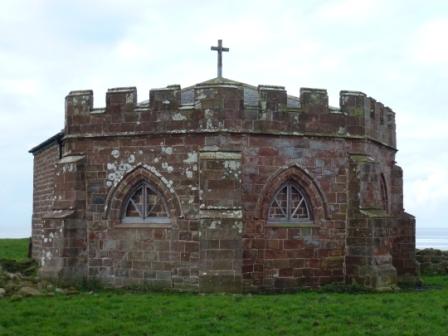
 Chapter house meets silver frieze of dappled
clouds dipped in river. Beacon white sun lights
the margins of eyes; prior, pilgrim, traveller.
Holiday makers rush to shore, seekers
of ages dress lost walls. Broken healers
see a liminal sky, on a statue writ
in silver: Mars Nodontis. “Be our healer.
Beside the lapping tides and flashing sky,
Cloud Maker, fix our wounds and make us whole.
Return this no-time to a holy day.”

 The Sanctuary of Vindos
I’m intrigued by Mars Nodontis, is this what it is about? http://en.wikipedia.org/wiki/Nodens
Exactly 🙂
I love this poem. Are the last lines yours or are they written at the place? Never been there, where is it?
It’s on the South bank of the River Lune, close to Glasson Dock in North Lancashire.
‘Nodontis’ is the dative case of the nominative ‘Nodens’, as ‘Martis’ would be for ‘Mars’. A votive offering to Mars Nodens (a Roman cross-identification of deities) would read, in Latin, ‘Martis Nodontis’, i.e., ‘To Mars Nodens’. So I have a *tiny* picky criticism of its use in the poem, where the vocative (i.e., directly addressing, literally ‘calling’) case ‘Nodens’ should really have been used.
Ah, I was under the impression that was the name on the statue http://www.roman-britain.org/places/cockersand_moss.htm Could the inscription be wrong?
Could be, Lorna. Though more probably, I think, a dedication than a naming. But who would I be to correct a native speaker of a dead language?
I really love this short poem about Cockersand Abbey.
I love the way you describe ‘the lapping tides’ and ‘this no-time’
And so much else about the mood and atmosphere of the place.
It raises many interesting questions.
When is a place holy or consecrated?
And when is it not?
A Roman inscription is perhaps not holy now-at least not to many.
An abbey sounds holy but this one receives few true pilgrims, just holiday seekers.
And I’ve seen many chapels and churches turned into offices or second homes in Wales
Much has been forgotten.
The dedication to Nodens interests me.
My name is Gwynn.
Gwynn means ‘fair, bright, white’
The name of Gwynn’s father (ap Nudd) appears to derive from the Celtic deity Nodens.
And it is Nodens remembered here at Cockersand abbey
Gwynn is cognate with Irish ‘Fionn’
As such Gwynn has connections to the Irish Fionn mac Cumhaill whose father was Nuada.
Few people worship Nodens now
Our modern gods are at the shopping centre or or celebrities-may be a football team of the Premier League (not lower)
I know the Abbey because as a child from the age of 6-12 years I often spent my holidays at Glasson Dock just a short walk away.
I stayed in a caravan that looked out from a hill over to Cockerham and in a more northerly direction over across the Lune estuary to Sunderland Point. That’s just a few hundred yards across from Cockersand Abbey but feels more remote when you actually go there-like its the end of the earth.
I never made a pilgimage as a child to Cockersand Abbey but I did visit, as a child Sunderland Point and made my own commemoration there, my own pilgrimage to a grave on unconsecrated ground.
And so I want to share a poem now that deals with that very place.
The poem follows a similar theme to Cockersand Abbey
When does a place become holy/consecrated?
Which ancestors do we remember and for what?
The poem is by U A Fanthorpe.
I think she was, for a while, a poet based at Lancaster University.
—————————————————————-
Sunderland Point and Ribchester
Sunderland Point, where the sea, wind, sky
Dispute dominion, on a spur of land
So bitter that you’d think no one would take
The trouble to go there.
Here SAMBO lies,
A faithful NEGRO, who (attending his Master
From the West Indies) DIED
On his Arrival at Sunderland.
It is, of course, unconsecrated ground.
Now children stagger here on pilgrimage,
Their offerings the sort of things you’d find
On a pet’s grave: a cross of driftwood,lashed
With binder-twine; a Woolworth vase,
Chocked up with grit and pebbles, crammed
With dead wild flowers.
Sam lies very low.
You can allow him any voice you like.
Despair, pneumonia,exile, love, are variously
Thought to have killed him. A good place
To bring the kids in summer at weekends.
Ribchester had a stone, now lost.
Camden preserved the proper idiom:
‘By this earth is covered she who was once
Aelia Matrona, who lived 28 years, 2 months,
And 8 days, and Marcus Julius Maximus,
Her son, who lived 6 years, 3 months,
And 20 days.
A place to bring the kids.
Children are the most authentic
Pilgrims, having farthest to go, and knowing
Least the way.
The Romans understood
The use and pathos of arithmetic.
And the Ribble bites its banks, and the sea gnaws at the
shore.
So many patterns gone, the ‘faithful slave’, the ‘son
Most dutiful to his father’. The word
Strives to be faithful, but the elements
Are against it.
We are all exiles , Sam,
From the almost-forgotten country
Before the divorce, before the failed exam,
Before the accident, before the white man came.
Your situation’s more extreme than most,
But we all of us, all of us seek
That country. And you, who so clearly were not
Your own man, lying in no man’s land,
A journey’s end for children, seem in your muteness
To be meaning something.
Alternative:
The massive Roman formulas: ‘the century
Of Titius built 27 feet…..
………..According to the reply of the god.
—————————————————————————————————————
There is something else interesting about this poem.
That of course is the fact that nearly half the poem is about Ribchester and the Ribble and in another poem, you have, Lorna addressed yourself to the lost stone/ weathered inscription at Ribchester and the Ribble’s power to take life (Remember the river’s tide?)
Perhaps at some future date, I will comment on your poem about Belisama.
Recently I tried to think where I could go to find sacred landscapes of Lancashire.
Perhaps some book could tell me.
Or perhaps the sacred places would come to me as a surprise or by chance?
I found the most sacred of places in your poem of Cockersand Abbey
Sam does lie very low across the estuary-just a few hundred yards from Cockersand
His journey is far greater than mine
Somewhere in the West Indies there was somebody who was left behind by Sambo.
Someone was his mother, someone perhaps a wife or a child?
I am reminded of a Celtic song/poem
Mabon’s journey
A song for two voices.
For me it is an echo in the Otherworld/ the Celtic imagination -it recalls for me the moment when Sambo was taken from his mother/ from his loved one into slavery and exile.
Mabon appears in the Mabinogion.
Mabon was stoen from his mother
In the end it was a salmon, a totem animal of wisdom, who remembered Mabon and from the river revealed Mabon’s whereabouts
He had to be freed from captivity by Culhwch in his quest to win Olwen from a Giant
——————————————————————————–
Madron: Where are you going to, Mabon, my son?
Where are going, my pretty one?
Mabon: I’m bound on a journey, Mother, he said,
To the land of the living, the lands of the dead.
Modron: Where is that country, Mabon, my son?
Who is its ruler my pretty one?
Mabon: Where the cold winds cease blowing, where the snows never fall,
To the place where the Sleeping Lors sits in his hall.
Modron: How will you journey, my son?
What will you fetch there, my pretty one?
Mabon: On the ship that is silent, by the cold river deep,
And I’ll bring back the cauldron from the Lord locked in sleep.
Modron: When will I see you , Mabon, my son?
When will I kiss you, my pretty one?
Mabon: When the ages turn round at the brink of the sun,
When the birds at the wellhead have ended their song.
Modron: How shall I find you, Mabon, my son?
How shall I find you, my pretty one?
Mabon: By leaf, flower and feather, by ways high and low.
By the brand of the cauldron, the radiant brow.
(Poem by Caitlin Matthews- note: Taliesin= radiant brow)
Interestingly , the poem by Fanthorpe speaks movingly of a love between mother and child at Ribchester swept away by the river dying at 28 and just six years.
We don’t know how old Sam is or about his mother
And his inscription is just as unclear about the real person lying in the land
——————————————————————————————————
Yes we are all exiles, Sam.
For me, the near-forgotten country is most likely my childhood days looking out to Cockerham, watching the tides, walking along the lapping shores.
I wish for a moment that there were a ‘no-time’.
I tried to go back 3 years ago to visit the old haunts at Glasson Dock.
The caravan site where I stayed is still there-not much changed.
The skylarks no longer sing-they are rarer now-as are the lapwings in the fields and the linnets in the lane-they have gone too.
I went back 3 years ago and walked around Glasson along the estuary-and came eventually to Cockersand Abbey. It had meant nothing to me as a child.
But as an adult it was a spiritual experience of a kind
The lapping shores reminded me of the poem by Arnold ‘Dover Beach’.
I will not recount it here but it speaks of
‘The sea of faith
was once, too, at the full, and round earth’s shore
Lay like the folds of a bright girdle furl’d
But now I only hear
Its melancholy, long, withdrawing roar,
Retreating to the breath
Of the night-wind down the vast edges drear
and naked shingles of the world’
It is true as U A Fanthorpe (what a name!) says:
Children are the most authentic
Pilgrims, having farthest to go, and knowing
Least the way
And to think that here as a child I was young and easy and it was a no-time
Time let me hail and climb
Golden in the heydays of his eyes.
Oh as I was young and easy in the mercy of his means,
Time held me green and dying
Though I sang in my chains like the sea.