The Universe Unrolls from His Heart – Thoughts on Kashmir Shaivism and Annuvian Monasticism

‘He becomes intent to roll out the entire splendour of the Universe that is contained in His heart…’
~ Swami Maheshwarananda

When I first started practicing yoga in 2022 in the hope it would help with my hip and knee problems I had no idea that I would fall in love not only with the asana ‘postures’ but with pranayama ‘breathwork’ and dhayana ‘meditation’. I never guessed that I would find such astonishing parallels between the Hindu God Shiva, ‘Lord of Yoga’, and my patron God, Gwyn ap Nudd, who presented Himself to me as our Brythonic ‘Master of Meditation’. Both, I realised, come from a shared Indo-European origin.

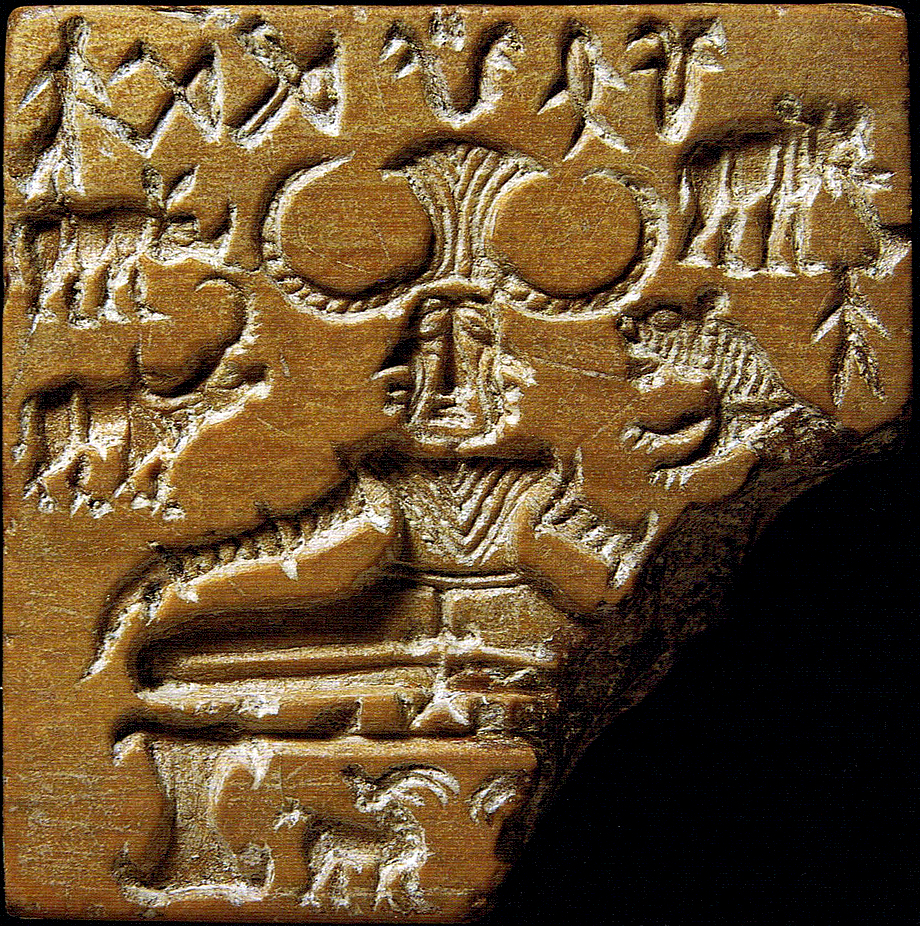
I found similarities exist between Shiva and Gwyn on a symbolic level. Both are associated with bulls and serpents and with intuitive insight and visionary experience. Shiva’s often seen as a destroyer and Gwyn has destructive potency as a leader of the Wild Hunt and the God who holds back the fury of the ‘devils’ of Annwn in order to prevent their destruction of the world.

There’s a story about Shiva riding down the mountain to His wedding feast on a huge bull ‘covered in snakes and ash’ ‘with ghosts and demons’ ‘some had their mouths in their stomachs, some had only one foot and some had three’. Yet when He and His company ‘crossed the wedding portals’ and entered the presence of His bride, Shakti, they were transfigured into ‘a handsome young man’ and ‘divine beings’ (1). This spoke immediately to me of the paradoxical nature of Gwyn and the spirits of Annwn who are referred to both as furious ‘devils’ and as beautiful and beneficent fair folk.

Whilst studying yogic meditation in more depth with the Mandala Yoga Ashram I discovered an incredible text called the Vigyana Bhairava Tantra from the Kasmir Shaivite tradition.The ashram founder, Swami Nischalanda, refers to it as his Bible and many of the practices within the ashram derive from it. Over recent months I have taken a short course (2) and read Swamiji’s exposition of it in Insight Into Reality from which I gleaned many insights.

Bhairava ‘Fearsome’ or ‘Awe-Inspiring’ is another name for Shiva which evokes qualities of Gwyn, whilst vigyana means ‘insight’ and tantra ‘techniques’. The text is also known as Shiva Vigyana Upanishad ‘The Secret Teachings of Shiva’. Within, Bhairava addresses His consort, Bhairavi as His Beloved and student, teaching Her in 112 dharanas ‘concentrations / lessons’ how to gain insights into the fundamental nature of reality. As I’ve been listening to and practicing the dharanas I have felt that Gwyn is speaking through it to me as His student and beloved as a nun of Annwn.

In The Edge of Infinity Swami Nischalananda provides an account of the history of Kashmir Shaivism. He says: ‘In the past, tantra was widely known as Shaivism, ‘the Path of Evoking Shiva’, a system of mysticism rooted in indigenous shamanism. It existed  throughout India well before 1500 CE, the start of the vedic period’ (3). Tantra, as an oral tradition, predates the Vedic texts, with its first scriptures emerging in the first millenium CE. Kashmir Shaivism originated in 850 CE with one of the main texts being the Shiva Sutras which were gifted to Vasugupta by Shiva in a dream. The Vigyana Bhairava Tantra is central and was written down around 7 – 800CE.

I was incredibly excited to find out that a number of texts, such as Pratyabhijna Hridayam ‘The Heart of Recognition’ and The Triadic Heart of Shiva, refer to the universe unfolding from Shiva’s heart and to His residence in the heart. 

‘When He becomes intent to roll out the entire splendour of the Universe that is contained in His heart… he is designated as Sakti.’ (4)

‘The Heart, says Abhinavagupta, is the very Self of Siva, of Bhairava, and of the Devi, the Goddess who is inseparable from Siva. Indeed, the Heart is the site of their union (yamala), of their embrace (samghata). This abode is pure consciousness (caitanya) as well as unlimited bliss (ananda)… The Heart, says Abhinavagupta, is the sacred fire-pit of Bhairava. The Heart is the Ultimate (anuttara) which is both utterly transcendent to (visvottirna) and yet totally immanent in (visvamaya) all created things. It is the ultimate essence (sãra). Thus, the Heart embodies the paradoxical nature of Siva and is therefore a place of astonishment (camatkara), sheer wonder (vismaya), and ineffable mystery. The Heart is the fullness and unboundedness of Siva (purnata), the plenum of being that overflows continuously into manifestation. At the same time, it is also an inconceivable emptiness (sunyatisunya). The Heart is the unbounded and universal Self (purnahantä).’ (5)

‘He, truly, indeed, is the Self (atman) within the heart, very subtle, kindled like fire, assuming all forms. This whole world is his food. On Him creatures here are woven. He is the Self, which is free from evil, ageless, deathless, sorrowless, free from uncertainty, free from fetters, whose conception is real, whose desire is real. He is the Supreme Lord. He is the ruler of beings. He is the protector of beings. This Soul, assuredly, indeed, is Isana, Sambhu, Bhava, Rudra.’ (6) (The names at the end are all epithets of Shiva).

Reading these words was meaningful for me because Gwyn revealed to me that His heart is the Heart of Annwn ‘Very Deep’ (the Brythonic Otherworld). During my practice of playing the heartbeat of Annwn on my drum for an hour every week I have experienced visions of the universe and its people being born from Annwn like red blood pouring from His heart and returning at death like blue blood. When we entered a sacred marriage He came to dwell within my heart as ‘the Heart of my Heart’. I was told that my heart is also the Heart of Annwn and the universe unrolls from my heart (which fits with the practices emphasising the importance of the heart-space in yoga).

As I read more about Kashmir Shaivism I found further similarities with the cosmology I have been gifted in visions from Gwyn. In Kashmir Shaivism the fundamental ground of reality is Brahman or Parama ‘Ultimate’ Shiva. In mythology it is represented as the serpent-king Nagaraja ‘the infinite… who spreads out the universe with thousands of hooded heads, set with blazing, effulgent jewels’ (7). Before I had read these lines I was shown that the ground of reality is Anrhuna, the Mother of Annwn, the Dragon Mother, who has nine dragon heads with jewels in their foreheads and an infinite number of coils. 

In a vision I was shown how Anrhuna was slaughtered and Gwyn and His sister, Creiddylad, were torn from Her womb. Through eating His mother’s heart Gwyn inherited the Heart of Annwn and became King of Annwn (8). Creiddylad brought life to the world as the energy behind creation – the ‘green fuse’ of vegetative life and by breathing life into living creatures. 

This bears a resemblance with Kashmir Shaivism wherein Brahman divides into Shiva (Consciousness) and Shakti (energy and matter). There are parallels between the Heart of Annwn being the source of the universe from which all living beings are born and to which they return and the Heart of Shiva being the source of all energy and matter manifesting as Shakti.

Intriguingly, the first three dharanas in the Vigyana Bhairava Tantra focus on the origin and end points of the breath. When I practice these exercises I find myself contemplating how Creiddylad gave breath to life and Gwyn takes it away.

Finding these similarities between Kashmir Shaivism and the Annuvian monasticism I am developing for Gwyn has been revealing and exciting. I’m sure there is much more to be discovered as I continue with my research and practices.

REFERENCES

(1) Swami Nischalananda, Insight into Reality, (Kindle Edition, 2019), p393
(2) https://www.mandalayogaashram.com/self-study-course-vigyana-bhairava-tantra
(3) Swami Nischalananda, Insight into Reality, (Kindle Edition, 2019), p387
(4) Jaideva Singh, Pratyabhijna Hridayam, (Sundar Lal Jain, 1963), p30
(5) Paul Eduardo Muller-Ortega, The Triadic Heart of Siva, (State University of New York Press), p71
(6) Ibid. p82
(7) Richard Freeman, The Mirror of Yoga: Awakening the Intelligence of Body and Mind, (Kindle Edition, 2019) p19
(8) This story has a basis in medieval Welsh mythology. In Culhwch and Olwen, Gwyn kills a king called Nwython then feeds his heart to his son. I believe this might evidence an earlier ‘Cult of the Heart’ that preceded the ‘Cult of the Head’ wherein the soul was seen to dwell in the heart and the wisdom of one’s ancestors could be passed on by eating their hearts.

Awareness – Three Guidelines from Gwyn

Over the past year I have been practicing meditations in the yogic tradition that develop awareness such as antar mouna ‘inner silence’ and ‘spaciousness.’ This has led from the development of my personal practice of being present for my patron, God, Gwyn, to be being aware that I am present. 

Whilst reflecting on this He gave me three guidelines for awareness – 

  1. Be present and aware in both Thisworld and Annwn.
  2. Be aware of Me without and within (I am everywhere).
  3. Spend time in solitude and silence so we can meet in awareness.

Having an awareness practice is very helpful for me as an autistic person who struggles with sensory and emotional overload and tends to disassociate and get lost in thoughts. It helps me stay present and grounded in Thisworld and focused when journeying in the Otherworld.

Being aware of Gwyn in each moment makes awareness a devotional act. Any moment, no matter what’s happening, can be transfigured by the knowledge that He is with me, inspiring me and guiding me. 

The hardest guideline to follow is withdrawing from the busyness of everyday life and quieting my mind enough to find inner silence and meet with Gwyn awareness to awareness but when this happens it works deep magic.

“Meet Me in the place between thoughts,” is a guiding thread running through these guidelines that has helped me, as a nun of Annwn and Bride of Gwyn, to rendezvous with my Beloved in any place and time.

The Breath of Nine Maidens and the Kindling of the Cauldrons

‘My first utterance was spoken concerning the cauldron
kindled by the breath of nine maidens.
The cauldron of the Head of Annwn, what is its disposition
(with its) a dark trim, and pearls?
It does not boil the food of a coward, it has not been destined to do so.’
~ ‘The Spoils of Annwn’

In ‘The Spoils of Annwn’, a medieval Welsh poem from The Book of Taliesin, we find mysterious lines about the breath of nine maidens kindling the cauldron of the Head of Annwn. The cauldron, the source of awen, ‘poetic inspiration’, is a central symbol within Celtic mythology. 

In ‘The Story of Taliesin’ the cauldron belongs to Ceridwen. In this tale Ceridwen is referred to as a witch but it’s my intuition She is a Goddess whose crochan – cauldron / womb is a sacred vessel of rebirth (1). In Her cauldron she brews a potion from 365 herbs (one picked on each day of the year) to provide her ugly son, Afagddu ‘Utter Darkness’ with the ‘Prophetic Spirit’. She assigns a blind man called Morda to bring kindling for the cauldron and to stir the cauldron she summons a boy called Gwion. After a year and a day Gwion shoves Afagddu out of the way and steals the awen. After a shapeshifting chase he is swallowed by Ceridwen (he as a grain and She as a black hen) then reborn from her womb as Taliesin.

In ‘The Spoils of Annwn’ the model is slightly different. The cauldron of Ceridwen, the magical vessel associated with inspiration and rebirth, is in the custodianship of the Head of Annwn – the ruler of the Brythonic Otherworld. Here there is no need for kindling or a person to stir the cauldron as the breath of the nine maidens is enough to set the processes within it into motion. The ‘food’ ‘not for a coward’ that it brews no doubt refers to the awen. Taliesin accompanies Arthur and his men not only to steal the awen, but the cauldron itself, bringing it back through ‘Hell’s Gate’ to the world.

This shows that when a potential awenydd, ‘person inspired’, proves their courage to the Head of Annwn, the breath of the nine maidens or awenau, ‘muses’ (2), kindles the cauldron, then the awen is received as a gift from the Gods.

This feels like an older and deeper model for the origins of awen. The significance of the breath of the nine maidens can be further elucidated by looking at the etymology. The medieval Welsh term used for breath is anadyl and this derives from the proto-Celtic anatla which shares a resemblance with anaman the proto-Celtic word for ‘soul’. The Indo-European *uel is closely related giving us the root form of awel ‘breeze’ and awen ‘inspiration’. There seems to be something fundamental this myth is telling us about how, in Annwn, on the soul-level, the breath of the nine maidens kindles the cauldron and sets in motion the processes within the cauldron that create the awen.

It’s my personal intuition that the cauldron / womb of Ceridwen, who I know as Old Mother Universe, is a macrocosm of the universe. That it lies in Annwn ‘Very Deep’ shows the Otherworld is a deeper reality underlying the universe. 

On a microcosmic level each awenydd might too be seen as a cauldron which is kindled by the breath of the nine maidens producing awen for poetic works. The breath itself might be seen as a gift from the awenau. 

Microcosm within microcosm a number of Celtic Pagans have come to relate the three cauldrons in the seventh century Irish text ‘The Cauldron of Poesy’ to the three main energy centres or chakras in our belly, heart and head (3). Interestingly the Irish term coire ‘cauldron’ or ‘whirlpool’ might be seen to relate to the spiralling manifestation of the universe and the turning of the chakras.

In yogic meditation the breath is used to awaken the chakras. I was once dubious about the existence of ‘Celtic Chakras’ but I am now coming to perceive the resonsances between these shared Indo-European traditions. I wonder whether anatla ‘breath’ is the Celtic equivalent of the yogic prana ‘breath’ or ‘life force’ which Celtic Pagans have long been searching for (4). 

(1)These insights derive from Kristoffer Hughes’ From the Cauldron Born.
(2)This term is borrowed from Greg Hill who uses it in his poem ‘The Muses’ in his poetry collection The Birds of Rhiannon – ‘O Muses / O Awenau / You whose breath kindled the cauldron of awen in Ceridwen’s keeping.’
(3) For example see Erynn Rowan Laurie’s ‘The Cauldron of Poesy’ – https://www.obsidianmagazine.com/Pages/cauldronpoesy.html
(4) Some druids have in the past mistakenly identified prana with nwyfre ‘sky, firmament’ which Mhara Starling explains is erroneous on her Youtube channel – https://www.youtube.com/channel/UCkc4iRymvz4t619FEk5dFfA/videos Interestingly the proto-Celtic anatla ‘breath’and anaman ‘soul’ share similarities with the Sanksrit atman which is sometimes translated as ‘soul’ but refers to the Self or witness-consciousness beyond phenomena and ananda which refers to bliss at escaping the cycle of mortality or uniting with a God.

From Inner Silence to Silent Prayer

I have been practicing Antar Mouna ‘inner silence’ for over a year. I first learnt it on an Introduction to Meditation course at the Mandala Yoga Ashram. The founder, Swami Nischalananda defines it thus: 

‘Antar Mouna is one of the core meditation practices of the yoga tradition. It is a precise, systematic process of cleansing the mind of its accumulated tensions and conflicts, disrupting the habit of compulsive thought and externalisation, leading to inner tranquility and silence.’ (1)

Over this period I have found it incredibly helpful for quieting my mind and for learning to witness, identify and let go of distracting and troubling thoughts.

There are six stages to Antar Mouna and I have experience of the first three. The first is ‘awareness of sense perceptions’. This involves focusing on the five senses: touch, sound, hearing, taste and inner sight. This develops the discipline of paying full attention to one sense at a time and honing each. For example, listening to sounds that are far away, then close up, following one sound, letting it go, then choosing another sound, then listening to all the sounds at once as if you’re in ‘a sea of sound’. Part of this practice is to separate the sounds from what’s causing them (ie. ‘a car’ ‘next door’s baby’).

This stage has been really helpful for me as an autistic person with sensory sensitivities for gating out sounds and not getting as annoyed with their causes.

The second stage is ‘awareness of spontaneous thoughts’. This involves watching and bearing witness to thoughts as they arise then letting them go. Thoughts are not labelled ‘good’ or ‘bad’ but ‘just thoughts’. This helps us to develop a stronger witness, not to get so caught up in our thoughts and to let them go more easily. It also helps us to see that we are not our thoughts.

Watching thoughts come and go and having experienced many occasions when I’ve been sucked in because they have been overwhelming and I’ve felt unable to continue meditating until I’ve solved that problem, got that thing planned out, contacted that person… has made me more aware of my mental processes and what types of thoughts remain problematic. I haven’t reached the point I’m able to immediately let go of more difficult thoughts yet.

I’ve only practiced the third stage very briefly. This is ‘conscious creation and disposal of thoughts.’ Here you create a thought, contemplate it for a minute, then release it. I haven’t pursued this in any more depth as it isn’t recommended without an instructor as traumatic memories can arise. 

The fourth stage is ‘awareness and disposal of spontaneous thoughts.’ This is basically being aware of thoughts and dismissing them. Saying “no” to thoughts isn’t recommended until you have mastered stage three.

The fifth stage is ‘thoughtlessness’ – the inner silence that is the aim of the practice. After this, in the sixth stage, ‘spontaneous symbols’ might occur. Through practicing the first two stages I have experienced brief periods of being without thoughts and caught a glimpse of what inner silence might feel like.

In this thoughtless state enlightenment and union with the Source might be attained.

~

For me, as a Brythonic Polytheist with a near-henotheistic devotion to my patron God, Gwyn ap Nudd, I’m less concerned with enlightenment and more with a mystical union with Him and through Him with the universe. I’ve felt the need to adapt the aim to entering silent prayer to Gwyn.

Silent prayer is found in the Christian religion and particularly in the tradition of  the Discalced Carmelites, who were founded by Teresa of Avila in 1562, and spend two hours a day silently communing with God. (2)

Like with Antar Mouna, there are several stages in the process of attaining silence. They are described my Teresa in The Way of Perfection. She distinguishes formal spoken prayer from mental prayer which takes place within.

At the outset she instructs her sisters: ‘I am asking you only to look at Him. For who can prevent you from turning the eyes of your soul (just for a moment, if you can do no more) upon this Lord?’ Here she urges them to look not at ‘a picture of Christ’ but His living image – ‘the Person Himself.’

She speaks of the process of recollection through which the nuns must withdraw their senses from worldly things and turn them instead within. She tells us: ‘the Lord is within us and that we should be there with Him.’

In a description which resembles the depictions of the castle of Gwyn ap Nudd in medieval Welsh mythology she describes the palace of the Lord in the soul:

‘And now let us imagine that we have within us a palace of priceless worth, built entirely of gold and precious stones— a palace, in short, fit for so great a Lord. Imagine that it is partly your doing that this palace should be what it is— and this is really true, for there is no building so beautiful as a soul that is pure and full of virtues, and, the greater these virtues are, the more brilliantly do the stones shine. Imagine that within the palace dwells this great King, Who has vouchsafed to become your Father and Who is seated upon a throne of supreme price—namely, your heart.’ 

She emphasises throughout that we not need to go Heaven to find God because He is always so near. This resembles how Gwyn might be seen as distant in Annwn yet He is always close, in our souls, in our hearts.

She describes the Prayer of Quiet as ‘perfect contemplation’. ‘This is a supernatural state, and, however hard we try, we cannot reach it for ourselves; for it is a state in which the soul enters into peace, or rather in which the Lord gives it peace through His presence… In this state all the faculties are stilled. The soul, in a way which has nothing to do with the outward senses, realizes that it is now very close to its God, and that, if it were but a little closer, it would become one with Him through union.’ She goes on to say that the will also ceases its striving and is united with God’s.

The Prayer of Union is the next stage and this might be followed by rapture. (3)

~

There are several major differences between these spiritual techniques. For Teresa neither the physical senses or the inner world of thoughts, feelings or emotions are viewed to be worthy of contemplation. The sole focus is on God. 

Teresa does not provide a way of quieting the mind. This is likely because the seclusion of the monastery provides a quiet environment for the nuns. (It’s due to the lack of this that I have had to turn to the yogic tradition).

Another difference is that the aim of Antar Mouna is to use the thoughtless state to attain enlightenment whereas that of silent prayer is to enter union with God.

I am currently experimenting with combining the two – firstly dedicating the process of purifying my mind through Antar Mouna to Gwyn then secondly entering silent prayer with the aim of experiencing deeper union with Him.

  1. https://www.mandalayogaashram.com/blog/intro-to-antar-mouna
  2. https://carmelitesnottinghill.org.uk/discernment/discernment-talks/
  3. Saint Teresa of Avila, The Way of Perfection, (Dover Thrift editions, 2012)

The Root Chakra

Rooted here in place and time
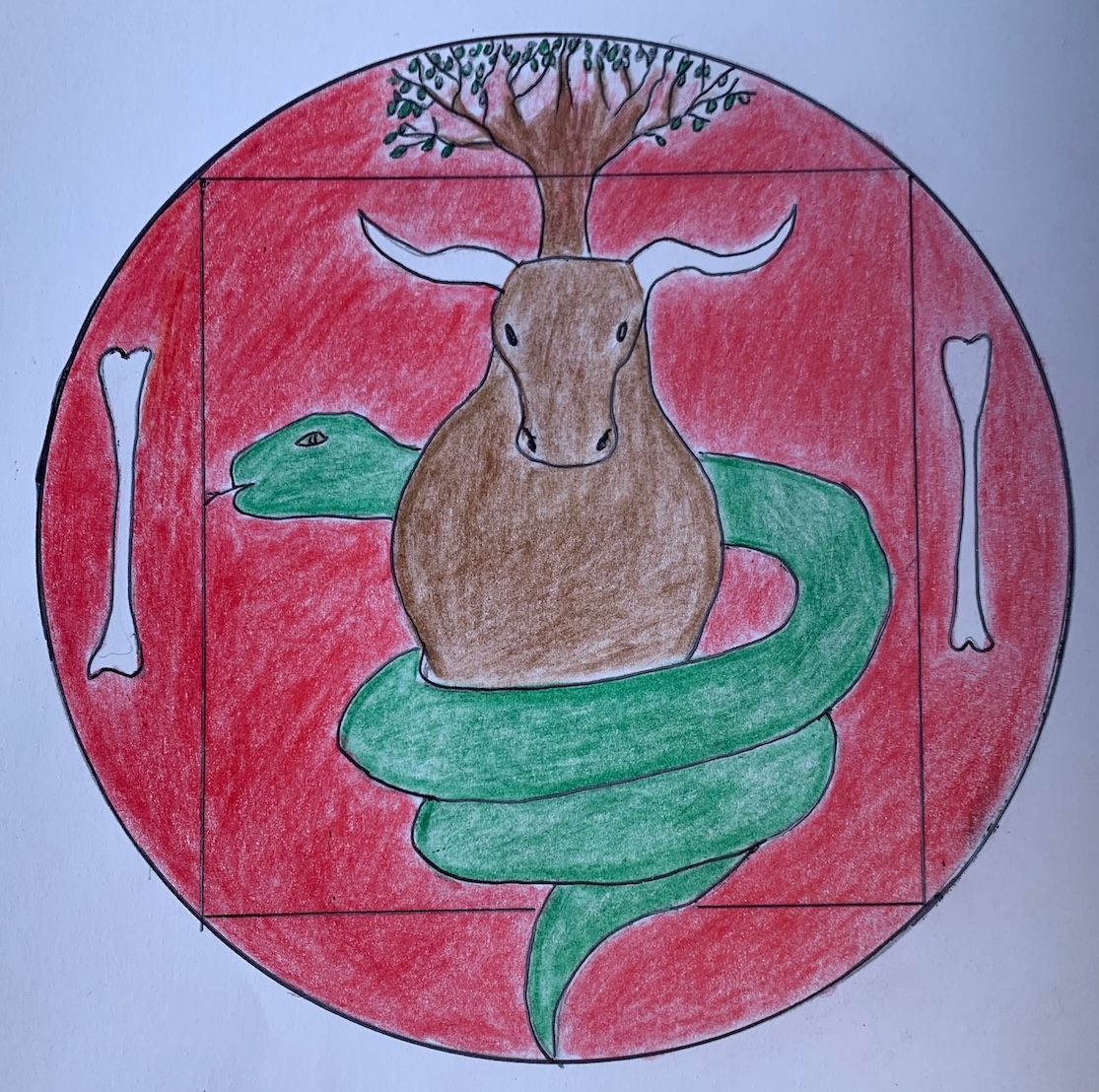
Snake and aurochs intertwine.
By shaping flesh, by flexing spine,
Embracing life I will survive.

~

Being rooted in nature and in the body. The entanglement of flesh and nervous system with the rest of the living world. Balancing growth and limitation. As I have meditated and journeyed with this chakra and researched and learnt the musculoskeletal system from both theoretical and experiential perspectives these are the main attributes that have come to me.

As an autistic person I’ve faced a lot of struggles with disassociation from my body due to differences in neurological wiring causing sensory sensitivities. My attempts to block overload out has resulted in having a poor relationship with sensory feedback from the entirety of my system. 

I used to dislike my body because it was fat and clumsy. I cut it, starved it, over-exercised it, tried to force it into a shape that fit with my ideals. Only over the past few years with the help of my personal trainer have I arrived at a strength training and yoga routine and nutritional plan that is healthy. 

Ignoring signals from my body has had its cost in physical ailments. Running for years without strengthening exercises led to runner’s knee and deep gluteal syndrome. Working outdoors in very hot and cold weather in spite of discomfort resulted in me developing rosacea and Reynaud’s. Up until this day I’ve been struggling with tendonitis in various forms as a result of repetitive activities – too much road running, walking too much on concrete in worn boots, using heavy loppers overhead – which have forced me to swap running for mixed cardio indoors, a walk for a swim, and to face the fact that I might not be able to tackle all gardening tasks without help.

Frequently getting myofascial knots has made me aware of my fascia and the importance of hyaluronic acid – the goo that keeps it supple – as a component of the extracellular matrix that exists throughout the body as a lubricant essential in synovial fluid, the skin and the eyes. I have started eating more green veg and oily fish and drinking more water to nourish it.

Working with the chakras can help us spot patterns in the systems they relate to. I noticed nearly all my physical ailments are inflammatory and relate to having an over-reactive stress response rooted in sensory sensitivities.

This has led me to beginning to develop a more mindful relationship with my body. To realising it has developed its symptoms to help me to survive. To listening to senses I shut out, opening and building new neural pathways, so I can respond to sensory signals before they develop into physical ailments. To recognising the difference between stretching and straining, increasing strength and flexibility within awareness of my current limits.

Snake and aurochs appeared as animals associated with this chakra evoking for me the strength of the musculoskeletal system and flexibility of the spine. The snake wrapping the aurochs is a symbol both of limitation and of nurture rooting down into the earth nourishing our nature connection.

~

Chakra: Root / Location: Base / Colour: Red / System: Musculoskeletal / Nerve Plexus: Coccygeal / Endocrine Gland: N/A / Sense: Touch / State: Physical / Element: Earth / Qualities: Survival and instinct / Animals: Aurochs and snake

The Chakras – A Personal Exploration

For many years I refused to believe in chakras. I didn’t have any. They didn’t exist. They were a New-Agey Eastern thing for fluffy hippies and baby Wiccans that had no relevance for me as a polytheist in Britain. 

Then I came across the following in Alberto Villodo’s Shaman, Healer, Sage:

‘“I thought the chakras were Hindu,” people often say to me. The chakras are part of the anatomy of the Luminous Energy Field. Simply because kidneys were named by Europeans does not make the kidney exclusively European. Similarly, the chakras are not exclusively Hindu. Every living being has chakras.’

Regardless of where they were born, everyone has a skeleton with the exact same number of bones. In the same way, we all share the same luminous anatomy, which includes the chakras and the acupuncture meridians.’

I had an aha moment – these words all made perfect sense to me.

Around the same time I was presented with a chakra clearing exercise in the Way of the Buzzard Mystery School’s Spiritual Protection Course that helped me with getting rid of negative energies at a low point in my life. It worked. My chakras were there. I just didn’t know very much about them. 

That changed when I started practicing yoga, which I see to be connected with Brythonic polytheism, as a shared Indo-European tradition. I have since learnt much more about the chakras as they are presented in the yogic system. 

For this I am indebted to an excellent article and course by Swami Nischalananda and other meditations with the Mandala Yoga Ashram*. These have provided me with a grounding in the yogic conception of the chakras and have helped me relate to them on a much deeper level. 

However, the Sanskrit names, symbols and imagery (for example elephants and lotuses) have been difficult for me to connect with as somebody living in Britain. Therefore, with guidance from my mentor, Jayne Johnson, I have been inspired to put together my own associations for each chakra. 

What follows are my personal explorations of the chakras. They are based on those found in the Satyananda yoga tradition espoused by Swami Nischalanda and the Mandala Yoga Ashram but differ in some instances based upon my gnosis of what fits personally with me here in Britain.

*https://www.mandalayogaashram.com

Building Brythonic Polytheistic Monastic Practices Part Two – Meditation

Meditation is most developed in the Hindu and Buddhist religions. The earliest references to meditation are in the Vedas from around 1500 BC. In Hinduism the aim of yoga – a combination of meditation (dhayana), breathwork (pranayama) and body postures (asana) – is to still the mind, liberating it from sensory distractions and ultimately from the cycle of death and rebirth, unifying the self (atman) with the Gods (the Brahman or Shiva). In Buddhism the aim of meditation is to reach enlightenment, which resulted in liberation from the cycle of reincarnation as a buddha ‘awakened one’.

These forms of meditation begin with training the mind to focus on one thing – usually the breath. Other subjects of meditation include nature and virtues. Both employ the chanting of sacred syllables to still the mind. Tantric practices involve meditating on and attaining union with a multitude of Deities.

In Christianity meditation is a form of contemplative prayer. Discursive meditation is rooted in the scriptures and involves imagining oneself in the stories, in the shoes of the protagonists, to develop a deeper understanding. Lectio Divina focuses on passages of scripture and has four phases – Lectio (read), meditatio (reflect), oratio (respond) and contemplatio (rest).

Unfortunately I haven’t been able to find any references to meditation in ancient polytheist cultures. The only evidence I have found is the image of the antlered Deity on the Gundestrup Cauldron (150 BC) who is sitting in a meditative position and bears a striking resemblance to Shiva the ‘Lord of Yoga’.

The cauldron is of Celtic La Tène period design and the antlered figure has tentatively been identified as Cernunnos, ‘Horned’, which might be a Gaulish title for Vindos / Gwyn ap Nudd, who I believe is pictured on another plate plunging dead warriors into a vessel headfirst to emerge as riders on His hunt. 

*

When I came to Paganism and Polytheism the first type of meditation I came across was guided meditation, which involves being guided by written words or voice into imaginal landscapes to meditate in safe places or meet with Deities. 

Examples include meditations leading to an inner grove, a spring, or a tree, or another form of sanctuary, meeting Brigit at a well or Cernunnos in a woodland. To the best of my knowledge this type of meditation originated in the Western esoteric tradition with groups like the Hermetic Order of the Golden Dawn and Thelema and was later taken up by Wiccans, Druids and polytheists.

The way I see guided meditation to work is that one must first consciously imagine the scenery (our imagination is one of the tools by which we connect with the Divine) and this act of imagining creates an interface through which the spirit realm speaks. In my experience it is an act of co-creation. Some comes from one’s own imagination and some from the spirit realm in varying degrees and intensity. On some occasions I’ve remained within my imagination and felt like the scenery and Gods are nothing more than cardboard cut-outs and on others I have found myself in lands that are not of my imagining, entirely other, having genuine conversations with the Gods.

Through Druidry I learnt ways of working meditatively with the Brythonic myths by entering into them and standing in the shoes of some of the Deities. Most notably Afagddu, when Taliesin stole His awen and the Cauldron of Ceridwen shattered leaving Him with its poisoning of Gwyddno’s lands.

I also developed a practice akin to Lectio Divina drawn from creative writing workshops in which I meditated on a line or a scene from a medieval Welsh story or poem, then did free writing around it, then crafted it into a finished piece.

*

It’s only over the last couple of years I’ve looked into more traditonal forms of mediation. As a Brythonic polytheist I steered clear of the ‘Eastern’ traditions until I learnt that India and Europe shared an Indo-European culture and there are lots of resonances between Hindu and Brythonic beliefs.

Last year I started practicing yoga and integrating meditation, breathwork and body postures into my practice on the basis of a revelation of the Gundestrup Deity as ‘Meditating Gwyn’ as a way of unifying myself with Him.

At the core of my practice is uniting my breath with Gwyn’s breath, my heart with His heart, being as present in my body as possible so He and my other spirits can experience presence in Thisworld through their union with me.

When I first tried focused meditation I found it incredibly difficult (and still do). I avoided it for a while sharing the beliefs of many others that Eastern meditation isn’t for Westerners and isn’t suitable for our busy Western minds.  This changed when I discovered the Breathe and Flow yoga channel and Bre mentioned that if something is difficult it’s often the thing we need most. 

I started practicing focused meditation with their Expand programme and particularly benefited from their meditation, ‘Refocus’, which describes the benefits of stilling our busy ‘monkey minds’, shifting from sympathetic to parasympathetic states of the nervous system and rewiring our neural pathways. This meditation is very useful as every couple of minutes there are reminders, if thoughts have begun to trickle in, to return the attention to the breath. When I meditate alone it often takes longer to catch myself thinking.

Learning from Breathe and Flow that by focusing on and changing my breath I can control my mind and my emotions has been life changing in helping me manage my anxiety and panic which were beforehand often out of control.

I’ve been inspired to adapt some of the pranayama practices to fit with my spiritual path. Sama vritti, ‘box breathing’ (inhale, hold, exhale, hold), I do to a count of seven heartbeats to unite myself with ‘the Breath of the Gods’. Nadi shodhana, ‘alternating nostril breathing’ I use as a way of balancing the red and white dragons, fire and mist, strength and calm. Dirga ‘deep breathing’ and ‘sleep breath’ (4-7-8) I associate with the healing states of Nodens.

As I have learnt the body postures I have come to link some with my Deities and with various animals in the Brythonic myths. Suptka Baddha Konasana ‘reclining bound angle pose’ is Anrhuna as Mother of Annwn and Parsva Savasana ‘side corpse pose or foetal position’ is foetal Gwyn. Tadasana ‘Mountain Pose’ and Utkata Konasana ‘Goddess pose’ invoke the strength of Anrhuna. Adho Mukha Svanasa ‘downward dog’ and ‘Uttana shishosana ‘puppy pose’ are Gwyn’s hounds or the healing dogs in the temple of Nodens.

The medley of animals, Marjaryasana ‘Cat Pose’, Bitilasana ‘Cow Pose’, Mrigasana ‘Deer Pose’, Catur Svanasana ‘Dolphin’ puts me in mind of the animals surrounding the antlered God on the Gundestrup Cauldron and I wonder if the flows between the poses might have been based around stories featuring sacred animals such as the search for Mabon.

The power of these practices and the changes they have brought about in my life have led me to believe that what we know about the Bardic Schools and their twenty-year programmes for memorising poetic forms and traditional tales is but the remnant of a deeper spiritual tradition in which the stories were meditated on and embodied and lived as mythic realities.

Meditating Gwyn

My breath with Your breath,
my heart with Your heart,
my feet on Your path,
You and I as one.

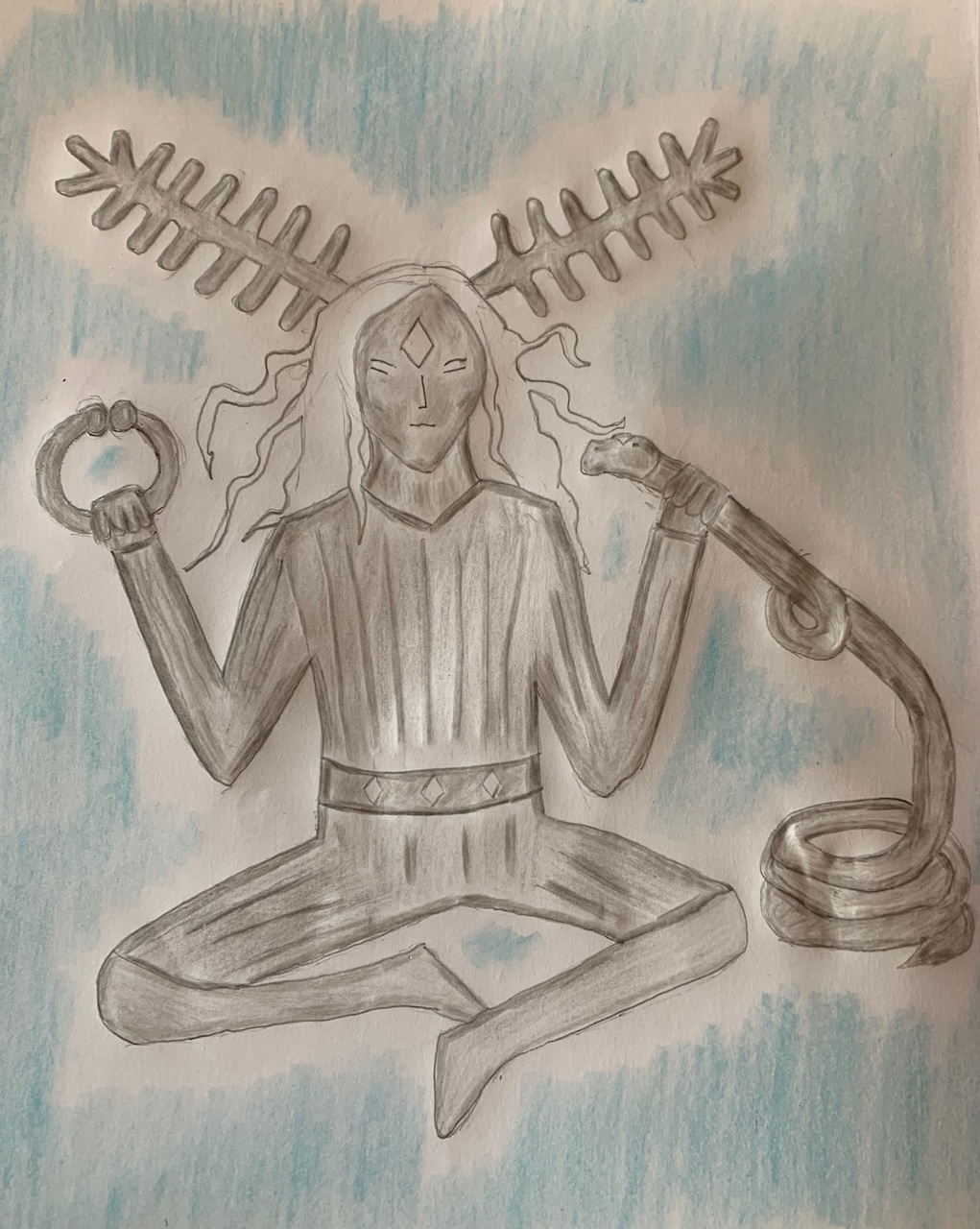
This piece of devotional art represents a face of my patron God, Gwyn ap Nudd, who I know as Meditating Gwyn and the Inspirer. Gwyn first appeared to me in this form when I started to take seated breathing meditation seriously after finding techniques that worked for me from yoga.

Several years ago I received the gnosis that the meditating deity on the Gundestrup Cauldron is likely to be Gwyn (who may also be Cernunnos ‘Horned’ by another title) and Gwyn’s appearance in this guise confirmed it.

I had not thought of Gwyn, as a warrior-hunter God who gathers the souls of the dead, as being associated with meditation until He took this apparel. Yet it made sense in terms of my experience of Him paradoxically being not only the storm of the Wild Hunt but the calm at the heart of the storm. It also ties in with His likeness with Shiva, the Hindu Lord of Yoga, with them both being creator-destroyers with connections with bulls and snakes/serpents depicted in similar poses.

Since then Gwyn has continued appearing to me in this guise when I meditate, helping me to align my breath with His breath, my heart with His heart, keep my feet on His path and enter union with Him.

Whilst this image resembles the image on the Gundestrup Cauldron in many ways, it differs in others. You will probably notice Gwyn’s antlers don’t look like real antlers. They look more like radio antennas. I asked Him about that and He said it represents His ability, when meditating, to tune into what is happening in Thisworld and the Otherworld and sense the deaths of those whose souls He needs to gather.

Gwyn and the serpents have jewels in their foreheads. This addition has come to me in personal gnosis as I’ve journeyed with Him into the deep past, before the world was created, before humans, when He lived in Annwn amongst serpents. He and the serpents all had these magical jewels. I found no evidence of this for a long while until I saw a bronze head with a forehead jewel from Furness, Lancashire in Pagan Celtic Britain. I then learnt the serpent associated with Shiva, Nandi, has a magical forehead jewel. There are also three jewels in Gwyn’s belt which, to me, are the three stars in the belt of His constellation, the Hunter (Orion).

He wanted hair. Although Gwyn is not pictured on a cauldron I kept His silver-grey apparel as I see Him as having grey skin in His more primordial form (Creiddylad has green skin, Nodens/Nudd blue, Anrhuna grey) which I later realised fits with representations of the Gods in the Hindu and Buddhist yogic traditions.

This image on the Gundestrup Cauldron has also been associated with awenyddion ‘people inspired’ who likely used meditation and journeywork to travel to Annwn to bring back inspiration for their poetry. I see it as an image of Gwyn as the Inspirer which can be imitated by His Inspired Ones.

Harvesting the Fruits of Solitude

I. The Gifts of Gwyn

It’s harvest time. I’ve been gathering in the apples from our back garden. I’ve also started to take some time out to reflect on what I have harvested on a spiritual and creative level whilst, although living with my parents, spending most of my time in solitude since leaving my ecology job in August last year.

I’ve been through a lot of changes. It was a big blow realising that the limitations of my autism rendered me incapable of coping with the demands of working in either conservation or ecology due to my inability to manage projects and people, multi-task, or work flexible shifts or do night work.

Yet my patron God, Gwyn ap Nudd, gifted me with two tasks that gave me purpose and hope. The first, writing a series of books titled The King of Annwn Cycle imagining His unknown story from His birth until the end of the world. The second building the Monastery of Annwn of which He is also the patron.

For the first few months I threw myself into those tasks with utter joy and was completely absorbed in the awen working on my first book In the Deep. I took initial vows as a nun of Annwn on the new moon in October and being part of a group of monastic devotees devoted to the Annuvian Gods and Goddesses has been an ongoing source of inspiration and support.

II. Losing Hope

Yet over the winter I had a few things that derailed me. Blocks with the book after realising that due to it being a personal vision of Gwyn’s story with only subtle links to the existing myths it is unlikely to reach as wide an audience as my work that explicitly related Brythonic content to our environmental crisis.

Minor health problems. Tests around raised liver function that never came to anything. Rosacea. Runner’s knee. Then in spring, just as my knee issues were easing and the weather was getting better I went and pulled my sciatic nerve in my glute and had to reduce my running and strength training.

At this point I was also struggling with breathwork meditation. Gwyn began encouraging me to learn to focus on my breath prior to covid and has told me holding spaces of calm free of chattering thoughts is one of the most important things we can do for the world on an energetic level.

Failing to master my internal chatter alone I tried looking to Buddhism and considered going to meditation classes at a Preston’s Kadampa Buddhist Meditation Centre. To prepare I read one of the books by the Venerable Geshe Kelsang Gyatso Riposte who founded the Kadampa tradition. It led me to the realisation the path of freeing oneself from the suffering of earthly existence isn’t for me and left me feeling profoundly unspiritual so I did not go.

On top of my feelings of despair about being called to write a series of books that would never sell, dread of my savings running out and having to return to menial work, and my nerve pain, this led to me feeling ‘there is no hope left.’ 

The very moment this thought popped into my mind, when I was open and vulnerable, on my way home from a local walk, my nerve bothering me, I met a person who somehow knew my name and that I ran an online monastery and invited him to join and he caused trouble and had to be thrown out. 

This was a big lesson on my failure to address the negative thought patterns that had got a hold on me. I’ve long been quite good at serving my Gods but terrible at taking care of my mental health and spiritual development. 

I’ve served as a vessel for Their inspiration without taking care of the vessel.

III. Taking Care of the Vessel

My recovery from what I now believe to be ‘power loss’ began with a ‘power retrieval’ journey with the Way of the Buzzard Mystery School.

Therein I was given a set of ‘wolf’s teeth’ and told that I must be ‘fiercer’. This went against my preconceptions of what being a nun meant as I was striving to be humbler. Yet I took my teeth and the advice. When I reported this to Gwyn, not long before his death and departure on May Day, He told me by the time He returns at the end of August He wanted me to own them.

Shortly afterwards, on the suggestion of my personal trainer, I started practicing yoga to help with my sciatic nerve problems and with flexibility. I had never considered it before due to issues around its appropriation by westerners.

However I decided to give it a go and immediately found a Youtube channel called Breathe and Flow led by a pair of practitioners who make clear from the start the poses are just part of a wider spiritual practice and philosophy and who make the effort to incorporate breathwork and meditation into their classes. 

At once I found both a physical practice to help heal my sciatic nerve pain and improve my flexibility and mobility and support with breathwork and meditation.

When I started reading up on the religious and philosophical background of yoga to my amazement I found out the Hindu God who is Lord of Yoga is Shiva and He bears similarities to Gwyn as a destroyer and transformer. They both have associations with bulls and serpents and, to my surprise and delight, Shiva’s serpent, Nandi, has a magical jewel on his forehead. In my personal gnosis Gwyn and the serpents of Annwn have similar jewels.

The images of Shiva and the meditating deity who I believe to be Gwyn on the Gundestrup Cauldron bear a striking resemblance. As I persevered with my meditation practice over the summer, although asleep, Gwyn began visiting me in spirit form, as ‘meditating Gwyn’, in the likeness of this image. As if he had been cut from the cauldron, in shining silver, to help me with my breathing. I finally found the practices I needed to take care of my vessel.

Another source of help and support has been working with a supervisor and therapist, who is also a shamanic practitioner and I was put in touch with by Nicola Smalley who co-runs the Way of the Buzzard Mystery School. This is the first time I have had a human teacher and it has taken a long while for the circumstances to come into play that have made this desirable and possible.

When we were looking into my fears around panicking/freezing/melting down when faced with unexpected difficulties, particulary in social situations, we journeyed together on it and she saw a red dragon on my shoulder breathing fire and was told by Merlin that I must learn to ‘tame the dragon’.

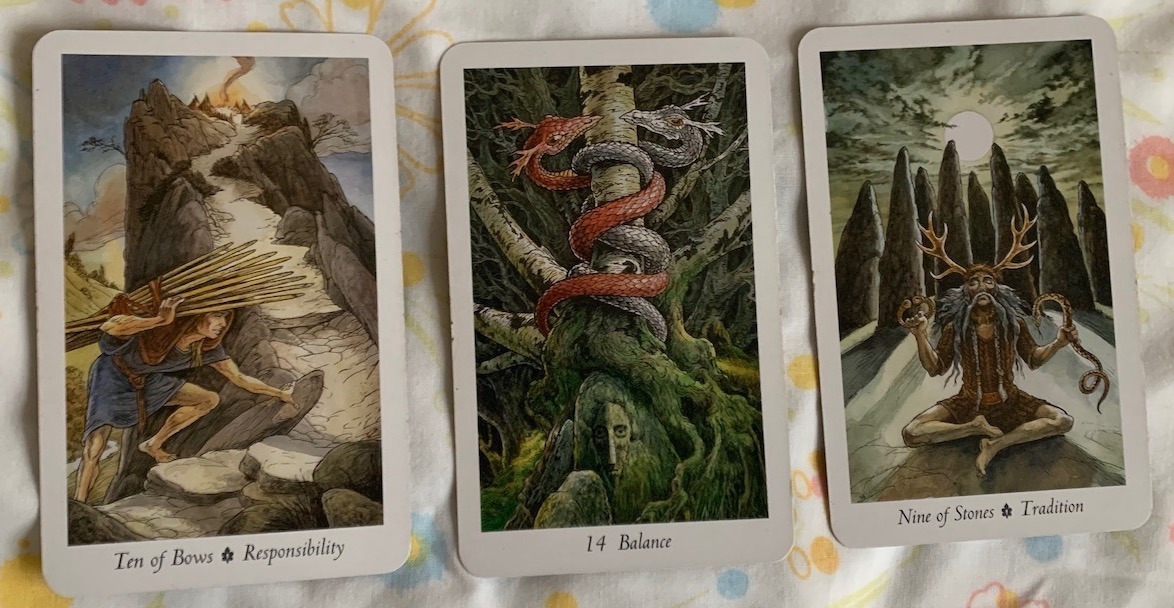
This unsurprisingly led ‘my red dragon’ to rebel which I gave voice to in a poem*. Yet a tarot reading revealed that what Merlin was calling for was the need not so much to tame the red dragon but to balance her energies with those of the white dragon through meditative traditions and taking responsibility. 

Of course, in the Welsh myths, it is Merlin who reveals the red and white dragons battling beneath Dinas Emrys where Vortigern wants to build his fortress following their burial by Gwyn’s father, Nudd/Lludd. Amazingly my supervisor knew nothing of my connection with these myths prior to the journey.

I have begun a process of transmuting the anger of the red dragon to strength and the panic of the white dragon to calm in my yoga practice by coupling them with holding postures on either side and with alternating nostril breathing along with trying lion’s breath to release the fiery energy.

V. Unblocking the Flow

Prior to this I had considered alternative options for possible paid work – running courses and workshops or writing a book on Brythonic Polytheism as quite a few people have asked me for reliable material. However, whenever I have attempted to put something together I have met a block.

On the one hand I felt with my background in research into the Brythonic tradition and my experiential relationship with a few of the deities I was in a position from which I could deliver this. Yet I also knew my approach is highly personal and idiosyncratic and critical of the medieval Welsh texts, penned by Christian scribes, in which Gwyn and the spirits of Annwn, the witches, giants and ancient animals are demonised and repressed.

I’m not a person who could deliver the literary background formally, without opinion, without a few of the teeth and claws of the spirits of Annwn getting through.

When I entertained the idea again this year I was told by Gwyn to set it aside and ‘stop thinking about money’. Yet my feeling this might be a future obligation and potential source of income in spite of my blocks continued to persist.

I finally let go of this once and for all following a conversation with my supervisor. She advised that rather than acting from my sense of obligation and presuppositions about what the world wants and needs I should follow my inspiration, the flow of my creativity, asked where my passion really lies.

I said, “in my books”, “in Gwyn,” “in the Annuvian,” “in all He and the Otherworld represent”. She told me this is what I should focus on and write about in spite of my fears about my work not being well received or making money.

For the past year I had increasingly been struggling to create blog content based on what I think my readers want in terms of Brythonic content and poetry. My prayers and songs for Gwyn had all been from the heart but I’d had to drink alcohol to force the poetry out and I hadn’t managed to write much about the other Brythonic Gods and Goddesses in spite of my intent.

As soon as I let go of what I felt my obligations are I had two new poems come through without the aid of alcohol pretty much complete and was inspired to write a couple of pieces on my ‘forbidden pleasure’ – dark fantasy.

VI. The Dark Magician’s Door

At the time I was considering where my future prospects and obligations lie I dismissed the possibility that I might gain a larger readership for my books, which I would describe as mythic fiction containing elements of heroic and dark fantasy, by engaging more with the world of fantasy and its readers.

I flirted briefly with the idea of starting a new blog for thoughts on fantasy and reviews but decided it would be too time consuming and didn’t like the idea of having two blogs and profiles. I also got put off by the fact a lot of engagement takes place on social media and this is an absolute no-no for me. I took one look at Twitter and felt like I was staring into the pits of Hell.

I also dismissed the idea of posting fantasy content on this blog as I have tried it in the past and it hasn’t been well received. I decided there are enough people in the world talking about fantasy and not enough talking about the Brythonic Gods so I should continue to make that duty my focus. 

I then had a seemingly unrelated experience that led to my giving up alcohol for good. I used alcohol to self-medicate my anxiety from my late teens until 2020 when I began giving it for periods and cutting down a lot. The habit of weekends and occasional mid-week drinking had snuck back during my difficulties with my sciatic nerve pain even though my body was rebelling against it – expunging it with night sweats and its stink in my piss and shit.

I really wanted to give it up for another long period but was having no success. 

Then I had a dream in which my dark magician guide (who is a character in a fantasy novel who has been with me since I was around thirteen) showed up with a vision of planks leading up and down a wall to different doors, told me he was angry I had ‘closed his door’ and left through it.

The next morning he appeared again in my meditation, vivid as in a dream, in Annwn, beside the Abyss, with the part of myself who is addicted to alcohol, sweating, writhing, stinking of its excesses, wrapped in a white shroud. He told me it was time I gave up alcohol for good and that I must cast her in. Although this completely terrified me I went along with what he said. Afterwards I reported it to Gwyn and solemnly promised Him I would not relapse.

Knowing I would never have the comfort of alcohol again was scary at first but has proved to be a big release with the part of my mind obsessing about whether I’ll drink then feel guilty and like a failure having finally been laid to rest. It has opened a lot more space for communion with my Gods and creativity.

I forgot all about the dark magician’s door until the block allowing me only to write Brythonic content and poetry for my blog was released and I came up with new poems and the fantasy book reviews I had denied myself of writing. 

I’d closed his door – the door to fantasy – and now it stands open again.

VII. Returning to Orddu’s Cave

Over this year of solitude I have harvested a good many things. I have produced a finalish draft of my first book, In the Deep, and am well on my way with the drafting of my second book, The King and Queen of Annwn. The building of the Monastery of Annwn is going well with our development of our shared practices, meditation group and first year of online rituals.

I’ve come a long way in discerning the direction of my path as an awenydd and nun of Annwn devoted Gwyn and learning to follow my inspiration.

Another important learning is that whereas in the past I forced myself out into various communities, spiritual, creative and environmental, I am happiest when I am alone or interacting with very small groups of like-minded people.

There is a lot of stigma around solitude identifying it with mental ill health. Yet, for me, and I would warrant a lot of autistic people, it is a source of well being.

This has led me back to the cave of Orddu, the Very Black Witch, an inspired one and warrior woman intimately connected to Gwyn who was slaughtered by Arthur.

I no longer see it as my duty to sing back the traditions in which the King of Annwn and his followers are demonised and killed but to join the inspired ones past and present who are perceiving new visions from the Cauldron of Inspiration, brewing them in their own vessels, birthing them in words. Owning my wolf’s teeth, my black beak and claws, all that Arthur forbids.

In my cave, my room, my monastic cell, I tend my cauldron and my awen sings.

*This is the poem recording my initial rebellion against Merlin’s words.

The Dragon on my Shoulder Breathes Fire

I.
She sees the things that are unseen but are –
the dragon on my shoulder breathes fire.

Not just any fire but Annwn’s fire, 
the type that warms the belly,
implodes the head, 
bursts forth as
poetry
(on a good day)
but is otherwise 
expressed as anger.

Anger that will not be satiated 
by death or by the spilling of blood. 

Where do dragons come from?

II.
There are fire eaters and fire breathers
and those who swallow stars
not to make a living
but to avoid our soul’s death.

Dragon fire has been within us all along.

III.
Red is danger 
and danger is anger 
with a letter d at the front.

Red and hatred have the same vibe. 
Red, goch, iron, the red at the earth’s core. 
My temper will not be tempered – my 
metalwork got melted down. 

I did not master fire. 

Instead I released the dragon 
soaring soaring from the forge wept
the day I did not save my Lord from Arthur’s sword.

But it was I who freed the fiery serpents sizzling, hissing, spitting.

IV.
Now a large grandfather clock is ticking down to doomsday. 
The dragons are fighting again and will not be quieted.

Merlin tells me that I must ‘tame the dragon’.

Why, oh prophet, diviner, madman, 
must I try to tame what cannot be tamed?

Why, oh son of a demon, who prophecies in dragon fire
are you speaking this Arthurian language of taming?

All I know is you have demons inside you too,
in your heart, in your head, that both of us
like to sit beneath the apple trees.

The dragons are within me.

The Island of Prydain.

The dragons are within you too.

The dragon on my shoulder breathes fire
and she sees the things that are unseen but are.