Black poplars who do you grieve?

We have not the myth of a son
of the sun who got burnt
by the sun and fell.

When Maponos
stole the horses of Bel
and rode skywards to the horror
of His mother He did not come to grief.

Although Maponos burned He was not burnt.

He returned instead alive and ablaze,
replenished, youth renewed,
as the Sun-Child.

So, why, black poplars, do You grieve?

Do You grieve because Your brother lives?
Do You grieve because You are jealous?
Do You grieve because You got no grief?

Or is there a story of another brother?

A forgotten son of Matrona,
daughter of the King of Annwn,
who mounted a black horse and rode
after the black sun when it set and sunk
to the depths of the Underworld?

Did He drown in a black lake?
Was He eaten by a black dragon?
Or does He still wander lost in sorrow
through a labyrinth unillumined
by the rays of the black sun?

Poor brothers, did You search 
for Him and almost lose yourselves?
Did You get trapped in a dark prison
and scrape Your bloody fingers
against the walls and weep?

If so, how did You get here?

Did You ride with the black sun
or with the King of Annwn on the back
of His black horse who carries lost souls?

Did He plant You here, He and His Queen,
with labyrinthine roots winding down?

Did He seal Your tears deep within?

Did He kiss Your fingers like His Bride’s,
tuck them into a yellow bud
to emerge again
only in the spring to reach
not for the black sun but the love of a mate?

Did He bring You here to tell me when
I grieve my fingers are not talons
to scrape the walls
and my tears are not sap
to entrap the insects who get in their way?

Did He bring You here so I could learn
from Your clawing, Your crying,
my clawing, my weeping,
to turn my grief inward in winter
and then, in spring, to reach out in love?


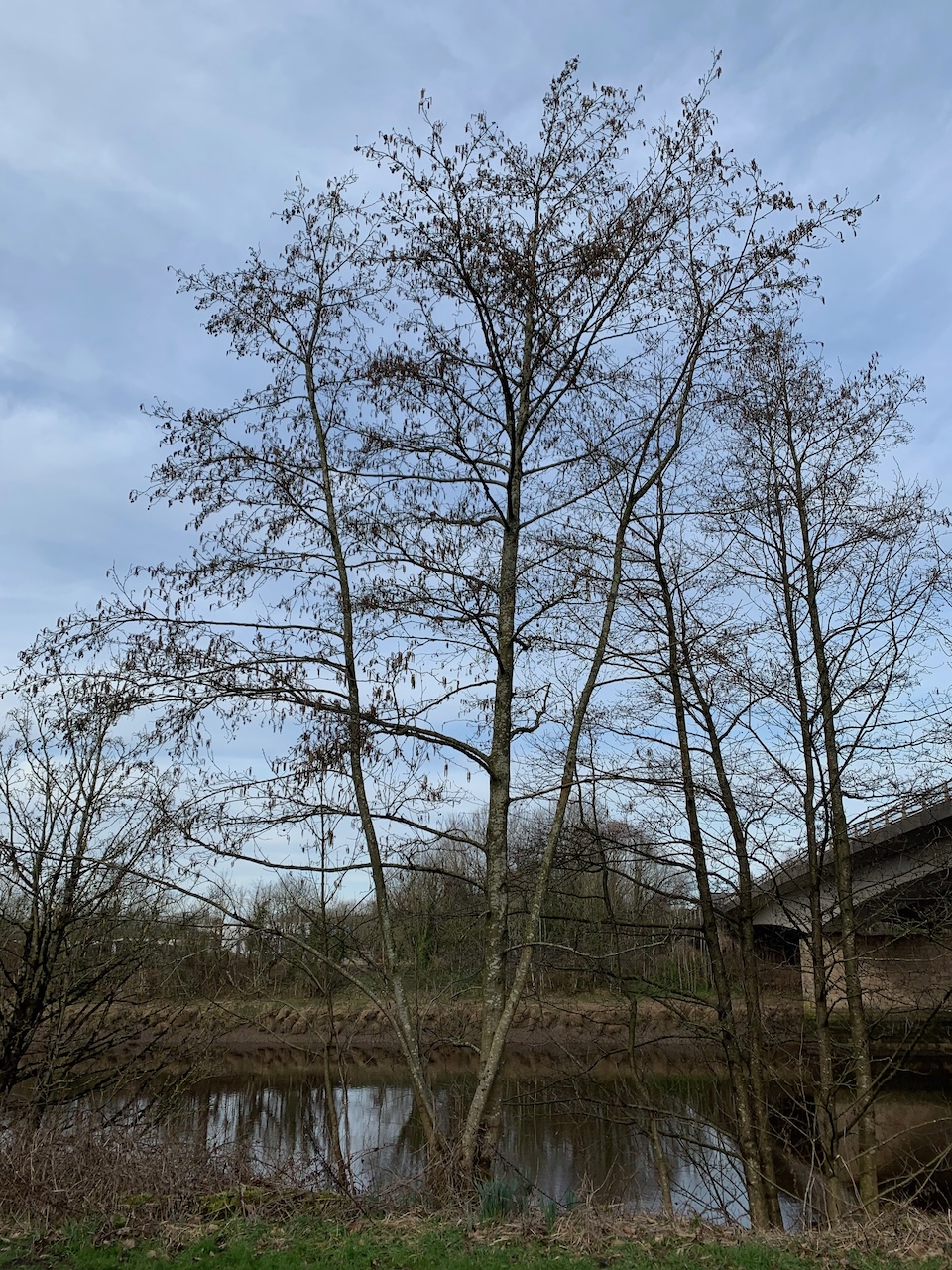
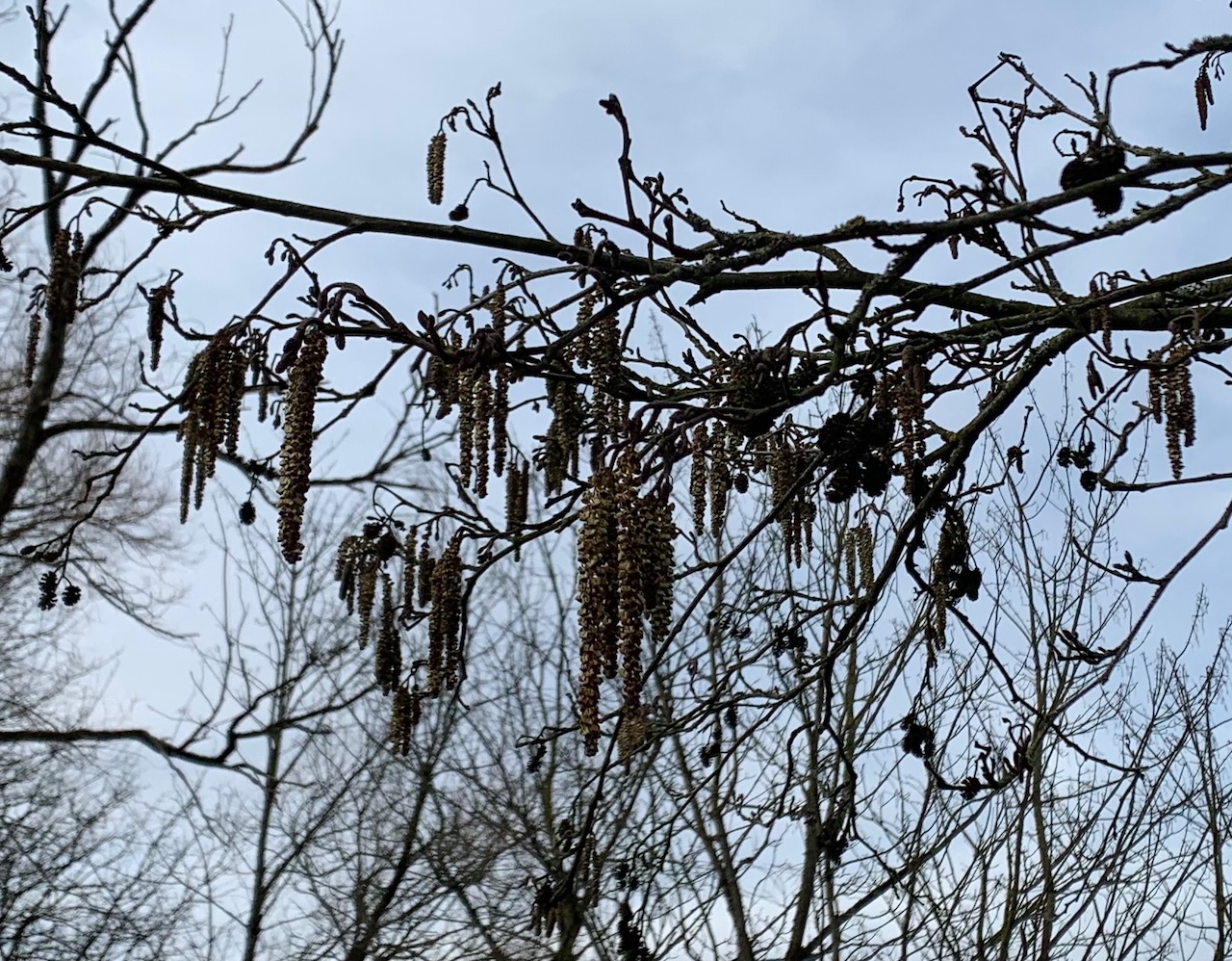
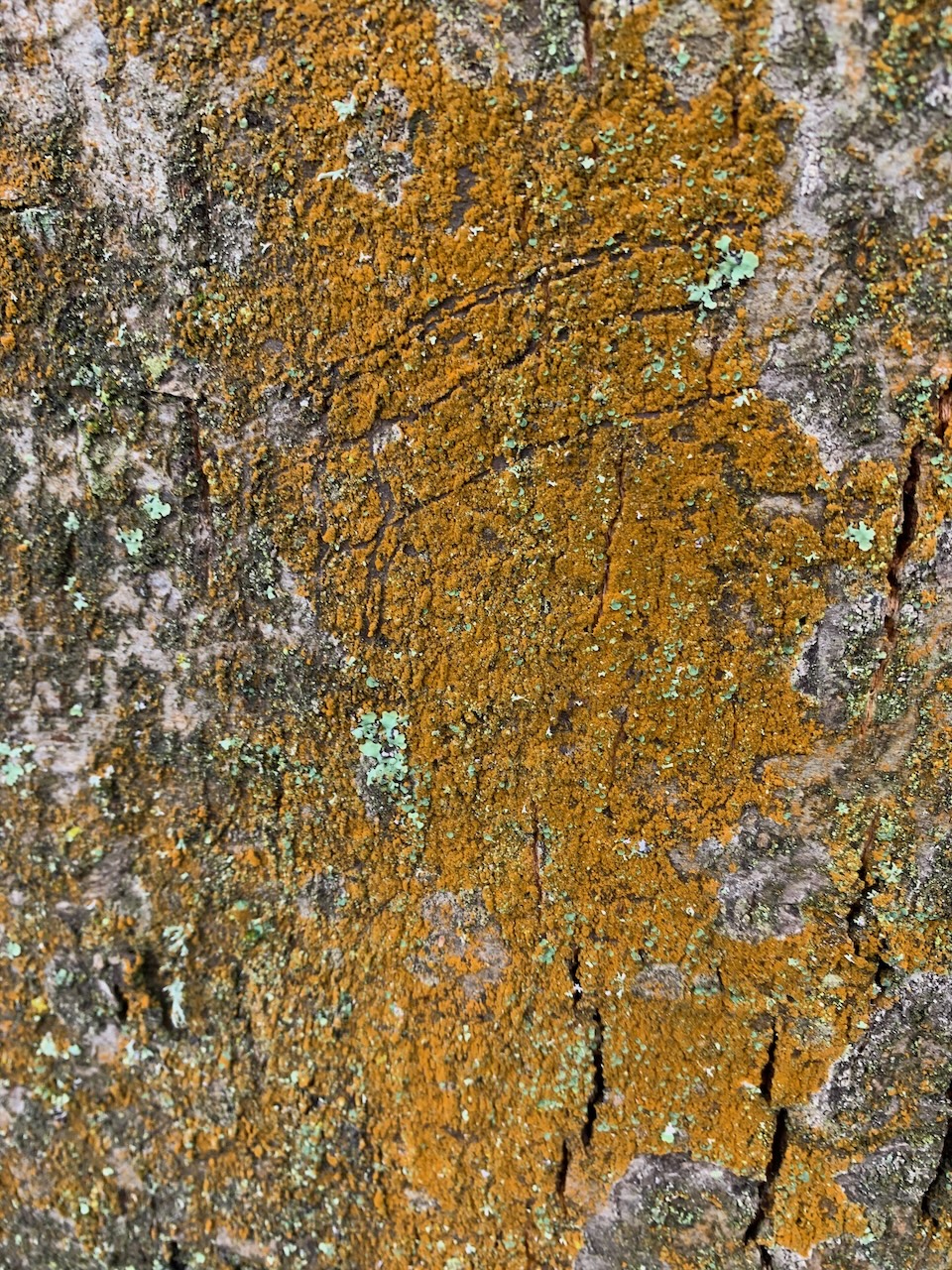
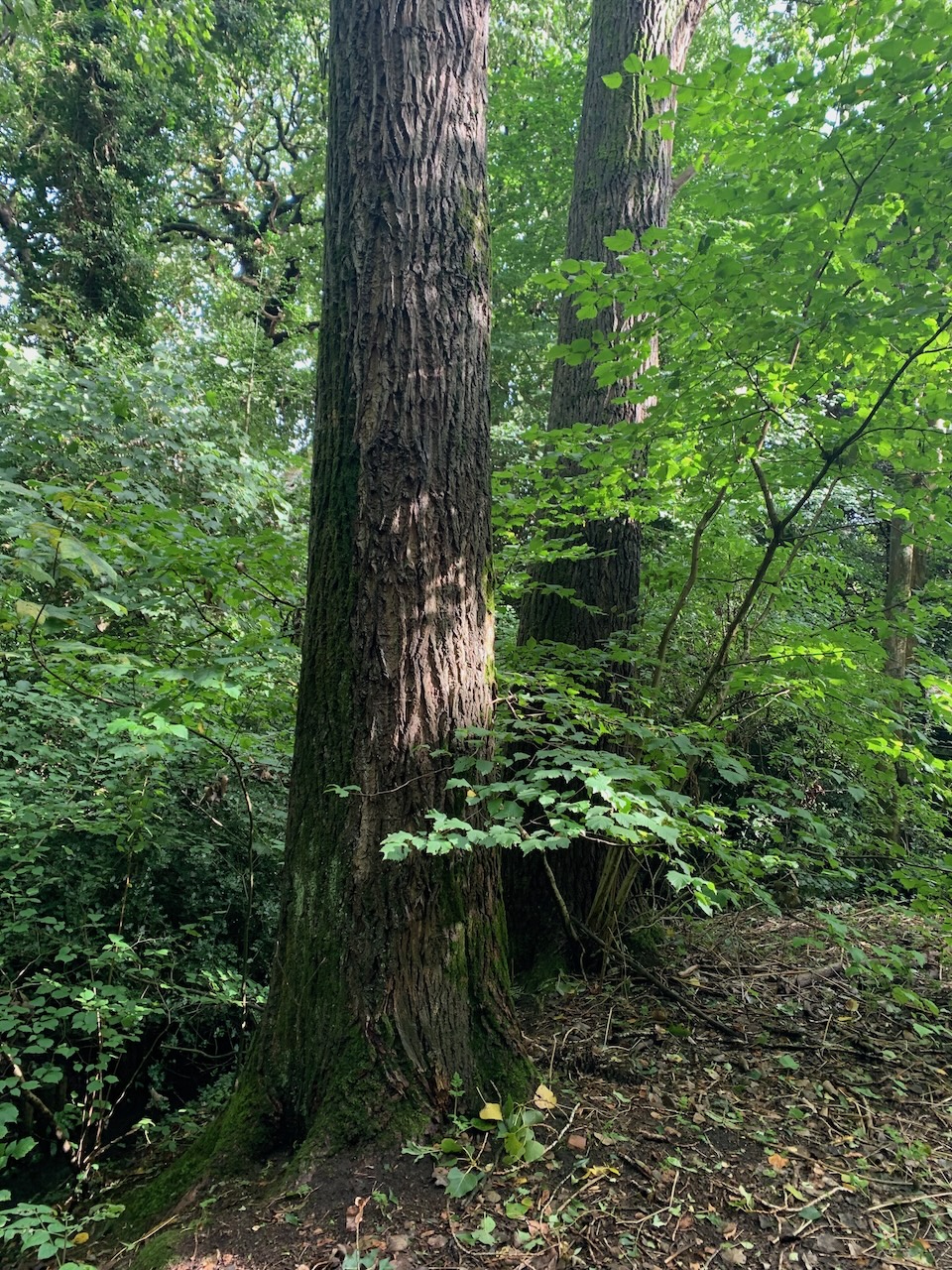
*This poem is addressed to the two black poplars who stand at the source of Fish House Brook, near to the Sanctuary of Vindos, in my hometown of Penwortham. The photograph is of one of the fallen catkins, taken in spring 2022, not quite emerged.

Black Poplars at the Source

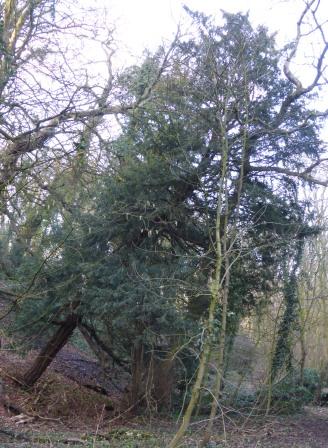
Beside the source of the brook in Greencroft Valley stand two black poplars. There aren’t any known British myths about black poplars but, in Greek myth, they are associated with Hades (the Underworld) and death. 

In Homer’s Odyssey, poplars, described in different translations as ‘tall’ and ‘dusky’, so likely black, with willow, form Persephone’s Grove. Springs, throughout world myth, are seen as entrances to the Underworld.

In another story from ancient Greece, Phaethon, son of the sun God, Helios, drives his father’s chariot too close to the sun. His blazing end brings deep grief to his sisters, who are transformed into black poplar trees. The amber sap is said to be their tears. Thus its associations with death and sorrow. 

In more recent folklore the red male catkins are referred to as ‘Devil’s Fingers.’

This leads me to believe that there might have once been parallel British myths about black poplar, connecting it with springs at the entrance to Annwn and with the groves of Annwn’s Queen. Perhaps there was once a story in which the red male catkins were the bloody fingers of Annwn’s King?

I will admit that I’m not sure if these trees are true black poplars (Populus nigra) or hybrids because black poplars are rare. Plus, I’m not referring to the true source of Fish House Brook but to the outflow pipe that the culverted brook emerges from. The original source would have lain further south, somewhere on Penwortham Moss, which has been drained and replaced by housing. The brook is culverted under the gardens on the other side of my street, Bank Parade, also giving its name to Burnside Way. I feel this relates to my founding of the Sanctuary of Vindos / Gwyn ap Nudd, a King of Annwn, very near to the ‘black poplars’ at the ‘source’.

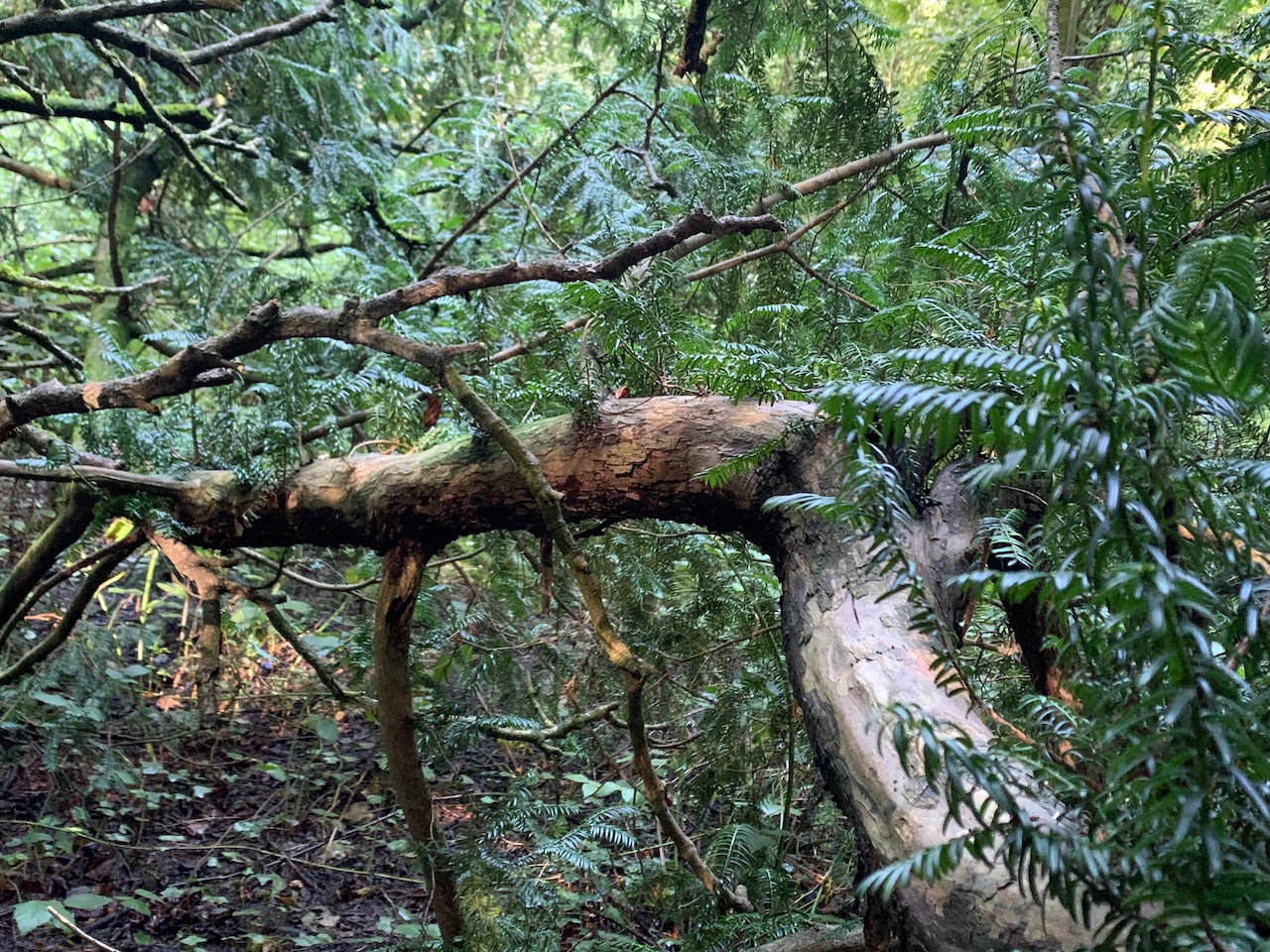
In a shamanic journey I visited the poplars for advice on descending to the ancestors in preparation for some ancestral healing work. I was shown the left tree represented my mother line and the right my father line. I slid down the roots of the left into a cavern where a group of spirits were drinking from cups from the same source. I was told that on the new and full moons I must consecrate a cup of water and make an offering:

“To the Gods,
spirits and ancestors –
we all drink from the same source.”

I felt this related to keeping the source clean – something I have been trying to do as a volunteer in Greencroft Valley with the Friends group I set up (now part of Guardians of Nature).

Aspen – Tree of the Woman’s Tongue

“Can you hold your tongue for a year and a day?” My patron God, Gwyn, challenged me. 

“No,” turned out to be my answer, “no – I cannot.”

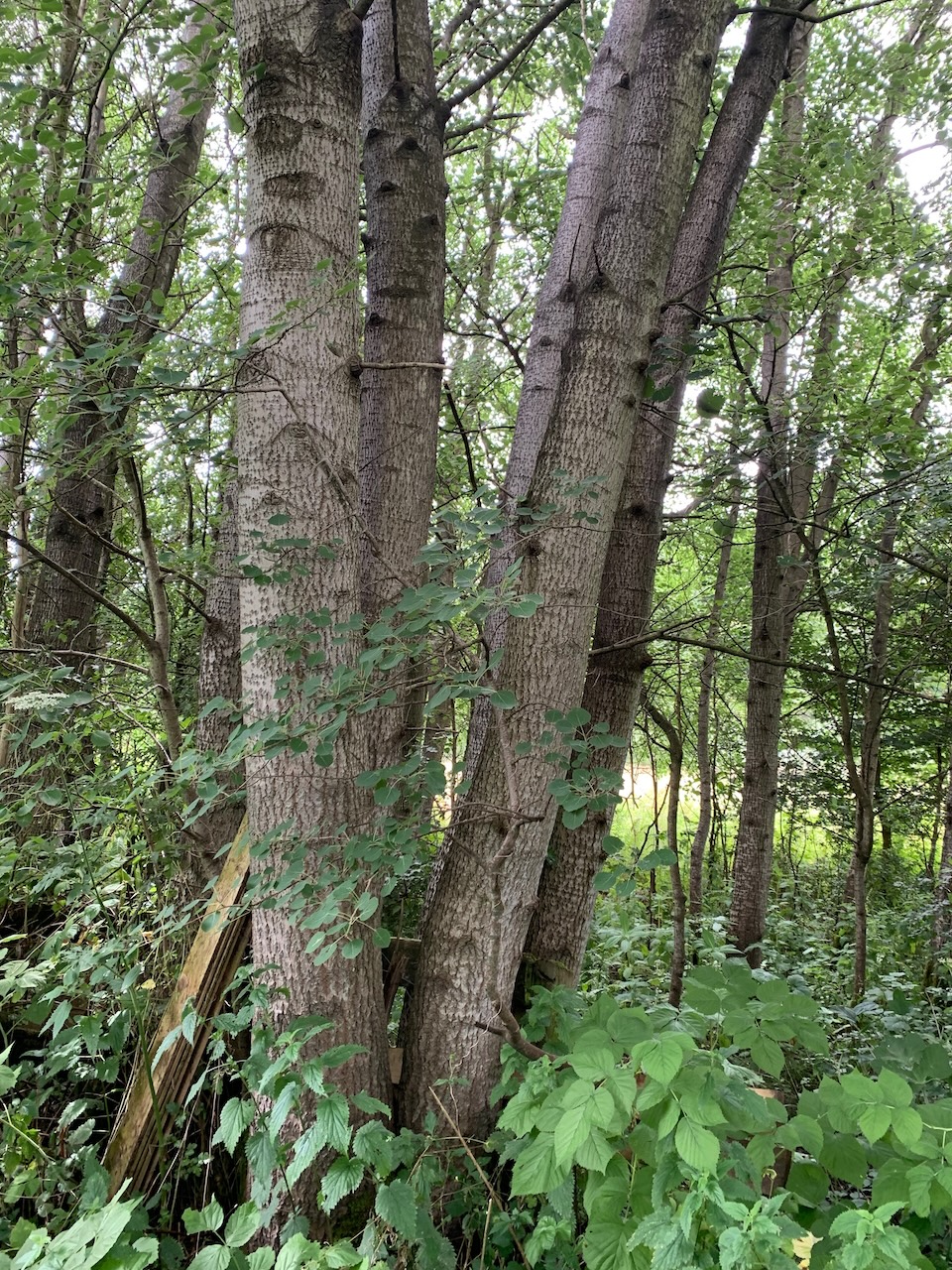
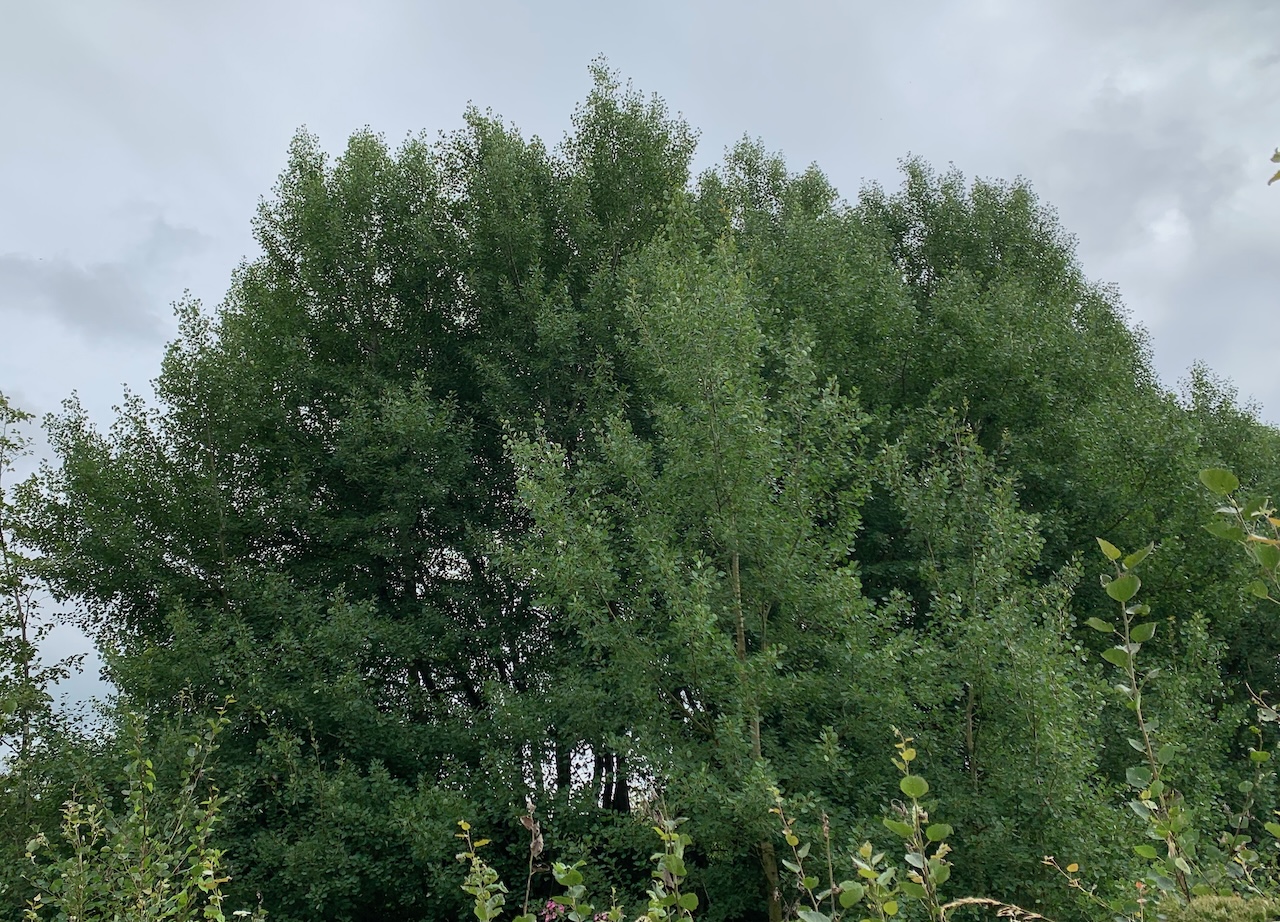
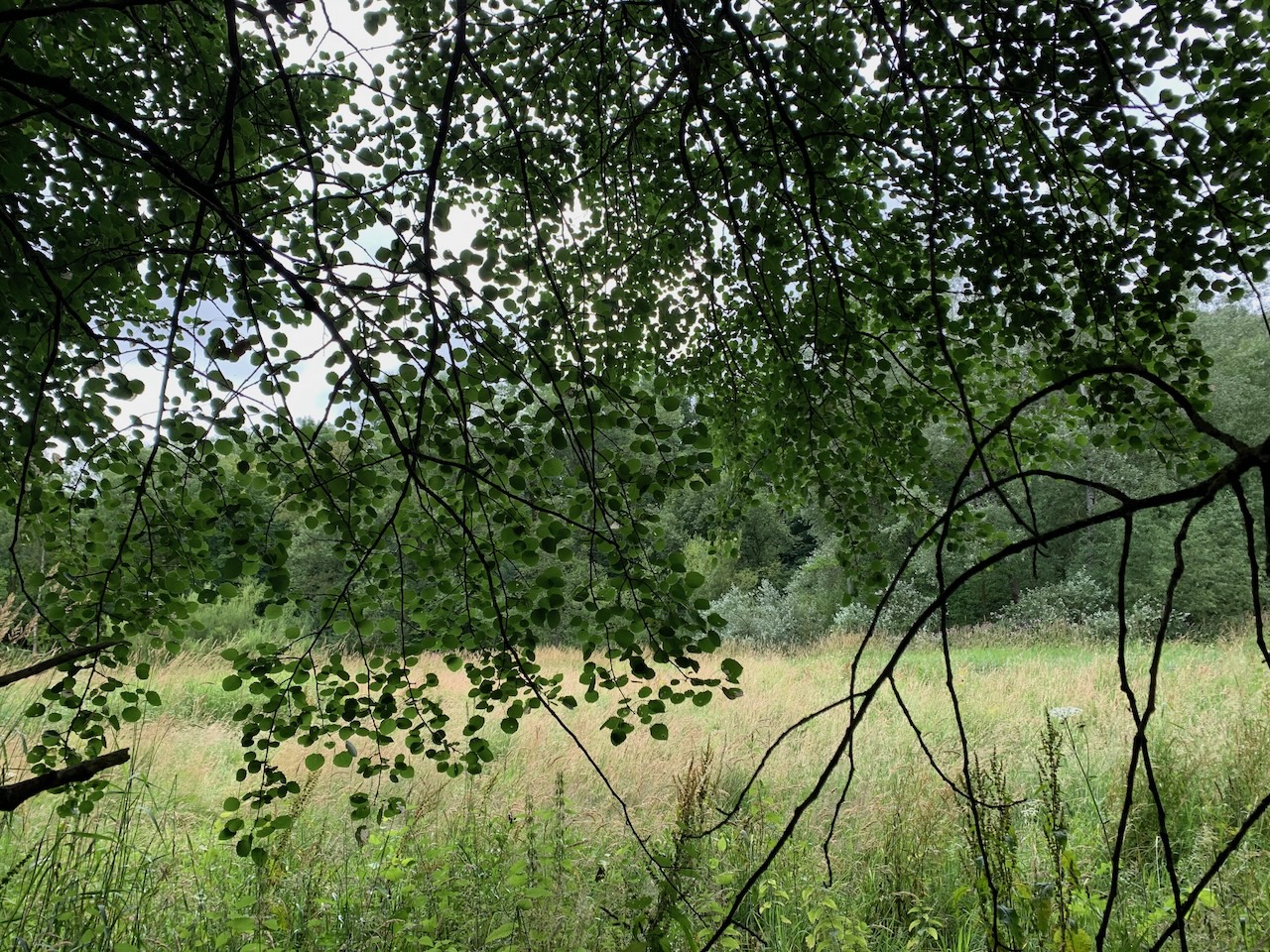
No coincidence that this year I have been connecting more deeply with aspen. Because of the talkative rattling of is leaves it is known in Welsh as coed tafod merchen ‘tree of the woman’s tongue’ and coed tafod gwragedd ‘tree of the wife’s tongue’. Similarly in Scotland it is known as ‘old wives’ tongues’. 

The English, ‘aspen’ derives from the Germanic asp perhaps relating to its snake-like bark or to snake’s tongues. Its Latin name, Populus tremens, refers to its leaves which are said to quake restlessly as it provided wood for the cross Jesus was crucified on.

An ominous tree, associated with prophecy, until recently it existed at the peripheral edges of my vision. Small stands in local woodlands, on the edges of roads and paths, just one considerable colony at Fishwick Bottoms.

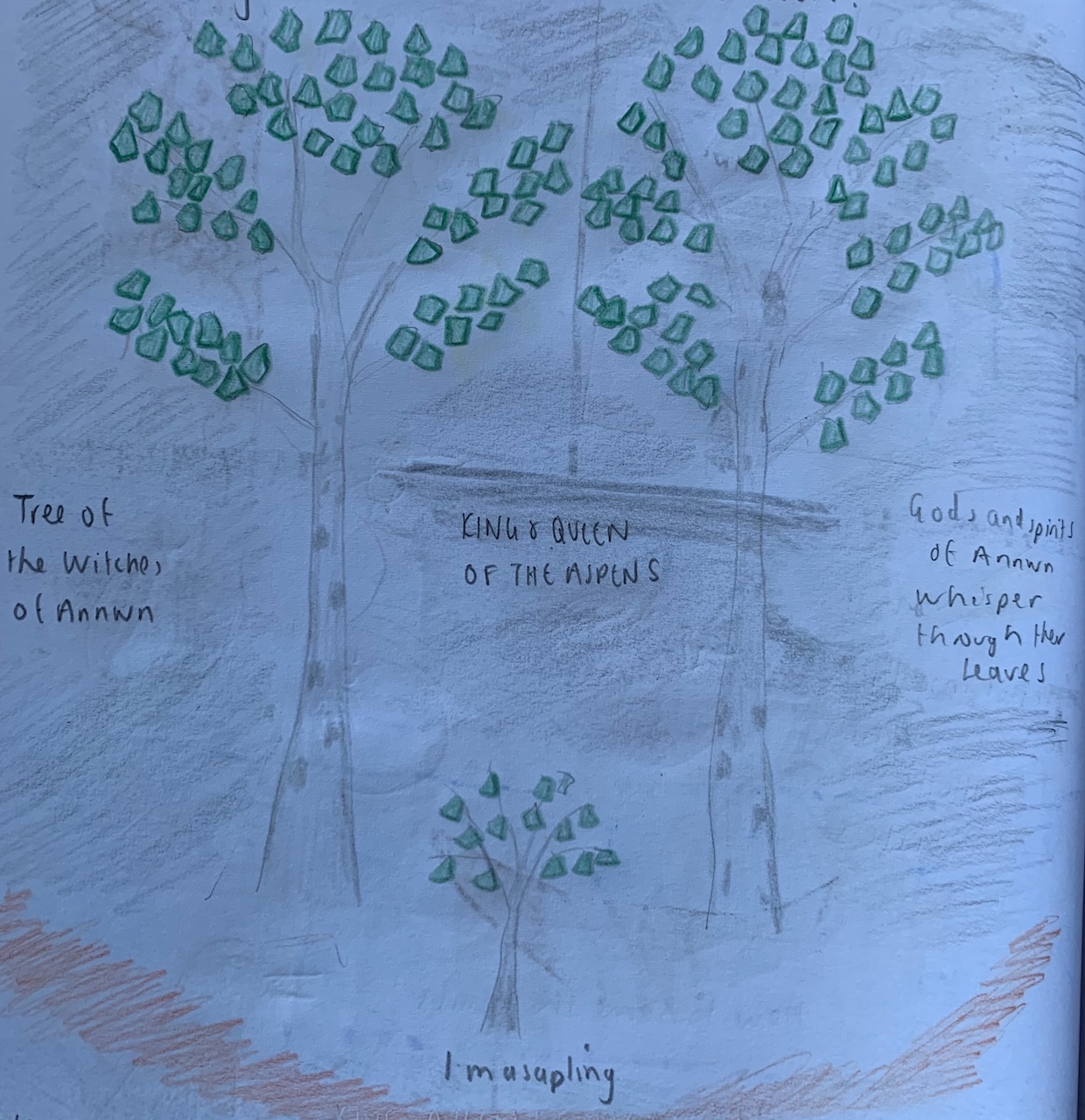
I’ve spoken to it in passing and sat beneath its leaves and listened to its chatter. I’ve journeyed to it, met the King and Queen of the Aspens, learnt that it was the favoured tree of Orddu, Orwen and and their ancestors, the Witches of Annwn who have become spiritual guides for me in the traditions of the Old North.

Orddu showed me that the woodland in Pennant Gofid, ‘the Valley of Grief’ was an aspen wood that had been there since the end of the Ice Age. We walked together as she pointed out the fungi and buzzing flies in areas of decay. Afterwards I learnt that aspen supports numerous detrivore species of fungi, up to 155 on a rotting log and saxoproxylic Diptera favour the microhabitats created by decaying sap under its bark.

Aspen is usually a sociable tree that grows in colonies yet Orddu introduced me to a single Talking Aspen she and her ancestors sat under to read the prophecies from its leaves. I was instructed to sit beneath it with her mother, Orwen’s skull, to listen to the wagging tales of old and dead witch’s tongue.

I was shown, in autumn, how the Witches of Annwn fly as birds of aspen. 

“In winter, when the aspen is silent,” Gwyn asked me, “can you hold your tongue?”

“No,” turned out to be my answer, “no – I cannot.”

Like old women, old wives, old witches, this middle-aged nun of the aspened suburbs and wife of the King of Annwn cannot hold her tongue. 

Aspen needs to tremble. Tongues need to wag. Words need to be typed. I need to write for the sake of my well being, for my Gods, for those who find inspiration in my work in spite of giving up all hope I will make a living from it.

Over my period of silence I’ve found a new way forward as a shamanic guide providing one-to-one shamanic sessions in my local community and am planning to start a shamanic circle here in Penwortham in the New Year.

Step by step my Gods and spirits are showing me my path as a nun of Annwn. Part of this is reclaiming my relationship with my abandoned creativity and embracing it as a way to health and healing for myself and others.

*Information about aspen in this document comes from ‘The Biodiversity and Management of Aspen Woodlands: Proceedings of a one-day conference held in Kingussie, Scotland, on 25th May 2001.’

Pioneering with Birch

Birch. From the Proto-European bhereg ‘to shine, bright, white.’ Bedwen in Welsh. Beithe in Irish. The first letter in the ogham alphabet. I haven’t been drawn to working with ogham much but the associations between birch and new beginnings have long resonated for birch is a pioneer tree. Always the first to colonise new ground, leading the way for other trees, larger woods.

There’s a particular narrow strip of birch wood I like to visit, on the side of an old tram road, next to what was once a gas works, now a new housing estate. In spite of this the trees seem to dance. It’s a place where unique fungi associated with birch can be found such as birch polypore and fly agaric.

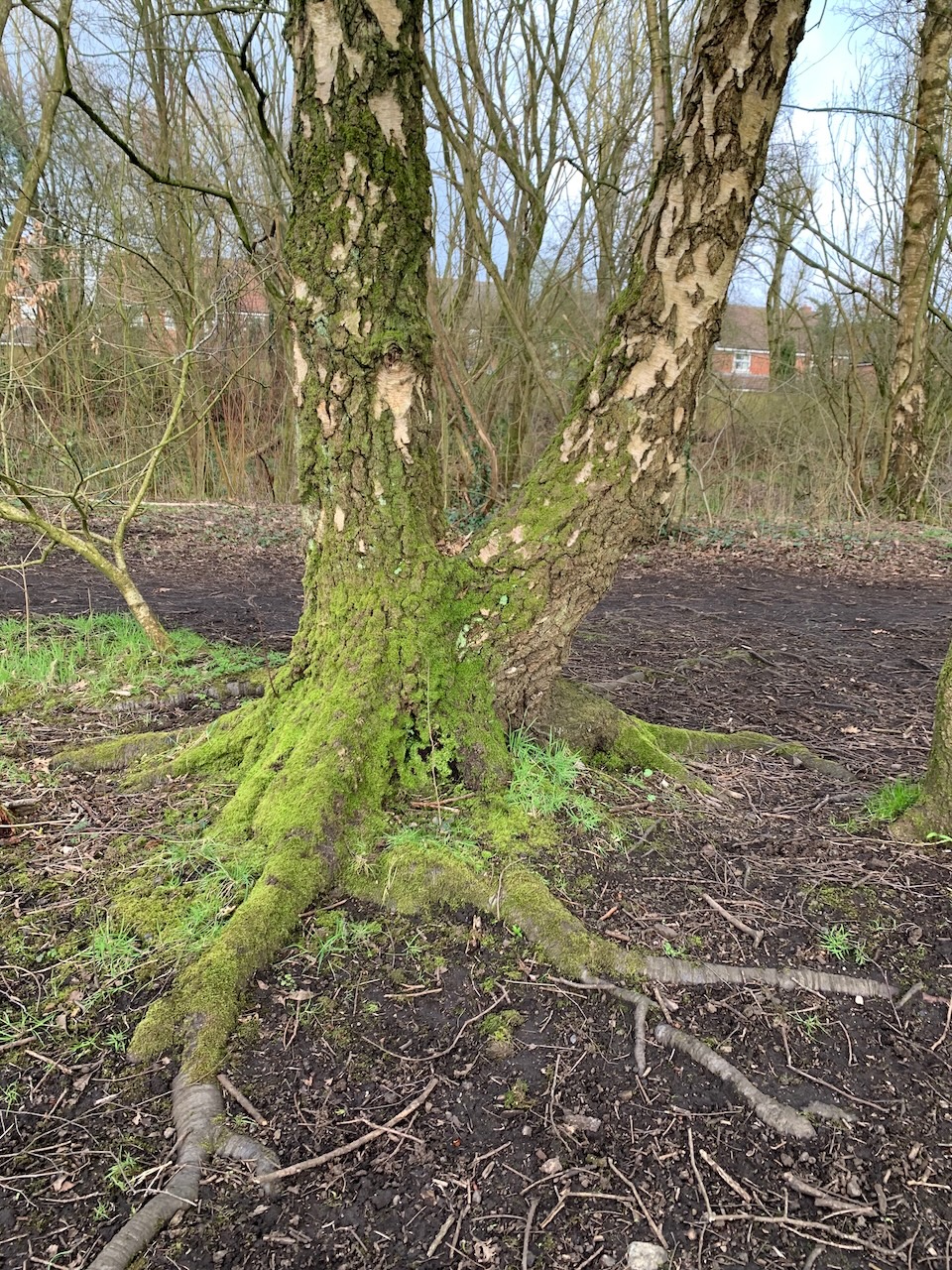
I made a new beginning this year and am prompted for aid to turn to birch. I’m drawn to a forked birch whose twin trunks remind me of the two things I’ve been inspired to bring together this year: flowers and feathers, horticulture and shamanic healing, grounding and soul flight.

I spend some talking and listening with the birch and am shown a vision of the wind blowing birch catkins into the future and told that I must ‘dream on.’

Dream on, dream on… I realise I must dream bigger… that these two aims must serve my larger dream of becoming a nun of Annwn – a guide of souls.

Following a session with my spiritual mentor overnight I’m gifted the idea of soul guidance one-to-ones then, in divination, the butterfly image for it. 

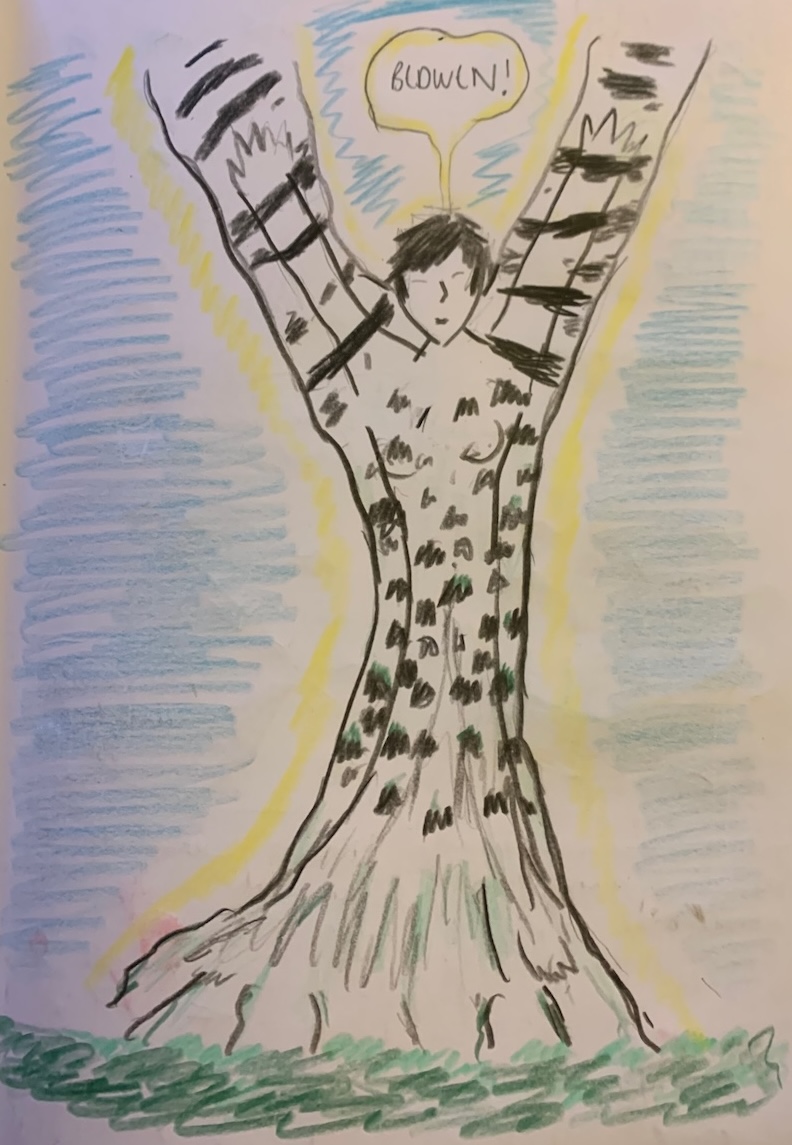
On the new moon I make the launch and pray to birch for aid chanting her name. In vision I become one with her, beautiful, strong, ready for the sap to flow.

In this month’s Way of the Buzzard Mystery School journey circle the topic is ‘preparing new ground’ and we are working with birch, rowan or alder. The birch calls to me again and I receive some transfomative insights – ‘a nun of Annwn is a pioneer species’. I must ‘prepare new ground for others’, for ‘a new woodland’, ‘move forward’, ‘root deep’, and ‘not turn back’.

I realise it’s time to step fully into my role as a nun of Annwn. Rather than returning to a secular job and remaining stuck as Lorna Smithers to give myself fully to my calling from the Gods and put everything into becoming Sister Patience. To making the Monastery of Annwn a reality both online and in the physical world.*

Pioneering with birch I have begun using my monastic name for all communications aside from financial and legal. Most of my community know now – there is no turning back.

*This has become possible because my mum has offered to help me out financially if I run out of savings before finishing my shamanic healing course in three years time. I was hoping to find paid work in horticulture but ran into the same barriers for a horticultural project officer job as for conservation due to the limitations with my autism around people management and multitasking. I also realised a physical job in a plant nursery or as a gardener would not last due to my knee problems as I can’t kneel for long and at forty-two am not getting any younger. I was thinking about cleaning again but knew longterm it would have a negative impact on my mental heath. So I asked my mum for help and she agreed rather than see me stressed again. I will be continuing to volunteer in horticulture as a way of giving back to land and community.

To Ebura

You have the power
to slow the beat of my heart. 

If I touched your needles
you might stop it.

That’s why they also call you 
Taxus baccata – toxic berry carrier.

Your taxines (taxine A and B, paclitaxel, 
isotaxine, taxicatine, taxols A and B)
jam channels of myocardial cells,
bring about cardiac arrest.

Cardiotoxic tree the Eburones drank your poison 
extracted ex arboribus taxeis – 
you stopped their hearts.

Beneath your boughts
I hear the echoes of their heartbeats
still beating slowly, so slowly like
the greater beat of the Heart of Annwn.

Like so many poisons
you are my cure.

*Ebura is the Proto-Celtic name for yew. The English ‘yew’ and Welsh ‘Ywen’ derive from the Proto-Germanic *iwo. The Eburones were a Gaulish-Germanic tribe in north-east Gaul.

The Hunt is Late

I fear
the hunt
is late
this year

because
of the green
canopies

because
of the unfallen
leaves

because
your presence
is just

a whisper
of an antlered
figure in

boughs
not yet shaken
by wind.

You are here.

You are here

I know it
by the black cat
who leaps

into my
arms trembling.
The quick-

ening beat
of my heart and
the shiver

of winter
rain falling by
lamplight.

You are here.

You are here.

I know it
when I recite
my poem –

the rain
falls harder your
night-drum

beating
within me and
the wood.

Shadows
stretch and prowl
yet your

hunters
remain dark to
the seer.

I fear
the hunt
is late
this year.

*This poem is addressed to Gwyn ap Nudd, a Brythonic god whose hunt traditionally rides to gather the souls of the dead on Nos Galan Gaeaf. It is based on my marking of the occasion by reciting my poem ‘When You Hunt for Souls in the Winter Rain‘ (in the winter rain!) for Gwyn in Greencroft Valley. I find it disturbing that some of the leaves are still green and many have not yet fallen at this time of year, which in the Celtic calendars marks the beginning of winter. (The Welsh Nos Galan Gaeaf means ‘The night before the first day of winter’ and the Irish Samhain means ‘Summer’s End’).

Swyn

Swyn – charm or incantation; magic
Kristoffer Hughes

This woodland will not be felled by the axe of man or god. I drift with the souls through the mist of blood. It is damp on my cheeks and eyelashes. This is not the time for weeping, but undoing what Gwydion has done. When the featherless wings brush my face I push them away lightly and set to work.

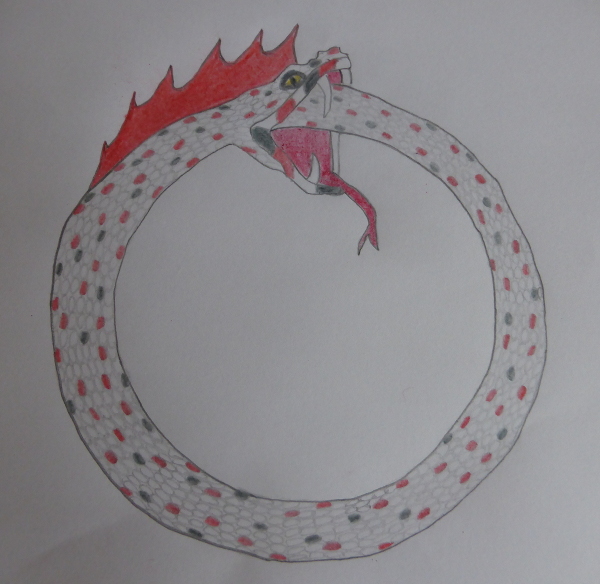
It must begin and end with a snake biting her tail.

It takes me weeks (in this place the weeks are counted by the dripping of the blood) to ease the snakeskin down from the trees, to sew up the tears, to stick the scales back on with super glue, then stretch it out in a circle around the woodland. Lastly I retrieve the skull, prop open the jaws with a strong branch, slip the end of the tail between them, give my instructions to those who will bring the end.

The toadstone with its antidote must form the centre.

With ropes I drag it out of the bloody pool of bones and feel like Sisyphus as I push it into the central grove. A lapwing calls “pee-wit, pee-wit” circling overhead, a red-eared hound sits at my side, and a doe watches fractiously from between the trees as I sponge off the blood and polish it with a yellow duster, beginning to hum a tune as the bufonite sparkles green as emerald beneath my touch.

In the jaws of the hundred-headed beast the gateways must be opened.

I leave the woodland and climb the hill to where the heads of the beast are piled up like a totem. Stepping inside each set of cavernous jaws I light a candle to illuminate each cave and redraw the gateways around each throat with a glow-in-the-dark marker pen and somewhere hear a belly rumble.

The eagle-feathered staff of the swynydd to reverse the swyn.

Slithering on damp bone I climb my way up slowly, a candle, a gateway, in every skull, to the very top. I wrest Gwydion’s staff from between two skulls and shake his presence from it. Gently I untie the eagle feathers and watch them drift slowly to the ground like Lleu sung from the oak in Nant Lleu.

With a smile I tie on the feathers of the owl and speak a prayer to Blodeuwedd and all her kind. I call to my Lord of Annwn, Brân with his alder shield, Pryderi the swineherd dead before his time.

Beneath the stars of promise, seated on the top skull of the beast, one leg crossed over the other, I sing:

Blood drenched trees
beyond Caer Nefenhyr
souls amongst the trees
will you ever be free?

As I sing I see the trees awakening as if from a long sleep, staring about in horror, shaking off the blood. Birch is abashed by his blood-stained armour whereas Ash is proud of his splashes and scars. Golden Rod, afraid her beauty will be forever be marred, lays down her rods of golden flowers like swords.

From their bloody death-spots the souls unattach themselves, ease themselves out of the mist, the rain.

Blood drenched trees
enchanted into warriors
woodland of lost souls
will you ever be free?

A bending of the boughs, a turning and circling in confusion, the deep rumbling voice of Oak as he argues with Holly again, the silvery tongue of Birch calming them, the dream-wisdom of Willow, the fire of Rowan, prickly Blackthorn playing devil’s advocate, the squeak of clover demanding a say.

Souls fly like moths to the flame to the jaws of the beast. The green light of the toadstone begins to glow.

Blood drenched trees
will you return to Annwn
with souls of mist and feather?
Will you accept freedom?

The green light soothes them and, as a woodland, as a whole, united by blood and mycelium they agree.

The souls step into the caverns, to the gateways, and the beast shudders to life. The snakeskin begins to twitch. I sense the end approaching like the snap of countless jaws as the snake bites her tail.

Speckled Crested Snake Ouroboros Med

*This piece follows on Caer Nefenhyr and is based upon a spirit journey into the otherworldly landscape where ‘the Battle of the Trees’ took place.

After the late-night meeting

my head was pale and flashing
a tawdry halo a broken circuit
a worn out lighthouse
behind my eyes.

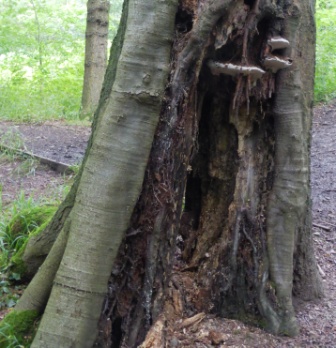
I went to a hollow tree
and sat myself within it.
In the slow drip of mulch
and closeness of fungus
a full moon overhead.

The ants came inexorably
shiny-black shivering over
my skin. When I clamped
my mouth they lanced
my ears. Clambered in.

Tiny mouths chewing
like an orchestra of saws
they ate the nil-light
and came out glowing.
Pouring from my mouth

in an illuminated stream
crackling legs growing distant.
A million bright footprints
teeming from my head:
an empty mulch, a hollow tree.

Beech Tree, Carr Wood

Coille Coire Chuilc: Seeking Annwn in Caledon

Coille Coire ChuilcThere once existed a tradition amongst the northern Britons of locating Annwn north of Hadrian’s wall. Its origins may be found in the writings of Tacitus about tribes beyond the northern frontier who spoke a different language to the Britons and were impossible to subdue. Ptolemy was the first person to refer to this area as Caledonia Silva.

The 6th C classical writer Procopius said: ‘Now in this island of Britain the men of ancient times built a long wall, cutting off a large part of it; and the climate and the soil and everything else is not alike on the two sides of it… on the north side… it is actually impossible for a man to survive there even half an hour, but countless snakes and serpents and every other kind of wild creature occupy their area as their own. And, strangest of all, the inhabitants say that if a man crosses this wall and goes to the other side, he dies straight away… They say, then, that the souls of men who die are always conveyed to this place.’

These writings show within the Romano-British culture of the Old North the Caledonian forest was considered to be a wild, hostile place associated with death.

Culhwch and Olwen (1350), a medieval Welsh text set during the Arthurian period preserves remnants of these superstitions. In the stories of Gwyn, Gwythyr and Creiddylad and the Very Black Witch, Arthur ‘goes north’ to inhospitable lands. Both stories feature Gwythyr ap Greidol, a northern ruler and warrior of Arthur’s court and Gwyn ap Nudd, a king of Annwn. The latter is an ancient British god associated with wild places and the dead. It is my intuition it was after a vision of Gwyn and his host at the Battle of Arfderydd that Myrddin Wyllt went mad and fled to Celyddon (Caledon) where he wandered thirty years amongst gwyllon (wild, ancestral spirits).

As the story of Gwyn, Gwythyr and Creiddylad is set at Calan Mai, a friend and I decided to head north to Coille Coire Chuilc (one of the southernmost remnants of the Caledonian forest) on the May bank holiday weekend.

Coille Coire Chuilc is an ancient woodland of Scots pines lying between the river Cononish and Allt Gleann Auchreoch close to the village of Tyndrum in Strath Fillan. Tyndrum grew out of the lead mining industry. The mines were located in Beinn Chuirn. During the 18th C pack horses travelled 50 miles to Alloa with lead ingots then back with fuel for the smelter.

Cononish HillsDuring the 19th C gold was discovered in the hills of the Cononish glen, which led to a miniature gold rush. This ended in the 20th C but has recently restarted with the approval of a second planning application to Scotsgold Resources in 2011. Gold is once more being mined from the hills and may be panned from the river Cononish, although it is more likely one will find lead and pyrite: ‘fool’s gold’. As the area is renowned for its ‘fairy places’ it was interesting to hear the hills were hollowed with mines where one is more likely to find false gold than the real deal…

Our expedition to Coille Coire Chuilc did not go to plan. Firstly we took the ‘wrong’ path, ending up north of the river Cononish rather than within the woodland. However this had the advantages of providing a good view of the distant Scots pines and an excuse to walk back down the river, seeing some sensational falls, ravines and trees clinging drastically to rocks.

The next set back was that the bridge across the Allt Gleann Auchreoch pictured in The Ancient Pinewoods of Scotland: A Guide (2013) was plankless and uncrossable!

This led to a precarious injurious fording of the burn into a woodland of bent old round-crowned pines and deep sphagnum mosses that didn’t feel overly friendly to two foolish searching humans.

Blog 6. Coille Coire ChuilcDying trees stood with a stark grey dignity reminiscent of gwyllon; ancestral presences of their land. A land where we were not at home. Where all was strange and fey. And said leave.

On our return, after I slipped over again crossing a boggy patch, one of the more positive points was glimpsing a magnificent bird which I think may have been a golden eagle.

Blog 9. Golden EagleTyndrum itself, however, was hellish. No longer a mining village but conglomeration of shops and a tourist information centre. We arrived at the scene of an accident where a car had hit a motorbike and shortly afterward saw two near car crashes within the space of a minute. We saw the whole place was now based around the tourist industry and as tourists we were part of the problem.

I felt like I was a long way north of the wall far from home in a landscape that did not want me.

I left with the impression that whilst the story of Gwyn, Gwythyr and Creiddylad in Culhwch and Olwen contains universal themes (the battle between winter and summer kings for a maiden goddess on May Day) its variant from Strathclyde locating Annwn in the Caledonian forest very much belonged to its time and people.

The fairies of Coille Coire Chuilc had concerns of their own with mining and tourism and little care for a pair of wanderers from Lancashire seeking the ancient roots of a Brythonic tale that may never have been located in their woodland at all.

Whether Myrddin ever fled quite so far remains uncertain. Perhaps we went too far north. However I think sometimes you must stray too far to come back…