‘From the Well of Life Three Drops Instilled’

‘… to nobler sights
Michael from Adam’s eyes the film removed
Which that false fruit that promised clearer sight
Had bred, then purged with euphrasy and rue
The visual nerve (for he had much to see)
And from the Well of Life three drops instilled.
So deep the power of these ingredients pierced
Even to the inmost seat of mental sight
That Adam now enforced to close his eyes
Sunk down and all his spirits became entranced.
But him the gentle angel by the hand
Soon raised and his attention thus recalled:
Adam, now ope thine eyes and first behold
The effects which thy original crime hath wrought…’
Paradise Lost
I’ve recently been re-reading John Milton’s Paradise Lost (1667). The third or fourth time round this epic vision seems no less powerful in its depictions of Heaven and Hell and Earth both pre and post fall or radical in Milton’s writing the perspective of Satan and his inner motivations and turmoil.

As an Annuvian kind of person I will admit to feeling more sympathy with Milton’s rather magnificent Satan, refusing to serve in Heaven preferring to reign in Hell, the only one amongst the fallen angels (who include many pre-Christian gods) who dares travel to Paradise to thwart God’s plans by bringing about the fall, than the brainless Adam and Eve, Milton’s spoilsport God, or his Son.

The ending, with its deus ex machina, again was disappointing. It turns out the fall was not only predicted but designed by God to make possible and all the more powerful Jesus’ redemption of humanity. Paradise Lost is, in essence, a work of theodicy, written ‘to justify the ways of God to men’.

I’m sharing this because, whilst re-reading the book, I found the lines cited above that seem to contain Christian and pre-Christian Brythonic lore. When the archangel, Michael, purges Adam’s fallen sight he not only uses traditional plants – euphrasy, or eyebright, and rue were used for treating eye ailments – but ‘three drops’ from ‘the Well of Life’. This grants Adam visions of the future, mainly the ill-doings of his offspring until the Flood. As far as I know there is a Tree of Life but not a Well of Life in Paradise in Christian literature, which makes me wonder if it comes from another source.

The most obvious is the Welsh ‘Story of Taliesin’. In this tale Gwion Bach steals three drops of awen ‘inspiration’ from the cauldron of Ceridwen, which grant him omniscience as the all-seeing Taliesin. Milton’s evocative description of these ‘ingredients’ piercing ‘to the inmost seat of mental sight’ and putting Adam into a trance before he opens his eyes to see the future fit shares similarities with the prophetic visions of Taliesin and other awenyddion, ‘persons inspired’ referred to by Gerald of Wales.

However, although this story had been published in Welsh in the mid-16th century, it was not available in English at Milton’s time. Whether he had travelled to Wales (Milton was born in London, studied at Cambridge, lived in Berkshire, and travelled extensively throughout Europe before returning to London) or had heard the story in England in some form remains unknown.

The resemblances are so uncanny that, if he had not, it seems possible he was tapping into some deeper source. It is of interest that Milton refers not to a cauldron, but to a well, a far older image. Throughout the British and Irish myths cauldrons and wells are associated with inspiration and rebirth.

After Gwion tastes the awen Ceridwen pursues him in a shapeshifting chase and swallows him into her crochan ‘cauldron’ or ‘womb’ from which he is reborn, shining-browed, and omniscient as Taliesin. In ‘The Second Branch’ the cauldron brings dead warriors to life. In ‘The Spoils of Annwn’, refusing to ‘boil the food of a coward’ it is associated with the bardic initiation rites of Pen Annwn.

In the Irish myths the Well of Segais is associated with imbas ‘inspiration’. No-one was allowed to approach it except its keeper, Nechtan, and his three cup-bearers on pain of their eyes exploding. However, Boann, Nechtan’s wife, disobeyed. It overflowed and she was dismembered and died. The river created took her name – the Boyne. When Finn burnt his thumb whilst cooking a salmon from this river he received the imbas. In The Battle of Moytura the Tuatha Dé Dannan dig Wells of Healing and throw in their mortally wounded, who not only come out whole but more ‘fiery’ than before (!).

It seems that Milton is, indeed, tapping into a deep source. Here, in Peneverdant we once had a Well of Healing, dedicated to St Mary at the foot of Castle Hill, which I believe was associated with an earlier Brythonic mother goddess of healing waters who has revealed her name to me as Anrhuna. I believe she is the consort of Nodens (cognate with Nechtan) and the mother of Gwyn ap Nudd (cognate with Finn), Pen Annwn. Perhaps we once had a myth based around these deities that has now been lost.

In Paradise Lost, for Adam, as for many who taste the three drops of inspiration (aside perhaps for Taliesin) possessing foreknowledge is both a blessing and curse. At first he laments Michael’s gift:

‘O visions ill foreseen! Better had I
Lived ignorant of future, so had borne
My part of evil only, each day’s lot
Enough to bear! Those now that were dispensed,
The burden of many ages, on me light
At once, by my foreknowledge gaining birth
Abortive to torment me, ere their being,
With thought that they must be! Let no man seek
Henceforth to be foretold what shall befall
Him or his children…’

He is then reconciled by his perception of God’s purpose:

‘… Now I find
Mine eyes true op’ning and my heart much eased,
Erewhile perplexed with thoughts what would become
Of me and all mankind, but now I see
His Day in whom all nations shall be blest.’

‘O goodness infinite, goodness immense!
That all this good of evil shall produce
And evil turn to good more wonderful
Than that which by Creation first brought forth
Light out of darkness!’

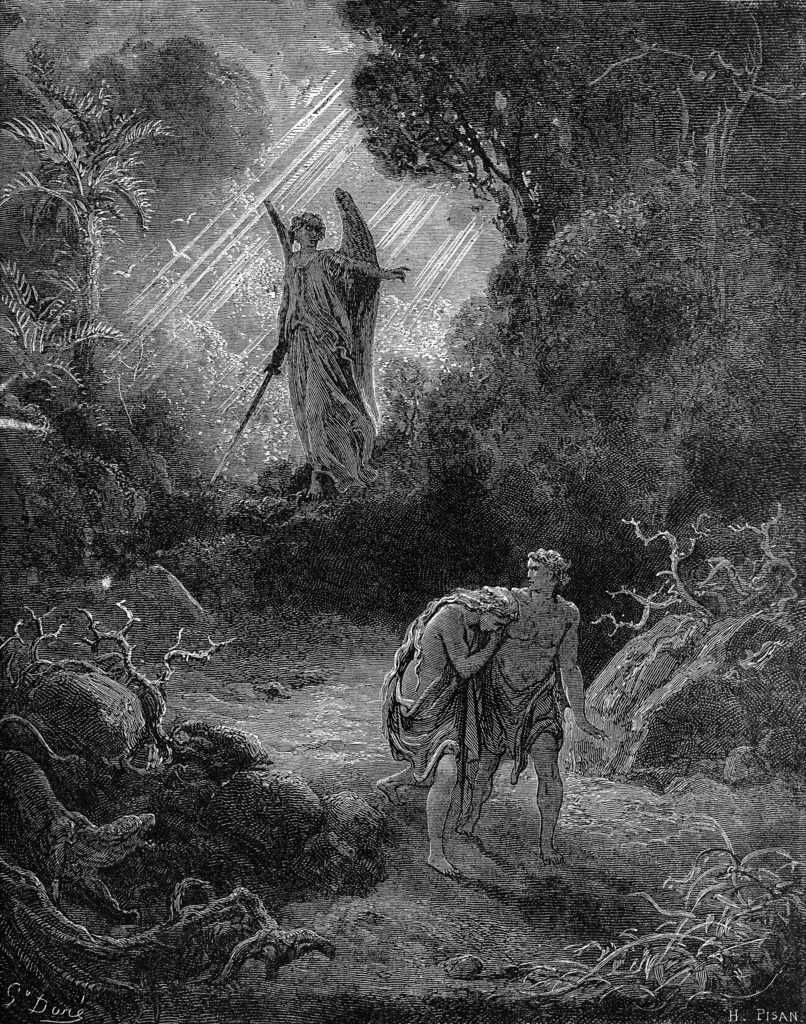
Adam’s visions give him the strength to depart with Eve from Paradise to Earth to beget humankind. The gate to Paradise, to the Tree of Life and the Tree of Knowledge, and no doubt to the Well of Life is barred and guarded by a ‘flaming brand’ ‘the brandished Sword of God’ ‘fierce as a comet’.

In Christian literature, in contrast to the simplistic notion preached to school children that the souls of good people go to Heaven and those of bad people go to Hell, Paradise is not truly regained until after the Apocalypse and Jesus’ harrowing of Hell and the resurrection of the dead.

It may be suggested that, in our Brythonic myths, all souls return to the Well of Life. That, with a little awen to awaken ‘mental sight’, the living can travel in spirit to Annwn and be reborn as awenyddion.

Here, in Peneverdant, where the well has run dry due to the foolishness of humans shattering the aquifer when moving the river Ribble to create Riversway Dockland, it remains possible to traverse the waters of the past, of the Otherworld, to return to the unfathomable source from which Milton drew.

Afagddu, Prophet of Darkness

I. The Dark Son

Afagddu, ‘Utter Darkness’, is a minor figure in Welsh mythology whose significance has not been recognised because he was pushed out of the way by Gwion Bach, who became the celebrated bard, Taliesin.

Afagddu’s mother is Ceridwen. She and God are called on interchangeably as the ultimate source of awen, divine inspiration, by the medieval bards. This suggests she is the greatest of the Brythonic deities, the Great Goddess closest to a creator God, Old Mother Universe, the creatrix and destructrix from which all life is born and to whom it returns at the moment of death.

If this is the case, then surely her son, Afagddu, should hold a greater position within Brythonic tradition? Why is his story shoved aside like a dirty secret? Why is his name not better known?

I believe this is partly due to his hideous apparel. In Elis Gruffudd’s recording of ‘The Story of Taliesin’ we are told his ‘looks, shape and carriage were extraordinarily odious’. Firstly they named him Morfran, ‘Great Crow’ or ‘Sea Raven’ but ended up calling him Afagddu ‘Utter Darkness’ ‘on account of his gloomy appearance’. John Jones’ redaction describes him as ‘the most ill-favoured man in the world’ and compares him to his sister, Creirwy, ‘Living Treasure’, ‘the fairest maiden in the world’.

Afagddu’s ancestry goes some way to explaining his looks. Ceridwen’s name can be translated as ‘crooked wife’ (from cwrr, ‘crooked’, and fen, ‘wife’) and ‘fair and loved’ (from cerid, ‘love’ and wen, ‘fair’). Perhaps because she is both crooked and fair she gave birth to crooked and fair children. Afagddu’s father is Tegid Foel, ‘the Bald’, whose patrimony is Llyn Tegid. Tegid’s baldness, along with his rulership of a lake rather than a human kingdom, suggest he is a monstrous water deity.

Unfortunately for Afagddu he was born ‘in the days when Arthur started to rule’ – a period when Christianity was the religion of warrior elites who built their status through the repression of the gods, monsters, ancestral animals, and witches of the ancient British pagan traditions. Ceridwen was allegedly keen for Afagddu to ‘win acceptance amongst the nobility.’ It’s my suspicion this was the addition of a Christian interculator who was either ignorant of Ceridwen’s identity as a goddess or purposefully erased it. At some point she was reduced to a ‘magician’ and Tegid to a ‘nobleman’.

II. The Spirit of Prophecy

In Gruffudd’s recording, after realising that Afagddu will not be recognised for his looks, Ceridwen decided instead to ‘make him full of the spirit of prophecy and a great prognosticator of the world to come.’ The link between his ‘ugliness’ and being chosen for a prophetic vocation may date back to traditions of pagan Britain wherein differences were celebrated and revered rather than despised.

After ‘labouring long in her arts’ Ceridwen discovered a way of achieving prophetic knowledge by choosing certain herbs on certain hours and days and brewing them in a cauldron for a year and a day. Resultingly ‘three drops containing all the virtues of the multitude of herbs would spring forth; on whatever man they fell… he would be extraordinarily learned and full of the spirit of prophecy.’

Interestingly, in John Jones’ version, Ceridwen learnt to ‘boil a cauldron of awen’ from the book of the Fferyllt, ‘Alchemists’, and books of astrology. We find a steady shift from a pagan standpoint where Ceridwen was the omniscient mother of the stars and planets and herbs and well aware of their motions and qualities, to her working hard at her art, to her learning it from the books of human mages.

In both variants Ceridwen made the fatal mistake of recruiting a young man called Gwion Bach to stir the cauldron. In Gruffudd’s, after a year and a day had passed, she stationed Afagddu beside the vessel to receive the drops on the allotted hour then… fell asleep!!! When the trio sprang forth, Gwion shoved Afagddu out of the way and received their blessings. In Jones’s, ‘three drops of liquid accidentally leapt from the cauldron onto the thumb of Gwion Bach; lest he be burnt, he thrust the digit into his mouth.’ In the former Gwion was an active thief and in the latter an innocent bystander.

From 'The Story of Taliesin' on Sacred Texts

In both retellings the cauldron shattered and the remains of the brew spilled out and poisoned the land. Ceridwen was, understandably, furious. After finding out what happened from Afagddu she chased Gwion through a variety of shapes (he fled as hare, she pursued as a greyhound, he leapt into a river as a salmon and she dived as an otter, he took flight as a bird and she followed as a hawk) before he became a grain of wheat and she became a black hen and swallowed him whole.

For Afagddu her reaction was too late. Pushed aside by Gwion, who was reborn all-knowing and shiny-browed to take centre stage as Taliesin, erased from the story, he fell into utter darkness. We never find out how he felt or reacted to the theft of the awen. Imagining our own emotions we can assume he was disappointed, angry, jealous, bitter, consumed by wrath. Bereft of the spirit of prophecy, abandoned by his mother in a poisoned land, disparaged by the nobility, Afagddu chose another path.

III. The Man With Stag’s Hairs

From other texts we learn ‘Morfran son of Tegid’ became a fearsome warrior. In The Triads of the Island of Britain, Triad 24, he is listed with Gilbert son of Cadgyffro and Gwgawn Red-Sword as one of ‘Three Slaughter-Blocks of the Island of Britain’. Someone who is an ysgymyd aeruaeu, ‘slaughter block’ or ‘chopping block of battles’ ‘holds his ground firmly… in spite of the enemy’s blows’.

Morfran son of Tegid appears in the court list in Culhwch and Olwen:‘no-one wounded him at the battle of Camlan because of his ugliness. Everyone thought he was an attendant demon; he had hair on him like a stag.’ He is compared, this time, with ‘Sanddef Pryd Angel angel-face – no-one wounded him at the battle of Camlan because of his beauty. Everyone supposed he was an attendant angel.’

Morfran is still clearly despised. The reference to him having ‘stag’s hair’ connects him with other warriors who became wyllt ‘mad’ or ‘wild’ in battle and took the forms of wild animals. In The Gododdin combatants are described as ‘bull of an army’, ‘wolf in fury’, ‘terrible bear’ and ‘celebrated stag’.

He shares a kinship with the shapeshifters who Arthur captured and forced to join his hunt for Twrch Trwyth ‘King of Boars’. These include Rhymi who took ‘the form of a she-wolf’ and gwyllon such as Cynedyr Wyllt who was ‘nine times wilder than the wildest beast’. Whether Afagddu fought on Arthur’s side freely or was coerced remains uncertain. Whatever the case his description suggests he became wyllt and battled in a stag-like guise.

The comparison of Morfran to an ‘attendant demon’ is evocative of the ‘devils of Annwn’ led by Gwyn ap Nudd, a pagan god, who gathers the souls of the dead from the battlefield. Gwyn’s epithet is ‘Bull of Battle’ and he has ‘horns on his head’. His host, members of his ‘Wild Hunt’, are part animal.

The evocation of attendant demons and angels gathering souls from the battlefield presents us with a vivid depiction of the conflict between paganism and Christianity. Morfran is placed on the side of Gwyn.

IV. The Bird of Wrath

We find further evidence of Morfran/Afagddu’s connections with battlefield demons in ‘The Death Song of Uther Pendragon’ in The Book of Taliesin. Uncannily the celebrated bard channels Uther’s voice:

I broke a hundred forts.
I slew a hundred stewards.
I bestowed a hundred mantles.
I cut off a hundred heads.

Later lines refer to Afagddu:

The unskillful
May he be possessed by the ravens and eagle and bird of wrath.
Avagddu came to him with his equal,
When the bands of four men feed between two plains.

These lines are obtuse and require unpacking. Firstly we find a reference to an unskillful warrior who Taliesin-as-Uther calls for to be ‘possessed by the ravens and eagle and bird of wrath’. This seems, again, to be evoking the tradition of shapeshifting wherein warriors were possessed by a bird or animal.

The ‘bird of wrath’ is Morfran/Afagddu; he appears in the next line and Morfran means ‘Great Crow’ or ‘Sea Raven’, a name for a cormorant. His approach with his ‘equal’ refers to his bird-form.

The final line is the most difficult to comprehend. Its reference to bands of four men feeding is suggestive of bird-like or animal-like behaviour. In the context of the poem I believe it refers to men-in-bird-form feeding on the corpses of the dead on a battlefield ‘between two plains’.

References to corpse-eating birds are prevalent throughout medieval Welsh literature. Gwenddolau owns two birds: ‘two corpses of the Cymry they ate for dinner, and two for their supper’. The Eagle of Pengwern is ‘greedy for the flesh of Cynddylan’. Gwyn’s ravens ‘croak over gore’. In Rhonabwy’s Dream, Owain’s warband, who are described as ravens, not only kill Arthur’s army but carry off their heads, eyes, ears, and arms. The Papil Stone depicts two bird-headed men bearing a human head between their long beaks, which make them look more like cormorants than carrion birds.

The image of men-as-birds feeding on the dead is a horrific one and perhaps portrays fearful superstitions about warriors who become wyllt. These may not be entirely ungrounded. Bones bearing human teeth marks from Gough’s cave show some of the early Britons practiced cannibalism. In Culhwch and Olwen, Gwyn forced Cyledyr to eat his father’s heart, making him wyllt.

The evidence suggests Afagddu not only partook in the slaughter at numerous battles but may also have joined the birds who feasted on the corpses of the dead. His name became a self-fulfilling prophecy. Driven over the edge by losing the awen he lost himself in war and surrendered to utter darkness.

V. A Night of Unordinary Darkness

Afagddu’s name is derived from y faggdu, ‘a night of unordinary darkness’. What happened to him after he was seen at Camlan amongst the battlefield demons remains unknown. If, as I have surmised, he killed other men and ate their flesh, we can guess he descended traumatised into a long dark night.

That most famous of the gwyllon, Myrddin Wyllt, slew his sister’s son and daughter whilst battle-mad. After the Battle of Arfderydd he witnessed Gwyn and his host arriving to gather the souls of the dead. One of Gwyn’s spirits tore him out of himself and assigned him to the forest of Celyddon where he recovered from trauma, guilt, and grief and learnt the arts of poetry and prophecy.

Is it possible Afagddu also made a recovery and became a poet and prophet? Lines from ‘The Hostile Confederacy’, from The Book of Taliesin, suggest he did:

Until death it shall be obscure –
Afagddu’s declamation:
skilfully he brought forth
speech in metre.

Here we find references to the obscurity of his prophetic speech and to his mastery of poetic metre. Afagddu has become a poet-prophet. How he won his awen and became filled with the spirit of prophecy remains obscure as his declamation. I have only my own experiences and intuitions to go on.

Three years ago, during a conversation with Gwyn, I was transported into ‘The Story of Taliesin’. I found myself in Afagddu’s shoes, watching as the cauldron shattered and the contents spilled out, poisoning the streams and rivers, killing Gwyddno Garanhir’s horses and other animals and birds. I walked with Afagddu as he attempted to comfort the dying. Since then I have been inspired to write about him visiting other areas polluted by man-made disasters, helping those affected, cleaning up the land.

Whereas Myrddin found healing in the forest of Celyddon, Afagddu found it in the darkest of places. Perhaps undoing the damage caused by his mother’s cauldron is his way of making reparations, not only for the toxic effects of her attempt to brew the awen for him, but for his own atrocities.

Afagddu’s awen arises from nights of darkness and poisoning and death in which he sees his own nature reflected. They have their own poetry, which seems ugly to an Arthurian eye, but less so from an Annuvian perspective that embraces what our society derides as hideous as poetic and prophetic.

Afagddu’s story is not without happiness. He owns a horse, ‘Silver-White, Proud and Fair’, one of ‘Three Beloved Horses of the Island of Britain’. Her fairness speaks of faerie/Annuvian qualities. I believe she was a gift from Annwn, from Gwyn, in return for his help with the dead and dying lands. She represents his awen, galloping silver-white, proud and fair, from the longest and darkest of nights.

SOURCES

A.O.H. Jarman (transl.), Aneirin – Gododdin, (Gomer Press, 1998)
Charlotte Guest, The Mabinogion, (1877)
Kristoffer Hughes, From the Cauldron Born, (Llewellyn, 2013)
Marged Haycock, Legendary Poems from the Book of Taliesin, (CMCS, 2007)
Patrick Ford, Mabinogi and Other Welsh Tales, (University of California Press, 2008)
Rachel Bromwich (ed), The Triads of the Island of Britain, (University of Wales Press, 2014)
William F. Skene (transl), The Four Ancient Books of Wales, (Forgotten Books 2007)