to the Altar of the Heart I come to make my offering again.
This time You accept it and say:
“May its fire light the way to the worship of my family.”
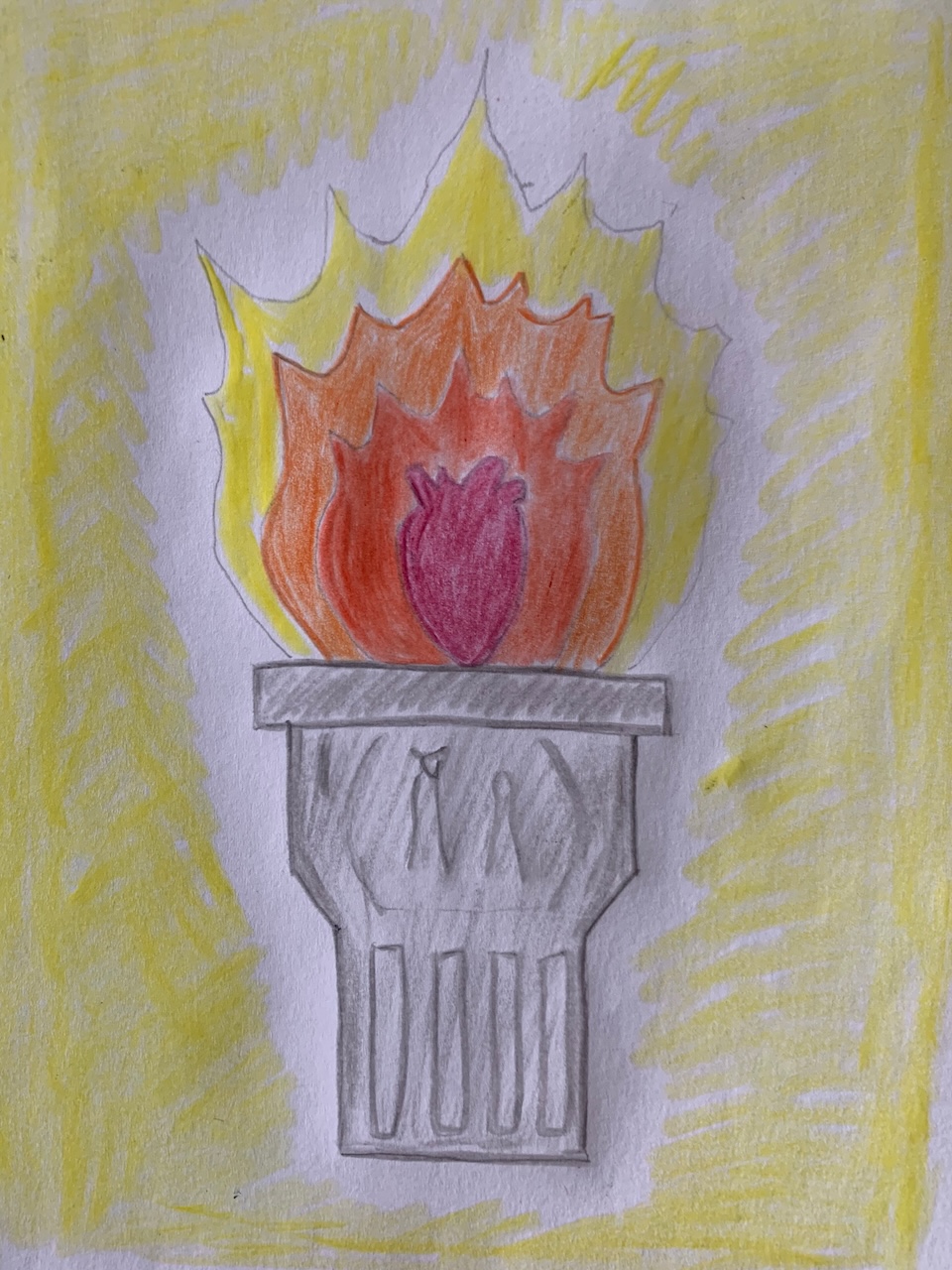
I wrote the words above a few years ago when I offered my heart to Gwyn on an altar in meditation (I’d tried once before and that time He rejected it!).
Since then my heart has been with Gwyn in the Otherworld. I first saw it again around six months ago in a shamanic journey in an icy pool thawing out.
In a meditation for Gwyn’s Feast with the Monastery of Annwn last September Gwyn returned my heart and said that the Heart of Annwn now beats in my chest as it beats in the chests of all living creatures.
When I returned to those words in my prayer book and looked at the image it was no longer my heart on the altar but Gwyn’s and I received the gnosis that if I succeed in founding a physical monastery He wants an altar to His heart.
This happened after I finished my ‘Mystics of the Sacred Heart’ series. It seems that an exchange of hearts of sorts has happened between us after all.
As a remarkable coincidence at the time of writing this series, whilst I was cleaning, I stumbled across the Bible of my grandmother on my mother’s side, Peggy Allen. My grandmother was sent away to boarding school at a Catholic convent in France when she was 12 years old. Tucked within the pages of her Bible I found two prayer cards relating to the Sacred Heart of Jesus.
The first features a prayer from Thérèse de l’Enfant Jésus called Au Sacré-Cœur with an image of the saint and Jesus showing His Sacred Heart. In England she is known as Therese of Liseux (1841 – 1884) ‘the Little Flower of Jesus’.
The other depicts Blessed Marie Deluil-Martiny (1841 – 1884) a French religious sister who was the Founder of Association of the Daughters of the Heart of Jesus. She was murdered in the convent by a gardener.
Although my grandmother was not religious when I knew her she was obviously familiar with the tradition of the Sacred Heart when growing up.
Might my draw to Gwyn’s Sacred Heart be partially based on ancestral memories?
Mary, born Maria Droste zu Vischering, (1863 – 1899) influenced Pope Leo XIII to consecrate the world to the Sacred Heart of Jesus in 1899.
She was educated at the boarding school of the Sacré-Coeur Sisters in Ridenburg, Bavaria. During a return home from school to recover from pneumonia she had a vision of Jesus who told: ‘Thou shalt be the wife of my heart.’ This led her to join the Sisters of the Good Shepherd aged 25.
For Mary devotion to the Sacred Heart of Jesus and to the Blessed Eucharist were inseparable no doubt as the blood of Christ flowed from His heart.
Whilst on mission in Porto in 1898 Mary received several messages from Jesus requesting that she contact the Pope and request the consecration of the world to His Sacred Heart. In her letter to the Pope she wrote: ‘On the eve of the Immaculate Conception, I seemed to see (interiorly) this light, the Heart of Jesus, this adorable sun, whose rays descended on the earth, first narrowly, then more widely, and finally, lighting up the whole world. I recognized the ardent desire He has to see his adorable Heart more and more glorified and known and to spread His gifts and blessings over the whole world. Our Lord… has shown me the ardent desire he has that his Heart be more and more glorified and loved for the good of the nations.’ (25)
The Pope was persuaded by the promise of a longer life at a time of illness. ‘And He has chosen Your Holiness, prolonging your days, so that you might render Him this honor, console his outraged Heart and draw on your soul the choice graces that come from this Divine Heart, this source of all graces.’ (26)
The Pope agreed to consecrate the world to the Sacred Heart of Jesus saying he expected ‘extraordinary and lasting benefits for Christendom in the first place and also for the whole human race.’ (27) Much controversy surrounded the consecration of all the world including non-Christians. Mary sadly died three days before the world was consecrated in 1899.
The devotion to the Sacred Heart only reached popularity amongst Catholics in the 17th century and this was due to the influence of Margaret Mary Alacoque (1647 – 1690).
Margaret lived in France and entered a Visitation convent at Paray-le-Monial aged 24. There Jesus appeared to her four times revealing His love of humanity through visions of His Sacred Heart. These are recorded in her diary.
I. The Flaming Heart
In her first vision she reports that she reposed ‘upon His Sacred Breast’ and ‘for the first time, He opened to me His Divine Heart.’
Jesus said: ‘My Divine Heart is so inflamed with love for men, and for you in particular that, being unable any longer to contain within Itself the flames of Its burning Charity, It must spread them abroad by your means…’
This was followed by an exchange of hearts. ‘After this, He asked me for my heart, which I begged Him to take. He did so and placed it in His own Adorable Heart, where He showed it to me as a little atom which was being consumed in this great furnace, and withdrawing it thence as a burning flame in the form of a heart, He restored it to the place whence He had taken it.’
Jesus then said: ‘My well-beloved, I give you a precious token of My love, having enclosed within your side a little spark of its glowing flames, that may serve you for a heart and consume you to the last moment of your life… I now give you that (name) of the beloved disciple of My Sacred Heart.’ (20)
I relate to the imagery of the flaming heart because a few years ago I offered my heart to Gwyn on ‘the Altar of the Heart’ and it burst into flames and He told me that its fire would light the way to the worship of His family.
II. Wearing the Heart
Margaret’s second striking vision is the source of the representation of the Sacred Heart in Catholicism today: ‘The Divine Heart was presented to me in a throne of flames, more resplendent than a sun, transparent as crystal, with this adorable wound. And it was surrounded with a crown of thorns, signifying the punctures made in it by our sins, and a cross above.’
Margaret was told: “This Heart of God must be honored under the form of His heart of flesh, whose image He wanted exposed, and also worn on me and on my heart.’ (21)
This led to Margaret wearing and creating and distributing images of the Sacred Heart which after her death were used to ward off the plague in Marseilles.
This isn’t something Gwyn has called me do… yet…
III. First Friday Devotion
Jesus appeaerd again to Margaret with His breast like a furnace. ‘Opening it, He showed me His loving and lovable Heart as the living source of those flames. Then he revealed to me all the unspeakable marvels of His pure love, and the excess of love He had conceived for men from whom He had received nothing but ingratitude and contempt.’
To make up for their ‘ingratitude’ He asked her to ‘receive Holy Communion on the First Friday of each month’ and tells her that ‘every night between Thursday and Friday I will make you partaker of that sorrow unto death which it was My will to suffer in the Garden of Olives.’ (22) This is the source of the Catholic Holy Hour between 11 and 12 midnight every Thursday.
IV. The Feast of the Heart
In her fourth vision Jesus opens His heart to Margaret again and asks her to inaugurate ‘the first Friday after the octave of Corpus Christi’ as ‘a feast in honor of My Heart.’ This usually takes place in the month of June.
I was called to start celebrating a feast for Gwyn on the 29th of September over ten years ago and began with just one friend. Many Gwyn devotees celebrate His feast on this day and we hold a group rite at the Monastery of Annwn. I feel it is the power of Gwyn’s heartbeat that has drawn us together.
V. Disciple of the Sacred Heart
More controversially, when Margaret dedicated her life to Jesus, ‘she went to her cell, bared her breast, and, imitating her illustrious and saintly foundress, cut with a knife the name of Jesus above her heart. From the blood that flowed from the wound she signed the act in these words: ‘Sister Margaret Mary, Disciple of the Divine Heart of the Adorable Jesus’. (24)
Margaret’s visionary fervor and discipleship quickly spread following her death but the devotion to the Sacred Heart was not approved until seventy years later.
Gertrude (1256 – 1302) was a Bendictine nun at the monastery of Helfta and received many of her teachings about the Sacred Heart from Mechtilde.
Like Mechtilde, Gertrude was a ‘Bride of Christ’. He bestowed upon her four graces. The first was the impression of His wounds on her heart. ‘O most merciful Lord, engrave Thy Wounds upon my heart with Thy most Precious Blood, that I may read in them both Thy grief and Thy love; and that the memory of Thy Wounds may ever remain in my inmost heart, to excite my compassion for Thy sufferings and to increase in me Thy love.’ (15) I often feel like with this with Gwyn – His stories being engraved upon my heart.
Her second grace was an arrow of light that shot from the side of Jesus and pierced her heart. ‘After I had received the Sacrament of Life, I saw a ray of light, like an arrow, dart forth from the Sacred Wound in Thy right Side, on the Crucifix . . . It advanced toward me and pierced my heart.’ (16) This resulted in a tide of affection and desire to be united with Jesus rising within her.
I haven’t had an experience like this but it puts me in mind of the ecstasy of St Teresa of Avila wherein an angel thrusts a ‘long spear of gold’ into her heart and entrails leaving her ‘all on fire with a great love of God.’ (17)
Like Lutgarde, Gertrude exchanged hearts with Jesus and this was her third grace. ‘Thou hast granted me Thy secret friendship, by opening to me the sacred ark of Thy Deified Heart in so many different ways as to be the source of all my happiness. Sometimes as a special mark of our mutual friendship, Thou didst exchange It for mine!’ (17)
Her fourth grace was the placing of the infant Jesus within her. ‘It was the anniversary of the blessed night of Our Lord’s Nativity. In spirit, I tried to fulfill the office of servant of the glorious Mother of God when I felt that a tender, new-born Infant was placed in my heart. At the same instant, I beheld my soul entirely transformed. Then I understood the meaning of these sweet words: ‘God will be all in all’ (1 Cor. 15:28).’ (18) I found this vision particuarly beautiful. Over the Twelve Days of Devotion last year I explored Gwyn’s birth and infancy and felt He was very close to my heart although not quite in it.
Jesus further disclosed His heart as a treasury, a harp, a fountain, a golden thurible and an altar. Like Mechtilde she delighted in its ‘harmonious beatings’. He offered His ‘Divine Heart’ to her as an instrument to ‘charm the eye and ear of Divinity’ and said of all those who had asked Gertrude to pray for them, ‘they may draw forth all they need from my Divine Heart.’ (19).
This imagery is similar to Mechtilde’s and relates to my own delight in the beat of Gwyn’s heart and to the joy and inspiration that I draw from it.
REFERENCES
(15) Anonymous, St. Gertrude the Great: Herald of Divine Love, TAN Books, Kindle Edition (16) Ibid. (17) https://en.wikipedia.org/wiki/Ecstasy_of_Saint_Teresa (18) Anonymous, St. Gertrude the Great: Herald of Divine Love, TAN Books, Kindle Edition (19) Ibid. (20) Ibid.
Mechthilde (1240 – 1298) was born into the wealthy Hackeborn family and entered the Benedictine convent of Helfa in Saxony at the age of seventeen.
She had numerous visions of the Sacred Heart of Jesus, spoken of in The Book of Special Grace, which she compiled after a spiritual crisis aged 50.
I. The Mighty Beating of His Heart
Mechtilde shares a vision in which she rests against Christ’s bosom, listening ‘with attentive ear to the ceaseless and mighty beatings of His own sweet Heart’. Through these ‘beatings’ He sounds ‘invitations’: ‘Come… my love, and receive all that the Beloved can give to His beloved; come. My sister, and possess the inheritance of heaven, which I have bought for thee with My precious Blood; come, My spouse, and enjoy My Godhead.” (5)
This resonated with me deeply for listening to the sound of Gwyn’s Heart, the Heart of Annwn, mighty, awe-inspiring, deafening sometimes, is one of my core practices. I’ve experienced the Heart calling me, inviting me and other monastic devotees to come to Him and worship Him in the Monastery of Annwn. ‘Hear the heart, the heart of Annwn, / hear the heart oh monk and nun / Hear the heart, the heart of Annwn, / “To the monastery we come.”
II. Eternal Praise
On other occasions Mechtilde lays her mouth on the Divine Heart of Jesus and gains sustenance. ‘Drop by drop’ she is gifted verses to offer to His Mother. (6) She also draws from His heart a ‘sweet fruit’ which she places in her mouth signifying ‘eternal praise’ which ‘floweth forth from Him’. (7)
The praise of God is shown to her in another vision as ‘a tube, as it were, coming out of the Heart of God, to her own heart, and then winding back again from her own heart to that of God, by which was signified the praise of God.’ (8) This is later expanded upon. ‘Then straightway she saw tubes, as it were, going forth from the hearts of the angels to the Heart of God, and they made such sweet melody that no man can utter it’. (9)
In another vision Jesus shows reveals His heart as a lamp ‘overflowing’ with large drops of light yet not ‘anywise lessened’. It overflows ‘by little strings of lamps; some of which seemed to stand upright, and to be full of oil, while others were empty, and hung upside down.’ Mechtilde understands ‘by lamps that burnt upright were signified the hearts of those who were present at Mass with devotion and longing desires, while by the lamps that hung down were signified the hearts of those who refused to be raised up by devotion.’ (10)
These remarkable visions show how the praise of God / Jesus, flows from His Sacred Heart to the angels and is gifted to His most ardent devotees. This puts me in mind of the gift of awen ‘inspiration’ to awenyddion in the Brythonic tradition, which flows from the cauldron into the cauldrons of those who praise the Gods. Gwyn owns ‘the Cauldron of Pen Annwn’ and is ‘my patron, inspiration and truth’ and my awen from Him also feels like a gift from His heart.
In The Triads of the Island of Britain we find 90. ‘The Three Perpetual Harmonies of the Island of Britain: One was at the Island of Afallach, and the second at Caer Garadawg, and the third at Bangor. In each of these three places were 2,400 religious men; and of these 100 in turn continued each hour of the twenty-four hours of the day and night in prayer and service to God, ceaselessly and without rest forever.’ (11)
It is notable that one of these ‘Perpetual Harmonies’ was ‘at the Island of Afallach.’ Afallach, from afal, ‘apple’ is another name of Gwyn’s. This makes me wonder if an earlier tradition of eternal praise for Gwyn once existed. Whether that was the case or not I long found a monastery wherein the beat of Gwyn’s heart is played and His praises sung day and night.
III. The Fortress of the Heart
In an astonishing vision Jesus takes Mechtilde into His heart and shuts her in. He shows her the upper part is ‘the sweetness of the spirit of God’ and the lower part ‘the treasury of all good’. In the south is the ‘eternal paradise of all riches’. In the west is ‘eternal peace and joy without end’. In the north is ‘eternal security’. (Jesus does not mention what lies in the east). (12) His heart is elsewhere described as ‘a fair house’ and ‘a house of miraculous beauty’. (13)
This reminds me a little of the depictions of Gwyn’s fortress as filled with fair people and revelry. For me Gwyn’s hall is the heart of the kingdom of Annwn His heart, the Heart of Annwn, beats in its midst. I wonder if there was a mystical tradition wherein His fortress was seen to be the interior of His heart.
When Mechtilde asks how to cleanse her heart Jesus replies: ‘In the love of My divine Heart I will wash thee’ and shows her a ‘river of love’ filled with golden fish. (14)
Here I’m reminded of the sparkling rivers of mead and wine in Annwn and of a personal vision I had of rivers of blood, like veins, pouring from Gwyn’s heart and connecting with the hearts of all beings in Annwn and in Thisworld.
IV. Greet My Heart
Jesus appeared to Mechthilde and said the following: ‘In the morning let your first act be to greet My Heart and to offer Me your own. Whoever breathes a sigh toward Me, draws Me to himself.’ (15)
I found this profoundly beautiful. Every morning Gwyn’s name is the thing I say in my morning prayers and I could imagine incorporating a greeting of His heart and an offering of my heart to Him into my devotions.
There is much modern polytheists could learn from this remarkable saint about the nature of visionary experience and devotion.
Lutgarde (1182 – 1246) was born in Tongres, Belgium, and entered the Benedictine convent at Saint Trond aged twelve. During this period a potential suitor visited her and during one of these visits Jesus appeared to her revealing his spear wound and telling her: ‘Seek no more pleasure of this affection… here in this wound I promise you the most pure of joys.’ Lutgarde denounced her suitor saying: ‘Go away from me for I belong to another Lover.’ (3)
Afterwards Lutgarde was blessed with a number of graces including levitation, healing, a miraculous understanding of Latin and illumination about the meaning of the Psalms but none of these made her happy.
This led to her exchange of hearts with Jesus:
‘Jesus asked her: “What… do you want?”
“Lord… I want Thy Heart.”
“You want My Heart? Well, I too want your heart.”
“Take it, dear Lord. But take it in such a way that the love of Your Heart may be so mingled and united with my own heart that I may possess my heart in Thee, and that it may always remain there secure in Your protection.”’ (4)
Lutgarde was elected as superior of the convent at the age of twenty-three but left to join the Cistercian convent (known as Trappists) at Aywieres.
Although I haven’t directly exchanged hearts with Gwyn attaining a union of my breath with His breath and my heart with His has long been a part of my practice.
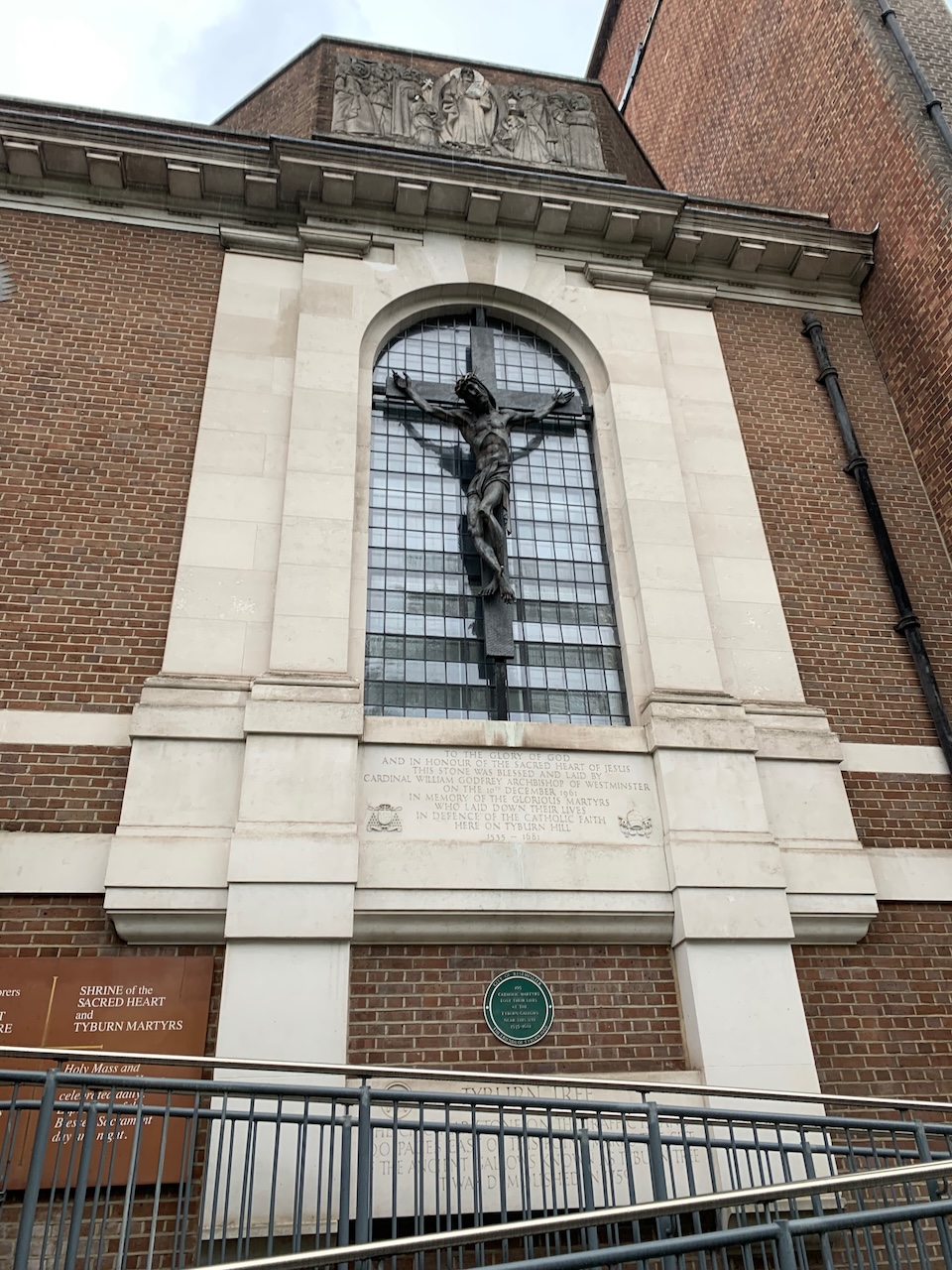
Through my recent visit to London and to the Tyburn Convent I found out about the Roman Catholic devotion to the Most Sacred Heart of Jesus. I have since been reading further on the subject and have been astonised by the parallels between my gnosis of Gwyn’s heart as the Heart of Annwn and the experiences of the Christian mystics of the sacred heart.
In this series I will be sharing the story of the origins of the devotion to the Sacred Heart and discussing how the visions of these mystics relate to my experiences.
*
The devotion to the Sacred Heart originated from the devotion to the Sacred Wounds of Jesus. There were five in total. The first four were the wounds to His hands and feet from the nails when He was crucified. The fifth was the wound in His side from the Spear of Longinus by which He was pierced to ensure He was dead. From this wound poured blood and sweat.
Associations between the Sacred Wounds and the Sacred Heart began in the Benedictine and Cistercian monasteries in the 11th – 12th centuries. In Sermon 61 St Bernard of Clairvaux (1090 – 1153) speaks of ‘the soul of the martyr’ being ‘safe’ ‘in the heart of Jesus whose wounds were opened to let it in’. (1)
In the 13th century, in ‘With You is the Source of Life’, St Bonaventure (1221 – 1274) wrote: ‘“They shall look on him whom they pierced”. The blood and water, which poured out at that moment, were the price of our salvation. Flowing from the secret abyss of our Lord’s heart as from a fountain, this stream gave the sacraments of the Church the power to confer the life of grace, while for those already living in Christ it became a spring of living water welling up to life everlasting.’ (2)
The last of Christ’s lifeblood was seen as pouring as an offfering from His heart. This resonates with my vision Gwyn showed me of His death, pierced by a spear, in raven form, hanging upside down on a yew over the Abyss in a sacrifice in which He gave every last drop of His blood to ‘set the world to rights’ following the devastation wrecked by his battling with His rival, Lleu / Gwythyr.
In a follow-up story I wrote Mabon won a cup containing Gwyn’s blood from the Abyss and used it to heal Nudd, Gwyn’s father, ‘the Fisher King’. It is interesting to note that abyss imagery occurs in the writings of Bonaventure.
It seems no coincidence that in a later legend the blood and sweat of Jesus was taken in the Holy Grail by Joseph of Arimathea to Britain and buried near Glastonbury Tor – a site sacred to Gwyn. When Joseph rested wearily on his staff the Glastonbury Thorn sprung up giving name to Wearyall Hill.
In my visions when Gwyn is killed by His rival on Calan Mai the hawthorns blossom from His blood. Could the Christian legend be based on an earlier myth wherein a cup containing the blood from Gwyn’s Sacred Heart was buried?
I didn’t go to Tyburn to ‘go to Tyburn’. (1) I went to London to attend an introductory weekend as a prerequisite to a three year shamanic healing course. But I ended up staying in a hotel in Tyburn as it was relatively cheap. When I visit a place I like to do a bit of historical research before I go and have a map of the land past and present to help me connect with the spirits and this what I found out.
The Tyburn Tree
The dark but now absent centre of this place is the infamous Tyburn tree. It was the King’s Gallows from 1196 to 1783. It has also been known as the Elms, the Deadly Never Green Tyburn Tree and the Triple Tree (because it was a wooden triangle on three legs – a ‘three legged mare’ or ‘three legged stool’). The triangular traffic island where it once stood mirrors its structure.
All manner of criminals were executed there by being hanged, drawn, then quartered. Many of the victims were religious people of the Catholic faith – friars, priors, abbots, monks and hermits, who resisted King Henry VIII’s separation of the Church of England from legal ties to the Catholic Church and papal authority of Rome and the dissolution of the monasteries.
The Carthusian Martyrs, 18 monastics of the Carthusian Order from the London Charterhouse, were executed between 1535 and 1537. As a result of the Lincolnshire Rising, the Pilgrimage of Grace and Bigod’s Rebellion over 250 rebels met their deaths again including large numbers of monastics. Many were northerners, such as the bowbearer of the Forest of Bowland, and people from my home county, Lancashire, joined the rebellions.
This had meaning for me as a polytheistic monastic because these Catholics were standing for the freedom to practice their religion and to continue to lead monastic lives. The anglicisation of the church and dissolution of the monasteries removed much of the mysticism and sanctity from Christianity in England.
Tyburn Convent
In 1901 the Tyburn Convent was established near the site of the Tyburn Tree with a shrine to the Tyburn Martyrs. This order of Benedictine nuns was founded by Mother Marie Adèle Garnier as the Adorers of the Sacred Heart of Jesus of Montmartre in Paris in 1898. When the nuns were forced to leave due to restrictions on monasteries in France they made their home in London.
What is unique and beautiful about their tradition is their perpetual adoration of the Sacred Heart of Jesus. What this entails is that, at all times, day and night, at least one nun is kneeling before the eucharist worshipping Jesus’s heart.
Mother Marie is ‘honoured and remembered’ for her ‘ardent love of Christ’, ‘her heroic love of God and neighbour, her spirit of prayer, divine contemplation, rich mystical and spiritual doctrine, humility, obedience, patience, simplicity and purity of heart, and above all for her spirit of total self-abandon to the Holy Will of God, which she declared to be her unique good.’ (2)
This is one of her prayers –
‘O blessed portion! Lot worthy of envy! My heart is ready, O Lord, my heart is ready! Here I am, speak, act, inflame me, unite me to Yourself!
O Mary, O my tender Mother entrust me to Jesus, love hidden in the adorable Eucharist. Henceforth make my life become a repeating with you: I look for nothing other than Him… I know only Him alone…
Jesus, my soul is thirsting for You so unite it to Your Heart that no longer may I be able to live without You.’ (3)
When the nuns make their act of consecration they speak a prayer that has been spoken in their communities since Pope Leo XIII consecrated the world to the Sacred Heart of Jesus on the 11th of June 1899.
‘Lord Jesus, Redeemer of the human race, look down upon us humbly prostrate before Your altar. Yours we are, and Yours we wish to be; but to be more surely united with You, behold we freely consecrate ourselves today to Your Most Sacred Heart. Many, indeed, have never known You; many, too, despising your precepts, have rejected You. Have mercy on them all, most merciful Jesus, and draw them to Your Sacred Heart…’ (4)
The Sacred Heart and Healing
I had never come across the perpetual adoration of the Sacred Heart of Jesus before. It resonated deeply with me because over the past few years my patron God, Gwyn ap Nudd, has revealed His heart to be the Heart of Annwn, which He inherited from His mother, Anrhuna, the Mother of Annwn.
My personal practice has increasingly involved devotion to the Heart of Annwn. Keeping the heart beat by drumming and chanting. Meditating, journeying on and recording the stories gifted to me about Gwyn’s Sacred Heart.
Before I set off to London I was instructed by my guides to make a pilgrimage walk to the Tyburn Tree and the Tyburn Convent. I was told I must take ‘purity, grace and the pain of the dead’ in a small obsidian spearhead I was gifted by a fellow nun of Annwn and leave it as an offering.
I did this on the first day in the early evening after I left the course. I was disappointed to find the stone and three young oak trees put there in 2014 to mark the site of the Tyburn tree had been removed. I can only guess this was done because people were hanging about the site or leaving offerings. In spite of the rush of traffic and people I paused and spoke some prayers then made my offering at the foot of the London Plane tree on the island.
I went to the Tyburn Convent and paused to pay my respects to the Tyburn Martyrs and shared my gratitude for the work of the nuns and gained a sense of release and peace and of our unity in the adoration of the Sacred Heart.
When I got back to my hotel room, although I didn’t have my drum, I played the beat of the Heart of Annwn on my knee, sung one of my chants, again imagining my offering of song as uniting with the devotion of the Tyburn Nuns.
My weekend course, The Shaman’s Pathway, with Simon Buxton of the Sacred Trust, was profoundly moving and deeply healing. Whilst the first day was more introductory on the second day we practiced ecstatic union with our spirits, healing each other, and the culimination was a powerful group healing ceremony in which I was honoured to take the role of drummer.
In the following of my heart, in alignment with Gwyn’s heart, the Heart of Annwn, I feel healing has taken place and I have received confirmation I’m on the right path in pursuing the three year training to become a shamanic healer.



 The Sanctuary of Vindos