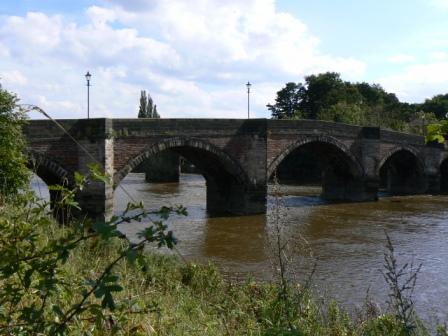
Belisama is the goddess of the river Ribble, which runs from Ribble Head in North Yorkshire, through Ribblesdale, Central Lancashire and out to the Irish Sea. Her name is known from Ptolemy’s Geography 2AD, where at co-ordinates corresponding to the Ribble’s estuary he places ‘Belisama aest[1]’. Inscriptions to Belisama have also been found in Vaison-la-Romaine in Provence and Saint-Lizier, in the Pyrenees[2].
Her name has received a number of interpretations. Nick Ford translates ‘Rigabelisama (Riga-, a queen, and Belisama)’ as ‘Most Shining One’ making her the ‘Most Shining Queen’ or ‘Most Mighty Queen’[3]. Seeing the dazzling beauty of the Ribble illumined by sunlight or moonlight confirms the legitimacy of this epithet to me. However Delamarre claims the translation of bhel as ‘white or brilliant’ is based on a false interpretation of Belinus’ identification with Apollo. Belinus is ‘the Powerful One’ and Belisama is the ‘Most Powerful One’[4]. Watching the Ribble after heavy rain, particularly at high tide conveys a sense of her power, as does observing the landscapes she has shaped.
The town of Ribchester has a close connection with the Ribble. It’s native name Bremetonacon means ‘place by the roaring river[5].’ In Saint-Lizier Belisama is identified with the Roman goddess Minerva. A bust of Minerva was found at Ribchester and it was once largely accepted the town had a temple to Minerva-Belisama[6]. Whilst it would make sense that a place of worship dedicated to Belisama was located in the heart of the Ribble Valley beside the roaring ford this is based on a mistranslated inscription[7]. To whom the temple was dedicated is unknown. As a large part has been washed away by the Ribble it might be assumed either that it didn’t belong to Belisama or she didn’t want one.
A question I’ve pondered is how much to read into Belisama’s possible identification with Minerva at Ribchester- when the Romans built the fort in 70AD they were polytheists, and their experiences of Belisama may have led to this equation. Minerva is a goddess of wisdom, crafts and healing. From the Norman period (and indubitably before), until the end of the 18th century the Ribble was renown for being rich in salmon, the quintessential fish of wisdom, with the most important of the fish garths being located at Fish House Bridge in Penwortham[8]. Another possible reason for this identification is that wisdom can be gained from watching and listening to the flow of the Ribble in different spots. One of the lessons I’ve learnt from Belisama is dynamism and change; due to a combination of the tides, rain fall and the position of the sun or moon her waters never look the same in any place.
In terms of crafts, Belisama has inspired a good deal of creative writing from the poems of Richard Dugdale (the Bard of Ribblesdale 1849), James Flockhart’s ‘The River’ (1854), Gerard Manley Hopkins’ ‘Ribblesdale’ (1876) and John Heath-Stubb’s ‘The Green Man’s Last will and Testament’ – ‘the cruel nymphs / Of the northern streams, Peg Towler of the Tees / And Jenny Greenteeth of the Ribble, / Sisters of Belisama, the very fair one’ (1973)[9]. Jane Brunning, a Penwortham based author blogging as Reigh Belisama runs a site called ‘Save the Ribble,’ which played a leading role in preventing the river barrage at Brockholes and continues to oppose fracking on the Ribble Estuary[10].
Belisama’s influence on the cotton industry can be recalled by the number of old mills on her tributaries. Without Riversway Dockland, which was created by moving the Ribble from Strand Road to her present course beside Castle Hill, Preston could not have played its huge role in the industrial revolution. Whilst I’m unaware of any associations linking Belisama with physical healing, spending time beside the Ribble usually has a calming, cleansing effect on me.
Moving from Belisama to the Ribble, the first mention of the change of name is in ‘the Latin Life of St Wilfrid’ (patron saint of Preston) where ‘lands identified as ‘round Ribble’ (iuxta Rippel), Yeadon, Dent and Catlow’ are granted by the English ruler to ‘the community at Ripon’[11]. The Saxon Ripel was taken by Ekwall to mean ‘tearing, reaping’ making the Ribble ‘the tearing one’[12] relating Belisama’s qualities of power and might. Andrew Breeze suggests that Ribble may derive from the Welsh rhybwyll, which combined with the prefix ri could mean very great wisdom[13]. The name change and it’s interpretations demonstrate the qualities of flux and continuity innate to Belisama.
For me in present day Penwortham, (which without Belisama, in its current form would not exist), Belisama and her tributaries continue to shape the valleys and plains, as well as the lives of the wildlife and people who inhabit them. Belisama’s power and wisdom shine throughout her ever changing course and in those by which it is transmitted, whether by the spoken or written word, craftsmanship, or in the actions of those who stand against her exploitation and pollution.
[1] http://www.roman-britain.org/ptolemys-geography.htm
[2] Whilst this might be seen to indicate the presence of a goddess worshipped across Britain and Gaul, Nick Ford reminds us ‘most, if not all, the names of Celtic divinities seem to be descriptive epithets rather than real names.’ Nick Ford ‘Ribchester (Bremetenacum Veteranorum): Place of the Roaring Water’ Lancashire’s Sacred Landscape, ed. Linda Sever, 2010, p82.
[3] Ibid.
[4] http://theses.univ-lyon2.fr/documents/getpart.php?id=lyon2.2009.beck_n&part=159190
[5] Nick Ford ‘Ribchester (Bremetenacum Veteranorum): Place of the Roaring Water,’ Lancashire’s Sacred Landscape, ed. Linda Sever, The History Press, 2010, p82
[6] Malcolm Greenhalgh, Ribble River and Valley: A Local and Natural History, Carnegie Book Production, 2009, p83.
[7] ‘commander of the unit and region’ was mistranslated as ‘to the very mighty numen and queen’ Nick Ford ‘Ribchester (Bremetenacum Veteranorum): Place of the Roaring Water,’ Lancashire’s Sacred Landscape, ed. Linda Sever, The History Press, 2010, p82
[8] Alan Crosby, Penwortham in the Past, Carnegie Press, 1988, p48
[9] John Heath-Stubbs ‘The Green Man’s Last Will and Testament,’ Earth Shattering: Eco-Poems, ed. Neil Astley, Bloodaxe Books, 2007.
[10] http://save-the-ribble.blogspot.co.uk/
[11] Andrew Breeze, ‘Communications Yrechwydd and the River Ribble,’ Northern History, XLVII; 2, September 2010, p324.
[12] Ibid. p324
[13] Ibid. p326.


 The Sanctuary of Vindos