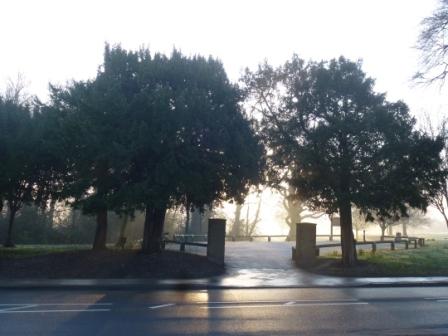
The River Syke

Syke StreetOn a rainy day in the not so-distant future, Tom, a tour-guide in training, decided to visit the city of Preston.

Great intrigue surrounded the town of priests, which had once been the Catholic capital of Lancashire. Every spire and street name told a story, from the cathedral of St Walburge to Friargate, to the catacombs beneath St Peter’s. Each had its relics and dealt in a great number of copies to tempt the less discerning tourist.

However, Tom was not interested in the rise and decline of Christianity. Neither did he care for the oral tales passed on by the city’s people such as the headless black dog that haunted Maudlands, the wicked fairy on the market with his tricksy ointment, or the Bannister Doll.

Tom had been led to Preston by a new myth about the underground river Syke.

This watercourse had run from present day Syke Street, through Winckley Square, parallel with Fishergate then into the Ribble at the New Bridge. At one point there had been fish garths across the Ribble and a boatyard where the two rivers met. In 1812, as industrialisation progressed, the Syke was culverted beneath the town. It had not seen daylight since.

250 years later, as part of a desperate money-making bid, the tourist board decided to open its underground passageway to the public. Above the grate covering the Syke’s mouth they erected a ticket booth, then a flight of stairs leading down to a platform. Over the entrance was placed a flashing neon sign- Enter the mouth of Annwn- the Ancient British Otherworld.

Caroline, Tom’s girlfriend, had been obsessed by stories about Annwn. “It is a beautiful, terrible world,” she had used to tell him, “peopled with fairies and monsters. There are thin places where you can slip over. It is possible to find your ancestors, and the lost ones you once loved. It’s possible to escape again, if you do not fall prey to its seductions.”

Several days ago, Caroline had left on a trip to Preston and had not returned. She was not the only one. Another three people had been reported missing, mysteriously disappearing on the boat ride back to the entrance. These stories were connected with rumours of people hearing strange songs and experiencing visions of ships and fishermen, huge fish, and women with fishtails.

If it hadn’t been for Caroline’s absence, Tom would have thought this was all propaganda. However, his strongest suspicion was these tall tales were a cover for poor management. A fact left untold was that the Ribble is tidal. Should the attraction remain open as the tides washed in, the entrance to the Syke would be blocked and its passageway flooded. Tom suspected these poor souls had drowned, and he was terrified Caroline might have met the same fate.

After paying his admission, Tom entered a sheltered area where he joined two families, three couples and a group of teenage girls who were talking and laughing.

“We need to look out for ghostly fishermen.”

“Mermaids.”

“Mermen, more like.”

“It’s some kind of creature with slimy tentacles that will drag you down through the water and into the Otherworld.”

Once the preceding group had exited they were ushered down to the platform. Standing beside the Ribble’s churning grey, Tom recalled Caroline telling him how every river had its goddess and each stream its nymph. The name of the Ribble’s goddess was Belisama and it was believed she claimed a life every seven years.

“Is everybody ready to enter the mouth of Annwn?” asked the tour guide, an aging man dressed in a wax jacket and waders. His long greying hair hung damp from beneath a fisherman’s hat.

To cries of affirmation he pressed a button, which rolled back the grate. The passageway was illumined by intermittent white lights, which cast an occasional silver sheen on the dark water. One by one they entered the tunnel, walking in a single line, on the river’s left. Enthralled by its impenetrable flow, Tom could not help himself imagining Caroline trapped beneath those waters drowning amongst terrible aquatic creatures who had not seen sunlight for 250 years.

The girls in front of Tom jostled and giggled. “I can see a fish!” “I think it was a mermaid!” As their conjectures became wilder their voices grew more high pitched.

The weight of the walls pressed in and the river’s roaring voice and echo rose to an unsteadying crescendo. By the time they reached the boat, Tom was trembling and disoriented. As he crossed the gangplank onto Syke’s Trawler, it took all his effort to hold his balance. Looking beneath he glimpsed something silver, dark and serpentine, then in a flash of dread saw Caroline’s sunken face staring up at him. The tunnel spun around him.

The next thing he knew, Tom was assailed by the scent of wax and brine. The tour guide was lowering him onto a wooden bench, fastening his seat belt and placing his hands firmly on the rail. “Hold on tight. Keep your eyes well shut and be careful not to listen. You do not want to fall prey to the lures of Annwn.” There was a mocking, knowing look in his grey eyes

He cast off and took the wheel with such exuberance and expertise Tom realised he must have been a true fisherman in his time.

The boat pitched down river. The teenagers screamed.

“Sy-ke!” “Sy-ke!” Tom was almost deafened by the river repeating its name. “Sy-ke!” “Sy-ke!” Or could it be the voice of its goddess?

The limitations of the tunnel shattered to reveal bright sky and a flashing landscape, the grey shapes of yachts and fishermen.

“There are places where you can slip over,” Caroline’s words filled Tom’s mind.

He held tightly to the rail, imagining himself as Odysseus lashed to the mast.

“It is possible to find your loved ones.”

Tom realised Caroline’s voice was not in his mind. She stood on the adjacent vessel beside an older fisherman who shared her dark features. Tom guessed he was her grandfather.

“Caroline!” Tom cried.

“Tom, how I’ve missed you, I knew you would come to find me!” Caroline rushed to the edge of her boat.

“I’ve been worried sick about you,” said Tom. “What happened?”

“Come and join us,” said Caroline. As her boat drifted closer she held out her hand.

Unable to stop himself, Tom let go of the rail and unfastened his seatbelt. Leaning between the swaying boats he took Caroline’s hand and scrambled over. After all those long months they were together again, embracing and kissing. In her arms the rocking deck, perilous river and distinction between the worlds no longer mattered.

A horn blared from Syke’s Trawler.

Caroline pushed Tom away. “The tides are coming in.” The colour left her face and her skin became cold to his touch. With the sweep of a long black and silver fishtail she dove into the water. Tom noticed her grandfather had already disappeared. The boat shuddered beneath his feet then, with a dismal groan, plank by plank began to break apart.

With a thunk something round and orange struck his chest. It was a rubber ring, attached to a rope, attached to the trawler.

“Get in and keep hold,” the tour guide’s voice bellowed, “if you want to return to Preston, that is.”

Struggling against panic, Tom managed to pull the rubber ring on as the deck gave way beneath him and a wave crashed over his head. The cold water stunned him. He struggled and gasped for breath, thrown this way and that between the incoming tide and the river’s force. Hauled back onto the trawler by the tour guide he coughed up salt water before descending into uncontrollable sobs.

By the time his tears had ended, the boat was safely moored on the Ribble’s bank and the rest of the group had gone.

“You love her, but you don’t want to die for her?” the tour guide’s voice was soft in Tom’s ear. His nostrils filled with his briny scent. “I know how you feel, and I may be able to help.”

Tom looked up hopefully, “how?” he rasped.

“It is possible to walk, or sail, between the worlds,” said the old fisherman. “Why don’t you join me, as my trainee, at the helm of Syke’s Trawler? You can learn to serve our goddess. We’re desperately short of tour guides.”

Mouth of the River Syke

Gwyn Portrait, April’s End

The huntsman has ridden all night, following the brilliance of the spirit roads- the shining tracks that criss-cross the island of Britain. Instead of returning home he remains here for dawn, listening to the idiosyncrasies of each bird’s song, watching dew form on blades of grass, on petals of hawthorn blossoms and may flowers.

He is and is not the mist, riding through damp meadows over hills, mountains and moors on a pale horse accompanied by a hound of the same complexion. He is and is not each sun-lit cloud he travels with, the touch and whisper of the wind.

He cannot stay here long, for this world we see as the land of the living is not his. He must return home to Annwn, the Otherworld, to prepare for a battle that cannot be won. To fight for a maiden he shouldn’t have loved, shouldn’t still love… in bluebells and forget-me-nots, emerging greens and white and yellow flowers he sees her colours.

For a moment he is possessed by memories of their passion, and the crimes it drove him to. A glimpse of his blacked face in a reed strewn pool shows no amount of war paint can mask his guilt, which he must live with for as long as there are people to sing his songs.

He searches for a sign. What is Judgement Day? When is it? Although he knows the language of the trees and plants, the tracks of every wild creature and the flight of birds, these questions are beyond his power to divine. When the worlds end, will Creiddylad and I be together again?

May Flower, Penwortham

Black Dog

He lies beneath my bed
and skrikes through the night,
plummeting the suburb into blackness.

Dampening floodlit windows,
putting out the streetlights,
he licks my hand when I am lonely.

When I fear I cannot live he takes me
to the otherside where we enter
the secret commonwealth of Middleforth

padding along the causey past the windmill’s
constant throb, cows with swaying udders
and hens clucking in the tithe barn.

Yet on communal ground
we are still invisible outcasts
with insatiable hunger and baleful breath.

Bound here by an obscure debt we pace the causey,
sniffing for dog-bones buried by the wayside
in a ritual that once had meaning on a lightless night.

Middleforth BrowMiddleforth Green, Spring Mist 007 - CopyMiddleforth Green

Gwyn’s Apprenticeship and the Role of the Awenydd

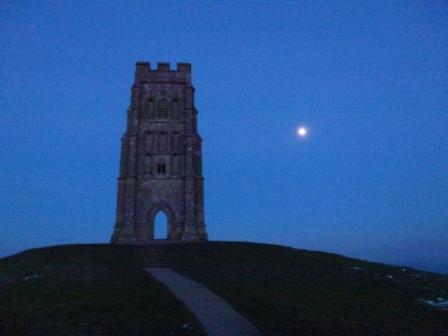
Moon over Castle HillAfter two years studying Druidry (and many years prior to this of searching) on the morning of the winter solstice I received a name for my spiritual path- Awenydd. It was a gift, bestowed by Gwyn ap Nudd (1) and the spirits of my local landscape.

Over the past year my path has grown to centre on my apprenticeship to Gwyn, which began when I made a vow to him as my patron at Glastonbury’s White Spring last January. This role has involved learning more deeply the life cycles of the trees, plants and wildlife of my local area, journeying to meet their spirits and travelling into the land’s past to learn its history. With Gwyn’s guidance I have journeyed the Otherworld, gaining direct experience of realms such as Annwn and Faery, met their inhabitants and borne witness to mythic events.

In exchange I have strived to share this magic through poetry with the aim of revealing my local landscape as inspirited and communicating my vision of the Otherworld. I believe this serves Gwyn for it his task as a king of the Otherworld and leader of the Wild Hunt to maintain the dynamic between the worlds lest this one be destroyed (2). Being gifted with the role of the Awenydd seems to be a natural development of this relationship.

An early description of the Awenyddion can be found in Giraldus Cambrensis’ 12th century manuscript, Description of Wales.

‘There are certain persons in Cambria, whom you will find nowhere else, called Awenyddion, or people inspired; when consulted upon any doubtful event, they roar out violently, are rendered beside themselves, and become, as it were, possessed by a spirit. They do not deliver the answer to what is required in a connected manner; but the person who skilfully observes them, will find, after many preambles, and many nugatory and incoherent, though ornamented speeches, the desired explanation conveyed in some turn of a word: they are then roused from their ecstasy, as from a deep sleep, and, as it were, by violence compelled to return to their proper senses. After having answered the questions, they do not recover till violently shaken by other people; nor can they remember the replies they have given. If consulted a second or third time upon the same point, they will make use of expressions totally different; perhaps they speak by the means of fanatic and ignorant spirits. These gifts are usually conferred upon them in dreams: some seem to have sweet milk or honey poured on their lips; others fancy that a written schedule is applied to their mouths and on awaking they publicly declare that they have received this gift.’ (3)

When I first read this passage a couple of years back I found little I could relate to. Returning to consider it now I find the ideas more resonant.

A phrase which immediately stands out is that the Awenyddion are people inspired. Within the Bardic Tradition I have found the predominance of structured courses of training and people’s preconceptions about the role of the Bard problematic. Experience has taught me I cannot learn stories or poems by rote. Myths and the deities within them have a life of their own, calling through Bardic, folkloric and contemporary texts, or revealing themselves in the landscapes of either world to impart the gifts of inspiration and transformation when the time is right.

Following a conversation with a visiting speaker at my local pagan society, who when I named my path as “Druid Bard” assumed I was of the ‘Bardic Grade’ and completing a ‘gwers’ within OBOD I began to question (and not for the first time) whether this name was a true fit with my spirituality.

During this period I asked Gwyn how my apprenticeship related to Druidry. He told me my role is bound up with the primal Awen, which flows before thought through all things. This supported my suspicion that true inspiration can only speak when systems, concepts and fear of other people’s opinions are set aside. Only by listening directly to the Awen and my own intuition could I become a person inspired and create works worthy of sharing with others.

Another point of resonance is that inspiration is a gift from the spirits, through possession, dreams, milk or honey or a ‘written schedule.’

I’ve never been possessed in the sense of losing my senses and being unable to recall what happened afterward. However I have channelled the voices of spirits and deities whilst writing poetry. During a writing trance visions have appeared where they have revealed themselves in new ways and I’ve recognised their guiding hand even when making finishing touches, in the gift of a completing image or right feeling of a word.

I’ve also been gifted with inspiration in dreams. One of my most significant dreams was when I learnt the identity of my white totem mare. She appeared to me winged and I joined consciousness with her to fly to the top of Castle Hill, a local sacred site. Another important dream occurred the night before my birthday. After seeing a moon bridge in the river Ribble I dreamt of questioning a series of gnarled fay in a cave in Castle Hill. When I realised the process was futile Gwyn appeared and inquired why I hadn’t asked him. By this time I had forgotten the question. The dream conveyed a powerful message about the ethos of questioning in the realms of Faery and dream.

The mention of milk or honey puts me in mind of mead, which in my experience certainly inspires connection with the spirits, writing processes, performances and rituals. The image of the ‘written schedule’ touching an Awenydd’s lips seems to symbolize direct inspiration through the written word.

In the modern world the role of the Awenydd is not limited to ecstatic prophets. Kristoffer Hughes places ‘becoming Awenydd’ – ‘becoming the inspirer’ at the core of Druidry. He says ‘they were the enlightened ones, those who serve, those who inspire to bring others into the mystery of spirit and the great song… by inspiration.’ (4)

Elen Sentier is an ‘awenydd, a spirit keeper and taleweaver from a long family lineage.’ She describes this path as ‘British native shamanism.’ (5) Alongside her reindeer goddess, Elen of the Ways she works with Gwyn as ‘the goddess’ guardian.’ Part of her work involves tracing Elen’s Deer Trods which are also the ‘energy roads’ down which Gwyn leads the Wild Hunt. Many of these are ‘spirit paths’ taking souls to the Otherworld (6) and correspond with corpse roads such as Church Avenue on Castle Hill.

For me the name Awenydd has a magic born of its direct connection with the spiritual source which flows through the land defying all systems and can only be spoken in poetry. My role as an Awenydd is one that I only have intimations of at present- small clues to the potential of learning with the leader of the wild chase and king of the Otherworld to travel the spirit paths and experience the mysteries of the primal Awen in order to return as the inspirer.

(1) Gwyn ap Nudd is a Brythonic deity. His name means White Son of Mist. He is a king of the Otherworld, leader of the wild hunt and guide of souls.
(2) Evidence of this role is found in The Mabinogion, ‘Twrch Trwyth will not be hunted until Gwyn son of Nudd is found- God has put the spirit of the demons of Annwfn in him, lest the world be destroyed. He will not be spared from there.’ Sioned Davies, ‘How Culhwch won Olwen,’ The Mabinogion, (2007), p199
(3) http://www.gutenberg.org/cache/epub/1092/pg1092.html
(4) Kristoffer Hughes, Natural Druidry, (2007), p67
(5) Elen Sentier, Elen of the Ways, (2013), pvii
(6) Ibid. p26-28

Honouring Gwyn ap Nudd

Glastonbury Tor, January 2013On the Winter Solstice a post for Winter’s King.

Samhain has passed. We’re in the dead season. The wild hunt rides the passageways of time and spirit paths lie open. Communities gather and ancestors draw close. Here I feel called to honour Gwyn ap Nudd by telling the story of how he became my muse and patron and made my life whole.

My first meeting with Gwyn took place at the nadir of a crisis. At the end of August 2012 I reached a point of conflict between my spiritual path and ambition to become a professional writer. After two years work completing a fantasy novel I realised its world was too complex and the language too heavy, it held little relevance or hope for a contemporary audience and was at odds with my developing relationship with the land and its myths.

His first appearance was at the head of a fairy procession at a local sacred site. Although I knew of the legend of the fairy funeral I didn’t think I’d encounter it directly nor did I suspect it would be led by a Welsh Fairy King. Yet Gwyn made his name and message clear. The myths of this land are real and he could help me access them. He challenged me to journey with him to the Otherworld, the condition of his guidance being that I lay aside my personal ambitions.

I spent several days considering- could I truly give up my ambition to become a professional writer? How would this change my life? How did I know I could trust him? What if I didn’t come back? Yet this experience, although it was confusing and terrifying felt more powerful and real than anything that had ever happened to me. I knew it was a once in a life time opportunity and I’d only get one chance. I returned to the fairy site and agreed.

Gwyn opened the gates to the past of this land and its myths. With his guidance I learnt how to ride the skies and ancestral pathways on my white mare, viewing the landscape’s lineaments from contemporary suburbia to medieval farmland, oak wood and peat bog to tundra and the age of ice. I met with ancestral people, the ghosts of trees and stampeding aurochs. I entered Faery and descended to Annwn.

Yet I still questioned what a deity associated with Wales and Glastonbury was doing in Lancashire. Reading his myths I realised two of Gwyn’s main stories- the abduction of Creiddylad and Arthur’s slaying of Orddu take place in the North. In the conversation with Gwyddno Garanhir, which depicts his role gathering the souls of the battle dead Gwyn says:

‘I have been where the soldiers of Prydain were slain,
From the East to the North;
I am alive, they in their graves!
I have been where the soldiers of Prydain were slain,
From the East to the South
I am alive, they in death!’

Gwyn is not only a king of Annwn and the fairies but a traveller between the worlds and across the landscape of Britain, maintaining the bonds between nature and humanity, the living and the dead. As a ruler and guide of this isle’s ancestral people his turning up at the head of a local fairy procession was not out of place.

Reassessing my past experiences I realised this wasn’t the first time I’d felt his influence. At Glastonbury festival in my late teens the veil had been lifted to reveal a vision of the Otherworld, a place I now recognise as Gwynfyd, which was coupled with a feeling of truth and ecstatic unity. Thirteen years later he had finally made his presence known, leading me from the cycle of aspiration, failure and frustration caused by my ambition to be a writer back to this magical unison with the land and its myths. He had made my life whole. In January I returned to Glastonbury and made my vow to him at the White Spring.

Since then my relationship with Gwyn has been a constant source of support and inspiration. Whilst the only piece of literature I know of that might link him with the Bardic Tradition is a reference in ‘The Spoils of Annwn’ to the Chief of Annwn possessing a cauldron warmed by the breath of nine maidens, I see him as a god of primal poetry- the wild Awen that thunders like the hunt through space and time and exists in the magic of nature, the songs of the fay and wisdom of the ancestors.

With his guidance I have discovered ways of connecting more deeply with the land and its spirits, its known myths and some unknown ones (a couple of which correspond with factual evidence!). In return I strive to communicate what I have learnt through written and spoken words to maintain the bonds between nature and humanity, this world and the Otherworlds.

And so, as we gather in the dead season, the wild hunt rides and spirit paths lie open I choose this time to tell this story to thank and honour Gwyn ap Nudd.

Wild Hunt Villanelle

When the wild hunt rides on a thundering night
Hurtling from the deeps and bowers of unseen Annwn
They raze all life with their sundering might,

Sweeping heavens black warriors of starry white
Unite with rebel cries to form a spectral fugue.
When the wild hunt rides on a thundering night

Cities tremble as the harrowing horns descry
Ghost white horses, hounds of death and long lost truth.
They raze all life with their sundering might

As they gather up the souls of the dead in flight
Striking with a fear none but their kindred can endure.
When the wild hunt rides on a thundering night

Bringing down the skies and singing back the light
Around our fires only hope can see us through.
They raze all life with their sundering might

Then vanish to Annwn from tumultuous heights
Ending the old year and heralding in the new.
When the wild hunt rides on a thundering night
They raze all life with their sundering might.

Gwyn’s Feast

Welcome guest, make yourself at home,
My processions are coming home for autumn.
There is no lack of wood upon the hearth,
The hounds are calm, the horses fed and watered.
Put knife to meat, drink your share from the horn,
There is endless plenty in my cauldron.
Join and dream to the songs of my bards,
They play a magic from the world’s beginning.
Beneath the Faery moon and Annwn’s stars
All things are sung back to wonder.
Welcome guest, make yourself at home,
My processions are coming home for autumn.

*The original manuscript ‘Gwyn ap Nudd and St Collen’ (1536) relating Gwyn’s feast on Glastonbury Tor can be found here:  http://www.maryjones.us/ctexts/collen.html It’s possible it took place on Michaelmas day, September 29th, which marks the last day of summer and beginning of Autumn.

Peneverdant, A Lunar Cycle

I. Dark Moon

On a dark moon
the lady in the ivy
winds down the dark hill
and the falling graves.

All memory
is sliding into darkness,
the river’s tides
her open mouth.

She is waiting
for the return
of her tribe
on their oaken boats.

The moon is dark
over the river-
an eye, a maelstrom
between the worlds.

The fleet are ready,
the church is empty,
graves as hollow
as the old green hill.

She will be waiting
in the ivy
for the return
of her tribe
on their oaken boats.

II. New Moon

All is darkness
but the splash of the tide,
the wing of an owl.

Lady Ivy
recounts her losses
on the hill
and the bank
where the hangman
wore his cowl.

They are waiting
in the maelstrom eye
of the new moon-
the river’s entryway
to living day
and deep Annwn.

They are waiting,
her hidden tribe
on their oaken boats
in a slit of light,
an opening moonbeam
to row through
the night
to the old green hill.

III. Moon First Quarter

There is wisdom
in the eyes of an owl-
a demand,
a categorical imperative.

Behind cumulonimbus clouds
secretly moon’s orb
is swelling.

They row.
History is written
in their woad-
gods and goddesses,
an oak king,
the lakes and water courses
of their oaken fleet,
the moon’s eye
in the shining river
and all the laws of the deep.

IV. Full Moon

The moon is full
behind the clouds.
She casts no light
on the empty boats,
the processional route
around the old green hill,
the moving river of woad.

Lantern bearers
pass the old iron rails,
the gloomy gathering of graves
to assemble on the mound,
igniting the beacon fire.

By the wing of an owl
the clouds are moved.
The moon looks down,
victorious.

They salute her orb
in the shining river,
the gods of the hill
and the deep.

On this night
of opened graves
anything is possible
in the light of the beacon fire
before the lambent eye of the moon.

V. Moon Last Quarter

Night has fallen
from the moon’s closing eye.

The owl has flown
to the hunt.

The fire gone cold
with the lanterns’ glow
is eclipsed by street lamps
and brake lights.

The by-pass roars
by the old green hill.
The river is concreted
back in her new course.

Lady Ivy
winds down
the hill and the graves.
She waits
for the tribe to row
to the river-moon
on their oaken boats,
to her maelstrom-eye
between the worlds.

Forest

Faery Lane, May 2013


I.

A forest
holds a very small possibility
in the sigla of trees
and in a ruddock’s song.

Raindrops lace the ivy,
in a cinema of shade
fairytales catch hands
with desperate grace.

II.

For in my nightmare
the leaning yew fell down.
The door to Annwn closed,
although the wolves still howl.

The people were dead,
the gods were gone
and the ghosts no longer mourned
their shadowed passing.

III.

Yet the forest
kept alive the possibility
of hope emerging
from its bowers

like a white stag bounding
from Annwn’s mounds
with red-eared hounds
and antlered huntsmen.

IV.

Now we read
the sigla from the trees
and listen out
for a ruddock’s song.

In the cinema of ivy
our myths still dance
a forest of possibility
in a raindrop’s glance.

Faery Lane, May 2013

The Search for Mabon

Mabon son of Modron… was taken when three nights old from between his mother and the wall… No-one knows where he is, nor what state he’s in, whether dead or alive.’
– How Culwch Won Olwen

Narrator:
On the verge of May when the veil is thin
Between city and suburb and faery hall and glen
Modron born of Avalon bewails her missing son.
If he is not rescued, summer will not come.

Across Britain’s suburbs and industrial towns
A clarion blast sounds on a white bone horn.
The landscape reverberates like water at its call.
Plunging steeds leap forth bearing fair Cai tree tall,
Bedwyr swinging the spear of nine blows,
Gwalchmai hawk eyed screeching,
Gwryrh each language speaking,
Cynddylig guide, Menw the enchanter,
And Eidoel son of slaughter.

Cai:
We’ve searched all of Wales and England too
Mabon is lost midst the sky scraper rows.
The impenetrable wall we cannot break through.
Hidden is his prison and invisible its rooms.

Gwalchmai:
We’ve lost the wolf and elk, walrus and bear
See the drays of grey squirrels have replaced the red.
The countryside has evaporated, bees are humming scarce,
The wildest animals are gone. This land is sunk in death.

Gwryrh:
I’ve spoken to the cattle, sheep and pigs
And the household pets but they no longer speak.
I’ve tried asking people but they neither see nor hear,
While the darkness keeps darkening and Modron weeps.

Menw:
The curse on this land cloys denser than a spell,
Its wizards are more cunning than the witches of Caerglow.
As Mabon’s release is their shining sun
If he remains in prison then their days are done.

Cai:
Why should we care?

Gwalchmai:
The subjects here are our distant sons and daughters
Prisoners like Mabon in their tower block quarters.

Bedwyr:
And if Mabon is not sought,
Twrch Trwyth will not be caught,
The razor he carries stolen,
Yssbaddaden will not be shaven
And Culwch will not win Olwen.

Cai:
Then we must seek out the oldest animals.
I believe a blackbird can be found nearby.

Blackbird of Cilgwri (on the Wirral Peninsula):
When I first came here I alighted on an anvil,
Watched engrossed the glow of the furnace and hot iron.
My song combined with the hammer as I pecked,
Joined by centuries of smiths until only a nut remained.
When factories replaced the forge I hid it.
My nut and I survived the blitz.
I have seen industry rise and fall and suburbs sprawl
But know not the prison of Modron’s son.
Yet I know one shaped before me who might
And if you wish I will serve as your guide.

Stag of Rhendynfre (in Cheshire):
When I first came here there was an oak sapling
That grew like my antlers branching into a mighty crown.
It fell, leaving a stump red with blood. Over Farndon
Welsh and Angles, Royalists and Roundheads fought.
I have seen battles aplenty lost and won
But know not the prison of Modron’s son.
But I know one shaped before me who might
And if you wish I will serve as your guide.

Owl of Cwm Calwyd (in Gwynedd):
When I first came here this vale of Conwy was wild wood
Destroyed by men, grown back, brought down again.
I have seen mine shafts sunk, pit men gone
But know not the prison of Modron’s son.
But I know one shaped before me who might
And if you wish I will serve as your guide.

Eagle of Gwernabwy (in Gwynedd):
When I first came here from my tall rock I tasted the stars, rolled
Their crackle on my tongue and passed their wisdom to my young.
Now my rock is sunk, the sky forbidden. To Gwynedd
I have seen carloads of holiday makers come,
But know not the prison of Modron’s son.
Yet in a lake on the Severn dwells a salmon
Who drowned me before I wrenched fifty tridents from his spine.
I think you might benefit from his wisdom.

Salmon of Llyn Lliw (on the mouth of the Severn):
Mabon was once prisoner in Gloucester’s wall
But now the cell is empty, his captors gone.
Rumour tells me by the Ribble in the North
Mabon is imprisoned in another house of stone.

Narrator:
Down the old tram road they see the Ribble’s shining vista,
Hear the song of the river, catch the moonlight shimmer.
From the dazzling pitch and flow a salmon pokes his nose.

Salmon of the Ribble:
Stand upon on my shoulders and to Mabon we will go.

Narrator:
The intrepid troupe assemble on the salmon’s back
And ride to the north bank with their steeds swimming behind.

Salmon of the Ribble:
Cross through Avenham Park to the city of Preston.
Listen for the groan of Mabon in his prison.
Modron’s son is cruelly engorged
In the seat of all that’s wicked- in the Centre of St George.

Narrator:
Lances high to starry sky, flags unfurled the cavort ride
Crashing over tarmac and bursting neon lights
To rally at the entrance of the centre of all evil
Where the elevators slide and the lifts glide baleful.
Artificial lights light the artificial caer
And a one eyed giant bawls

One Eyed Giant
Who goes there?

Cai:
Mount the lance, draw the sword, stay the shield, set the spear,
We will tear down the walls like the fire cracks a bier.
Wheel the steed, raise our arms, to this wickedness amend
Wrest the son from his prison, by the hand of my friend.

Narrator:
Doorways shatter like a crystal cave in
Steeds arc bucking like the breath of Faery
Down the false lit corridor their swiftness chasing
To the circlet hall where the giant is waiting.

His circular eye is as gold as wealth
His maw brims wide to devour the world
Glistening black as a politician’s soul
He unwinds his scales into dragon form.

Cai smites with lethal bright immutable sword,
Growing taller than the tallest of the trees on Avenham park.
One thrust from handsome Bedwyr strikes nine blows
Driving the serpent into dismal throes.
Eidoel Aer, pepped for the slaughter
Cuts a phalanx of sores into the creature’s quarters.
Gwalchmai’s hawk pecks its eye bone bare
Cai thrusts his sword into the eyeless stare.
The scales subside like a sliding slogan
At the flick of nine wands the spell is broken.

Ascend nine wizards in immaculate suits
They float on greed and designer shoes.
Their ties are tied in perfect knots
Like the bonds of life in the hangman’s garrotte.

Menw steps forward with his wand of hazel

Menw:
Subtle illusionists, cease your evil!

Wizard One:
Fools of Faery, you don’t stand a chance
When the light of the world lies locked in our banks.

Wizard Two:
Deep in our vaults Mabon laments
As we sap out his life to sustain our command.

Cai:
Curse your greed, we will have our inspiration.
Menw, weave a spell, let us fight his liberation.

Narrator:
Menw raises his wand, the hallowed hall crackles
And rocks in rivets like a dome in shackles.
Shop faces fall like dull dumb dolls,
Beauty’s errant features leak ugly holes.

Deep within the atmosphere the air is shimmering
Strangled in their suits the wizards are shrivelling.
On the strike of spear and sword thick runs the gore
Sluicing parapets of wealth down the stairs and out the doors.
Slicing through disguise, every garment falls
The knights of Faery tear down the wall.

From the house of stone, Mabon rises,
On the slender stroke of dawn, as a shaft of beaming light.
Pure and youthful, small but bright,
His miniscule frame holds infinitesimal might.

He leashes his hound, mounts white dark mane
Travailing forth at a time of desperation.
Gathers the reins, readies his bow,
Notches an arrow for a-hunting he must go.

Hence Mabon was sought,
Twrch Trwyth was caught,
The razor was stolen,
Yssbaddaden was shaven
And Culwch won Olwen.

Modron born of Avalon gathers in her arms
And rejoices glad her fleeting son as beaming summer comes.