2. The Hamper of Gwyddno

‘The Hamper of Gwyddno Long-Shank: Food for one man would be put in it, and when it was opened, food for a hundred men would be found in it.’
The Thirteen Treasures of the Island of Britain

I.
After the picnic I’m left to clear up the mess:
hundreds of crisp packets,
chocolate wrappers,
beer cans

mixed with debris
washed up on the beach
where it’s said Gwyddno kept
a hamper that would feed one hundred men.

Some say it was a basket others a fish weir.
In it he found a shiny-browed bard.
“I’m no good to eat,”
said Taliesin.

He slipped away
like a gingerbread child.
As I pick through the bin bags
shiny black and squishy as basking seals

my litter pickers clamp onto a tiny skull
like forceps and pull the foetus out
shrivelled by sea water
still kicking.

“Not food,”
he says, “but a poet!
Those idiots threw me away.
A nation starved of poetry will ever hunger!”

II.
A man with long legs and a piercing beak
walks the tidal brink footprints fading
as soil trickles away like sand
through an hourglass.

He will take the hamper on crane-wings
into a sunset red as his crown,
black legs spelling out
our fate.

~

The Hamper of Gwyddno

~

Gwyddno Garanhir ‘Long-Legged Crane’ lived during the 6th century. He is the son of Cawdraf and thus part of the Macsen Wledig lineage*. He is associated with ‘Porth Wyddno in the North’ one of the ‘Three Chief Ports of the Island of Britain’. I believe this was Portus Setantiorum, the lost port of the Setantii, which lies north of Fleetwood in Lancashire. Its flooding in 574 may have given rise to the poem in The Black Book of Carmarthen where Gwyddno berates Seithenin and Mererid for failing to close the flood gates. This legend is more famously set in Borth and Conwy in Wales.

Gwyddno also appears in ‘The Story of Taliesin’. His land and horses are poisoned when Gwion mistakenly imbibes the Awen thus shattering Ceridwen’s cauldron. Gwion, reborn from Ceridwen’s womb as Taliesin, is found in ‘a coracle or hide-covered basket’ in Gwyddno’s fish weir, which is famed for yielding ten pounds of salmon every Nos Galan Gaeaf. This story is located in Conwy but, as the earliest poems attributed to the historical Taliesin are in praise of the northern warlord, Urien Rheged, it seems likely there were northern variants.

Hampers were introduced to Britain from France in the Norman period by William the Conqueror. As mwys means both ‘hamper’ and basket’ in Welsh and the ancients Britons were renowned for their skill at weaving wicker baskets, I believe it was a beautifully crafted basket. It’s also possible ‘hamper’ was a metaphor for Gwyddno’s abundant fish weir or fertile farmlands before they were drowned.

Getting Gwyddno’s Hamper is amongst the forty impossible tasks Culhwch must fulfil for Ysbaddaden. The giants says: ‘If the whole world were to gather around it, three nines at a time, everyone would find the food that he wanted in it, just to his liking. I want to eat from that the night my daughter sleeps with you. He will not give it willingly to any one, nor can you force him.’ Unfortunately we do not find out how or if Culhwch gets the Hamper. Its magical property is suggestive of Otherworld origins.

Gwyddno’s epithet (garan means ‘crane’ and hir ‘long’) connects him with cranes who, with their black, white, and red colouring, and intricate dance-steps and flight patterns have long-standing associations with Annwn. In ‘The Conversation of Gwyn ap Nudd and Gwyddno Garanhir’ Gwyn appears to escort Gwyddno back to his realm. I’ve always pictured Gwyddno departing as a crane and flying to the Island of the Dancing Cranes where fish is ever plentiful and from where the basket (woven by a crane-woman?) might have originated.

*According to some versions of Bonedd Gwyr y Gogledd. Other genealogies differ.

~

SOURCES

Gilbert J. French, ‘On the Sculptured Stones of Scotland, Ireland and the Isle of Man’, Journal of the British Archaeological Association, Vol. 15
Peter Bartrum, A Welsh Classical Dictionary: People in History and Legend up to about A.D. 1000, (National Library of Wales, 1993)
Rachel Bromwich (ed), The Triads of the Island of Britain, (University of Wales Press, 2014)
Sioned Davies (transl.), The Mabinogion, (Oxford University Press, 2007)
Patrick Ford, Mabinogi and Other Welsh Tales, (University of California Press, 2008)
The History of the Hamper from 1066 to 2016’, Regency Hampers
Mwys’, Geriadur Pryfysgol Cymru

1. The Sword of Rhydderch

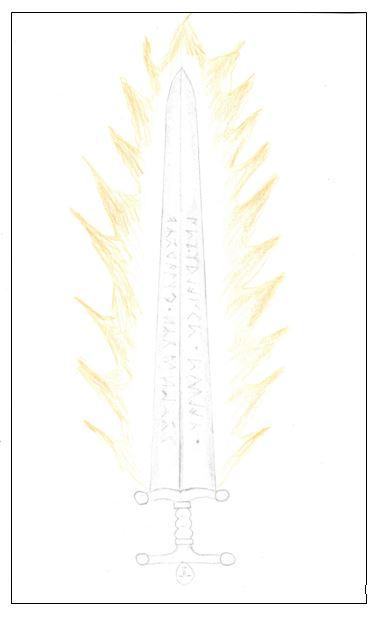
Dyrnwyn (‘White-Hilt), the sword of Rhydderch the Generous: if a well-born man drew it himself, it burst into flame from its hilt to its tip. And everyone who used to ask for it would receive it; but because of this peculiarity everyone used to reject it. And therefore he was called Rhydderch the Generous.’
The Thirteen Treasures of the Island of Britain

I draw the sword.
It does not burst into flames
when my mongrel hand closes
around the bone-white hilt,
pulls it from its sheath.

It balances uneasily
in my incompetent grip
remembering the death-grip
of kings, its blood-groove
steeped in redness.

My tasteless saliva
dries up as I see blood
pouring from the mouths
of victim after victim,
the fire in their eyes

dimming as the blade
burns brighter and brighter
in the white-knuckled unburnt hands
of Rhydderch the Generous:
defender of the Faith.

I fear it will burn me,
but it remains colder than flesh,
puzzling, inhuman, this thing
drawn from stone forged
by infernal magic.

I wish I had the strength
to break it over my knee
and return the broken halves
to the caves of the underworld
or throw it into the river:

Clutha’s outstretched hand
would souse its flames in the deep,
but its fire has drawn the life from me;
the victims it keeps claiming,
their heads on stakes.

~

Sword of Rhydderch Border

~

Rhydderch Hael ‘the Generous’ was the son of Tudwal Tudglyd and a descendant of the Macsen Wledig lineage. He ruled Alt Clut (Strathclyde) from 580 until 614. Rhydderch’s patronage of St Kentigern and epithet ‘defender of the Faith’ show he was Christian. His wife was Gwenddydd*, sister of Myrddin ap Morfran: a warrior of Gwenddolau, ruler of Arfderydd.

Rhydderch was renowned for his generosity and exploits in war. In 547 he was part of a raiding party who burnt Arfon to the ground. With his allies Rhydderch defeated Gwenddolau at the Battle of Arfderydd in 573 at a terrible cost: Myrddin killed Rhydderch and Gwenddydd’s only son and daughter. Driven mad by guilt and grief by killing his sister’s children Myrddin fled to the forest of Celyddon where Rhydderch pursued him relentlessly.

Rhydderch fought with other northern rulers: Urien, Gwallog, and Morgan, against the Angles at Ynys Metcaut. His absence from the Battle of Catraeth suggests by 600 he was too old to fight. In 614 he died childless, of old age, and the rulership of Alt Clut went to Nwython ap Gwyddno.

The name of Rhydderch’s sword, Dyrnwyn, ‘White-Hilt’, probably derives from its bone handle. Like many other Celtic long swords it may have been carved with an anthropomorphic figure, perhaps resembling Rhydderch or one of its past owners, with a head for its pommel, a body for its sword-grip, and arms and legs for its crossbars.

Its peculiarity – that it bursts into flame from hilt to tip whenever a well-born man draws it – points to the importance of bloodlines to the Brythonic rulers. Intriguingly the wielder of the sword does not get burnt. Perhaps the condition for wielding the sword was that it set alight without burning the one who drew it and the king was decided by this trial. Prior to Christianity this may have been rooted in proving one’s fitness to the sovereign goddess of the land who, in Alt Clut, was Clutha, goddess of the river Clyde.

Dyrnwyn shares similarities with Arthur’s sword, Caledfwlch, ‘Breach of Battle’, which was engraved with two serpents who spat jets of flame and was so terrifying his adversaries could not look at it. Later known as Excalibur its owner proved himself worthy by drawing it from a stone and it was returned to Morgan, the Lady of the Lake, a goddess of Avalon.

These fiery weapons of Christian warlords may have some basis in the Biblical story of the cherubim placed at the east of Eden with a flaming sword that turned every way to guard the way to the tree of life. If we wish to look for a pagan origin, perhaps a sword of flame was wielded by the pre-Christian god of summer and fire, Gwythyr ap Greidol, ‘Victor son of Scorcher’ against his rival, Gwyn ap Nudd, ‘White son of Mist’, a god of winter and ruler of Annwn.

Such weapons may have been forged by the smith-god, Gofannon, who is connected with nearby Govan. Smithing, and particularly the skill needed to make a flaming sword, would have been viewed as magical processes. No doubt there once existed a story about how Dyrnwyn originated and came into the hands of Rhydderch the Generous.

*She is also known as Ganied and Langoureth.

~

SOURCES

Mac Congail, ‘Little Metal Men – Celtic Anthropomorphic Swords’, Balkancelts,
Nennius, History of the Britons, (Book Jungle, 2008)
Peter Bartrum, A Welsh Classical Dictionary: People in History and Legend up to about A.D. 1000, (National Library of Wales, 1993)
Rachel Bromwich (ed), The Triads of the Island of Britain, (University of Wales Press, 2014)
Sioned Davies (transl.), The Mabinogion, (Oxford University Press, 2007)

The Thirteen Treasures of the North

The Thirteen Treasures of the Island of Britain appear in a number of medieval Welsh manuscripts. The earliest is the autograph of Gwilym Tew in Peniarth Manuscript 51 and is dated to 1460. It introduces the list as ‘The Names of the Thirteen Treasures which were in the North’.

This shows the Thirteen Treasures were intimately associated with the Old North: the Brythonic-speaking kingdoms of northern England and southern Scotland that arose in post-Roman Britain and fell to Anglo-Saxon and Scottish rule between the 6th and 11th centuries. Most of the owners of the treasures are included in the genealogies of the Men of the North.

In later lists, notes were added describing the magical properties of the treasures. The following is a variant in the hand of Rowland Lewis o Fallwyd from Cardiff MSS 17 (16th C) cited by Rachel Bromwich in The Triads of the Island of Britain.

~

THE THIRTEEN TREASURES OF THE ISLAND OF BRITAIN

(The Names of the Thirteen Treasures of the Island of Britain, which were in the North):

1. Dyrnwyn (‘White-Hilt’), the sword of Rhydderch the Generous: if a well-born man drew it himself, it burst into flame from its hilt to its tip. And everyone who used to ask for it would receive it; but because of this peculiarity everyone used to reject it. And therefore he was called Rhydderch the Generous.

2. The Hamper of Gwyddno Long-Shank: Food for one man would be put in it, and when it was opened, food for a hundred men would be found in it.

3. The Horn of Brân the Niggard from the North: whatever drink might be wished for was found in it.

4. The Chariot of Morgan the Wealthy: if a man went in it, he might wish to be wherever he would, and he would be there quickly.

5. The Halter of Clydno Eiddyn, which was fixed to a staple at the foot of his bed: whatever horse he might wish for, he would find in the halter.

6. The Knife of Llawfrodedd the Horseman, which would serve for twenty-four men to eat at table.

7. The Cauldron of Dyrnwch the Giant: if meat for a coward were put in it to boil, it would never boil; but if meat for a brave man were put in, it would boil quickly (and thus the brave could be distinguished from the cowardly).

8. The Whetstone of Tudwal Tudglyd: if a brave man sharpened his sword on it, if he (then) drew blood from a man, he would die. If a cowardly man (sharpened his sword on it), he (his opponent) would be no worse.

9. The Coat of Padarn Red-Coat: if a well-born man put it on, it would be the right size for him; if a churl, it would not go upon him.

10, 11. The Vat and Dish of Rhygenydd the Cleric: whatever food might be wished for in them, it would be found.

12. The Chessboard of Gwenddolau son of Ceidio: if the pieces were set, they would play by themselves. The board was of gold, and the men of silver.

13. The Mantle of Arthur in Cornwall: whoever was under it could not be seen, and he could see everyone.

~

The whereabouts of some of the treasures can be identified through the locations of their owners. The map of the Old North below is taken from Wikipedia and originates from John T. Koch’s Celtic Culture. I have added the numbers of the treasures.

Thirteen Treasures of the North Map

~

It has been suggested that, like the Four Treasures of the Tuatha Dé Danann from Irish tradition: the Stone of Fál, Spear of Lug, Sword of Nuada, and Cauldron of the Dagda, the Thirteen Treasures of the North are ‘hallows’: holy artefacts associated with the gods and the Otherworld.

The magical properties of the Thirteen Treasures, which grant wishes, provide copious amounts of food or drink, and have a testing function, may be suggestive of origins in Annwn, ‘the Deep’, the Brythonic Otherworld, which was later known as Faery.

If this is the case, it may be conjectured that stories once existed about how the owners won the treasures. This is supported by the inclusion of the story of the theft of cauldron of Dyrnwch in Culhwch and Olwen, which also mentions the Hamper of Gwyddno and a magical horn.

In the existing lists their magic is less associated with Annwn than with the ruling elites of post-Roman Britain whose hunger for power and internecine rivalry led to the fall of the Old North to the Anglo-Saxons. This world was dominated by male warlords and, for me, as a female awenydd living in the 21st century, is one I find difficult to connect with.

For me the question has arisen of whether the Thirteen Treasures are holy artefacts associated with the gods and the Otherworld relevant to today or the rich boy’s toys of a forgotten age. Through research, meditating, journeying, and writing, I have attempted to provide an answer.

Over the next twelve days, as an alternative to the twelve days of Christmas (this works because 10 and 11 are included together), I will be posting original poems based on my experiences with the treasures along with notes documenting my research.

Gwenddydd: The Dreamer at the End of the World

I have come hither to tell
Of the jurisdiction I have in the North;
Every region’s beauty is known to me.’
The Dialogue of Myrddin and his Sister Gwenddydd

Many people have heard of Merlin and a few of the northern British wildman, Myrddin Wyllt. But what of Gwenddydd, Myrddin’s twin sister, who was also an important prophetic figure from the Old North, whose legacy has been overshadowed by her brother’s?

Gwenddydd and Myrddin lived during the 6th century and their father’s name was Morfryn. From the poems attributed to Myrddin in The Black Book of Carmarthen (1350), we can derive that he was a warrior of Gwenddolau. His deep fondness of his lord suggests the twins grew up at Caer Gwenddolau (Liddel Strength) in Arfderydd (Arthuret).

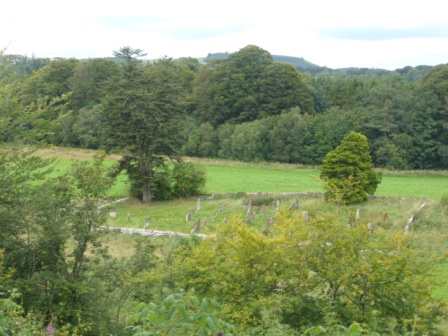
View from Liddel Strength

Liddel Strength

What kind of upbringing did Gwenddydd have? Gwenddolau was renowned as a ‘Bull-Protector’ and cattle-raiding warlord. Many legends surround him: he owned two birds who ate two corpses of the Cymry for dinner and supper; his gwyddbwyll set played itself; he conjured a mysterious battle-fog; his soul was gathered from the battlefield by Gwyn ap Nudd.

These stories have led scholars such as Nikolai Tolstoy to argue that Gwenddolau was the last of the northern British pagan warlords. Unfortunately this cannot be proven as many of the Christian warlords had magical abilities and, like Gwenddolau, were named as the owners of ‘The Thirteen Treasures of the Island of Britain, which were in the North’.

Whatever the case, Gwenddolau was a formidable figure. Gwenddydd grew up alongside Myrddin and their four brothers, Morgenau, Cyvrennin, Moryal and Moryen in a male-dominated culture where internecine warfare and cattle-raiding between the kingdoms of the Old North was the norm.

The ethos of the society was ‘heroic’. The warriors who committed the most blood-thirsty deeds in battle and stole the most cattle won immortality in the songs of the Bards. Both pagans and Christians believed that inspiration and prophecy originated from the Awen*; those able to give voice to it (particularly for military purposes) were held in high esteem.

The medieval texts suggest that women played a subordinate role to men as wives and home-keepers. How much this accurately reflects 6th century society and how much the gloss of medieval scribes is open to question. There are suggestions in several texts that Gwenddydd was seen as important, not only due to her upbringing at Caer Gwenddolau, but because of her intelligence and her prophetic abilities.

Gwenddydd eventually married Rhydderch Hael** who ruled Alt Clut from present-day Dumbarton. It is my belief this was a political marriage to cement an alliance between the kingdoms of Arfderydd and Alt Clut. Whether this was arranged by Gwenddolau or initiated by Gwenddydd in accord with her own political aims remains a matter of conjecture.

Dumbarton Rock

Dumbarton Rock

It’s my opinion that Gwenddydd was not just a pawn in the games of the male warlords. In ‘The Dialogue of Myrddin and his Sister Gwenddydd’ from The Red Book of Hergest (1380 – 1410) she speaks of ‘the jurisdiction’ she has ‘in the North. / Every region’s beauty is known to me.’

Gwenddydd was an important co-ruler. Not only did she have ‘jurisdiction’ over Alt Clut and, perhaps, Arfderydd, but the whole of the North. This may have been founded on her prophetic abilities: her capacity to see the unfolding of the fates of all the regions.

The alliance between Arfderydd and Alt Clut lasted for at least as long as it took Gwenddydd and Rhydderch’s son and daughter to grow to fighting age (from around 550 to 573 – a long time in those war-torn days!); it is notable that both Gwenddydd’s son and her daughter became warriors. It then broke down with tragic consequences, leading to the Battle of Arfderydd in 573 (whether Gwenddydd foresaw this battle remains uncertain).

Many reasons have been cited for the Battle of Arfderydd. In The Triads of the Island of Britain (13th C), it is listed as one of three ‘futile battles’ because it was fought over a Lark’s Nest: possibly an allusion to the nearby fortress of Caer Laverock. Another theory is that Rhydderch allied against Gwenddolau with other Christian warlords to bring an end to northern British paganism. Alternatively it may simply have been about land and power.

Rhydderch and his allies, Gwrgi and Peredur, fought against Gwenddolau and his nephew, Dreon ap Nudd. Gwenddolau was killed. Gwenddydd’s son and daughter fought on Rhydderch’s side and were slaughtered by Myrddin. The latter tragedy is referenced in a poem attributed to Myrddin called ‘The Apple Trees’ from The Black Book of Carmarthen (1350):

‘Now Gwenddydd loves me not and does not greet me
– I am hated by Gwasawg, the supporter of Rhydderch –
I have killed her son and her daughter.
Death has taken everyone, why does it not call me?…

Oh Jesus! would that my end had come
Before I was guilty of the death of the son of Gwenddydd.’

These lines show that Gwenddydd was devastated by Myrddin’s slaughter of her children. Understandably, her love of her twin had turned to hatred, and she refused to speak to him. Other poems show that Rhydderch was actively pursuing the killer of his children.

In ‘The Apple Trees’, Myrddin mentions his ‘sweet-apple tree’ has ‘a peculiar power’ which ‘hides it from the lords of Rhydderch’. In ‘The O’s’, which are addressed to a ‘little pig, a happy pig’, he tells it to ‘Burrow in a hidden place in the woodlands / For fear of the hunting-dogs of Rhydderch Hael, defender of the Faith.’

These poems are attributed to Myrddin during the time he was wyllt (‘wild’ or ‘mad’). Tormented by battle-trauma, guilt, and grief, and haunted by a blinding vision of a martial battalion in the skies***, he wandered the forest of Celyddon ‘for ten and twenty years’ amongst other gwyllon (‘wildmen’ or ‘madman’) speaking poems to the wild creatures. When he emerged, he used the art of prophecy to warn against future bloodshed.

Eventually, Gwenddydd forgave Myrddin. Her reasons for this decision remain mysterious. Did she realise Myrddin’s slaughter of her children resulted from the fatal circumstances of the breakdown of Gwenddolau and Rhydderch’s allegiance and the power-hunger of the northern warlords? Did she sympathise with Myrddin’s suffering? Did she acknowledge his use of prophecy to warn against future wars?

Their reconciliation is evidenced by several texts. In The Life of Merlin (1150) Gwenddydd persuades Rhydderch to send out a messenger with a cither to charm Myrddin back to Rhydderch’s court. When he arrives she kisses him and twines her arms around his neck. However, unable to bear civilised life, Myrddin flees back to the forest, where Gwenddydd builds him a home. After Rhydderch dies, Gwenddydd joins her brother in Celyddon.

We learn ‘She too was at times elevated by the spirit so that she often prophesied to her friends concerning the future of the kingdom.’ Gwenddydd speaks of future conflicts through a blend of cosmic, animal and martial imagery:

‘I see two moons in the air near Winchester and two lions acting with too great ferocity, and one man looking at two and another at the same number, and preparing for battle and standing opposed.  The others rise up and attack the fourth fiercely and savagely but not one of them prevails, for he stands firm and moves his shield and fights back with his weapons and as victor straightway defeats his triple enemy.  Two of them he drives across the frozen regions of the north while he gives to the third the mercy that he asks, so that the stars flee through all portions of the fields…

I see two stars engaging in combat with wild beasts beneath the hill of Urien where the people of Gwent and those of Deira met in the reign of the great Coel.  O with what sweat the men drip and with what blood the ground while wounds are being given to the foreigners!  One star collides with the other and falls into the shadow, hiding its light from the renewed light…’

Finally, Myrddin says, ‘Sister, does the spirit wish you to foretell future things, since he has closed up my mouth and my book? Therefore this task is given to you; rejoice in it, and under my favour devoted to him speak everything’.

In The Story of Myrddin Wyllt (16th C), during the period of his madness, Gwenddydd delivers food and water to her brother’s forest abode. She shares her dreams with Myrddin and he interprets them. Three dreams relate to the unfair distribution of wealth, the fourth concerns an attack by foreigners and in the fifth, in a graveyard, Gwenddydd eerily hears children speaking from their mother’s wombs.

‘The Dialogue of Myrddin and his Sister Gwenddydd’ takes place when the twins are aged: Myrddin has ‘white hair’. After telling Myrddin of her ‘jurisdiction… in the North’ Gwenddydd asks him a series of questions about who will rule Prydain. The positions of prophet and interpreter are reversed and we can conjecture that the twins habitually swapped roles. With the aid of wyllon mynydd (‘mountain ghosts’) Myrddin  predicts all the rulers of Prydain until:

‘…the time of Cymry suffering
Without help, and failing in their hope–
It is impossible to say who will rule.’

The tone then becomes apocalyptic:

‘When killing becomes the first duty
From sea to sea across all the land–
Say, lady, that the world is at an end…

There will be no portion for priest nor minstrel,
Nor repairing to the altar,
Until the heaven falls to the earth…

Extermination, lady, will be the end…

There will be no more kings!’
Gwenddydd consoles Myrddin:
‘Arise from your rest,
Open the books of Awen without fear.
Hear the discourse of a maid,
Give repose to your dreams.’

It is clear that the twins’ deaths are drawing near. Gwenddydd suggests Myrddin seek communion. Brother and sister finally commend one another to God and ‘the supreme Caer’.

This echoes a story from The Life of St Kentigern (12th C)****. Myrddin predicts his ‘threefold’ death by stoning, being pierced by a stake and drowning and asks for the sacrament from Kentigern. After receiving it he flees to meet his predicted end by being stoned by shepherds and falling onto a stake in the river Tweed.

Nothing is recorded about Gwenddydd’s response to her brother’s death or how she perished. However, from ‘A Fugitive Poem of Myrddin in his Grave’ in The Red Book of Hergest we can infer that Myrddin continues to speak from the afterlife with ‘mountains ghosts’, who ‘come to me / Here in Aber Carav.’ It is thus likely Gwenddydd also possesses the ability to speak her dreams and prophesies with the aid of spirits from her grave: her ‘supreme Caer’.

As our world is threatened by many ends: climate change, mass extinctions, global warfare, what does she dream? Could her story – one of loss, forgiveness and a determination to prophesy against future bloodshed, form a source of inspiration for people seeking alternative narratives to the militant worldviews responsible for her son and daughter’s death, the deaths of millions of others, and our living landscape?

Blog 6. Coille Coire Chuilc

Coile Coire Chulic – one of the last remnants of Celyddon

*Divine inspiration.
**This is depicted in The Life of Merlin (1150), a fictionalised account of Myrddin’s life by Geoffrey of Monmouth based on earlier sources. Myrddin appears as Merlin and Gwenddydd as Ganieda.
***This is recorded in The Life of Merlin and The Life of St Kentigern. I believe Myrddin saw Gwyn ap Nudd and the spirits of Annwn as in The Black Book of Carmarthen, Gwyn states his presence at Gwenddolau’s death as a gatherer of souls. The spirits who interact with Myrddin and Gwenddydd may be spirits of Annwn.
****Here Myrddin is named Lailoken, which is derived from Llallogan ‘other’.

Gwyn ap Nudd and Brân ap Ywerydd: Five Brâns?

In ‘The Conversation of Gwyn ap Nudd and Gwyddno Garanhir’, Gwyn states his presence at the death of Brân ap Ywerydd:

‘I was there when Brân was slain,
Ywerydd’s son of wide fame,
When battle-ravens croaked.’

Gwyn recites Brân’s name amongst the names of three famous northern warlords: Gwenddolau ap Ceidio, Gwallog ap Llenog and Meurig ap Careian* and also Llachau, Arthur’s son. It is clear Brân was slain in battle and that Gwyn was present as a psychopomp to gather his soul back to Annwn. Brân’s name must have held meaning for Gwyddno Garanhir** and the audience. Who is Brân ap Ywerydd? Scholars have attempted to solve this puzzle by identifying him with a number of mythological and historical figures.

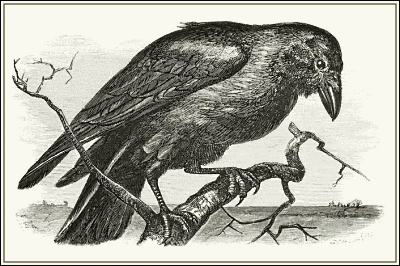
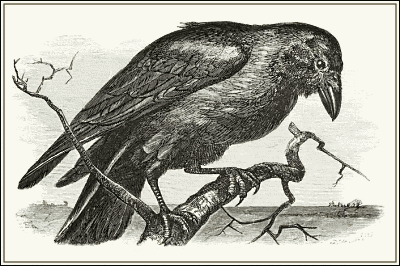
Brân the Blessed

raven-clipart-we-heart-it-public-domain

There exists a tradition which identifies Brân ap Ywerydd with Bendigeidfran ‘Blessed Raven’ or ‘Brân the Blessed’ son of Llŷr. Brân is a well known and much loved figure in British mythology who was fatally wounded in a battle against King Matholwch of Ireland. His severed head, buried beneath the Tower of London, served an apotropaic function protecting the Island of Britain until Arthur dug it up.

Scholars such as John Rhŷs and John Koch identify Iwerydd as the mother of Brân the Blessed. Koch says ‘Iwerydd (Atlantic) was a goddess from the Atlantic ocean, from the Western land of Hades, which could have been Ireland (Iwerddon). Iwerydd married Llyr and bore him two children named Brân (Raven) and Branwen (White Raven).’

The birth of Brân, his sister, Branwen, and perhaps their brother Manawydan by Iwerydd and Llŷr Llediaith (Irish Ler ‘the sea’, Welsh Llediaith ‘half-speech) makes sense within the context of Brân’s gargantuan stature and his affairs across the sea in Ireland.

If Brân ap Ywerydd and Brân the Blessed were identified, this would place Gwyn at the near-apocalyptic battle between the armies of Brân and Matholwch where the Irish dead are reborn from the Cauldron of Rebirth before it is broken by Efnysien. Of the Irish only five pregnant women are left alive. Just seven British survivors return with Brân’s head. If Gwyn attended the death of Brân the Blessed it might be suggested he also served as psychopomp to the victims of this terrible clash.

However, there are arguments against the identification of these two Brâns. Elsewhere, Brân the Blessed’s mother is named as Penarddun (‘Chief Beauty’). In ‘The Second Branch’ of The Mabinogion, Bendigeidfran is named as a son of Llŷr with Manawydan as his brother and Branwen as his sister. Nysien and Efnysien are sons of Euroswydd by ‘his own mother Penarddun, daughter of Beli.’

In The Triads of Ancient Britain, Llŷr Half-Speech is named as one of ‘Three Exalted (Supreme) Prisoners of the Island of Britain’. He was ‘imprisoned by Euroswydd’. It seems likely Euroswydd conceived Nysien and Efnysien with Penarddun whilst Llŷr was his prisoner.

Although textual evidence provides a stronger case for Penarddun being Brân’s mother than Iwerydd, within mythology we often find multiple genealogies which are equally valid. Iwerydd and Penarddun could also be titles for the same divinity. Therefore the identification of these two Brâns cannot be ruled out.

Brân ap Ymellryn

Grufudd Hiraethog identifies Brân ap Ywerydd with Brân ap Ymellyrn: a historical figure who appears in the poems attributed to Llywarch Hen. These are set after the assassination of Llywarch’s cousin, Urien Rheged, on the order of his jealous rival, Morgan, during a campaign against the Anglo-Saxons on Lindisfarne in 585.

Llywarch bore Urien’s head home. Afterward, Urien’s sons and Llywarch were driven from their lands in the Old North*** by Urien’s enemies who included Dunawd, Morgant, Gwallawg and Brân ap Ymellyrn. In The Death of Urien, Llywarch speaks of his plight (Pasgen and Elphin are Urien’s sons):

‘Dunawd, the chief of the age, would drive onward,
Intent upon making battle,
Against the conflict of Pasgen.

Gwallawg, the horseman of tumult, would drive onward,
Intent upon trying the sharpest edge,
Against the conflict of Elphin.

Brân, the son of Mellyrn, would drive onward,
Collecting men to burn my ovens:
A wolf that looked grimly by the banks of Abers.

Morgant and his men would drive onward,
Collecting a host to burn my lands:
He was a mouse that scratched against a rock.’

Llywarch flees to the court of Cynddylan in Powys. After Cynddylan is killed, he is again left homeless and destitute. A friend advises him to trust neither Brân nor Dunawd and to take refuge in Llanfawr:

‘Trust not Brân, trust not Dunawd;
Consort not with them in hardship.
Herdsman of calves, go to Llanfawr.’

Glyn E. Jones suggests Brân ap Ymellyrn may be identified with Brân ap Dyfnwal (Ymellyrn was his mother and Dyfnwal his father). This places him with Urien, Llywarch and their enemies Gwallawg and Dunawd amongst the descendants of Coel Hen within the lineages of the Old North.

Brân Galed

Hiraethog identifies Brân ab Ywerydd with Brân Galed (‘the Niggard’). He is the keeper of a magical horn that appears amongst ‘The Thirteen Treasures of the Island of Britain’ ‘which were in the North’: ‘The Horn of Brân the Niggard from the North: whatever drink might be wished for was found in it.’ Most of the owners of the treasures (who include Gwyddno and Gwenddolau) are ‘Men of the North’ and lived during the 6thC.

In the marginalia of an early list is a story about how Myrddin asked for the treasures from the thirteen owners. They all agreed if Myrddin obtained Brân’s horn, they would hand their treasures over, assuming Brân was so niggardly he would never give his up. Somehow, Myrddin persuaded Brân to give him the horn and he took all the treasures to a glass house where they remain forever.

It has been suggested Taliesin played a role in Brân’s decision. In a poem by Guto’r Glyn ‘Miserly, niggardly Brân they used to call him, who of old was descended from the Men of the North; Taliesin, no mean magician, transformed him into one better than the three generous men.’ In some variants Taliesin is the collector of the treasures. In another, Hercules slays a centaur and obtains Brân’s horn from its head.

Brân at Cynwyd

In The Gododdin we find the line ‘Brân was at Cynwyd’. Jenny Rowlands notes ‘Cynwyd is attested as both a personal and place name’. It may relate to a battle where Pelis, son of Urien fought, or to his leadership of the Cynwydion (named after Cynwyd Cynwydion, another descendent of Coel Hen).

Considering the antipathy between Urien’s sons and Brân ap Ymellyrn, it seems possible Pelis and the Cynwydion fought against Brân ap Ymellyrn and his allies and are commemorated at Cynwyd. Brân may have perished there too. The location remains unconfirmed, although there is a Cynwyd near to Corwen beside the river Dee in Wales.

Five Brâns?

Can we ascertain Brân ap Ywerydd’s identification with any or all of these Brâns? Are we looking at one, two, three, four or five different figures?  I think it’s safe to say that Brân the Blessed and the Brâns of the sixth century are entirely different due to the differences in timescale and mythological and historical context.

Within the context of Brân ap Ywerydd’s appearance in ‘The Conversation of Gwyn ap Nudd and Gwyddno Garanhir’, I think it most likely, like Gwenddolau, Gwallog and Meurig, he is a northern British figure from the 6thC. Brân ap Ywerydd, Brân ap Ymellyrn, the Brân who was at Cynwyd, and Brân Galed could be the same person.

We can tentatively piece together his story as follows: Brân was the son of Ywerydd and Dyfnawl and lived during the period of intense internecine conflict between the Brythonic kingdoms of the Old North as they fought against the Anglo-Saxons. Brân, Gwallawg, Dunawd and Morgant allied against Urien and Llywarch, arranging Urien’s assassination and driving Llywarch from the North. Brân later fought against Urien’s son, Pelis, at Cynwyd and perished and Gwyn attended his death. Brân was renowned for his niggardly nature and keeping his horn and his drink to himself. Sometime after his death, this fell into the realm of myth and became one of the Thirteen Treasures.

Gwyn’s association with Brân the Blessed cannot, however, be ruled out. As Gwyn is a ruler of Annwn and guide of the dead he could well have attended Bendigeidfran’s death too. The croaking ravens in each of the elegaic verses spoken by Gwyn invoke Brân’s presence as a reminder of the futile, destructive and seemingly unending nature of war.

Associations between ravens and the battlefield continue to endure in contemporary poetry. Speaking of the Iraq war in her modern rewriting of the traditional ballad ‘The Two Ravens’, Clare Pollard writes:

‘I watched the ravens feed on war,
and knew I’d watch for evermore.’

***

*Meurig ap Careian is a famous northern warlord if Careian is a scribal error and he is identified with Meurig ap Idno. I’ll cover this in a later post.
**Another ‘Man of the North’ associated with Porth Wyddno in the North and Borth in Wales.
***Some scholars associate Llywarch with Caerlaverock (Caer Llywarch) on the Solway Firth. Others have conjectured he may have ruled ‘South Rheged’ (Lancashire?) from modern-day Ribchester.

SOURCES

Clare Pollard, ‘There Wasn’t Even a Song in that Desolation: Poetry After a Decade in Iraq
Heron (transl), ‘Gwyn ap Nudd and Gwyddno Garanhir’, (2015)
John Koch, Celtic Culture: A Historical Encyclopedia, (ABC-CLIO, 2006)
John Rhŷs, Studies in the Arthurian Legend, (Adamant Media Corporation, 2001)
Peter Bartrum, A Welsh Classical Dictionary, (National Library of Wales, 1993)
Rachel Bromwich (ed), The Triads of the Island of Britain, (University of Wales Press, 2014)
Sioned Davies (transl.), The Mabinogion, (Oxford University Press, 2007)
William F. Skene (transl), The Four Ancient Books of Wales, (Forgotten Books 2007)

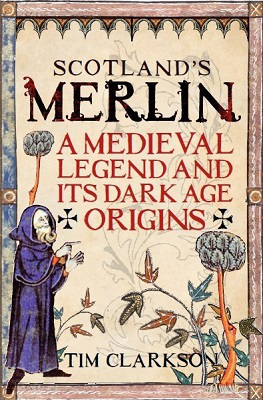
Review: Scotland’s Merlin by Tim Clarkson

Scotland's Merlin by Tim ClarksonTim Clarkson is an independent researcher and historian who gained a PhD in medieval history from the University of Manchester in 2003. He has since written four books on the history of Scotland and the Old North. Scotland’s Merlin: A Medieval Legend and its Dark Age Origins is his fifth.

This clearly written and well-researched book traces the story of Merlin, a figure best known from television as a wizard and advisor of King Arthur associated with Wales and Cornwall, back to its origins in Dark Age southern Scotland, which was then part of the Old North.

Clarkson begins with Geoffrey of Monmouth’s Historia Regum Britanniae as the source of Merlin’s depiction as an Arthurian wizard then turns to the Vita Merlini where we find a different ‘Scottish’ Merlin: a ‘Man of the Woods’ possessed ‘by a strange madness’ after a battle who seeks solitude in the Forest of Calidon and predicts his own threefold death.

This depiction originates from Geoffrey’s knowledge of medieval Welsh poems about Myrddin Wyllt, who became wyllt (‘wild’) after fighting in the Battle of Arfderydd and fled to the forest of Celyddon where he found solace beneath an apple tree with a little pig.

One of Clarkson’s more contentious arguments is that this northern wildman was not originally called Myrddin but Llallogan. The earliest roots of his story may be found in Vita Merlini Silvestris, where Lailoken (Llallogan) tells St Kentigern he became mad after a battle then begs for sacrament before his three-fold death.

The name Myrddin arose from the false etymology of ‘Carmarthen ‘Merlin’s Fort’ (Welsh Caerfyrddin, with ‘m’ softening to ‘f’)’. There is no ‘need to imagine that Lailoken of the North was already known as ‘Myrddin’ before his story migrated to Wales’.

More contentiously, Clarkson claims that Myrddin was not pagan but Christian. This is partially based on textual evidence. Lailoken pronounces ‘I am a Christian’ and petitions Kentigern for the sacrament. In the medieval Welsh poems, Myrddin addresses Jesus and his sister, Gwenddydd, urges him to take communion before he dies.

Clarkson also contests Skene and Tolstoy’s views that Gwenddolau, the northern British ruler who Myrddin fought for at Arfderydd was a pagan. The 5thC archaeological evidence shows ‘the aristocratic landholding elite proudly displayed their Christian credentials on memorial stones’.

‘the organisational infrastructures of paganism were unlikely to have survived the onslaught of the new religion. The two institutions could not exist side-by-side. Wherever Christianity came, the old beliefs died out within a couple of generations. Christian missionaries in the Celtic lands were not, as it is sometimes imagined, willing to turn a blind eye to pagan worship. They were determined to eradicate it. In such a climate of non-tolerance it is very unlikely that druidism, in whatever form, was able to survive… we should envisage Gwenddolau as a Christian king.’

Although Clarkson claims Merlin was not a pagan he admits it is possible to see him as a Celtic seer, shaman, or awenydd, in the Christian tradition. Rather than asserting his view as correct he encourages readers to make up their own mind whether ‘the original story was sprinkled with Christian allusions by later writers and all references to paganism were expunged’ or ‘there was no pagan narrative from the outset.’

Before I read this book it was my personal opinion that the medieval poems about the pagan wildman Myrddin Wyllt formed the earliest strata of the Merlin legend, and that the vitae of St Kentigern and Vita Merlini Silvestris contained later Christianised variants as propaganda promoting Kentigern and the Christian church. I haven’t been persuaded otherwise. It remains my opinion that Gwenddolau was one of the last pagan rulers of the Old North and that Myrddin was pagan; the allusions to Jesus and communion were added by Christian scribes.

Minor personal disagreements aside, this is an excellent book which does valuable work in tracing the origins of the Arthurian wizard, Merlin, to their roots in the story of a northern British warrior who became ‘wyllt’ at the Battle of Arfderydd, found solace amongst the wild creatures of the forest and became a renowned prophet.

I’d recommend this book to everybody interested in Merlin, British mythology, and the history of southern Scotland and the Old North. As somebody based in Lancashire it’s encouraging and inspiring to see the forgotten Dark Age histories of the north returning to life and being reclaimed.

You can find out more about Scotland’s Merlin and how to buy a copy on Tim Clarkson’s blog HERE.

Maelawr Gawr and Gwerthmwl Wledig: Pen Dinas in Retrospect

P1120829

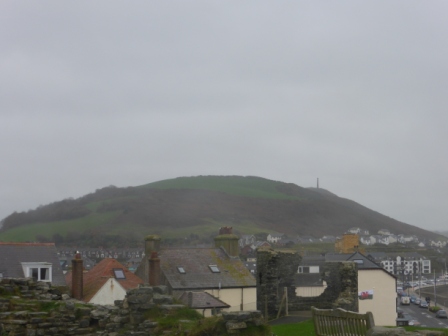
When I went to visit Heron in Borth last year I stayed in Aberystwyth. On my last day I had the chance to climb Pen Dinas (‘Head of the Citadel’). This is the name of the northern summit of the hill overlooking Aberstwyth which lies between the rivers Ystwyth and Rheidol.

When I made my visit, I went with limited knowledge. I’d read on Wikipedia that there was a Bronze Age burial mound on the southern summit. It was the site of two consecutive Iron Age hill-forts, one of which had been raided. The Romans did not occupy the hill, but a 4thC hoard of coins suggested they used it as a shrine.

I also read that Pen Dinas was associated with Maelawr Gawr (‘the giant’) who had three sons called Cornippyn, Crygyn and Babwa. Like in so many British stories he was presented as an adversary. In this case it isn’t clear what he’d done wrong. The crux of the story is that he was captured in Cyfeiliog and sentenced to death.

Maelawr asked his enemies a final request: to blow on his horn three times. The horn was so loud and forceful that on the first blow his hair and beard fell out, on the second his finger and toenails fell off and on the third the horn blasted apart and crumbled into pieces.

Cornippyn heard the horn whilst he was out hunting with horse and hound. He set off to rescue his father so fast he tore the head off his hound. He spurred his horse on in one leap over the Ystwyth and was slain in his attack on Maelor’s captors. Crygyn and Bwba were murdered in their fortresses in Llanilar and Llanbadarn Fawr the same night.

P1120748

I was drawn up the hill by the magnetism of the Wellington Monument on the northern summit. It felt like a strong place: like the aura of giant wasn’t quite gone nor the feeling of relative safety offered by occupying a high hill.

P1120741

Looking toward Penparcau I didn’t spot or hear a headless hound but I did see a pair of ravens.

Clouds marched in on a growing wind. I found myself feeling distant from the harbour beneath, Aberystwyth and the cliff railway, not so much in place but time.

P1120743

I felt Gwyn’s presence and that of others cloaked in cloud and knew he had been there to gather the dead.

That was unexpected and it wasn’t until several months later I found a possible explanation. In The Triads of the Island of Britain I found the fragments of a story set during the Dark Ages.

One of ‘Three Horses who carried the Three Horse Burdens’ is ‘Dappled the horse of the sons of Gwerthmwl Wledig, who carried Gweir and Gleis and Archenad up the hill of Maelawr in Ceredigion to avenge their father.’

‘The hill of Maelawr’ has been identified as Pen Dinas by Owen Jones. In Cymru, he says ‘in the land of Aber Teifi there was in former times before Brutus came to this island, the giant Maylor, and the place where he lives is still called Castell Maylor, built upon a high hill or ridge which is called Y Dinas, beside the river Ystwyth, within the freehold of the town of Aberystwyth.’

It appears that Gwerthmwl led an attack on Maelawr and was defeated hence his three sons rode up Pen Dinas to avenge him. Pen Dinas was the site of two Dark Age battles as well as a raid in the Iron Age. There is no record of whether Gwerthmwl’s sons succeeded.

Further research turned up that Gwerthmwl was an important (albeit now forgotten) figure in British mythology who originated from northern Britain. In Rhonabwy’s Dream he appears as one of forty-two of Arthur’s counsellors.

In the ‘Three Tribal Thrones’ he is listed as ‘Chief Elder’ in ‘Pen Rhionydd in the North’ alongside ‘Arthur as Chief of Princes’ and ‘Cyndeyrn Garthwys’ (St Kentigern) as ‘Chief of Bishops’.

Pen Rhionydd has been identified with Ptolemy’s Rerigonium ‘very royal place’ and may have been located on the Rhinns. One possible location is Port Patrick, which used to be called Portree (from port righ ‘King’s Port’). Another is Penrith. Wherever Pen Rhionydd was, Gwerthmwl’s three sons travelled a long way to avenge their father’s death.

Gwerthmwl also appears in The Triads as one of ‘Three Bull-Spectres’. Epithets such as Bull Chieftain, Bull Protector and Bull of Battle were commonly assigned to Dark Age warriors to illustrate their strength and battle-prowess.

Gwerthmwl’s status as a Bull-Spectre suggests he was as a bull-epitheted warrior who remained as a ghost. Another interpretation is he became wyllt ‘wild’ or ‘mad’ as a result of his battle with Maelawr (the welsh for Bull Spectre is tharw ellyll).

It is notable that Gwyn, who is addressed as a Bull of Battle by Gwyddno Garanhir, has strong associations with warriors with bull-epithets and gwyllon.

The resting place of Gwerthmwl is listed in ‘The Stanzas of the Graves’:

‘The grave of a chieftain from the North
is in the open land of Gwynasedd,
where the Lliw flows into the Llychwr;
at Celli Friafael is the grave of Gyrthmwl.’

Gwerthmwl’s grave is where the Lliw runs into the Llwchwr near Casllwchwr in Gower. He was buried a long way south of Pen Dinas and a long, long way from Pen Rhionydd in the North.

In the story of Maelawr and Gwerthmwl I come across another example of the destructive conflicts between the people of Wales and the North which Gwyn attended as a psychopomp.

What makes this particular story interesting is that Maelawr is most famously remembered as a giant. This raises the question of whether he was always known as a giant or was a human chieftain who literally grew in status after defending his hill from Gwerthmwl.

Could the story of Maelawr’s capture and death be founded on the vengeance of the sons of Gwerthmwl?

The answer lies buried as the giant’s bones, his fallen beard, fingernails, toenails, the broken pieces of his horn which still blasts clouds over the pillar that marks the location of his citadel.

P1120742

P1120866

SOURCES

Mike McCarthy, ‘Rheged: An Early Historic Kingdom near the Solway’ in Proc Soc Antiq Scot, 132 (2002),
Peter Bartrum, A Welsh Classical Dictionary: People in History and Legend up to about A.D. 1000, (National Library of Wales, 1993)
Rachel Bromwich (ed), The Triads of the Island of Britain, (University of Wales Press, 2014)
Sioned Davies (transl.), The Mabinogion, (Oxford University Press, 2007)
Wikipedia ‘Pen Dinas’ https://en.wikipedia.org/wiki/Pen_Dinas

Glasgow Cathedral and the Stories of Teneu, Kentigern and Lailoken

P1120028

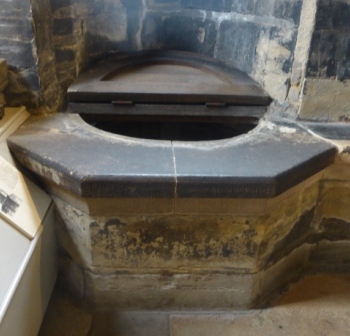
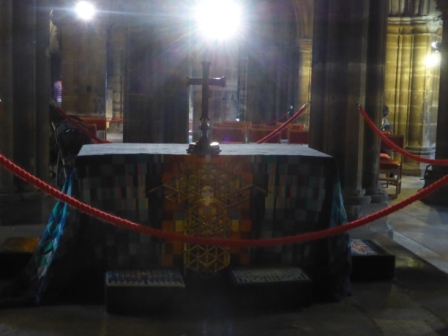
One of the last places I visited during my time in Glasgow was the cathedral, which was founded on the site of St Kentigern’s tomb. The first stone was laid in 1136 and the building was consecrated in 1197. During this period, Bishop Jocelin commissioned Jocelyn of Furness to write The Life of St Kentigern (1185) to encourage devotion to the saint.

The story of Kentigern’s birth is a troubling one. His mother, Teneu, was the daughter of Lleuddun, ruler of Gododdin. Teneu was seduced by Owain, ruler of Rheged, in the guise of a woman. Afterward she became pregnant.

When Lleuddun found out, he threw her off Dumpelder (Traplain Law: a hill in Gododdin, which may have been the seat of power prior to Din Eiddyn; Edinburgh). Luckily she survived and washed up in a coracle on the river Forth at Culross. There Kentigern was born.

Teneu is now revered as a saint. A medieval chapel to her once stood on the site of her grave at present-day St Enoch Square. At the ritual to Epona, I was told the well in the cathedral dedicated to Kentigern as Mungo may originally have been to Teneu. This is backed up the nearby street-name Lady Well Street.

P1120066

This made me wonder whether Teneu may have been a pre-Christian deity. Owain is often equated with Mabon and his mother is Modron. These names are derived from the pre-Christian deities Maponus ‘the Son’ and Matrona ‘Mother’. In a Welsh romance, Owain courts, acts as a guardian for, and eventually marries ‘The Lady of the Well.’

Combined with her river-journey this suggests Teneu may have been a deity connected with sacred waters. If this is the case, her appalling treatment by both Owain and Lleuddun forms a sad reflection on the transition from a worldview where water-deities were revered and women were treated as equals to patriarchal Christianised society.

Teneu and Kentigern were taken in by Saint Serf, who named the boy Mungo ‘my dear’. Kentigern started preaching when he was twenty-five and built a church where the cathedral now stands. He was then expelled by an anti-Christian movement headed by King Morken, ruler of Strathclyde*.

Kentigern fled to Wales until called back by Strathclyde’s new Christian ruler, Rhydderch Hael, after the Battle of Arfderydd in 573. Rhydderch’s defeat of the pagan ruler, Gwenddolau, formed a precedent for St Kentigern’s conversion of the people of Hoddom, who were said to have worshipped Woden**. Kentigern then returned to Glasgow.

Whilst praying in the wilderness, Kentigern met Lailoken (Myrddin Wyllt) who spoke of the source of his ‘madness’: a vision of host of warriors in the sky after the Battle of Arfderydd and being ‘torn out of himself’ by an evil spirit and assigned ‘to the wild things of the woods’.

Afterward, Lailoken followed Kentigern back to Glasgow and took to prophesying from a steep rock above Molendinar Burn (unfortunately covered over in the 1870’s and now beneath Wishart Street) north of the church.

Little heed was paid to his words because they were obscure and unintelligible and he refused to repeat himself. However, some of his ‘apparently idle remarks’ were written down. I wonder whether these lost fragments, passed on orally, could have formed the basis for the prophetic poems attributed to Myrddin in The Black Book of Carmarthen?

Just north of Glasgow Cathedral, Lailoken predicted his ‘three-fold’ death and supposedly begged Kentigern for communion before he met his end.

P1120017


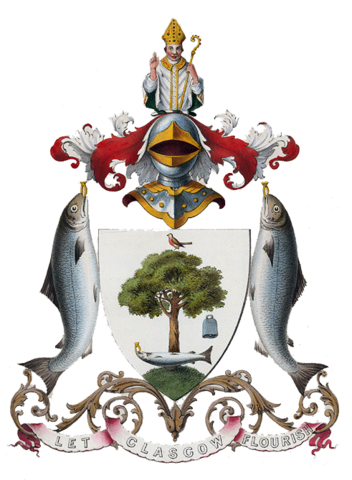
Kentigern’s miracles are depicted outside and within the cathedral and on Glasgow’s Coat of Arms: a robin he brought back to life, a hazel tree from which he started a fire, and a bell he brought back from Rome. Most curious is a fish which swallowed a ring, belonging to Rhydderch’s wife, Languoreth. Rhydderch is said to have thrown her ring into water with the purpose of proving she had given it to a lover. By ordering one of his monks to catch the fish, Kentigern saved her from execution.

Perhaps Kentigern’s compassion resulted from knowledge of his mother’s near execution at the hands of his grandfather?

In his old age Kentigern became increasingly debilitated to the point his chin needed to be tied up with a bandage. He is said to have died in the bath on Sunday 13th of January in 614.

P1120074

*An alternative king list does not name Morken but Tutagual, Rhydderch Hael’s father as his predecessor to the rulership of Stratchclyde.
**This seems to be an anachronism because the Anglo-Saxons had not arrived in south-west Scotland in the 6th century.

Dumbarton Rock

Consolidating Gwyn ap Nudd’s links with the Strathclyde Britons

In October after the ritual to Epona I stayed overnight with Potia and Red Raven in Glasgow. The next morning, Red Raven kindly took me to visit Dumbarton Rock: Dun Breatann ‘Fortress of the Britons’ to continue my research on Gwyn ap Nudd’s lost connections with the Old North.

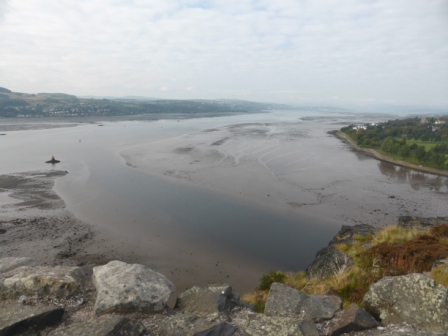
Dumbarton Rock stands on the estuary of the river Clyde beside the river Leven, stern, stony, commanding, cloven into two peaks, White Tower Crag and The Beak. Its proximity to an ancient hill fort on Carman Hill and Roman Forts such as Whitemoss guarding the estuary suggest its use as a defensive position from at least the Iron Age and Romano-British periods. Looking up at its vertical cliff face from beneath and climbing its 557 steps provided a distinct impression of how difficult it would have been to attack.

Dunbreatann emerged as the capital of Strathclyde, controlling south-west Scotland after the Romans withdrew from the Antonine Wall, in the 4th century. Later it was known as Alt Clut ‘Clyde Rock’. The first written reference comes from St Patrick from Ireland between 453 and 493AD, reprimanding Coroticus (Ceretic, ruler of Alt Clut) for taking his new Christian converts and selling them as slaves to the Picts.

The majority of its rulers were descendants of Ceretic: notably Dyfnawl Hen, Cinuit, Clinoch, Tutagual then Rhydderch Hael. After Rhydderch’s death in 612, rulership passed to another line stemming from Ceretic: Neithon son of Guipno and his lineage ruled until Dumbarton Rock was taken by the Vikings in 869.

A fragment in The Black Book of Chirk states that following the death of Maelgwn Gwynedd in 547, Elidyr Mwynfawr (first cousin of Tutagual and husband of Eurgain, Maelgwyn’s oldest legitimate daughter) attempted to seize the throne from Maelgwn’s illegitimate son, Rhun. Elidyr was killed at Arfon. This led to Rhydderch Hael, Clydno Eiddin, Nudd Hael and Mordaf Hael burning Arfon in revenge and being pursued north by Rhun’s forces to the river Gweryd.

Elidyr’s journey is recorded in a triad of ‘Horse-Burdens’ where the eponymous water-horse Du y Moroedd (‘The Black One of the Seas’) is said to have carried Elidyr and his party (seven and a half people including a cook hanging onto the crupper- hence the half!) from an unknown Benllech in the north to Benllech on Anglesey. Du is notably the steed ridden by Gwyn ap Nudd in the hunt for Twrch Trwyth (‘King of Boars’).

Rhydderch Hael (‘the Generous’) is the most famous of Strathclyde’s rulers. He was renowned as one of ‘Three Generous Men of Britain’ and owned a sword called Dyrnwyn ‘White Hilt’ which burst into flames when held by a well-born man and was numbered amongst the Thirteen Treasures of Britain.

The extent of Rhydderch’s generosity is hinted at by the third ‘Unrestrained Ravaging’ where Aeddan Fradog (‘the Wily’) came to his court and left no food, drink nor living beast (if Rhydderch was exceedingly generous and Aeddan took everything he must have been greedy and unrestrained indeed: one can sense the shock and disbelief of a contemporaneous audience).

Rhydderch championed Christianity and was the patron of St Kentigern. He came to power in 573, which coincides with the Battle of Arfderydd. Poems attributed to Myrddin Wyllt in The Black Book of Carmarthen suggest Rhydderch played a leading role in the defeat of the pagan ruler, Gwenddolau at Arfderydd and this was a factor in his rise to power.

In The Black Book of Carmarthen Gwyn ap Nudd states his presence at Gwenddolau’s death. Gwyn’s appearance to gather the soul of Gwenddolau and other dead warriors played a role in Myrddin’s madness and flight to Celyddon. The ex-warrior become wild man and prophet was hounded by Rhydderch Hael and supposedly converted to Christianity by St Kentigern.

Rhydderch also played a prominent part fighting against Theodric of Anglo-Saxon Bernicia with his Brythonic allies Urien Rheged, Gwallog ap Llenog and Morcant Bulc. During the campaign, whilst the Anglo-Saxons were successfully blockaded on Lindisfarne, Morcant assassinated Urien; a move which eventually led to the fall of the Old North.

Rhydderch’s successor, Nwython (Neithon) and his family feature prominently in the episode of Gwyn, Gwythyr and Creiddylad in How Culhwch won Olwen. After Gwyn ‘abducts’ Creiddylad from Gwythyr and takes her to Annwn, Nwython, his sons Cyledyr and Pen, Dyfnarth (Dynfawl?) and his Dyfnarth’s father Gwrgst Ledlwm join Gwythyr in an assault on Gwyn to win her back (four generations of Strathcylde Britons!).

Gwyn defeats Gwythyr and his army and imprisons them. During their imprisonment, Gwyn kills Nwython and feeds his heart to Cyledyr, who becomes wyllt (‘wild’ ‘mad’). Arthur then rescues Gwythyr and his men and places a command on Gwyn and Gwythyr to battle for Creiddylad every May Day until Judgement Day.

It is my intuition this story originates from an earlier seasonal myth where a hero (‘the Summer King’) challenged the god of Annwn (‘the Winter King’) for the love of a goddess of fertility and sovereignty who may originally have been revered as a free agent in a sacred marriage.

This episode is only one variant, fixed in 6th C Strathclyde, known because of its incorporation within the narrative of How Culhwch won Olwen (14th C). It is clear Gwyn has lost his status as a god of Annwn and Creiddylad her independence as a fertility goddess. Its fixity may be read to mark the death of a seasonal rite and its transition into story.

No doubt this coincided with the rise of Christianity, which led to Gwyn’s demonisation as the representative and literal embodiment of the ‘demons’ of Annwn and Creiddylad’s demotion to a helpless maiden flung like a ragdoll between two male lovers and finally locked away, powerless, in her father’s house.

The seasonal myth is thus replaced in the 6th century with a story designed for the political purpose of cementing alliances between the Strathclyde Britons, Gwythyr ap Greidol (deified as ‘the Summer King’) and Arthur against a common enemy: the demonised King of Winter and Annwn, Gwyn ap Nudd.

The disturbing sequence of Gwyn’s murder of Nwython and torture of Cyledyr has led me to question whether it has any historical basis. From my research so far there is nothing to suggest Nwython died a sudden or inexplicable death or disappeared during a campaign (often attributed to otherworldly forces).

However this does not mean such stories did not exist. Another explanation is that it was cited by the bards of Christian rulers to highlight the atrocities Gwyn committed against the lineage of Strathclyde to keep paganism at bay. One can only imagine the fear and repulsion of Strathclyde’s people and in particular Nwython’s descendants when it was voiced.

P1110994

It seems possible early variants of these stories were told in the fortress on The Beak alongside inaugural poems which would form Y Gododdin and The Black Book of Carmarthen. The existing texts suggest belief in Gwyn as a psychopomp lingered on beside the Christian faith for a long while. As a guide and warrior-protector to some and a cruel, demonic figure to others, he haunted the margins of every recital of battle-tales.

After Dumbarton Rock was taken by the Vikings, the kingdom of Strathclyde re-emerged up-river at Govan and stretched from Glasgow into Penrith in Cumbria. During this transition and, later, when Strathclyde was finally integrated into Scotland in 1034 many Britons went into exile and settled in Wales. In medieval Wales the oral tales about Gwyn ap Nudd and the fall of the Old North were finally penned.

Since then Dumbarton Rock has seen various uses; most notably as a medieval royal castle with its famous Wallace Tower. It is now primarily a tourist attraction within the custodianship of Historic Scotland.

Time passes. History fades into story into myth and even myth is forgotten. Yet the deepest myths are fated to return from the most distant edges of the otherworld like a boomerang.

P1110997

Looking out across the Clyde and Leven from the Fortress of the Britons I saw a pair of ravens who have lived forever on that ancient rock flying on the winds from there into poetry to the realm of the gods and back again.

P1120006

On that note I’ll thank Red Raven for taking me to Dumbarton Rock and bring this piece to end.

Hoddom and Brydekirk: The Fire of the Gods Endures

St Kentigern on Glasgow Coat of Arms, Wikipedia Commons

In Jocelyn’s The Life of St Kentigern there is a story about the saint’s recall from Wales to the Old North by Glasgow’s ruler, Rhydderch Hael. Following an angelic vision, Kentigern sets out with 665 disciples and arrives in Hoddom where he is greeted by a multitude of people.

Drawing a cross and invoking the Holy Trinity, Kentigern orders anyone against the word of God to depart. This results in ‘a vast multitude of skeleton-like creatures, horrible in form and aspect’ departing from the assemblage and fleeing from sight.

Reassuring the terrified crowd Kentigern ‘lays bare’ what they believe in. He condemns their idols to the fire and tells them their principal deity ‘Woden’ from whom they claim descent is nothing more than a mortal man of a pagan sect whose body is ‘loose in the dust’ whilst his soul ‘endures the eternal fire’ in the underworld.

As Kentigern preaches faith in Jesus Christ the flat plain of ‘Hodelm’ rises into a hill which remains to this day. The people ‘renounce Satan’ and are washed in the waters of baptism.

This foundation legend explains the association of the site of the church and the graveyard beside the river Annan across from Woodcock Air (the hill) at Hoddom with St Kentigern.

Woodcock Air Hill

The Life of St Kentigern was commissioned by Jocelyn, Bishop of Glasgow, and written by Jocelyn, a monk of Furness, in the 12th century. As a literary hagiography it was clearly designed to promote the life of Kentigern (who lived in the 6th century) and vilify paganism. As a historical document it should be approached with caution, particularly in light of the anachronism concerning Woden.

Whilst there is archaeological evidence of a Northumbrian monastery based around St Kentigern’s church at Hoddom it was not founded until the 8th century. (This is evidenced by an 8th century letter sent by Alcuin to Wolfhard, Abbott of Hodda Helm). The Anglo-Saxons did not arrive until long after Kentigern died. It seems Jocelyn wove later tales concerning the conversion of Woden’s worshippers into the text.

This leaves us with the question of who the people of Hoddom venerated prior to Kentigern’s arrival. The existence of a local cult is evidenced by a Roman altar stone found in the wall of the church at Hoddom Cross and built into the porch in 1817. Unfortunately when it was found the sides could not be seen and the ‘mouldings of the capital and base’ had been ‘dressed off’. There are no clues who it was dedicated to.

However the surrounding area echoes with pagan memories: the place-names Brydekirk and Lochmaben; an altar to Vitris and a ram’s head at Netherby; the story of Gwenddolau, the last pagan Brythonic king, whose soul was gathered by Gwyn ap Nudd after he was killed at the Battle of Arfderydd. Myrddin Wyllt’s flight from Arfderydd in battle-madness to Celyddon.

Intrigued and troubled by the story of Kentigern’s conversion of the people of Hoddom, wondering whether between the lines and beneath the Hollywood-style Biblical pyrotechnics any ‘truths’ (or at least personal gnoses) about their pagan religion may be intuited from the land, I returned to the area North of the Wall.

Walking from Ecclefechan to Hoddom, the first thing that struck me was the teeming of nature in the Scottish villages and fields. Flocks of spotted starlings on the roofs and telephone wires. Droves of sparrows flitting in and out of the hedgerows. The un-mowed roadsides were alive with flowers and every flower was covered with bees. Slick black slugs wandered through long grasses. I felt an unusual liberty in ‘the right to roam’.

Hoddom CrossMy first stop was at the church at Hoddom Cross. Roofless and derelict due to a fire, ivy climbed its walls and mausoleums. Ferns and wildflowers pushed through the railings to adorn older graves marked by sandstone gravestones. Newer graves with shiny porcelain headstones adorned with freshly wrapped bouquets glimmered in the background.

Something birch-white caught my eye. Going to investigate I found myself blinking in disbelief. In a Christian graveyard a couple of miles from any village I was staring at what to all appearances was a carving of a white dog with a purposively painted red nose. Dormach red-nose! I thought immediately of Gwyn ap Nudd’s famous hound who accompanies him as he guides the dead to the otherworld.

Admittedly it had antler-like twigs for ears and might have been a representation of Rudolph the red-nosed reindeer. But why carve it white from birch? It looked far more like a dog and a hound of Annwn at that. Too strange a find in a graveyard to be pure coincidence when I was tracing the deity(s) associated with the Roman altar (which I did not see).

River AnnanAfter visiting the ‘new’ church I walked to St Kentigern’s graveyard at Hoddom across the Annan from Woodcock Air. Watched over by a tall fir (or pine?) tree it was blissfully overgrown with ferns, yarrow, willowherb, bee-humming knapweed, decorated by harebells.

St Kentigern's Graveyard

Wandering amongst the gravestones I noticed carved images of skulls and crossbones and remarkable winged souls which a notice recorded as ’18th century folk art’. So here are Kentigern’s skeletons, I thought, unbanished. Symbols of death and our transition to the otherworld living on through years of Christian rule.

From the vantage point on Woodcock Air as I looked down on St Kentigern’s graveyard the sandstone gravestones shifted into brown-clad people. I gained a sense of the slowness of lives decanted by prayer, steady seasonal work in the fields, the slow turning of cart wheels, the satisfaction of self-subsistency and knowing you would die and be buried in your land close to your community.

St Kentigern's Graveyard from Woodcock AirAnd beneath the Northumbrian monastery did I gain a sense of St Kentigern’s church? The scene of conversion? The deity(s) to whom the ‘idols’ were dedicated? The ‘truth’ felt buried deep. Momentarily seeing the raised area where the church stood as a burial mound I thought back to Jocelyn’s words about ‘Woden’ being a mortal man of a pagan sect whose body is in the dust whilst his soul ‘endures the eternal fire’ in the underworld.

Could these words be read obliquitously to refer to a deified ancestor or ancestral deity believed to live on in the brightness of the world beyond this world? Perhaps even to Gwyn who as a psychopomp and leader of ‘the Wild Hunt’ is Woden’s closest Brythonic equivalent?

BrydekirkI also had the opportunity to visit Brydekirk. Intriguingly Ronald Cunliffe Shawe claims Gwenddolau worshipped ‘Woden’ and ‘a fire goddess’. His reference leads to the passage about Woden in The Life of St Kentigern. I can’t find anything mentioning a fire goddess. However Gwenddolau’s worship of such a deity would make perfect sense if Brydekirk is named after Bride or Brigid. Brigid was later venerated as St Brigid and her priestesses tended an eternal flame.

At the church I was told by one of the parishioners it was indeed named after St Brigid of Ireland. I also learnt St Bryde’s Well was a natural spring and was gifted with an indispensable description of its location.

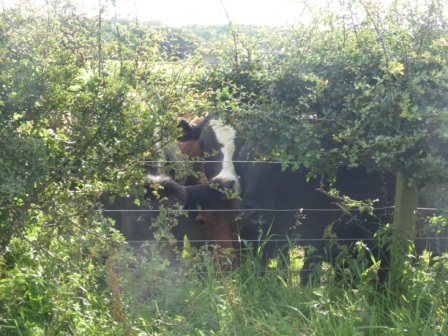
My walk to the well down the Annan then alongside fields was accompanied by a curious herd of cows who followed peeping out through gaps in the hedge. Their strange behaviour led me to recall the story of how St Brigid was raised by a white cow with red ears: another otherworldly animal.

CowsThe area surrounding St Bryde’s Well was hopelessly overgrown with brambles, nettles and Himalayan Balsam. With the guidance of the parishioners I still couldn’t find it. Ready to give up I saw what looked like a pink veil. I first assumed it was a votive offering marking the spring. When I got closer I realised it was a balloon strung with pale gauze. Another extraordinary marker that proved to be no mere coincidence.

Turning round, I noticed a water dispenser and beyond heard running water. Seeing a rivulet at the bottom of a steep bank running into the Annan, I followed its course to find a small stream leading to the natural spring pouring from amongst mosses and ferns into an orangey circular basin: St Bryde’s Well.

Across the river I also visited the remains of St Bryde’s tower. All I found was a single flight of steps climbing upward into the fire of the sun. Could this has have been a stairway walked by Brigid’s priestesses who maintained her eternal flame?

St Bryde's TowerI returned to Penwortham with no clear answers about how or whether St Kentigern converted the people of Hoddom or what they experienced and believed. Such ‘truths’ can only be conjectural and are always determined by our questions, assumptions and  beliefs.

What I gained was a deeper understanding of how our physical and literary landscapes interweave. How sign and signified lead the dance of a journey which is led by the gods who lead us to places where all distinctions break down in the numinosity of their presence.

At Hoddom and Brydekirk I met a myriad inhabitants of a northern land and I met Gwyn and Bride (who I know here in Lancashire as Brigantia) in new ways. I learnt that within the land and its stories and even in the most depredatory of Christian texts the fire of the gods endures.