Thursday the 9th of July was a strange and crazy day. My disastrous morning began with buying blu-tac to put up signs for a conference at work: signs I realised on arrival I hadn’t printed off. It went downhill from there. After managing to print the signs double-sided and procrastinating whether to leave at the agreed time of 9.45am after doing such a botched job, I fled to the Lancashire Archives.
On arrival I realised I had spent the £5 I put in my purse for a photography pass on blu-tac. Apologising and rushing to the cash machine, my head was in such a spin I entered the wrong pin code thrice and had to go to my bank to get a new one and ask for the money in person.
That done, I had a reasonable amount of success in photographing the 1811 Enclosure Act for Fulwood Forest and accompanying map and acquiring Ronald Cunliffe Shaw’s massive tome The Royal Forest of Lancaster from the basement of the Harris Library. With the huge book under my arm, feeling slightly nervous about dropping or damaging it, I headed home.
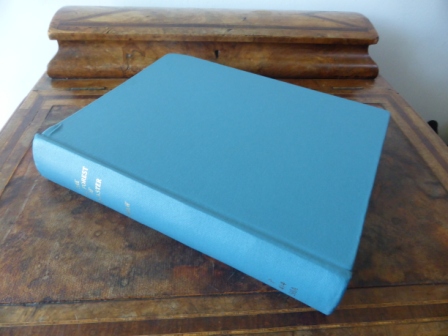
The Forest of Lancashire by Ronald Cunliffe Shawe
Walking down Riverside beside the Ribble, crossing a street, I caught the silvery glint of a pair of glasses. Stopping to pick them up and wondering what to do with them, I heard a shout from behind. It was a postman, who told me the glasses were his and he had lost them because he had been trying to catch a duckling and put it back over the river wall.
Assuming said duckling had been caught and put back I walked on, only moments later, to see her; striped tawny and brown running panickedly with a flap of short wings dangerously close to the roadside. With no idea how I was going to catch her or where to put the book I began following her with the aim, at least, of making sure she wasn’t run over.

Riverside
As the duckling pursuit approached Penwortham Bridge a couple on a tandem bike stopped to help. The woman took my book and her partner and I managed to herd the duckling into a front yard. Four bins stood on the right. When she ran behind we manoeuvred them to form a make-shift duck pen.
When we finally thought we had caught her she slipped through the cyclists’ hands yet he managed to catch her in the next garden whilst I was left explaining to the owner of the house why we had used his bins to make a duck-pen.
The cyclist handed me the duckling and the pair departed. Realising quickly that holding the frightened creature was a job that necessitated constant attention and two hands, and with no sign of the duckling’s mother in sight, I asked the local resident if he would hold her whilst I phoned for advice.
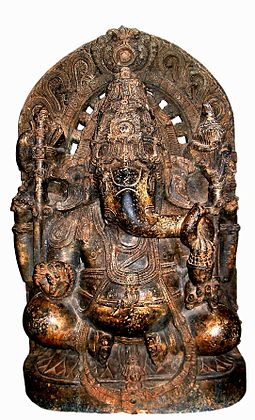
13th C statue of Ganesh, courtesy of Wikipedia
He kindly obliged, inviting me into the porch of his vibrantly decorated house where I borrowed his telephone to ring the RSPCA whilst standing in front of a statue of Ganesh. I first met Ganesh when I performed Puja to him at a Druid and Hindu gathering last year. Beforehand I had been stressed as I’d been told at the last minute I had to drastically cut down a talk I’d spent some time preparing and rehearsing. After the Puja, I felt calm and my contribution went well.
Whilst navigating the phone system of the RSPCA was an absolute nightmare, Ganesh provided a sense of reassurance. Eventually I got put through to a human operator by pressing the line for ‘tangled and trapped animals’. She told me to remain beside the river and look out for the mother for a couple of hours and if I didn’t see her to call them back.
Realising I couldn’t hold the duckling and use my phone I called my friend, Nick, who was luckily in town and said he would meet me. Leaving my book at the Broadgate resident’s house, I walked up river and noticed a small family of ducks. However, the mother showed no sign of having lost one of her flock.
When I met Nick he told me he had phoned his friend, Lee, an animal rescue volunteer. She arrived within minutes in her van with a bird carrier. When I mentioned the family Lee said as it wasn’t certain the duckling belonged to them it was safer for her to take her home. Farewells were made to the duckling who ran swiftly into the carrier then, clearly exhausted, settled down.
After a catch-up with Nick, Lee departed. Reassured the duckling was safe, I picked up the book and thanked the gentleman. Thinking back, I couldn’t help pondering how if I hadn’t been delayed at the archives I would have been home a couple of hours ago reading my book and wouldn’t have seen and rescued the duckling at all.
However this strange chain of events had not reached its end. Close to home I found my local valley filled with smoke. Although I assumed it must be from someone’s bonfire I checked the woodland and was glad I did as someone had built and abandoned a large fire which, with the wind, looked perilously close to the withered cow parsley and other dry vegetation.
I rushed home, dropped off the book and picked up two buckets and a jug to fill them from Fish House Brook. After ten trips the fire was out. I was left exhausted and shaken by the realisation if it hadn’t been for my delay at the archives and the duckling pursuit I might have got home before the fire was lit and it might have caused considerable damage to the valley.
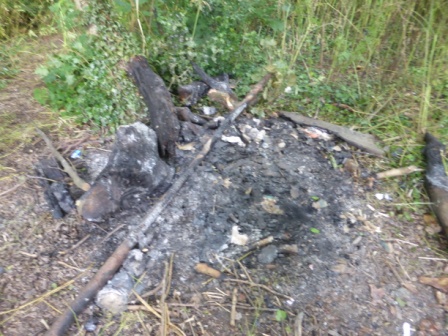
Doused fire, Greencroft Valley
Looking back I can make no clear sense of the events. Yet what stands out is the slow inexorable pull of nature away from the white noise of forms and formalities. From the confines of the university to the archives and enclosed and mapped landscape of 1811 to the living webbed running feet of the duckling to the manual labour of filling buckets from my local stream, with a hiss, fizz and sizzle, dousing the fire in the valley I love.
A clearish lesson is I’m much better at rescuing ducklings and fire-fighting than administration and I feel more myself and grounded in these tasks and the land. And what of Ganesh? Hindu god of removing obstacles, peace and new beginnings? I hope his appearance signals a time when I can clear away my failures, renew my connection with my land and my gods and move on, even if means sacrificing some of the ambitions that led me to the position I’m currently trapped in.

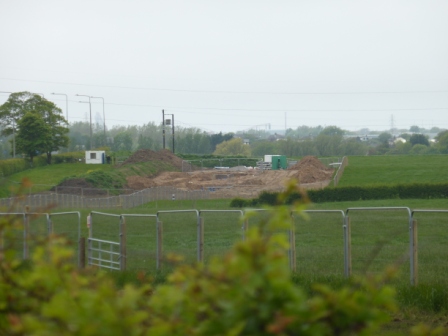


 The Sanctuary of Vindos