The Brightness beyond Endurance: Gwyn ap Nudd and the Battle of Arfderydd

In my waking dream spears pierce the night sky opening onto another night filled with rainbows and blinding stars. Battle cries ascend from black fog. In a stained glass window I glimpse a man with a hunched back in a green and mossy gown departing from a picture into darkness. From these images I derive my research on Gwyn ap Nudd and the Old North should begin with the Battle of Arfderydd. This is an account of my initial findings and thoughts to date.

The Battle of Arfderydd haunts Britain’s consciousness as one of three of the most futile Dark Age battles. It took place in 573 and was fought between Brythonic rulers of the Old North; Gwenddolau ap Ceidio and his cousins Gwrgi and Peredur ap Eliffer. All were descendants of Coel Hen. Thus it epitomises the internecine strife that prevented northern rulers from putting up a successful resistance to the Angles of Northumbria.

The Triads of Ancient Britain tell us it was fought over a lark’s nest. This probably refers to Caerlaverock (‘Lark’s Fort’) on the site of which still stands a stunning medieval castle. It is generally believed the Battle of Arfderydd took place on the plain between Liddel Water and Carwinley Burn. It is possible the motte and bailey named Liddel Strength was the location of Gwenddolau’s fort. After Gwenddolau was killed, his war-band retreated to the fort and held out for ‘a fortnight and a month’ before their defences fell and they too were slain and (according to a local tradition) buried near Upper Moat.

In ‘The Dialogue of Gwyn ap Nudd and Gwyddno Garanhir’ Gwyn states his presence at Gwenddolau’s death:

‘I was there when Gwenddolau was slain,
Ceidio’s son, a pillar of poetry,
When ravens croaked on gore.’

That Gwenddolau adhered to a pre-Christian mythos featuring Gwyn as a god who gathered the souls of the dead to Annwn is hinted at by certain lines in the Triads. Gwenddolau is referred to as one of three ‘Bull Protectors’ of Britain. Gwyn himself is referred to as a ‘Bull of battle’. Contrary to popular belief, Celts and not Vikings wore helmets affixed with bull horns. The bull was viewed as a sacred animal and its qualities were attributed to war leaders and psychopomps. It is also of interest ‘Gwyn’ and ‘Gwen’ both mean ‘white’ or ‘blessed’.

Gwenddolau is also said to own a pair of birds who wear a ‘yoke of gold’ and devour two corpses of the Britons for dinner and two for supper. If the latter is an oblique reference to funerary practices whereby bodies are left on stone slabs for their flesh to be consumed by carrion birds this shows Gwenddolau and his people were not performing Christian burials. The northern Britons may have believed Gwyn’s presence as a gatherer of souls was signalled by the approach of corpse-eating birds (or dogs or wolves). Gwenddolau’s birds may have had a permanent position in this role.

Another striking passage which may read as a portrayal of Gwyn’s presence at the Battle of Arfderydd with the spirits of Annwn can be found in The Life of St Kentigern. Here, Lailoken (Myrddin Wyllt) tells the saint of a vision which drove him to madness in Coed Celyddon (the Caledonian Forest):

‘In that fight the sky began to split above me and I heard a tremendous din, a voice from the sky saying to me ‘Lailocen, Lailocen, because you alone are responsible for the blood of all these dead men, you alone will bear the punishment for the misdeeds of all. For you will be given over to the angels of Satan, and until the day of your death you will have communion with the creatures of the wood. But when I directed my gaze towards the voice I heard, I saw a brightness too great for human senses to endure (my italics).

The Brightness beyond EnduranceI saw, too, numberless martial battalions in the heaven, like flashing lightning, holding in their hands fiery lances and glittering spears which they shook most fiercely at me. So I was torn out of myself and an evil spirit seized me and assigned me to the wild things of the woods, as you see.’

It seems possible the introduction of the voice of God and angels of Satan are a Christian cover for the appearance of Gwyn and the spirits of Annwn. Gwyn’s earlier name Vindonnus ‘clear light, white’ links him to the unendurable brightness. As a god of thresholds; between the worlds and life and death, experiences of his presence take place on the edge of human sense. Hence Lailoken / Myrddin’s transition from ‘sanity’ to ‘madness.’

The battalions in the sky look more like warriors than angels. The notion that the spirits of Annwn include deified ancestors arriving to take their fallen kindred fits with their numinous apparel. These spirits are frequently demonised by Christian writers. That an ‘evil spirit’ (ie. a spirit of Annwn) tears Lailoken / Myrddin ‘out of himself’ and assigns him to the wildwood is a significant factor in his flight and later recovery.

In the saga poetry of The Black Book of Carmarthen and The Red Book of Hergest we witness Myrddin’s transformation from a golden-torqued warrior of Gwenddolau’s court into a poet who prophecies against war. Myrddin shares harrowing depictions of ‘the blood-shed of battle’ and his guilt about the deaths of Gwendydd’s children. Whether he is literally responsible for killing them or feels responsible is uncertain.

‘Now Gwendydd loves me not and does not greet me…
I have killed her son and daughter.
Death has taken everyone, why does it not call me?
For after Gwenddolau no lord honours me.’

He mourns Gwenddolau’s death:

‘I have seen Gwenddolau, a glorious prince,
Gathering booty from every border;
Beneath the brown earth now he is still,
Chief of the kings of the North, greatest in generosity.’

Myrddin also speaks of his flight from ‘Rhydderch Hael, defender of the Faith’. Rhydderch was ruler of Alt Clut and renowned for championing Christianity and his patronage of St Kentigern. Myrddin’s words have led some scholars to believe Arfderydd was fought between Pagan (Gwenddolau) and Christian (Rhydderch) forces. After Gwenddolau’s death Rhydderch rises to greater power, forming an alliance with Urien Rheged, Gwallog ap Llenog and Mercant Bwlc against the Angles at Lindisfarne.

During this period Myrddin retreats to Celyddon, keeping the company of wild creatures such as wolves, a piglet and a favoured apple tree. He states he has wandered ‘ten and twenty years’ with ‘madness and madmen’ ‘gan willeith a gwyllon.’ Myrddin’s epithet ‘gwyllt’ means ‘mad’ or ‘wild.’ ‘Gwyllon’ can refer to ‘madmen’, ‘wildmen’ or to ‘spirits’ or ‘shades.’ They may be equated with the ‘seven score men’ who fought at Arfderydd then lapsed into madness in Celyddon and perished. These gwyllon are ancestral presences; spirits of Annwn.

Myrddin’s capacity to see the spirits of Annwn may result from his vision of the brightness beyond endurance. Whilst initially it tips him over the edge, it confirms the existence of Gwyn and his spirits and an afterlife. This provides him with the strength to live through suffering; ‘Snow up to my hips among the wolves of the forest, / Icicles in my hair’ until his ‘threefold’ death. Myrddin says ‘After enduring sickness and grief in the Forest of Celyddon / May I be a blissful man with the Lord of Hosts.’ (In ‘The Dialogue of Gwyn ap Nudd and Gwyddno Garanhir’ Gwyn is referred to as ‘Lord of Hosts’.)

Associations between Gwyn and healing processes that take place in the wild also appear in a fourteenth century Latin manuscript called Speculum Christiani: ‘Some stupid people also stupidly go to the door holding fire and iron in the hands when someone has inflicted illness, and call to the king of the Benevolent Ones and his queen, who are evil spirits, saying ‘Gwyn ap Nudd who are far in the forests for the love of your mate allow us to come home.’

Myrddin’s vision also grants him the power of prophetic poetry. It is noteworthy that this former warrior uses poetry to give voice to the horror of warfare and to warn against future bloodshed. A critical attitude toward war differentiates the saga poems from earlier heroic poetry. We might recall similarities between Myrddin’s ‘Death has taken everyone, why does it not call me?’ and Gwyn’s ‘I have been where the warriors of Britain were slain / I live on; they are dead’. Both are laments.

Unfortunately, the northern British stories of Gwyn ap Nudd and Myrddin Wyllt and the deep, wild wisdom they contain are little known in contrast to the courtly Christian tales of King Arthur, Merlin and his knights. For a medieval aristocracy later bent on Crusades; ‘One King, One God, One Law’ there was no room for a northern wild man and his words against war or the ruler of an otherworld and ancestral presences immanent in the wild places of this-world. Perhaps this can be changed…

***

SOURCES

Blake, William The Complete Poetry and Prose of William Blake (Anchor Books, 1988)
Breeze, Andrew “The Name and Battle of Arfderydd, near Carlisle,” Journal of Literary Onomastics: Volume 2: Issue 1, Article 1. (2012)
Evans, J. Gwengobryn The Black Book of Carmarthen (Lightning Source UK Lmtd, 1907)
Heron (transl.) ‘Gwyn ap Nudd and Gwyddno Garanhir’ https://barddos.wordpress.com/2015/02/08/gwyn-ap-nudd-and-gwyddno-garanhir/
Hunt, August The Arthur of History: A Reinterpretation of the Evidence (August Hunt, 2012)
Pennar, Meirion (transl.) The Black Book of Carmarthen (Llanerch Enterprises, 1989)
Rudiger, Angelika H. ‘Gwyn ap Nudd: Transfigurations of a character on the way from medieval literature to neo-pagan beliefs’ in Gramarye, Issue 2 (University of Chichester, Winter 2012)
Skene, William F. The Four Ancient Books of Wales (Forgotten Books 2007)
Thomas, Neil ‘The Celtic Wild Man Tradition and Geoffrey of Monmouth’s Vita Merlini: Madness or Contemptus Mundi?’ in Arthuriana Vol. 10, No. 1 (Spring 2000)
Tolstoy, Nikolai The Quest for Merlin (Sceptre, 1985)

Imagine the Old North

Imagine the Old North. What can it be? Can you see it in this land, from your green hill across the marsh how the ordinary people saw it?

Can you see ravens in trees amongst the crows? Was it common enough for magpies?

Can you imagine the rumours of embittered warlords and honey-tongued bards who sung their praises? Can you taste weak beer or braggot? Do you feast on dog or wild boar?

Can you imagine living in a world where the animals speak? How will you learn their tongues? Will they lead you into their expanses?

Your books are filled with stories. Can you imagine the ones who got away? How their hearts beat on river-banks and they were pierced by spears as carrion birds circled? How the sleek otter swept into the depths and carried their death-cries to his young? Can you imagine what the ravens whispered in their thatched nest?

Can you imagine the task of bringing peace to the battle-dead?

Where all the darkness of history wanders and I hold the spirits of Annwn back… can you imagine?

What can our poetry be? A sound, a scream, a panorama of the Old North in a beam of light?

River Ribble from the Ribble Way, east of Ribchester Bridge
*Questions posed by Gwyn ap Nudd.
**Photograph of the river Ribble from the Ribble Way east of Ribchester Bridge.

Gwyn ap Nudd and Gwyddno Garanhir

This is a link to Heron’s translation and interpretation of ‘The Dialogue of Gwyn ap Nudd and Gwyddno Garanhir,’ found in The Black Book of Carmarthen. This dramatic dialogue is one of the earliest pieces of known literature featuring Gwyn ap Nudd, who appears as a divine warrior and gatherer of the battle-dead.

Heron has undertaken an important task, as the only translation currently available to the public on the internet is William Skene’s (1868), which is both dated and considered flawed. His hard work and understanding of this poem on historical and mythic levels is highly appreciated.

Greg Hill's avatar

IMG_0109
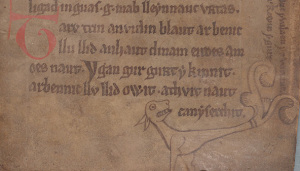
The beginning of the Exchange Between Gwyn ap Nudd and Gwyddno Garanhir in the manuscript of The Black Book of Carmarthen

An interpretation of the conversation between 
Gwyn ap Nudd and Gwyddno Garanhir.

 This conversation appears in a manuscript collection known as The Black Book of Carmarthen which is a collection of copies from earlier manuscripts made by a monk in Carmarthen in the Thirteenth Century, some of which are verses which may have originally been embedded in lost prose sagas. As with much early Welsh verse some parts of it are difficult to interpret and the only easily available version in English is that contained in Skene’s Four Ancient Books of Wales, a pioneering translation which is now regarded as flawed. I’ll provide my own attempt to translate it during the course of the ensuing discussion based on consulting modern editions and commentaries in Welsh. There are some…

View original post 1,690 more words

Spirits of Annwn fly over reaped fields

Spurned birds circle
fields weeping
for all that is good
in the world
gone

dry harvest
all the legions of the dead
strewn fallen scattered
let them seed
this world in the arms of their loved ones

the circles begin again
hearts cut in twain

by the reapers’ blades
hear them come
softly sweeping bare-footed
with the silence of a love song

pile straw onto carts

the hallowed dead
ascending in a cloud of wings

spirits of Annwn fly over reaped fields

then down and under
circling circling

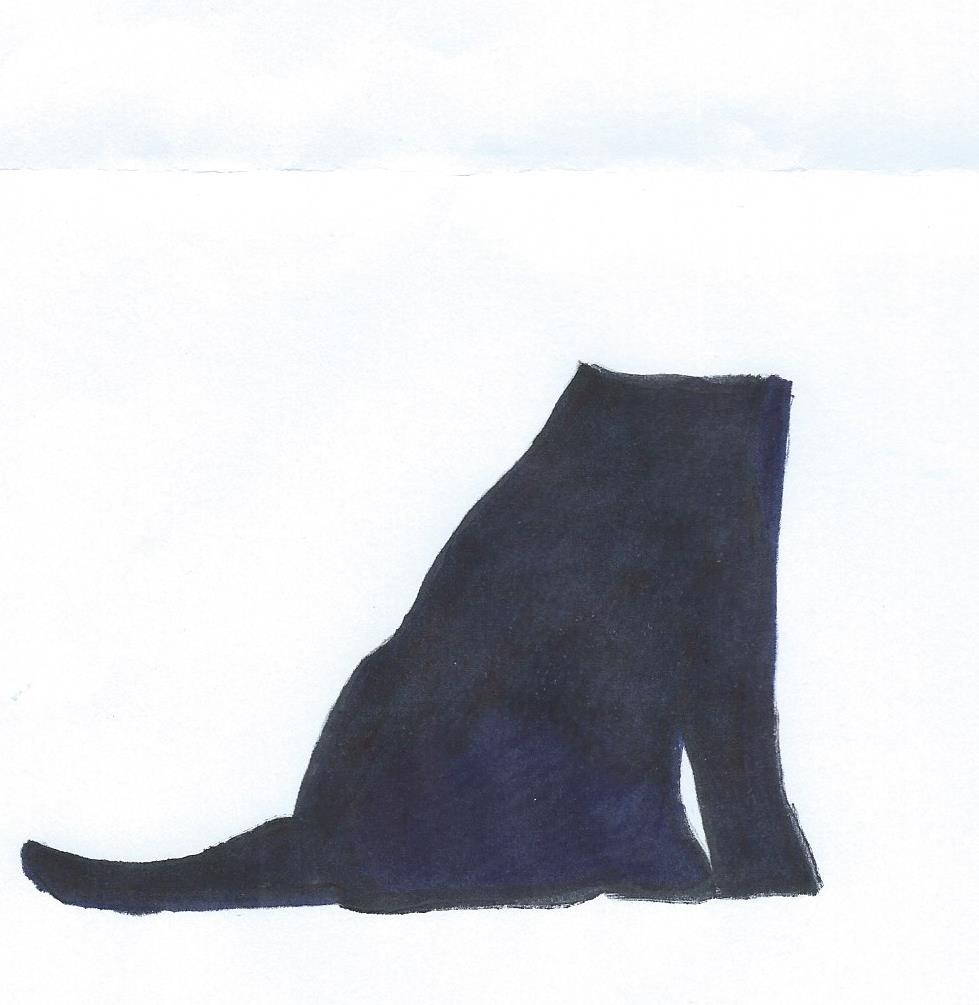
The Black Dog of Preston

The Black Dog of PrestonI have recently been researching the legend of the black dog of Preston. The process has led me on a journey through the places it is associated with and their history. It has also brought me to consider the meaning and origin of its roles as a harbinger of death and guardian of the town’s gates.

I first came across this tale earlier in the year on a walk with local folklorist Aidan Turner-Bishop, which was organised by UCLan Pagan Society. Aidan told us that a headless black dog haunts the area between Maudlands and Marsh Lane.

St Walburge's

St Walburge’s

These locations seem significant due to their history. Maudlands receives its name from a 12th century leper hospital dedicated to St Mary Magdalene, which was dissolved in 1548 and later replaced by St Walburge’s.

Preston International Hotel

Preston International Hotel

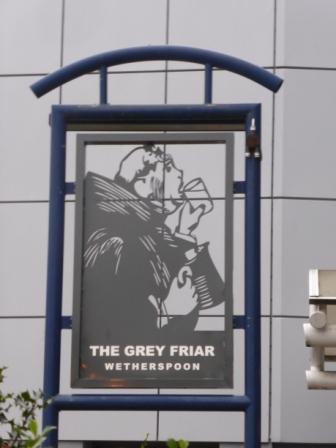
Marsh Lane was the location of a Friary belonging to the Franciscan Order, which was founded in 1260 and dissolved in 1539 and occupied the position of Preston International Hotel. The Friary gave its name to Friargate and the The Grey Friar Pub.

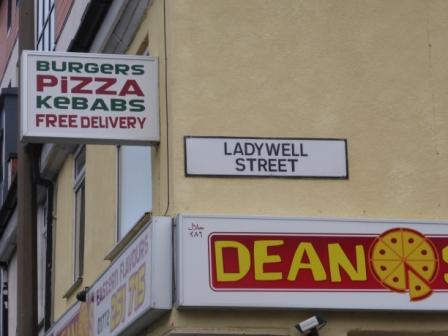
The Grey FriarNext to it was Ladywell, which was venerated up until the nineteenth century and is now remembered only by the street name (1). Water was piped from Ladywell to the Friary.

Ladywell - CopyThe earliest written records of the black dog I have come across are in Charles Hardwick’s Traditions, Superstitions and Folklore (1872). Firstly, ‘I remember in my youth hearing a story of a headless boggart that haunted Preston’s streets and neighbouring lanes. Its presence was often accompanied by the rattling of chains. I forget now what was its special mission. It frequently changed its form, however, but whether it appeared as a woman or a black dog, it was always headless’ (2).

And secondly, ‘This spectre hound or dog is a very common sprite in Lancashire. I remember well being terrified in my youth in Preston, by Christmas recitals of strange stories of its appearance, and the misfortune which its howling was said to forebode. The Preston black dog was without a head, which rendered the said howling still more mysterious to my youthful imagination’ (3).

A story called ‘The Black Dog of Preston’ is serialised by James Borlase in The Preston Guardian in December 1878. This story is set in 1715 during the period of the Jacobite rebellion, which led to the Battle of Preston.

Once again, it appears as a portent of death ‘several people who had been abroad late at night and alone, had caught sight of the THE BLACK DOG OF PRESTON, a headless boggart, who could howl nevertheless, and whose howl meant death, as also did its lying down upon a doorstep to someone who dwelt within that special house’ (4).

A connection between the black dog and Gallows Hill is mentioned twice. The first instance is a mock sighting of ‘the huge and hideous form of The Headless Black Dog of Preston, a weird boggart that for centuries was famous in our town, pawing the air, swaying from side to side, and howling most lugubriously’. Here it turns out to be one of the protagonists’ servants clad in a sheepskin (5).

In the second it appears as a guardian of the dead; ‘sixteen of the lesser rebels were hanged upon Gallows Hill in chains, and there suffered to remain for many months, guarded, it is said, of a night time, by the Headless Black Dog of Preston’ (6).

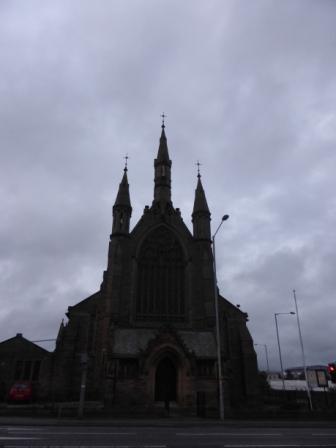
English Martyrs' Church

English Martyrs’ Church

English Martyrs' Church, Gallows Hill

English Martyrs’ Church, Gallows Hill

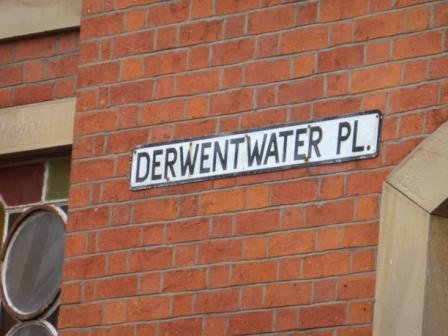
The English Martyrs’ Church, which now stands on the summit of Gallows Hill, derives its name from these executions. The nearby street names Derwentwater Place and Lovat Road refer to Jacobites captured and killed in the rebellion. That people were hung and decapitated there is evidenced by two headless bodies found during the building of North Road, which cuts through the hill. The area is described as a ‘provincial Tyburn’ (7).

Derwentwater PlaceThe black dog is also connected to the strange phenomenon of the parting of the Ribble’s waters, which occurred in the years 1715 and 1774 and is recounted by Peter Whittle. ‘The river Ribble, in Lancashire, stood still; and for the length of three miles, there was no water, except in deep places; in about five hours it came down with a strong current, and continues to flow as usual’ (8).

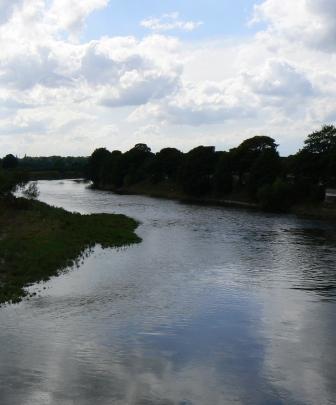
As the protagonists in Borlase’s story ride double into the Ribble, down river from Walton Bridge, their horse shies, ‘it was not the water that was terrifying the horse, but a great black something, like a weed-covered rock, that seemed to be lying half in and half out of it… the thing became suddenly instinct with life, and rolling rather than moving toward them exhibited the hideous form of The Headless Black Dog of Preston…The black dog uttered a most lugubrious howl, not withstanding its headlessness, and then waddled off; whereupon, and immediately, a most extraordinary circumstance occurred, for with a roar the river parted in twain from the Preston shore’ (9).

The river Ribble from Walton Bridge

Whilst this story is fictitious it is possible some of its elements are founded on earlier beliefs.

During the 19th century the superstition that a howling dog was a portent of death was popular. James Bowker says ‘few superstitions have a wider circle of believers in Lancashire than that which attributes to dogs the power of foretelling death and disaster’ (10). Hardwick attributes this to the dog’s delicate sense of smell, saying the capacity to scent putrid flesh ‘may have influenced the original personification of the dog as an attendant on the dead’ (11).

Contemporary writer Alby Stone suggests this superstition may relate to earlier beliefs about dogs being able to see spirits and thus forewarn of death. She adds ‘in many traditions… such creatures are not merely harbingers of death. They are both guides to and guardians of the land of the dead’ (12). In Borlase’s tale the black dog appears as a guardian of the dead on Gallows Hill and guides the protagonists across the Ribble.

It is possible to link this liminal role to the term ‘boggart,’ which Hardwick and Borlase use interchangeably with ‘black dog’. According to Brand ‘boggart’ may derive from the Northern pronunciation of ‘bar’ meaning ‘gate’ and ‘guest’ meaning ‘ghost.’ A boggart or ‘bar-guest’ is hence a ‘gate-ghost’ (13). To complicate things further ‘gate’ actually meant ‘street,’ hence Friargate. Brand says ‘Many streets are haunted by a guest, who assumes many strange appearances, as a mastiff-dog, &c. It is a corruption of the Anglo-Saxon gast, spiritus, anima.”’ (14).

Friargate IIThis is interesting as older maps of Preston show the town’s ‘bars.’ The bar of Friargate is located in the present day position of The Sun Hotel, not far from Marsh Lane (15).

Approximate Location of Friargate Bar

Approximate Location of Friargate Bar

This may go some way to explain the Friargate connection. The black dog may be seen as both a guardian of the physical gates of the town and the gateways between the lands of the living and dead. The former is supported by a reference on the Paranormal Database, which says ‘It is said that the town was once haunted by a headless black hound, appearing when danger threatened the town’ (16).

This idea may date back to pre-Christian beliefs. Alby Stone argues that evidence of ritual burials dating back to Bronze Age Britain suggests that dogs may have been killed and interred to serve as spirit guardians. She lists a pair of dogs buried at Flag Fen in Peterborough and another at Caldicot in Gwent (17). A recent example suggesting such practices may have continued into the medieval period and beyond is the discovery of the seven foot skeleton of Black Shuck outside Leiston Abbey (18).

At the time Bowker was writing it appears the belief in ‘foundation burials’ was current in Lancashire. He cites Rev. S. Baring Gould, ‘It was the custom to bury a dog or a boar alive under the corner-stone of a church, that its ghost might haunt the neighbourhood, and drive off any who would profane it—i.e. witches or warlocks’ (19). However, as far as I know, there is no archaeological evidence of this kind of practice in Preston.

There are other idiosyncrasies bound up with the legend that are less easy to interpret. For example how did the black dog lose its head; was it a dog beheaded as part of a ritual burial, or is it the ghost of a decapitated human?

There is also the paradox that although the boggart was supposedly laid it continues to haunt the streets of Preston. Hardwick says ‘The story went that this boggart or ghost was at length “laid” by some magical or religious ceremony in Walton Church yard. I have often thought that the story told by Weaver, a Preston antiquary, in his “Funerall Monuments,” printed in 1631, and which I have transcribed at page 149 of the “History of Preston and its Environs,” may have had some remote connection with this tradition’ (20). If the black dog was laid in 1560 as part of Dee and Kelly’s misdemeanours in Walton Churchyard,  which are referred to in Weaver’s story, how come it figures so largely in tales set in 18th to 19th C Preston?

I’ve visited Walton Churchyard and seen no obvious signs of a boggart having been laid, such as the Written Stone in Longridge (21). However, like in this legend and a tale from Clayton Hall ‘Whilst ivy climbs and holly is green, / Clayton Hall boggart shall no more be seen’ (22) there is a holly tree in the centre of the graveyard and plenty of ivy about. Holly is renown for its apotropaic function (23).

Holly Tree, Walton Churchyard

Holly Tree, Walton Churchyard

One possibility is that it wasn’t laid. Another is that the laying was ineffective. The Gristlehurst Boggart was reputedly laid in a hollow and assuaged with milk but still seemed to be out and about causing trouble at the time Edwin Waugh was writing (24).

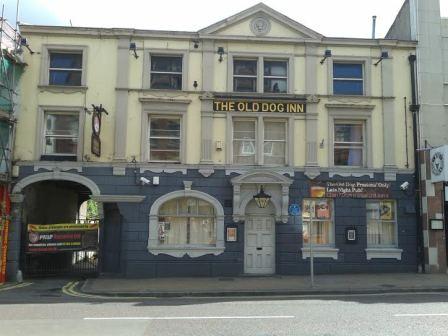
Old Dog Inn

The Old Dog Inn

Aside from these stories, and the pub name The Old Dog Inn (which is tenuous as it pictures a grey coloured hound with a head) I haven’t come across any more evidence of its existence. More current accounts of paranormal activity in Lancashire refer to big cats.

Old Dog - Copy

The Old Dog

Could this be because the black dog of Preston has abandoned the city? Or could it be because nobody who has seen it or heard it howling has lived to hear the tale?..

(1) David Hunt, A History of Preston, (2009), p31-33
(2) Charles Hardwick, Traditions, Superstitions and Folklore, (2012), p130
(3) Ibid. p172
(4) The Preston Guardian, 17th December 1887
(5) Ibid.
(6) The Preston Guardian, 24th December 1887
(7)http://www.englishmartyrspreston.org.uk/history1.htm#Gallows%20Hill%20History%20of%20the%20Church%E2%80%99s%20Location
(8) Peter Whittle, aka Marmaduke Tulket, A topographical, statistical, & historical account of the borough of Preston, (1821), p15
(9) The Preston Guardian, 24th December 1887
(10) James Bowker, Goblin Tales of Lancashire,(1878), http://www.gutenberg.org/files/41148/41148-h/41148-h.htm
(11) Charles Hardwick, Traditions, Superstitions and Folklore, (2012), p174-5
(12) Alby Stone, ‘Infernal Watchdogs, Soul Hunters and Corpse Eaters,’ in ed. Bob Trubshaw, Explore Phantom Black Dogs, (2005), p36
(13) John Harland and T.T. Wilkinson, Lancashire Folklore, (1867), p50
(14) Ibid.
(15) David Hunt, Preston Centuries of Change, (2003), p39
(16)http://www.paranormaldatabase.com/reports/shuckdata.php?pageNum_paradata=9&totalRows_paradata=258
(17) Alby Stone, ‘Infernal Watchdogs, Soul Hunters and Corpse Eaters,’ in ed. Bob Trubshaw, Explore Phantom Black Dogs, (2005), p41
(18) http://www.dailymail.co.uk/news/article-2629353/Is-skeleton-legendary-devil-dog-Black-Shuck-terrorised-16th-century-East-Anglia.html
(19) James Bowker, Goblin Tales of Lancashire, (1878) http://www.gutenberg.org/files/41148/41148-h/41148-h.htm
(20) Charles Hardwick, Traditions, Superstitions and Folklore, (2012), p130
(21) Aidan Turner-Bishop, ‘Fairy and Boggart Sites in Lancashire’ in ed. Linda Sever, Lancashire’s Sacred Landscape, p105 and 107
(22) John Harland and T.T. Wilkinson, Lancashire Folklore, (1867), p50
(23) Aidan Turner-Bishop, ‘Fairy and Boggart Sites in Lancashire’ in ed. Linda Sever, Lancashire’s Sacred Landscape, p106
(24) Edwin Waugh, ‘Gristlehurst Boggart,’ Lancashire Sketches Vol. 2, http://gerald-massey.org.uk/waugh/c_sketches_2a.htm

Gwyn ap Nudd and the Spirits of Annwn: Remembering the Underworld Gods

I recently came across an article through the Caer Feddwyd Forum (1) called ‘The Underworld Gods’ by medieval scholar, Will Parker. It brought to my awareness the existence of an inscription in Chamalieres in central France, which took the form of a prayer or invocation addressed to an entity or group of entities known in Ancient Gaul as the andedion, ‘the Under-world God(s)’ or ‘Infernal One(s)’ (2).

Parker links the andedion to the Irish andee ‘non-gods’ and suggests a similar group of deities would have been worshipped in Iron Age Britain. Through etymological links between the ‘elements Clt. dio(n) (Ir. dé) ‘god(s)’ and ‘the suffix ande-/an-‘ he connects them to Annwn ‘not world’, Britain’s indigenous otherworld or underworld. Parker goes on to identify the andedion and andee with the spirits of Annwn and their ruler, Gwyn ap Nudd.

This is of interest to me because Gwyn is my patron god. Parker’s insights make it possible to trace a trajectory from Iron Age beliefs concerning underworld gods, through Gwyn’s appearances in medieval literature and later folklore to those who worship him today.

Gwyn ap Nudd ‘White Son of Mist’ is a Brythonic deity. His veneration dates back, at least, to the Iron Age, where he appears as Vindonnus ‘White or Clear Light,’ in a trio of Gallo-Brythonic inscriptions in Essarois. Here he is equated with Apollo, another hunter deity (3). It is likely he was worshipped across Britain as Vindos ‘White’ (4). It has also been conjectured that Gwyn and his hunting dog, Dormarth ‘Death’s Door’ occupied the astrological positions of Orion and Sirius to the ancient Britons.

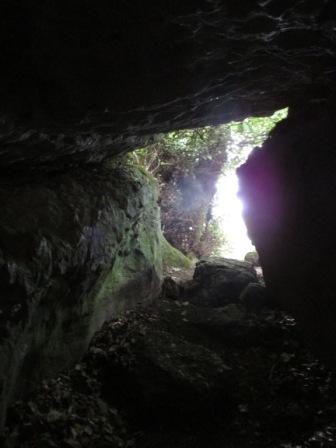
Cave, SilverdaleParker suggests Late Bronze Age ‘ritual shafts’ and ‘offering pits’ containing depositions including human and animal bones, grain, pottery and metalwork express a ‘quid-pro-quo’ relationship between the ancient Britons and the underworld gods. If he is correct, it is possible that Vindos / Gwyn, Dormarth and other kindred spirits were involved in these rites.

Gwyn’s first literary appearances are in medieval Welsh texts; ‘How Culhwch Won Olwen’ (11th C) in The Mabinogion and ‘The Dialogue of Gwyddno Garanhir and Gwyn ap Nudd’ (13th C) in The Four Ancient Books of Wales. These texts have roots in an older, oral tradition and contain fragments of tales from across Britain that predate Christianity. A significant number of these, including two featuring Gwyn, are from ‘The Old North’ (5). This is important to me because I connect with Gwyn in Lancashire.

Parker argues that superstitions about the underworld gods carry over into The Mabinogion. This is evidenced in the disappearance of livestock, children and crops. Pwyll’s encounter with Arawn, a King of Annwn, is the catalyst for the unfolding drama of the first four Mabinogi. Parker says these stories show the spirits of Annwn could not ‘be simply dismissed or ignored. Instead, a complex narrative had to be constructed in which, through a series of symbolic ritual manoeuvres, their power was drawn out, confronted and finally neutralised.’ The attempts of medieval scholars to disempower these deities can be seen at work in the development of Gwyn’s mythology.

In ‘The Dialogue of Gwyddno Garanhir and Gwyn ap Nudd,’ (6) Gwyn is presented as a divine warrior returning from battle to the Tawe near the vale of Neath. Gwyddno, ruler of Cantre’r Gwaelod, speaks of and addresses him with reverence and respect. ‘Bull of conflict was he, active in dispersing an arrayed army, / The ruler of hosts, indisposed to anger, / Blameless and pure was his conduct in protecting life.’ Other epithets Gwyddno uses include ‘hope of armies’ and ‘hero of hosts.’ ‘Host’ may refer to the spirits of Annwn.

Gwyn introduces himself as ‘Gwyn, the son of Nud, / The lover of Creurdilad, the daughter of Lud.’ He names his horse as ‘the torment of battle’ and refers to Dormarth as ‘truly the best of dogs,’ ‘handsome,’ ‘round bodied’ and ‘ruddy nosed.’ References to his possession of a ‘polished ring’ and ‘golden saddle’ are also suggestive of his status.

The title ‘Bull of Conflict’ refers to Gwyn’s role as a psychopomp. At the end of the poem he describes his travels across Britain gathering the souls of fallen soldiers. He appears to be berating this task. ‘I have been where the soldiers of Prydain were slain, / From the East to the North; / I am alive, they in their graves! / I have been where the soldiers of Prydain were slain / From the East to the South / I am alive, they in death!’

This poem contains important clues about Gwyn’s identity as a divine warrior and huntsman, whose role was to gather the souls of the dead and take them to Annwn.

In ‘How Culhwch Won Olwen’ in The Mabinogion, Gwyn is depicted as a huntsman and advisor to King Arthur. His place in Arthur’s court list and apparent subjection to both Arthur and God may be read as attempts by medieval scholars’ to explain and downgrade his position.

That ‘Twrch Trwyth will not be hunted until Gwyn son of Nudd is found’ (7) hints at his role as leader of the hunt, and knowledge of otherworldly beings. The Twrch was a king reputedly turned into a swine by God. When Gwyn does not reveal his location it is possible he is defending his own.

The advice of Gwyn and Gwythyr ap Greidol ‘Victor Son of Scorcher’ is also needed by Arthur to find Pennant Gofid in the ‘uplands of hell,’ which Evans and Bromwich say is ‘clearly situated in North Britain’ (8). When they reach this location, Gwyn and Gwythyr advise Arthur in his defeat of the ‘The Hag of Pennant Gofid,’ another otherworldly entity. The parcity of their advice, which leads to several failed attempts by Arthur’s men before the Christian King is forced to step in to slay her, may also suggest that Gwyn and Gwythyr are acting as tricksters.

A pair of lines fundamental to understanding Gwyn’s mythos, and which continue to intrigue and perplex me, are the following; ‘God has put the spirit of the demons of Annwfn in him, lest the world be destroyed. He will not be spared from there’ (9).

Taken literally, this seems to mean that at some point during the period of Christianisation God put the spirit of the demons of Annwn ‘in’ Gwyn’s person to prevent the world’s destruction. Or it may mean that he granted Gwyn rulership of them for this purpose. However, it is probable that the agency of God was brought in as a cover to excuse the prevalent belief in the existence of these spirits and their ruler.

Even if we assume God’s agency is a cover for existing beliefs, the notion that Gwyn somehow contains ‘the spirit of the demons of Annwn’ is a fascinating one. In a conversation via e-mail, Heron (10) told me the word ‘spirit,’ in Welsh, is ‘aryal,’ which can mean ‘ferocity,’ ‘essence’ or ‘nature’. He referred me to Evans and Bromwich, who say ‘Gwyn’s partaking of the ‘nature of the devils of Annwfn’ indicates a recognition on the part of the redactor of the tale that Gwyn ap Nudd belonged to a sinister and forbidden mythology’ (11). Within this mythology he may already be seen to embody the nature of these entities, or to hold power over them.

That the destruction of the world is at stake suggests Gwyn’s role was extremely significant. If it is assumed this notion has older roots, some of the offerings of the ancient Britons may be explained as attempts to placate these spirits and their ruler due to their destructive capacity. It is also possible Gwyn was invoked as the only being who could hold them in check.

Fears and superstitions surrounding Gwyn and the spirits of Annwn may lie behind the story of his abduction of Creiddylad. After Creiddylad, who is both Gwyn’s lover and sister, elopes with Gwythyr, Gwyn seizes her back. It might be assumed he takes her to Annwn, and that this suggests an underlying fear of being abducted by Gwyn and his forces.

Gwythyr amasses his armies and attacks Gwyn. Gwyn triumphs and captures a number of Gwythyr’s allies, who are mainly rulers of the Old North. During their captivity Gwyn slaughters Nwython, cuts out his heart and feeds it to his son, Cyledr, who goes mad. This could be read as a clear example of Gwyn’s ferocity and hints at existing superstitions about what goes on in Annwn.

Evans and Bromwich say the concentration of the names of people Gwyn kidnaps suggest ‘that north Britain was the ultimate place of origin for the Creiddylad episode, and that this incident was one of the surviving fragments of tradition emanating from there’ (12). It is therefore likely it originates in earlier beliefs held about Gwyn and his host by the Northern Britons.

Arthur eventually comes North to Gwythyr’s aid and frees his noblemen. Afterward he makes peace between Gwyn and Gwythyr by placing a dihenydd ‘fate’ on them. This dictates that they must fight for Creiddylad’s hand every Calan Mai ‘May Day’. An added condition, which seems particularly unfair, is that Creiddylad must remain in her father’s house, and no matter who wins neither can take her until Judgement Day. It is likely Arthur’s agency was brought in to explain an earlier myth, which was already prevalent in the Old North.

Whilst, on one level, this myth may be about fears of abduction to the underworld, it is more frequently interpreted as a seasonal drama comparable with Hades’ capture of Persephone. In this reading, Creiddylad is a maiden goddess who embodies the powers of spring and fertility. Creiddylad’s abduction by Gwyn may explain the failure of these powers at Calan Gaeaf, the first day of winter. Gwythyr and Arthur’s rescue of her at Calan Mai, the first day of summer, may explain their resurgence.

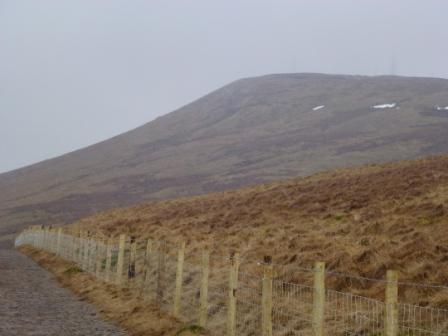
Winter Hill

Winter Hill

Gwyn is also seen as the Winter King. It is possible his white, shining qualities relate to snow and cold, associations which could date back to the Ice Age. Elen Sentier links Gwyn with the reindeer goddess Elen of the Ways (13) and the Boreal forest. He may also be connected with the North wind. The 14th C Welsh poet Dafydd ap Gwilim refers to ‘Tylwyth Gwyn, talaith y gwynt’ ‘the family of Gwyn, the province of the wind’ (14). The pervasiveness of a myth featuring Gwyn in Northern Britain could have a basis in its harsh winters.

In a later text, The Life of St Collen (14th C), Gwyn is referred to as ‘the King of Annwn and the Fairies’ and is supposedly banished by the saint from Glastonbury Tor (15). The transition from belief in Gwyn as a King of Annwn to King of the ‘Tylwyth Teg’ or ‘Fair Folk’ is a significant one. The original natures of Gwyn and the spirits of Annwn are covered over by their reduction to diminutive form. However, hints at their mythos can still be found in the majority of folktales.

Gwyn retains his status as leader of the Wild Hunt in the folklore of Wales and Somerset. There he is seen to appear on horse back with a pack of white, red-eared hounds, riding out on Nos Calan Gaeaf and through the winter months, chasing down the souls of the dead. To hear his hounds is an omen of death. The other riders are seen often seen as captive souls and may represent the spirits of Annwn.

In the North West of England, however, the hunt is assigned either to the Norse god Odin, or to Christian angels. In Cumbria it is Michael, and in Lancashire and Yorkshire Gabriel is said to lead a pack of black, red-eyed dogs, the Gabriel Ratchetts.

Coincidentally, Preston born writer Francis Thompson is famous for a poem called ‘The Hound of Heaven.’ Anybody who has felt like Gwyn’s hounds are on their tail might find these lines hauntingly familiar; ‘I fled Him, down the nights and down the days; / I fled Him, down the arches of the years; / I fled Him, down the labyrinthine ways / Of my own mind; and in the mist of tears / I hid from him, and under running laughter.’ (16)

More recently, Gwyn’s significance as an ancient god has been attested by contemporary scholars such as Geoffrey Ashe, in King Arthur’s Avalon (2007) and Nicholas R. Mann in The Isle of Avalon (1996) and Glastonbury Tor (2012). He is also the subject of a full length book called Gwyn: Ancient God of Glastonbury and Key to the Glastonbury Zodiac (2007) by Yuri Leitch.

This increase in interest suggests we are approaching a time when Gwyn and the spirits of Annwn are taken seriously as Brythonic deities again. However, the main focus of these books is Gwyn’s role at Glastonbury, with only a small mention of his place in Wales and other areas of Britain. Disappointingly there is no mention of Gwyn’s activities in the North. In this respect I have only my own experiences and conjectures to go on.

Fairy Lane

Fairy Lane

I first met Gwyn on Fairy Lane in my hometown of Penwortham, where he challenged me to journey with him to Annwn. Since then I have worked with him as a guide to the otherside of my local landscape and its hidden myths. His interest in my locality surprised me at first. However, it seems less surprising when looked at in the context of his role as an ancient underworld god of Britain, particularly in relation to the history and folklore surrounding this site.

Penwortham has been inhabited since 4000BC. The Riversway Dockfinds, a collection of animal bones, 30 human skulls, two dug out canoes and the remains of a timber structure suggest the existence of a lake village on Penwortham Marsh. Nearby is Castle Hill, a point of military and religious importance. There is a church dedicated to St Mary on the summit of Castle Hill, which means it was likely to have been a pre-Christian sacred site.

That the church is dedicated to St Mary and she was also the patron saint of a healing well at the foot of Castle Hill suggest the presence of an earlier female deity with healing powers, who has been Christianised as Mary. Three human skulls found in the wall of the church (17), which may have served an apotraic function suggest superstitious beliefs in chthonic spirits were also once popular but not openly acknowledged.

The survival of the legend of Penwortham Fairy Funeral attests to these superstitions. In the earliest version in Bowker’s Goblin Tales of Lancashire (1878), it is set on Church Avenue on Castle Hill. Two men walking home to Longton encounter a procession of fairies carrying a coffin. Robin, one of the men, looks into the coffin and sees his own miniature corpse. Frightened by the sight, they follow the fairies into St Mary’s graveyard. Robin attempts to prevent the burial by reaching out to grab the leader of the fairies. The procession vanishes and Robin, driven mad, topples to his death from a haystack a couple of months later (18). In later versions, this story takes place on Fairy Lane, which runs through Penwortham Wood at the foot of Castle Hill.

This legend may be interpreted to hint at older beliefs in underworld gods. Church ways are often identified with spirit paths. It is possible that prior to Christianity people believed chthonic spirits to have been actively involved in bearing the deceased to the underworld. The ringing of bells to drive them away and superstitions surrounding lych gates are testaments to fear of such entities. The movement of the legend to Fairy Lane may be seen as an attempt to sever their connection with the church. It is also possible it represents a shift in the energy of the area.

Gwyn ap Nudd and the spirits of Annwn (more frequently referred to as fairies today) are frightening beings. However, they play an essential role in maintaining the relationships between the worlds, the seasons, and the living and the dead. Like death itself and the cold dark of winter they will never go away. Their roles and identities, covered over or ignored for many centuries, can be recovered and understood.

Like Pwyll’s meeting with Arawn, my relationship with Gwyn has changed my life. He guides me to visions in Annwn and the physical world I would not be able to access without him. He teaches me to walk the spirit paths and inspires me to learn the song lines of this land’s ancestral heritage.

As late summer arrives, harvesters take to the fields and leaves begin to fall I sense the spirits of Annwn stirring, the first hint of the breath of winter on the wind. Monday is the date of the commemoration of the beginning of the First World War. When I help lay candles in front of Preston cenotaph for each of the 1956 soldiers who lost their lives I will remember that care of the souls of the battle dead was once believed to be Gwyn’s role.

(1) http://www.caerfeddwyd.co.uk/
(2) http://www.mabinogi.net/sections/Appendix/The_Underworld_Gods.pdf
(3) James MacKilliop, Dictionary of Celtic Mythology, (1998), p375
(4) Robin Herne, Old Gods, New Druids, (2009), p48
(5) A collection of Kingdoms in the North of England and Southern Scotland from 500AD and 800AD.
(6) Transl. William F. Skene, ‘The Dialogue of Gwyddno Garanhir and Gwyn ap Nudd,’ The Four Ancient Books of Wales, (2007), p210-211
(7) Transl. Sioned Davies, ‘How Culhwch Won Olwen,’ The Mabinogion, (2007), p199
(8) Ed. Rachel Bromwich and Simon Evans, Culhwch and Olwen, (1992), p169
(9) Transl. Sioned Davies, ‘How Culhwch Won Olwen,’ The Mabinogion, (2007), p199
(10) https://www.blogger.com/profile/02055792516386371373
(11) Ed. Rachel Bromwich and Simon Evans, Culhwch and Olwen, (1992), p133
(12) Ibid. p150
(13) Elen Sentier, Elen of the Ways, (2013), p26-28
(14) Dafydd ap Gwilim, Poems, (1982), p132 – 133
(15) http://www.maryjones.us/ctexts/collen.html
(16) Francis Thompson, The Hound of Heaven and Other Poems, (2000), p11
(17) Rev C. Nelson, St Mary’s Church, Penwortham, Lancashire, Archaeological Watching Brief and Explanation, (2011), p48
(18) http://www.gutenberg.org/files/39712/39712-h/39712-h.htm#THE_FAIRY_FUNERAL

Many thanks to Heron and Lee at Caer Feddwyd for bringing Will Parker’s article to my attention.

Corpse Road

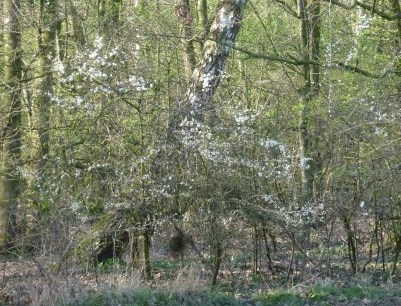
Birch and Blackthorn, Hurst Grange Park, PenworthamWho’ll walk the corpse road back to me?
– ‘Revenants’ Andrew O’Riordan

Where spring brings hope to downy birch
And blossoms of stars to blackthorn trees
When the hunt is still as the final frosts
Who will walk the corpse road back to me?

Where spring brings hope to drunks of the woods
With the pale potential of anemone
When my court dance in dew where a man lay cold
Who will walk the corpse road back to me?

Where spring brings hope to primrose hills
But none to vagrants on city streets
When wills clash like I do with impudent rivals
Who will walk the corpse road back to me?

Where spring brings hope to prison gardens
For a watchful moment the condemned walk free
When to solitary confinement comes Annwn’s darkness
Who will walk the corpse road back to me?

Where spring brings hope to those who can see it
Yet Victorian cells of asylums scream
When dreams of my kind are derided as madness
Who will walk the corpse road back to me?

Where spring brings no hope and death is release
And no fusion of flowers can quench the pain
When souls are lost as my absent queen
Will you walk the corpse road back to me?

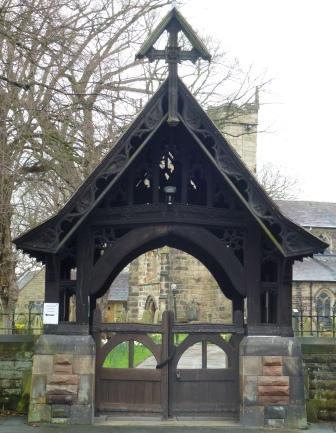
Lych Gate, St Mary's Church, Penwortham* Poem written in the voice of Gwyn ap Nudd, a British King of the dead and the fairies