The One Who Didn’t Go To The Meadows of Defwy

In the fifth verse of ‘The Spoils of Annwn’ Taliesin berates ‘pathetic men’ (monks) who do not know ‘who made the one who didn’t go to the Meadows of Defwy’. I have been perplexed for several months by these lines, which pose the questions: Where and what are these mysterious meadows? Who didn’t go? What is the significance of not going? Who is his/her maker?

The Meadows of Defwy

Both my research and spirit-journeys suggest the Meadows of Defwy are in Annwn, ‘the Deep’, the Brythonic Otherworld. ‘The Spoils of Annwn’ depicts Arthur’s raid on seven otherworldly fortresses and his plundering of its treasures. Arthur’s adversaries are Pen Annwn, ‘the Head of the Otherworld’, and his people.

In the fifth verse, the Meadows of Defwy are connected with the Brindled Ox and Caer Vandwy, ‘the Fortress of God’s Peak’. In ‘The Conversation of Gwyn ap Nudd and Gwyddno Garanhir’, Gwyn (Pen Annwn) speaks of his ‘sorrow’ at witnessing ‘a battle at Caer Vandwy’ where ‘the honoured and fair’ fought Arthur’s raiding party and lost. This resulted in the theft of the Brindled Ox.

The first time I journeyed to the Meadows of Defwy I walked straight into the aftermath of the Arthur’s battle and recorded what I saw in the following verse:

A plain of blood where men once stood.
The lights have gone out in Caer Vandwy.
The clashing sea rolls over shield and spear.
The living dead. The dead dead again.

The Brindled Ox had been stolen, leaving only the deep trails of his struggling hooves as he was hauled aboard Prydwen, Arthur’s ship. His herd were frightened witnesses who had watched from a distance.

The association of the Brindled Ox with the Meadows of Defwy suggests it is a place where the animals of Annwn graze. This is backed up by the folktale Childe Roland, in which Roland found herds of horses, cows, sheep, goats, swine, and a flock of hens in Fairyland/Annwn. Roland beheaded each of their herders before assaulting the Fairy King’s castle.
wild-flowers-1363733002BId

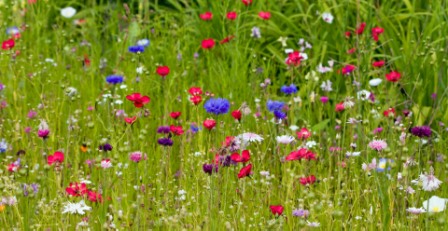
In more recent journeys I have found myself galloping through the Meadows of Defwy as a horse with the horse-herds. The meadows have appeared as a paradisal place of endless grassy plains alive with meadowflowers, bees, butterflies, grasshoppers, crickets.

It shares a kinship with ‘the Plains of Annwn’, which are written about by modern polytheist Nick Ford:

Broad and wide the plains of Annwn,
Sweet and thick, the grass thereon;
Fragrant with a million flowers,
Where graze the herds of Riganton.

Mild the breeze breathes on the pastures,
Blows the grasses that way, this;
As the horse-herds, like the wind, race
Further than the mind can guess.

The Meadows of Defwy are connected with the mare goddess Rigantona/Rhiannon and seem to bear some resemblance to the Elysian Fields of Greek mythology where the souls of the dead go to lead a blessed and happy afterlife.

Marged Haycock suggests Defwy is a river-name deriving from def-/dyf ‘black’ and may have been viewed as a river of the dead. A river Dyfwy is referred to in ‘The Spoils of Taliesin’: ‘Fine it is on the banks of Dyfwy / when the waters flow’. The Elysian Fields are located by the river of Oceanus, which separates this world from the underworld.

This ties together to suggest the Meadows of Defwy are a liminal place where the dead reside happily alongside the animals of Annwn (unless assaulted by thisworldly raiders!).

The One Who Didn’t Go

 It is my belief the phrase ‘the one who didn’t go the Meadows of Defwy’ does not literally mean someone who has not visited the meadows, but refers figuratively to someone who has escaped death.

Who could that be?

After pondering this question for a long while I received an answer from Greg Hill’s new translation of ‘The Conversation Between Taliesin and Ugnach’. When I first read this poem, which opens: ‘Horseman who rides to the fortress, / With white hounds and great horns’ I had a strong feeling the horseman was Gwyn, but was confused by his revelation of his name as Ugnach.

My confusion was laid to rest by Greg’s explanation that the suffix -ach signifies a supernatural character. It’s therefore likely to be another title of Gwyn/Pen Annwn. Greg added in a discussion that when Ugnach identifies himself he uses the word ‘heno’, a variant on ‘name’, but that ‘heno’ also means ‘tonight’. He might be saying ‘he is Ugnach just for tonight’.

The identification of Ugnach with Gwyn/Pen Annwn makes perfect sense in the context of the poem. Ugnach repeatedly extends his invitation to Taliesin to visit his fortress, promising ‘shining mead’, ‘wine flowing freely’, ‘fine gold for your spear-rest’ and a ‘bed’. Taliesin refuses to be lured by his ‘speech honeyed and fair’ and repeatedly states he does not know Ugnach. Whilst acknowledging Ugnach’s feast he insists he cannot stay.

Taliesin is refusing to stay with Ugnach in the lands of the dead; to accept death; to go to the Meadows of Defwy.

Taliesin is the One Who Didn’t Go To The Meadows of Defwy. Characteristically he is riddling about himself!

Who then is his maker?

Taliesin describes his making in ‘the Battle of the Trees’:

It was not from a mother and a father
that I was made,
and my creation was created for me
from nine forms of consistency:
from fruit, from fruits,
from God’s fruit in the beginning;
from primroses and flowers,
from the blossom of trees and shrubs,
from earth, from the sod
was I made,
from nettle blossom,
from the ninth wave’s water.
Math created me
before I was completed.
Gwydion fashioned me –
great enchantment wrought by a magic staff.

It seems this story refers to his making prior to his incarnation as Gwion Bach and rebirth from the womb of Ceridwen as Taliesin. He believes himself to have been created by the magician gods ‘before the world (was made)’ ‘when the extent of the world was (still) small’.

Thus he places himself above the processes of death and rebirth symbolised by the cauldron of Ceridwen which stands at the centre of the feast of Pen Annwn. Refusing to go to the fortress of Ugnach, Taliesin goes instead to ‘the fortress of Lleu and Gwydion’. Caer Gwydion is located in the Milky Way. There he hopes to reside in eternal life with his makers.

Taliesin escapes the fortress from which he helped steal the cauldron, the meadows where he fought ‘the honoured and fair’, the god of many names he refuses to know, but for how long?…

SOURCES

 Greg Hill, ‘The Conversation Between Gwyn ap Nudd and Gwyddno Garanhir’, The Way of the Awenydd
Greg Hill, ‘The Conversation Between Taliesin and Ugnach’, The Way of the Awenydd
Marged Haycock, Legendary Poems from the Book of Taliesin, (CMCS, 2007)
Nick Ford, ‘The Plains of Annwn’, Association of Polytheist Traditions

Caer Vandwy and the Theft of the Brindled Ox

A plain of blood where men once stood.
The lights have gone out in Caer Vandwy.
The clashing sea rolls over shield and spear.
The living dead. The dead dead again.

***

The sixth fortress in ‘The Spoils of Annwn’ is Caer Vandwy. This has been translated as ‘Fortress of God’s Peak’ and ‘Fort of the High God’. Marged Haycock uses ‘Mand(d)wy Fort’ but does not explain her re-rendering. It could relate to Manawydan (‘Manawyd’ in ‘Arthur and the Porter’). The connection of a sea-god with an island location seems credible.

In the verse relating to Caer Vandwy, Taliesin again berates ‘pathetic men’ (monks) for their lack of insight into certain mysteries he is knowledgeable about:

‘I don’t deserve to be stuck with pathetic men trailing their shields,
who don’t know who’s created on what day,
when at mid-day God was born,
(nor) who made the one who didn’t go to the Meadows of Defwy.’

The second line suggests the existence of a Bardic riddle enumerating mythic and/or historic figures born on certain days. In line three, Haycock reconstitutes Dwy ‘God’ from Cwy. Caitlin and John Matthews prefer Cyw ‘chick’ whereas Sarah Higley sticks with Cwy as a personal name.

Haycock’s choice fits with the translations of Caer Vandwy as a fortress belonging to (a) God. This may not be the Christian God. In the next verse Taliesin refers to the ‘pathetic men’ as ‘(those) who don’t know on what day the Lord is created’. Lord is translated from Pen ‘Head’. Perhaps this god is Pen Annwn ‘The Head of Annwn’.

Next we come across an unnamed person ‘who didn’t go to the Meadows of Defwy’. Haycock suggests Defwy is a river-name meaning ‘black’ (from def-/dyf) and poses the question ‘Was this imagined as a river between this world and the next?’

The Matthews link the Meadows of Defwy to Gweir ap Gweirioed ‘Hay son of Grassiness’ (the divine prisoner in verse one) and say ‘we may be looking at Doleu Defwy as an otherworldly meadow’.

This brings to mind the Gwerddonau Llion (translated as ‘green meadows of the sea’ and ‘green islands of the floods’). In a triad* referring to ‘three losses by disappearance of the Isle of Britain’ Gavran is said to have gone to sea in search of the Gwerddonau Llion.

Philip Runngaldier connects the Gwerddonau Llion with the sunken land of Cantre’r Gwaelod ‘The Bottom Hundred’ and says they are inhabited by ‘Gwyllion’: ‘the shades of (Llyn) Llion’ ‘the dead’. Perhaps the one who didn’t go to these mysterious meadows escaped death.

***

Taliesin continues to deride the monks:

‘those who know nothing of the Brindled Ox, with his stout collar,
(and) seven score links in its chain.’

Grazing on the Meadows of Defwy we come across an animal of great fame: Ych Brych ‘The Brindled Ox’. He appears in The Triads as one of ‘Three Principal Oxen of the Island of Britain’:

‘Yellow Spring (‘The One of the yellow of spring’)
and Chestnut, of Gwylwylyd (or ‘a meek and gentle ox),
and the Brindled Ox.’

His capture is amongst the ‘impossible tasks’ Arthur and his men must fulfil on Culhwch’s behalf in Culhwch and Olwen. For food to be grown for Culhwch and Olwen’s wedding feast, a field must be ploughed by the divine ploughman, Amaethon.

The plough must be pulled by a team of six oxen: ‘the two oxen of Gwylwlydd Winau, yoked together’, ‘Melyn Gwanwyn and the Ych Brych yoked together’ and ‘two horned oxen… Nyniaw and Peibiaw.’

Two oxen from the triad: Yellow Spring and the Brindled Ox are placed together and Gwylwylyd appears as the owner of two oxen, presumably Chestnut and an unnamed ox. Intriguingly Nyniaw and Peibiaw are the sons of the king of Archenfield ‘whom God transformed into oxen for their sins.’

John Rhŷs records a folkloric story where Nyniaw and Peibiaw are brother kings. One moonlit night, Nyniaw boasts his field is ‘the whole firmament’. Peibiaw says his sheep and cattle are grazing in his fields: ‘the great host of stars, each of golden brightness, with the moon to shepherd them.’ Nyniaw is furious and a terrible battle ensues which leads to their transformation into oxen by God.

This may be a Christianised explanation of their shapeshifting capacities. In The Tain, the two bulls Finnbennach and Donn Cuailnge are ‘pig-keepers’ ‘practiced in the pagan arts’ who can ‘form themselves into any shape’. Tricked into falling out, they battle against each other as birds of prey, whale and seabeast, stags, warriors, phantoms, and as dragons before becoming maggots, being swallowed by cows and reborn as bulls. It seems likely the Brindled Ox was originally a shapeshifter with the capacity to take human and other forms.

***

In the last lines of the verse Taliesin says:

‘And when we went with Arthur, sad journey,
save seven none came back from Caer Vandwy*’.

The final line is repeated as a refrain at the end of each verse. Of three full loads of Prydwen who went to Annwn, only seven survivors return. Some catastrophe has taken place. Lines spoken by Gwyn ap Nudd in The Conversation of Gwyn ap Nudd and Gwyddno Garanhir suggest this was a battle at Caer Vandwy:

‘to my sorrow
I saw battle at Caer Vandwy**.

At Caer Vandwy I saw a host
Shields shattered, spears broken,
Violence inflicted by the honoured and fair.’

It is my growing intuition the names of individual fortresses are in fact different names for the same fort. In the previous verse Taliesin said six thousand men and an incommunicative watchman were standing on Caer Wydyr’s glass walls. Gwyn is referring to the catastrophic battle against the people of Annwn by which Arthur and his men broke into the fort. After breaking in, they took Gweir, stole the Head of Annwn’s cauldron, and captured the Brindled Ox before slamming ‘Hell’s gate’ shut.

A couple of months ago Brian Taylor drew my attention to a passage in James Hillman’s The Dream and the Underworld which illustrates the parallels between Arthur’s raid on the Head of Annwn’s fortress and Hercules’ assault on the House of Hades: ‘drawing his sword, wounding Hades in the shoulder, slaughtering cattle, wrestling the herdsman, choking and chaining Cerberos… the Herculean ego does not know how to behave in the underworld’.

As I continue my own journey through ‘The Spoils of Annwn’ where others see a quest for inspiration, I see violence, desecration, the utmost disrespect for the people of Annwn: a trail of atrocities committed by a power-hungry warlord and ambitious bard.

Far from being a model for seekers of Annwn’s mysteries it advocates the selfish pursuit of objects of desire through deceit and brute force. Our stories of journeys to the underworld are reflected in the upperworld and we have still not outgrown this Arthurian/Herculean mindset.

New ways of approaching Annwn based on respectful relationships with its people are required. Perhaps in time these will yield the stories needed to replace Arthur’s hegemony. But first repairs must be made…

*This is referred to in The Cambro Briton but I can’t find a source. It isn’t in The Triads of the Islands of Britain.
**Rather than using Haycock’s unexplained re-rendering of Gaer Vandwy I have stuck with the name in the Welsh text.
***Heron translates kaer wantvy as Caer Fanddwy. I’ve stuck to Caer Vandwy for consistency.

SOURCES

Caitlin and John Matthews, King Arthur’s Raid on the Underworld, (Gothic Image, 2008)
Heron (transl), ‘Gwyn ap Nudd and Gwyddno Garanhir’
James Hillman, The Dream and the Underworld, (CN, 1979)
Marged Haycock (transl.), Legendary Poems from the Book of Taliesin, (CMCS, 2007)
Philip Runggaldier, Llyn Llion Theory, (Matador, 2016)
Rachel Bromwich (ed), The Triads of the Island of Britain, (University of Wales Press, 2014)
Sarah Higley (transl.), ‘Preiddu Annwn’, (Camelot, 2007)
Sioned Davies (transl.), The Mabinogion, (Oxford University Press, 2007)
Thomas Kinsella (transl), The Tain, (OUP, 1979)
Wirt Sikes, British Goblins, (Lightning Source, 1880)