Inbetween my decision to rewrite In the Deep and beginning I decided to return to some of the source material. I had been avoiding The Book of Taliesin for a long long time because, as a devotee of Gwyn ap Nudd, a King of Annwn, I find his support of Arthur in the raiding of Annwn (1) and of Lleu and Gwydion in battling against Annuvian monsters (2) incredibly emotive.
Still, I took another look, and didn’t find anything I hadn’t remembered. And Taliesin’s warmongering and bragging had got no less annoying.
Then, when, I was out running this morning I found my mind wandering to Taliesin mocking ‘pathetic men’ (monks) who do not know when God / the Lord, potentially Pen Annwn ‘Head of the Otherworld (3), was born / created then referring to monks who ‘congregate’ or ‘howl’ (4) like a pack of dogs’ and ‘like wolves’ ‘because of the masters who know’ the answers to certain riddles such as ‘the wind’s course’, ‘how the light and darkness divide’.
I had always assumed those monks were Christians but as I was running the question came into my mind, ‘What if they were monks of Annwn?’
*
My first intimation of the possibility of the existence of previous monks and nuns of Annwn occurred during my night long vigil for my lifelong dedication to Gwyn.
I spent the first six hours alone in my friend’s living room drawing a card from the Wildwood Tarot for each hour. My first card was the Four of Vessels – Boredom. Disappointing. But not unexpected. So I sat and surrendered to the likelihood the first hour was likely to be very boring. But instead of getting bored I got very lonely and found myself lamenting that I had no tradition to follow, no-one else for support in making such deep vows to Gwyn.
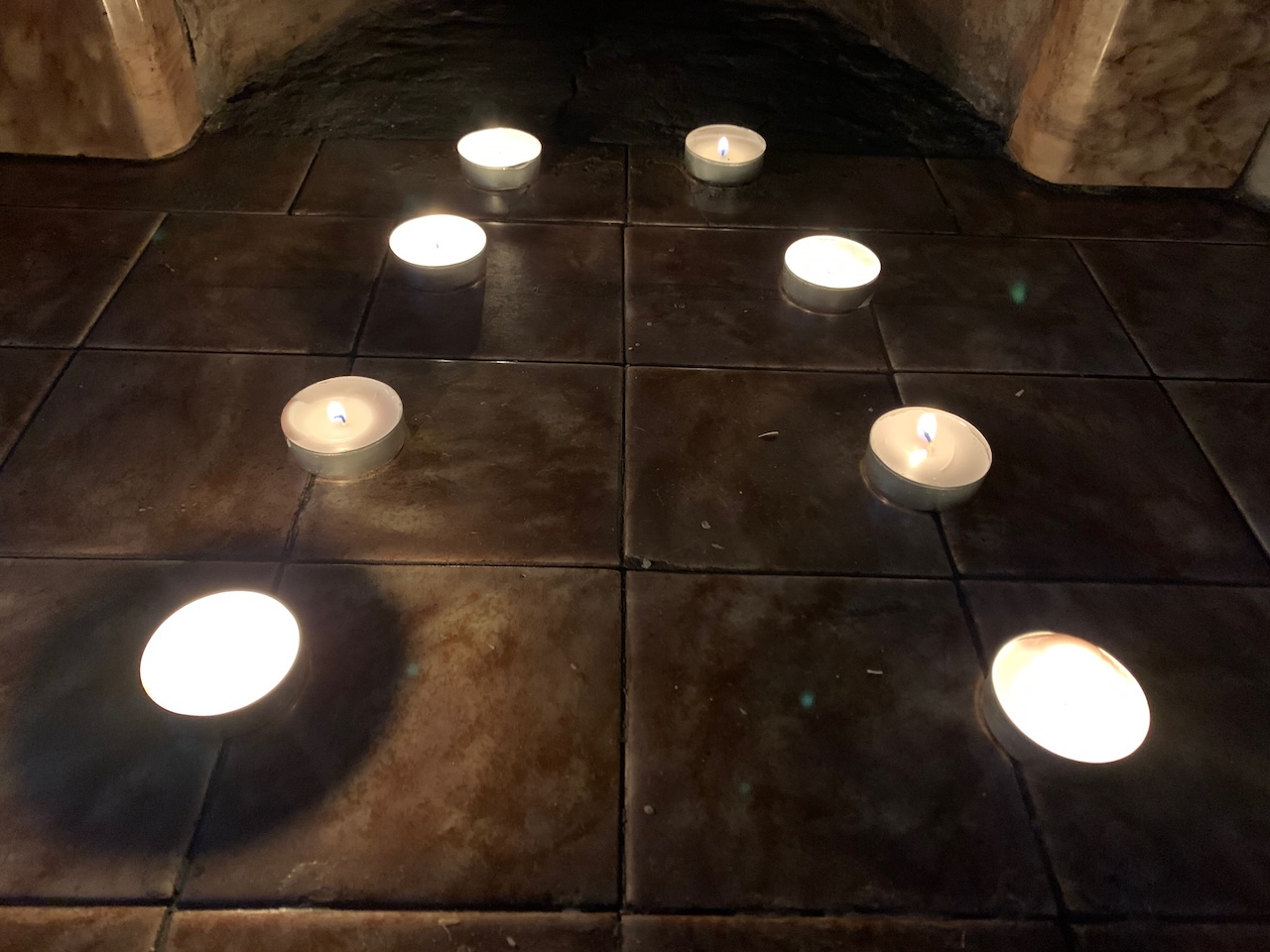
Then I had a vision. I was no longer alone. I was in some kind of underground shrine, chapel, or tomb, with long lines of monks and nuns wearing dark robes carrying candles before and behind me.
I had always thought they were monastics from other traditions who walked similar paths and had come to provide me with company but now I’m wondering if they might have been past and future monastic devotees of Annwn.
*
This reasoning might seem a bit wild particularly considering there is no evidence for monks or nuns of Annwn in Brythonic literature or lore.
However, if we look at those lines from Talieisn, first off we find them in Preiddeu Annwn ‘The Spoils of Annwn’ wherein the bard accompanies Arthur on his devastating raid on Gwyn’s realm from which only seven return.
Secondly, the monks are exhibiting extremely strange behaviour for Christians – congregating or howling like dogs or wolves. This would make far more sense if they were devotees of Gwyn who is associated with a red-nosed hound called Dormach (5) and the Cwn Annwn ‘Hounds of the Otherworld’ (6) and whose father, Nudd, is referred to as ‘the superior wolf lord’ (7).
Thus, it might be argued, Taliesin is taunting monks of Annwn with accusations of not knowing the mysteries of their God – Pen Annwn – when He was born / created, of the source of the wind, the division of light and darkness. These seem bound up with Annw(f)n (from an ‘very’ and dwyfn ‘Deep) as the primordial reality that ‘underlies or underpins our known universe’ (8).
*
Even further, another of Taliesin’s taunts, is that they do not know ‘how many saints are in the void, and how many altars’. Again it would seem odd if saints and altars were consigned to ‘the void’ rather than raised to the Christian Heaven. If they were Christians… yet the consignment to the void of Annuvian saints and altars would make a lot more sense.
Read into this more deeply and we find the disturbing possibility there existed monastic devotees of Annwn with saint-like qualities who with the altars of their Gods were committed by the likes of Taliesin and Arthur to the void.
It is notable here ‘void’ is translated from diuant ‘space, void, annihliation, death’. These monastics have not returned to Annwn, ‘the Deep’, the regenerative deep home of their God but have instead been annihilated. Their names and memories chillingly wiped by Christianity from existence.
Could it be their voices I hear from the void at this time the veil is thin?
(1) In ‘The Spoils of Annwn’,
(2) In ‘The Battle of the Trees’.
(3) Potentially the Christian God but another possibility is Pen Annwn, the Head of the Otherworld, as in the second instance ‘Lord’ is translated from Pen.
(4) Margeret Haycock’s translation reads ‘congregate’ and Sarah Higley’s ‘howl.’
(5) In ‘The Conversation of Gwyn ap Nudd and Gwyddno Garanhir’.
(6) In the story of Iolo ap Huw in John Rhys Celtic Folklore.
(7) In ‘The Pleasant Things of Taliesin’.
(8) Kristoffer Hughes, ‘The Thirteenth Mount Haemus Lecture: Magical Transformation in the Book of Taliesin and The Spoils of Annwn’.
 The Sanctuary of Vindos