The Cow of Anrhuna

At the head of the line…
the spoil was the cow of An(r)hun(a)
.’
~ The Battle of the Trees

I am the Cosmic Cow.

I am white and red with seven legs,
eleven udders pouring the whitest milk,
a red crown of twelve stars upon my head.

My cow bells sound through the sea of stars.
My milk is the origin of the Milky Way.

I am ever loving and ever giving.

You cannot capture me because
I always come willingly.

You cannot take my milk
because I am always pleased to give.

Milk me until your fingers are bare bone
and my milk will never run dry,
not until you have used
every bucket in the world
and you have emptied every mine.

I am ever living and ever giving.

I can melt the heart
of the cruelest warlord
with one look from my soft eyes
And halt the wars betwen nations
with the scent of cud between my soft lips.

I am the spoil but I cannot be spoilt –
white, blessed, holy am I.


‘The Battle of the Trees’, in The Book of Taliesin, records a conflict between the Children of Don and Arawn, King of Annwn, and His otherworldly monsters.*

We are told ‘At the head of the line / the spoil was the cow of Anhun’. The cow, as the spoil, is absolutely central to the battle but, unfortunately we find out nothing else about her. All we are told is, ‘It caused us no disaster’. This suggests the cow is a benevolent being but we find out nothing more.

Marged Haycock suggests that Anhun is St Anthony and this buch ‘cow’, ‘buck’, ‘buck-goat’ or ‘roebuck’ might be the satyr he met in the wilderness.

This didn’t feel quite right to me – I couldn’t see the Children of Don fighting over a satyr. For a long while I saw this animal as an Annuvian cow akin to the Brindled Ox, who was stolen in ‘The Spoils of Annwn, but could discern no more.

Then, a few months ago, I was sitting looking at the name ‘Anhun’ and saw a couple of spaces between the letters filled in by the name An(r)hun(a). This title means ‘Very Great’ and she is a found Goddess who myself and a number of other awenyddion have come to know as the Mother of Annwn and of its ruler, Gwyn. (It’s my personal belief Gwyn and Arawn are titles of the same God). 

Anrhuna’s association and possible identification with a magical cow ties in with parallels from Irish mythology. Her Irish cognate is Boann or Bó Find, which might derive from the Proto-Celtic *Bou-vindā ‘White Cow’. She is the wife of Necthan (Nuada) who is cognate with Nodens / Nudd ‘Mist’ the father of Vindos / Gwyn ‘White’. *Bou-vindā fits with Her being the mother of Vindos.

Bo Find ‘White Cow’ and Her sisters Bo Rhuad ‘Red Cow’ and Bo Dhu ‘Black Cow’ came from the Western Sea to make barren Ireland green and fertile. 

My personal gnosis around the Cow of Anrhuna presents her as a cosmic cow akin to Auðumbla ‘hornless cow rich in milk’ whose milk fed the primordial giant, Ymir, from whom the world was made in the Norse myths. Also to the sacred cow and bovine appearances of the Divine Mother, Kamadhenu, and the Earth Mother, Prithvi, in the Hindu religion. 

Her loving and giving nature and endless supply of milk also link to later folklore. In the Welsh lore we find Gwartheg y Llyn, ‘Cows of the Lake’ who belong to the lake-dwelling Gwragedd Annwn ‘Wives of the Otherworld’. They are usually white or speckled / brindled and are captured for their milk and, on being mistreated or milked dry, disappear back to their lakes.

In England we find the legend of the Dun Cow who provides plentiful milk until a witch tricks her by milking her with a sieve not a pail and she dies of shock. There are two variants here in Lancashire. In one the dead cow’s rib is displayed at Dun Cow Rib Farm in Longridge. In a happier variant her milk saved the people from the plague and she was buried at Cow Hill in Grimsargh.

I now like to think these stories derive from a deeper myth featuring the Cow of Anrhuna. It also made me smile that the cattle of Annwn, likely the cow’s daughers, are associated with the Wives of Annwn after my marriage to Gwyn.

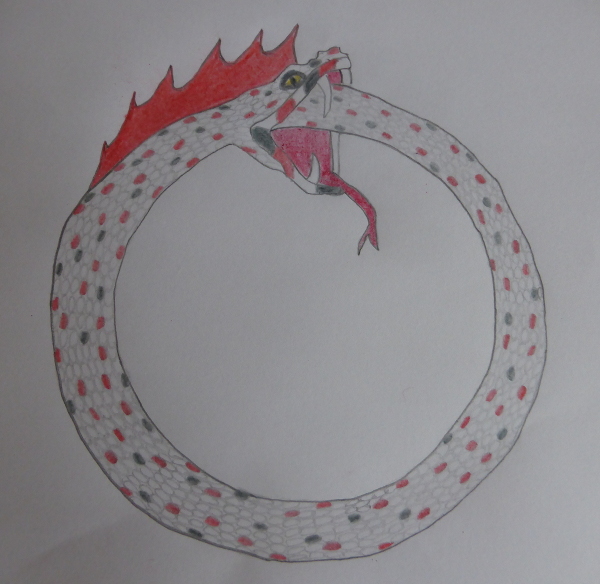
*Gwydion fashions the trees ‘by means of language and materials of the earth’. Lleu is the battle-leader, ‘Radiant his name, strong his hand, / brilliantly did he direct a host’. Peniarth MS 98B records how the battle was caused by Amaethon stealing a roebuck, a greyhound and a lapwing from Arawn. Arawn’s monsters include a black-forked toad, a beast with a hundred heads and a speckled crested snake.
Swyn

Swyn – charm or incantation; magic
Kristoffer Hughes

This woodland will not be felled by the axe of man or god. I drift with the souls through the mist of blood. It is damp on my cheeks and eyelashes. This is not the time for weeping, but undoing what Gwydion has done. When the featherless wings brush my face I push them away lightly and set to work.

It must begin and end with a snake biting her tail.

It takes me weeks (in this place the weeks are counted by the dripping of the blood) to ease the snakeskin down from the trees, to sew up the tears, to stick the scales back on with super glue, then stretch it out in a circle around the woodland. Lastly I retrieve the skull, prop open the jaws with a strong branch, slip the end of the tail between them, give my instructions to those who will bring the end.

The toadstone with its antidote must form the centre.

With ropes I drag it out of the bloody pool of bones and feel like Sisyphus as I push it into the central grove. A lapwing calls “pee-wit, pee-wit” circling overhead, a red-eared hound sits at my side, and a doe watches fractiously from between the trees as I sponge off the blood and polish it with a yellow duster, beginning to hum a tune as the bufonite sparkles green as emerald beneath my touch.

In the jaws of the hundred-headed beast the gateways must be opened.

I leave the woodland and climb the hill to where the heads of the beast are piled up like a totem. Stepping inside each set of cavernous jaws I light a candle to illuminate each cave and redraw the gateways around each throat with a glow-in-the-dark marker pen and somewhere hear a belly rumble.

The eagle-feathered staff of the swynydd to reverse the swyn.

Slithering on damp bone I climb my way up slowly, a candle, a gateway, in every skull, to the very top. I wrest Gwydion’s staff from between two skulls and shake his presence from it. Gently I untie the eagle feathers and watch them drift slowly to the ground like Lleu sung from the oak in Nant Lleu.

With a smile I tie on the feathers of the owl and speak a prayer to Blodeuwedd and all her kind. I call to my Lord of Annwn, Brân with his alder shield, Pryderi the swineherd dead before his time.

Beneath the stars of promise, seated on the top skull of the beast, one leg crossed over the other, I sing:

Blood drenched trees
beyond Caer Nefenhyr
souls amongst the trees
will you ever be free?

As I sing I see the trees awakening as if from a long sleep, staring about in horror, shaking off the blood. Birch is abashed by his blood-stained armour whereas Ash is proud of his splashes and scars. Golden Rod, afraid her beauty will be forever be marred, lays down her rods of golden flowers like swords.

From their bloody death-spots the souls unattach themselves, ease themselves out of the mist, the rain.

Blood drenched trees
enchanted into warriors
woodland of lost souls
will you ever be free?

A bending of the boughs, a turning and circling in confusion, the deep rumbling voice of Oak as he argues with Holly again, the silvery tongue of Birch calming them, the dream-wisdom of Willow, the fire of Rowan, prickly Blackthorn playing devil’s advocate, the squeak of clover demanding a say.

Souls fly like moths to the flame to the jaws of the beast. The green light of the toadstone begins to glow.

Blood drenched trees
will you return to Annwn
with souls of mist and feather?
Will you accept freedom?

The green light soothes them and, as a woodland, as a whole, united by blood and mycelium they agree.

The souls step into the caverns, to the gateways, and the beast shudders to life. The snakeskin begins to twitch. I sense the end approaching like the snap of countless jaws as the snake bites her tail.

Speckled Crested Snake Ouroboros Med

*This piece follows on Caer Nefenhyr and is based upon a spirit journey into the otherworldly landscape where ‘the Battle of the Trees’ took place.

Caer Nefenhyr

I was in the Fort of Nefenhyr:
herbage and trees were attacking.
Poets were singing;
soldiers were attacking.’
The Battle of the Trees

The trees are still. Frozen. Still stained with blood thigh-deep. It trickles down trunks, drips from boughs. Mighty Oak is soaked in it and whomping Willow and Alder, who marched at the fore as Brân clashed his spear on his shield and Lleu, strong-handed, radiant, rode in the branches like an Eagle.

Blood is dripping from heart-shaped Ivy. Honeysuckle cannot shake off her tendrils. Clover is drowned. Bramble is, of course, in his element, and Blackthorn is bloodily pretty. Birch regrets putting on his armour, now speckled white and red like a hound, he is kneeling like a sorrowful knight.

Raspberry, who did not put on his defensive palisade, lies broken and bereft of his blood-red fruits. Vine the destroyer is destroyed, Pear the oppressor oppressed, Bracken the pillager pillaged. Heather, no longer purple but red, regrets being enchanted into the army. Cherry’s commotion is silenced.

Pine, in the place of honour, downed his needles and wept. Dogwood, bull of battle, hangs his head. In the woodland beyond Caer Nefenhyr it rains nothing but blood and the cry of a lapwing ever circles.

Souls of soldiers and poets flit between the trees like birds fighting over blood-red berries like harpies. They have gazes like the fragile doe who wanders leaving bloody footprints between worlds.

A sagging snakeskin is strung up, stretched out in the trees like an afterbirth, emptied of a hundred souls.

Amidst the alders is a bloody pool. In it float the bones of a toad and his hundred claws. In the centre is the green and glowing toadstone from his head which, like a crown, symbolised his majesty.

Beyond the woodland, on a hill, like a cairn or totem, are piled the hundred heads of a great-scaled beast. The roof of his tongue and his napes are empty of battalions yet cries still echo from the hollows.

Atop the heads, like a flag of victory, is Gwydion’s staff with Eagle feathers fluttering in the wind.

In the Woodlands Beyond Caer Nefenhyr it Rains Nothing but Blood

‘In the woodland beyond Caer Nefenhyr it rains nothing but blood’