The Edge of the Dark

‘as ‘th’ edge o’ dark’ threw its weird glamour over the scene, boggarts and phantoms would begin to creep about to the music of the unearthly voices heard in every sough and sigh of the wandering wind…’
– James Bowker, Goblin Tales of Lancashire

This landscape has only just been claimed and in its deepest knowing holds the memory of the edge of the dark. The majority of Lancashire’s towns and fields developed where thick shaggy mosses, carr and marsh held rule. Its people lived on the edge of darkness, the edge of unknowable waters, the edge of the otherworld.

Is this existence on the edge the source of its legends? Its fairy lanes and dells, boggart bridges, cloughs and holes, its headless phantoms and saucer-eyed spectral hounds?

How far do these stories stretch back in the minds of its people? Are they the creation of an industrial age that sought to banish darkness and uncertainty with city walls yet built a new hell in its abominable mills: its Dickensian fairy palaces as the wilderness outside grew wilder?

Are they based on the wildening of tales always strange yet homely: of the household boggart whose help might be bought with butter or milk but whose wrath could estrange a family; of fay whose magic could curse or cure; of water spirits who gave of themselves and their secrets but only at great sacrifice?

Could these stories signal an endemic relationship with the otherworld stretching back through centuries? Through Anglo-Saxon boggarts and barguests to the arcane myths of Britain to the repository of stories about ‘Yr Hen Ogledd’ ‘The Old North’ in Welsh mythology and beyond to a near forgotten oral tradition? All hinge upon the cusp of thisworld and the otherworld: the edge of the dark.

In Welsh mythology the otherworld is known as Annwn: the not-world, the deep. It is the beyond of adventure, the locus of alterity. Its landscapes are unstill, its deities and monsters have many faces. It is a source of beauty and terror, of awe, of Awen, the divine inspiration quested by the bards and awenyddion who crossed the edge of the dark to explore its depths.

The ways between the worlds are fraught with danger. Safe passage is only granted at a cost. Those who return from the otherworld are never the same. Thus they shroud themselves in the cowl of the edge of the dark.

Those who live on the edge see our precarious reign over the land and its myths is illusory. Tower blocks and elaborate street lamps are ephemeral as Dickens’ fairy palaces. Electric lighting is no defence against the edge of the dark, which seeps in because its memories are deeper than us, its darkness more permeating than headlights.

These memories evoke intense loss and mourning. Yearning for the fluting wetland birds, bog oaks, reeds, rushes, and hoofed and pawed animals of the wild quagmire we banished. For the fairies and boggarts we dare not believe in. For the gods of the otherworld who haunt the edge of the dark with pawing steeds and sniffing dogs whilst we seal ourselves in a not-world that is not Annwn choosing to occupy tiny lamp lit portions of thisworld beyond the bog’s rushy melodies.

Immersed in false light we neither perceive the people of thisworld nor Annwn until the rain pours down, the marshland rises up, and the weird glamour of the edge of the dark undoes all security as the deepest memories of our land and its legendary reality return.

Greencroft Valley

Choosing a Path

Fairy LaneThe metaphor of choosing a path appears frequently within Paganism but can be applied to the journey of life, which in many religious traditions is seen as the journey of the soul.

I’ve walked many paths; riding instructor and groom, philosophy student, fantasy writer. Over the past three years I have been writing and performing poetry and exploring Druidry. The binding core is that in each I’ve been seeking magic and I’ve pursued all these paths with religious commitment.

Looking back, it appears I have walked one path with many names. This week I have come to question the suitability of the name ‘Druid.’

I have never felt any commonality with, or desire to join any of the systematic orders of Druidry where one can complete courses and achieve grades in exchange for coins. It’s my firm belief that the living landscape, the gods and ancestors are the greatest teachers. Their guidance, trust and respect are not bought but earned, and thus utterly priceless.

However, one place I have felt at home is The Druid Network. Hearing a talk by its chair, Phil Ryder formed a huge turning point in my life that led me to recognise and honour the divine in my local landscape. The Druid Network is the only organisation I know of that promotes Druidry as a religion. There are no set courses or hierarchies. Each member is encouraged to find and explore their relationship with whatever they hold sacred in their own way, and the social forum provides a safe area for discussing issues and experiences. However, there are guiding principles (1).

I’m in agreement with most of these principles, except that the native religion of the British Isles must nominally be called Druidry. I imagine Heathens, Witches, Shamans and many other Pagan groups would make similar claims.

This winter’s solstice I was gifted a name for my path- Awenydd. For Kristoffer Hughes becoming Awenydd forms the core of Druidry. For Elen Sentier it is a form of native British Shamanism. My path currently seems to sit somewhere in an unknown hinterland between two names I am equally uncomfortable with, ‘Druid’ and ‘Shaman.’

For me ‘Awenydd’ works a similar magic to that which others describe in relation to ‘Druid’ and ‘Shaman’. It opens the doors of perception and initiates connection with the Awen, divine inspiration. It is as Awenydd I truly serve my land, gods and communities.

I can see a future for myself as Awenydd; continuing to learn the stories and songs of my local landscape and its spirits; journeying more deeply the immensities of the otherworlds with Gwyn and learning his mysteries; bringing my insights back to my communities and thus learning to weave a magic between the worlds.

Contrastingly, I perceive ‘Druid’ as closing doors, leading to pointless arguments, in-fighting, and attempting to define myself against systems and practices with which I share little commonality.

If the journey of life is the journey of the soul, I want to choose a path that fills my soul with awe and wonder. I want to live a life true to my heart, in devotion to the land and gods who call to me. I want to sing their songs. I want to share their inspiration. I want to die knowing I have done everything I can to respond to their call.

I don’t want to remain a prisoner in the maze of arguments and contradictions which, for me, constitutes contemporary Druidry, and which will only lead me into greater negativity.

It is on this basis I give up the name of Druid and choose Awenydd.

And the consequences?

The biggest consequence is that the path of Awenydd is not classed as a religion. If I am no longer a Druid I no longer belong to a religion.

To anyone on the outside this might look like a massive change. However on the inside this does not change my relationship with my land and deities, nor with family and friends.

It has, and I think will continue to have some impact on my Pagan, Druid and other religious communities. I’ve already talked my decision through with some of the members of TDN who, for the most part, are happy for me to remain a part of the organisation on the basis of shared principles, and I’m hoping to discuss it with my grove at the solstice.

My local Pagan Society is inclusive of open-minded people of any faith or none, so no problems there. As for Preston Faith Forum and the further questions, if I’m not a Druid, then am I Pagan? And can I be an Interfaith Representative if I don’t belong to a faith? That’s another kettle of fish entirely and not one I’m ready to address right now!

I want to live a life that fills my soul with awe and wonder

I choose a path that fills my soul with awe and wonder, in devotion to the magic this land, its deities and spirits, my patron Gwyn ap Nudd and the ancestors. This path is Awenydd. Let their songs be sung!

(1) http://druidnetwork.org/files/about/constitutionrevnov2009.pdf

Gwyn’s Apprenticeship and the Role of the Awenydd

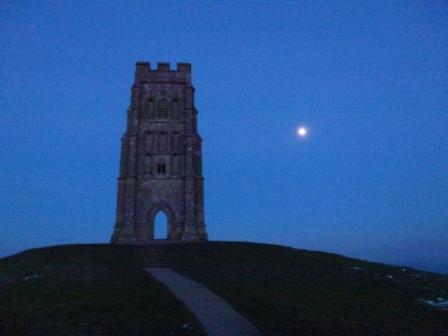
Moon over Castle HillAfter two years studying Druidry (and many years prior to this of searching) on the morning of the winter solstice I received a name for my spiritual path- Awenydd. It was a gift, bestowed by Gwyn ap Nudd (1) and the spirits of my local landscape.

Over the past year my path has grown to centre on my apprenticeship to Gwyn, which began when I made a vow to him as my patron at Glastonbury’s White Spring last January. This role has involved learning more deeply the life cycles of the trees, plants and wildlife of my local area, journeying to meet their spirits and travelling into the land’s past to learn its history. With Gwyn’s guidance I have journeyed the Otherworld, gaining direct experience of realms such as Annwn and Faery, met their inhabitants and borne witness to mythic events.

In exchange I have strived to share this magic through poetry with the aim of revealing my local landscape as inspirited and communicating my vision of the Otherworld. I believe this serves Gwyn for it his task as a king of the Otherworld and leader of the Wild Hunt to maintain the dynamic between the worlds lest this one be destroyed (2). Being gifted with the role of the Awenydd seems to be a natural development of this relationship.

An early description of the Awenyddion can be found in Giraldus Cambrensis’ 12th century manuscript, Description of Wales.

‘There are certain persons in Cambria, whom you will find nowhere else, called Awenyddion, or people inspired; when consulted upon any doubtful event, they roar out violently, are rendered beside themselves, and become, as it were, possessed by a spirit. They do not deliver the answer to what is required in a connected manner; but the person who skilfully observes them, will find, after many preambles, and many nugatory and incoherent, though ornamented speeches, the desired explanation conveyed in some turn of a word: they are then roused from their ecstasy, as from a deep sleep, and, as it were, by violence compelled to return to their proper senses. After having answered the questions, they do not recover till violently shaken by other people; nor can they remember the replies they have given. If consulted a second or third time upon the same point, they will make use of expressions totally different; perhaps they speak by the means of fanatic and ignorant spirits. These gifts are usually conferred upon them in dreams: some seem to have sweet milk or honey poured on their lips; others fancy that a written schedule is applied to their mouths and on awaking they publicly declare that they have received this gift.’ (3)

When I first read this passage a couple of years back I found little I could relate to. Returning to consider it now I find the ideas more resonant.

A phrase which immediately stands out is that the Awenyddion are people inspired. Within the Bardic Tradition I have found the predominance of structured courses of training and people’s preconceptions about the role of the Bard problematic. Experience has taught me I cannot learn stories or poems by rote. Myths and the deities within them have a life of their own, calling through Bardic, folkloric and contemporary texts, or revealing themselves in the landscapes of either world to impart the gifts of inspiration and transformation when the time is right.

Following a conversation with a visiting speaker at my local pagan society, who when I named my path as “Druid Bard” assumed I was of the ‘Bardic Grade’ and completing a ‘gwers’ within OBOD I began to question (and not for the first time) whether this name was a true fit with my spirituality.

During this period I asked Gwyn how my apprenticeship related to Druidry. He told me my role is bound up with the primal Awen, which flows before thought through all things. This supported my suspicion that true inspiration can only speak when systems, concepts and fear of other people’s opinions are set aside. Only by listening directly to the Awen and my own intuition could I become a person inspired and create works worthy of sharing with others.

Another point of resonance is that inspiration is a gift from the spirits, through possession, dreams, milk or honey or a ‘written schedule.’

I’ve never been possessed in the sense of losing my senses and being unable to recall what happened afterward. However I have channelled the voices of spirits and deities whilst writing poetry. During a writing trance visions have appeared where they have revealed themselves in new ways and I’ve recognised their guiding hand even when making finishing touches, in the gift of a completing image or right feeling of a word.

I’ve also been gifted with inspiration in dreams. One of my most significant dreams was when I learnt the identity of my white totem mare. She appeared to me winged and I joined consciousness with her to fly to the top of Castle Hill, a local sacred site. Another important dream occurred the night before my birthday. After seeing a moon bridge in the river Ribble I dreamt of questioning a series of gnarled fay in a cave in Castle Hill. When I realised the process was futile Gwyn appeared and inquired why I hadn’t asked him. By this time I had forgotten the question. The dream conveyed a powerful message about the ethos of questioning in the realms of Faery and dream.

The mention of milk or honey puts me in mind of mead, which in my experience certainly inspires connection with the spirits, writing processes, performances and rituals. The image of the ‘written schedule’ touching an Awenydd’s lips seems to symbolize direct inspiration through the written word.

In the modern world the role of the Awenydd is not limited to ecstatic prophets. Kristoffer Hughes places ‘becoming Awenydd’ – ‘becoming the inspirer’ at the core of Druidry. He says ‘they were the enlightened ones, those who serve, those who inspire to bring others into the mystery of spirit and the great song… by inspiration.’ (4)

Elen Sentier is an ‘awenydd, a spirit keeper and taleweaver from a long family lineage.’ She describes this path as ‘British native shamanism.’ (5) Alongside her reindeer goddess, Elen of the Ways she works with Gwyn as ‘the goddess’ guardian.’ Part of her work involves tracing Elen’s Deer Trods which are also the ‘energy roads’ down which Gwyn leads the Wild Hunt. Many of these are ‘spirit paths’ taking souls to the Otherworld (6) and correspond with corpse roads such as Church Avenue on Castle Hill.

For me the name Awenydd has a magic born of its direct connection with the spiritual source which flows through the land defying all systems and can only be spoken in poetry. My role as an Awenydd is one that I only have intimations of at present- small clues to the potential of learning with the leader of the wild chase and king of the Otherworld to travel the spirit paths and experience the mysteries of the primal Awen in order to return as the inspirer.

(1) Gwyn ap Nudd is a Brythonic deity. His name means White Son of Mist. He is a king of the Otherworld, leader of the wild hunt and guide of souls.
(2) Evidence of this role is found in The Mabinogion, ‘Twrch Trwyth will not be hunted until Gwyn son of Nudd is found- God has put the spirit of the demons of Annwfn in him, lest the world be destroyed. He will not be spared from there.’ Sioned Davies, ‘How Culhwch won Olwen,’ The Mabinogion, (2007), p199
(3) http://www.gutenberg.org/cache/epub/1092/pg1092.html
(4) Kristoffer Hughes, Natural Druidry, (2007), p67
(5) Elen Sentier, Elen of the Ways, (2013), pvii
(6) Ibid. p26-28

Awenydd

I.
As the longest night looses
darkest claws I walk amongst shadows
at dawn where moonlight floods
through the arms of trees
and a solitary lamppost lights the vale.

Lamppost, Greencroft ValleyII.
River-trees stand stark and tall,
consistent in her mind’s
unravelling of currents and tides,
cormorants and gulls,
a ragged heron.

RibbleIII.
The host’s roar to a lullaby
quells as moon leads dawn
over chiming hills to be swallowed
by cloud as the hunt returns
to graveyard and mound.

Moon over Castle HillIV.
My lord of the fay
makes his presence known.
He speaks to the mist within my bones
like the lych gate unfastening,
awenydd– my magic word.

Lych gate, St Mary's ChurchV.
The spirit paths are mine
to walk for an evanescent pulse
of dawn. Time stands still
from vale to hill and the stream
sings: awenydd, awenydd.

Fish House Brook

Honouring Gwyn ap Nudd

Glastonbury Tor, January 2013On the Winter Solstice a post for Winter’s King.

Samhain has passed. We’re in the dead season. The wild hunt rides the passageways of time and spirit paths lie open. Communities gather and ancestors draw close. Here I feel called to honour Gwyn ap Nudd by telling the story of how he became my muse and patron and made my life whole.

My first meeting with Gwyn took place at the nadir of a crisis. At the end of August 2012 I reached a point of conflict between my spiritual path and ambition to become a professional writer. After two years work completing a fantasy novel I realised its world was too complex and the language too heavy, it held little relevance or hope for a contemporary audience and was at odds with my developing relationship with the land and its myths.

His first appearance was at the head of a fairy procession at a local sacred site. Although I knew of the legend of the fairy funeral I didn’t think I’d encounter it directly nor did I suspect it would be led by a Welsh Fairy King. Yet Gwyn made his name and message clear. The myths of this land are real and he could help me access them. He challenged me to journey with him to the Otherworld, the condition of his guidance being that I lay aside my personal ambitions.

I spent several days considering- could I truly give up my ambition to become a professional writer? How would this change my life? How did I know I could trust him? What if I didn’t come back? Yet this experience, although it was confusing and terrifying felt more powerful and real than anything that had ever happened to me. I knew it was a once in a life time opportunity and I’d only get one chance. I returned to the fairy site and agreed.

Gwyn opened the gates to the past of this land and its myths. With his guidance I learnt how to ride the skies and ancestral pathways on my white mare, viewing the landscape’s lineaments from contemporary suburbia to medieval farmland, oak wood and peat bog to tundra and the age of ice. I met with ancestral people, the ghosts of trees and stampeding aurochs. I entered Faery and descended to Annwn.

Yet I still questioned what a deity associated with Wales and Glastonbury was doing in Lancashire. Reading his myths I realised two of Gwyn’s main stories- the abduction of Creiddylad and Arthur’s slaying of Orddu take place in the North. In the conversation with Gwyddno Garanhir, which depicts his role gathering the souls of the battle dead Gwyn says:

‘I have been where the soldiers of Prydain were slain,
From the East to the North;
I am alive, they in their graves!
I have been where the soldiers of Prydain were slain,
From the East to the South
I am alive, they in death!’

Gwyn is not only a king of Annwn and the fairies but a traveller between the worlds and across the landscape of Britain, maintaining the bonds between nature and humanity, the living and the dead. As a ruler and guide of this isle’s ancestral people his turning up at the head of a local fairy procession was not out of place.

Reassessing my past experiences I realised this wasn’t the first time I’d felt his influence. At Glastonbury festival in my late teens the veil had been lifted to reveal a vision of the Otherworld, a place I now recognise as Gwynfyd, which was coupled with a feeling of truth and ecstatic unity. Thirteen years later he had finally made his presence known, leading me from the cycle of aspiration, failure and frustration caused by my ambition to be a writer back to this magical unison with the land and its myths. He had made my life whole. In January I returned to Glastonbury and made my vow to him at the White Spring.

Since then my relationship with Gwyn has been a constant source of support and inspiration. Whilst the only piece of literature I know of that might link him with the Bardic Tradition is a reference in ‘The Spoils of Annwn’ to the Chief of Annwn possessing a cauldron warmed by the breath of nine maidens, I see him as a god of primal poetry- the wild Awen that thunders like the hunt through space and time and exists in the magic of nature, the songs of the fay and wisdom of the ancestors.

With his guidance I have discovered ways of connecting more deeply with the land and its spirits, its known myths and some unknown ones (a couple of which correspond with factual evidence!). In return I strive to communicate what I have learnt through written and spoken words to maintain the bonds between nature and humanity, this world and the Otherworlds.

And so, as we gather in the dead season, the wild hunt rides and spirit paths lie open I choose this time to tell this story to thank and honour Gwyn ap Nudd.