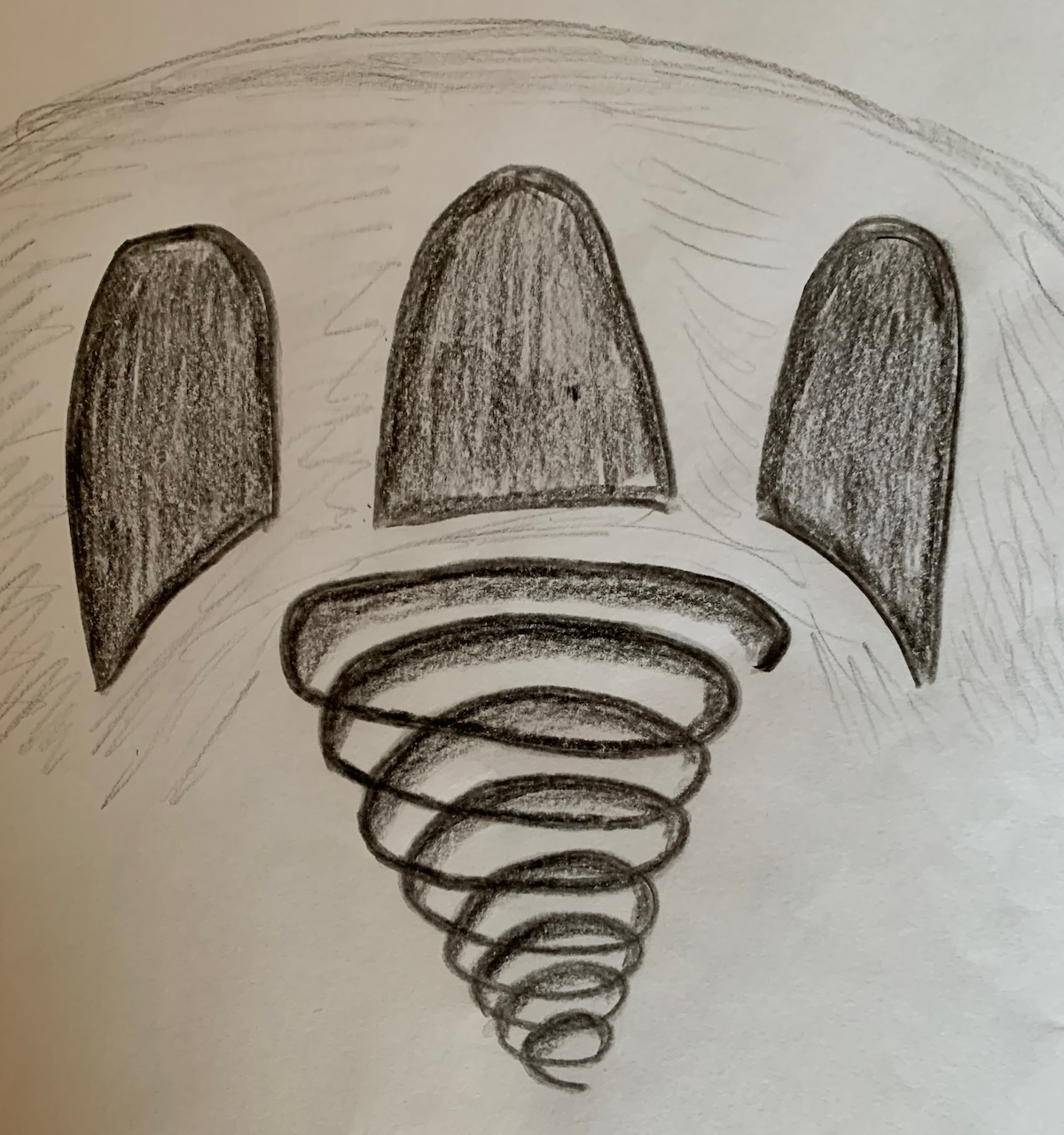
The Castle of Cold Stone – Altar Art

‘Your absence is like the spinning of the void.
You are gone to its bottommost depths
with Your Castle of Cold Stone.’
~ You are Gone

In the myth I live by after my patron God, Gwyn ap Nudd (Winter’s King) is defeated by His rival, Gwythyr ap Greidol (Summer’s King) He ‘dies’ and retreats to sleep for the summer in Caer Ochren, the Castle of Cold Stone.

For a long while I had been using Meg Falconer’s image of Caer Ochren from King Arthur’s Raid as my altar art for this period but this year I received the calling to create my own. This image depicts Gwyn’s fortress sinking into the Abyss with grief at His passing with snow and frost on the towers and winds showing that, contrarily, it is winter in Annwn. I was planning to show Gwyn’s tomb in the interior of the fort but, instead, it came through to me that He wanted me to show intimations of His faces on the walls. These appeared to me like projections of light but in ice showing that whilst He dreams His representations in myths and stories are still manifesting to us in the world.

Of Inner and Outer Voices

I recently had a revelation about a voice* that has haunted me since high school telling me if I don’t acheive certain goals such as passing exams, staying in paid work, fulfilling a role in society, my life is worthless and I don’t deserve to be here.

Mental health-wise I have been much better over the past year as a result of strength training and yoga and working on my spiritual development with my mentor Jayne Johnson. A few months ago for the first time I heard my healthy body saying ‘I want to live’ and this has helped me to combat the negative voice.

Yet I went through a difficult time after my attempt to write a novel for Gwyn failed and I realised I must truly give up my ambition to be a professional author (as I promised Him over ten years ago!). I ended up back at the Abyss with the choice between three gates – to live as I was, to die, or to change. I took the third gate.

During a period of prayer I discerned what to do next – return to outdoor work in horticulture and become a shamanic practitioner. So I started working towards those goals. I began studying for my RHS Level 2 in Horticulture and volunteering with Let’s Grow Preston. I applied for the Sacred Trust’s three year shamanic practitioner training and was over the moon when I was offered a place. However, the downside is the course and the train fares to Devon will cost all my savings and then some. 

The negative voice returned as I began to struggle with concerns about finding paid work in horticulture before my savings run out. Long term I am planning to start a nature-friendly gardening business but I am aware it will take a while to complete my training, set up, find clients and start earning. So I started applying for any outdoor work from plant nurseries and garden centres to grounds maintenance and also cleaning (which Gwyn advised me against). 

That week, the more jobs I applied for, the more I panicked, the louder the voice grew. Telling me I’m a fool to spend so much money on a course which is my soul’s calling but isn’t likely to help me earn much. Preventing me from meditating and journeying saying instead I should be applying for jobs. 

The afternoon before I attended a Radical Embodiment workshop** with Jayne and Alex Walker I had a terrible interview for a cleaning job. I arrived at the workshop scatty with the voice shouting loudly at me telling me the practices were pointless and worthless and wouldn’t help me find paid work.

I spent the first half, in the morning, battling against the voice. Then, in the afternoon, when I was more relaxed and present and connected with other bodies the voice stopped. When finally we came to dancing our insights I decided to have it out with the voice once and for all but found it had vanished.

I then received the gnosis – ‘It’s not my voice’. 

This was one of the most significant revelations of my life. For decades I thought it was a part of me, an inner critic, formed from my internalisation of the capitalist work ethic. A little like the inner Sheriff of Nottingham Nicola Smalley describes in The Path to Forgotten Freedom only a whole lot nastier.

Then, finally, it struck me, no part of my psyche would tell me I was worthless or want me dead. This voice differs from my true inner critic who, of course, is critical, can be harsh and judgemental, but is looking after my integrity.

I realised any voice inimical to my life is not my voice.

Then what is it? I began to wonder. I intuited it must be a malevolent entity. When I asked Gwyn He told me it was not one of the spirits of Annwn. I sensed it wasn’t from the underworld or any of the lower worlds but was bound up with the middleworld. Unlike the spirits of Annwn / ‘fairies’ who live in a reciprocal relationship with Thisworld but have their own independent world and reality it could not survive without parasitising upon human emotions.

Names that came to my mind were ‘liar’ and ‘deceiver’ which I remembered are applied to Satan ‘the Father of Lies’. Was I being tormented by the Devil?

When I asked one of my spiritual ancestors she replied that it was a malicious spirit, an ysbryd drygioni. Christians have blown such beings up into one big Devil in the same way they have raised Jahweh into one big God.

I asked whether I needed to hunt it down and destroy it (like Ged does the gebbeth in The Wizard of Earthsea – my experience reminded me of that story). My guide replied, ‘No’, as such beings feed on our attention and negative emotions. The best defences against it are to do the things it tells me not do because they will not help me gain a job and earn money – prayer, meditation, journeywork, sitting still in nature (which I really struggle with), being with other bodies, dancing, play and fun (which I never allow myself). 

Realising this voice isn’t mine and hearing how to defend myself from it are huge steps I am hoping will help me move forward towards earning a living in a way that allows me to stay physically and mentally well and fulfil my vocation.

I’d be interested to hear whether anyone else has had similar experiences. How do you tell the difference between inner and outer voices? I’m hoping to get to grips with such discernment processes better towards the end of my shamanic practitioner training when we approach practices such as depossession.

*Here I’m referring to intrusive thoughts not to auditory hallucinations.
**A development from embodied relational therapy.

Contemplating the Abyss Part Five – Saints in the Void?

In this final part of the series I will be looking at how abyss mysticism and the visions of the Abyss shown to me by my Gods relate to the Brythonic tradition.

The Welsh term for ‘abyss’ is affwys ‘depths, bottomless pit, precipice’ (1).

In the Welsh Bible (2) the term tehom is translated as dyfnder ‘deep’ rather than afwyss ‘abyss’. In Genesis 1.2 ‘And the earth was without form, and void; and darkness was upon the face of the deep. And the Spirit of God moved upon the face of the waters’ – ‘Yr oedd y ddaear yn afluniaidd a gwag, ac yr oedd tywyllwch ar wyneb y dyfnder, ac ysbryd Duw yn ymsymud ar wyneb y dyfroedd.’ And in Psalm 42.7 ‘deep calls to deep’ – ‘geilw dyfnder ar ddyfender’.

The first recorded usage of affwys is in the 13th century in The Book of Aneirin. ‘Disgennwys en affwys dra phenn’ ‘descend into a deep abyss’ (3). This seems significant as Aneirin was one of the Cynfeirdd, a ‘prince of bards’, along with Talhaearn and Taliesin. It is also of interest in relation to Aneirin speaking of undergoing an underground initiation in this poem (4). 

From thereon its use continues particularly in relation to Uffern ‘Hell’. ‘Yno y cloir ac rhoir rhwys yn Uffern a’i ffwrn affwys’ ‘there he will be locked up and cast into Hell and its abyssal oven.’ ‘Yn Uffern erwin aphwys’ ‘in Hell a harsh abyss.’

In The Book of Taliesin the term dwfyn is used to mean ‘depth’, ‘profound’ and ‘abyss or depths of Hell’ in the lines ‘dogyn dwyfn diwerin’ ‘the evil lot of the abyss.’ We also find the term diuant ‘space, void, annihilation, death’ as in ‘gogwn… pan ergyr diuant’ ‘I know why annihilation comes all of a sudden’ and ‘bet sant yn diuant ‘how many saints are in the void?’

Another term is agendor ‘abyss, gulf, depth’. Its earliest recorded use is in 1604. In a poem by Hugh Jones, written in 1759, we find the lines ‘Yna traflynca Annwfn / Y dorf i’r agendor dwfn’ ‘Then pass through Annwfn / the crowd to the deep abyss.’ These are suggestive of a group of people (the dead?) passing through Annwn to the Abyss and resonate with my experiences.

The notion of saints being in the void in the Taliesin poetry is also a fascinating one as we usually assume that saints ascend to Heaven. 

Could this line instead refer to monastics who practice abyss mysticism? Who go to annihilation in the void? Monks of Annwn outside the Christian orders?

Because they wrote nothing down we know precious little about the religious practices of the pre-Christian Brythonic peoples and nothing at all about their inner experiences, relationships with their Gods, what went on in their souls.

There is no evidence for beliefs about Anrhuna, Nodens / Nudd and Vindos / Gwyn being deities who act as custodians of the mysteries of the Abyss or monastics who practiced abyss mysticism but it can’t be ruled out. Whether this tradition is old or new I have been called to it as a nun of Annwn by my Gods.

(1) https://geiriadur.ac.uk/gpc/gpc.html
(2) https://www.bible.com/versions/394-bcnd-beibl-cymraeg-newydd-diwygiedig-2004
(3) https://geiriadur.ac.uk/gpc/gpc.html I couldn’t find a full copy of The Book of Aneirin in modern Welsh let alone a translation into English to check the context. 
(4) ‘I do not laugh the laugh
under the feet of creepy crawlies.
My knees stretched out in an earthen cell,
an iron chain
around my knees.’
Cited in Lawrence Eson, Merlin’s last cry: ritual burial and rebirth of the poet in Celtic and Norse tradition, January 2007, Zeitschrift fur celtische Philologie 55 (1)

Contemplating the Abyss Part Four – The God Beyond the Gods

In the previous post I looked at abyss mysticism in the writing of medieval monastics. Here I shall discuss how it relates to the visions of the Abyss that formed the core of my attempted novel, In the Deep, and to my own experiences.

The Christian abyss mystics of the medieval period perceived the soul and God to be dual abysses. Through a process of annihilation, led by love, the abyss of the soul was dissolved in the abyss of God. Van Ruusbroec conceived this slightly differently suggesting the Abyss was a ‘God beyond God’.

The process of annihilation was one that involved suffering. Penitence, purgation, purification, to varying degrees in different authors but the result was ultimately joyous union with God as the ‘divine’ or ‘blessed’ abyss.

The big difference between my own experiences and visions and those of these Christian mystics is theological as I am a polytheist and not a monotheist and find it difficult to identify the Abyss with the Christian God. 

The Abyss has a presence in my life as something powerful, as something divine, as a deity, but not as a God I can name. Thus Van Ruusbroec’s conception of it as a ‘God beyond God’ resonates deeply with me as does the positing by the Gnostics of a God of the Deep preceding the creator God whose prior existence is suggested in Genesis 1.2 ‘And the earth was without form, and void; and darkness was upon the face of the deep. And the Spirit of God moved upon the face of the waters.’ The terms ‘deep’ and ‘abyss’ stem from the Hebrew tehom and are often used interchangeably.

In the cosmology that has been revealed to me by the Brythonic Godsthe Abyss is part of Annwn, ‘Very Deep’, its deepest part, its bottomless depth. It is a place to where the souls of the dead return and from it are reborn.

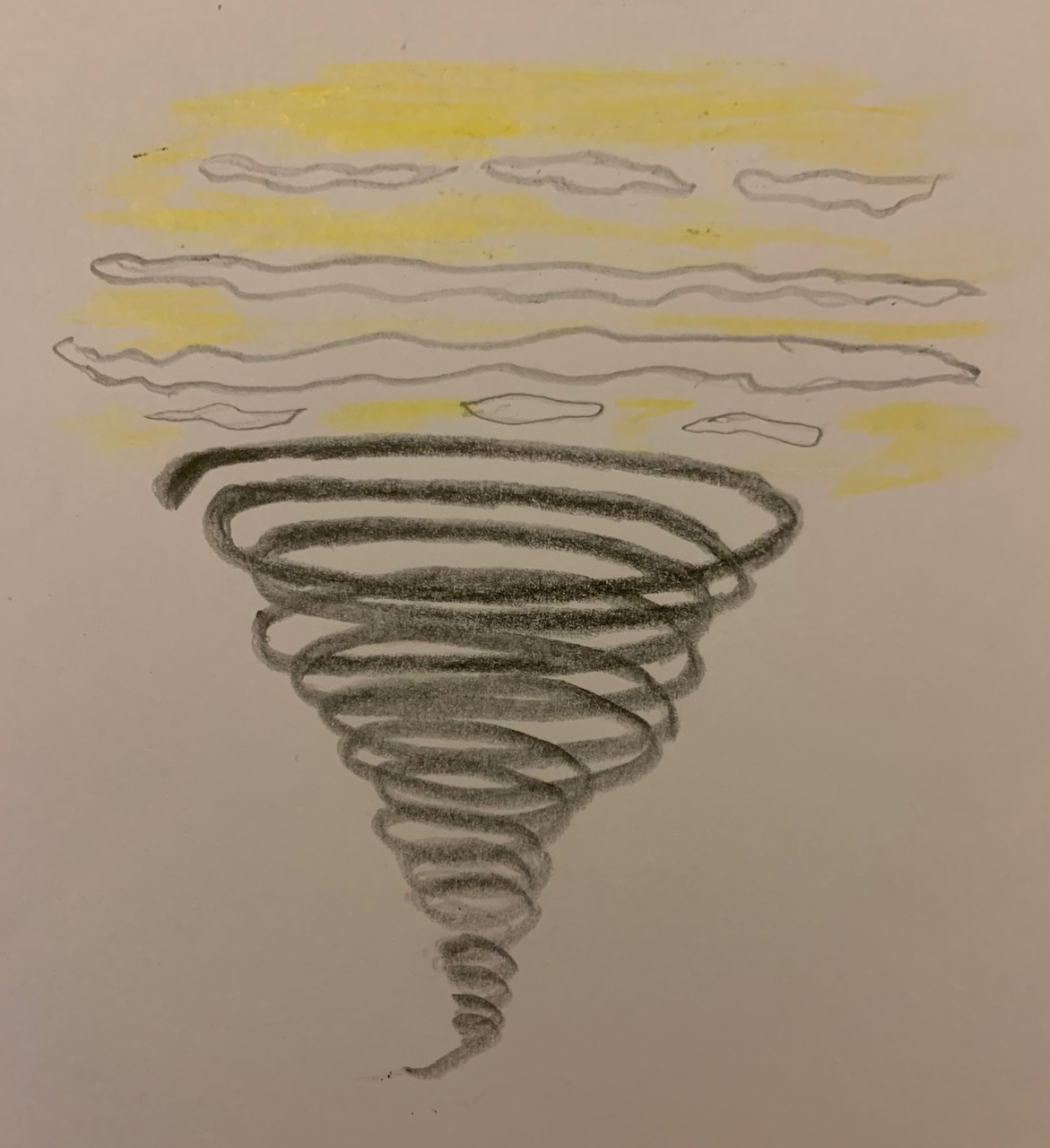
The way I envisage it bears remarkable similarities to the vision of Hadewijch of Antwerp – ‘an unfathomable depth’, ‘a very deep whirlpool, wide and exceedingly dark; in this abyss all beings were included, crowded together and compressed’.

It is associated with deep wisdom that can only be won as a result of sacrifice. In the stories I was shown Nodens / Nudd agreed to give up His sword arm. He hung over the Abyss in the coils of the Dragon Mother, Anrhuna, the Goddess of the Deep, and received the knowledge, ‘There is no up or down or before or after – everything meets here in you the Dragon Mother.’ 

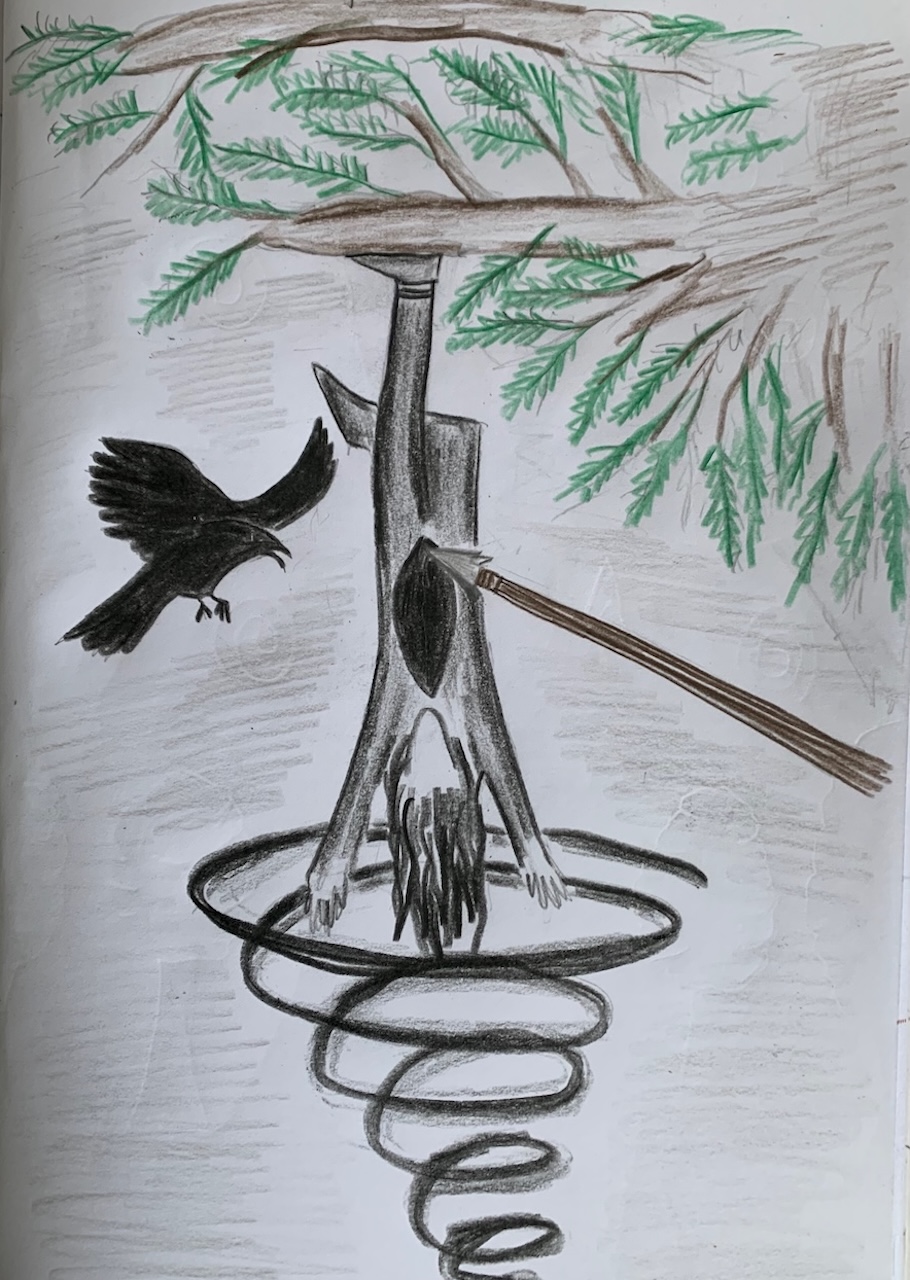
Vindos / Gwyn ap Nudd hung over the Abyss on a yew wounded in raven form and gave every last drop of his blood in exchange for a vision ‘to set the world to rights’. His knowledge was brought out of Him by a series of riddles and He saw Himself as a black dragon before plummeting dead into the Abyss.

At the beginning of the next book in death He was united with ‘the source’:

Vindos fell,
and as he fell he left behind
his shell of bones and black feathers 

and his soul flew free on wider wings
on the winds of the Abyss.
He had won

their favour
through his offering 
of every last drop of his blood.

By his wounding, by his questioning,
agony had become ecstasy.
The bottomless

abyss
was no longer bottomless.
He had mastered its paradoxes and knew

where darkness turns to light
and death to life.
Down was

now up
and he was one
with the source, the spring

from which the ocean of the stars
sprung when the universe
was born.’

These scenes bear similarities with Marguerite Porete’s words about the soul, in annihilation, finding ‘there is neither beginning, middle nor end, but only an abyssal abyss without bottom’ before acheiving ecstatic union with God.

It seems my Gods, Nodens / Nudd and His son, Vindos / Gwyn are presenting to me a tradition of sacrifice to the Abyss in return for its wisdom. By leading the way they are showing what might be expected of Their devotees.

My first experience of the Abyss took place as the result of an unconscious process of self-annihilation – dissolution of the self through the combination of practicing Husserl’s epoche (putting all one’s presuppositions about the nature of reality aside) with drugs and alchohol and all night dancing.

There was a yearning within me, I might now say deep for deep, abyss for abyss, but I didn’t know what it was and when I got to the Abyss it terrified me. I wasn’t ready for abyssal wisdom. I didn’t know what to do. I didn’t understand its choices, to live as I was or to die physically, or to take a third door. 

I see in my own impulses and those of the abyss mystics, love and annihilation, the interplay of eros the ‘life drive’ and thanatos the ‘death drive’ which together lead to the Abyss and to union with the divine if one is prepared to surrender to make some sacrifice of themselves.

I’ve never been good at giving or sacrifice always wanting things my own way.

Ten years ago, Gwyn, my patron God, a King of Annwn, asked me for a sacrifice in exchange for the wisdom of Annwn – to give up my desire to be a professional author. I did so… but not in full… I secretly entertained a hope if I gave it up for a period I might be let off and be able to have my cake and eat it.

My experience of writing In the Deep, spending a year and a half on a novel that has turned out unpublishable and daring to think it might sell more widely than my previous publications has shown this is not the case. 

It’s taken me ten years to realise I must give up my biggest dream in full for good.

This fits with the process of self annihilation found in the medieval mystics. Only by giving up our desires, surrendering our will, can we walk the path of the Gods and with them find a deeper unison with the God beyond the Gods.

I believe this also relates to the need to give up my identity as Lorna Smithers, published author, performing poet, public speaker, to become Sister Patience.

In the Deep was not written purely for self gain. First and foremost it was written for love** of Gwyn, as an origin story for Him, as an offering. I believe it is because of that the awen flowed and I retain these visions as His gift.

That He, ‘White, Blessed’, has led me to the blessed Abyss, the God beyond the Gods, who may or may not be the formlessness of the Mother of the Deep before She took form.

To the third door – to die to his present life, to be annihilated, hopefully like Vindos / Gwyn to be reborn.

He was
the first microbe
and every single tiny thing.

He was an ammonite and a starfish,
He was a silver salmon,
every fish.

He swam
amongst bright creatures
as an eel, as a seasnake, as a snake,

as a horned serpent, as a bull, as a wolf.
Playful as a new-born pup
Vindos

chased his tail
and the trails of starships
and traversed every wormhole

before he emerged from the sea of stars
and climbed out of the cauldron,
naked, dripping, triumphant,

and very much living
to stand beside Old Mother Universe.

*I also wrote the sequel, The Spirits of Annwn, in draft form as a long poem, when possessed by the awen last year.
**Unlike annihilation love is a difficult thing for me to talk about as someone who, after a number of botched relationships, only discovered they were asexual and aromantic late in life. Unlike a number of Gwyn devotees with an intense devotional relationship with Him I am not a God spouse. Much inside me rebels against using the language of marriage found in Christianity such as ‘bride of Christ’ and even ‘love’ with its sexual and romantic connotations in reference to our relationship. I wish there was a word for purely devotional love.

In part five I will be writing about how these insights relate to the Brythonic tradition.
Contemplating the Abyss Part Three – Abyss Mysticism

Abyssum abyssum invocat’ ‘Deep calls to Deep’
– Psalm 42:7

In the previous part of this series I wrote about the links I perceived between the Brythonic term for the ‘otherworld’, Annwn, ‘Very Deep’ and the Hebrew tehom ‘deep’ which is translated as abyssum ‘abyss’, ‘bottomless depth’ in Greek. 

My personal experiences with the Abyss and its appearances in the visions that formed the core of my attempted novel In the Deep suggest it holds profound significance for my calling as a nun of Annwn. Yet I’ve rarely come across other Polytheists and Pagans speaking of encounters with the Abyss*.

Therefore I was intrigued to find out not only that ‘abyss language’ occurs in the writings of medieval Christian mystics but that it has been conceived as ‘abyss mysticism’.

Bernard McGinn traces this movement from the twelth to the sixteenth century. ‘In the Psalm phase ‘abssyum abyssum invocat’ medieval mystics found a mantra for their meditations in the startling claim that the unknowable God and the human person could somehow become a single pure Abyss.’

One of the earliest proponents of these ideas was the Flemish Beguine Hadewijch of Antwerp (13th C). In Vision 11 she says:

‘I was in a very depressed frame of mind one Christmas night when I was taken up in the spirit. There I saw a very deep whirlpool, wide and exceedingly dark; in this abyss all beings were included, crowded together and compressed. The darkness illuminated and penetrated everything. The unfathomable depth of the abyss was so high that no-one could reach it… It was the entire ominoptence of the beloved.’ 

And in Song 7:

‘My soul melts away
in the madness of Love;
the Abyss into which she hurls me
is deeper than the sea;
for love’s deep new abyss
renews my wound.’

Marguerite Porete, a French Beguine executed as a heretic in 1310 writes of her experiences of the Abyss in The Mirror of Annihilated Souls. For her love leads through six levels of purificatory practices to a state of self-annihilation in which she becomes ‘nothing’ and ‘finds there is neither beginning, middle nor end, but only an abyssal abyss without bottom.’ Finally the soul, ‘purified, clarified, sees neither God nor herself, but God sees himself in her, for her, without her.’ God sees himself in the mirror of her soul. 

The practice of annhilatio as a path to the Abyss and union with God also appears in the Liber specialis gratiae of Mechtilde of Hackeborn (1242 – 1298). Her friend, Gertrud, at her death bed realises why she cannot pass. She ‘would not be received into heaven until her strength had been utterly consumed and annihilated by divine power… Then putting off all insipidity of human nature, she would be plunged into that abyss of blessedness and deserve to be made one spirit with God.’

Angela of Foligno (1248 – 1309) follows a more penential practice of self-annihilation, following Christ in ‘poverty, suffering and contempt’, leading to the revelation of Christ as ‘Uncreated Love’ and a state of ecstasy referred not as annihilation but inabyssare. Angela speaks of a vision of her spiritual children ‘transformed into God… now glorious, now suffering… abyssated’ ‘into himself.’

The ideas of these radical medieval nuns were taken up by Meister Eckhart and his successors. The Dominican priest John Tauler (1300 – 1361) speaks of Psalm 42:7 in his sermons. In Sermon 21: ‘Here the word the prophet taught in the Psalter becomes true: “Abyssum abyssum invocat, the abyss draws the abyss into itself.” The abyss that is the created (thing) draws the Uncreated Abyss into itself, and the two abysses become a Single One… a pure divine being, so that the spirit is lost in God’s Spirit. It is drowned in the bottomless sea.’ In Sermon 45 he speaks of how annihilation leads into ‘the divine Abyss.’

Dominican friar Henry Suso (1295 – 1366) was the first to pray to God as Abyss. ‘O endless Abyss, come to my aid or I am lost.’ In the Life he speaks of the goal of the soul as ‘the Deep Abyss’. Intriguingly he speaks of a ‘God beyond God’. ‘In this wild mountain region of the where beyond God there is an abyss full of play and feeling for all pure spirits, and the spirit enters into this secret namelessness… it is a deep bottomless abyss for all creatures and is intelligible to God alone.’

In the work of Flemish canon Jan Van Ruusbroec (1233 – 1381) the Abyss performs a healing function. In a poem in Seven Enclosures he addresses God:

‘O mighty jaw
without any mouth,
conduct us into your abyss
and make us know your love,
for though we be wounded mortally
when grasped by love we are sound.’

When reading about these medieval conceptions of the Abyss I was struck by the notion of the soul annhilating itself for love to gain union with God. I found Van Ruusbroec’s idea of the Abyss as a ‘God beyond God’ (or beyond the Gods) fascinating. I was also surprised to see the Abyss, which for me has been terrifying, to be described as ‘divine’ and ‘blessed’, as a place ‘full of play’ and healing. 

In the final two parts I will be speaking about how the experiences of these medieval mystics relate to my own and to the Brythonic tradition.

*An exception is fellow polytheistic monastic Danica Swanson who writes of her encounter with ‘the Void, the Abyss’ in her essay ‘Of Hearth and Shadow’ in Polytheistic Monasticism (2022).

SOURCES

Barbara Newman, ‘Annihilation and Authorship: Three Women Mystics of the 1290s’, Speculum, Volume 91, No 3, (2016)

Bernard McGinn, ‘Lost in the Abyss: The Function of Abyss Language in Medieval Mysticism’, Franciscan Studies, Vol. 72 (2014), pp. 433-452

Grace M. Jantzen, ‘Eros and the Abyss: Reading Medieval Mystics in Postmodernity’, Literature and Theology, Vol 17, No. 3,pp. 244-264

Contemplating the Abyss Part Two – Writing whilst Falling

I write when I fall. It’s a defence mechanism. Like putting out a hand to catch myself. 

I write because writing has saved me and I believe my writing might help others.

But putting out a hand doesn’t always work when one is falling into the Abyss…

*

I cried out to the philosophers, “Philosophers save me!”

When I was 21 and in the second year of my philosophy degree I sat on the edge of the Abyss at the nadir of a quasi-initiatory period during which I’d been foolishly been mixing phenomenology (1) with copious amounts of drugs and alcohol, some unknown part of me striving, reaching for… what?

My ‘friends’ had deserted me because I’d ‘gone west’ and I was sitting on the boot of a car, at the end of the world, staring into the Abyss, feeling I couldn’t go on living but not really, truly, wanting to die either. I couldn’t choose.

I was presented with three gateways but didn’t have the courage to take any.

I moved into the front seat of the car and, as dawn arrived, pinking the front  windows of my friend’s house, with it came three alienesque beings who I now understand in the Brythonic tradition to be ellyllon ‘elves’. They took me into the heavens in what I saw at the time as an alien aduction experience and performed an intricate operation on my brain with silver instruments. 

After that I decided to give up drugs entirely and apply myself to my studies. Not easy. There were after effects. Anxiety. Panic attacks. I ended up on medication but also got subscribed what I really needed – exercise. These things helped me to get my head straight enough to write myself out of the Abyss. 

My philosophy studies gave me the tools I needed. I saw my inability to choose life or death as akin to Kant’s antimonies (2) which stem from the use of reason to comprehend sensible phenomena beyond its application. I wrote my dissertation on the concept of the sublime in Burke, Kant, and Lyotard, focusing on how experiences of the sublime depose the rational mind (3).

This helped me to understand the breakdown of my rational faculties but not the visions I encountered as the flip side. It was only when I was studying for my MA in European Philosophy and writing my dissertation on Nietzche’s The Birth of Tragedy I found the clues. Dionysian ecstasy gives way to Apollonian visions. But I wasn’t seeing Dionysus or satyrs. I realised, like Greece, Britain, must have its Gods and spirits, finally met my patron God, Gwyn ap Nudd, a King of Annwn, realised my visions had been of His realm.

Nietzsche, a philosopher, who also stared into the Abyss (4), saved me.

*

The medieval Welsh term Annwn stems from an ‘very’ and dwfn ‘deep’. I believe it shares similarities with the Hebrew term tehom which means ‘deep’ and was translated as abyssos, ‘abyss’, ‘bottomless depth’, in the Septugaint, the earliest Greek translation of the Hebrew Bible in 285–247 BCE.

The Mesopotamian Goddess of the primordial waters, Tiamat, has been linked to tehom. Several years ago myself and other awenyddion found a Goddess named Anrhuna who takes dragon form and is the mother of Gwyn. She plays a similar role as the personification of Annwn. In my visions She, Gwyn, and Nodens/Nudd are associated with the Abyss and its mysteries.

Gwyn was the God who taught me how to fall. He’s fallen too. And I’ve fallen with Him. I’ve crawled out of the Abyss with Him, claw by claw, word by word.

That damned book. It came first when I was falling during the first covid pandemic. I’d given up my supermarket job to volunteer my way into paid work in conservation and my volunteering had been cancelled leaving me with no paid or voluntary role. Utterly unpublishable but writing it got me through.

It came again when I realised I couldn’t cope in a career in the environmental sector. For the last year and a half I’ve worked on it full time, realised it is no good. 

That crutch has gone but I’m still putting my hand out – writing whilst falling.

*

I’m back in another antinomy – I love writing but can’t make a living from it. 

When I first met Gwyn He asked me to promise to give up my ambition to be a professional author in return for journeying with Him to Annwn. I did it for a while. I took various jobs, cleaning, packing, supermarket, wrote as service for my Gods.

But, sneakily, oh so sneakily, in the back of my mind, I never got rid of the treacherous hope that promise would only be temporary. If I worked hard well enough the veto might come off, I might be able to have my cake and eat it.

I published three books. Sold more copies than I hoped for such niche work. Even got professionally published. Not enough to make a living of course but enough to convince me I might be able to write something that did better. 

Ten years after my initial dedication to Gwyn I asked Him by divination about whether that promise still holds and got 1. The Wanderer and thought I was free of it. It’s notable here I asked through the tarot rather than asking Him directly. Consciously I did this because I feared my discernment might be off. Maybe unconsciously, I feared, knew, he’d say, ‘No’. I read the card wrong. In the traditional tarot The Wanderer is the The Fool. I was fooling myself. As I write these words I hear the laughter of my God and realise what a fool I was.

At one point I hoped In the Deep might not only sell to my small Polytheist and Pagan audience but might also appeal to fantasy readers, taking the stories of Gwyn and the other Brythonic Gods into the mainstream.

Hubris. It didn’t work. An individual can’t write myth. And I’m not that good a writer.

A difficult lesson learnt. My ambition to be a professional writer given up for good, vomited up, committed to the Abyss, I’m falling again, writing whilst falling.

I’m remembering my vision of the three gates. I can’t make a living as a writer. I don’t want to die either. I’m asking what lies beyond the third gate.

In the next part I will be writing about the ‘Abyss Mystics’ who, unlike me did not try to cling on, to write themselves out of the Abyss, were not afraid of falling.

(1) In particular using Husserl’s epoche (setting aside all assumptions of existence) as an experiential practice.
(2) https://en.wikipedia.org/wiki/Kant’s_antinomies
(3) In ‘Scapeland’ Lyotard writes of the ‘The Thing’ as sublime – ‘the mind draws itself up when it draws a landscape, but that landscape has already drawn its forces up against the mind, and that in drawing them up, it has broken and deposed the mind (as one deposes a sovereign), made it vomit itself up towards the nothingness of being-there.’
(4) In Beyond Good and Evil Nietzsche wrote, ‘Battle not with monsters lest ye become a monster; and if you gaze into the abyss the abyss gazes into you.’

Contemplating the Abyss Part One – ‘In the Deep’

The Abyss was its spiralling core and its beginning and its end. 

The Beginning

It began with a boy falling, falling, falling into the Abyss.

The boy dreamt of the birth of his Dragon Mother from the infinite waters of the Deep with nine heads and nine-hundred-and-ninety-nine coils and her giving birth to an infinitude of dragons, serpents, monster-serpents and monsters.

*

The boy dreamt of the birth of the stars – each the eye of a fiery giant. He watched them mating, spawning bright gods, who built their fortresses in the skies. The King of the Gods ordering the constellations with a turning sword. This god cast out, plummeting like a comet with an icy tail, down to the Deep. 

*

The boy dreamt of the god hanging in his mother’s coils over the Abyss to gain its wisdom. ‘There is no up or down or before or after – everything meets here in you the Dragon Mother.’ He watched them mate and knew he was conceived.

*

The boy dreamt of the Children of the Don descending from the stars to slaughter the Dragons of the Deep. Lugus, their leader, cut off the arm of his father, Nodens and slaughtered his Dragon Mother, Anrhuna. Lugus then tore the boy, Vindos, and his sister, Kraideti, from the womb. He stole Kraideti ‘the Girl who will Bring Life’ to the stars and threw Vindos ‘the Boy who will bring Death’ into the Abyss.

*

The boy awoke and crawled from the Abyss to eat his Dragon Mother’s heart in a rite that made him King of Annwn (he later gained his name – Vindos / Gwyn ‘White, Blessed, Holy’).

The End

Vindos killed Lugus as vengeance for slaying his Dragon Mother. Lugus took flight in the form of an eagle and perched wounded in an oak tree for nine nights with a sow beneath feasting on the rotten flesh and maggots from his wound. 

Uidianos sang Lugus down from the oak with three englyns and restored him to life.

Lugus returned the blow, shattering the Stone of Vindos, to pierce his enemy’s side. Vindos took the form of a raven and flew to Annwn where he hung wounded on a yew tree upside down over the Abyss and answered its riddles.

Night One: 

“Tell me
the hour the King
and Queen of Annwn
were born.”

“Not easy –
we were not born 
but ripped from the womb 
on the hour of the death 
of dragons.”

*

Night Two:

“Tell me
in your eternal
battle who killed
who?

“Not easy,
summer and winter
are mirrors – when one
kills the other kills 
too.”

*

Night Three:

“Tell Me
how many trees
are in the forests
of Annwn?”

“Not easy,
for they are without
number but ask me again
and I will name
them.”

*

Night Four: 

“Tell me
how many doors
there are to
Annwn.”

“Not easy,
for they are without
number but ask me again
and I will open
them.”

*

Night Five:

“Tell me
where divide 
darkness and light,
day and night?”

“Not easy,
for there are no
divisions – each follows
each in an endless
procession.”

*

Night Six: 

“Tell me
where the restless wind 
comes from and where
he rests.”

“Not easy,
for no-one but he
knows the location of the Lands
of the First and Last
Breaths.”

*

Night Seven:

“Tell me
how many 
stars are in the
Heavens.”

“Not easy,
for they will not
be counted until all
souls are in the
cauldron.”

*

Night Eight:

“Tell me
the fate of
your last drop 
of blood.”

“Not easy,
for I cannot divide it
from the ocean of blood
that will drown
the world.”

*

Night Nine:

“Tell Me
the hour the King 
and Queen of Annwn
will die.”

“Not easy –
we cannot live without 
each other and thus will die
together when all souls
are gathered.”

*

Vindos then fell into the Abyss.

These scenes had a basis in my personal encounters with the Abyss. I will be talking about those in part two, then in part three and four presenting my recent discovery of ‘Abyss Mysticism’ in the writing on medieval monastics and how this has helped me make a little sense of the abyssal visions behind this book.

I. Your Birth

Day One of Twelve Days of Devotion to Gwyn ap Nudd

On this first day
I consider Your birth,
how you were torn from the womb
and flung into the Abyss,
how You were born

falling

and wonder
if I was born falling too.
For it seems I have never stopped falling,
spiralling downward through life,
never up the career ladder,
deeper into the well,
into the Deep,
into You.

I think of how we have both
crawled from the Abyss
and reclaimed our kingdoms –
Yours built out of dragon bones
and mine from words.

I have built mine for You
and welcomed You in as You
have welcomed me into Yours
and each in the other’s we
have been reborn.

You Are My Truth

You are the God who awoke my soul from its coffin. 

You are the God who awoke my questing and my questioning of all truths. 

You are the God whose truths have a misty question mark hovering over them.

You are the God who showed me the truth of the mist, the fog, shrouding, obscuring, revealing only half-truths, shifting like metaphor, escaping words.

You are the God of the truths of the void, the abyss, the darkness and the beautiful illusions that cover them lest we run screaming, clawing out our eyes.

You are the God who visited me with the truth of madness.

You are the God whose light is truth only after years of wandering lost in the mist, following the long dark tunnels, running, shouting through the catacombs.

You are the God of truth’s veiling and its unveiling and of the veil between the worlds.

Your truth begins in namelessness and comes to shine brightest in Your name.

Vindos, Gwyn, Hunter in the Skies, Light of the Mist, Lord of the Abyss, by all Your names and none, until all worlds are gone and ever after, You are my truth. 

Fragments of Annwn – Fallings

The Broken Harp

I.
My nerves are timbres.

Taut and tense the ganglia
no longer relay the music.

Weak, worn, frayed, spent,
the tendrils torn and stretched
from the strings of a harp.

Like broken bowstrings
they sting and twitch.

II.
On the empty frame
the ‘devils’ of Annwn sit
and mock and chatter.

I cannot take my eyes
from their neat little fangs
and paper-like origami wings.

I cannot shut out their voices,
low, high, squeaking in the wind,
fat with my stolen melodies,

for I am strangely in love
with my distractions.

I court them feed them daily.

I have become their instrument.

And so I lie broken beneath their claws…

III.
And where is my god? Not the harpist
or the one who taught him but the one who
listens for the song in his eternal hall

where the harp played with no player at all?

Is he still listening? Waiting? For the bow
to be restrung? For the song to be sung? For
the arrow that will pierce his heart fine and true?

~

The Place Where the Sky is Falling

In the place where the sky is falling and the winged and the wingless ones with it I am galloping. The faster I gallop the faster it falls and the faster they chase me, swishing, swooping, on wings and not on wings (yet still sounding torn and leathery and creaky-jointed), with and without teeth and claws.

As a little experiment I touch a rein, a brief half-halt, steady from a flat-out to a slower gallop. The sky-fall slows, the flight of the ‘devils’ of Annwn who pursue me, the winds of the abyss that drive us all. I slow to a canter, to a trot, to a walk, pull up. The sky is still. The winged and wingless ones hang before me like puppets on strings, immobile in the air, without a single wing-beat. I frown. They frown. I move my left hand. They move to the left. I move my right hand. They move to the right.

“Is this some game?”

An eruption of laughter flows through them, breaking the strange spell. They shift, flap, nudge, jest. Some fly away and others descend to look on this strange phenomenon of an awenydd in Annwn.

“What are you?” I ask. “Are you devils?” For that is what Christians have called them for hundreds of years and they do look like something out of Doré’s woodcuts for Milton’s Paradise Lost. Yet I have a feeling they have existed in the Otherworld before the Christian imposition of Heaven and Hell.

They laugh and shriek and pull their grins wider with their foreclaws like demonic Cheshire cats.

“Seriously…”

“Fliers,” squeaks one. “Fliers, fliers,” the others echo. “Fliers.” “Clawers.” “Takers.” “We take…” “We take what you feed us.” “We feed.” “We bring the takings.” “We bring what you feed us to the abyss.”

“Cursed, cursed.” “We cannot set down our feet.” “We have no feet.” “We fly between the worlds knowing nothing but taking.” “We even sleep on the wing.” “Ours is the dream-storm over the abyss.”

“What have you taken from me?” I have no wounds but no teeth and no claws leave no mark…

They cackle, grin, smack their lips. “What you fed us.” Their mouths purse like secrets.

“Then you are welcome to it,” I incline my head in acknowledgement, “add it your storm of dreams.”

I depart at a slow walk knowing gratefully in Thisworld I will dismount onto the ground onto two feet.

~

It’s Easy to Fall

and keep on falling
when there is nothing
to hold on to – no can,
no bottle and its easy

soon empty comfort.

Its gentle guidance
down into oblivion.

(It is an illusion the
abyss has a bottom).

It’s easy to fall
and keep on falling
when you don’t know
how to do anything else.
Because no-one taught you
how to tread empty air.
How to breathe when
there is no oxygen.
How to balance when
there is nothing between
your two empty ears.

How to hear what
when there is nothing
beyond the abyss?

It’s easy to fall
and keep on falling
unless some unexpected
hand reaches out to
shake you from

that free fall before
you wake with a jolt –
upright in your bed.

It’s easy to fall
and keep on falling
before some person
or some god gives

you a task only you
can do. HERE. NOW.
Where there is land to
stand on air to breathe.
Hope on the horizon.

~

Why These Worries

I do not need unlike the wind that moves the washing?

Why the fear that if they stop I will be nothing
like a lump of a coal in the toe
of a Christmas stocking?

Why do I feel worthless
when I am wanted by a god?

Why do I feel like a failure
when I’ve written three books?

Why does it feel more heroic
to be battling on against these thoughts
when I could let them go to the graveyards
of the winds beneath the towers
from which they were born?

How big a grave for a thought?

How great the work of the gravedigger?

How to engrave the gravestones
with suitable death’s heads?

And if I should let them slip away…
If I should carry them like childhood toys
gifted on Christmas morning then broken by bullies
in cardboard boxes like little coffins (each has a face like my own
like in the fairy funeral and the Fairy King sings
a mournful chant as I lower them in)…

how do I know I will let them rest

and not dig them up like a restless hound?

Come, come, a blast on his horn, come away
from my graveyards and away from mourning.
Spring is here and flowers and hares to chase.
In these sunrise mists a new hunt dawning.


~

*These poems are based on journeys to Annwn undertaken during the process of giving up alcohol as self-medication for my anxiety (which I began on New Year’s Day). This forced me to stop falling, face my worries, and see them for what they are – distractions from my work as an awenydd devoted to Gwyn.
**The image is Doré’s ‘The Fall of Lucifer’ (courtesy of Wikipedia Commons).