Soul exchange is a shamanic healing for soul loss and might be seen as a form of soul retrieval. In this instance, the focus is on a loss of soul to another person who we have been in a relationship with. It’s based on the notion that as we move in and out of relationships with other persons we can pick up parts of each other. Persons can include family, friends, lovers and pets, and groups and organisations. This is a natural process. Soul exchange is needed if we become overly attached to, bound up with, or intertwined with another person and the attachments feel unhealthy. It’s a little like giving somebody’s possessions back at the end of a marriage.
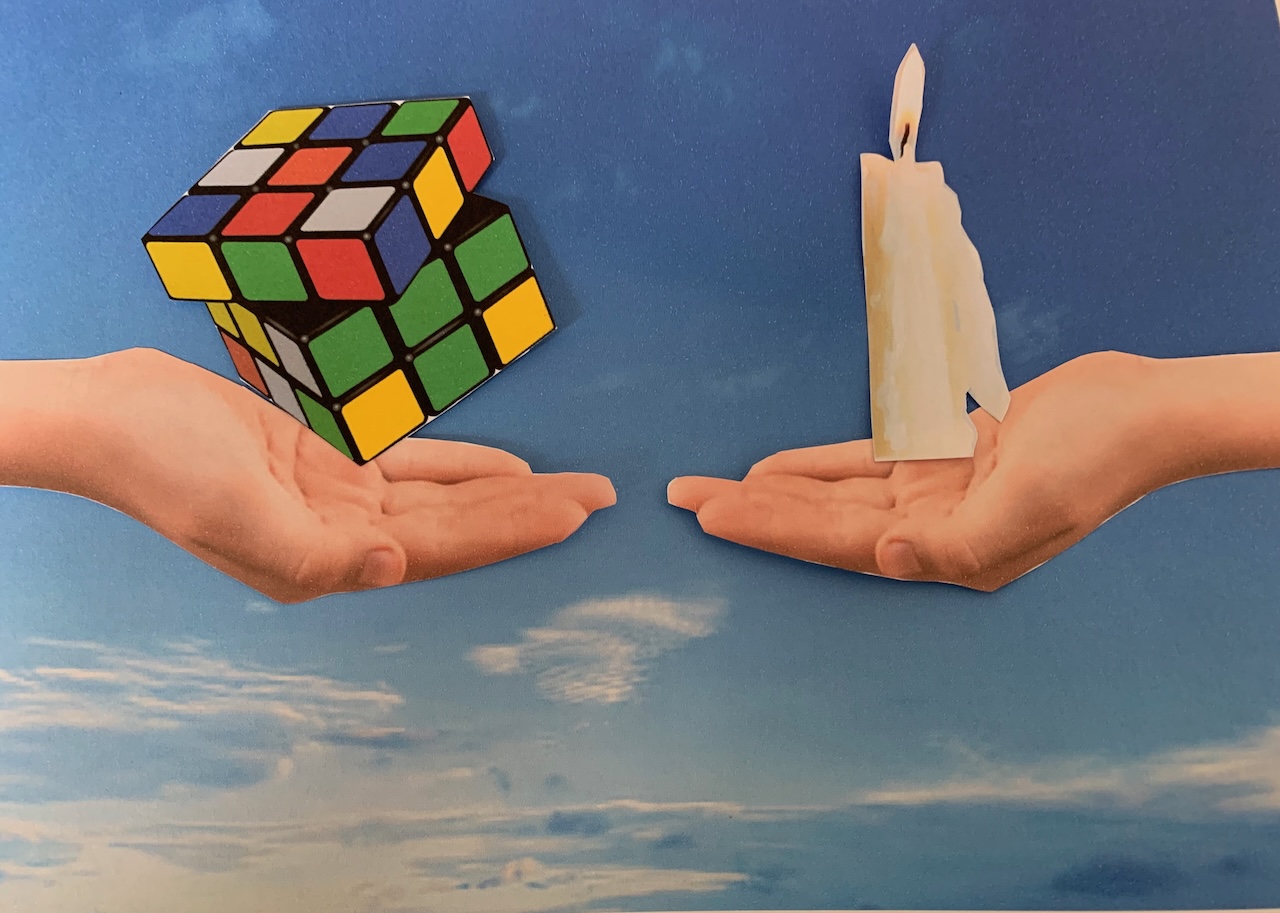
A soul exchange, as I have been taught it, takes place in a neutral location in the Otherworld. Both parties have the opportunity to return soul parts that do not belong to them. In terms of what we mean by ‘soul parts’ in this context, I like Nicholas Breeze Wood’s definition ‘packages of personal energy’ (1). The soul parts appear as objects and are metaphorical.
The practitioner journeys the client to the location and the spirit of the person with whom the soul exchange is to take place is invited to attend. It is important to note that soul exchange is the only shamanic healing that does not require permission from the person in physical reality. This is firstly because the spirit of the person has free choice whether to join in and secondly because you are giving something back that belongs to them and are not taking anything of theirs. This makes possible the process with persons who may be reluctant in this world but are willing in spirit.
Once the spirit of the other person is present, the process has been explained to them, and they have agreed, the soul exchange can begin. The client takes the first turn, giving back any soul parts that do not belong to them. They do this by reaching into themselves and bringing forth the parts in the form of objects. These are given, one by one, to their power animal, who takes them to the power animal of the other person, who hands them over.
Another point to note is the importance of the exchange taking place between the power animals. This is to maintain distance and prevent re-entanglement or re-traumatisation if the relationship was traumatic. Direct speech and eye contact between the client and the other person should be avoided.
The recipient then has the choice of whether or not to take the soul parts. Any parts not taken are transformed or disposed of by the power animals or left in the Otherworld for the spirits of place to deal with as they see fit.
Once the client has unburdened themselves of all the soul parts that do not belong to them, the other person is invited to give back any soul parts they might have taken in the same way.
Once the soul exchange is done, it is also helpful to check for any unhealthy energy cords between the client and the other person and to ask the power animals to cut, dissolve, or transform them in some way.
Once the process has been completed, the spirit of the other person and the spirits are thanked and the practitioner and the client journey back to this world.
Afterwards, the client has a chance to speak to the practitioner about their experience. They may or may not want to discuss the significance of the objects. If they do, the practitioner will guide them to make their own interpretation rather than interpreting the objects for them. The client will be encouraged to journal their experience and to meditate on, journey on, or create art around the objects if they are inspired to do so.
As always, after a shamanic healing, the client should take it easy for the rest of the day and eat nourishing food and drink plenty of water. They should keep an eye out for any effects and shifts in their energy levels and in the sense of their relationship with the other person and others around them. It’s also good to look out for nature signs, dreams and other coincidences.
***
My first formal experience of soul exchange was under the guidance of my mentor. (I had tried it alone informally but hadn’t got it right). We decided to work with a family member with whom I have a difficult relationship, to check in whether either of us was holding on to soul parts that don’t belong to us.
The process was not straightforward because one of the person’s ancestors turned up and it turned out that an additional soul exchange needed to take place between the two of them before the one with me could be carried out.
Since the soul exchanges, the family member has had more energy and there have been less arguments between us, although our relationship hasn’t improved. I think that’s because 44 years of ingrained habits are difficult to unstick.
The soul exchanges overseen by my mentor gave me a good grounding for working with clients. I began by working with volunteer clients then moved on to charging a student rate. I have so far conducted soul exchanges for clients with a variety of persons, including family, friends, partners and an organisation.
When I first started out with soul exchange, I saw it as an accessory process to soul retrieval that was not quite on a par with the core shamanic techniques in the Harner school of shamanism. Having worked with it myself and with clients, I’ve come to realise that it is just as useful and just as powerful.
One of the things I like most about soul exchange, as an autistic person, is that it has a structure that is easy to follow. Because it takes place in a set location and follows a set procedure, it isn’t quite as unpredictable as soul retrieval, which can take you anywhere in the spirit world and anything can happen.
However, this doesn’t mean that things can’t get intense. The soul parts and the process of release can bring up strong emotions, as can cutting the cords, and the final parting (if it is made) between the persons involved. In these instances, I have intuited, with the help of my guides, when to speak and when to allow the client space, providing patient and compassionate support. I have also learnt to trust in the wisdom of my own spirit helpers and those of the client and the other person, who know what to do when we do not. On several occasions they have displayed ways of disposing of or transforming objects and removing cords beyond the thinking of me or a client.
From my own experience and client work, I have learnt how different interactions can feel between persons in the real world and in spirit. In the latter, there is a sense of lightness, as another client noticed, a generosity, in contrast to when the two sides are weighed down by material concerns and dissensions.
Afterwards, benefits have been felt in terms of unburdening, letting go and release. Memories have felt less intense. There has been a sense of distancing and separation. Energy has returned, with an ability to move on.
It has been a pleasure and an honour to hold space for this sacred process. My training in soul exchange is now complete and I am looking forward to continuing to offer this healing as an important component of my shamanic practice.
Footnotes
(1) Nicholas Breeze Wood, ‘Soul Loss and Retrieval’, Sacred Hoop 131, p50
 The Sanctuary of Vindos