Six s’s of Sister Patience that will live on

With the Monastery of Annwn, I took vows of simplicity and sustainability. I simplified my wardrobe, cutting it down to three sets of winter clothes, three sets of summer clothes, a couple of things for in between, and gym kit. All but my fleeces, coats, and waterproofs fit into my great-grandmother’s chest of drawers. I never buy clothes or shoes unless I need them. I once had altars to many Brythonic gods and various spirits, but as they were little used (the only thing worse than no altar is a neglected one), I rearranged them to reflect my near-henotheistic devotion to my patron God, Gwyn ap Nudd. I walk or cycle within my limitations as someone with knee issues and a cheap bike (after my last one was stolen), and do my best to buy local or at least British food.

Solitude has always come naturally to me. I love being alone (with my Gods), and only the call of the awen or the fulfilment of my shamanic vocation can happily draw me out of this state. Silence has been one of the greatest blessings. As an autistic person, exterior quiet has long been essential for me, but it’s only since exploring Eastern methods of meditation and Christian methods of prayer that I have managed, on occasion, to attain the inner silence needed to truly listen to the Gods.

I’ve lived in the same house in Penwortham pretty much since I was four years old, so stability really accords with me. Increasingly, I have no desire to travel. I’m happier and happier deepening my relationship with my home, garden, local valley, and walking and cycling in the local area. 

When I learnt I must give up the name Sister Patience, I feared her sanctuary would have to go with her. I was saddened to think of the departure of its spirit. Yet Gwyn came along and asked that I dedicate it to Him by His older name Vindos. I was absolutely delighted. It felt so right (although I had a sneaking feeling that He might have been planning for this all along…).

Another word, which I can’t include as it doesn’t begin with an ‘s’ but does have ‘s’s’ in it, and forms the spiritual core of all the ‘s’s’ is godspouse. It was as Sister Patience I married Gwyn, as a nun of Annwn, similarly to a Bride of Christ. I’m glad to say that we’re still happily wed and our relationship will live on. In retrospect I guess it makes sense that a year after we get married He moves in!

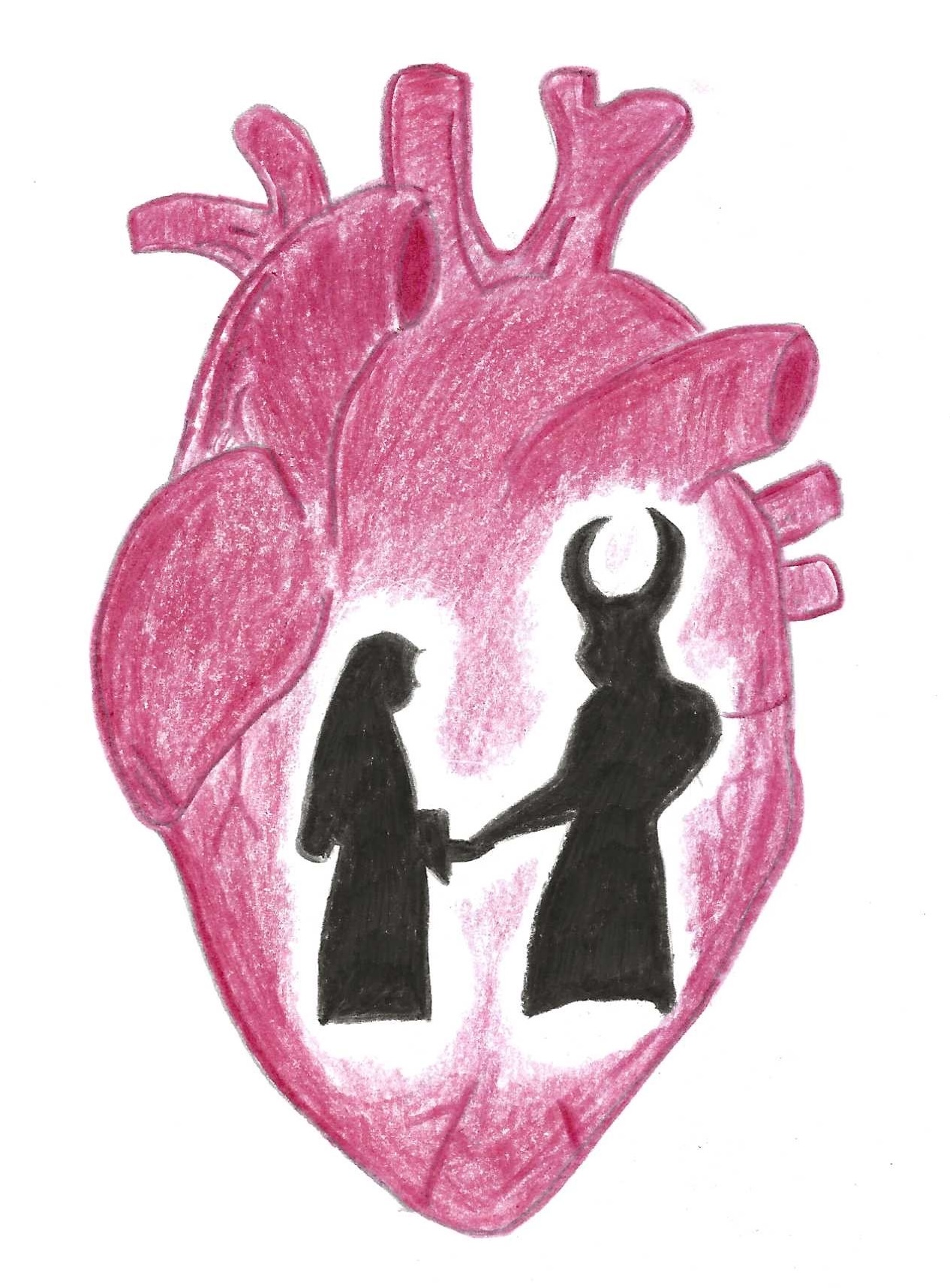
Beneath is an image from the cover of a poetry book about our marriage called ‘The Heart of Annwn’ that I wrote for Gwyn and was planning to offer to Him when I retook my temporary monastic vows this year. The book wasn’t quite good enough and the vows will not be made, but I’m hoping I might one day rework it. For now, here is the image I was planning to use as cover art.
On the Need for Noise and the Stigma around Silence

I have recently returned to Sara Maitland’s A Book of Silence and it has raised a number of thoughts about the need for noise and the stigma around silence in our current society. 

I first read this book in 2015 which was timely as had I ended up burnt out on noisy social media and attending noisy protests and learnt from this book that ‘noise’ shares the same roots as ‘noxious’ and ‘nausea’. 

Throughout my life I have struggled with noise. I was brought up in a bookish household and always preferred reading to the noise of the radio or television. When I started school I was horrified by the noisiness of the other pupils, always talking, shouting, preferred to play alone or flee to the silence of the library. I will never forget the time I first stayed over at another girl’s house. She had the television in her room on not only all evening but kept it on all night because she couldn’t sleep without it. I didn’t get a wink of sleep. When I was involved with horses I didn’t understand the need for the noise of a radio and was horrified by the people who left radios on for their horses in their stables all night based around their personal need for human noise. It’s only since giving up alcohol I have realised how much it played a role in my being able to tolerate the noise of being with groups of people at events and gatherings.

During my involvement with community groups and people in general I have noticed an awkwardness around silence and the need to fill it with noise. If someone is quiet or silent this is seen as a bad thing. Something is wrong. That person needs to be ‘brought out of themself’ – to be noisier.

This present need for noise is beyond my understanding and Maitland goes some way to explain it but I’d like to share first some of the questions she raises about the nature and definition of the opposite of noise – silence. 

Maitland notes that the OED dictionary of silence is the absence of noise and speech but notes also that silence can mean ‘without language’. Until I returned to this I had always thought of reading and writing as silent activities and of a library as a silent place. 

This then got me thinking about the spaces where we read. I have experienced social media, such as Facebook and Twitter, to be incredibly noisy. Discord too. Old style forums less so. My own room with a book quietist. So it seems here we are dealing with levels of noise grading down to quiet but perhaps not with silence itself if silence is indeed the absence of language.

I found Maitland’s personal conception of silence very interesting. She speaks of it as ‘a separate ontological category’ ‘not a lack of language but an otherness different from language. Not an absence of sound but the presence of something which is not sound.’ Silence is presence. ‘God is silence’.

Maitland is a Christian so her identification of God with silence is based on that tradition. Her words got me thinking about my own relationships with the Gods and how they relate to noise and language and silence. My patron God, Gwyn ap Nudd, is renowned for being quite noisy. He hunts the souls of the dead with a noisy pack of hounds and holds noisy revels at His feast. Like many other pre-Christian Gods and, really, all Gods (including the Judaeo-Christian God who is paradoxically silence yet He speaks His Word) Gwyn is known through language – through myth, through stories, through folklore. Yet, for me, He is both the storm of the hunt and the calm in the midst of the storm. He encourages me to spend time in silent meditation, focusing purely on my breath or on the sights and sounds in nature around me.

Maitland goes on to say our ‘desire to break the silence with constant human noise is… an avoidance of the sacred terror of that divine encounter’. It is a flight from ‘the Great Chthonic Terror’. We have attempted to defeat silence not by magic but ‘our rules – our own laws not the gods… enshrined in language.’

I agree that much of our need for noise and the stigma around silence is a flight from the divine, from the bigger than us, from what terrifies us. We break the silence because we are afraid of the Deities who might break us. 

Maitland’s ‘otherness’ and ‘Great Chthonic Terror’ I am tempted to identify with the Annuvian, the ‘Very Deep’, the unknown and unspeakable domain of the 80% of the universe that is dark matter and the unused 90% of our brains.

Maitland notes that silence has long played a strong role and initiatory function within various spiritual and religious traditions particularly for monastics. She speaks of her three year period in silent seclusion at Weardale as ‘a novitiate’ and of herself as a ‘silence novice’. 

As a nun of Annwn I have been led to cut down on noise and spend more time in quiet engagement with language reading and writing or in silence. Contrary to the stigma this has been massively beneficial to my mental health.

Half Moon and the Holly King

Half moon over Greencroft ValleyHalf bitten moon cries a waning scream.
Her severed pieces are brought by the stream
to the cavernous lair of the holly king
who grinds his axe on a sharpening stone
and prepares his block for the gore of heroes.

Silent and pensive he waits in his cave.
The moon arrives and his blood red eyes
are filled with silver swimming.
Outside the blackbirds sing
a song which knows no kenning.

The half formed moon describes her sorrows.
The king laments his lack of heroes-
vision waned and bravery gone.
Blackbirds sing their endless song
of an empty sky and bloodstained block…

then as hope elides a knight of dawn
approaches on a starless horse
with fire-lit eyes and maenad’s locks.
She boldly casts her gauntlet down
at the feet of the holly king.

The half formed moon departs from his arms.
He performs his task with an aura of calm.
The blackbirds watch in silence.
Then moon and lair are gone.
Dawn rides free, afraid, yet unharmed.

Holly, Greencroft Valley