
This artwork is based on a shamanic journey during the Twelve Days of Devotion to Gwyn ap Nudd wherein I found myself travelling across the stars and experiencing the universe being birthed as a song (Awen) from the Cauldron of Ceridwen.
This artwork is based on a shamanic journey during the Twelve Days of Devotion to Gwyn ap Nudd wherein I found myself travelling across the stars and experiencing the universe being birthed as a song (Awen) from the Cauldron of Ceridwen.
In a recent journey circle at the Way of the Buzzard Mystery School we journeyed to Bear to ask for advice on overwintering. I was expecting to receive my usual guidance on slowing down and making time for rest. What happened was surprising.
When I got to the cave Bear was in a torpor. I pulled back his skin, like velcro, and found to my shock that he was mechanical inside. I searched inside his insides, which were like circuit boards and pulled out a box of cornflakes! I then found myself in a cottage with the three bears shouting at them: “You should be eating porridge not cheap cornflakes!” This made me realise they were not real bears. In the basement of the cottage I found three bear pawprints leading into a woodland. There I found the three bears inside each other like Russian Dolls playing a drum. I was told I must play ‘the Bear Drumbeat.’ As they drummed images came from the drum and were made manifest. I was told, this way, I must ‘repopulate the forest.’
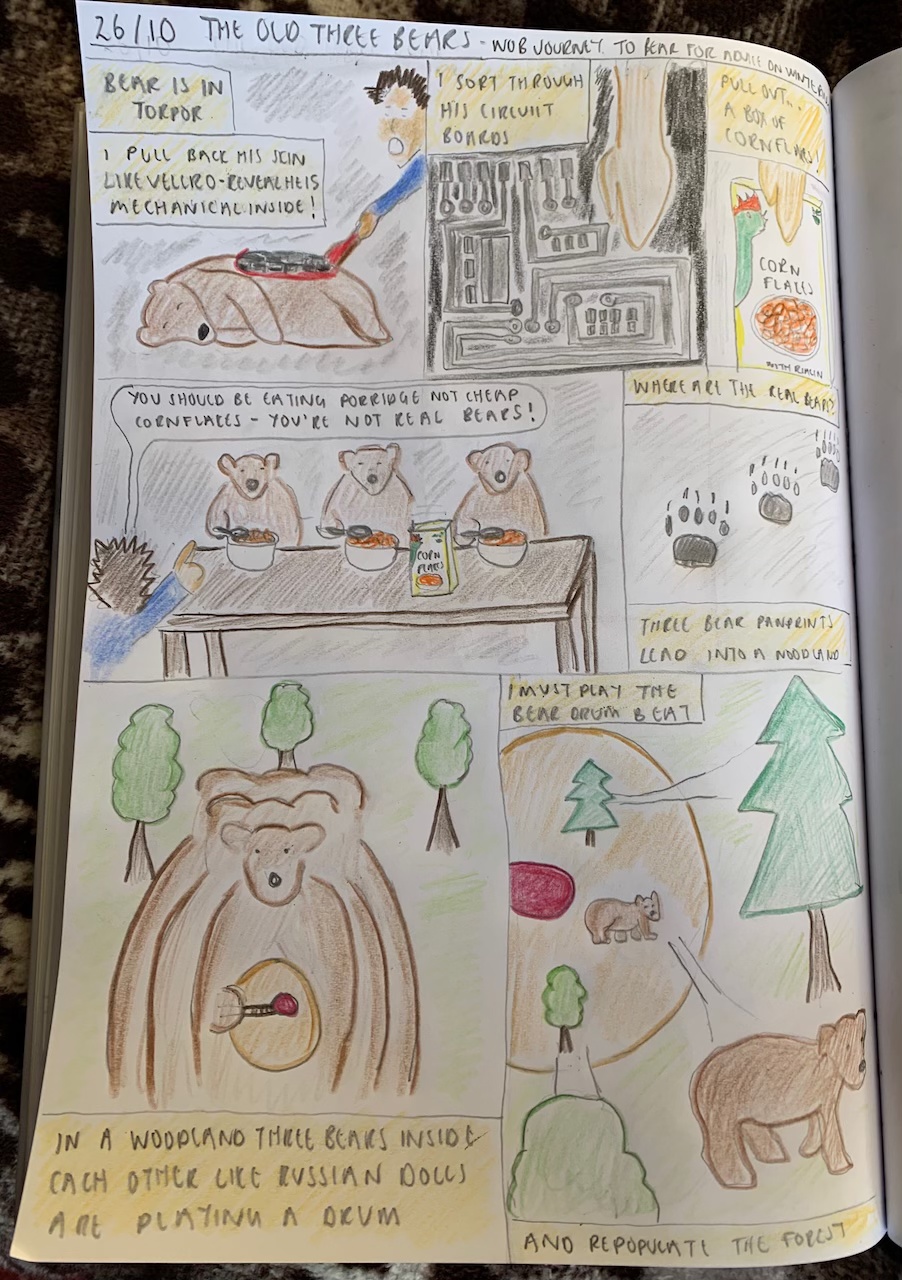
This got me wondering if the Goldilocks and the Three Bears story has roots in an older myth about the Old Three Bears from the time between when the Romans imported oats to Britain to feed their horses and potentially to make porridge and bears became extinct 1,500 years ago. Could the Three Bears within each other be a triple form of the Celtic Bear God or Goddess, Artaios or Artio?
Their advice is suggestive of how images of the Otherworld are evoked by a shamanic drumbeat and of the power of durmming and imagination to create more ecologically viable futures to which extinct animals like Bear might return.
Shamanism was conceptualised and reintroduced to Western Europe in the 1970s by an American anthropologist called Michael Harner. Harner travelled to the Amazon in the late 1950s and 1960s and lived with the Shuar and Conibo peoples to study their religion. When he reached the point he could find no more information one of the Conibo elders told him he must experience it directly by drinking ayhuasca. The visions he experienced served as proof of the existence of a spiritual reality. He was initiated into both tribes as a shaman and trained in their practices. He then travelled the world visiting shamanic peoples and learning from them.
From this process Harner extracted the core of world-wide indigenous shamanisms without the cultural rites and trappings and made it accessible to Westerners. Harner-style shamanism is therefore also referred to as core shamanism.
Harner claimed that at the core of all shamanic cultures is the belief in three worlds. The Middle World is unique because it has both a physical reality (this world) and a spiritual reality (which might be seen as the other side of this world). Then there is the Lower World, below, where we find natural landscapes and nature spirits such as animals, plants and trees. We might also find mythic and folkloric beings, Gods and Goddesses and ancestors (who are most often from ancient shamanic cultures). In the Upper World, above, we find ethereal and heavenly landscapes and the spirits of clouds, the sun, the moon, the stars, along with the Gods and spirits associated with the heavens in world religions including the Christian God and angels. We also find ascended ancestors such as Christian saints, Hindu gurus, Buddhist boddhisatvas and wise elders such as philosophers and magicians.
It was Michael Harner who brought the shamanic journey to the forefront of shamanism and backgrounded the traditions of inviting the spirits to be here with us or into our bodies. A core shamanic journey has a set framework and structure.
First and foremost one always journeys with an intention. This is the focus of the journey and keeps it on track, preventing the practitioner from getting side-tracked or lost. The intention can be to ask for guidance on a problem, for healing, to find something that has been lost, or simply to explore or spend time with the spirits. It is essential that the intention is held to throughout the shamanic journey.
The shamanic journey always begins at a departure point. This is somewhere in the physical world that is meaningful to the practitioner. To get to the Lower World it must be a place from where one can descend and can be a natural feature such as a cave, a pool, a spring, a tree root, or a manmade feature like a tunnel or a subway. For the Upper World one can take flight from a hill or mountain, or a church tower, or go up a chimney, or travel upwards on smoke or up a ladder. In the Middle World we merely need to enter a trance state to travel its spiritual otherside.
It is through Michael Harner the shamanic journey came be primarily associated with a drum. Harner trialled many different methods of entering a shamanic trance and reached the conclusion that a drumbeat is the quickest, safest and most effective. A beat of 4 – 7 beats per second shifts the mind very quickly into the theta state (gamma – highly focused, beta – everyday busy mind, alpha – meditative, theta – daydream-like, delta – sleep). It offers both a safe way to journey and come back. To signal the end of a journey a call-back beat is sounded – 4 rounds of six sharp beats. This is followed by a minute or so of rapid fire beats. This tells the person who is journeying to thank whoever they are communicating with, then turn around and retrace their steps to their departure point following the same route as they went in. This method brings them back, well-grounded, into their body.
There are also a number of core concepts and practices. One of the concepts is that each of us has a power animal. This is drawn from the northern Native American cultures and is seen to be a spirit animal who is with us throughout our life and is the source of our personal power. Our relationship with our power animal is usually deeper and more personal than with other animal spirit guides who tend to come and go. Power animals are most often found in the Lower World.
Another core concept is the spirit teacher who is usually found in the Upper World. This teacher, again, unlike other human and spirit teachers, tends to be with us throughout most of our lives supporting us and offering guidance through life’s lessons.
One of the best known core practices is soul retrieval. This is based on the notion that when we experience traumatic events a part of our soul is shocked out of us and takes refuge in spiritual reality. We also send parts of our souls away in order to fit in with consensus reality in the physical world – these are often parts that are child-like or wild and might prevent us from attaining material success and financial security. Because those parts are long lost or because we sent them away it takes a shaman’s skill to bring them back. Spontaneous soul retrieval can also occur when we make positive changes in our lives that appeal to lost soul parts, calling them to return. Other core practices include extraction – the removal of harmful energies, depossession – the removal of harmful entities, and psychopomping.
Core shamanism has its advantages and disadvantages. Its main advantage is that it is not tied to one culture or religion, thus making it universal and available to everyone. It also allows practitioners from across varying traditions to practice together.
The disadvantage of this, however, is that the practices take place without the cultural rites for interacting with local and communal spirits such as prayers and offerings, there is no mythic framework or roadmap of the spiritual reality, neither are there traditions of initiation or tribal elders to oversee the initiatory and learnng processes.
Yet the universality and proliferation of core shamanism is overall a good thing as it is giving people back their birth right – the ability to journey to the spiritual reality and commune with helping spirits in order to gain guidance, healing and inspiration.
 The Sanctuary of Vindos