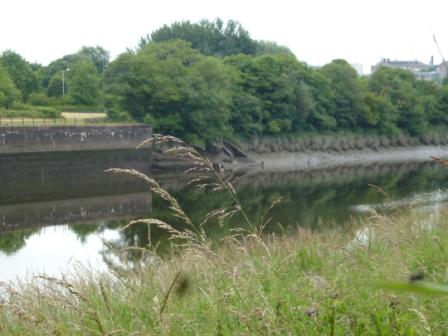
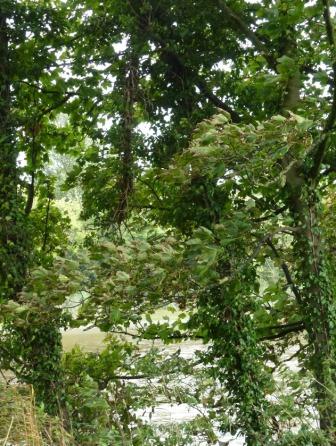
Nith’s Estuary

After visiting the site of the Battle of Arfderydd, we chose to stay in the Nith Hotel at the mouth of the estuary as it was close to Caerlaverock and because I wondered whether, like Neath, there was a connection with Nudd and his son, Gwyn. I went with no strong expectations or feelings.

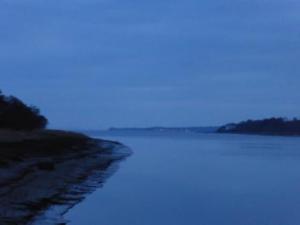
When we arrived at the car park I was utterly blown away. Clouds dark blue and dappled silver were reflected perfectly in still quiet waters. Splitting the silence hollering overhead flew drove after drove of barnacle geese following the river’s course then disappearing from sight at the estuary.

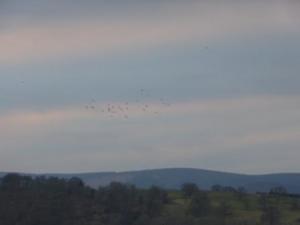
Earlier we had accidentally spooked a field filled with these magnificent birds. With barking cries and clamouring wings they took off flashing black and white, ascending into hurtling v’s.Shortly afterward a covey of swans flew over honking deep and resonant calls.
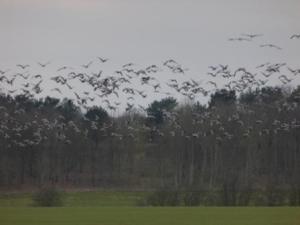
SwansIn the folklore of Wales, northern England (and beyond) ‘the Wild Hunt’ is associated with flights of swans and geese. Gwyn is one of its leaders. The term is usually limited to instances where the birds cannot be seen and those who hear them fear for their lives and souls.

My experience in this case was more of beauty than terror. The estuary of the Nith where sky met river and Criffel displayed its otherside in the lucid water was clearly a liminal place. There was something deeply magical about the passing birds and their wild song.

This reminded me a translation of Annwn (the Brythonic ‘otherworld’ Gwyn rules) is ‘the deep’. Annwn as hidden depth has intriguing resonances with the sound of ‘Nudd’. Onomatopoeically it links not only to Neath and Nith but the concepts beneath, underneath and the netherworld. This evening showed Annwn’s depth is immanent in this-world and can be experienced here.

Later on the brink of sleep I found myself thinking of Nudd / Nodens’ temple on the estuary of the river Severn. People made votive offerings to him as a god of hunting, healing and dream then slept in a designated space and priests interpreted their dreams in the morning.

Recently I discovered Nudd is not only the name of a family of Brythonic gods but also a human family name. Dreon ap Nudd fought on the dyke of Arfderydd not far from the Nith. His father, Nudd Hael, is included in the genealogies of the Men of the North. In the Yarrow valley lies a memorial stone to ‘the illustrious princes Nudus and Dumnogenus. In this tomb lies the son of Liberalis.’ Tim Clarkson says ‘Nudus is a Latinisation of Nud or Nudd.’

It seems possible this ancient northern family derived their name from Nodens / Nudd and that he was their ancestral deity and they may have served him in a similar way to the priests on the Severn. Preparing to slip into the netherworld, ‘the land of Nod,’ I wondered how many other worshippers of Nudd and his kindred had slept on Nith’s estuary.

In the morning when I awoke the barnacle geese were flying back up river to feed on the fields and salt marsh. Several groups landed on the banks and by making a careful approach we managed to draw close enough to photograph them.

Barnacle GeeseBarnacle geese possess some fascinating folklore. It was once believed they grew on driftwood like barnacles hanging down from their beaks until they grew a coat of feathers and were ready to fly away. Their growth from barnacles in summer explained why they only appeared as birds in the winter months.

Visiting the Caerlaverock Wildfowl and Wetlands Trust we found out the ‘real’ reason they can only be seen in winter. Barnacle geese incubate their eggs and raise their goslings in Svalbard in Norway between May and September when the Gulf Stream melts the ice. As winter approaches they fly 3000 km south to the Solway Firth.

In the 1940’s there were only 300 birds. Due to the work of the trust there are now over 30,000. However, if global warming continues it is possible that ice melting early in Svalbard will leave their eggs vulnerable to being eaten by polar bears.

As well as finding out more about barnacle geese we got to see whooper swans up close at feeding time. Whooper swans are another over-wintering bird who fly in from Iceland and can be told apart from mute swans by their yellow beaks.

Whooper SwansIt is my growing intuition that Gwyn, as a god of winter, may have a connection with birds over-wintering in Britain and that this would vary from place to place.

Imagine the Old North

Imagine the Old North. What can it be? Can you see it in this land, from your green hill across the marsh how the ordinary people saw it?

Can you see ravens in trees amongst the crows? Was it common enough for magpies?

Can you imagine the rumours of embittered warlords and honey-tongued bards who sung their praises? Can you taste weak beer or braggot? Do you feast on dog or wild boar?

Can you imagine living in a world where the animals speak? How will you learn their tongues? Will they lead you into their expanses?

Your books are filled with stories. Can you imagine the ones who got away? How their hearts beat on river-banks and they were pierced by spears as carrion birds circled? How the sleek otter swept into the depths and carried their death-cries to his young? Can you imagine what the ravens whispered in their thatched nest?

Can you imagine the task of bringing peace to the battle-dead?

Where all the darkness of history wanders and I hold the spirits of Annwn back… can you imagine?

What can our poetry be? A sound, a scream, a panorama of the Old North in a beam of light?

River Ribble from the Ribble Way, east of Ribchester Bridge
*Questions posed by Gwyn ap Nudd.
**Photograph of the river Ribble from the Ribble Way east of Ribchester Bridge.

The Star-Strewn Pathway

‘Thence rolled down upon him the storm-clouds from the home of the tempest;
thence streamed up the winter sky the flaming banners of the Northern lights;
thence rose through the illimitable darkness on high
the star-strewn pathway of the fairy king.’
-Wirt Sikes

I write this post as a newcomer to the path of the Awenydd, having walked it in earnest little longer than a year and a day. The terms Awen and Awenydd have been familiar since coming to Druidry. In the Awen I found a name for the all-consuming force of inspiration that has burnt forever in my veins with the fire of stars in the iciest reaches of a dark universe. Its furious purpose was revealed by a god after many years of searching.

Restless years. Wilder years. Seeking Blake’s infinite. Throwing my soul into the furthermost abysses of Western European philosophy where reason bites its own tail, curls up and dies and the only way to survive the white hot sun of truth is to burn with and express its creativity.

Trying to find a framework to decipher visions of our native spirit world without knowing if my experiences were ‘real’. Searching Christian mysticism, Graeco-Roman, Saxon and Norse mythologies and finding only analogies. Discovering Britain has its own mythology in The Mabinogion, The Triads of the Island of Britain, The Four Ancient Books of Wales and regional folk and faerie lore.

Finally, Gwyn ap Nudd, my Fairy King finding me and teaching me to walk the Star-Strewn Pathway.

***

The Star-Strewn Pathway begins in one’s local area with the recognition the whole landscape is inspirited. Awen sings from the earth-sun at this world’s core through its molten mantle, sandstone bedrock, layers of clay and harrowed loam. Wonder can be found in backyards of composting earthworms and hatching spiders.

Pathways lead to suburban edgelands. Narrow valleys of trees impossible to build on, brooks shrunken by drainage systems tripping down wooden platforms. Algae-covered stagnant ponds beloved of ducks. Decaying mills pink with Herb Robert housing volleys of pigeons circling above.

These places are inspirited and there are spirits: huge boggarts who once stretched gurgling through mosslands grey and whiskery; undines clasping their last waters; newly planted woodlands arising into forms of consciousness with inherent knowledge of tree, bird and mycelia of mushrooms to the tread of deer.

Inevitably pathways lead abroad. It is necessary to trace local brooks to the river’s crashing heart, find its trickling source and greet rolling tides with the sea at its shining estuary. To meet its Great Goddess who washes her hair by moonlight and stretches watery arms throughout the watershed.

To travel ancient woodlands of oak men, snow-topped mountains of icy blasting and cities of tower blocks, steeples and malls which guard a heritage locked in catacombs and glassy vaults. Every facet of woe and joy, awe and strife, adds to the alchemy of our own sun.

***

In rain or mist, at twilight to the touch of thunder, it is possible to step from known to unknown pathways. Wandering lost in a storm-cloud of emotion I have often found myself on unfamiliar tracks with strange figures, no longer myself. Sometimes it is those dusky shadows who beckon me, footsteps leading into the wildwood’s tangled heart.

In the wildwood all the fay lights are lit by stars. They dance and glimmer, throwing bright shapes and longer shadows across paths which intertwine like roots. These paths have their own lives, untwining and uprooting to walk their own way through the wood. Where the fay strew their lanterns on the ground one might find the Star-Strewn pathway.

There is a long tradition of caves and holes leading to the underworld. Their entryways are utter darkness. Timeless. Illimitable as despair. They lead into a womb of tunnels, the edge of an abyss, to where that age-old creatrix Old Mother Universe gives birth to stars. From thence the Star-Strewn Pathway unfurls through underground heavens.

When the moon is full she lays out her bridge of vibrant stars in the river. The ripples become stepping stones. From the river-moon the Star-Strewn Pathway leads through the catastrophic beauty of falling stars to the star-decked parapets of the Fairy King’s hall.

At his banquet stars burn and freeze. The order of things is undone. In the crux of fairy arts, the Fairy King’s Star Cauldron, the wonder of the universe is reflected and re-made anew.

***

There are other ways to reach Gwyn’s Hall. As many ways as there are souls. Some fly with coveys of hounds or wild geese. Others do not need to fly at all.

This is not the path for everyone. There are many gods, stars and cauldrons.

Any soul flight requires a return to and grounding in the body of this world; dragging backward through hedgerows, screaming and echoing from slanting rock-faces to kiss the earth with bloodied and muddy lips.

Apostasies need voicing in cafes and bars, chain-stores and museums. Launching into the internet’s mirror-void where the dust-mote of a spark of Awen can be multiplied into a million blazing simulacra fading as quickly into black holes.

Following the Star-Strewn Pathway does not lead to catasterism ‘placing amongst the stars,’ but living a full life upon this earth, returning to and from the halls of our deities, knowing only our bones and star-songs will survive for future generations. Until, with our land and gods, we are swallowed by the sun. Perhaps in this manner we will receive our final catasterism.

***

*This article was written for and first published with an introduction by Heron on ‘The Path of the Awenydd‘. This blog aims to explicate and explore this lesser known path. It is also an excellent and growing resource on Bardic, Brythonic and Faerie Lore. Do check it out. Many thanks to Heron for supporting my work.

Review: Your Face is a Forest by Rhyd Wildermuth

Your Face is a ForestRhyd Wildermuth is a writer and social worker based in Seattle. He writes for ‘The Wild Hunt,’ ‘Patheos Pagan’ and ‘Polytheist.com’ and blogs at ‘Paganarch.com.’ He describes himself as ‘a dream-drenched, tea-swilling leftist pagan punk bard.’ He is also a student of Druidry with OBOD. What drew me to his work was his boldness, passion, vision and the fact he proudly and outspokenly ‘worships gods.’

Your Face is a Forest is a collection of essays and prose. Rhyd describes his style as ‘weaving a forest from meaning’. This book’s a tapestry of poetic prose and prose poetry woven from themes that make sense as a whole only in the non-rational way trees make a forest. It’s rough, edgy and raw, and also a little rough around the edges, which adds to its anarchic charm.

Rhyd invites the reader to step into his life and accompany him through the places where he lives into forests behind to meet the faces of ‘the Other’ in ‘tasselled willows’, pines and alders, satyr dances and Dionysian revels. To find the tooth of an elk long dead and buried where cars now drive. A world full of life and another world behind it.

What I love about this book is that Rhyd speaks deeply and richly of both worlds. On pilgrimages to France and Germany he tells of the wonder of waking in a field of rabbits, playing flute with locals on unknown streets, sitting within the pink fur womb of a Berlin bar. He speaks of his despair at social inequality and the continuing repression of homosexuality in Christian colleges. He is a poet of the sacredness of this-worldly life on all levels.

He also shares some of his innermost visions of the gods and otherworlds. These have guided his life and thus form the reader’s guiding threads. Outstanding was a vision of Bran, which deserves quoting in full; ‘When I saw Bran, his great black cloak rippled in an unseen wind, his powerful form straddling a Breton valley between the River of Alder and the sea. But the cloak fled from his body, a myriad of ravens having stripped from his flesh sinew and skin, leaving only great white pillars of bone, the foundation of a temple and a tower. I do not yet know where his head lies.’ On his pilgrimages we find a mysterious tower on a mountain, a stone head in a fountain and a magical cloak. But Rhyd doesn’t give all his secrets away.

Other deities include Arianrhod, Ceridwen, Brighid, Dionysos and the unnamed gods and spirits of the city streets, buried forests and culverted rivers. What I liked most about these sections is that rather than kowtowing to being acceptable, Rhyd speaks his experiences directly and authentically. This was encouraging and inspiring for me and I think will be for other polytheists whose encounters with the gods go beyond known mythology and conventional Pagan text books. There are few modern authors who speak of the mystical aspects of deity and Rhyd does it exceptionally well.

I’d recommend Your Face is a Forest to all Pagans who are looking for real, undoctored insights into nature and the gods. Because it’s not only about Paganism and is written by somebody fully immersed in the beauty and pain of life and the search for love I’d recommend it to non-Pagans too, particularly those interested in spiritual journeys and visionary prose and poetry. Quoting Rhyd’s dedication, to ‘Everyone who’s ever looked into the Abyss / And brought back light for the rest of us.’

Your Face is a Forest is available through Lulu: http://www.lulu.com/shop/rhyd-wildermuth/your-face-is-a-forest/paperback/product-21887986.html

Review: Creatures by Greg Hill

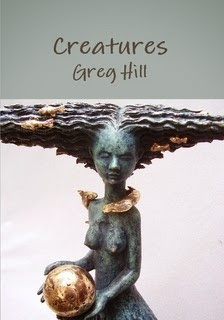
Creatures by Greg HillGreg Hill lives in Wales. He was editor of The Anglo-Welsh Review and contributes regularly to Welsh literary magazines. I’ve followed his blog for a while and was delighted when I heard about the release of his first full length collection of poetry in print; Creatures.

The title alone creates intrigue. What kind of creatures? The epigraph replies; ‘All creaturely things… Plants growing, / Roads running, / Rivers flowing, / Places that sing.’ It is clear from the outset this collection is about an animate landscape where every being is a creature, alive and sentient.

The first ekphrastic poem is based on the picture on the cover; Fidelma Massey’s sculpture, ‘Water Mother,’ who dreams thoughts of water into being. Here, the ‘cosmic ebb and flow’ of thought and water is contained in the poem. Analogies between living water and perception recur throughout the book. In ‘Cwm Eleri’ the poem’s tight structure fails to contain the river, which slips from grasp like time. In ‘Myddleton’s River’ water-ways link London, Wales and the underworld, forming a conduit for complicated alchemical processes of mental and physical transformation.

The contrast between our immediate perception of creatures and those aspects of their being impossible to grasp is central. A jackdaw sitting happily in the hearth becomes ‘an image… a token of wildness… like a jigsaw piece from another puzzle;’ a homely and familiar event made strange. Greg writes that as a heron dips out of sight ‘a part of me fell out of the sky with it,’ lost ‘except that something / settles in the flow of these words.’ We can never completely grasp our perceptions. Only through words can they find permanent representation.

Several poems present roads, paths and boundaries as living entities and how our understanding of them shifts once they are crossed and they slip into memory. If we try to return, the roads are ‘dull,’ ‘dusty,’ ‘empty.’ Our former selves are shadows, unfamiliar reflections. ‘Strange border guards’ usher us ‘from what / we neither know nor recognise.’ These haunting and complex poems demonstrate how choices shape our relationship with the landscape and hence our memories.

The mysteries of the Bardic Tradition and its creatures are explored in novel ways. ‘Awen’ depicts a shepherd lad inspired to speak poetry by a spirit ‘like a forest god’ who is elusive as the words he inspires. Four episodes from the Mabinogion are covered. I was fascinated by ‘A Scaffold for a Mouse,’ which depicts ‘Manawydan living in a dream / landscape with the life / conjured out of it like a flat plane.’ Through his ‘firm grip’ on the mouse, ‘a small thing / for a great purpose,’ he breaks the ‘powerful magic’ of Llwyd, awakening ‘form to its true nature’ thus freeing Rhiannon, Pryderi and Cigfa.

This collection depicts a relationship with the creaturely world that is on the surface simple and direct yet beneath mysterious and disconcerting. Each time I return to these poems I discover new meanings and thematic relationships within the whole. I’d recommend this book to anybody who likes poetry with lots of depth and has a love for nature, myth and creatures.

Creatures can be purchased through Lulu here: http://www.lulu.com/spotlight/greghillpoetry

Greg Hill’s poetry site is here: http://greghill.weebly.com/
Greg’s blog, Hill’s Chroicle can be found here: http://hills-chronicle.blogspot.co.uk/

Ribble Illusions

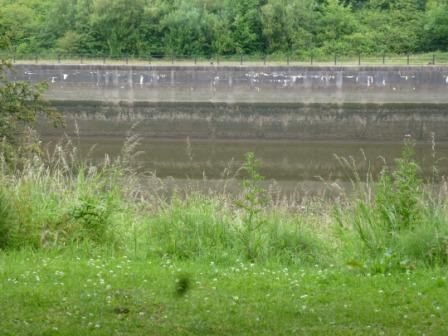
Yesterday I had a most uncanny experience. Approaching the river Ribble from Castle Hill, I found myself facing a long stretch of tide marked wall that gave the appearance it had dropped away into nowhere. I was struck by a sudden sense of vertigo. The Ribble couldn’t have disappeared, as if had fallen into a void, surely?

River RibbleOn closer inspection, seeing the reflections of the grilles and staircases, and catching subtle fluctuations in the surface of the water, I realised this was an illusion created by a combination of its stillness with the markings on the stone.

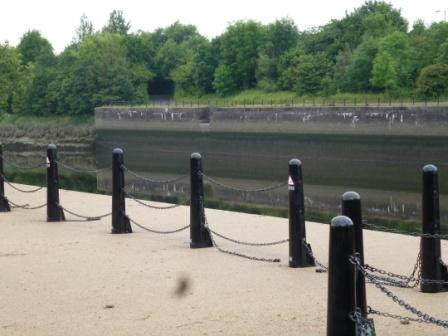
River Ribble, reflection of a grilleRiver Ribble, stairsTo my relief at either end of the concrete barriers, the ‘true’ water level was clear.

River Ribble, water level

River Ribble, water levelDrawn  to stay a while in meditation on the strange appearance and disappearance of the river, which occurred as I shifted my eye-line, I was gifted with the sight of several birds. Common and black headed gulls and terns circled, their darker shadows mirrored in the water. Another bird, which I think may have been a grebe or even a black throated diver flew in. Diving with quick flips of its tail it emerged, for the most part, triumphant with white-silver fish, which after a brief kerfuffle vanished down its throat. Finally, a heron arrived to land majestically on a piece of flotsam.

Heron, river RibbleFor me this goes to show that even where it is channelled, the Ribble is a magical and mind altering place. I give thanks to the river, all its visitors and inhabitants, and its goddess Belisama.

The River Syke

Syke StreetOn a rainy day in the not so-distant future, Tom, a tour-guide in training, decided to visit the city of Preston.

Great intrigue surrounded the town of priests, which had once been the Catholic capital of Lancashire. Every spire and street name told a story, from the cathedral of St Walburge to Friargate, to the catacombs beneath St Peter’s. Each had its relics and dealt in a great number of copies to tempt the less discerning tourist.

However, Tom was not interested in the rise and decline of Christianity. Neither did he care for the oral tales passed on by the city’s people such as the headless black dog that haunted Maudlands, the wicked fairy on the market with his tricksy ointment, or the Bannister Doll.

Tom had been led to Preston by a new myth about the underground river Syke.

This watercourse had run from present day Syke Street, through Winckley Square, parallel with Fishergate then into the Ribble at the New Bridge. At one point there had been fish garths across the Ribble and a boatyard where the two rivers met. In 1812, as industrialisation progressed, the Syke was culverted beneath the town. It had not seen daylight since.

250 years later, as part of a desperate money-making bid, the tourist board decided to open its underground passageway to the public. Above the grate covering the Syke’s mouth they erected a ticket booth, then a flight of stairs leading down to a platform. Over the entrance was placed a flashing neon sign- Enter the mouth of Annwn- the Ancient British Otherworld.

Caroline, Tom’s girlfriend, had been obsessed by stories about Annwn. “It is a beautiful, terrible world,” she had used to tell him, “peopled with fairies and monsters. There are thin places where you can slip over. It is possible to find your ancestors, and the lost ones you once loved. It’s possible to escape again, if you do not fall prey to its seductions.”

Several days ago, Caroline had left on a trip to Preston and had not returned. She was not the only one. Another three people had been reported missing, mysteriously disappearing on the boat ride back to the entrance. These stories were connected with rumours of people hearing strange songs and experiencing visions of ships and fishermen, huge fish, and women with fishtails.

If it hadn’t been for Caroline’s absence, Tom would have thought this was all propaganda. However, his strongest suspicion was these tall tales were a cover for poor management. A fact left untold was that the Ribble is tidal. Should the attraction remain open as the tides washed in, the entrance to the Syke would be blocked and its passageway flooded. Tom suspected these poor souls had drowned, and he was terrified Caroline might have met the same fate.

After paying his admission, Tom entered a sheltered area where he joined two families, three couples and a group of teenage girls who were talking and laughing.

“We need to look out for ghostly fishermen.”

“Mermaids.”

“Mermen, more like.”

“It’s some kind of creature with slimy tentacles that will drag you down through the water and into the Otherworld.”

Once the preceding group had exited they were ushered down to the platform. Standing beside the Ribble’s churning grey, Tom recalled Caroline telling him how every river had its goddess and each stream its nymph. The name of the Ribble’s goddess was Belisama and it was believed she claimed a life every seven years.

“Is everybody ready to enter the mouth of Annwn?” asked the tour guide, an aging man dressed in a wax jacket and waders. His long greying hair hung damp from beneath a fisherman’s hat.

To cries of affirmation he pressed a button, which rolled back the grate. The passageway was illumined by intermittent white lights, which cast an occasional silver sheen on the dark water. One by one they entered the tunnel, walking in a single line, on the river’s left. Enthralled by its impenetrable flow, Tom could not help himself imagining Caroline trapped beneath those waters drowning amongst terrible aquatic creatures who had not seen sunlight for 250 years.

The girls in front of Tom jostled and giggled. “I can see a fish!” “I think it was a mermaid!” As their conjectures became wilder their voices grew more high pitched.

The weight of the walls pressed in and the river’s roaring voice and echo rose to an unsteadying crescendo. By the time they reached the boat, Tom was trembling and disoriented. As he crossed the gangplank onto Syke’s Trawler, it took all his effort to hold his balance. Looking beneath he glimpsed something silver, dark and serpentine, then in a flash of dread saw Caroline’s sunken face staring up at him. The tunnel spun around him.

The next thing he knew, Tom was assailed by the scent of wax and brine. The tour guide was lowering him onto a wooden bench, fastening his seat belt and placing his hands firmly on the rail. “Hold on tight. Keep your eyes well shut and be careful not to listen. You do not want to fall prey to the lures of Annwn.” There was a mocking, knowing look in his grey eyes

He cast off and took the wheel with such exuberance and expertise Tom realised he must have been a true fisherman in his time.

The boat pitched down river. The teenagers screamed.

“Sy-ke!” “Sy-ke!” Tom was almost deafened by the river repeating its name. “Sy-ke!” “Sy-ke!” Or could it be the voice of its goddess?

The limitations of the tunnel shattered to reveal bright sky and a flashing landscape, the grey shapes of yachts and fishermen.

“There are places where you can slip over,” Caroline’s words filled Tom’s mind.

He held tightly to the rail, imagining himself as Odysseus lashed to the mast.

“It is possible to find your loved ones.”

Tom realised Caroline’s voice was not in his mind. She stood on the adjacent vessel beside an older fisherman who shared her dark features. Tom guessed he was her grandfather.

“Caroline!” Tom cried.

“Tom, how I’ve missed you, I knew you would come to find me!” Caroline rushed to the edge of her boat.

“I’ve been worried sick about you,” said Tom. “What happened?”

“Come and join us,” said Caroline. As her boat drifted closer she held out her hand.

Unable to stop himself, Tom let go of the rail and unfastened his seatbelt. Leaning between the swaying boats he took Caroline’s hand and scrambled over. After all those long months they were together again, embracing and kissing. In her arms the rocking deck, perilous river and distinction between the worlds no longer mattered.

A horn blared from Syke’s Trawler.

Caroline pushed Tom away. “The tides are coming in.” The colour left her face and her skin became cold to his touch. With the sweep of a long black and silver fishtail she dove into the water. Tom noticed her grandfather had already disappeared. The boat shuddered beneath his feet then, with a dismal groan, plank by plank began to break apart.

With a thunk something round and orange struck his chest. It was a rubber ring, attached to a rope, attached to the trawler.

“Get in and keep hold,” the tour guide’s voice bellowed, “if you want to return to Preston, that is.”

Struggling against panic, Tom managed to pull the rubber ring on as the deck gave way beneath him and a wave crashed over his head. The cold water stunned him. He struggled and gasped for breath, thrown this way and that between the incoming tide and the river’s force. Hauled back onto the trawler by the tour guide he coughed up salt water before descending into uncontrollable sobs.

By the time his tears had ended, the boat was safely moored on the Ribble’s bank and the rest of the group had gone.

“You love her, but you don’t want to die for her?” the tour guide’s voice was soft in Tom’s ear. His nostrils filled with his briny scent. “I know how you feel, and I may be able to help.”

Tom looked up hopefully, “how?” he rasped.

“It is possible to walk, or sail, between the worlds,” said the old fisherman. “Why don’t you join me, as my trainee, at the helm of Syke’s Trawler? You can learn to serve our goddess. We’re desperately short of tour guides.”

Mouth of the River Syke

Mary of the Marsh

Enduring years of disconnection,
incredulity of stars,
anger beneath the heavens,
she scathed the priests and walked alone,
drifting among chapels, knowing she didn’t belong,
her robes of night fell on soft rushes.

They say she walked along the marsh.
They say she walked out to the river.
They say she looked out to the sea.

In the damp, dark parishes
paradise was never hers,
she walked amongst the outcasts and the sick
healing wounds that should never open,
seeing what shouldn’t be seen,
her robes of night fell on troubled waters.

Mary of the lepers,
Mary of the marsh,
I saw you running to the river,
I saw you running to the sea.
How you longed to sail away…

Awenydd

I.
As the longest night looses
darkest claws I walk amongst shadows
at dawn where moonlight floods
through the arms of trees
and a solitary lamppost lights the vale.

Lamppost, Greencroft ValleyII.
River-trees stand stark and tall,
consistent in her mind’s
unravelling of currents and tides,
cormorants and gulls,
a ragged heron.

RibbleIII.
The host’s roar to a lullaby
quells as moon leads dawn
over chiming hills to be swallowed
by cloud as the hunt returns
to graveyard and mound.

Moon over Castle HillIV.
My lord of the fay
makes his presence known.
He speaks to the mist within my bones
like the lych gate unfastening,
awenydd– my magic word.

Lych gate, St Mary's ChurchV.
The spirit paths are mine
to walk for an evanescent pulse
of dawn. Time stands still
from vale to hill and the stream
sings: awenydd, awenydd.

Fish House Brook