Ancestor Work – Remembrance and Healing

Introduction – Gwyn and Remembrance

I have been working with the ancestors since I discovered Paganism in 2010 and, more deeply, since meeting my patron God, Vindos / Gwyn ap Nudd, in 2012 and dedicating myself to Him as His awenydd ‘person inspired’.

Gwyn is a Brythonic God of the dead who gathers the souls of the deceased to His realm, Annwn (‘Very Deep’, the Otherworld). Ancestry is significant in the Brythonic tradition. This is shown in the medieval Welsh poem, ‘The Conversation of Gwyn ap Nudd and Gwyddno Garanhir’, wherein one of the first questions that Gwyddno asks Gwyn is about His descent. The genealogies of the Men of the North trace the lineages of sixth century rulers, such as Gwyddno himself, through seven generations, to common ancestors. The role of the bard was to keep alive the name of his lord and his predecessors, to tell their stories, exult their victories, and deride their enemies. Their legacies were tightly intertwined with the land where they lived, as shown by the names Urien Rheged and Maelgwn Gwynedd.

Whilst this tradition focuses on male wealthy male warlords, it would have been likely that that, during this period, ordinary people also had their share of ancestral stories that were passed down from generation to generation. Their tales, too would have been inextricably bound up with their local landscape.

Ancestors of the Land

When my service to Gwyn began, I was called to honour the ancestors of my locality – my hometown of Penwortham and the nearby city of Preston. Through a combination of research and shamanic journeying with Gwyn, I recovered the lost memories of the ‘Dwellers in the Water Country’ from the prehistoric period through medieval times and industrialisation to now. 

Learning about the prominent landowners and lords of the manor, such as the Fleetwood and Rawstorne families and cotton lords such as John Watson and John Horrocks, was unavoidable. However, I was inspired to focus more on those who had been oppressed and those who dissented, such as the orphans who worked in Penwortham Mill and the Preston Cotton Martyrs.

Penwortham Mill (now demolished) where John Watson’s orphans worked.

For me, giving voice to their memories was a magical act that honoured their lives and resistance, making them heard, making them visible. It struck me that Nudd or Lludd, Gwyn’s father, was associated with the Luddites in the form of King Lud and was a rallying figure for their rebellion.

Ancestors of Spirit – Orddu

Orddu

I was also called to work with and honour spiritual ancestors. An example of this is how I won the favour of my spirit teacher, Orddu, ‘Very Black’, a ‘witch’, who lived in a cave in Pennant Gofid, ‘the Valley of Grief’, in an unnamed location in northern Britain. Orddu’s story is recorded in Culhwch and Olwen. Herein, Arthur kills her by cutting her in twain with his knife, then drains her blood and uses it to grease the beard of the giant, Ysbaddaden Bencawr. 

This gristly story appalled me. After reading it, I couldn’t stop hearing Orddu’s screams. I journeyed to the cave in Pennant Gofid and found her remains. I was made aware that she had become one of the spirits of Annwn, the restless dead, whose fury Gwyn holds back to prevent the destruction of the world. 

This led me to doing further journeywork to recover and tell the story of Orddu and her lineage, from her mother, Orwen, ‘Very White’, back to their foremother, Eira, ‘Snow’ who I was shown was the first of their lineage to inhabit the cave in Pennant Gofid after the Ice Age. Their stories formed a central thread in my books, The Broken Cauldron and Gatherer of Souls. They recorded journeys in which I laid Orddu’s bones to rest, recovered the last drop of her blood and returned it to Pennant Gofid. Through these acts of bardic and shamanic magic, I placated her spirit, and she left the spirits of Annwn and returned to her home to become a spirit teacher.

Ancestors of Blood

I have honoured my blood ancestors for a while, but it’s only recently that I’ve started working with them on a deeper level for healing purposes. I started out with putting their photographs in an ancestral space on my mantelpiece. When I went to Samhain rituals with a local Druid grove it was notable that my grandfather on my mum’s side, Henry Collison, always wanted to go. When I took his photo everybody admired him and said he was a handsome man. He liked that a lot – he was always a lady’s man. I sensed my grandmothers were less willing. When I considered taking my grandad on my dad’s side, his photo fell down the back of the fire, showing he did not want to go to a Druid rite.

Henry Collison – Grandad on mum’s side

I’ve long sensed that my grandad, Henry, remains quite close to me. He died of a heart attack whilst my mum was pregnant with me and I intuit our souls met. When I attended a local spiritualist church for the first time, in 2024, and one of the members got a Henry, being autistic and having better relationships with household objects than other humans, my mind went straight to our new extra-large Henry hoover with super suction. By the time I’d recalled that my grandad was called Henry, I’d lost the chance to receive a message and dared not speak up and admit my late realisation because of the hoover. The next morning, when I woke up, my hair dryer had been turned round the wrong way and the nozzle had been taken off. I sensed Henry laughing. I admitted to what had happened the next week. 

At this time, I had decided to start working with my family ancestors in earnest through the Way of the Buzzard ‘Ancestral Echoes’ course and with my shamanic mentor, Jayne Johnson, as part of my apprenticeship. 

The reason I had delayed working with them for so long was because I have a difficult relationship with my dad and feared it would place limitations on my how well I would be able to relate to my ancestors on his side. There have been a few blocks, but I’ve discovered most have been open to contact. 

I began with the basic step of finding an ancestor ally to guide this work. I then started doing some ancestral research but, unfortunately found that the Ancestry site which most researchers used was too confusing for my autistic brain. Luckily, my mum, who I introduced to shamanism a few years ago and is techy, fell in love with this area and got hooked on researching our ancestors. She’s managed to get back seven generations along most of our bloodlines and followed some back to as early as the fourteenth century. 

We’ve since been journeying to our ancestors, starting with my grandmothers and grandfathers, then moving on to my great grandparents and beyond, to check whether they’ve passed safely and any of them need healing and, with the help of our guides, carrying out any work that has been needed. This has, so far included basic healings, soul retrieval, and psychopomping.

I have also learnt that our ancestors not only live on in the otherworlds and in other lives in which they have been reincarnated, but within us. That means their healing can take place within us. For example, I feel that overcoming binge eating and not being overweight for too long and becoming diabetic (as happened to my grandmother on my mum’s side and my mum) has helped heal this tendency within our lineage. Likewise, my giving up of alcohol has helped heal this addictive trait on both sides. My grandmother on my dad’s side was an alcoholic and my great grandfather on my mum’s side died an alcoholic in a mental hospital when he was in his 30s. I believe some of my fears about becoming an alcoholic and going mad came from him. 

Client Work

Although I am not officially offering ancestral healing, as I’m only just starting out myself, I have done ancestral work with clients as and when it’s come up. I have provided clients with guidance on how to research ancestors of land, blood, and spirit, held space for clients to journey to ancestors, and journeyed with and for clients to gather ancestral information. I have also helped a client to meet and build a relationship with an ancestor ally.

Conclusion – Ancestral Healing as a Lifelong Process

My work with ancestral healing to date has shown that it isn’t a quick fix, but a lifelong process. The work is long as the ancestral lines, leading back generation by generation, doubling (by the formula 2n) each time. 

I feel I have a reasonable knowledge of working with and honouring land ancestors and a strong relationship with one lineage of spiritual ancestors, Orddu and her kindred, who as ‘witches of Annwn’ are fellow followers of Gwyn. 

My work with my family ancestors remains ongoing. I am slowly getting to know them better. As an autistic person, unlike my mum, I’m never going to have a cup of tea and make small talk with them as it isn’t in my nature, but I feel they appreciate that I have made the effort to reach out and learn their stories.

I am confident that I can provide basic guidance to clients on ancestral work when it comes up, but for more in-depth ancestral healing, I would suggest finding a shamanic practitioner who specialises in this subject.
Gwyn ap Nudd and the Spirits of Annwn: Remembering the Underworld Gods

I recently came across an article through the Caer Feddwyd Forum (1) called ‘The Underworld Gods’ by medieval scholar, Will Parker. It brought to my awareness the existence of an inscription in Chamalieres in central France, which took the form of a prayer or invocation addressed to an entity or group of entities known in Ancient Gaul as the andedion, ‘the Under-world God(s)’ or ‘Infernal One(s)’ (2).

Parker links the andedion to the Irish andee ‘non-gods’ and suggests a similar group of deities would have been worshipped in Iron Age Britain. Through etymological links between the ‘elements Clt. dio(n) (Ir. dé) ‘god(s)’ and ‘the suffix ande-/an-‘ he connects them to Annwn ‘not world’, Britain’s indigenous otherworld or underworld. Parker goes on to identify the andedion and andee with the spirits of Annwn and their ruler, Gwyn ap Nudd.

This is of interest to me because Gwyn is my patron god. Parker’s insights make it possible to trace a trajectory from Iron Age beliefs concerning underworld gods, through Gwyn’s appearances in medieval literature and later folklore to those who worship him today.

Gwyn ap Nudd ‘White Son of Mist’ is a Brythonic deity. His veneration dates back, at least, to the Iron Age, where he appears as Vindonnus ‘White or Clear Light,’ in a trio of Gallo-Brythonic inscriptions in Essarois. Here he is equated with Apollo, another hunter deity (3). It is likely he was worshipped across Britain as Vindos ‘White’ (4). It has also been conjectured that Gwyn and his hunting dog, Dormarth ‘Death’s Door’ occupied the astrological positions of Orion and Sirius to the ancient Britons.

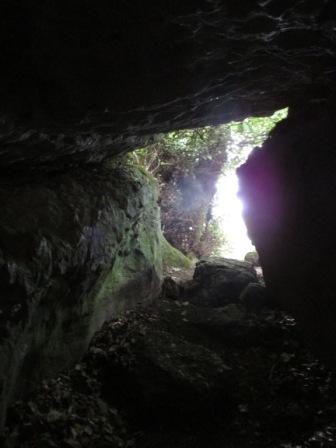
Cave, SilverdaleParker suggests Late Bronze Age ‘ritual shafts’ and ‘offering pits’ containing depositions including human and animal bones, grain, pottery and metalwork express a ‘quid-pro-quo’ relationship between the ancient Britons and the underworld gods. If he is correct, it is possible that Vindos / Gwyn, Dormarth and other kindred spirits were involved in these rites.

Gwyn’s first literary appearances are in medieval Welsh texts; ‘How Culhwch Won Olwen’ (11th C) in The Mabinogion and ‘The Dialogue of Gwyddno Garanhir and Gwyn ap Nudd’ (13th C) in The Four Ancient Books of Wales. These texts have roots in an older, oral tradition and contain fragments of tales from across Britain that predate Christianity. A significant number of these, including two featuring Gwyn, are from ‘The Old North’ (5). This is important to me because I connect with Gwyn in Lancashire.

Parker argues that superstitions about the underworld gods carry over into The Mabinogion. This is evidenced in the disappearance of livestock, children and crops. Pwyll’s encounter with Arawn, a King of Annwn, is the catalyst for the unfolding drama of the first four Mabinogi. Parker says these stories show the spirits of Annwn could not ‘be simply dismissed or ignored. Instead, a complex narrative had to be constructed in which, through a series of symbolic ritual manoeuvres, their power was drawn out, confronted and finally neutralised.’ The attempts of medieval scholars to disempower these deities can be seen at work in the development of Gwyn’s mythology.

In ‘The Dialogue of Gwyddno Garanhir and Gwyn ap Nudd,’ (6) Gwyn is presented as a divine warrior returning from battle to the Tawe near the vale of Neath. Gwyddno, ruler of Cantre’r Gwaelod, speaks of and addresses him with reverence and respect. ‘Bull of conflict was he, active in dispersing an arrayed army, / The ruler of hosts, indisposed to anger, / Blameless and pure was his conduct in protecting life.’ Other epithets Gwyddno uses include ‘hope of armies’ and ‘hero of hosts.’ ‘Host’ may refer to the spirits of Annwn.

Gwyn introduces himself as ‘Gwyn, the son of Nud, / The lover of Creurdilad, the daughter of Lud.’ He names his horse as ‘the torment of battle’ and refers to Dormarth as ‘truly the best of dogs,’ ‘handsome,’ ‘round bodied’ and ‘ruddy nosed.’ References to his possession of a ‘polished ring’ and ‘golden saddle’ are also suggestive of his status.

The title ‘Bull of Conflict’ refers to Gwyn’s role as a psychopomp. At the end of the poem he describes his travels across Britain gathering the souls of fallen soldiers. He appears to be berating this task. ‘I have been where the soldiers of Prydain were slain, / From the East to the North; / I am alive, they in their graves! / I have been where the soldiers of Prydain were slain / From the East to the South / I am alive, they in death!’

This poem contains important clues about Gwyn’s identity as a divine warrior and huntsman, whose role was to gather the souls of the dead and take them to Annwn.

In ‘How Culhwch Won Olwen’ in The Mabinogion, Gwyn is depicted as a huntsman and advisor to King Arthur. His place in Arthur’s court list and apparent subjection to both Arthur and God may be read as attempts by medieval scholars’ to explain and downgrade his position.

That ‘Twrch Trwyth will not be hunted until Gwyn son of Nudd is found’ (7) hints at his role as leader of the hunt, and knowledge of otherworldly beings. The Twrch was a king reputedly turned into a swine by God. When Gwyn does not reveal his location it is possible he is defending his own.

The advice of Gwyn and Gwythyr ap Greidol ‘Victor Son of Scorcher’ is also needed by Arthur to find Pennant Gofid in the ‘uplands of hell,’ which Evans and Bromwich say is ‘clearly situated in North Britain’ (8). When they reach this location, Gwyn and Gwythyr advise Arthur in his defeat of the ‘The Hag of Pennant Gofid,’ another otherworldly entity. The parcity of their advice, which leads to several failed attempts by Arthur’s men before the Christian King is forced to step in to slay her, may also suggest that Gwyn and Gwythyr are acting as tricksters.

A pair of lines fundamental to understanding Gwyn’s mythos, and which continue to intrigue and perplex me, are the following; ‘God has put the spirit of the demons of Annwfn in him, lest the world be destroyed. He will not be spared from there’ (9).

Taken literally, this seems to mean that at some point during the period of Christianisation God put the spirit of the demons of Annwn ‘in’ Gwyn’s person to prevent the world’s destruction. Or it may mean that he granted Gwyn rulership of them for this purpose. However, it is probable that the agency of God was brought in as a cover to excuse the prevalent belief in the existence of these spirits and their ruler.

Even if we assume God’s agency is a cover for existing beliefs, the notion that Gwyn somehow contains ‘the spirit of the demons of Annwn’ is a fascinating one. In a conversation via e-mail, Heron (10) told me the word ‘spirit,’ in Welsh, is ‘aryal,’ which can mean ‘ferocity,’ ‘essence’ or ‘nature’. He referred me to Evans and Bromwich, who say ‘Gwyn’s partaking of the ‘nature of the devils of Annwfn’ indicates a recognition on the part of the redactor of the tale that Gwyn ap Nudd belonged to a sinister and forbidden mythology’ (11). Within this mythology he may already be seen to embody the nature of these entities, or to hold power over them.

That the destruction of the world is at stake suggests Gwyn’s role was extremely significant. If it is assumed this notion has older roots, some of the offerings of the ancient Britons may be explained as attempts to placate these spirits and their ruler due to their destructive capacity. It is also possible Gwyn was invoked as the only being who could hold them in check.

Fears and superstitions surrounding Gwyn and the spirits of Annwn may lie behind the story of his abduction of Creiddylad. After Creiddylad, who is both Gwyn’s lover and sister, elopes with Gwythyr, Gwyn seizes her back. It might be assumed he takes her to Annwn, and that this suggests an underlying fear of being abducted by Gwyn and his forces.

Gwythyr amasses his armies and attacks Gwyn. Gwyn triumphs and captures a number of Gwythyr’s allies, who are mainly rulers of the Old North. During their captivity Gwyn slaughters Nwython, cuts out his heart and feeds it to his son, Cyledr, who goes mad. This could be read as a clear example of Gwyn’s ferocity and hints at existing superstitions about what goes on in Annwn.

Evans and Bromwich say the concentration of the names of people Gwyn kidnaps suggest ‘that north Britain was the ultimate place of origin for the Creiddylad episode, and that this incident was one of the surviving fragments of tradition emanating from there’ (12). It is therefore likely it originates in earlier beliefs held about Gwyn and his host by the Northern Britons.

Arthur eventually comes North to Gwythyr’s aid and frees his noblemen. Afterward he makes peace between Gwyn and Gwythyr by placing a dihenydd ‘fate’ on them. This dictates that they must fight for Creiddylad’s hand every Calan Mai ‘May Day’. An added condition, which seems particularly unfair, is that Creiddylad must remain in her father’s house, and no matter who wins neither can take her until Judgement Day. It is likely Arthur’s agency was brought in to explain an earlier myth, which was already prevalent in the Old North.

Whilst, on one level, this myth may be about fears of abduction to the underworld, it is more frequently interpreted as a seasonal drama comparable with Hades’ capture of Persephone. In this reading, Creiddylad is a maiden goddess who embodies the powers of spring and fertility. Creiddylad’s abduction by Gwyn may explain the failure of these powers at Calan Gaeaf, the first day of winter. Gwythyr and Arthur’s rescue of her at Calan Mai, the first day of summer, may explain their resurgence.

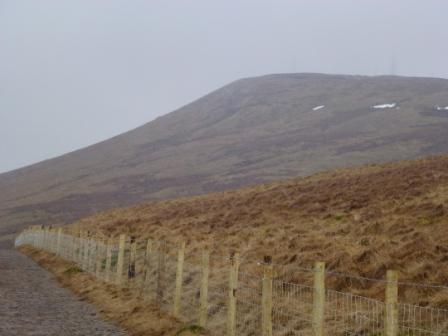
Winter Hill

Winter Hill

Gwyn is also seen as the Winter King. It is possible his white, shining qualities relate to snow and cold, associations which could date back to the Ice Age. Elen Sentier links Gwyn with the reindeer goddess Elen of the Ways (13) and the Boreal forest. He may also be connected with the North wind. The 14th C Welsh poet Dafydd ap Gwilim refers to ‘Tylwyth Gwyn, talaith y gwynt’ ‘the family of Gwyn, the province of the wind’ (14). The pervasiveness of a myth featuring Gwyn in Northern Britain could have a basis in its harsh winters.

In a later text, The Life of St Collen (14th C), Gwyn is referred to as ‘the King of Annwn and the Fairies’ and is supposedly banished by the saint from Glastonbury Tor (15). The transition from belief in Gwyn as a King of Annwn to King of the ‘Tylwyth Teg’ or ‘Fair Folk’ is a significant one. The original natures of Gwyn and the spirits of Annwn are covered over by their reduction to diminutive form. However, hints at their mythos can still be found in the majority of folktales.

Gwyn retains his status as leader of the Wild Hunt in the folklore of Wales and Somerset. There he is seen to appear on horse back with a pack of white, red-eared hounds, riding out on Nos Calan Gaeaf and through the winter months, chasing down the souls of the dead. To hear his hounds is an omen of death. The other riders are seen often seen as captive souls and may represent the spirits of Annwn.

In the North West of England, however, the hunt is assigned either to the Norse god Odin, or to Christian angels. In Cumbria it is Michael, and in Lancashire and Yorkshire Gabriel is said to lead a pack of black, red-eyed dogs, the Gabriel Ratchetts.

Coincidentally, Preston born writer Francis Thompson is famous for a poem called ‘The Hound of Heaven.’ Anybody who has felt like Gwyn’s hounds are on their tail might find these lines hauntingly familiar; ‘I fled Him, down the nights and down the days; / I fled Him, down the arches of the years; / I fled Him, down the labyrinthine ways / Of my own mind; and in the mist of tears / I hid from him, and under running laughter.’ (16)

More recently, Gwyn’s significance as an ancient god has been attested by contemporary scholars such as Geoffrey Ashe, in King Arthur’s Avalon (2007) and Nicholas R. Mann in The Isle of Avalon (1996) and Glastonbury Tor (2012). He is also the subject of a full length book called Gwyn: Ancient God of Glastonbury and Key to the Glastonbury Zodiac (2007) by Yuri Leitch.

This increase in interest suggests we are approaching a time when Gwyn and the spirits of Annwn are taken seriously as Brythonic deities again. However, the main focus of these books is Gwyn’s role at Glastonbury, with only a small mention of his place in Wales and other areas of Britain. Disappointingly there is no mention of Gwyn’s activities in the North. In this respect I have only my own experiences and conjectures to go on.

Fairy Lane

Fairy Lane

I first met Gwyn on Fairy Lane in my hometown of Penwortham, where he challenged me to journey with him to Annwn. Since then I have worked with him as a guide to the otherside of my local landscape and its hidden myths. His interest in my locality surprised me at first. However, it seems less surprising when looked at in the context of his role as an ancient underworld god of Britain, particularly in relation to the history and folklore surrounding this site.

Penwortham has been inhabited since 4000BC. The Riversway Dockfinds, a collection of animal bones, 30 human skulls, two dug out canoes and the remains of a timber structure suggest the existence of a lake village on Penwortham Marsh. Nearby is Castle Hill, a point of military and religious importance. There is a church dedicated to St Mary on the summit of Castle Hill, which means it was likely to have been a pre-Christian sacred site.

That the church is dedicated to St Mary and she was also the patron saint of a healing well at the foot of Castle Hill suggest the presence of an earlier female deity with healing powers, who has been Christianised as Mary. Three human skulls found in the wall of the church (17), which may have served an apotraic function suggest superstitious beliefs in chthonic spirits were also once popular but not openly acknowledged.

The survival of the legend of Penwortham Fairy Funeral attests to these superstitions. In the earliest version in Bowker’s Goblin Tales of Lancashire (1878), it is set on Church Avenue on Castle Hill. Two men walking home to Longton encounter a procession of fairies carrying a coffin. Robin, one of the men, looks into the coffin and sees his own miniature corpse. Frightened by the sight, they follow the fairies into St Mary’s graveyard. Robin attempts to prevent the burial by reaching out to grab the leader of the fairies. The procession vanishes and Robin, driven mad, topples to his death from a haystack a couple of months later (18). In later versions, this story takes place on Fairy Lane, which runs through Penwortham Wood at the foot of Castle Hill.

This legend may be interpreted to hint at older beliefs in underworld gods. Church ways are often identified with spirit paths. It is possible that prior to Christianity people believed chthonic spirits to have been actively involved in bearing the deceased to the underworld. The ringing of bells to drive them away and superstitions surrounding lych gates are testaments to fear of such entities. The movement of the legend to Fairy Lane may be seen as an attempt to sever their connection with the church. It is also possible it represents a shift in the energy of the area.

Gwyn ap Nudd and the spirits of Annwn (more frequently referred to as fairies today) are frightening beings. However, they play an essential role in maintaining the relationships between the worlds, the seasons, and the living and the dead. Like death itself and the cold dark of winter they will never go away. Their roles and identities, covered over or ignored for many centuries, can be recovered and understood.

Like Pwyll’s meeting with Arawn, my relationship with Gwyn has changed my life. He guides me to visions in Annwn and the physical world I would not be able to access without him. He teaches me to walk the spirit paths and inspires me to learn the song lines of this land’s ancestral heritage.

As late summer arrives, harvesters take to the fields and leaves begin to fall I sense the spirits of Annwn stirring, the first hint of the breath of winter on the wind. Monday is the date of the commemoration of the beginning of the First World War. When I help lay candles in front of Preston cenotaph for each of the 1956 soldiers who lost their lives I will remember that care of the souls of the battle dead was once believed to be Gwyn’s role.

(1) http://www.caerfeddwyd.co.uk/
(2) http://www.mabinogi.net/sections/Appendix/The_Underworld_Gods.pdf
(3) James MacKilliop, Dictionary of Celtic Mythology, (1998), p375
(4) Robin Herne, Old Gods, New Druids, (2009), p48
(5) A collection of Kingdoms in the North of England and Southern Scotland from 500AD and 800AD.
(6) Transl. William F. Skene, ‘The Dialogue of Gwyddno Garanhir and Gwyn ap Nudd,’ The Four Ancient Books of Wales, (2007), p210-211
(7) Transl. Sioned Davies, ‘How Culhwch Won Olwen,’ The Mabinogion, (2007), p199
(8) Ed. Rachel Bromwich and Simon Evans, Culhwch and Olwen, (1992), p169
(9) Transl. Sioned Davies, ‘How Culhwch Won Olwen,’ The Mabinogion, (2007), p199
(10) https://www.blogger.com/profile/02055792516386371373
(11) Ed. Rachel Bromwich and Simon Evans, Culhwch and Olwen, (1992), p133
(12) Ibid. p150
(13) Elen Sentier, Elen of the Ways, (2013), p26-28
(14) Dafydd ap Gwilim, Poems, (1982), p132 – 133
(15) http://www.maryjones.us/ctexts/collen.html
(16) Francis Thompson, The Hound of Heaven and Other Poems, (2000), p11
(17) Rev C. Nelson, St Mary’s Church, Penwortham, Lancashire, Archaeological Watching Brief and Explanation, (2011), p48
(18) http://www.gutenberg.org/files/39712/39712-h/39712-h.htm#THE_FAIRY_FUNERAL

Many thanks to Heron and Lee at Caer Feddwyd for bringing Will Parker’s article to my attention.