Caer Siddi is a legendary fortress in the enigmatic medieval Welsh poem ‘The Spoils of Annwn’, which is written from the perspective of Taliesin and describes his journey with Arthur and his men aboard the warship, Prydwen (‘Fair Form’) to seven fortresses in Annwn (‘the deep’).
Their aim is to accomplish a series of tasks including the rescue of the divine prisoner, Gwair, the theft of the cauldron of the Head of Annwn and capture of the Brindled Ox. Parallels with the anoethau (‘impossible tasks’) in Culhwch and Olwen suggest a shared source in Brythonic tradition.
Caer Siddi is the first fortress Arthur’s party raid. The name Caer Siddi has been translated as ‘Fortress of the Mound’ or ‘Fortress of the Fairies’ from the Welsh caer ‘fortress’ and Irish síd which refers both to the aos sí ‘fairies’ and the sídhe ‘mounds’ they inhabit. Another translation is ‘Fortress of the Zodiac’ from the Welsh siddi ‘zodiac’.
In ‘The Spoils of Annwn’ Taliesin says:
‘Maintained was Gwair’s prison in Caer Siddi,
throughout Pwyll and Pryderi’s story.
No-one went there before he did –
into the heavy grey chain guarding the loyal lad.
And before the spoils/herds of Annwfn he was singing sadly.’
Caer Siddi is presented as a prison and Gwair is its first prisoner. Gwair’s imprisonment takes place throughout the story of Pwyll and Pryderi, which is set in the ‘British foretime’ preceding the Roman invasion. Gwair’s prison is magically maintained until Arthur’s day.
The line referring to ‘the spoils/herd of Annwfn’ links the first verse to ensuing verses where the cauldron is stolen, no doubt filled with Annuvian treasure, and the Brindled Ox is towed away from his custodianship of Annwn’s herds.
Gwair’s sad song may be likened to the lamentation of Mabon son of Modron in ‘a house of stone’ in Culhwch and Olwen. Mabon and Gweir son of Gweirioed (Gwair) are listed alongside Llŷr Half-Speech as ‘Three Exalted Prisoners of the Island of Britain’ in The Triads.
Mabon provides an alternative triad of prisoners: ‘he who is here has reason to lament… no-one has been so painfully incarcerated in a prison as I, neither the prison of Lludd Llaw Eraint nor the prison of Graid son of Eri.’
There are clear parallels between the trios Mabon, Llŷr, Gweir / Mabon, Lludd, Graid. Some scholars claim Llŷr / Lludd and Gweir / Graid are the same people.

Lundy’s Jetty and Harbour by Michael Maggs, Wikipedia Commons
The name Gweir ap Gweirioed has been translated as ‘Hay son of Grassiness.’ Gwair means ‘hay’, gweirglodd ‘meadow’ and gweiryn ‘blade of grass.’ The green island of Lundy is known as Ynys Weir. Whether this was Gwair’s place of origin or imprisonment remains uncertain. Perhaps Gwair is a deity of grasslands and meadows and his imprisonment is representative of a barren or winter landscape.
In Culhwch and Olwen, Graid son of Eri is part of an army imprisoned by Gwyn ap Nudd, a ruler of Annwn and god of winter. Arthur rescues Graid and the other prisoners along with Graid’s dog, Drudwyn, the leash of Cors Cant Ewin to hold him with, and a steed called Myngddwn for Mabon to use on the hunt for Twrch Trwyth.
Whether these are two different tellings of the same narrative is unclear. However we can assert that imprisonment in Annwn is a longstanding theme in medieval Welsh literature.
***
Caer Siddi is also mentioned by Taliesin in ‘The Chair of Taliesin’:
‘Harmonious is my song in Caer Siddi;
sickness and old age do not afflict those who are there,
as Manawyd and a Phryderi know.
Three instruments/organs around a fire play in front of it
and around its turrets are the wellsprings of the sea;
and (as for) the fruitful fountain which is above it-
its drink is sweeter than white wine.’
Contrastingly, for Taliesin, Caer Siddi is a paradisal place where he has attained a Bardic chair. This has been linked to his claim to have spent ‘three times in the prison of Arianrhod’ in The Story of Taliesin. He also says ‘My darling is below / ‘Neath the fetters of Arianrhod’.
Arianrhod (‘Silver Wheel’) and her home, Caer Arianrhod, an island off the coast of Gwynedd seven miles south west of Caernarvon, are described by Taliesin in ‘The Chair of Ceridwen’:
‘Arianrhod, famed for her appearance surpassing the radiance of fair weather,
her terrifying was the greatest shame (to come) from the region of the Britons;
a raging river rushes around her court,
a river with its savage wrath beating against the land:
destructive its snare as it goes round the world.’
Here she appears as a beautiful yet imposing deity. This description fits with her representation in the Fourth Branch of The Mabinogion where she refuses to give her son, Lleu, a name, arms or a wife.
Unfortunately nothing is written about what happened to Taliesin during his imprisonment in Caer Arianrhod, whether he rescued his ‘darling’ and how this links to his chair in Caer Siddi. Analogies between the ‘heavy grey chain’ and ‘snare’ of a river may suggest Caer Arianrhod is Caer Siddi.
Many scholars and modern Druids interpret Taliesin’s period of imprisonment as a form of Bardic initiation giving rise to his shapeshifting capacities and omnipresence:
‘I was in a multitude of forms
before I was unfettered:
I was a slender mottled sword
made from the hand.
I was a droplet in the air,
I was the stellar radiance of the stars.’
‘I was revealed
in the land of the Trinity;
And I was moved
through the entire universe;
And I shall remain till doomsday
upon the face of the earth.’
***
It is of interest that Taliesin says Manawydan and Pryderi know Caer Siddi. In the Third Branch, Manawydan, his wife Rhiannon, Pryderi and his wife Cigfa follow a white boar to a fortress that belongs to Llwyd Cil Coed, a powerful enchanter who has put a spell on Dyfed.
In spite of Manawydan’s warnings, Pryderi enters. Captivated by a golden bowl hanging over a well he touches it and gets stuck. Rhiannon follows and meets the same fate. A blanket of mist descends and with a tumultuous noise the fortress disappears.
When Llwyd sends his people as mice to devour Manawydan’s wheat fields, Manawydan captures his pregnant wife in mouse form. By threatening to hang her on a miniature gallows, he persuades Llywd to remove the enchantment and release Rhiannon and Pryderi.
Afterward, Llwyd reveals he enchanted Dyfed as revenge for the violence inflicted by Pwyll, Rhiannon’s first husband and Pryderi’s father, on his friend Gwawl ap Clud. As Rhiannon is a divinity associated with Annwn, it may be suggested Gwawl and Llywd are Annuvian figures too.
This is backed up by Llwyd’s reappearance in Culhwch and Olwen. After Arthur and his men return from Ireland with the cauldron of Diwrnarch Wyddel, they land ‘at the house of Llwydeu son of Cilcoed at Porth Cerddin in Dyfed. And Mesur y Pair (‘the measure of the cauldron’) is there.’
The cauldron of Dyrnwch the Giant is listed amongst ‘The Thirteen Treasures of the Island of Britain’ and its property of not brewing meat for a coward identifies it with the cauldron of the Head of Annwn. The symbolic links between ‘the measure of the cauldron’ at Llwyd’s house and the well and golden bowl in his enchanted fortress are intriguing.
***
Caer Siddi is mentioned again in Ellis Gruffydd’s Chronicle of the Ages (16th C). Gruffydd claims that ‘Merlin was a spirit in human form’ who appeared in ‘the time of Maelgwn Gwynedd’ as Taliesin ‘who is said to be alive yet in a place called Caer Sidia.’
He appeared a third time as the son of Merfyn Frych son of Esyllt and ‘was called Merlin the mad. From that day to this, he is said to be resting in Caer Sidia, whence certain people believe firmly he will rise up once again before doomsday.’
An alternative story about Merlin’s resting place is found in Pen. 147. Myrddin (an earlier name for Merlin) sets out to acquire the Thirteen Treasures of the Island of Britain. The owners of the treasures agree to hand them over if Myrddin can obtain the Horn of Brân the Niggard.
Surprisingly, Brân agrees. Myrddin obtains all Thirteen Treasures and takes them to ‘the Glass House’, which is frequently identified with Bardsea Island.
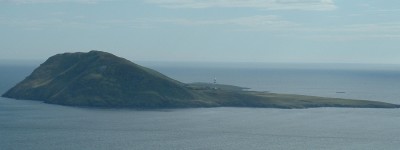
Bardsea Island by Mynydd Mawr, Wikipedia Commons
***
Caer Siddi has many faces. It is the place where Gwair sings sadly fettered by a heavy grey chain. It disappeared with Rhiannon and Pryderi whilst they stared entranced into a golden bowl. Taliesin holds a Bardic chair there beneath a fountain of mead ever remembering when its rivers were a savage snare. Myrddin rests with an old, battered cauldron filled with rescued treasure beside the well where the golden bowl once hung.
These faces of Caer Siddi were known in medieval Wales. What are its faces now? I can’t tell you because I haven’t got there yet. Not getting there led to some surprising discoveries and I’ll share them in the next post.
SOURCES
Heron, ‘Merlin, Taliesin and Maponus’
John and Caitlin Matthews, King Arthur’s Raid on the Underworld, (Gothic Images, 2008)
Marged Haycock, Legendary Poems from the Book of Taliesin, (CMCS, 2007)
Patrick Ford, Mabinogi and Other Welsh Tales, (University of California Press, 2008)
Rachel Bromwich (ed), The Triads of the Island of Britain, (University of Wales Press, 2014)

 The Sanctuary of Vindos