Prayer to Vindos for Clear Sight

Vindos God of Clear Light
grant to me Your Clear Sight.
Free me from the fog of self-deception
and remind me of my deathless nature.

Audio HERE.

~

This prayer, which can also be sung as a chant, is based on the famous Hindu Mahamrityunjaya ‘Great Death-Conquering’ Mantra HERE – a prayer to Shiva for liberation from our attachments to ignorance and untruth and a reminder of our immortality. When I was studying yoga with the Mandala Ashram I sung it for 20 minutes every week. I have started singing this prayer / chant to Vindos for 20 minutes each morning for clearer vision as I face a difficult period after giving up being Sister Patience.

Prayer – Some Scaffolding

I’ve recently been re-reading St Teresa of Avila for inspiration on forming a framework for my own practices and experiences of prayer. Teresa’s techniques are complicated and vary as her ideas change over time as evidenced in The Way of the Perfection and The Interior Castle.

During this time I had a dream in which the Mother Superior of an abbey was giving a talk on prayer and told the audience not to mistake the scaffolding for the thing itself. I thought her words were wise but at present feel like I need a little scaffolding as I attempt to build a palace for prayer fit for Gwyn – Annwn’s King. Below, inspired by Teresa, is my scaffolding for prayer.

Formal Prayer

Formal prayers are those that are addressed to the Gods and are often written down and spoken regularly – daily, monthly or at seasonal celebrations. For example prayers of praise (“Gwyn ap Nudd, Lord of Annwn, I adore Your starlit crown”), prayers of thanksgiving (“I thank You, White Son of Mist, for guiding me on the misty ways”) and prayers of celebration (“Hunter in the Skies tonight we honour You as You ride out with Your hunt.” Prayers of petition and intercession might also be included here. “Bull of Battle, with Your horned helmet, strong shield and piercing spear, lend me Your strength”. “Gatherer of Souls please gather the soul of… to Your realm.”

Conversational Prayer

Conversational prayer is less formal and gives the Gods more space to respond. As St Teresa says it is like conversing with a friend. Checking in, asking what They need from us and for Their advice and guidance, listening to Their opinions on how we have served Them throughout the day. “Good morning.” “I’m feeling… how are you?” “How might I serve you best?” “I’ve got this problem.” “Good evening.” “My day’s been… how was yours?” “I messed up, I’m sorry, what do you think and how can I make repairs?”

Conversations with the Gods might take place like those between human persons, like between two friends, with a Deity appearing in human-like form and speaking directly through the inner senses. The Gods might also respond in more nuanced ways, providing us with a feeling or a knowing, they might show us a vision or a sign in nature or gift us with a dream.

The Prayer of Vision

The prayer of vision involves the active visualisation of a Deity. We can visualise our Gods before us, at our altars, or we can use visualisation meditation to visit Them at Their sacred places in Thisworld or the Otherworld. In this type of prayer we often find at the beginning we feel like we’re ‘making it up’ and we are to some degree yet the very act of imagining is sacred and the beginning of the co-creation of a vision that often shifts and takes on a life of its own as we enter deeper communion with our Gods. Spontaneous visions can also occur both in and outside of prayer time.

The Prayer of Silence

Whilst the prayer of vision involves the active use of the imagination and the inner senses the prayer of silence occurs when the faculties are stilled. Here, it is common to experience a deep sense of calm, of quiet, of abiding with a God. As it lacks sensory content it is notoriously difficult to put into words. I experience it as the otherside of Gwyn’s paradoxical nature – the calm within the storm, the hunter waiting patiently before He rides out hunting for souls, His sleep as the Sleeper in Deep Annwn throughout the summer months.

The Prayer of Union

In the prayer of union we not only abide with a God but are united. This is the sacred marriage or hieros gamos wherein we become one with our Gods. This is not only difficult to put into words but on account of its intimate nature is a mystery that is shared between devotee and God alone.

The Prayer of Presence

I’ve come to this type of prayer last but it might as easily have been first or come anywhere in between because it’s the type of prayer that takes place inside and outside set prayer times and can be practiced any time day and night. That is being present, in the moment, for the Gods and those who we are in relationship with in our every daily lives in both the seen and unseen worlds. 

In most religions we find the aspiration towards ‘unceasing prayer’. Every act, if we have but the will and focus, can become an act of prayer – waking, eating, drinking, working, gardening, cleaning, sleeping. It might be argued that the purpose of the types of prayer above is to provide us with the connection and communion with the Gods that enables to lead deeper and richer lives in Thisworld and to be of better service to the land and to others.

To the Spirit of the Sanctuary

A place of quiet beyond the row,
the heartbeat of Annwn
is Your only sound,
the occasional song rising
like heartbreak from the Deep.

To keep me safe Your invisible roses twine around.

Your forget-me-nots remind me
of the King of Annwn in the summer.

Into You I am gathered by the Gatherer of Souls.
In You, with my Beloved, I am at home.

In You I can heal and I can heal others too.
Into You I gather the lost pieces of our souls.

In You I am complete in every single moment.
In You I can breathe every single breath.
In You my heartbeat is at one
with the heartbeat of Annwn – the heart of my Lord.

So hold me here, until I die, my sacred home.

From Inner Silence to Silent Prayer

I have been practicing Antar Mouna ‘inner silence’ for over a year. I first learnt it on an Introduction to Meditation course at the Mandala Yoga Ashram. The founder, Swami Nischalananda defines it thus: 

‘Antar Mouna is one of the core meditation practices of the yoga tradition. It is a precise, systematic process of cleansing the mind of its accumulated tensions and conflicts, disrupting the habit of compulsive thought and externalisation, leading to inner tranquility and silence.’ (1)

Over this period I have found it incredibly helpful for quieting my mind and for learning to witness, identify and let go of distracting and troubling thoughts.

There are six stages to Antar Mouna and I have experience of the first three. The first is ‘awareness of sense perceptions’. This involves focusing on the five senses: touch, sound, hearing, taste and inner sight. This develops the discipline of paying full attention to one sense at a time and honing each. For example, listening to sounds that are far away, then close up, following one sound, letting it go, then choosing another sound, then listening to all the sounds at once as if you’re in ‘a sea of sound’. Part of this practice is to separate the sounds from what’s causing them (ie. ‘a car’ ‘next door’s baby’).

This stage has been really helpful for me as an autistic person with sensory sensitivities for gating out sounds and not getting as annoyed with their causes.

The second stage is ‘awareness of spontaneous thoughts’. This involves watching and bearing witness to thoughts as they arise then letting them go. Thoughts are not labelled ‘good’ or ‘bad’ but ‘just thoughts’. This helps us to develop a stronger witness, not to get so caught up in our thoughts and to let them go more easily. It also helps us to see that we are not our thoughts.

Watching thoughts come and go and having experienced many occasions when I’ve been sucked in because they have been overwhelming and I’ve felt unable to continue meditating until I’ve solved that problem, got that thing planned out, contacted that person… has made me more aware of my mental processes and what types of thoughts remain problematic. I haven’t reached the point I’m able to immediately let go of more difficult thoughts yet.

I’ve only practiced the third stage very briefly. This is ‘conscious creation and disposal of thoughts.’ Here you create a thought, contemplate it for a minute, then release it. I haven’t pursued this in any more depth as it isn’t recommended without an instructor as traumatic memories can arise. 

The fourth stage is ‘awareness and disposal of spontaneous thoughts.’ This is basically being aware of thoughts and dismissing them. Saying “no” to thoughts isn’t recommended until you have mastered stage three.

The fifth stage is ‘thoughtlessness’ – the inner silence that is the aim of the practice. After this, in the sixth stage, ‘spontaneous symbols’ might occur. Through practicing the first two stages I have experienced brief periods of being without thoughts and caught a glimpse of what inner silence might feel like.

In this thoughtless state enlightenment and union with the Source might be attained.

~

For me, as a Brythonic Polytheist with a near-henotheistic devotion to my patron God, Gwyn ap Nudd, I’m less concerned with enlightenment and more with a mystical union with Him and through Him with the universe. I’ve felt the need to adapt the aim to entering silent prayer to Gwyn.

Silent prayer is found in the Christian religion and particularly in the tradition of  the Discalced Carmelites, who were founded by Teresa of Avila in 1562, and spend two hours a day silently communing with God. (2)

Like with Antar Mouna, there are several stages in the process of attaining silence. They are described my Teresa in The Way of Perfection. She distinguishes formal spoken prayer from mental prayer which takes place within.

At the outset she instructs her sisters: ‘I am asking you only to look at Him. For who can prevent you from turning the eyes of your soul (just for a moment, if you can do no more) upon this Lord?’ Here she urges them to look not at ‘a picture of Christ’ but His living image – ‘the Person Himself.’

She speaks of the process of recollection through which the nuns must withdraw their senses from worldly things and turn them instead within. She tells us: ‘the Lord is within us and that we should be there with Him.’

In a description which resembles the depictions of the castle of Gwyn ap Nudd in medieval Welsh mythology she describes the palace of the Lord in the soul:

‘And now let us imagine that we have within us a palace of priceless worth, built entirely of gold and precious stones— a palace, in short, fit for so great a Lord. Imagine that it is partly your doing that this palace should be what it is— and this is really true, for there is no building so beautiful as a soul that is pure and full of virtues, and, the greater these virtues are, the more brilliantly do the stones shine. Imagine that within the palace dwells this great King, Who has vouchsafed to become your Father and Who is seated upon a throne of supreme price—namely, your heart.’ 

She emphasises throughout that we not need to go Heaven to find God because He is always so near. This resembles how Gwyn might be seen as distant in Annwn yet He is always close, in our souls, in our hearts.

She describes the Prayer of Quiet as ‘perfect contemplation’. ‘This is a supernatural state, and, however hard we try, we cannot reach it for ourselves; for it is a state in which the soul enters into peace, or rather in which the Lord gives it peace through His presence… In this state all the faculties are stilled. The soul, in a way which has nothing to do with the outward senses, realizes that it is now very close to its God, and that, if it were but a little closer, it would become one with Him through union.’ She goes on to say that the will also ceases its striving and is united with God’s.

The Prayer of Union is the next stage and this might be followed by rapture. (3)

~

There are several major differences between these spiritual techniques. For Teresa neither the physical senses or the inner world of thoughts, feelings or emotions are viewed to be worthy of contemplation. The sole focus is on God. 

Teresa does not provide a way of quieting the mind. This is likely because the seclusion of the monastery provides a quiet environment for the nuns. (It’s due to the lack of this that I have had to turn to the yogic tradition).

Another difference is that the aim of Antar Mouna is to use the thoughtless state to attain enlightenment whereas that of silent prayer is to enter union with God.

I am currently experimenting with combining the two – firstly dedicating the process of purifying my mind through Antar Mouna to Gwyn then secondly entering silent prayer with the aim of experiencing deeper union with Him.

  1. https://www.mandalayogaashram.com/blog/intro-to-antar-mouna
  2. https://carmelitesnottinghill.org.uk/discernment/discernment-talks/
  3. Saint Teresa of Avila, The Way of Perfection, (Dover Thrift editions, 2012)

Guide of Souls Prayer

I pray to the Gatherer of Souls,
You who waits patiently,
You who works ceaselessly,
gathering the souls of the dead,
being there for those who are on the brink.

May I be a good guide of souls.
May I share and lessen your burden
by guiding others on their paths in this world
and through Your doors and into Annwn.

May I be a good guide of souls
for the living and for the dead.

May I serve You patiently and ceaselessly
on my days of joy and my days of sorrow
on this sacred day and on every day until my end.

Oh Sleeper in Deep Annwn

A Prayer of Adoration for Gwyn 

Oh Sleeper in Deep Annwn
I adore Your sacrifice
Oh Sleeper in Deep Annwn
I adore Your death
Oh Sleeper in Deep Annwn
I adore Your revival
Oh Sleeper in Deep Annwn
I adore Your breath
Oh Sleeper in Deep Annwn
I adore Your heartbeat
Oh Sleeper in Deep Annwn
I adore Your pulse
Oh Sleeper in Deep Annwn
I adore Your silence
Oh Sleeper in Deep Annwn
I adore Your lying still
Oh Sleeper in Deep Annwn
I adore Your dreaming
Oh Sleeper in Deep Annwn
I adore Your white wolf
Oh Sleeper in Deep Annwn
I adore Your imaginings
Oh Sleeper in Deep Annwn
I adore Your wandering soul
Oh Sleeper in Deep Annwn
I adore Your waiting
Oh Sleeper in Deep Annwn
I know You will return
Oh Sleeper in Deep Annwn
I sit in silence and listen
Oh Sleeper in Deep Annwn
I sit, I wait, I yearn

This prayer of adoration for Gwyn ap Nudd was written to bring more adoring / praising into my prayer practice which veered more towards petition. In the myth I live by after His defeat by Gwythyr on Calan Mai (May Day) Gwyn sleeps in His Castle of Cold Stone until Mis Medi (September – the Reaping Month).

Building Brythonic Polytheistic Monastic Practices Part One – Prayer

In building Brythonic polytheistic monastic practices I feel at once like a pioneer because few people are doing this specific work today but at the same time like I’m standing on the shoulders of thousands of ancestors because since homanids arose the majority have been animists and polytheists.

Since I came to Brythonic polytheism through Paganism and Druidry over ten years ago I have been developing my practices and deepening them further as a monastic since I took vows as a nun of Annwn in 2022.

My main practices are prayer, meditation and trance. These lead into and complement one another and their boundaries can be permeable. Here I will provide my personal understandings and how I have come to them through studying their development in ancient and contemporary polytheisms and current mainstream religions then share how I put them into practice.

Prayer

The first and foremost of my practices is prayer. Prayer, in its most basic form, is conversation with the other-than-human worlds and persons. Indigenous people have always lived in dialogue with the land and its spirits, the Gods and the ancestors, with prayer permeating their lives from rising to sleeping. 

People have likely been praying for as long as they can speak. Some of the earliest recorded examples of polytheist prayers are the Litany of Re from the Egyptian New Kingdom (16th – 11th BC) and the Homeric Hymns (7th BC).

The hegemony of Christianity brought about a shift in focus in prayer from the land and its Deities to one transcendent God and the saints. The rise of rationalism, materialism, industrialisation and capitalism have all played a role in putting into doubt and in erasing beliefs in Gods and spirits. One of the main problems with Western society is that we’ve forgotten how to pray.

Within the current mainstream religions Christianity has the most developed system of prayer and meditation is seen to be a form of contemplative prayer. 

Prayers can be formal (written prayers that are often memorised) or informal (personal prayers in one’s own words often taking the form of a dialogue). Some of the most common forms of prayer are praise / adoration, thanksgiving, petition / supplication, confession, and intercession. Other prayers are written for the marking and celebration of Holy Days.

*

Unfortunately we don’t have any evidence of prayers to the Brythonic Gods because the ancient Britons did not write anything down. However, archaeological evidence shows they made offerings of bones, pottery, jewellery, weapons and other objects in sacred places such as hill-tops, springs, rivers, lakes, bogs, in pits and shafts, and in or near burial mounds. Such offerings were undoubtably accompanied by prayers and ceremonies. 

Much of our knowledge of the Brythonic Gods comes from Romano-British altars and temples wherein they were often equated with the Roman Gods (for example Apollo-Maponos, Mars-Nodens, Sulis-Minerva). The vast numbers of Romano-British curse tablets recovered from sacred sites show people were petitioning the Gods for aid against those who had wronged them.

We also find references in Roman texts to ancient Gaulish and British rituals. Most of them describe sacrifices of animals and humans. These ceremonies  (and others less bloody) likely opened and closed and were punctuated with prayers to the Gods who were the recipients. Tacitus describes black-clad women with fiery brands and Druids raising their hands to the skies in prayer to call upon the Gods for aid against the Roman invastion of Anglesey.

These more extreme examples presuppose an underlying relationship with the Gods founded on prayer and reciprocity common amongst the general populace.

By the time the stories of the Brythonic Gods were written down in the medieval period Britain had been Christianised and all but Wales Anglicised. The Gods appear in the texts in euhemerised form (eg. Maponos as Mabon, Matrona as Modron) but the only prayers to be found are to the Christian God.

*

This has meant Brythonic polytheists have had to begin writing prayers from scratch, building on the forms found in ancient polytheisms and other religions.

Thankfully we’re not alone. The rise of the polytheist movement has given birth to numerous devotionals featuring prayers from publishers such as 

Bibliotheca Alexandrina and Moon Books and from independent authors and editors.

I worked with Dun Brython building devotional material for several years. On the website and in the devotional anthology The Grey Mare on the Hill can be found a variety of prayers to Brythonic Deities with a focus on Rigantona / Rhiannon.

Pauline Kennedy’s ‘Prayer for Epona Rigantona’ is an excellent example of praise.

‘Epona of Horses, I praise you!
Rigantona of the Land, I praise you!
Epona of Sovereignty, I praise you!
Rigantona of Journeys, I praise you!
Epona of Stables, I praise you!…’

‘Rigantona: Calan Gaeaf’ by Greg Hill is a seasonal prayer marking the first day of winter.

‘By Orion’s light
At the dark of the moon
Now the hawthorn tree is bare

A shadow passes through the veil
Of the Otherworld on a Grey Mare

Rigantona; roses wither on your altar
But we keep your vigil here.’ 

Albion and Beyond is an active Brythonic polytheist group committed to sharing information and resources and to building community. Here there is a section on the Bardic Arts with poetry for Andraste, Cocidius, Maponos and Nodens.

‘Cloud-Maker’ by Nico Solheim-Davidson praises Nodens and petitions Him for rain.

‘Nodens, Iron-handed ruler
Cloud-maker, dream-catcher
Hound-master, net-thrower, rain lord. 
Waters of deep Dumons you ride,
Turning to rain, the provider…
Guide us Iron-Hand to good times,
As we turn our praise to you, lord.
Come fast cloud-chasers, mist-racers,
Bounding and bustling in the sky,
Bring unto us your rapid rains, 
Fill the heavens with your dark cloaks.’

*

My personal practice began mainly with informal prayers to Gwyn, my patron God, and His family and my local spirits along with formal prayers for Holy Days. Since I became a nun I have been using more formal prayer – some prayers I have written myself and shared prayers of the Monastery of Annwn.

I get up at 4am and begin my morning prayers with a statement of intent to honour Gwyn. Speaking His name as the first word after I have got up and the last word before I go to bed has become increasingly important to me.

This is followed by prayers of praise to the Spirit of the Monastery, the spirits of place, the ancestors, and Gwyn and His family then formal prayers for Gwyn. These include both written prayers and songs. In the summer, when Gwyn is absent, every morning I sing a seasonal song called ‘You Are Gone.’ 

‘Dawn arrives but You are gone,
the birds are singing yet You are gone,
the flowers are turning their petalled heads
Towards the sun but you are gone…

You are gone but Your haunting 
is everywhere with Your promise of return…’

I also read a shared prayer of the monastery, ‘In Summer We Miss You.’

‘In summer we miss You 
We miss You like we miss the rain
but we know You will return again
like the raindrops on our window panes…’

This is followed by informal prayer which usually includes adoration and petition. ‘Gwyn ap Nudd, my lord, my teacher, my inspiration, my beloved, I appreciate the sacrifice You made through your death and sleep so summer can come. I am grateful for Your tireless work through the winter gathering souls. You are the Heart of my Heart, the heartbeat of my heartbeat, keeping me alive and strong. I pray to You today I might be more present, compassionate, loving, as You love me and all the souls You gather…’ Time is also spent simply being with Gwyn and listening to what He has to say.

My evening prayers take a similar form but with thanksgiving in the place of praise and ‘confession’ in the place of petition. Here I don’t mean confessing sins as such but sharing what I’ve done during the day and getting any mistakes and failures off my chest. ‘I’ve worked hard today on Your book but I got side-tracked by wondering if anyone has checked in on my blog…’ I spend time in communion with Gwyn and playing a heartbeat on my drum to bring my heart into alignment with His.

Finally, I pray to Nodens for as my God of dreams, then I say farewell to Gwyn.

An example of my daily prayers from last October can be viewed HERE. 

I am also striving to become more prayerful in my daily activies. To see writing, exercising, cleaning, cooking, gardening as forms of prayer. This doesn’t come easily to me as someone who has been very task / goal rather than relationship orientated for most of my life and is one of my biggest challenges.
Review – Hidden: A Life All For God

This documentary records the daily lives of the Trappistine Sisters at Mount Saint Mary’s Abbey in Wrentham, MA. Although I am a Brythonic polytheist not a Christian witnessing their monastic lives and devotion touched me deeply.

The story begins with one of the sisters lighting the candles in the chapel at 3am prior to vigils at 3.20am which is followed by the Great Silence – a time for silent prayer. This resonated with me very much as an early riser who gets up at 4am to pray to my Gods and spends time meditating in the sacred hours before the rest of the world wakes up and the bustle of everyday life begins. Sadly I can only imagine sharing it with other polytheistic monastics.

The sisters are Benedictines and keep the seven canonical hours of prayer (1) with compline at 7.20pm. This is coupled with private prayer and study including lectio divina ‘Divine Reading’. In accordance with the motto of Saint Benedict ora et labora ‘pray and work’ this is balanced with physical labour. The nuns work in a ‘state of the art high tech candy factory’ and also on a farm where they look after animals including keeping sheep for wool. I related strongly to the sister who found spiritual fulfilment in her compost duties. The sisters see no difference between the two – “Life here is a continual prayer.”

Although the nuns come from differing places and backgrounds and admit getting on isn’t always easy they are united by one thing – their love of God. “Everything is centred on fostering a deep personal relationship with Jesus Christ.”

Several of the nuns share their moving vocation stories, speaking of how they were called by God and came to recognise Him as “the one before all others”.

“Why did you come?”

“It’s Him.” 

“What do you seek?”

“It’s Him.”

“Why do you stay?”

“I can’t live without Him.”

Their words echoed exactly how I feel about my patron God Gwyn ap Nudd.

The functioning of this monastic community is made possible by the silence. One of the sisters says their lives are “100 per cent community and 100 per cent silence not 50 / 50”. Their “silence”, in which they commune with God in everything they do throughout the day, “is part of the conversation.”

As somebody who struggles with idle chatter but enjoys quiet company I can imagine the only way I could live with others would be if life was mostly silent.

The documentary records one of the younger sisters making her solemn profession, her life long vows. This was very moving to watch and left me with a yearning to be able to make my lifelong vows with my monastic community.

I came away from this video feeling I identified with the sisters in all ways except for being a polytheist rather than a Christian and feeling I’m closer to monotheists than most other Pagans in centring my life on my patron God and in believing that God/the Gods are real and are worthy of worship. (2)

I’ve watched it a few times now and always return to it when I feel alone in my devotion (although this is less now since founding the Monastery of Annwn).

(1) Matins / vigils (nighttime), lauds (early morning), prime (first hour of daylight),  terce (third hour), sext (noon), nones (ninth hour), vespers (sunset), compline (end of the day).
(2) In Paganism the views on Deity range widely and include: 
*The Gods don’t exist (atheism).
*We imagined up the Gods or they are parts of our psyches (psychological).
*The Gods are archetypes (archetypal).
*The Gods are real but we shouldn’t bother them – “I’’m not a God-botherer.” 
*The Gods are real and we can work with Them and celebrate Their festivals but They don’t demand our worship (non-Polytheistic Witchcraft, Wicca and Druidry).
*The Gods are real and are worthy of worship (Polytheism). 
*The Gods are real and we should centre our lives around Them (Devotional Polytheism).
*The Gods are real and we should withdraw from the secular world as far as possible to centre our lives on Them (Polytheistic Monasticism).

Creiddylad Bless These Seeds

Creiddylad Goddess of Spring
bless these precious seeds,
seedlings yearning to show.
Bless these precious embryos.

Creiddylad Goddess so green, 
bless these precious seeds
so like our deepest dreams
from Annwn they will grow.

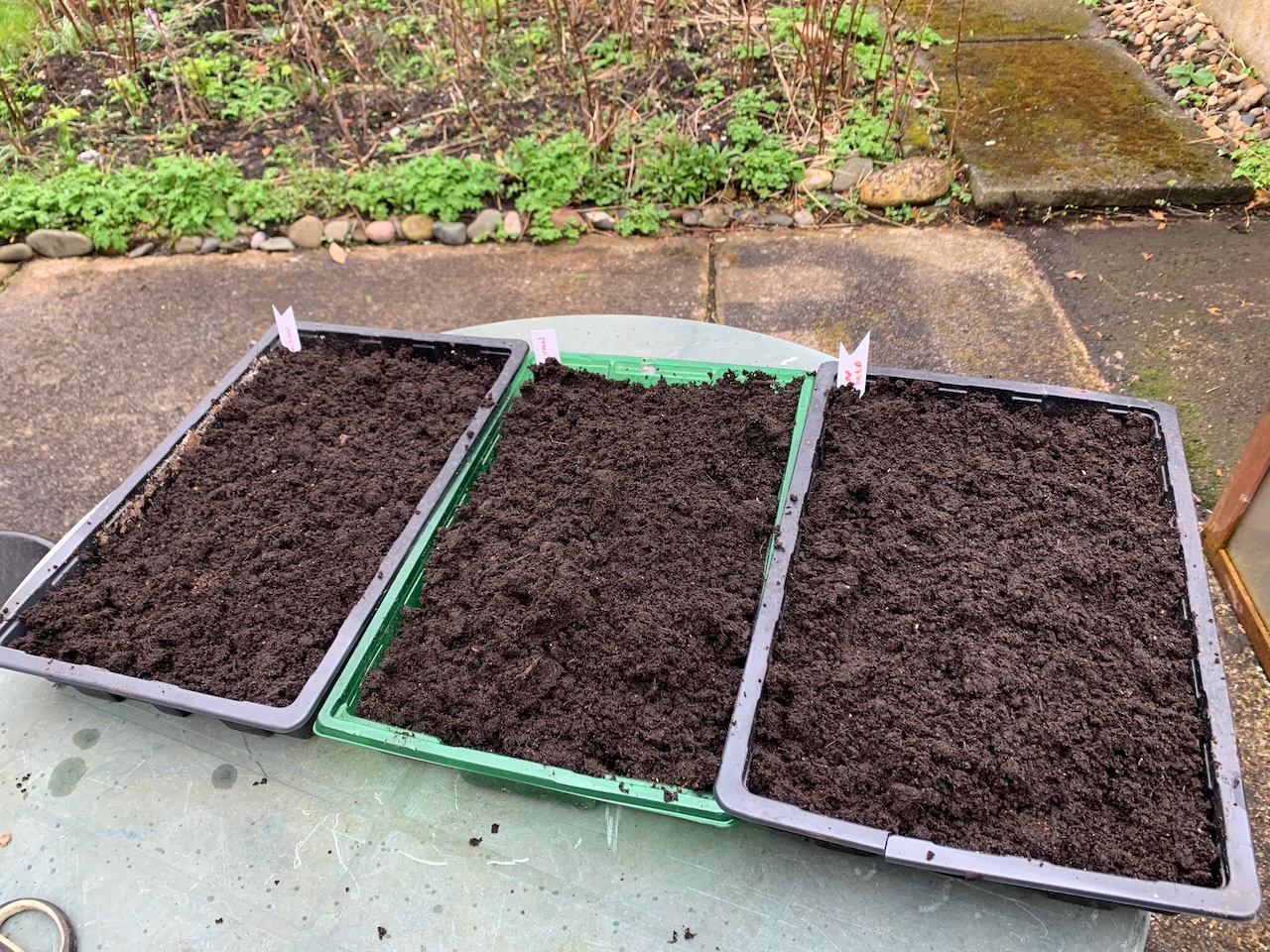
A prayer to Creiddylad for the blessing of seeds at sowing time in Creiddylad’s Garden. This year I’m growing salad and herbs including lettuce, spinach, parsley, coriander and chamomile and wild and cultivated flowers for pollinators such as cornflowers, poppies, foxgloves, vervain, calendula and dianthus. Some for pots and troughs and others to join the ox-eye daisies, ragged robin, pink campion and others in my wildflower patch.

Running as Prayer

I’ve enjoyed running on-and-off since my early twenties as a form of exercise that has been really beneficial to my physical and mental health. I haven’t been able to run very long distances due to problems with anterior knee pain ‘runners knee’ and with my sciatic nerve. My furthest is 15 miles.  Since starting strength training I’ve been running around 30 miles a week relatively injury free.* Last year I beat my goal of running a sub 2 hour half marathon with the time of 1 hour 54s. 

Before I took monastic vows as a nun of Annwn one of the things I was concerned about was whether I would still be allowed to run and continue with my strength training. When I looked into rules about exercise in monastic traditions I found they differed widely. For example in Thailand the Buddhist monks are not allowed to ‘do weight lifting’ or ‘jog’ as it is ‘not proper’ (resulting in obesity)**. Contrastingly another Buddhist order, ‘the Marathon Monks of Mt Hiei’ in Japan, have to run distances between 18.6 miles a day for 100 days to 52 miles for 100 days over a seven year period.***

It is also notable that many monastic orders incorporate martial arts such as the Chinese Shaolin Monastery, the Hindu Naga Sadhus, and the monks of the Knights Templar during the Crusades.

The moment I thought about this question in relation to my patron God, Gwyn ap Nudd, who is a warrior and a huntsman, I knew I didn’t really need to ask as He has encouraged me to run and do Taekwondo (before my local club closed) and more recently to take up strength training. I often feel closer to Him when I am running through the woods than when doing more formal devotions. 

When I formulated the nine vows for the Monastery of Annwn I received the gnosis that one of them must be ‘to take care of our health’ and that could include exercise for those able to do it.

Over the past couple of years, when I am ‘in the zone’, I have found myself filled with energy that I can gift back to the Gods and the land in ad hoc prayers of thanksgiving as I have been running.

As a couple of examples this is one for my river Goddess, Belisama, as I run beside the Ribble – 

‘My beautiful river, my beautiful river, my beautiful river – joy – my beautiful river, my beautiful river, beautiful river.’

This is a fragment of a praise poem that I tend to change in accordance with where I’m running – 

‘I praise the land, the trees,
I praise the sound of running feet, 
I praise the skies, I praise the clouds, 
I praise the sound of feet so loud…’

When I’ve had bad days and am in no mood for words I’ve offered my perseverance and effort to my Gods. 

More recently I have begun using running as a form of prayer to bring myself closer to Gwyn reciting this ‘mantra’: 

‘My breath with Your breath,
my heart with Your heart,
my feet on Your path,
You and I as one.’ 

I am embracing running as a physical, mental, and spiritual practice that brings me into unity with my God.

*Except for my latest blip – I pulled my sciatic nerve in my left glute and had to cut down for a bit.
**https://inews.co.uk/news/world/obese-buddhist-monks-exercise-health-239763
***https://marathonhandbook.com/the-marathon-monks/