Mary of the Marsh

Enduring years of disconnection,
incredulity of stars,
anger beneath the heavens,
she scathed the priests and walked alone,
drifting among chapels, knowing she didn’t belong,
her robes of night fell on soft rushes.

They say she walked along the marsh.
They say she walked out to the river.
They say she looked out to the sea.

In the damp, dark parishes
paradise was never hers,
she walked amongst the outcasts and the sick
healing wounds that should never open,
seeing what shouldn’t be seen,
her robes of night fell on troubled waters.

Mary of the lepers,
Mary of the marsh,
I saw you running to the river,
I saw you running to the sea.
How you longed to sail away…

Corpse Road

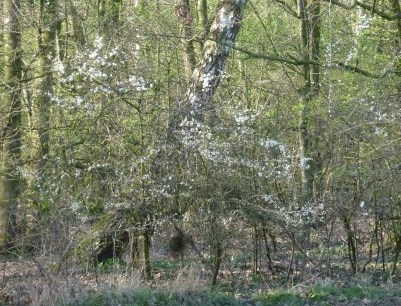
Birch and Blackthorn, Hurst Grange Park, PenworthamWho’ll walk the corpse road back to me?
– ‘Revenants’ Andrew O’Riordan

Where spring brings hope to downy birch
And blossoms of stars to blackthorn trees
When the hunt is still as the final frosts
Who will walk the corpse road back to me?

Where spring brings hope to drunks of the woods
With the pale potential of anemone
When my court dance in dew where a man lay cold
Who will walk the corpse road back to me?

Where spring brings hope to primrose hills
But none to vagrants on city streets
When wills clash like I do with impudent rivals
Who will walk the corpse road back to me?

Where spring brings hope to prison gardens
For a watchful moment the condemned walk free
When to solitary confinement comes Annwn’s darkness
Who will walk the corpse road back to me?

Where spring brings hope to those who can see it
Yet Victorian cells of asylums scream
When dreams of my kind are derided as madness
Who will walk the corpse road back to me?

Where spring brings no hope and death is release
And no fusion of flowers can quench the pain
When souls are lost as my absent queen
Will you walk the corpse road back to me?

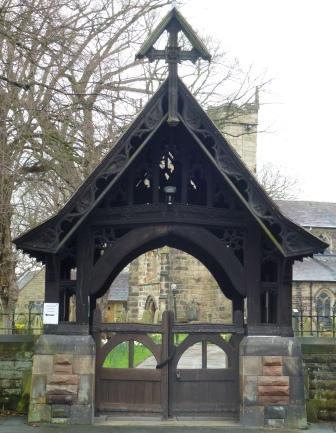
Lych Gate, St Mary's Church, Penwortham* Poem written in the voice of Gwyn ap Nudd, a British King of the dead and the fairies

Gatherer of Souls

I have been where the soldiers of Prydain were slain…
I am alive, they in their graves!
– Words spoken by Gwyn ap Nudd in The Black Book of Carmarthen XXXIII

Spring is here, daffodils
amongst the headstones,
flowers on the cenotaph
grieving summers of war-

shells shattering spirit paths,
ditches filled with corpses,
a perverse test of love
for brave young fools

and you being liminal,
battle rage and compassion
on the blood soaked fields
where banshees wail

gathering the fallen
from amongst explosions,
returning to Prydain
wracked and torn.

Spring is here, yet in
Annwn’s long autumn you know
the weight of the battle dead,
the sorrow behind the veil.

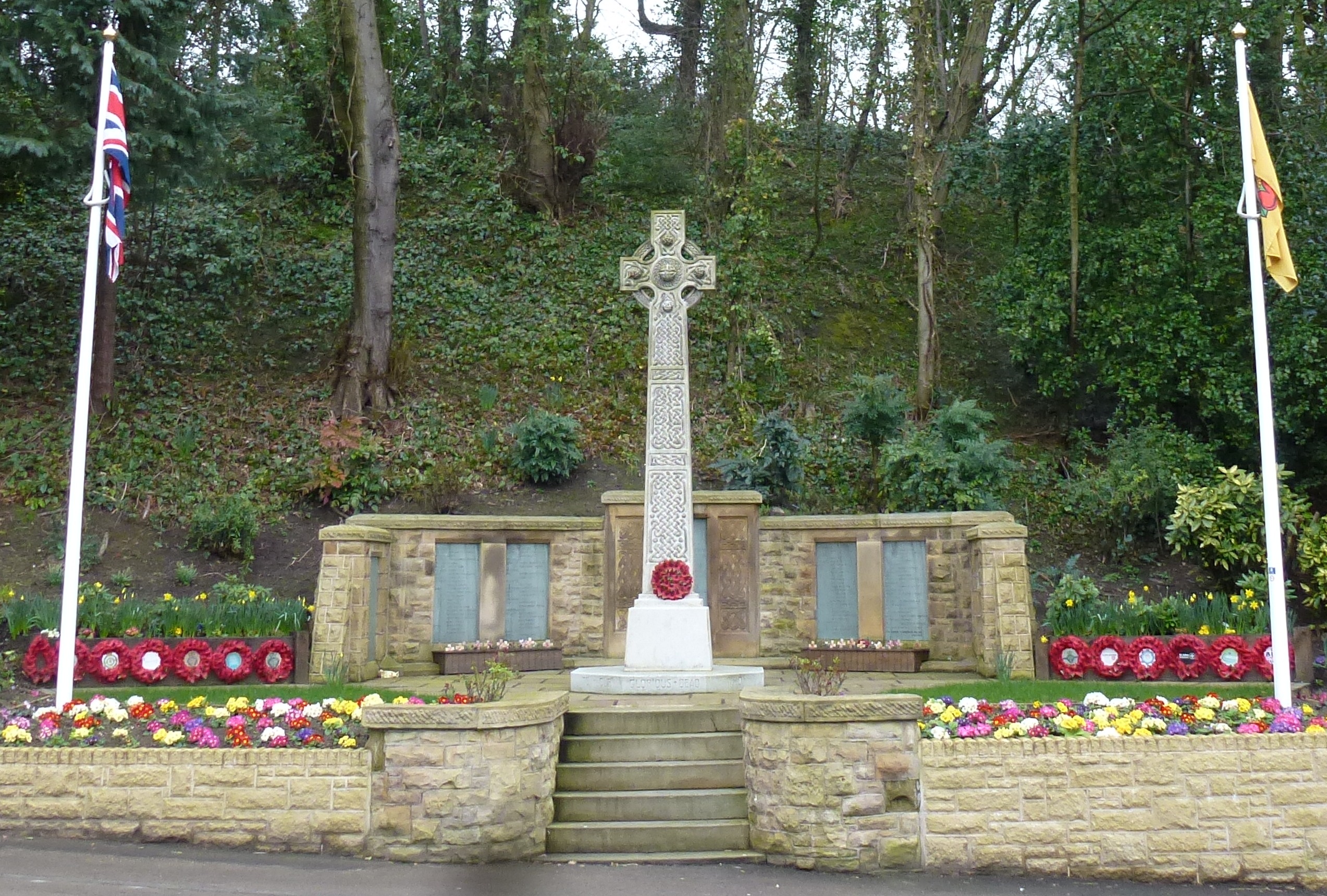
War memorial in Penwortham

Lancashire Boggarts

Boggart, Faery Ring TarotBoggarts are a type of spirit found in Lancashire and Yorkshire. In The Lancashire Dictionary Alan Crosby defines a boggart as a ‘ghost, sprite, evil spirit or feeorin.’ He says ‘there was scarcely an old house or a lonely valley which did not have its terrifying tales of creatures which roamed, shrieked and caused havoc – though most do not appear to have been especially malevolent, and some were just a nuisance.’ (1)

There are numerous boggart sites and tales in Lancashire. An old farmhouse in Boggart’s Hole Clough in Blackley was haunted by a creature with ‘a small shrill voice’ ‘like a baby’s penny trumpet’ who played tricks on the residents and their children. Having decided to leave, as they made their departure they heard the shrill voice say “ay, ay neighbour, we’re flitting you see.” Realising wherever they went the boggart would follow they turned back. (2)

The boggart of Barcroft Hall in Burnley was reputedly ‘a helpful little fellow’ until given a pair of clogs. After this he caused trouble, breaking pots and pans, making animals sick and lame, preventing the cows from milking and in a grand finale putting the farmer’s prize bull on the roof. Fed up of his tricks the farmer decided to leave. Crossing a small bridge he heard a voice call from beneath “stop while I’ve tied my clogs, and I’ll go with you!” The farmer resigned to go back.’ (3)

A story called ‘Hanging t’Boggart’ is set at the Boggart Houses in Hindley Green. A boggart with ‘aw mi mosses dreighed up’ appears as a man to Sammy. The man tells Sammy he can hang him, if he can hang Sammy afterward. Presuming the man will die, Sammy garrottes him. Leaving the body he finds the man sitting comfortably at his table ready to complete his part of the bargain. After Sammy’s corpse is found his acquaintances see ‘a big, black shape, mauling about the houses after dark.’ After a ‘terrible struggle’ accompanied by ‘spitting, hissing and other noises which sounded like curses in a foreign language’ they think they have hung the boggart to discover a big black cat in its place the following day. (4)

Other sites include Boggart’s Hole in Bolton and Boggart Bridge in Burnley, where the cost of crossing is a living thing or one’s soul. Clegg Hall hosts a boggart chamber and is haunted by a phantom boy, who was killed by his wicked uncle. Boggarts have been laid at Towneley Hall and Hothersall Hall. In Joseph Delaney’s recent series of Lancashire based children’s books The Wardstone Chronicles boggarts travel down leys wreaking havoc and the Spook’s household boggart manifests as a gigantic ginger cat.

In contemporary poetry boggarts appear as grander more primal elemental beings. In Seamus Heaney’s ‘Bog Queen’ a female boggart lies between turf and demesne wearing a black glacier for a sash, her breasts moraines, her diadem of gemstones dropping ‘in the peat floe / like the bearings of history.’ ‘Barbered / and stripped / by a turfcutter’s spade’ she rises ‘from the dark, / hacked bone, skull-ware, / frayed stitches, tufts, / small gleams on the bank.’ (5)

In ‘Milesian Encounter on the Sligachan’ Ted Hughes describes his intimations of what might have been ‘a Gruagach of the Sligachan! / Some boggart up from a crack in the granite!’

‘Eerie how you know when it’s coming –
So I felt it now, my blood
Prickling and thickening, altering
With an ushering-in of chills, a weird onset
As if mountains were pushing mountains higher
Behind me, to crowd over my shoulder-

Then the pool lifted a travelling bulge
And grabbed the tip of my heart nerve and crashed.’ (6)

These stories and poems show boggarts are intimately connected with ancient mosslands and ravines, farmhouses and their residents. They are spirits of place old as the lowland raised level peat bogs which once covered the majority of Lancashire, of which less than one percent remains. As the mosslands have been drained, cut for turves and enclosed for farming their spirits have been displaced into houses, attaching themselves to the families who farm the land.

Some are benign until treated in the wrong way whilst others are more sinister, instigating pacts based on exchanges of life for life. Bog bodies found in peat such as the Lindow Man as well as offerings such as axes, palstaves and spearheads (7) suggest the mosslands and / or their spirits were treated as deities with whom sacrificial exchanges once took place. What the stories continue to show is that when reciprocal relationships between families and the land, and perhaps within families themselves are damaged boggarts become troublesome.

In the urban mythology of today boggarts have been replaced by poltergeists, which fit better with contemporary theories about the paranormal. However I believe that throughout the landscape they remain, dried out forms stretching through the earth beneath our dwellings, appearing as helpful house sprites, stalking shadows or cats without names. And I believe it is possible, with due care, to form relationships with them.

(1) Alan Crosby, The Lancashire Dictionary, (Smith Settle, 2000), p26. Feeorin is a Lancashire word for fairy.
(2) Aidan Turner-Bishop, ‘Fairy and Boggart Sites in Lancashire,’ Lancashire’s Sacred Landscape (The History Press, 2010), p101
(3) http://www.ormerod.uk.net/History/Barcroft/barcroft_boggart.htm
(4) http://www.hindleygreenra.com/oldfacts.htm
(5) http://inwardboundpoetry.blogspot.co.uk/2006/08/198-bog-queen-seamus-heaney.html
(6) Ted Hughes, Collected Poems, (Faber and Faber, 2003), p655. The creature turns out to be a salmon.
(7) David Barrowclough, Prehistoric Lancashire, (The History Press, 2008), p159

The picture of the boggart is from The Faery Ring Tarot.
Winter Kingdom

As I make my circuit stars hold vigil in an icy breath.
Roses of Annwn bring beauty from death.
Wintering starlings spotted with snow
sleep in a tree that nobody knows.
There is a courtship of stability in this kingdom of cold
where we reknit the bonds as dream unfolds
in shadows of farmhouses down the pilgrim’s path
through old stony gates in footsteps of the past
to the healing well where a serpent’s eye
sees through the layers of time’s disguise.
A procession sways down the old corpse road
where the lych gate swings open and closes alone.
From the empty church bells resound.
Reasserting its place on the abandoned mound
a castle extends to the brink of the sky.
Within its dark memory a fire comes to life.
As warriors gather to warm their cold hands
I know I am a stranger in a strange land.

Fungi, Greencroft Valley


*Roses of Annwn is a kenning for mushrooms I came across in The Faery Teachings by Orion Foxwood

Half Moon and the Holly King

Half moon over Greencroft ValleyHalf bitten moon cries a waning scream.
Her severed pieces are brought by the stream
to the cavernous lair of the holly king
who grinds his axe on a sharpening stone
and prepares his block for the gore of heroes.

Silent and pensive he waits in his cave.
The moon arrives and his blood red eyes
are filled with silver swimming.
Outside the blackbirds sing
a song which knows no kenning.

The half formed moon describes her sorrows.
The king laments his lack of heroes-
vision waned and bravery gone.
Blackbirds sing their endless song
of an empty sky and bloodstained block…

then as hope elides a knight of dawn
approaches on a starless horse
with fire-lit eyes and maenad’s locks.
She boldly casts her gauntlet down
at the feet of the holly king.

The half formed moon departs from his arms.
He performs his task with an aura of calm.
The blackbirds watch in silence.
Then moon and lair are gone.
Dawn rides free, afraid, yet unharmed.

Holly, Greencroft Valley

Awenydd

I.
As the longest night looses
darkest claws I walk amongst shadows
at dawn where moonlight floods
through the arms of trees
and a solitary lamppost lights the vale.

Lamppost, Greencroft ValleyII.
River-trees stand stark and tall,
consistent in her mind’s
unravelling of currents and tides,
cormorants and gulls,
a ragged heron.

RibbleIII.
The host’s roar to a lullaby
quells as moon leads dawn
over chiming hills to be swallowed
by cloud as the hunt returns
to graveyard and mound.

Moon over Castle HillIV.
My lord of the fay
makes his presence known.
He speaks to the mist within my bones
like the lych gate unfastening,
awenydd– my magic word.

Lych gate, St Mary's ChurchV.
The spirit paths are mine
to walk for an evanescent pulse
of dawn. Time stands still
from vale to hill and the stream
sings: awenydd, awenydd.

Fish House Brook

Fairy Horse

Fairy horse fairy horse
Dancing on the brink
Of a cliff’s sharp edge
Above time’s dark sea.

Fairy horse fairy horse
Horned and winged
In a beam of bright moonlight
Her cold coat gleams.

Fairy horse fairy horse
With hooves of steel
Is quick to the hunt
And quicker to the kill.

Fairy horse fairy horse
Swift as poetry
And deadly as moonshine
Defies reality.

Fairy horse fairy horse
Eternally wick
Will never surrender
To a virgin’s tricks.

Fairy horse fairy horse
Will never be named.
She will never be caught.
She will never be tamed.

Faery Horse

Wild Hunt Villanelle

When the wild hunt rides on a thundering night
Hurtling from the deeps and bowers of unseen Annwn
They raze all life with their sundering might,

Sweeping heavens black warriors of starry white
Unite with rebel cries to form a spectral fugue.
When the wild hunt rides on a thundering night

Cities tremble as the harrowing horns descry
Ghost white horses, hounds of death and long lost truth.
They raze all life with their sundering might

As they gather up the souls of the dead in flight
Striking with a fear none but their kindred can endure.
When the wild hunt rides on a thundering night

Bringing down the skies and singing back the light
Around our fires only hope can see us through.
They raze all life with their sundering might

Then vanish to Annwn from tumultuous heights
Ending the old year and heralding in the new.
When the wild hunt rides on a thundering night
They raze all life with their sundering might.