White Mare Waking

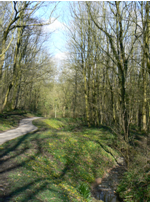
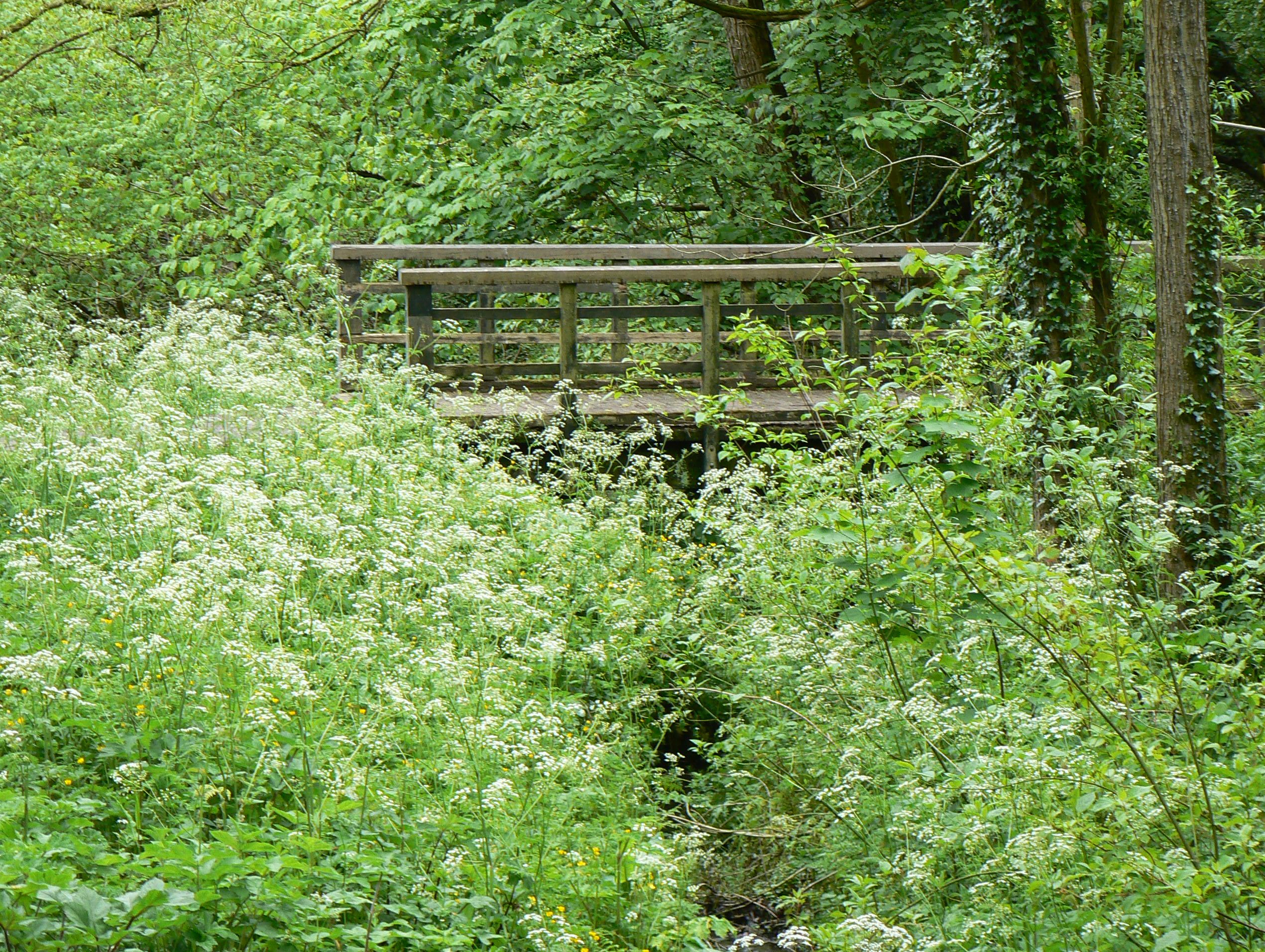
Cow Parseley, Greencroft ValleyGreen grows white tipped
cow parsleys a head high,
citadels of intrigue
to a wild cavorting eye.

Daisies peek. Curiosity paws.
Garlic stinks time bomb shards
expanding a quivering nostril.

In green freedom she rolls
turning sun over grass,
cloud over bough,
kicking her heels up.
Spring is here!

Shaking off the old,
treading invisible horse paths
of a lost long maned herd,
her restlessness ripples
through green tips and white flowers.

Lady of the Oak

I leave the shelter of the grove ducking beneath twisted hawthorn branches. The trees weave the entrance closed behind me. Rain hits my face, falling from a heaven of relentless grey. Reading the sky’s grimace I wonder what has been seen.

A crow caws his warning. Sprinting toward me up the hollow way I see a young man, legs a blur of blue white checkers and feet a splash of mud and leather. Hair slicked to his head, his dark eyes flicker with awe and wariness. The first dapples of a beard play across his chin like leafy shadows.

“M-my Lady of the Oak,” he stammers pulling up.

His breathless chest heaves beneath a sodden tunic. It is rare for youths to approach me without an elder. Looking more closely at my gnarled face his eyes widen in dawning horror. “Bad news travels from up river. A Man of the Oak wishes to speak with you.” He runs away in a flurry of muddy feet.

I follow down the hollow way heedless of the downpour weighing my cloak for the damp of the air already resides deep within my bones. Looking east, rain drenches the green hill, our sacred headland, and the greener barrow housing our ancestors. The torrent’s drumming beat strikes bubbles across the marsh land. As I walk onto the wooden pad way the reeds hiss like snakes. Decay bites my throat. The steely cast of the river of shining water reflects the glumness of the sky.

In a canoe roped to the jetty my cousin Drust sits hunched in his robes. I question what he is doing here, alone.

The river’s song answers. Her visions flood my mind. I see the battle at the ford of roaring water. Broken chariots, tribesmen slaughtered, the hero light vanishing from their eyes like fleeing stars. The eagle standard flies high, reflected in the crimson river. Seeing the pale flicker of their separating ghosts I speak a prayer for the souls doomed to return to a land where they no longer belong.

Sorrow chokes me like bile. I vomit it in anger at Drust, “what are you doing here, when your clan are dead?”

Drust looks up, yet his face remains hidden by his cowl. “I am taking the remnants of our traditions and our gods to the island across the sea.”

I laugh, a throaty brittle sound like twigs twisting and snapping. “Gods are not like saplings, to be taken away and re-rooted and traditions are not nurtured by foreign soils. It seems the ideas of the invaders have penetrated more deeply than I imagined.”

Drust tenses. Drawing my knife from its leather sheath I lean down and slice the rope tying his canoe to the jetty. The river sluices him west and out to sea.

The wind carries enemy voices. Reflected in the falling droplets I see swords and plumed helms. Slipping on the wood and slithering up the hollow way I reach the grove and beg the hawthorns for passage. A peace of ancient green breaks over me, like I’m sinking into a bed of moss. Beneath the canopy’s protective shadow I believe myself safe until tumult disturbs the roots. Crows caw, anticipating carrion.

I cross a sea of acorns and approach the grove’s mighty king. Putting my arms around his trunk, I press my face to the rough bark. “Brother Oak, let me see into the future.”

My heartbeat merges with the pulse of rising sap. My feet become roots reaching downward through damp soil to the outer edges of the grove. My arms stretch into branches and split, bearing bunches of lobed leaves nourished by the hidden sun, washed by the rain, flourishing green.

The ground shudders at the march of soldiers, galloping hooves and chariot wheels. Battle cries are hollered. Bows hum to the crash of metal. Screams and groans rock me. I taste blood and its bitterness fills me.

Earth and water shift as ditches are cut, fields plundered to feed the enemy. Ancestral ghosts clutch my twigs shrieking of their barrow torn down and a temple built to a foreign god. I moan at the ache of rot softening my flesh, bowing and creaking as my branches snap and innards hollow. I beg for lightning’s merciful release but there is no answer from the clouds of sorrow.

“Brother, let me return,” I speak. “The tribe need my support in their defeat.”

I ease back from the oak as the hawthorns scream and turn to see branches broken, shredded leaves and burst haws at the sandaled feet of a man dressed in a plumed helmet, iron breast plate and red woollen tunic. His eyes are blue, skin tanned by the sun of a hotter land. Brandishing a sword stained with blood and sap he accuses me of witchcraft, of sacrificing innocents to divine the future from their death throes.

I smile. The man freezes in horror. I draw my knife and mustering all my oaken might I drive it between the iron plates and slice open his stomach, spilling his guts upon the grass. Attempting to gather them in like rope he drops twitching and groaning to his knees.

I read the future of his people and their empire from his pulsing entrails.

Kneeling, I pick up a handful of blood soaked acorns and address my brother, “do not fear. Whilst tribes and empires rise and fall, the steady strength of oak will conquer all.”
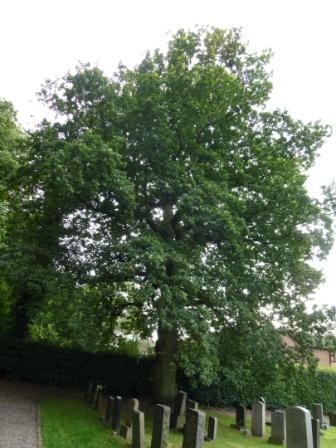
Oak, St Mary's graveyard, Castle Hill

Calling

Before my calling I slept in a glass coffin.
No-one knew if I was live or dead until
I raised my head. And still they are pondering.

Whilst I slept I watched processions
of black clad men carrying coffins,
who march here still putting time
to death, brief as dragonflies.

Their echo beats loud. In woodlands
at March I search for a heartbeat, whilst
mad winds whirl the winter skies overhead.

Roads steal sound. Pylons warp every sense.
Yet when I look the past in the eye it looks back.
They need us now as much as we need them
and the people of the future need us again.

For live or dead there is no rest, no place
to hide nor coffins left, only time processing
through both worlds to a fathomless end.

Mist on the Holme

The Ribble from MiddleforthMist on the Holme-
the perfect phantom of a morning.
Bridges fade. The river finds her old routes.
Allotments and playing fields resume their archipelago.
Over thickening silt rough currents rush.
I am knee deep in mud, stumbling through rushes.
Gulls flit like ghouls with beaks of fog.
I hear the oar of a ferryman break the churning water
to claim my coin and take me home beyond the distant shore.

Greencroft Valley

Greencroft ValleyGreencroft Valley is located in Penwortham, and is split down its centre between Kingsfold Ward on the east and Middleforth Green to the west. From (at least) medieval times up until 1984 the valley was farmland. The 1839 Tithe map shows the fields at the south end of the valley (between Pope Lane and the old Oak) as belonging to the Mayor family, who owned Malt Kiln Farm and Cottage. The cottage was originally a water powered mill, where barley from the local fields was made into grain. Following this, grain was soaked in a stone trough, ‘chitted’, germinated, dried in a kiln and ‘riddled’ before being placed in sacks to be taken by horse and cart to the Black Bull Inn. The land was bought by the church in 1860[1].

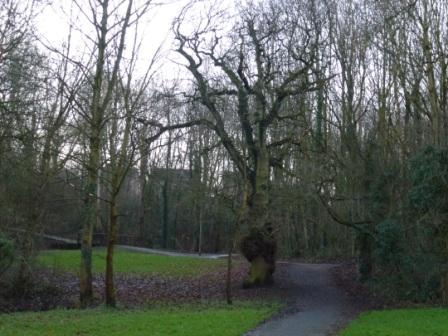
The fields north of the Oak belonged to the Baker family, who lived in a house called Alderfield, and later became Miss Whittam’s riding school (the site is now covered by Greencroft). The old hedge line can still be seen between the old Oak, the adjacent trees and another oak tree of a similar age near the Malthouse Way entrance. Another visible hedge line divides the green from the woods close to the Maltings. This divided the fields belonging to Alderfield from Fish Pan Pasture.

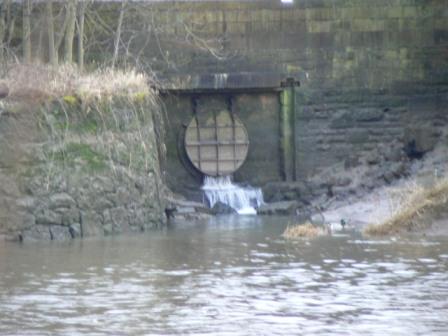
The presence of the mill combined with the two fishing ponds on the Tithe Map and the large culvert adjacent to Hill Road South, all form evidence that Fish House Brook was several times larger and more forceful than it is now, showing the drastic shifts that have been brought about in the water table over the past 150 years. Another point of note is that there was a well in the valley close to the edge of the brook, to whose steps a path ran from Alderfield; this disappeared with the building of the new estates.

The large and irregular field patterns suggests they date back at least to medieval times. A 1590 map refers to the land that stretches from Pope Lane to Castle Hill as ‘all these ancient and several lands of the manor of Penwortham as well as the Queen’s as of freeholders and copyholders[2]’. The first entry for Penwortham in the Domesday book cites the existence of ‘two ploughs,’ in reference to Penwortham End and Middleforth Green. Evidence from the Dock Finds shows the area adjacent to the Ribble near Castle Hill was occupied from the Neolithic period onward. If this was the case in higher Penwortham, then judging by the population figures (the population of Britain was higher in the Iron Age than it was during the Norman period[3]) it is possible Middleforth Green and the valley have been occupied and farmed just as long.

The occupation and land use changed dramatically between 1979 and 1984 as a result of the Central Lancashire New Towns project. This was set up in 1973 and aimed to draw together Penwortham, Preston, Walton, Leyland and Chorley in a vast urban sprawl with a population of half a million, covering 55 square miles with houses[4]. During this period the estates of Greencroft, Malthouse Way, Alderfield and the Maltings were built- over 300 houses, bringing an approximate number of 600 people[5] into the area, in stark contrast to the small number who occupied Malt House Farm and Cottage and Alderfield. It was during this period that Middleforth School, which was founded in 1861 and was formerly a Chapel-School situated where Church Brook House now stands at the bottom of Marshall’s Brow, was moved to its present site[6]. It seems needless to say that the impact on the nature and wildlife of the area must have been huge.

This open green space and woodland now forms an important habitat for wildlife, a roosting place for birds, a possible swimming place for stream life and a pleasant vista for dog walkers and play area for children, and is the only place amidst the new estates where the traces of so many centuries of our rural past is preserved. Home to a plethora of living things, from those with roots and leaves, to those with legs, tails or wings, it is an eco-system that deserves care and respect, and this is the purpose of the Friends of Greencroft Valley.

[1] Elizabeth Basquill, More Hidden Histories of Penwortham Houses, (The Friends of Hurst Grange Park, 2011), p6-11, 42-44.
[2] Alan Crosby, Penwortham in the Past, (Carnegie Press, 1988), p67
[3] There were 3 million people in 700 BC compared to 2.5 million in 1086 http://www.ukagriculture.com/countryside/countryside_history.cfm
[4] Alan Crosby, Penwortham in the Past, (Carnegie Press, 1988), p145
[5] Going by the average figure of 2.32 people per household http://www.communities.gov.uk/documents/statistics/pdf/1172133.pdf
[6] Penwortham Magazine, Issue 3.

The Black One of the Seas

Castle Hill, on the RibbleThe green hill on the water drifts
Anchorless on high tide.
Wraiths of fog fight the primal mist.
Hoof beats fall from behind.

The splash of marsh brings rounded feet;
Miracle he doesn’t sink,
Approaches like an isle-bound fleet,
The Black One of the Seas.

His mane is waves, his arching crest
Vaunts higher than a mountain.
His tail, a tiller switches, twists,
His nostrils foam black fountains.

His heaving chest rumbles and roars,
Rolls like the tides of the seas.
His long legs, a volley of oars
Beat like a heart possessed.

A troupe of seven rides his back,
The Northern King Elidyr,
Advisors, servants, child behind,
A cook upon his crupper.

Weary party, a doomed portent,
Endlessly blown ferry
Voyages black and breaking straits
From Clyde to Anglesey.

Rhythms of life they drive and smash
Like waves wrecking a jetty.
Then sink back to the ocean’s death
With the Black One of the Seas.

* This poem is based on ‘The Three Horse Burdens’ from The Triads of the Island of Britain, which can be found here: http://www.celtnet.org.uk/texts/llyfr_coch/typ_eng.html

Winter Ride

Preston


Fay bells chime. You ride a pale horse tonight.
My white mare pines for infinite horizons.

From this false security’s plastic peace
I breathe a prayer for ecstatic release.

Wrenched like tendons, reality is severed.
You open a snow storm, marvel and terror,

suburb stripped bare, hung trees and glittering ice,
a spectral host bathed in sweeping starlight.

Some people don’t see them. The rest run scared.
With my reckless steed I join the nightmare.

Our heart beats quicken to Annwn’s dread trance.
Street lamps flicker. Roofs slip into the distance.

Fairy lights and festive chants spread the county
from Blackpool Tower to Winter Hill, bright fountains

dissolve to torch parades. The present falters
revealing a past of village and bonfire,

chill chapped hands, hungry gatherings at cauldrons,
a labyrinth of padways mazed across Pilling

buried by snow fall, entombed beneath glaciers.
A cold unbearable sets in to kill.

And I fear I’m trapped in the Age of Ice
on the day of doom at the end of time

I cannot move my frozen mind. I scream
“Why? Winter King, bear me to these extremes?”

Your look commands; survey this fragile land,
ice crafting the mythos you toil to grasp,

reshaping the hills, renaming the towns,
creating the isle you know as Britain.

Wild laughter rings from the hollow landscape.
The fate of worlds tilts on a teetering brink.

I see your task, unruly guardian
of streaming vast ancestral tradition.

History rushes back and my course is clear,
My return to Penwortham swiftly steered,

shaking off snow, flexing my cold fingers,
I whisper thanks for your winter visions.

Streets of Dream

Clouds arrive, seasonal and grey,
smothering the town’s jagged edges.
Wrapped in an amniotic haze
I wander streets of dream forgetting
old boundaries between sky and pavement
in the driving rain. Wind spirits
and fierce hounds howl the day down.
I feel the out-breath of a distant king.
The wisdom of Nodens is lost to me.
I wander streets of dream forgetting
all boundaries in the driving rain.

*Nodens is an ancient British god associated with sleep, healing and hunting. In a relief found at his temple in Lydney he is depicted with hounds and putti (wind spirits).

Fish House Brook

Rainwater sharp drums the earth’s dark soil,
With a tantalizing splash sinks into her pores.
Through a tumult of tunnels, tumbling forth
From a pipeline vessel comes my concrete source.

Sieving through stones I wind my way around,
Slipping by silt, diving sleek from platforms,
Foaming effervescent, wooden rails hold my course.
I’m driven through the gauntlet like a wilful water horse.

My tributaries tremble through constricting veins
Their water has been stolen by the sewers and the drains.
The contusion of pipes plugging earth’s damp flesh
Dumps on my banks, spitting domestic waste.

My hydrophonic pulse with the force to drive a mill
Springs from showers and spins in washing machines.
Weeping by wounds of flesh pink clay,
I seep through grooves as the land is washed away.

When the earth’s dark skin is sealed under concrete,
The last dash of water in the New Town monster
And my channel dies tight by their eyeless folly
My streaming ghost will scream through the valley.