The Question of Technology and Technological Askesis

In the first two of his essays, ‘Four Questions Concerning the Internet’ (1) Paul Kingsnorth identifies the force behind the Machine (technology/the internet) as Ahriman, an evil and destructive spirit in the Zoroastrian religion (2).

He argues that ‘the sacred and the digital not only don’t mix, but are fatal to each other. That they are in metaphysical opposition.’ ‘The digital revolution represents a spiritual crisis’ and ‘a spiritual response is needed.’ As an aid to living through ‘the age of Ahriman’ he suggests the practice of ‘technological askesis.’ He notes that the Greek word ‘askesis’ has been translated as ‘self-discipline’ and ‘self denial’ and that asceticism forms the ‘foundation stone of all spiritual practices’. Its literal translation is ‘exercise’. ‘Asceticism, then, is a series of spiritual exercises designed to train the body, the mind and the soul.’ 

As a nun of Annwn in the making I can relate to much of what Kingsnorth is saying. As an animist and polytheist I perceive technology and the internet to be a living being with a will of its own although I’m not sure it can be reduced to one supposedly evil spirit. I tend to see it as the co-creation of many humans and many Gods, some more benevolent, some more malevolent. Unfortunately as the hunting ground of many malicious humans and non-human entities including the one I identified as the King of Distractions last week.

I personally do not agree with the statement that ‘the sacred and the digital don’t mix’ are ‘fatal to each other’ ‘in metaphysical opposition.’ I think their relationship is more complex and ambiguous. The internet can certainly steer us away from the sacred if we’re mindlessly scrolling or using it merely for entertainment. Yet it can help us deepen our relationship with the sacred if used mindfully to view content and engage in dialogue that is thoughtful and meaningful. 

Without the internet I would not have managed to reach the small but much appreciated audience I have today through my blogging and my books. The Monastery of Annwn would not exist as a virtual space of sanctuary where members feel safe to converse on the deeper aspects of spiritual practice and we wouldn’t be able to hold on-line meditations and events.

Although I didn’t have a name for it ‘technological askesis’ is something I have been practicing for a while. Firstly by leaving social media. More recently by blocking off my time on week days from when I get up at 4am until around 3pm to focus on my spiritual practice and writing and only when I have done my deeper work answering emails and using the internet. 

This has helped me to be more focused and less scattered. It hasn’t been easy – not being able to check my emails has been like an itch I can’t scratch and I’ll admit I’ve given in to checking them again at around 6pm ‘just in case there’s anything I need to deal with so I can relax for the evening.’ It’s possible next week I will set them back to 6pm so I only need to check them once and I might even try a day without checking them at all (!).

As I write this I see that going to such lengths and the amount of restraint I am having to use shows that I am under the sway of forces difficult to control within and without. I have an addiction to checking my emails and my blog and much of it comes from anxiety so might be labelled ‘email/blog anxiety’. I get anxious about ‘missing something’ or having one or more email or blog comment that is long or difficult to answer and getting overwhelmed. My checking is for reassurance – making sure ‘there are none there.’ 

Of course this is a bit silly as I have placed strict limitations on what I subscribe to and my communications and correspondences are usually from friends and thus friendly and encouraging and usually quite positive. 

I think when tackling the internet the best way forward is being mindful of how we are relating to it in terms both of our inner impulses and the forces without. Of how we are using it and how it is using us. Of the complex net of relationships it has brought us into, friendly and unfriendly, human and non-human.
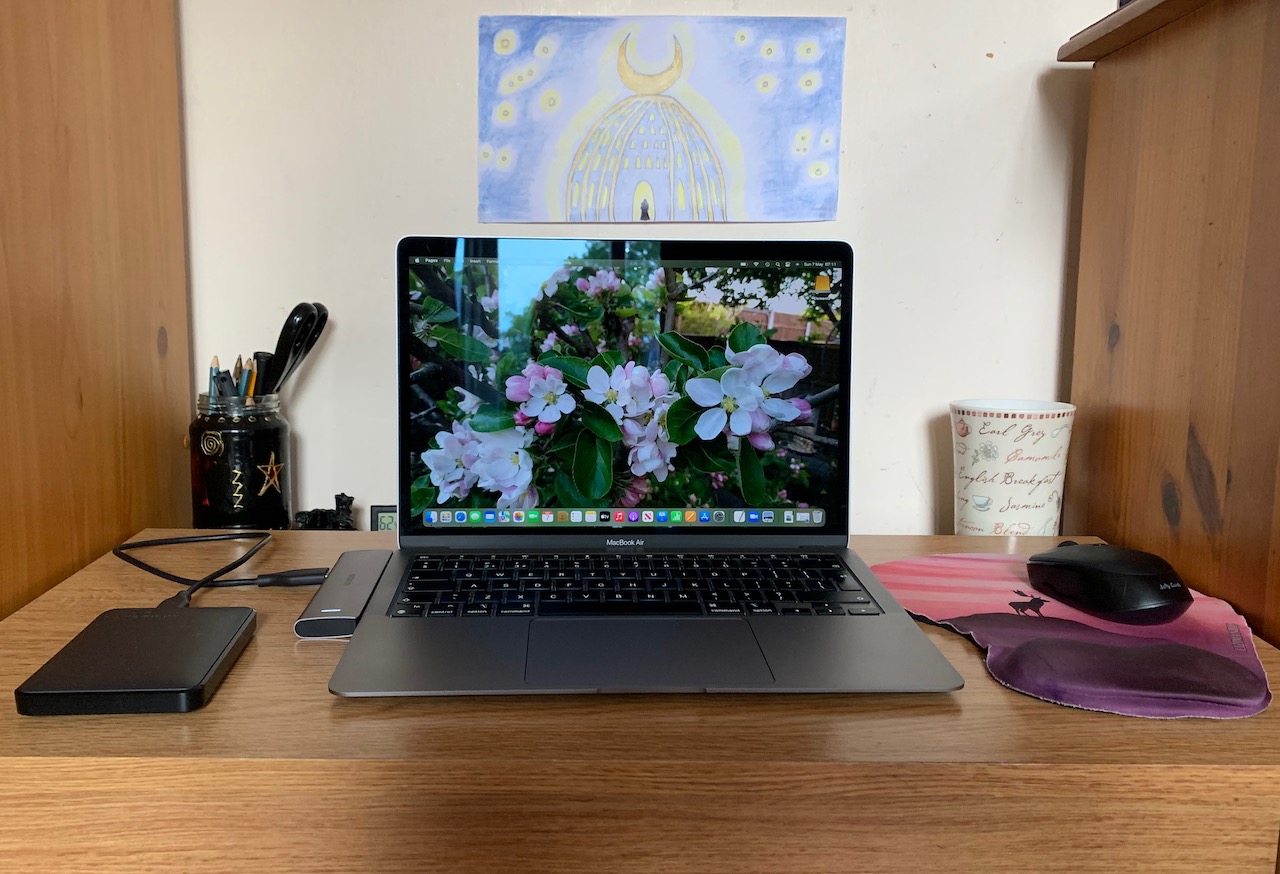
  1. ‘The Universal’ HERE ‘The ‘Neon God’ HERE
  2. Ahriman’s nature is described by John R. Hinnel: ‘He is the demon of demons, and dwells in an abyss of endless darkness in the north, the traditional home of the demons. Ignorance, harmfulness, and disorder are the characteristics of Ahriman. He can change his outward form and appear as a lizard, a snake, or a youth. His aim is always to destroy the creation of [Ahura Mazda] and to this end he follows behind the creator’s work, seeking to spoil it. As Ahura Mazda creates life, Ahriman creates death; for health, he produces disease; for beauty, ugliness. All man’s ills are due entirely to Ahriman.’ HERE

Black Mirrors

The first time I saw an Athonite monk pull a smartphone out from the pocket of his long black robes, I nearly fell over backwards… the pit that appeared in my stomach when I first saw a monk on the Holy Mountain with one of those black mirrors in his hand came from an instinct I’ve long had: that the sacred and the digital not only don’t mix, but are fatal to each other. That they are in metaphysical opposition.’
~ Paul Kingsnorth, ‘The Neon God

He sees a monk on mount Athos take a smart phone 
from his black robes and nearly faints in horror

whereas I run on – a nun of Annwn
with an Apple watch on my wrist telling me
when I have completed split one, split two, split three,
the exact mileage I have done, my pace, how many calories burned,
congratulating me when I close my move ring and exercise ring,
teaching me to breathe by mimicking
my breath with a cool blue cloud.

When I look into the black mirror I wonder
whether it is a parasite or a companion,

a trustworthy advisor
or a replacement for my body’s knowing.

I pose the question – IS TECHNOLOGY HOLY?

The black plastic reminds me of the primordial material,
the dark matter of the womb from which the universe was birthed,

the cauldron from which spilled the elements that would make
ion-x glass, liquid crystalline, an aluminium case,
a polyester with titanium strap,

the lithium ion rechargeable battery

(from cobalt mined by children in the Congo).

By age, height, weight, gender, heart beat movement, workout type
it measures whether my day has been a success.

Like counting the fall of apple, cherry
or orange blossoms I wonder
if it is beyond good
and evil?

It keeps
my horarium
for now and warns me
when the sun will be too hot
and when my heartrate is too high

but what the cost is yet to be considered…

On Conversions and the Need for Deeper Truths

Over the last few days I have been taking some time out from writing my novel in progress, In the Deep, after completing the second draft and realising some of the content has strayed from the imaginal into the imaginary. Not being sure how to remedy it I turned for insights to one of my favourite mythtellers Martin Shaw. I found the wisdom I needed in his video ‘On the Fall and the Underworld’ where he warns to be aware of engaging with avatars rather than divinities themselves, giving the example of ‘Baba Yaga with her teeth pulled out’. I had fallen afoul in this mistake in some of my later scenes with the winged serpents.

I also discovered, at first to my surprise, that Martin, whose works are deeply Pagan and animistic and based in his experience of extended wilderness vigils recently converted to Orthodox Christianity. I felt less surprised as I learnt about how this happened in relation to the rest of his personal journey in his dialogue with Mark Vernon ‘The Mossy Face of Christ’. Following a one hundred and one day vigil in a local wood in Devon he had an Old Testament style vision and retired to bed to hear 9 words that led him to the conclusion he must return to his ‘original home’ which was Eden. This was followed by a series of intense dreams featuring Jesus and the son of God moving into his life in a similar way to which He wrecked the temple in Jerusalem. Martin grew up in a Christian family and his practice already resembled that of the Desert Fathers and the peregrini who set out for wild places to find God.

Of course I could not help but relate this to the conversion to Orthodox Christianity of his friend, Paul Kingsnorth, whose writing I also admire, in particular ‘the Dark Mountain Manifesto’ (which was written with Dougald Hind in 2009). Kingsnorth writes of his experiences in ‘The Cross and the Machine’. Here he speaks of carrying an Abyss within him, of needing ‘a truth to surrender to’. He did not find this during his time as a Wiccan priest. Following a series of dreams he found it in Jesus and in Orthodox Christianity and his Abyss was filled.

‘In Orthodoxy I had found the answers I had sought, in the one place I never thought to look. I found a Christianity that had retained its ancient heart—a faith with living saints and a central ritual of deep and inexplicable power. I found a faith that, unlike the one I had seen as a boy, was not a dusty moral template but a mystical path, an ancient and rooted thing, pointing to a world in which the divine is not absent but everywhere present, moving in the mountains and the waters. The story I had heard a thousand times turned out to be a story I had never heard at all.’

There is much in both Shaw’s and Kingsnorth’s experiences I relate to as someone who received a calling to devote their life to a Brythonic god – Gwyn ap Nudd. The shock of a deity who was not expected stepping into one’s life and coming along and turning everything upside down. Inititally resisting. Submitting to the call in spite of being unsure what it means and being terrified what others will think.

I’ve also been tempted by Christianity. Like Kingsnorth I rejected it but still found myself hanging around churches and I additionally had a calling towards monasticism. As I approached my 35th birthday I was desperately aware this would be my last chance to become a Christian nun but I didn’t take it. I also had a couple of encounters with Jesus whilst working as a cleaner at a local Catholic school. His presence was everywhere and whilst I was cycling home I saw His face before me trying to mouth something in Middle Eastern. He then turned up at our dining table and I told Him politely I was already taken by Gwyn.

Looking at Shaw and Kingsnorth’s converstion to Christianity I can fully understand the need to respond to this strange and rebellious and self-sacrificing God-become-a-man, to take up the cross, to walk in a 2000 year tradition that has its book, its churches, its liturgy, its mysteries, its mysticism. That Christianity provides better trodden and more accessible ways to deeper truths than we find in modern Paganism and Polytheism as we have little over fifty years of development (if one claims Wicca and Pagan Druidry as points of origin).

Although I feel this impulse Christianity is not for me and the Christian God and his son/incarnation, Jesus, are not my God(s). I belong heart and soul to Gwyn.

As a polytheist nun who recently founded an online polytheistic monastery, the Monastery of Annwn, (of which Gwyn is the patron) I wish whole heartedly we had longer and more explicitly sacred texts than the fragmentary material from medieval Welsh literature, longstanding prayers and rites, systems of meditation, moreover physical monasteries. But we don’t. So our small group is having to make things up as we go along – sharing and co-writing prayers, joining together in meditation, discussing our experiences, putting together rituals. Our deeper truths too are there. We’re touching on mysteries and finding our mysticism. I believe this can be done just as well in Polytheism as in Christianity with a little patience.

I find it interesting to note the cross over between the impulses towards a rewilding of Christianity with the likes of Shaw and Kingsnorth and the call for more depth and discipline within Paganism and Polytheism with the Polytheistic Monastic movement.