Between September and November grey geese arrive in my locality. I’ve seen a local flock of greylag geese on the stretch of the river Ribble near Howick Cross at this time two years running. Greylags are the ancestors of domestic geese and residents in the UK all year round; migratory birds are only found in Scotland. This flock also contains Canada and domestic geese.
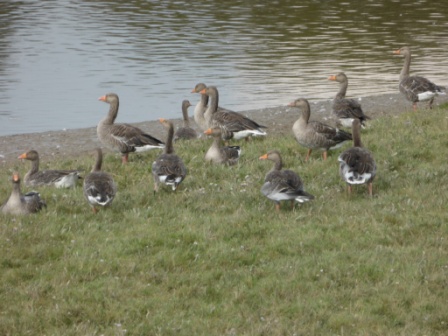
Greylag geese, river Ribble
More dramatically pink-footed geese begin arriving from Iceland and Greenland. They can be heard flying overhead to WWT Martin Mere. This year the first group touched down on September the 9th and there are currently 15000 roosting on the reserve.

Pink-footed geese, Martin Mere
Watching their return to the last fragment of Martin Mere at sunset is awe-inspiring. One can only imagine the noise and patterns of the skeins before the Lancashire’s Lost Lake, once 15 miles long, was drained.

Pink-footed geese return at sunset, Martin Mere
***
In the folklore of northern England, the cries of migrating geese are linked to Gabriel Ratchets. ‘Gabriel’ may derive from the name of the Angel of Death, the ‘gabble’ of geese, or the medieval word gabbe, ‘corpse’. ‘Ratchet’ originates from the Old English ‘ræcc’ meaning a ‘a dog that hunts by scent’.
The earliest record of Gabriel Ratchets is from 1664. Whilst living at Coley Hall in the Calder Valley, Reverend Oliver Heywood wrote in his Memoranda:
‘There is also a strange noise in the air heard of many in these parts this winter, called Gabriel-Ratches by this country-people, the noise is as if a great number of whelps were barking and howling, and ‘tis observed that if any see them the persons that see them die shortly after, they are never heard but before a great death or dearth… Though I never heard them.’
In his Notes on the Folklore of the Northern Counties of England and the Borders (1879), William Henderson suggests the ‘belief in a pack of spectral hounds’ originates from ‘the strange un-earthly cries, so like the yelping of dogs, uttered by wild fowl on their passage southwards.’
Lancashire folklorist James Bowker notes, in his Goblin Tales of Lancashire (1879), ‘Mr Yarrell, the distinguished naturalist, reduces the cries of the Gabriel Hounds, into the whistling of the Bean Goose… as the flocks are flying southward in the night, migrating from Scandinavia.’

Bean Goose, WWT Slimbridge, Wikipedia Commons
This appears to be a mistake: bean geese migrate from Scandinavia to Norfolk and southern Scotland. Here in Lancashire it seems more likely that pink-footed geese, with their ‘high-pitched honking calls, being particularly vocal in flight, with large skeins being almost deafening’ would have been associated with Gabriel Ratchets. The pink-footed goose is closely related to the Bean Goose and was once considered a subspecies. Perhaps Mr Yarrell conflated the two.
Gabriel Ratchets are often associated with a spectral huntsmen. This may originate from pagan beliefs about ‘the Wild Hunt’ which takes place at the time of year geese migrate. In Norse and Germanic tradition it is usually led by Odin or Woden, to whom a goose was sacrificed on the Autumn Equinox. The Germanic goddess, Berchta, has a goose-foot and also leads a hunt with a goose flying in front of her. Dancers in her processions, the Berchten, wear bird-masks.
In Brythonic tradition a leader of ‘the Wild Hunt’ is Gwyn ap Nudd. His hounds are known as Cwn Annwn ‘Hounds of the Otherworld’, Cwn Wybyr ‘Hounds of the Sky’, or Cwn Cyrff, ‘Corpse Hounds’. Like the Gabriel Ratchets they are seen as death portents because they hunt the souls of the dead. Gwyn is a ruler of Annwn who oversees the passage of souls between the worlds, which is mirrored by the migrations of geese.
***
Goose is traditionally eaten on Martinmas, November the 11th, which is dedicated to St Martin of Tours. This festival ‘originated in France, then spread to the Low Countries, the British Isles, Germany, Scandinavia, and Eastern Europe’. Martin attempted to hide in a goose pen to avoid being ordained as a bishop, but was given away by the cackling of geese. (I can’t help noticing connections between Martin, Martin Mere and geese…)

After the feast, divination was performed by the breast-bone. In 1455, Dr Hartlieb wrote, ‘When the goose has been eaten on St Martin’s Day or Night, the oldest and most sagacious keeps the breast-bone and allowing it to dry until the morning examines it all around, in front, behind and in the middle. Thereby they divine whether the winter will be severe or mild, dry or wet.’ In Hampshire ‘the nature of the coming winter’ was divined from a breast-bone and, in Yorkshire, weather was predicted from the colour of goose-flesh.
The British Apollo (1708) poses the question why the ‘breast of a fowl’ is ‘called the Merry Thought’ and provides the answer, ‘The original of that name was doubtless from the pleasant fancies that commonly arise from the breaking of that bone, and ‘twas then first certainly so called, when these merry notions were first started.’ Every Commercialmas someone in my family breaks the ‘wish-bone’ of our turkey and makes a wish.
These traditions are rooted in a wide-spread belief that the goose was an oracular bird. It has been argued this derives from the Etruscans who ‘believed geese had supernatural visionary powers as oracle birds with these prophetic powers residing within its bones’ and was brought to Britain by the Romans.
***
Our understanding of the oracles of geese has diminished; drained away with their wetland homes. We can no longer tell, from the cacophany of voices barking overhead, who carries news and who carries a death portent. Goose is rarely eaten in Britain, with the tradition of rearing flocks of domestic geese for food, particularly for during the festive season, being replaced by turkey farming. Divination has been reduced to a facile act of wish-fulfilment in a world increasingly disconnected from the language of the divine.
Yet, whilst there are geese, there is hope that their language can be re-learnt by re-attuning to their flight paths, their life ways, listening to their gabble, divining how this relates to teachings from our gods. Perhaps, as pumps are shut down and wetlands are re-flooded, our abilities to divine will return with the geese.

Martin Mere at sunset
***
SOURCES
Edward A. Armstrong, The Folklore of Birds, (Dover, 1958)
James Bowker, Goblin Tales of Lancashire, (Classic Reprint, 2015)
William Henderson, Notes on the Folklore of the Northern Counties of England and the Borders (Create Space, 2014)
‘Origin of the Wishbone Tradition’, Republic of You Blog
‘The Gabble Ratchets’, Ghosts and Legends of the Lower Calder Valley
Pink-Footed Goose, RSPB
WWT Martin Mere
 The Sanctuary of Vindos