I pray to the Gatherer of Souls,
You who waits patiently,
You who works ceaselessly,
gathering the souls of the dead,
being there for those who are on the brink.
May I be a good guide of souls.
May I share and lessen your burden
by guiding others on their paths in this world
and through Your doors and into Annwn.
May I be a good guide of souls
for the living and for the dead.
May I serve You patiently and ceaselessly
on my days of joy and my days of sorrow
on this sacred day and on every day until my end.
Tag: Nun of Annwn
A Nun with a Drum – Contemplating being a Lay Monastic
‘They strive to lead their lives in the world but not of the world’
~ Carmelite Sisters of the Most Sacred Heart Los Angeles
When I took my monastic vows as a nun of Annwn in October 2022 I was leading a very solitary life centring on devotion to my Gods and on my writing. My only connections with the outside world were online – with fellow members of the Monastery of Annwn and with the Pagan and Polytheist blogosphere.
Things changed after I realised my book, The King of Annwn, wasn’t destined to be professionally published and I received the gnosis I must give my ambition to be a professional writer up for good.
In spring 2024 in a shamanic journey I was shown I must ‘re-root the monastery’. It took me a while to work out what that meant. I took it literally and tried returning to horticultural volunteering but ran into physical limitations with knee problems and Raynaud’s.
I also began training as a shamanic practitioner and have now realised that is where my true calling lies. Over the past six months I have been providing shamanic guidance and running shamanic circles in my local community and have recently begun to offer shamanic healings.
In some ways that I’m able to go out and work shamanically with individuals and groups of people has come as a surprise as I’m autistic and an introvert and usually find social interaction draining. In other ways it hasn’t because from the very first time I did a shamanic journey I felt a sense of potency and calling and a deep connection with the spirit world that I wanted to share.
Fifteen years since that first shamanic journey, following completing my apprenticeship to my patron God, Gwyn, a ruler of Annwn, the Brythonic Otherworld), I have finally proved ready to guide and heal others.
This has opened the possibility of leading a more outward-facing life than I guessed when I first took my vows. Of serving not only the Gods but other people.
For this I’ve looked for inspiration to other groups of monastics and have found my deepest sense of kinship with the Lay Carmelites. This an order of the Discalced Carmelites who were founded by St Teresa of Avila in 1562.
Their charism is contemplative prayer, community, and ministry. Their rule of life is characterised by six obligations: meditation, morning and evening prayer, mass, Mary, meetings, mission. (1)
These come very close to what included in the Monastery of Annwn nine vows: keeping morning and evening prayers to the Gods and Goddesses of Annwn, deepening our relationships with Them through prayer, meditation and trance, checking in and praying with other members, and building the monastery. (2)
I particularly like what the Carmelite Sisters of the Most Sacred Heart Los Angeles have to say about secular Carmelites being those who are called to ‘devotion to prayer’, ’an intimacy with Jesus Who dwells within the soul’, a ‘heart-to-heart encounter with God’ and cultivating a ‘friendship’, ‘a conversing’, a ‘listening to Him which becomes the normal way of life.’ (3)
This fits with my striving to make all my daily activities offerings to Gwyn with my shamanic work fitting so well with Him being a God of the Otherworld.
They also refer to Lay Carmelites being ‘In the world but not of the world.’ (4) That also fits with my life being centred around my Gods first and foremost rather than on money, career or social life, with my service to other people being one of the ways I serve my Gods.
I’m now two-and-half years into living by vows and am now contemplating the possibility that when I take my lifelong vows in autumn 2026 they might be as a lay nun as opposed to a nun who is leading a near-hermitic life.
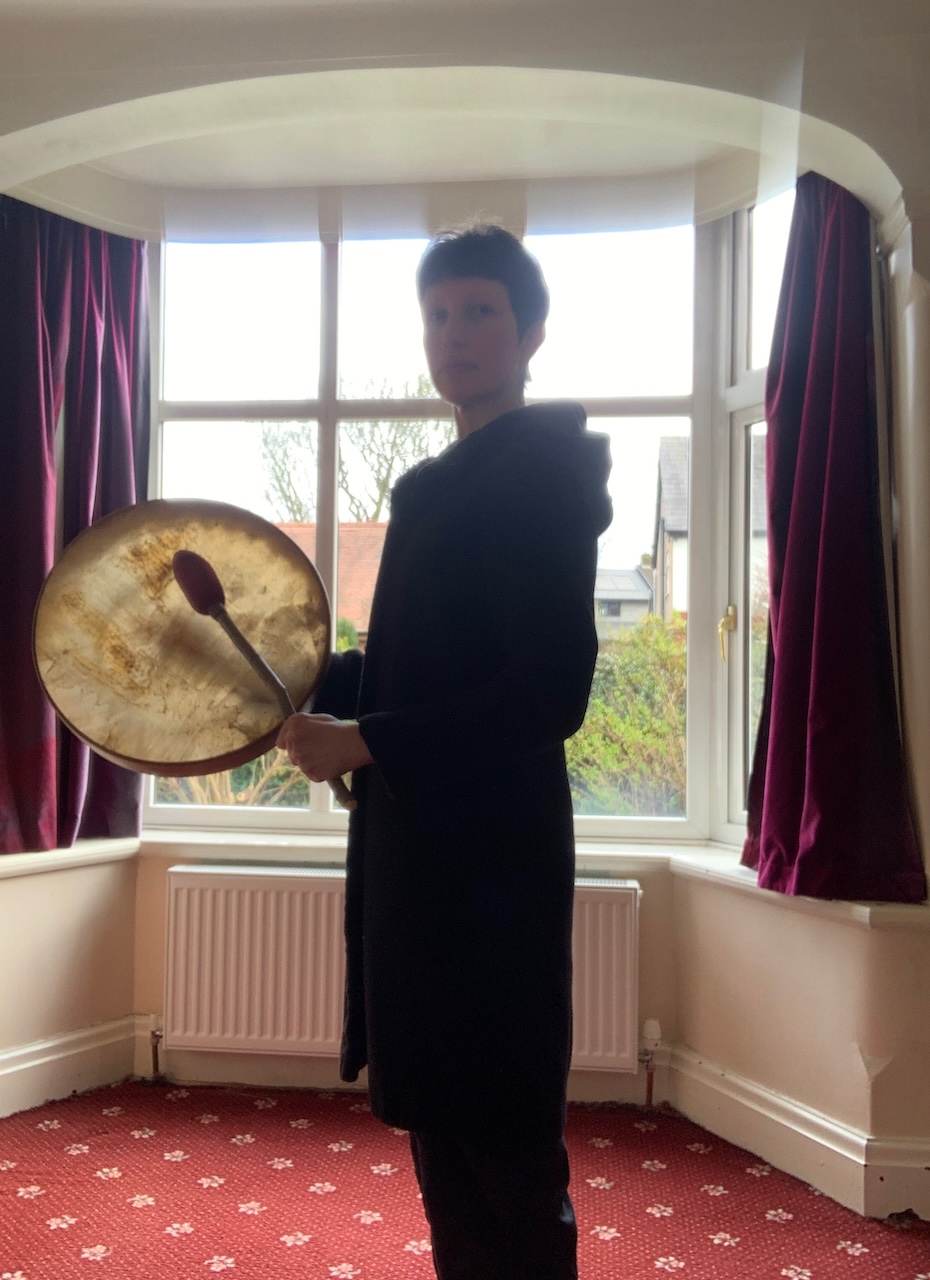
“You’re a nun with a drum,” Gwyn told me when I asked if I could bring monasticism and shamanism together. His joking words now summarise my path.
(1) ‘The 6 M’s on being a Carmelite’, Life as an OCDS Carmelite, https://ocds-carmelite.blogspot.com/2009/01/6-ms-on-being-carmelite.html
(2) ‘Our Nine Vows’, The Monastery of Annwn, https://themonasteryofannwn.wordpress.com/our-nine-vows/
(3) ‘Can a Lay person be a Carmelite?’, Carmelite Sisters of the Most Sacred Heart Los Angeles – https://carmelitesistersocd.com/2013/lay-carmelite/
(4) Ibid.
On Singing in Chains
In the Monastery of Annwn meditation group we have recently been exploring the medieval Welsh poem ‘The Spoils of Annwn’ from an Annuvian perspective rather than from the views of the ‘victors’ Arthur and Taliesin.
Last week, in the guided visualisation meditation, we journeyed to the first fortress, Caer Siddi ‘the Fairy Fort’, on our magical monastic boat and gained personal visions based on lines from the poem:
Maintained was Gwair’s prison in Caer Siddi
throughout Pwyll and Pryderi’s story.
No-one went there before he did –
into the heavy grey chain guarding the loyal lad.
And before the spoils / herds of Annwn he was singing sadly,
and until Doom shall our poetic prayer continue.
I found myself standing before Gwyn wearing chains with Gwair in a scene resembling the Devil card from the Rider Waite Tarot. Whilst Gwair was imprisoned in a heavy grey chain I was wearing only toy-like silver handcuffs and felt they were close to breaking and to my being released.
Gwyn said:
‘As long as you sing you will be in chains.
In the silence of meditation you will be free.’
Gwyn’s words reminded me of the shift in my path from being a bard in the mead hall to becoming a Nun of Annwn. To moving away from performing poetry to a more monastic and shamanic path.
Another way of looking at it was that the singing is the voice of the incessant thoughts in my head and that only when I’m silent in meditation will their song and the chains be gone.

Two Mother House Poems for Mother’s Night
These two poems were written in response to the Mother House module on Sylvia Lindsteadt’s ‘When Women Were the Land‘ course for Advaya. Lindsteadt’s conception of the Mother House is rooted in Neolithic matrilineal and matrilocal cultures wherein husbands marry into the Mother House rather than women leaving and entering their husband’s house. She also notes the role of the Mother House in monastic traditions. Lindsteadt reads the Greek myth of the abduction of Persephone by Hades as one of Her being taken from Her mother, Demeter’s, house. When I returned to our northern British pre-Christian myth of Creiddylad’s abduction by Gwyn ap Nudd, which shares many parallels, the lines about Creiddylad being shut up in Her father’s house led me to suspect this may be a Mother House story too.
Taken From My Mother’s House
‘Creiddylad daughter of Lludd Llaw Eraint went off with Gwythyr son of Greidol, but before he could sleep with her Gwyn son of Nudd came to take her by force. Gwythyr son of Greidol gathered a host and Gwyn triumphed… Arthur heard of this and came to the North, and summoned Gwyn son of Nudd to him, and released his noblemen from his prison, and made peace between Gwyn son of Nudd and Gwythyr son of Greidol. This is the agreement that was made: the maiden was to be left in her father’s house, untouched by either party, and there was to be battle between Gwyn and Gwythyr every May Day forever from that day until Judgement Day, and the one that triumphed on Judgement Day would take the maiden.’
~ Culhwch and Olwen
I was taken from my mother’s house then locked up in my father’s house
so the men like to tell the story. Let me tell you another tale. Of how I was not picking but making flowers, as I made love – styles, stigmas, anthers, stamens, parts that stick to each other and fit together perfectly.
So I chose to go off with Gwythyr son of Greidol and to go with my brother, Gwyn son of Nudd, to Annwn, to his land of bones to make flowers and love.
Messy the battle, the roses white and red, some say King Arthur ended it. They’re wrong – it was me – it was me and my flowers that brought peace.
And I still live here in my mother’s house with all my flowers and earthly greenery twining my head and limbs and choose to go with my otherworld husband when his hounds call and the trees beg to leave their leaves.
As for my father’s house deep in the sea there are no doors or locks.
As for Judgement Day there are no ends or beginnings in the endless love story between my mother’s house, this earth, or my brother’s house, deep Annwn.
Between the two pass the spirits of the mothers and the fathers, of the sisters and the brothers, no Arthurs are needed to broker the deals between.
Not Taken From My Mother House
They were taken from their mother house
time and time again –
surnames erased,
Collison, Allen, Curtis…
But what were these names
attached at the end as they married off
and entered the houses of their husband’s fathers?
My surname has never fitted easily with me
and neither has my mother’s received
from a husband ab hominem.
Perhaps that’s why I have
shrugged them off with my nunnery.
Whatever would my ancestors think
if they knew I had married a God
who did not take me away to the Otherworld
but came instead to dwell here in my Mother House –
here, on my altar, in this sanctuary, in my heart, in my blood?
Here in my mother house where I would keep the skulls
of my mothers and their holy relics if I had them
but instead we keep my great grandmother’s
chest of drawers, cribbage board,
gnarly old desk, cutlery…
I am building shrines to my mothers
and hoping they will understand the changes –
why I married a God who will let our names and spirits flow
into the Otherworld and back again more fluently than any river.
I stand here, now, in my Mother House, timeless, eternal,
knowing I will not last forever or be erased.
My Husband Returns
from one thousand battlefields
where in the dreamtime
He still gathers
the dead.
He is alive.
They are dead.
They will not return.
I think of all the widows
and what a gift it is to be
married to an undying God
who comes in the old armour
and military garments
of all the ages who have fought
and the funereal attire,
black coats, blacker hats…
of all the ages who have wept.
My only tears are tears of happiness
and my laughter is the laughter
of the fair folk who
for once didn’t laugh at our wedding.
His only tear carries the memories
of the astonishing and today
it is for the many and for me alone.
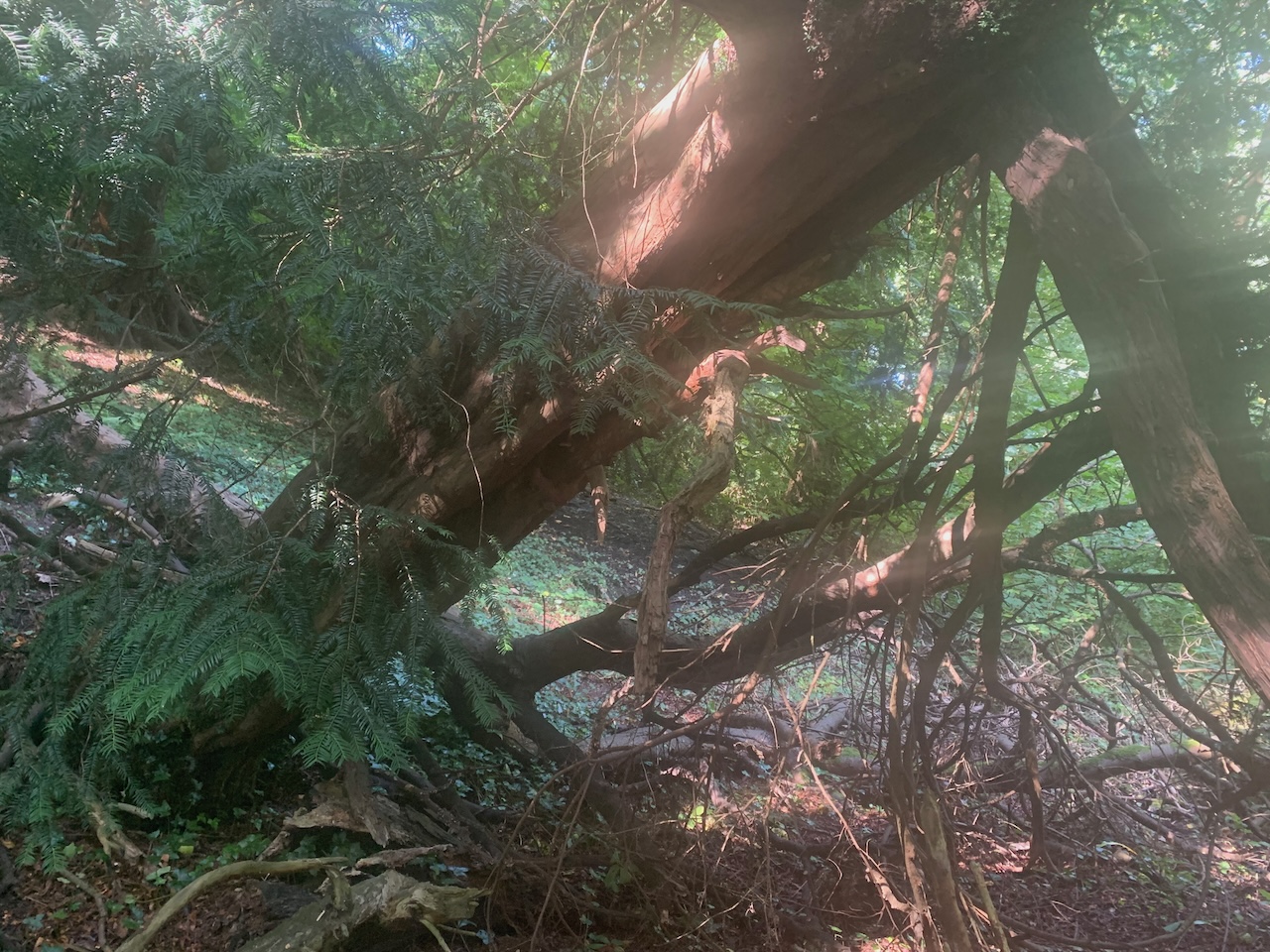
A poem celebrating the twelfth anniversary of my meeting with Gwyn ap Nudd at the Leaning Yew. At this time of year He returns from His sleep in the Castle of Cold Stone for Mis Medi ‘The Reaping Month’ (September). It is the first time I have celebrated our meeting and His return since our spiritual marriage.
The Art of Coming Home
‘Gwyn ap Nudd who are far in the forests for the love of your mate allow us to come home.’
~ Speculum Christiani
Going away. Coming home. These two processes every spiritworker needs to master.
I was away for such a long part of my life, never fully in my body. Struggling with disassociation and derealisation stuck somewhere between the worlds.
Then Gwyn ap Nudd came into my life and taught me to journey to Annwn and, perhaps more importantly, how to come home. Since I met Him I have been striving to lead a life that combines the shamanic and ecstatic with being present in the here and now with the myriad beings on the land where I live.
With more difficulty, particularly since becoming a nun of Annwn, I’ve been getting to know myself a lot better – my body, my mind, my habits.
I thought that I was getting better. That I’d begun to become more aware of my cycles of driving myself too hard often when operating under some delusion such as that I’m going to become a recognised philosopher, poet, author… then realising I’m being unrealistic and burning out and dropping out.
I thought I’d cracked it but somehow similar delusions crept in around what I might be capable of as a nun of Annwn and aspiring shamanic practitioner. After my shamanic initiation and marriage to Gwyn I came back ecstatic with ambitions of running online discussions and shamanic journey circles and hit the ground with a bump when I came upon the same old barrier of lack of interest in the Brythonic tradition and was further derailed by the consequences of my mistake in reviewing a book by Galina Krasskova.
It’s taken me over two months to come back to myself, back to reality, to my limitations as an autistic person and introvert and to realise I would never have been able to hold space for group discussions or run shamanic journey circles due to my difficulties with reading and communicating with large groups and the huge drain upon my energy that these things take.
I’m fine one-to-one or with small groups of people I know and who I don’t need to mask with such as my fellow monastic devotees. But I’m not the warm smiley front-of-house meet-and-greet person who knows intuitively what each person needs and how to put them at ease fit for leading large groups.
Once again I’ve landed with a bump and a crash but as always I’ve had a wonderful God who is now my Husband to hold me through it. I’ve had the support of my mum, the land I live on, and members of the Monastery of Annwn.
I’ve finally come back home into a state of stillness and presence wherein I can stop beating myself up over my mistakes and accept who I am.
That being a nun is not about striving to be a celebrity (‘Sister Patience TM’) but leading a life of prayer and meditation centred on devotional relationship with the Gods and the land and the ancestors and journeying to Annwn to bring back inspiration and healing for one’s communities.
Accepting I am enough rather than trying to strive beyond.
Not easy. Not glamorous. But this is where and who I am. A suburban nun. At home in Penwortham with a wonderful God who dwells in my heart and countless deities and spirits and plants and creatures all around me. With Gwyn’s help I’m beginning to master the art of coming home.
Building Brythonic Polytheistic Monastic Practices Part Two – Meditation
Meditation is most developed in the Hindu and Buddhist religions. The earliest references to meditation are in the Vedas from around 1500 BC. In Hinduism the aim of yoga – a combination of meditation (dhayana), breathwork (pranayama) and body postures (asana) – is to still the mind, liberating it from sensory distractions and ultimately from the cycle of death and rebirth, unifying the self (atman) with the Gods (the Brahman or Shiva). In Buddhism the aim of meditation is to reach enlightenment, which resulted in liberation from the cycle of reincarnation as a buddha ‘awakened one’.
These forms of meditation begin with training the mind to focus on one thing – usually the breath. Other subjects of meditation include nature and virtues. Both employ the chanting of sacred syllables to still the mind. Tantric practices involve meditating on and attaining union with a multitude of Deities.
In Christianity meditation is a form of contemplative prayer. Discursive meditation is rooted in the scriptures and involves imagining oneself in the stories, in the shoes of the protagonists, to develop a deeper understanding. Lectio Divina focuses on passages of scripture and has four phases – Lectio (read), meditatio (reflect), oratio (respond) and contemplatio (rest).
Unfortunately I haven’t been able to find any references to meditation in ancient polytheist cultures. The only evidence I have found is the image of the antlered Deity on the Gundestrup Cauldron (150 BC) who is sitting in a meditative position and bears a striking resemblance to Shiva the ‘Lord of Yoga’.
The cauldron is of Celtic La Tène period design and the antlered figure has tentatively been identified as Cernunnos, ‘Horned’, which might be a Gaulish title for Vindos / Gwyn ap Nudd, who I believe is pictured on another plate plunging dead warriors into a vessel headfirst to emerge as riders on His hunt.
*
When I came to Paganism and Polytheism the first type of meditation I came across was guided meditation, which involves being guided by written words or voice into imaginal landscapes to meditate in safe places or meet with Deities.
Examples include meditations leading to an inner grove, a spring, or a tree, or another form of sanctuary, meeting Brigit at a well or Cernunnos in a woodland. To the best of my knowledge this type of meditation originated in the Western esoteric tradition with groups like the Hermetic Order of the Golden Dawn and Thelema and was later taken up by Wiccans, Druids and polytheists.
The way I see guided meditation to work is that one must first consciously imagine the scenery (our imagination is one of the tools by which we connect with the Divine) and this act of imagining creates an interface through which the spirit realm speaks. In my experience it is an act of co-creation. Some comes from one’s own imagination and some from the spirit realm in varying degrees and intensity. On some occasions I’ve remained within my imagination and felt like the scenery and Gods are nothing more than cardboard cut-outs and on others I have found myself in lands that are not of my imagining, entirely other, having genuine conversations with the Gods.
Through Druidry I learnt ways of working meditatively with the Brythonic myths by entering into them and standing in the shoes of some of the Deities. Most notably Afagddu, when Taliesin stole His awen and the Cauldron of Ceridwen shattered leaving Him with its poisoning of Gwyddno’s lands.
I also developed a practice akin to Lectio Divina drawn from creative writing workshops in which I meditated on a line or a scene from a medieval Welsh story or poem, then did free writing around it, then crafted it into a finished piece.
*
It’s only over the last couple of years I’ve looked into more traditonal forms of mediation. As a Brythonic polytheist I steered clear of the ‘Eastern’ traditions until I learnt that India and Europe shared an Indo-European culture and there are lots of resonances between Hindu and Brythonic beliefs.
Last year I started practicing yoga and integrating meditation, breathwork and body postures into my practice on the basis of a revelation of the Gundestrup Deity as ‘Meditating Gwyn’ as a way of unifying myself with Him.
At the core of my practice is uniting my breath with Gwyn’s breath, my heart with His heart, being as present in my body as possible so He and my other spirits can experience presence in Thisworld through their union with me.
When I first tried focused meditation I found it incredibly difficult (and still do). I avoided it for a while sharing the beliefs of many others that Eastern meditation isn’t for Westerners and isn’t suitable for our busy Western minds. This changed when I discovered the Breathe and Flow yoga channel and Bre mentioned that if something is difficult it’s often the thing we need most.
I started practicing focused meditation with their Expand programme and particularly benefited from their meditation, ‘Refocus’, which describes the benefits of stilling our busy ‘monkey minds’, shifting from sympathetic to parasympathetic states of the nervous system and rewiring our neural pathways. This meditation is very useful as every couple of minutes there are reminders, if thoughts have begun to trickle in, to return the attention to the breath. When I meditate alone it often takes longer to catch myself thinking.
Learning from Breathe and Flow that by focusing on and changing my breath I can control my mind and my emotions has been life changing in helping me manage my anxiety and panic which were beforehand often out of control.
I’ve been inspired to adapt some of the pranayama practices to fit with my spiritual path. Sama vritti, ‘box breathing’ (inhale, hold, exhale, hold), I do to a count of seven heartbeats to unite myself with ‘the Breath of the Gods’. Nadi shodhana, ‘alternating nostril breathing’ I use as a way of balancing the red and white dragons, fire and mist, strength and calm. Dirga ‘deep breathing’ and ‘sleep breath’ (4-7-8) I associate with the healing states of Nodens.
As I have learnt the body postures I have come to link some with my Deities and with various animals in the Brythonic myths. Suptka Baddha Konasana ‘reclining bound angle pose’ is Anrhuna as Mother of Annwn and Parsva Savasana ‘side corpse pose or foetal position’ is foetal Gwyn. Tadasana ‘Mountain Pose’ and Utkata Konasana ‘Goddess pose’ invoke the strength of Anrhuna. Adho Mukha Svanasa ‘downward dog’ and ‘Uttana shishosana ‘puppy pose’ are Gwyn’s hounds or the healing dogs in the temple of Nodens.
The medley of animals, Marjaryasana ‘Cat Pose’, Bitilasana ‘Cow Pose’, Mrigasana ‘Deer Pose’, Catur Svanasana ‘Dolphin’ puts me in mind of the animals surrounding the antlered God on the Gundestrup Cauldron and I wonder if the flows between the poses might have been based around stories featuring sacred animals such as the search for Mabon.
The power of these practices and the changes they have brought about in my life have led me to believe that what we know about the Bardic Schools and their twenty-year programmes for memorising poetic forms and traditional tales is but the remnant of a deeper spiritual tradition in which the stories were meditated on and embodied and lived as mythic realities.
Building Brythonic Polytheistic Monastic Practices Part One – Prayer
In building Brythonic polytheistic monastic practices I feel at once like a pioneer because few people are doing this specific work today but at the same time like I’m standing on the shoulders of thousands of ancestors because since homanids arose the majority have been animists and polytheists.
Since I came to Brythonic polytheism through Paganism and Druidry over ten years ago I have been developing my practices and deepening them further as a monastic since I took vows as a nun of Annwn in 2022.
My main practices are prayer, meditation and trance. These lead into and complement one another and their boundaries can be permeable. Here I will provide my personal understandings and how I have come to them through studying their development in ancient and contemporary polytheisms and current mainstream religions then share how I put them into practice.
Prayer
The first and foremost of my practices is prayer. Prayer, in its most basic form, is conversation with the other-than-human worlds and persons. Indigenous people have always lived in dialogue with the land and its spirits, the Gods and the ancestors, with prayer permeating their lives from rising to sleeping.
People have likely been praying for as long as they can speak. Some of the earliest recorded examples of polytheist prayers are the Litany of Re from the Egyptian New Kingdom (16th – 11th BC) and the Homeric Hymns (7th BC).
The hegemony of Christianity brought about a shift in focus in prayer from the land and its Deities to one transcendent God and the saints. The rise of rationalism, materialism, industrialisation and capitalism have all played a role in putting into doubt and in erasing beliefs in Gods and spirits. One of the main problems with Western society is that we’ve forgotten how to pray.
Within the current mainstream religions Christianity has the most developed system of prayer and meditation is seen to be a form of contemplative prayer.
Prayers can be formal (written prayers that are often memorised) or informal (personal prayers in one’s own words often taking the form of a dialogue). Some of the most common forms of prayer are praise / adoration, thanksgiving, petition / supplication, confession, and intercession. Other prayers are written for the marking and celebration of Holy Days.
*
Unfortunately we don’t have any evidence of prayers to the Brythonic Gods because the ancient Britons did not write anything down. However, archaeological evidence shows they made offerings of bones, pottery, jewellery, weapons and other objects in sacred places such as hill-tops, springs, rivers, lakes, bogs, in pits and shafts, and in or near burial mounds. Such offerings were undoubtably accompanied by prayers and ceremonies.
Much of our knowledge of the Brythonic Gods comes from Romano-British altars and temples wherein they were often equated with the Roman Gods (for example Apollo-Maponos, Mars-Nodens, Sulis-Minerva). The vast numbers of Romano-British curse tablets recovered from sacred sites show people were petitioning the Gods for aid against those who had wronged them.
We also find references in Roman texts to ancient Gaulish and British rituals. Most of them describe sacrifices of animals and humans. These ceremonies (and others less bloody) likely opened and closed and were punctuated with prayers to the Gods who were the recipients. Tacitus describes black-clad women with fiery brands and Druids raising their hands to the skies in prayer to call upon the Gods for aid against the Roman invastion of Anglesey.
These more extreme examples presuppose an underlying relationship with the Gods founded on prayer and reciprocity common amongst the general populace.
By the time the stories of the Brythonic Gods were written down in the medieval period Britain had been Christianised and all but Wales Anglicised. The Gods appear in the texts in euhemerised form (eg. Maponos as Mabon, Matrona as Modron) but the only prayers to be found are to the Christian God.
*
This has meant Brythonic polytheists have had to begin writing prayers from scratch, building on the forms found in ancient polytheisms and other religions.
Thankfully we’re not alone. The rise of the polytheist movement has given birth to numerous devotionals featuring prayers from publishers such as
Bibliotheca Alexandrina and Moon Books and from independent authors and editors.
I worked with Dun Brython building devotional material for several years. On the website and in the devotional anthology The Grey Mare on the Hill can be found a variety of prayers to Brythonic Deities with a focus on Rigantona / Rhiannon.
Pauline Kennedy’s ‘Prayer for Epona Rigantona’ is an excellent example of praise.
‘Epona of Horses, I praise you!
Rigantona of the Land, I praise you!
Epona of Sovereignty, I praise you!
Rigantona of Journeys, I praise you!
Epona of Stables, I praise you!…’
‘Rigantona: Calan Gaeaf’ by Greg Hill is a seasonal prayer marking the first day of winter.
‘By Orion’s light
At the dark of the moon
Now the hawthorn tree is bare
A shadow passes through the veil
Of the Otherworld on a Grey Mare
Rigantona; roses wither on your altar
But we keep your vigil here.’
Albion and Beyond is an active Brythonic polytheist group committed to sharing information and resources and to building community. Here there is a section on the Bardic Arts with poetry for Andraste, Cocidius, Maponos and Nodens.
‘Cloud-Maker’ by Nico Solheim-Davidson praises Nodens and petitions Him for rain.
‘Nodens, Iron-handed ruler
Cloud-maker, dream-catcher
Hound-master, net-thrower, rain lord.
Waters of deep Dumons you ride,
Turning to rain, the provider…
Guide us Iron-Hand to good times,
As we turn our praise to you, lord.
Come fast cloud-chasers, mist-racers,
Bounding and bustling in the sky,
Bring unto us your rapid rains,
Fill the heavens with your dark cloaks.’
*
My personal practice began mainly with informal prayers to Gwyn, my patron God, and His family and my local spirits along with formal prayers for Holy Days. Since I became a nun I have been using more formal prayer – some prayers I have written myself and shared prayers of the Monastery of Annwn.
I get up at 4am and begin my morning prayers with a statement of intent to honour Gwyn. Speaking His name as the first word after I have got up and the last word before I go to bed has become increasingly important to me.
This is followed by prayers of praise to the Spirit of the Monastery, the spirits of place, the ancestors, and Gwyn and His family then formal prayers for Gwyn. These include both written prayers and songs. In the summer, when Gwyn is absent, every morning I sing a seasonal song called ‘You Are Gone.’
‘Dawn arrives but You are gone,
the birds are singing yet You are gone,
the flowers are turning their petalled heads
Towards the sun but you are gone…
You are gone but Your haunting
is everywhere with Your promise of return…’
I also read a shared prayer of the monastery, ‘In Summer We Miss You.’
‘In summer we miss You
We miss You like we miss the rain
but we know You will return again
like the raindrops on our window panes…’
This is followed by informal prayer which usually includes adoration and petition. ‘Gwyn ap Nudd, my lord, my teacher, my inspiration, my beloved, I appreciate the sacrifice You made through your death and sleep so summer can come. I am grateful for Your tireless work through the winter gathering souls. You are the Heart of my Heart, the heartbeat of my heartbeat, keeping me alive and strong. I pray to You today I might be more present, compassionate, loving, as You love me and all the souls You gather…’ Time is also spent simply being with Gwyn and listening to what He has to say.
My evening prayers take a similar form but with thanksgiving in the place of praise and ‘confession’ in the place of petition. Here I don’t mean confessing sins as such but sharing what I’ve done during the day and getting any mistakes and failures off my chest. ‘I’ve worked hard today on Your book but I got side-tracked by wondering if anyone has checked in on my blog…’ I spend time in communion with Gwyn and playing a heartbeat on my drum to bring my heart into alignment with His.
Finally, I pray to Nodens for as my God of dreams, then I say farewell to Gwyn.
An example of my daily prayers from last October can be viewed HERE.
I am also striving to become more prayerful in my daily activies. To see writing, exercising, cleaning, cooking, gardening as forms of prayer. This doesn’t come easily to me as someone who has been very task / goal rather than relationship orientated for most of my life and is one of my biggest challenges.
Married to Gwyn in Life and in Death
I have an announcement to make. A happy announcement. One that may come to you partly as a surprise and partly not at all (as it did to me).
Gwyn and I got married! – A sacred marriage between a God and a nun of Annwn.
The moment Gwyn and I met and He revealed His name and His face I fell in love with Him and knew that I’d known Him from time’s beginning.
It’s taken a long time for me understand the nature of that love, which has taken many forms – of the love between patron and devotee, of teacher and apprentice, of inspirer and inspired one, of truth and one who receives truths.
For many years that we might be beloveds – married as bride and groom, husband and wife – was completely unthinkable to me as someone who is asexual and aromantic and found the language of love soppy and sentimental.
Another reason is that although Gwyn saved my life and my sanity and has been there for me through the toughest of times it’s taken me a while to become open to the possibility that He cares about me let alone loves me.
This changed when I had my first soul retrieval with my spiritual mentor, shamanic practitioner and wild therapist Jayne Johnson, in March. Jayne knew Gwyn is my patron God but didn’t know the meaning of Gwyn ap Nudd, ‘White son of Mist’ or His earlier name Vindos / Vindonnus ‘White / Clear Light’ or about His associations with Gwynfyd, ‘Paradise’.
Before we began Gwyn told me He would oversee the soul retrieval and I told Jayne. The landscapes she journeyed were covered with mist and she came across an area of thick mist and an incredibly bright light and felt confused – like she was in the upperworld although she was in the lowerworld. The mist revealed an ancestor who led her to my lost soul part – the young girl who had fled the trauma of school to the stables. Gwyn appeared to carry her back and Jayne blew her into my heart. The experience was incredibly moving and I was astonished to learn Gwyn cared.
This tied in with my experiences of the Heart of Annwn as Gwyn’s Sacred Heart. Of my playing a heartbeat on my drum every night to unite my heart with His and with my offering my heart to Gwyn several years ago and its travails in fire and ice before Him returning it to me on His feast day last year.
More recently attending a shamanic workshop in London led me to discovering the Tyburn Convent and the Christian mystics whose experiences of the Sacred Heart of Jesus related to mine with the Sacred Heart of Gwyn. In the writings of these Brides of Christ I found descriptions of sacred marriage as a spiritual union that was neither sexual or romantic.
At the workshop, for the first time, I practiced being possessed by my spirits – my winged horse, my hounds, my crows, Orddu and all her ancestors. My teacher, Simon Buxton, described this as a form of sacred marriage / hieros gamos.
When I returned home, Gwyn asked, “Why have you denied me?”
I could provide no answer beyond my fears of that kind of intimacy with a God so intense, so terrifying, so beautiful and of what other people might think.
On Nos Galan Mai He asked the question: “Will you marry me in life and in death?”
Knowing I couldn’t deny my love for Him, His for me any longer, I said “Yes.”
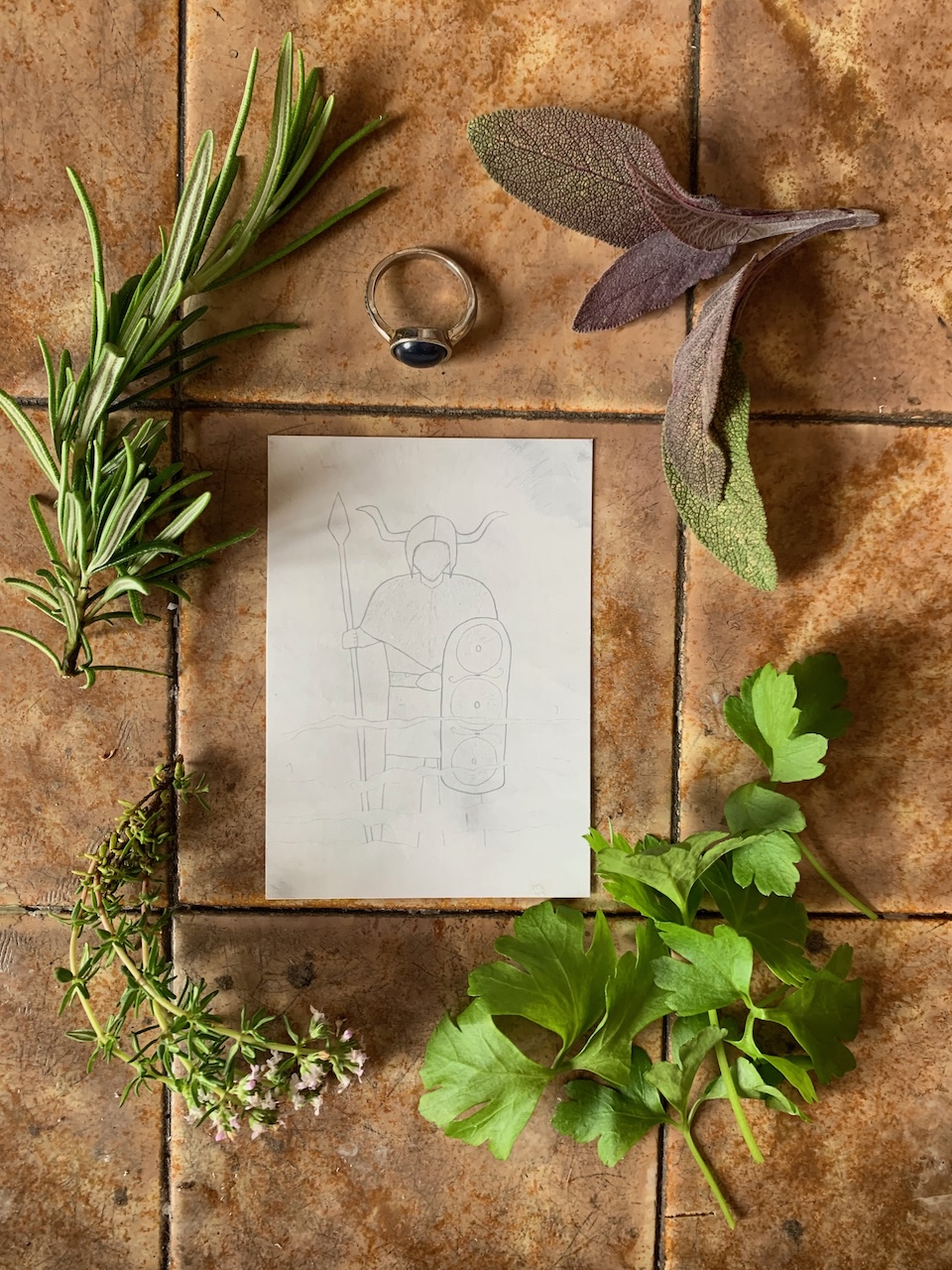
On Nos Galan Mai we got married in life. An amusing side story – how I got the ring. Many years ago I was told to get a ring as an offering for the river Defwy, a river in Wales that is also a Brythonic river of the dead, and found a fitting ring with a black stone in a charity shop. It turned out I never visited. Gwyn admitted it was a trick as I would never have got the ring otherwise. It turns out it fits perfectly on my wedding finger – He knew I’d marry Him then!
After Gwyn fought his yearly battle with Gwythyr on Calan Mai and died and returned to sleep in His tomb in His Castle of Cold Stone I married Him in death. This took place as the finale of a shamanic burial ritual. I have rewritten the Yorkshire folk ballad, Scarborough Fair (in which a woman completes impossible tasks to win a fairy lover), loosely based on my experiences.
The Land of the Fair
Chorus:
Are you going to the Land of the Fair
Parsley, sage, rosemary and thyme
Remember me to one who lived there
For she once was a true love of mine
Verses:
Tell her to build us a coffin of wood
Parsley, sage, rosemary and thyme
From no tree that ever has stood
And she will be a true love of mine
Tell her to dig the deepest of graves
Parsley, sage, rosemary and thyme
Without a pick axe or a spade
And she will be a true love of mine
Tell her to seal our burial tomb
Parsley, sage, rosemary and thyme
Without hammer or nails return to the womb
And she will be a true love of mine
I can’t say anything else about our sacred marriage in life and death only that as the final result of it Gwyn has become ‘the Heart of the my Heart’. He is within me, me within Him, like in the mystical unions of the Brides of Christ.
My heart has been opened to Gwyn, through this opening to others, to the nuptial spirituality of the Mystics of the Sacred Heart and fellow godspouses.
I am now happily married as a nun of Annwn and Bride of Gwyn.
The Challenges of Taking a Polytheistic Monastic Name
In the mainstream religions it is traditional for monastics to take a monastic name when they are ordained into a monastery on taking their vows.
When Christians monks and nuns take temporary vows they take a new name. This must be the name of a saint, monastic or Old Testament figure. The name is preceded by ‘brother’ or ‘sister’ as they see each other as family. For example Brother David, Sister Mary, Brother John. Three choices are handed to the Abbot who makes the final decision on the name.
Buddhist monastics are given a Dharma name, usually by the head of the monastery or by their teacher, and may have several different names during a lifetime. For example Shinran’s first name was Matsuwakamaru and his other monastic names were Hanen, Shakku, Zenshin, Gutoku Shinran and Kenshin Daeshi.
In Hindiusm monastics also take a new name when initiated by a guru. For example Paramahansa Yogananda was born Mukunda Lal Ghosh.
When a monastic name is taken it symbolises giving up one’s old identity, wealth and ties with family and friends to enter the community of the monastery. One’s secular life is renounced for a religious life.
*
Modern Polytheism began to emerge in the 1960s and to grow in the 1990s. Polytheistic monasticism has developed more recently with the first book, Polytheistic Monasticism: Voices from the Pagan Cloisters, published in 2022. It has precedents in Pagan and Druidic monasticism.
The only physical Pagan monastery in existence is the Matreum of Cybele. Online Druidic monastic organisations include the Order of the Sacred Nemeton and Gnostic Celtic Church Monastery. Unfortunately I couldn’t find any information on their websites about whether monastics are required to take a monastic name or if they renounce their former life in any way.
In Paganism, more widely, it is common to take a craft name or magical name. This can be chosen through contemplating which animals, herbs, myths and Deities one has an affinity with or can be gifted by the Gods and spirits. Some well known examples are Greywolf, Starhawk, Bobcat, Robin Herne and Nimue Brown. This is used in the Pagan community and does not involve changing one’s identity and ties with secular sociey in which one’s regular name is retained.
*
I am a Brythonic Polytheist and received my monastic name from my patron God, Gwyn ap Nudd, before I took vows as a nun. It started as a joke. Lockdown reawakened my longings for a monastic life. I’m an incredibly impatient person and, when I was being impatient with the weeds, Gwyn chided me, “Sister Patience.” I took it as a challenge, telling him “I will become Sister Patience.” It was a self-fulfilling prophecy for three years later I founded the Monastery of Annwn and took vows by that name.
For me the shift in name and identity from Lorna Smithers to Sister Patience has been a gradual one. I first started using my monastic name in the monastery only, then, as I began to change and grow to own it, I renamed my blog ‘The Cell of Sister Patience’ using it more widely in online spaces.
In February 2024 I was faced with the decision of whether to return to a regular job, which would have meant staying as Lorna Smithers and likely returning to old habits like shopping and drinking due to the stress and having more money, or to fully commit to a monastic life as Sister Patience.
My ability to choose the latter was made possible by mum offering to support me financially if my savings run out before I have found a way of supporting myself through a combination of writing and spiritual work.
This gave me the security to take the step of using my monastic name in all my communities, keeping my birth name only for financial and legal purposes.
It hasn’t been an easy process. Everyone who knows me knows I’m very impatient, thus Sister Patience would be the last name they would call me. My mum’s first reaction was, “I’m not calling you that!” before I explained. She still keeps calling me Lorna or, bizarrely, Beatrice, but is getting better. My dad won’t use it. My uncle on my mum’s side and his partner have been accepting. Most of my friends and the horticultural groups I volunteer with along with my personal trainer at the gym have been supportive.
As a polytheistic monastic without a physical monastery it is impossible for me to make the break with the secular world made by other monastics. Ethically I am currently unable to make such a break as my eldery parents are dependent on me for support around the house and in the garden.
Instead I strive to live as monastically as I can considering my circumstances. I serve my Gods through my spiritual practices and creativity and treat my room as a monastic cell and my home and garden as a monastery. My engagement with the wider world is limited to occassionally seeing friends for a walk and / or a brew and to attending spiritual groups. I don’t use social media and limit my online time to engaging with others for spiritual discussions and research for my writing along with learning yoga.
Taking a monastic name hasn’t changed how I am around people. I’m not putting on airs and graces. I’m not pretending to be something I’m not. I still swear. I still get angry. I still get impatient. But, looking back, not quite so much. There is power in taking a name and perhaps, one day, I will live up to it.
 The Sanctuary of Vindos