Nodens Father of Sea Horses

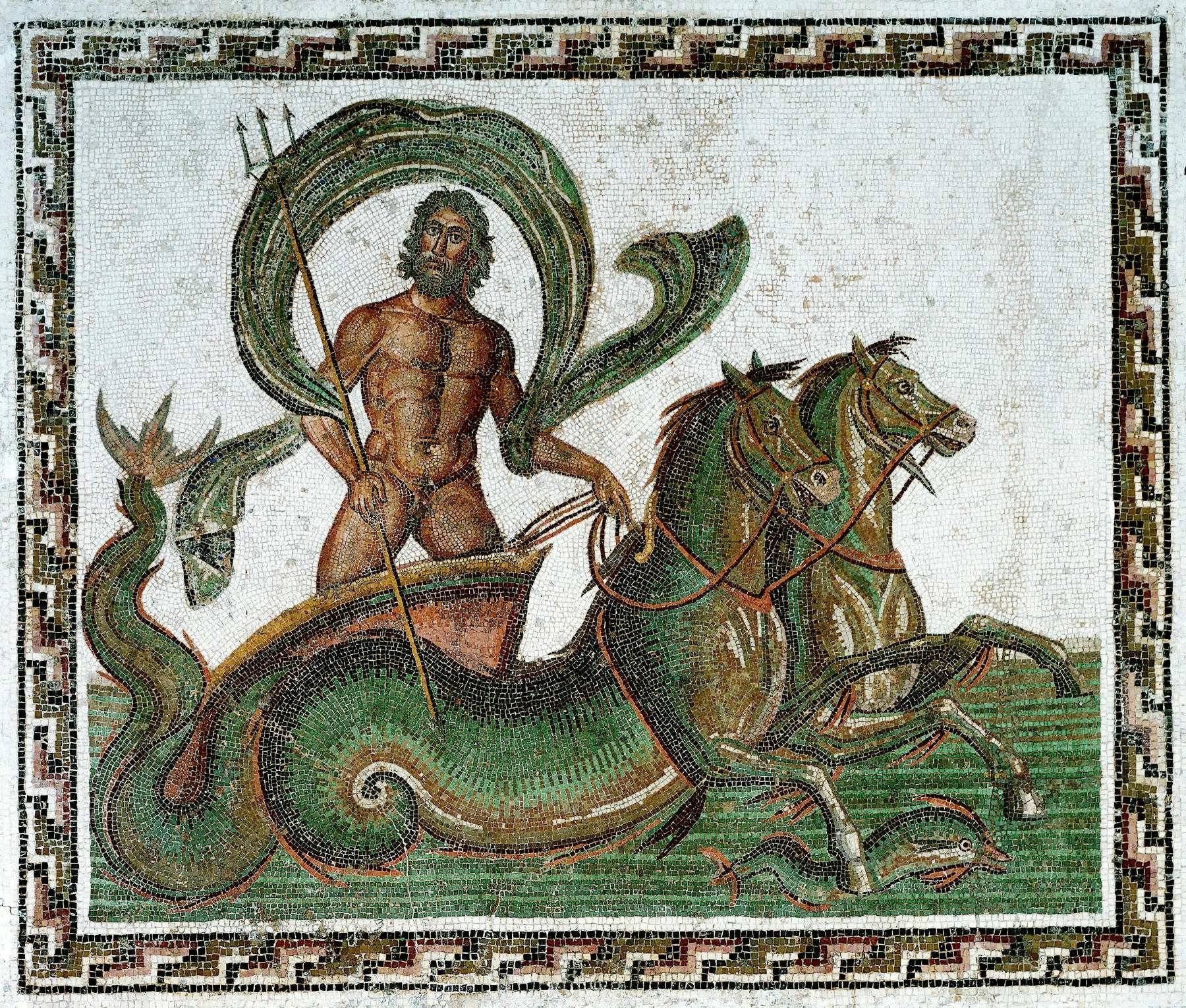
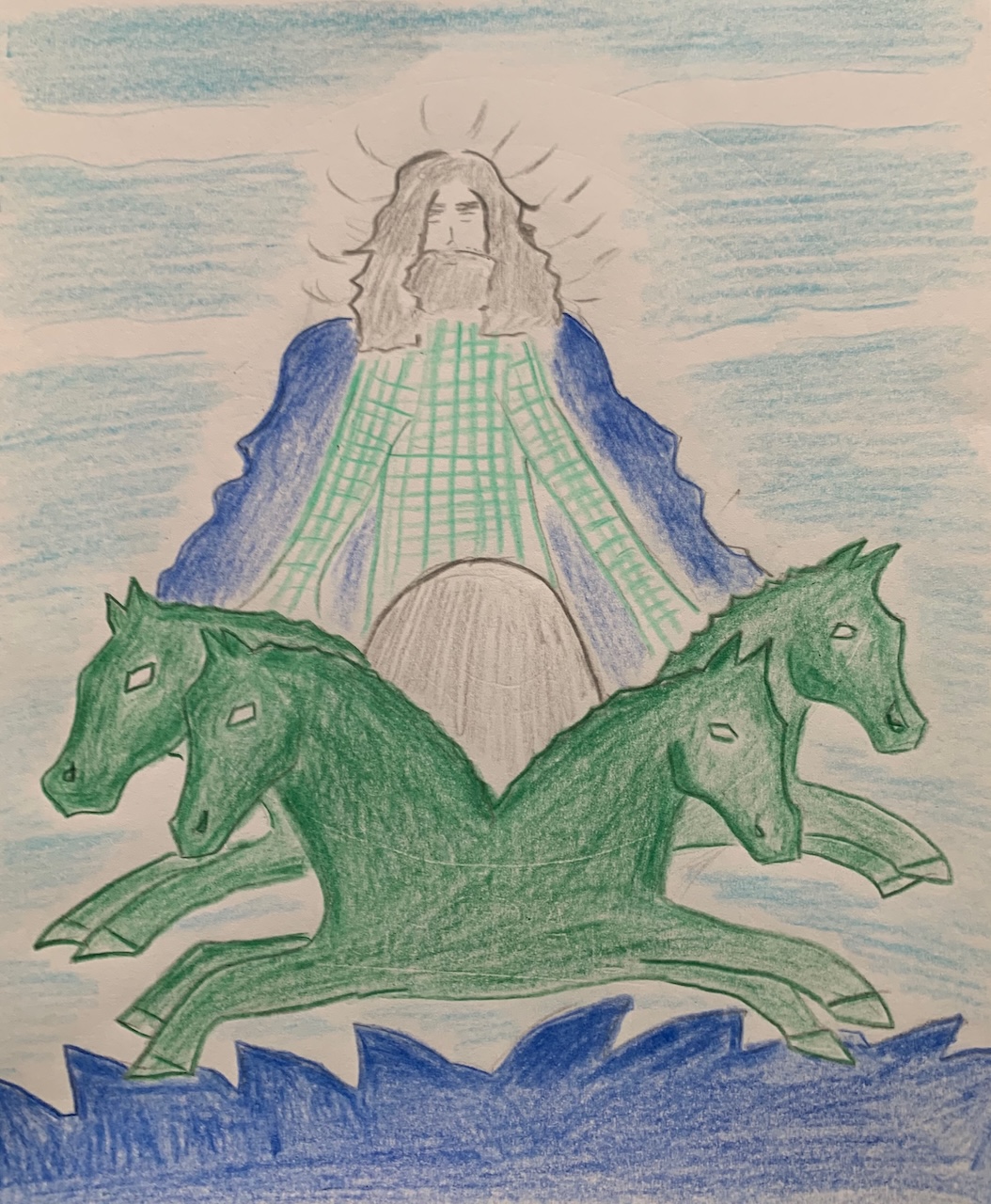
Recently, in one-to-one sessions with another monastic devotee of Annwn, we have been exploring her intuitions about Gwyn ap Nudd’s associations with the sea. Gwyn’s father, Nodens / Nudd, is equated with Neptune at Chesterholm in an inscription which reads Deo No / Neptu. This suggests, like Neptune, He is associated with freshwater and the sea, seahorses, and with horses more widely (Neptune was worshipped as Neptunus Equestris – God of horse racing).

Little is known about the myths of Neptune but there are many about His Greek counterpart, Poseidon Hippios ‘of the horse’, the Father of Horses. When Demeter fled Poseidon’s lust in the form of a mare He took the form of a stallion and mated with Her and She bore a colt called Arion ‘Very Swift’. In another tale He mated with Medusa and She gave birth to Pegasus.

These stories remind me of my personal gnosis about Nodens mating with Anrhuna, the Dragon Mother of Annwn, to bear Gwyn and Creiddylad and other children who might have included horses and seahorses. Intriguingly Rhiannon, who like Creiddylad is a Queen of Annwn, is a Horse Goddess. I often wonder if Creiddylad and Rhiannon are titles for the same Goddess who takes horse form. If so this would suggest that Nodens is the Father of Horses and likely Sea Horses here in Britain. That He might be the father of Gwyn’s sea-going steed, Du y Moroedd, ‘the Black of the Seas’.

It also make me wonder if Nodens and Anrhuna might be the parents of white winged horses like pegasus from whom my closest spirit animal, a white winged mare, is descended. March allelog, ‘flying horses’, are known in Wales.

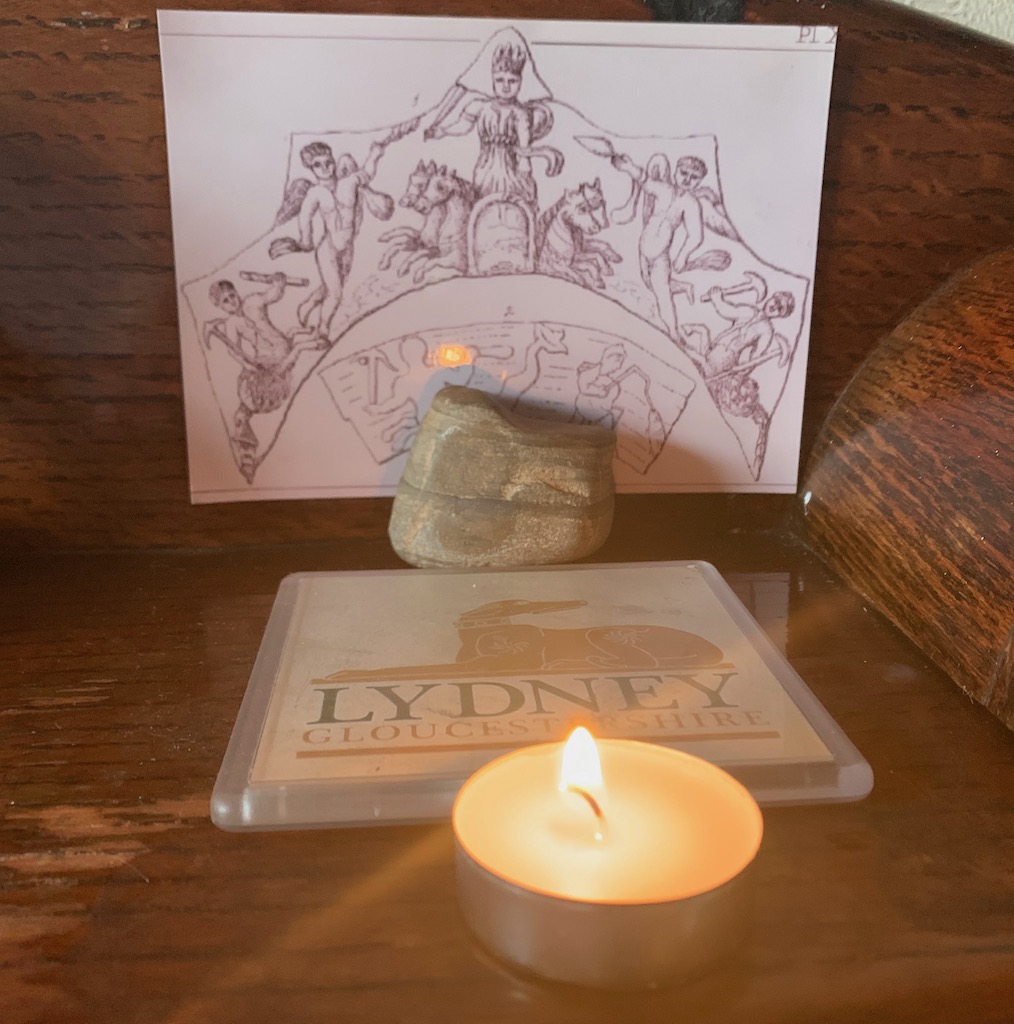
The devotional art above was born from these musings and is based on the mural crown depicting Nodens on a chariot pulled by four seahorses from Lydney and a triumph of Neptune in a chariot drawn by two seahorses from Sousse Archaeological Museum.

Vindos and the Salmon of Wisdom

Many years ago, when the Ribble was rich in salmon, at autumn they swam up river and up the tributaries not only to spawn. Near the source of Silver Fish Brook stood a hazel tree that was covered in nuts that were filled with wisdom. It was rumoured that if any fish ate nine nuts it would be filled with all the world’s wisdom. Yet no salmon managed to eat all nine nuts because the squirrels were greedy and the salmon were even greedier. They only managed to eat one or two until a mast year came and a big salmon barged past the rest and managed to eat nine nuts and was filled to the brim of his eyes, to the tips of his fins, to the top of his tail with all the world’s wisdom. 

Nodens Silver-Hand, the Catcher, the Fisherman, the Lord of the Waters and Dream heard of the this fish. Nodens was wise but He wanted more wisdom. So He went and sat at the place later known as Fish Pan Pool, took out His silver fishing rod and He fished for three long years. 

Finally, He caught the salmon, but instead of cooking him Himself He called to his son, Vindos. “Cook for me this fish but on no account eat any of his flesh.”

Vindos was a good lad. He obeyed. 

Yet as He turned the fish he tempted Him, “Vindos, Vindos, eat me, eat me and you will be filled with all the wisdom of the world.” 

Vindos said, “No, all the wisdom of the world already lies within me.”

He turned the fish and was careful not to get so much as a drop of fat on his fingers. 

The salmon did not give up. “Eat me, eat me and you will be filled with all the wisdom of the Land of Dream.”

“No, all the wisdom of the Land of Dream already lies within me.”

Vindos turned the fish and when a drop of fat leapt at him leapt back. 

The salmon did not give up. “Eat me, eat me and you will be filled with all the wisdom of the Deep Annwn – the Mysteries of the Otherworld.”

“No, all the wisdom of the Deep Annwn already lies within me.”

The fish sighed. He was nearly done. “Then feed me to your father.”

At this point Vindos beheld a vision. “No,” he said, “my father is already wise and I have foreseen that humanity will need your wisdom more in the future.”

Vindos let the salmon go and he went leaping, diving, swimming down Silver Fish Brook out to the Ribble. It is said he will not return again until the culverts are gone and the hazel tree is rich in nuts and wisdom.

*This story is based on the Irish story of the Salmon of Wisdom in Irish mythology drawing on parallels between Nechtan and Nodens and Finn and Vindos. Silver Fish House Brook refers to Fish House Brook which flows through Greencroft Valley in Penwortham where a wise hazel tree grows.

Dreaming the Monastery of Annwn

When I founded the Monastery of Annwn just over two years ago I feared it would always be a rule of one. To my utter surprise for such a niche interest (Brythonic Polytheistic Monasticism centring on the Annuvian Gods) the monastery is thriving with a dozen members, most of whom participate regularly in group rituals, meditations and check-ins, or on our online forum. Several of us are living by vows and the Rule of the Heart.

Only a few months ago I thought it would be impossible to support myself as a nun of Annwn but I have received glimmers of hope with my soul guidance sessions off to a good start and my Patreon membership growing a little. 

This month my spiritual mentor suggested instead of trying to logically plan my next steps ahead for the future we should open a space for dreaming. She challenged me to dream my biggest dream and set it down without thinking about the ‘real world’ limitations that might prevent it happening. 

Immediately I knew this was to make the Monastery of Annwn a physical reality. I’d already had lots of flashes of inspiration so I set them down then journeyed to the Spirit of the Monastery to ask for guidance for the future. 

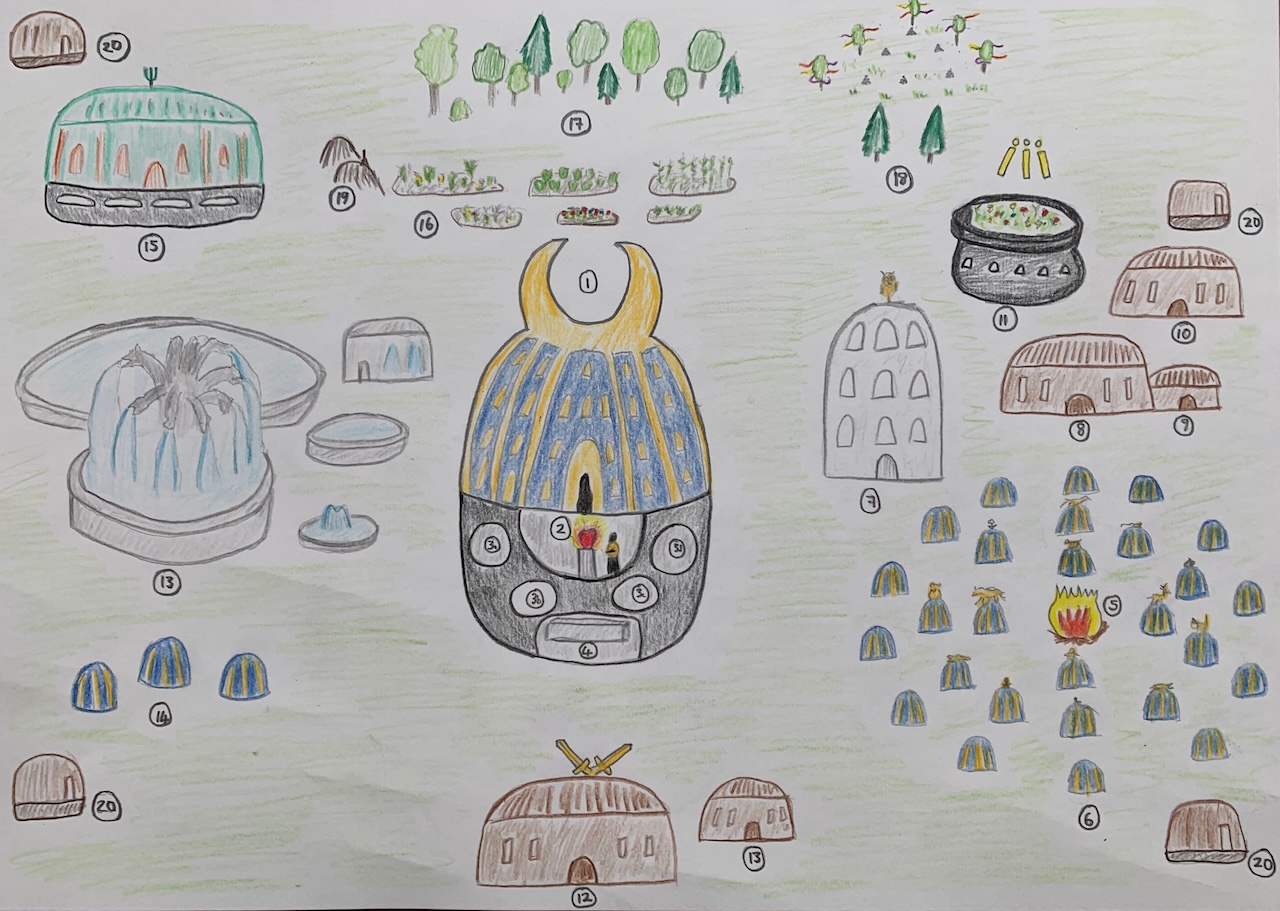
Below is my dream Monastery of Annwn at this point in time. I see it as a centre for worship of the Gods and Goddesses of Annwn, a sanctuary for healing and retreat, and a place for learning about the Brythonic tradition from a polytheistic perspective. It combines above ground, underground, indoor and outdoor spaces.

My hope is that it would sustain itself by growing its own food and making money from healings, retreats, running workshops and courses on Brythonic myths and Deities and polytheistic monasticism and sales of inspired works from monastic devotees.

(1) The Monastery of Annwn – The central temple space containing shrines to the Gods and Goddesses of Annwn and space for worship and ecstatic dance.
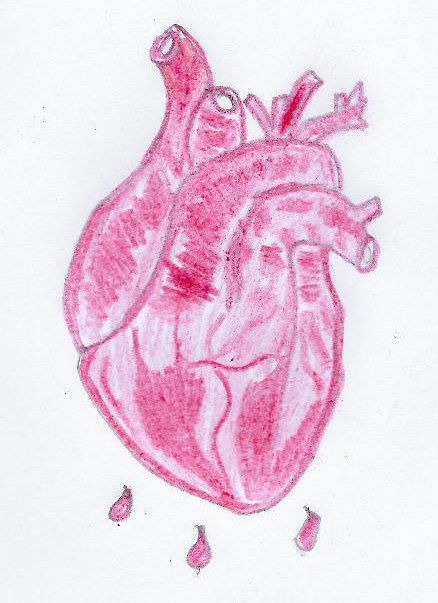
(2) The Chamber of the Heart – At its centre is the Altar of the Heart where  monastic devotees can venerate the Heart of Annwn. There will always be a monastic devotee keeping the beat of the heart day and night.
(3) Underground Caves – For communion a) Orddu’s Cave b) Cave of the Spirits of Annwn c) Cave of Bardic Incubation d) Cave of the Unknown.
(4) Gwyn’s Tomb – This will be where Gwyn symbolically lies in His tomb during the summer and monastic devotees will be able to visit and spend time in silence with Him. In winter the coffin will be removed and this will be a space of initiation involving death and rebirth prior to taking vows.
(5) The Hearth of Annwn –  A space where monastic devotees gather.
(6) Huts of the Monastic Devotees – There are three circles. The first two circles are hut for monastics who have made lifelong vows. On top of each hut is a representation of one of their tutelary spirits. The third circle is for novices and for those who are in the process of discernment.*
(7) Crazy Owl’s Library – A library containing books on Brythonic lore and monastic and mystery traditons along with mythology from around the world.
(8) Gwyn’s Feasting Hall – Here meals are served.
(9) Ceridwen’s Kitchen – Here nutritious food made with local ingredients is cooked. 
(10) Gwyn’s Guest House – A bunkhouse for guests.
(11) Awen Arts – An arts centre with an art gallery and performance space for poetry, singing and music and spaces for crafts and crafting. It will also contain a shop selling inspired works by monastic devotees.
(12) The Training Hall of Gwyn and Gwythyr – A hall for training in martial arts and other kinds of movement including dance and yoga. 
(13) Giant’s Gym – For strength training and rehabilitation. 
(14) The Healing Fountains of Anrhuna – A complex of healing waters including fountains, spas and pools and a shower house and baths for daily use.
(15) Healing Huts – Huts for shamanic healing and various therapies.
(16) The Dream Temple of Nodens – A temple for Nodens with underground dream incubation chambers and healing hounds.
(17) Creiddylad’s Garden – Here vegetables, salad, herbs and fruit are grown.
(18) Gwyn’s Wildwood – A woodland space for meditation, communion and celebration.
(19) The Blessed One’s Burial Ground – A natural burial ground for monastic devotees whose graves will be marked with small cairns. Potentially this might be expanded to provide space for others who support our aims.
(20) Ceridwen’s Compost Toilets – Four sets spaced around the monastery.
(21) Ceridwen’s Compost Heap – For recycling all waste from the garden and feasting hall.

Potentially, off scene, there will be ‘herds of Annwn’ – pigs and cattle for meat and milk and horses for horse riding and equine therapy.

*

Daily Routine

Communal worship will take place in the monastery mornings and evenings. Rather than breaking up the day with regular communal prayers like the Benedictines** prayer will be integrated into daily activities. Each will open with prayers of praise and petition and end with prayers of thanksgiving. For example, prayers to Creiddylad for gardening, prayers to Gwyn and Gwythyr for martial arts, prayers to Anrhuna for healing work. Meals will be preceded by prayers of thanksgiving to the spirits of the land.

Additional rituals will take place for Holy Days and on the dark, new and full moons.

Week Days

5am Communal worship in the monastery – morning prayers and songs for Gwyn ap Nudd and His family, the Spirit of the Monastery, the spirits of place and ancestors. 

5.30am Communal silence in the monastery (the only thing that will be heard is the beat of the Heart of Annwn).

6am Breakfast.

6.30am Communal practice in the monastery – Readings from Brythonic texts followed by meditation and contemplation or a shamanic journey.

7.30am Study in small groups in the library – Brythonic texts and Lectio Divina.

8.30am Exercise – Run, walk, strength training, martial arts, gentle movement (ie. yoga or chair yoga).

9.30am Shower and snack.

10am Study and practice in small groups – Brythonic lore, meditation, journeywork, spiritwork, divination, plant and tree spirit medicine, shamanic healing.

12 noon – Lunch.

12.30pm Devotional creativity or healing work.

2.30pm Manual labour – cleaning, laundry, groundskeeping, gardening.

5pm Baths.

5.30pm Tea.

6pm Free time for private prayer and study and group discussions.

8pm Communal worship in the monastery – evening prayers and songs for Gwyn ap Nudd and His family, the Spirit of the Monastery, the spirits of place and ancestors.

8.30pm Retire for evening prayers to Nodens as God of Dreams.

9pm Bed.

Saturday

5am Communal worship in the monastery – morning prayers and songs for Gwyn ap Nudd and His family, the Spirit of the Monastery, the spirits of place and ancestors. 

5.30am Communal silence in the monastery (the only thing that will be heard is the beat of the Heart of Annwn).

6am Breakfast.

6.30am Communal practice in the monastery – Readings from Brythonic texts followed by longer meditation and contemplation or shamanic journey.

9am – Snack.

9.30am – Ecstatic dance.

11.30am – Shower.

12 noon – Lunch.

12.30 – Free time in which some individuals and groups may choose to spend time in the woods or gardens or go for a longer walk in the local area.

5pm Baths.

5.30pm Tea.

6pm Free time for private prayer and study and group discussions.

8pm Communal worship in the monastery – evening prayers and songs for Gwyn ap Nudd and His family, the Spirit of the Monastery, the spirits of place and ancestors.

8.30pm Retire for evening prayers to Nodens as God of Dreams.

9pm Bed.

Sunday

5am Communal worship in the monastery – morning prayers and songs for Gwyn ap Nudd and His family, the Spirit of the Monastery, the spirits of place and ancestors. 

5.30am Communal silence in the monastery (the only thing that will be heard is the beat of the Heart of Annwn).

6am Breakfast.

6.30am Communal practice in the monastery – Readings from Brythonic texts followed by longer meditation and contemplation or shamanic journey.

9am – Snack.

9.30am – Personal spiritual development.

12 noon – Lunch.

12.30 – Pilgrimage walk involving prayers and offerings to local spirits.

4pm – Community gathering for sharing news and developments.

5pm Baths.

5.30pm Tea.

6pm Free time for private prayer and study and group discussions.

8pm Communal worship in the monastery – evening prayers and songs for Gwyn ap Nudd and His family, the Spirit of the Monastery, the spirits of place and ancestors.

8.30pm Retire for evening prayers to Nodens as God of Dreams.

9pm Bed.

*The Huts of the Monastic Devotees were inspired by Danica Swanson’s ideas around a ‘cottage cluster monastery’ and the bee hive huts of monastics associated with the south-western Irish seaboard.
**Matins / vigils (nighttime), lauds (early morning), prime (first hour of daylight),  terce (third hour), sext (noon), nones (ninth hour), vespers (sunset), compline (end of the day).

If you would like to see the Monastery of Annwn become a physical reality please like or comment.

Contemplating the Abyss Part Four – The God Beyond the Gods

In the previous post I looked at abyss mysticism in the writing of medieval monastics. Here I shall discuss how it relates to the visions of the Abyss that formed the core of my attempted novel, In the Deep, and to my own experiences.

The Christian abyss mystics of the medieval period perceived the soul and God to be dual abysses. Through a process of annihilation, led by love, the abyss of the soul was dissolved in the abyss of God. Van Ruusbroec conceived this slightly differently suggesting the Abyss was a ‘God beyond God’.

The process of annihilation was one that involved suffering. Penitence, purgation, purification, to varying degrees in different authors but the result was ultimately joyous union with God as the ‘divine’ or ‘blessed’ abyss.

The big difference between my own experiences and visions and those of these Christian mystics is theological as I am a polytheist and not a monotheist and find it difficult to identify the Abyss with the Christian God. 

The Abyss has a presence in my life as something powerful, as something divine, as a deity, but not as a God I can name. Thus Van Ruusbroec’s conception of it as a ‘God beyond God’ resonates deeply with me as does the positing by the Gnostics of a God of the Deep preceding the creator God whose prior existence is suggested in Genesis 1.2 ‘And the earth was without form, and void; and darkness was upon the face of the deep. And the Spirit of God moved upon the face of the waters.’ The terms ‘deep’ and ‘abyss’ stem from the Hebrew tehom and are often used interchangeably.

In the cosmology that has been revealed to me by the Brythonic Godsthe Abyss is part of Annwn, ‘Very Deep’, its deepest part, its bottomless depth. It is a place to where the souls of the dead return and from it are reborn.

The way I envisage it bears remarkable similarities to the vision of Hadewijch of Antwerp – ‘an unfathomable depth’, ‘a very deep whirlpool, wide and exceedingly dark; in this abyss all beings were included, crowded together and compressed’.

It is associated with deep wisdom that can only be won as a result of sacrifice. In the stories I was shown Nodens / Nudd agreed to give up His sword arm. He hung over the Abyss in the coils of the Dragon Mother, Anrhuna, the Goddess of the Deep, and received the knowledge, ‘There is no up or down or before or after – everything meets here in you the Dragon Mother.’ 

Vindos / Gwyn ap Nudd hung over the Abyss on a yew wounded in raven form and gave every last drop of his blood in exchange for a vision ‘to set the world to rights’. His knowledge was brought out of Him by a series of riddles and He saw Himself as a black dragon before plummeting dead into the Abyss.

At the beginning of the next book in death He was united with ‘the source’:

Vindos fell,
and as he fell he left behind
his shell of bones and black feathers 

and his soul flew free on wider wings
on the winds of the Abyss.
He had won

their favour
through his offering 
of every last drop of his blood.

By his wounding, by his questioning,
agony had become ecstasy.
The bottomless

abyss
was no longer bottomless.
He had mastered its paradoxes and knew

where darkness turns to light
and death to life.
Down was

now up
and he was one
with the source, the spring

from which the ocean of the stars
sprung when the universe
was born.’

These scenes bear similarities with Marguerite Porete’s words about the soul, in annihilation, finding ‘there is neither beginning, middle nor end, but only an abyssal abyss without bottom’ before acheiving ecstatic union with God.

It seems my Gods, Nodens / Nudd and His son, Vindos / Gwyn are presenting to me a tradition of sacrifice to the Abyss in return for its wisdom. By leading the way they are showing what might be expected of Their devotees.

My first experience of the Abyss took place as the result of an unconscious process of self-annihilation – dissolution of the self through the combination of practicing Husserl’s epoche (putting all one’s presuppositions about the nature of reality aside) with drugs and alchohol and all night dancing.

There was a yearning within me, I might now say deep for deep, abyss for abyss, but I didn’t know what it was and when I got to the Abyss it terrified me. I wasn’t ready for abyssal wisdom. I didn’t know what to do. I didn’t understand its choices, to live as I was or to die physically, or to take a third door. 

I see in my own impulses and those of the abyss mystics, love and annihilation, the interplay of eros the ‘life drive’ and thanatos the ‘death drive’ which together lead to the Abyss and to union with the divine if one is prepared to surrender to make some sacrifice of themselves.

I’ve never been good at giving or sacrifice always wanting things my own way.

Ten years ago, Gwyn, my patron God, a King of Annwn, asked me for a sacrifice in exchange for the wisdom of Annwn – to give up my desire to be a professional author. I did so… but not in full… I secretly entertained a hope if I gave it up for a period I might be let off and be able to have my cake and eat it.

My experience of writing In the Deep, spending a year and a half on a novel that has turned out unpublishable and daring to think it might sell more widely than my previous publications has shown this is not the case. 

It’s taken me ten years to realise I must give up my biggest dream in full for good.

This fits with the process of self annihilation found in the medieval mystics. Only by giving up our desires, surrendering our will, can we walk the path of the Gods and with them find a deeper unison with the God beyond the Gods.

I believe this also relates to the need to give up my identity as Lorna Smithers, published author, performing poet, public speaker, to become Sister Patience.

In the Deep was not written purely for self gain. First and foremost it was written for love** of Gwyn, as an origin story for Him, as an offering. I believe it is because of that the awen flowed and I retain these visions as His gift.

That He, ‘White, Blessed’, has led me to the blessed Abyss, the God beyond the Gods, who may or may not be the formlessness of the Mother of the Deep before She took form.

To the third door – to die to his present life, to be annihilated, hopefully like Vindos / Gwyn to be reborn.

He was
the first microbe
and every single tiny thing.

He was an ammonite and a starfish,
He was a silver salmon,
every fish.

He swam
amongst bright creatures
as an eel, as a seasnake, as a snake,

as a horned serpent, as a bull, as a wolf.
Playful as a new-born pup
Vindos

chased his tail
and the trails of starships
and traversed every wormhole

before he emerged from the sea of stars
and climbed out of the cauldron,
naked, dripping, triumphant,

and very much living
to stand beside Old Mother Universe.

*I also wrote the sequel, The Spirits of Annwn, in draft form as a long poem, when possessed by the awen last year.
**Unlike annihilation love is a difficult thing for me to talk about as someone who, after a number of botched relationships, only discovered they were asexual and aromantic late in life. Unlike a number of Gwyn devotees with an intense devotional relationship with Him I am not a God spouse. Much inside me rebels against using the language of marriage found in Christianity such as ‘bride of Christ’ and even ‘love’ with its sexual and romantic connotations in reference to our relationship. I wish there was a word for purely devotional love.

In part five I will be writing about how these insights relate to the Brythonic tradition.
Contemplating the Abyss Part One – ‘In the Deep’

The Abyss was its spiralling core and its beginning and its end. 

The Beginning

It began with a boy falling, falling, falling into the Abyss.

The boy dreamt of the birth of his Dragon Mother from the infinite waters of the Deep with nine heads and nine-hundred-and-ninety-nine coils and her giving birth to an infinitude of dragons, serpents, monster-serpents and monsters.

*

The boy dreamt of the birth of the stars – each the eye of a fiery giant. He watched them mating, spawning bright gods, who built their fortresses in the skies. The King of the Gods ordering the constellations with a turning sword. This god cast out, plummeting like a comet with an icy tail, down to the Deep. 

*

The boy dreamt of the god hanging in his mother’s coils over the Abyss to gain its wisdom. ‘There is no up or down or before or after – everything meets here in you the Dragon Mother.’ He watched them mate and knew he was conceived.

*

The boy dreamt of the Children of the Don descending from the stars to slaughter the Dragons of the Deep. Lugus, their leader, cut off the arm of his father, Nodens and slaughtered his Dragon Mother, Anrhuna. Lugus then tore the boy, Vindos, and his sister, Kraideti, from the womb. He stole Kraideti ‘the Girl who will Bring Life’ to the stars and threw Vindos ‘the Boy who will bring Death’ into the Abyss.

*

The boy awoke and crawled from the Abyss to eat his Dragon Mother’s heart in a rite that made him King of Annwn (he later gained his name – Vindos / Gwyn ‘White, Blessed, Holy’).

The End

Vindos killed Lugus as vengeance for slaying his Dragon Mother. Lugus took flight in the form of an eagle and perched wounded in an oak tree for nine nights with a sow beneath feasting on the rotten flesh and maggots from his wound. 

Uidianos sang Lugus down from the oak with three englyns and restored him to life.

Lugus returned the blow, shattering the Stone of Vindos, to pierce his enemy’s side. Vindos took the form of a raven and flew to Annwn where he hung wounded on a yew tree upside down over the Abyss and answered its riddles.

Night One: 

“Tell me
the hour the King
and Queen of Annwn
were born.”

“Not easy –
we were not born 
but ripped from the womb 
on the hour of the death 
of dragons.”

*

Night Two:

“Tell me
in your eternal
battle who killed
who?

“Not easy,
summer and winter
are mirrors – when one
kills the other kills 
too.”

*

Night Three:

“Tell Me
how many trees
are in the forests
of Annwn?”

“Not easy,
for they are without
number but ask me again
and I will name
them.”

*

Night Four: 

“Tell me
how many doors
there are to
Annwn.”

“Not easy,
for they are without
number but ask me again
and I will open
them.”

*

Night Five:

“Tell me
where divide 
darkness and light,
day and night?”

“Not easy,
for there are no
divisions – each follows
each in an endless
procession.”

*

Night Six: 

“Tell me
where the restless wind 
comes from and where
he rests.”

“Not easy,
for no-one but he
knows the location of the Lands
of the First and Last
Breaths.”

*

Night Seven:

“Tell me
how many 
stars are in the
Heavens.”

“Not easy,
for they will not
be counted until all
souls are in the
cauldron.”

*

Night Eight:

“Tell me
the fate of
your last drop 
of blood.”

“Not easy,
for I cannot divide it
from the ocean of blood
that will drown
the world.”

*

Night Nine:

“Tell Me
the hour the King 
and Queen of Annwn
will die.”

“Not easy –
we cannot live without 
each other and thus will die
together when all souls
are gathered.”

*

Vindos then fell into the Abyss.

These scenes had a basis in my personal encounters with the Abyss. I will be talking about those in part two, then in part three and four presenting my recent discovery of ‘Abyss Mysticism’ in the writing on medieval monastics and how this has helped me make a little sense of the abyssal visions behind this book.

The Hound with the Serpent Tails

I am a mystery
with one end in Thisworld
and one end in the Otherworld.

My tails lead down the long dark tunnels
from light to darkness
and for the lucky ones
back out to the light of day again.

What is my origin?
Was I born at midnight?
From what union?

From what spell?

Oh what has the cauldron
got to sing of my birth to those
who see me as the guardian
of the Gates of Hell?

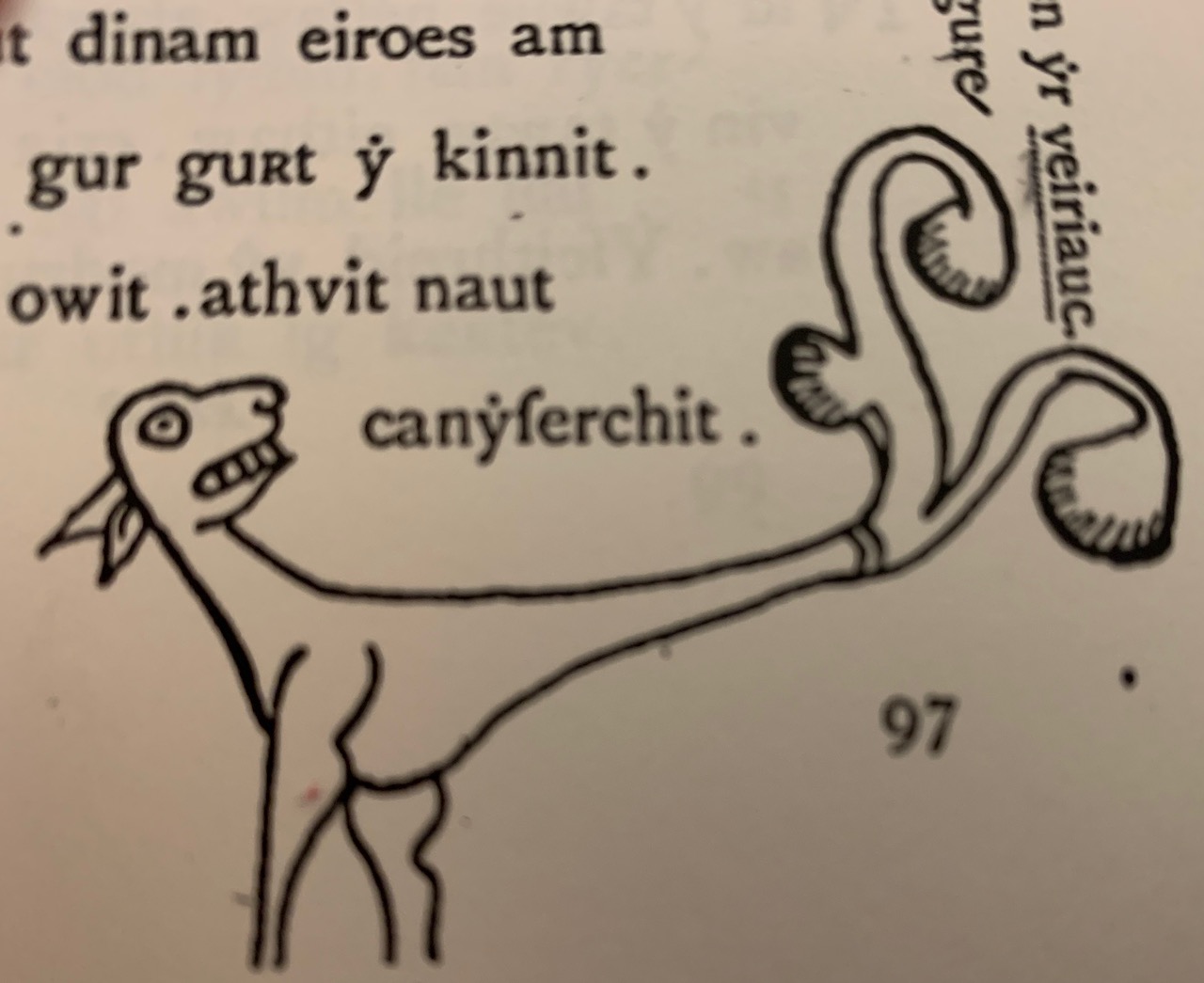
This image of Dormach, the favourite hound of Gwyn ap Nudd, is based on an sketch of him drawn by a monk in The Black Book of Carmarthen in ‘The Conversation of Gwyn ap Nudd and Gwyddno Garanhir’. Here he is described as ‘sleek and fair’ and as having a red nose. This description is similar to the Hounds of Annwn in the First Branch of The Mabinogion who are ‘gleaming shining white’ with ‘red ears’.

It is unknown why Dormach is depicted with serpent’s tails. It is likely due to his Annuvian nature. Nudd/Nodens, the father of Gwyn, is associated with a battle between red and white dragons and there is a mural of sea serpents in his temple.

In my novel-in-progress, In the Deep, I reimagine how Dormach came to be ‘the Hound with the Serpent Tails’. This story and other exclusive excerpts are available to my patrons on Patreon HERE.

Nodens God of Dreams and Building a Dreamwork Practice

Nodens is an ancient British God of water and healing dreams. This is evidenced from His temple at Lydney where He is pictured on a mural crown driving a chariot pulled by water-horses and flanked by spirits of the wind and sea. The layout suggests that pilgrims took a ritual bath in the bath house, made offerings in His temple, then retired to a dormitory to enter a sacred sleep. On waking their dreams were interpreted by an ‘interpretus’. 

I have been relating to Nodens as a God of dreams since 2012. I started connecting with Him around the same time I met His son, Vindos/Gwyn ap Nudd*. At this time I found out that Nodens was also worshipped here in Lancashire as evidenced by two Romano-British silver statuettes, dedicated to Him as Mars-Nodontis, found on Cockersand Moss. 

I used to suffer from insomnia and started praying to Nodens as a dream God when I was desperate to sleep the night before travelling to the midlands for a Druid Network Conference in the midlands at which I was speaking for the first time on the bardic tradition. I was nervous not only about the talk but staying away from home in the company of so many people. 

I prayed to Nodens… and I slept… and when I returned home I made Him an offering of mint tea and thus began my practice of praying to Him every night before I go to sleep and making regular offerings. Since then I have never struggled to getting to sleep although I still sometimes struggle with early waking. Skeptics amongst you might argue this is simply the consequence of having a winddown routine and spending time in darkness in front of a candle but I personally believe that my prayers to Nodens are the driving cause. 

Nodens has also helped me to build a dreamwork practice. Several years ago He instructed me to collect a ‘dream stone’ from the Ribble and to place it on His altar then to put my dreams into it as an offering to Him when I wake up. I also journal my dreams for the purposes of remembering them. In the evenings I reflect on my dreams before I pray to Nodens and go to sleep.

Interestingly Nodens has never played an active role in interpreting my dreams, although I have sensed His guidance when making interpretations. I have never used books, but have been encouraged to explore the personal symbology of my dreams and what certain images and themes mean when they arise.

I often dream that I am ‘back at the stables’ – mainly at Oakfield Riding School where I spent a large part of my childhood working on the yard for free rides and where I worked as a riding instructor after giving up my PhD. In my dreams it represents my desire to return to a safe and a familiar place.

Another common theme is visiting shops that are selling a combination of rock/goth clothing and accessories and Pagan paraphenalia. These consistently have multiple levels, like Preston market, or Affleck’s Palace in Manchester, where I used to shop and hang out. I often see people from the past. I find I can’t relate to them and I cannot find what I am looking for. These dreams remind me that although I had friends with a similar taste in music we had nothing in common outside that and I didn’t truly fit in. Also that what I was searching for, some kind of deeper meaning, cannot be bought.

It’s not that often the Gods show up in my dreams but when they do it is deeply meaningful such as when Gwyn showed me how to send my soul into a hazel tree, then a beetle, then something else, in order to escape execution.**

In many of my dreams, frustratingly, I know I am on a mission for Gwyn, but have failed or forgotten what it is, showing my anxieties about failing Him. 

I’ve never had an experience with Nodens in my dreams but sense the touch of His (silver) hand when there is humour. For example a couple of months back I mistakenly allowed a troublesome member who made an inciteful post into the Monastery of Annwn and was not sure what to do about it. I then dreamt I was working at the stables and found someone had put a turd in one of the horse’s water buckets and was furious. The dream told me that, in the same way I could not allow a person who puts turds in horse’s water buckets to come to the stables, I could not have someone who posts inciteful posts in the monastery. With the words of other members this convinced me to ban them.

Dreamworking with Nodens has not given me all the answers to my dreams but it has helped me to remember, record, listen to, honour and act upon them. Over the time I have been recording my dreams I have logged an increasing number each year showing my dream recall has been improving. 

I believe this practice is important as dreams are the way our Gods and our souls can speak to us with the least interference from our conscious minds. For this reason I don’t try to control my dreams through techniques like lucid dreaming.***

I would be interested to hear about whether anyone else has been inspired to take up a dream work practice with Nodens or works other ways with dreams.

*Nodens is known as Nudd or Lludd in medieval Welsh literature.
**I have recorded an account of this dream HERE.
***Another reason I haven’t experimented with this technique is that asking the question ‘am I dreaming?’ in everyday life would be a trigger for returning to doubts about the nature of reality and blurring of boundaries that led to me not knowing what was real and was not and made me fear I was going mad during a mental health crisis in my early twenties.

A good place to start getting into dreamwork is Nimue Brown’s book Pagan Dreaming HERE

King Fishing

I.

Your azure blue splash.

The quickness
of your dive.

Your kiss of fire.

Your splendour.

Your spine-snapping
savagery.

II.
Your body weight
in fish eaten

every day

fishing for
each of your young.

Your aeronautics.

III.
You were here
before someone wounded
the Fisher King

red dripping into blue

the blood from
his groin

like blood
from his queen’s
menses

flowing into the sea

(when male and female
had to bleed).

IV.
You were here
before the fae danced
in your colours

in the hall
of the King of Annwn
like devils

burning red
and cooling blue.

V.
You sat on your perch
and you watched

the gods –

some say
you advised
the Fisher King.

VI.
His wound

is beginning to heal
with the demise

of industry.

The red rivers
are flowing blue.

VII.
You are no longer
a myth

we cannot reach

on boats
of fish bones

sailing for halcyon days

because
they are here
like you

on this river.

VIII.
The Fisher King
is fishing.

The red world
is turning
blue.

This poem is the third of three pieces about creatures who build their nests in sandy banks and can be seen at Brockholes Nature Reserve. I wrote it a couple of weeks ago when I was applying for a paid traineeship on the Kingfisher Trail – a 14 mile recreational route following the rivers of the Croal-Irwell Valley connecting ‘the rural West Pennine Moors to the urban communities of Bolton, Bury, and Salford’ (HERE). Although I didn’t get the job (of 300 applicants I made the top three) I intend to walk the trail.

In this poem I link the kingfisher to Nodens/Nudd, an ancient British god of hunting, fishing, healing and dreams, from whose mythos the story of the Fisher King may have arisen (although Brân is a candidate too) and to his son, Gwyn ap Nudd, a King of Annwn/Faery, whose people make merry in red and blue costumes in his feasting hall.

Coincidentally, around the same time, Gwilym Morus-Baird published a video on ‘Gwyn ap Nudd and St Collen’ (HERE) where he discusses the symbology of Gwyn’s people wearing red and blue, which might have alchemical significance. Intriguingly he linked this to the two streams, Y Gwter Las and Y Gwter Goch which flow into Llyn y Fan Fach, the location of a story where a fairy bride is given away by a Fairy King-like figure.

The Lost Temple of Nodens

Nobody knows where the Lost Temple of Nodens on the Lancashire coast once stood.

All we know is that two silver Romano-British statuettes dedicated to Nodens as Mars-Nodontis were found on Cockerham Moss (in the 19th century?) and have since been stolen.

I believe it is likely they came from a shrine. My meditations reveal nothing more than the shuffling of robes against chapped skin, quick stitches undone rubbing bare legs, splashing feet. I do not know if they were dropped or deposited, whether by thieves or priests.

I long to know what the statues looked like, who shaped the Cloud Shaper from the clouds and gave him a form and name, who caught the Catcher with his catching hand, so fittingly made of silver

(arian, eraint, airgead, airgetlam, argentum, Ag, relating to quicksilver, hydrargyrum, Hg).

I long to know who brought them back from the Isles of Dream, from the Land of Nod, where our mythos is always forming, ever forming, from the combining of elements into molecules, where air meets water, from the oceans whence emerged the first life where he embraced his consort.

I long to know if he truly deemed it wise to teach the secrets of the atom to his son…

Long I have pondered the existence of his temple, never really got there, seen only the yawn of a priest called Slumber in a huge mouth-like hood and the departures of countless peregrini.

Yet my focus has been on the past. He and the cloud-shapers still shape the clouds as their temple.

Last week a group of polytheists came together to connect with Nodens in the misty interstices of the internet where we might sense him working with Gobannos in the co-creation of other worlds.

When we journeyed to the Lost Temple of Nodens we did not find an ancient temple, but a temple in progress, shaped from clouds, ‘like a cartoon in the making’*, becoming in the here-and-now.

I do not know how or if this temple will be built as its mysteries escape me like the phenomenon of a god made of mist becoming flesh and, on the battlefield, losing his hand, having it replaced by silver.

I do not know how I was touched by that hand, reaching out across the seas, from the Abyss.

I do not know how something comes from nothing, the distinction between dé and andé, god and un-god.

Temples are swept away by the sea, what is dissolved is lost, knowing the past is impossible.

The impossibility of truth shines like a star that died millions of years ago yet is seen by us so far away.

Perhaps in loss we recall ourselves through the light years – ours the silver hands to shape the now – the subtle vibrations of molecules that respond to form our temples in the old gods’ names.

This piece is based on a meditation on the lost temple of Nodens which I ran with Thornsilver Hollysong and Bryan Hewitt for Land Sea Sky Travel on the Nodens/Nudd day of our ‘Tylwyth Gwyn’ series.

*The quote ‘like a cartoon in the making’ was how one of the participants, Emily Kamp, described the temple. She has kindly given me permission to use her words.

The Peat Pit – the Fish Pond of Gwyn ap Nudd

For nearly a decade I have been writing enthusiastically about two topics – the lost wetlands of Lancashire (lakes, marshlands, wet woodlands, peat bogs) and my patron god, Gwyn ap Nudd. I didn’t realise there was a link until I watched the first of Gwilym Morus-Baird’s videos on Gwyn’s folklore.

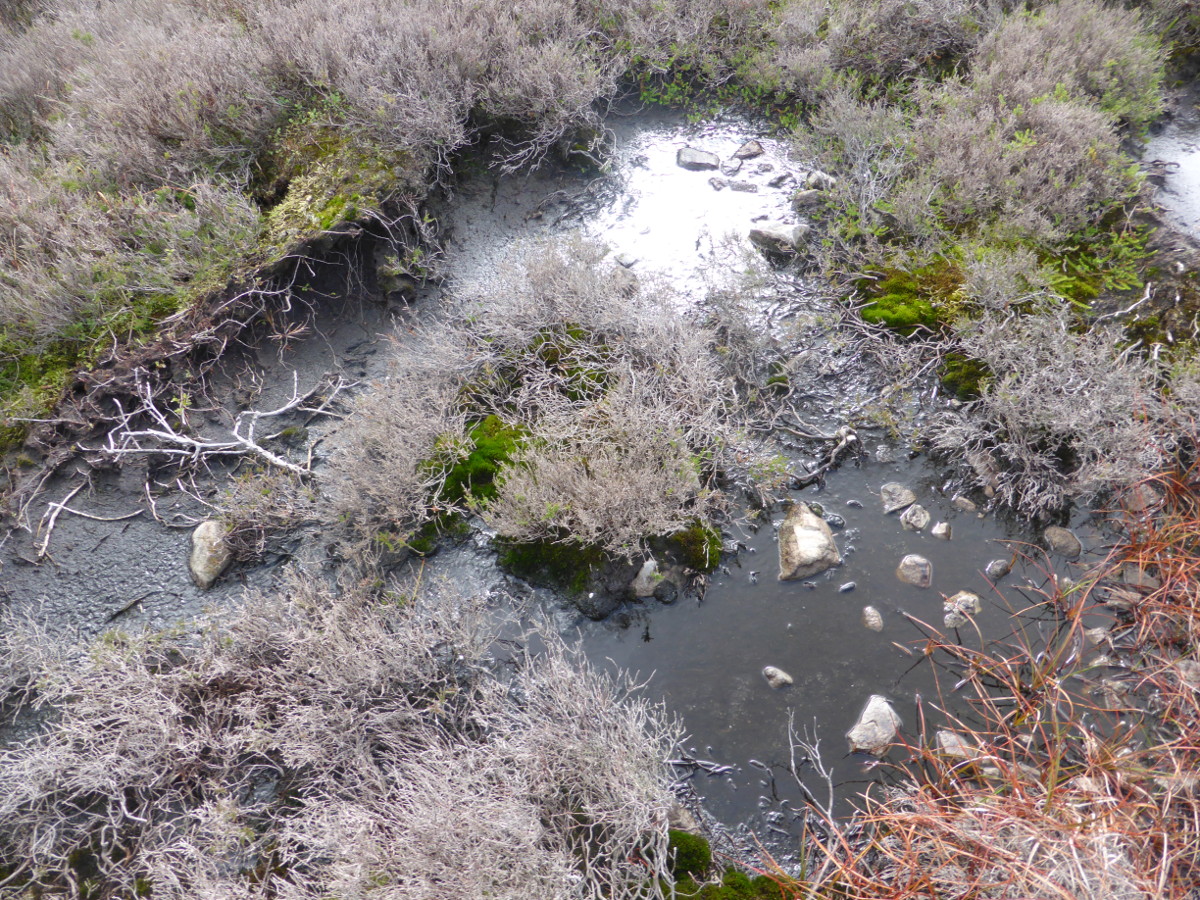
Here he shared three poems by the Welsh poet Dafydd ap Gwilym (1315-1350). Whilst I had read ‘Y Dylluan’, ‘The Owl’, and ‘Y Niwl’, ‘The Mist’, I was unfamiliar with ‘Y Pwll Mawn’, ‘The Peat Pit’. In this masterfully crafted and, in places, humorous poem, Dafydd ap Gwilym narrates how he and his ‘grey-black horse’ foolishly get lost on a ‘cold moor’ in the darkness and fall into a peat-pit.

Unfortunately much of the craftsmanship of the poem in Welsh is lost in translation. The original is written in strict metre with seven syllables in each line, follows an AA BB rhyme scheme, and also contains internal rhyme (possibly cynghanedd – it is beyond my skill to judge). It also features repetition.

Gwae fardd a fai, gyfai orn,
Gofalus ar gyfeiliorn.
Tywyll yw’r nos ar ros ryn,
Tywyll, och am etewyn!
Tywyll draw, ni ddaw ym dda,
Tywyll, mau amwyll, yma.
Tywyll iso fro, mau frad,
Tywyll yw twf y lleuad.

Woe to the poet (though he might be blamed)
who’s lost and full of care.
Dark is the night on a cold moor,
dark, oh, that I had a torch!
It’s dark over there, no good will befall me,
it’s dark (and I’m losing my senses) over here.
Dark is the land down below (I’ve been duped),
dark is the waxing moon.

Here, in the first verse, we see that not only are the rhyme and metre lost in the English translation but also the repetition of tywyll ‘dark’ at the beginning of six of the eight lines.

Dafydd ap Gwilym goes on to lament his ‘woe’ ‘that the shapely girl, of such radiant nature, / does not know how dark it is’ before admitting his foolhardiness for venturing out on the moors at night.

It’s not wise for a poet from another land,
and it’s not pleasant (for fear of treachery or deceit)
to be found in the same land as my foe
and caught, I and my grey–black horse.

Here we gain a sense of unhomeliness, of the poet having ventured far from home, to an arallwlad ‘other-land’ – to the land of his ‘foe’, who we might surmise is the otherworldly Gwyn, from the following lines and those in other poems. In ‘Y Niwl’ the mist is described as ‘his two harsh cheeks’ which ‘conceal the land’ ‘thick and ugly darkness as of night / blinding the world to cheat the poet.’

After speaking of how he and his horse drowned in the peat-pit, Dafydd ap Gwilym goes on to describe evocatively and curse the place of his undoing and to associate it directly with Gwyn and his spirits.

Such peril on a moor that’s an ocean almost,
who can do any more in a peat-pit?
It’s a fish–pond belonging to Gwyn ap Nudd,
alas that we should suffer it!

I love this image of ‘a moor that’s an ocean’. It reminds me of the German term schwingmoor ‘swinging wetland’. This evokes how a bog can sway with each step like the sea.

I am dying to know whether the reference to the peat-pit as a ‘fish pond belonging to Gwyn ap Nudd’ is a metaphor that Dafydd ap Gwilym has created or whether it comes from the oral tradition.

We know Nudd/Nodens, the father of Gwyn, is associated with fishing by the iconography at his temple in Lydney. A crown, which would have been worn by a priest of Nodens, features a strange fisherman with a long tail catching a salmon and images of fish and sea-serpents appear on a mural.

So it isn’t too surprising to find a reference to fish ponds belonging to Gwyn. However, anyone familiar with the ecology of peat bogs will be aware it is very rare to find fish in their waters due to the low oxygen levels. This raises the question: for what is Gwyn fishing?

I believe an answer can be found in a later English poem by Winthrop Mackworth Praed (1802 – 1839) called ‘The Red Fisherman’ which might also contain echoes of an older tradition.

This recounts how an abbot came to a pool with the ‘evil name’ ‘The Devil’s Decoy’ and encountered ‘a tall man’ on ‘a three-legged stool’ clad all in red with shrunken and shrivelled ‘tawny skin’ and hands that had ‘long ages ago gone to rest’ – ‘He had fished in the flood with Ham and Shem’.

With a ‘turning of keys and locks’ he took forth bait from his iron box’ and when he cast his hook ‘From the bowels of the earth / strange and varied sounds had birth’, ‘the noisy glee / of a revelling company’.

To this otherworldly music the red fisherman drew up ‘a gasping knight’ ‘with clotted hair’ ‘the cruel Duke of Gloster’. Casting off again, ‘a gentleman fine and fat, / With a big belly as big as a brimming vat’ ‘The Mayor of St Edmund’s Bury’. His next catch, with ‘white cheek’ ‘cold as clay’ and ‘torn raven hair’ was ‘Mistress Shore’ and, after countless others, finally a bishop. The abbot was cursed by the Red Fisherman to carry his hook in his mouth and from then on stammered and stuttered and could not preach.

If this poem derives from an older tradition based around the lore of his Gwyn and his father (like the Red Fisherman Gwyn was also identified with the devil) we might surmise he is fishing for the dead.

The mention of the noise of a revelling company is also pertinent as in ‘Y Pwll Mawn’ we find the lines:

A pit between heath and ravine,
the place of phantoms and their brood.
I’d not willingly drink that water,
it’s their privilege and bathing–place.

The term ellyllon is here translated as ‘phantoms’ but also means ‘elves’. It no doubt refers to Y Tylwyth Teg, ‘the fair family’ or ‘fairies’ over whom Gwyn rules as the Fairy King. ‘Brood’ has been translated from plant ‘children’ which is also suggestive of the family of Gwyn.

The peat-pit, like other bodies of water such as lakes, pools, springs, and wells, is a liminal place where Thisworld and the Otherworld meet, where the fair folk bathe, and their leader fishes for souls.

Finding out about this lore has deepened by intuition that Gwyn is associated with Lancashire’s lost peat bogs and former peat-pits, such as Helleholes, just north of my home.

At the end of his poem Dafydd ap Gwilym curses ‘the idiot’ who dug the peat-pit and swears he will never ‘leave his blessing in the peat bog’. This may refer to a practice taking place in his day – people leaving butter in peat bogs for the fairies, which may carry reminiscences of more ancient offerings to Gwyn and his family.

Contrarily, the next time I visit a peat bog, I intend to leave a blessing for Gwyn, the Blessed One.

*With thanks to Gwilym Morus-Baird for his video HERE and for pointing me in the direction of Dafydd ap Gwilym.net where ‘Y Pwll Mawn’ can be read in Welsh and English.