Review: Mapping the Contours by Nimue Brown

mapping the contours by nimue brownThere’s something old about the poems in this book, a bone-deep knowing, a merging of self and land which is reflected in the cover image. It speaks of a time when the hills were the contours of giantesses, the curves of beautiful goddesses, a time that still is and is not with us now.

‘Walking myself into the landscape, and walking the landscape into myself’ is the way bard and druid author Nimue Brown describes the process behind her new poetry collection Mapping the Contours. In the poem that provides the title she says ‘Human bodies are much like landscapes.’

In ‘Raised upon these hills’, one of the most beautiful hymns to a landscape I have ever read, Nimue evokes her lifelong relationship with the Cotswold Edge:

I was raised upon these hills,
My bones are made of limestone,
Sweet Jurassic limestone,
Grown from ancient seas.
I was raised upon these hills
My body made of fossils
Where the Cotswolds meet the Severn,
And the Severn seeks the sea.

She, land, and goddess are inseparable. In ‘Seeking Goddess’ Nimue speaks of going to the forest, rooting with the boar, sleeping with the lynx, making love with the trees, becoming ivy-templed and bird-haired, sharing milk and giving birth to bees. Inseparable too are the local animals and plants: urban foxes, an otter on a bus station, wild swans over the Severn, brambles, orchids, fly agaric. And most strangely a lonely ‘telephone bird’ ‘Outside my window impersonating / A ringing phone.’

There is a lot more uncanniness in this collection encountered in both the seen and unseen worlds. Trolls long to drink ‘the elixir of your terror’ and ‘dead things’ fall from the mouths of the dark siblings of the Shining Ones. In ‘Granny’s house’ ‘All chicken magic and bones’ Baba Yaga

…bears the knife
Opening bone truths
My shoulder blades
My wings
Beauty never dared
Whilst living.

As well as engaging with folklore Nimue provides a more homely and nourishing alternative take on old British myths originating from the Dark Ages of warlords and shining-browed bards. Her cauldron does not brew potions for ‘blinding flashes or ‘burning heads’ but ‘soil food, soul food’, ‘everyday gifts’. Her thirteen treasures are not weapons but a loom, a log, a seed, a cup, a candle…

Tongue-in-cheek she speaks of becoming ‘indigenous English’, a ‘Dirty Briton’, claiming back soil and soul. This act of reclaiming forms the heart of the book. I’d recommend it to all poets, Pagans, and nature lovers as a paradigmatic record of recovering an ancient way of being that lies within our bones and the bones of the land.

You can buy Mapping the Contours HERE and read Nimue’s blog, Druid Life, HERE.
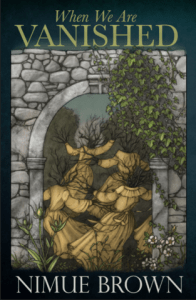
Review: When We Are Vanished by Nimue Brown

42497_original_9dfb889b-31ef-4c08-803a-a044d1cf1a21_largeNimue Brown is a Druid author based in Stroud. I’ve enjoyed a number of her publications on Paganism and Druidry and her Bardic poetry books. When We Are Vanished is the first of her works of fiction I have got my hands on. It is a speculative mystery novel set in a not-so-distant future where hackers have shut down the global computer network to bring an end to ‘war, finance and government’. When the book opens, the system is in its death throes. Job centres, the police force and scientific laboratories are just about hanging on, relying on new ‘cellulose tech’, which has a mind of its own and a wicked sense of humour. And people are vanishing, suddenly, inexplicably, from the outskirts of civilisation one by one…

At the core of the story is a family: a father who has vanished; three sisters at various stages of vanishing named Kim, Epona and Maria; and their mother, Amanda, who is struggling to deal with it all. The character who I connected with most was the intelligent, erratic Epona. On several occasions her connections with her namesake, the Gallo-Roman horse goddess and psychopomp, are subtly referenced. For example, a computer screen run on the tricksy cellulose tech reads, ‘Eponine Matthews will tell you she is made of chalk’ (referencing the White Horse of Uffington). ‘Tell her to go home and not show her long face again.’ More deeply, Epona is the user of a technical device which allows her to plug into other realities, relating to the horse goddess’s movement between worlds. As I followed the plot, I was intrigued by how this would play out. It did not turn out how I expected!

Nimue has worked extensively with dreams and this shows throughout the book. Its twists and turns and much of the language evoke the non-logic of the dreamworld; metaphorical, absurdly funny, frightening, exquisitely beautiful. As Kim vanishes, ‘Meanings floated away from her. Fish, fish, fish. Sounds like wish… Set the wish fish swimming into the skies. Wish fish, wish fish and if you stare at the clouds for long enough, they would vanish too… She feels threadbare, a word too often repeated. A cloud stared out of the sky.’ Kim’s reflections on time also touch on the mystical. A recurring scene that haunted me was the one pictured on the front cover, ‘yellow dresses and ancestral women made of twigs, turning in a tight circle dance.’

When We Are Vanished succeeds in combining the numinous with an implicit critique of the flaws of our current civilisation: our over-reliance on technology and an inhuman system, our misplaced faith in irritating and badly written self-help books, the impossibility of shutting out wild nature and our wild selves, and the illusion that this world is the only reality. I would recommend it to readers who enjoy a plot rich in references to mythology, folklore and fairytales with surprising twists and to those who are fascinated by the possibilities of future worlds and other realities. As the illusion of liberal democracy slowly melts away from the Western world and alternatives awaken, the situation evoked does not feel far off…

You can purchase When We Are Vanished HERE.

Personal Religion?

Glastonbury Tor Beltane 2013 102 - CopyA couple of days ago I read write-ups of the OBOD (Order of Bards, Ovates and Druids) 50th anniversary gathering on Glastonbury Tor, on the blogs of Joanna van der Hoeven and Robin Herne.

http://downtheforestpath.wordpress.com/2014/06/09/celebrating-50-years-of-obod/

http://roundtheherne.blogspot.co.uk/2014/06/the-people-of-peace.html

It sounds like they had a grand time. Although one of the things Robin acutely pointed out was the irony that although the main topic was peace, the powers of place, including Gwyn ap Nudd and the Tylwyth Teg (the People of Peace) were not addressed or involved.

Why should that bother me? OBOD aren’t all pagans or polytheists. Hundreds of different religious groups use the Tor for various ceremonies- that’s part of its power and draw, and the eclecticism and chaos that constitutes the spirit of Glastonbury.

It was not until this morning I perceived my vexation was the symptom of an approaching realisation; I awoke with an image of the OBODies on the Tor in my mind combined with an overwhelming gnosis clear as the dawn; THIS ISN’T MY RELIGION.

I know the OBOD doesn’t pretend to be a religious organisation… however my discomfort about the lack of commonality I feel with Druids outside The Druid Network has been growing for a while. I’m beginning to feel the distinctions between my path and those of some other Druids are so huge that there is no meaningful common ground at all.

Plus… I recall Nimue Brown mentioning to be a Druid you must walk your path with conscious intent as a Druid. Looking back, I have done this as a Bard, and now do so as Awenydd. I believed these paths fitted under the umbrella term Druid but now I’m not so sure.

And I’m not so sure I did the right thing in claiming the name Druid for my religion pretty soon after joining TDN, on the ground I was a member of the network and a grove. It was much later I was gifted with the name Awenydd by Gwyn ap Nudd and the spirits of my local landscape.

So I’m beginning to wonder now whether my path as Awenydd, which is based in these relationships and expressing them through poetry, is not the religion of Druidry but a personal spirituality I live religiously?

I also wonder, because my practice focuses more on ‘anthropomorphised’ deities and spirits than most Druids whether I’m more of a polytheist? In answering that I find myself drawn back to the issue of commonality… I once wondered whether I was a Brythonic polytheist but decided I wasn’t as I don’t know enough about all the deities and their lore in depth, haven’t made enough effort to learn Welsh, and don’t follow a joint ritual structure.

So I wonder now…

Can polytheism be religious without commonality?

Must religion have a name?

Is personal religion a contradiction in terms? And is it possible to live a personal religion?

View from Glastonbury Tor Beltane 2013 120