My Annuvian Path

I’m at liberty to share this because I don’t live in the age of Queen Victoria, King James, or King Arthur. I’m not Orddu, ‘the Very Black Witch’, in her cave waiting for the knife to cut her in twain. I’m not Elizabeth Southerns, Anne Whittle, Isobel Gowdie, or Isabella Rigby. Nobody blinks an eyelid when I say I worship a god of Annwn and speak with otherworldly spirits and in this I am blessed.

Still, my path is a lonely one not many choose to walk. Annwn means ‘the Deep’, ‘the Otherworld’. In this age the reign of superficiality and normalism is stronger than the influence of any monarch. There’s an inner policing – not a hanging or burning at the stake, just dismissal, lack of interest, in the mystical, the magical, the mythic, when they’re not reduced to cosplay or methods of self-development.

Paganism and Druidry have been demystified and the mystical systems that exist (in Druidry) still hinge around Taliesin and Arthur, ‘heroes’ who slaughtered and oppressed the gods and ‘monsters’ of Annwn. I keep returning to these traditions like a restless horse pacing its box, like I’m picking a scab, each time find myself more deeply disappointed; an outsider, a black sheep amongst the white-robed herds.

Perhaps our deepest myths died when Taliesin and Arthur stole the cauldron from the Head of Annwn. Something big must have perished to leave the void, filled for 1500 years by Christianity, now filled instead by the new religion of the self, the selfie, everyone wanting to be a celebrity bard in the virtual otherworlds, in the god-sized holes in their heads, which no longer have room for real gods. I have only a dim intuition what that was. If it is contained in our existing texts, it’s very well concealed. Seeking it out feels important and I can’t do so whilst wrestling with wider disillusionments.

I’ve finally reached the point my box-walking is at an end. A knowing I’ll never feel at home in mainstream Paganism or in Druidry. That my dream of being part of a physical community who get together for devotions, to work with myths, to discuss how such work can change the world, is unlikely to happen. I’ve complained of my disappointments and voiced my criticisms for the last time.

Now for some affirmations: I am an awenydd. I walk an Annuvian path. I will make the most of this opportunity my spiritual ancestors such as Orddu never had. I will reclaim our deepest myths. I will learn to live by them.

Annuvian Awen - Awen Ac Awenydd

Review: Creatures by Greg Hill

Creatures by Greg HillGreg Hill lives in Wales. He was editor of The Anglo-Welsh Review and contributes regularly to Welsh literary magazines. I’ve followed his blog for a while and was delighted when I heard about the release of his first full length collection of poetry in print; Creatures.

The title alone creates intrigue. What kind of creatures? The epigraph replies; ‘All creaturely things… Plants growing, / Roads running, / Rivers flowing, / Places that sing.’ It is clear from the outset this collection is about an animate landscape where every being is a creature, alive and sentient.

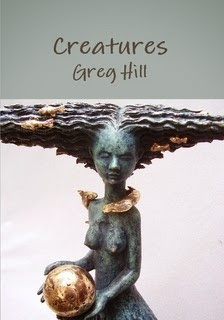
The first ekphrastic poem is based on the picture on the cover; Fidelma Massey’s sculpture, ‘Water Mother,’ who dreams thoughts of water into being. Here, the ‘cosmic ebb and flow’ of thought and water is contained in the poem. Analogies between living water and perception recur throughout the book. In ‘Cwm Eleri’ the poem’s tight structure fails to contain the river, which slips from grasp like time. In ‘Myddleton’s River’ water-ways link London, Wales and the underworld, forming a conduit for complicated alchemical processes of mental and physical transformation.

The contrast between our immediate perception of creatures and those aspects of their being impossible to grasp is central. A jackdaw sitting happily in the hearth becomes ‘an image… a token of wildness… like a jigsaw piece from another puzzle;’ a homely and familiar event made strange. Greg writes that as a heron dips out of sight ‘a part of me fell out of the sky with it,’ lost ‘except that something / settles in the flow of these words.’ We can never completely grasp our perceptions. Only through words can they find permanent representation.

Several poems present roads, paths and boundaries as living entities and how our understanding of them shifts once they are crossed and they slip into memory. If we try to return, the roads are ‘dull,’ ‘dusty,’ ‘empty.’ Our former selves are shadows, unfamiliar reflections. ‘Strange border guards’ usher us ‘from what / we neither know nor recognise.’ These haunting and complex poems demonstrate how choices shape our relationship with the landscape and hence our memories.

The mysteries of the Bardic Tradition and its creatures are explored in novel ways. ‘Awen’ depicts a shepherd lad inspired to speak poetry by a spirit ‘like a forest god’ who is elusive as the words he inspires. Four episodes from the Mabinogion are covered. I was fascinated by ‘A Scaffold for a Mouse,’ which depicts ‘Manawydan living in a dream / landscape with the life / conjured out of it like a flat plane.’ Through his ‘firm grip’ on the mouse, ‘a small thing / for a great purpose,’ he breaks the ‘powerful magic’ of Llwyd, awakening ‘form to its true nature’ thus freeing Rhiannon, Pryderi and Cigfa.

This collection depicts a relationship with the creaturely world that is on the surface simple and direct yet beneath mysterious and disconcerting. Each time I return to these poems I discover new meanings and thematic relationships within the whole. I’d recommend this book to anybody who likes poetry with lots of depth and has a love for nature, myth and creatures.

Creatures can be purchased through Lulu here: http://www.lulu.com/spotlight/greghillpoetry

Greg Hill’s poetry site is here: http://greghill.weebly.com/
Greg’s blog, Hill’s Chroicle can be found here: http://hills-chronicle.blogspot.co.uk/