To an Apple Tree

I.
Apple tree, sweet apple tree,
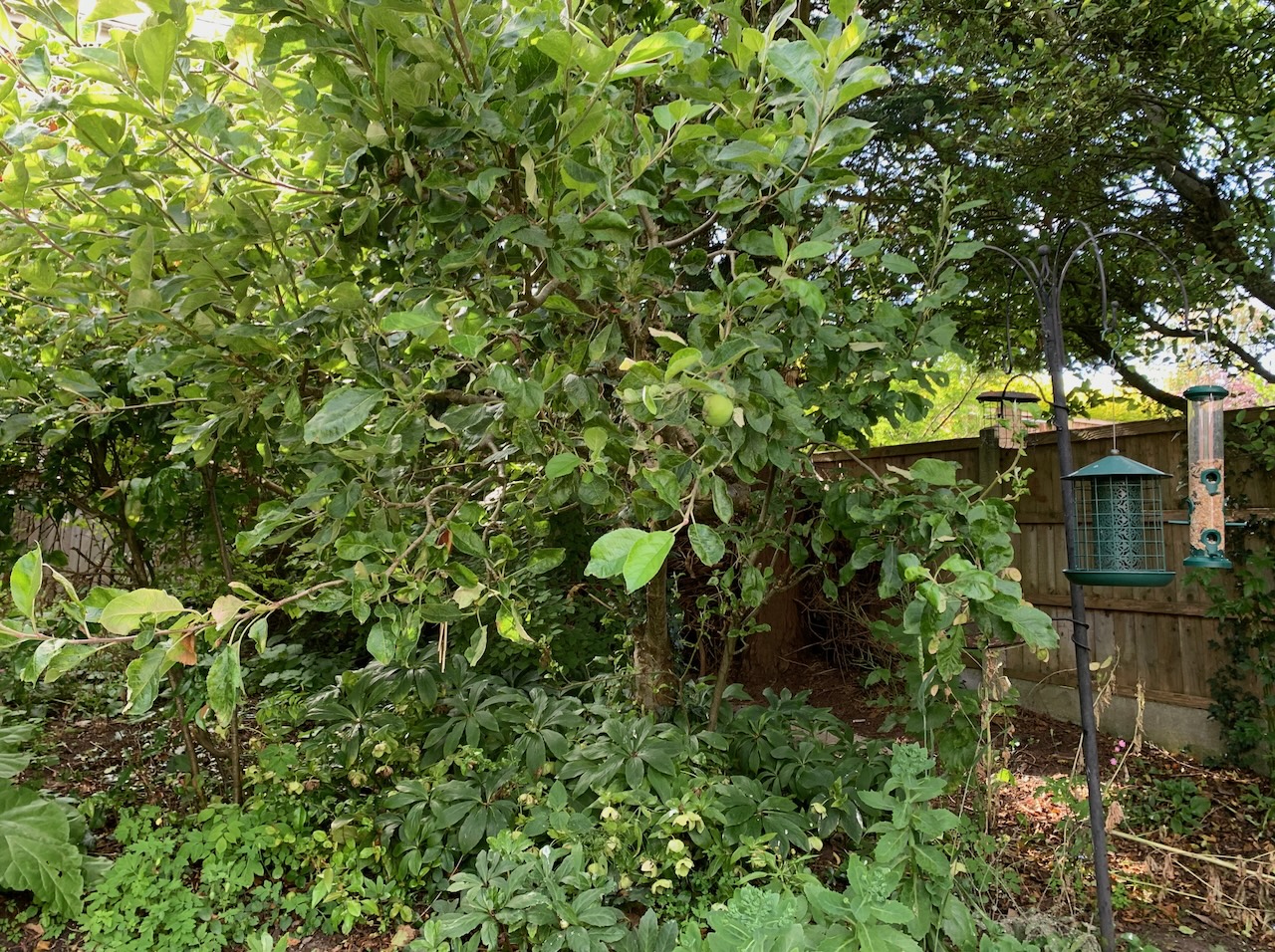
who grows in my suburban garden,
know I am no Myrddin and no prophet.

I fought not in the Battle of Arfderydd.
I was not a golden-torqued warrior.

I wandered not in the Forest of Celyddon.

But I have wandered for thirty years
with madness and madmen
in the wildernesses of suburbia
not knowing what is real and what is not.

I have known my pigs and my stolen berries
and my maidens of the suburban drains,
my Chwyfleian beneath her trap.

II.
Apple tree, sweet apple tree,
who grows close to my garden fence,
know I am no Myrddin and no prophet.

I knew not Gwenddolau and his two eagles
who feast on the flesh of the Britons every day
but I have been devoured by death-eaters.

I did not get involved with the games
of Gwenddolau and Rhydderch
on the gwyddbwyll board,
men gold and silver,

but I predicted the outcome
and did not speak up about Caerlaverock.

I ask that my Lord of Hosts have mercy on me.

III.
Apple tree, sweet apple tree,
near where the birds come to feed,
where the sparrows pick, the starlings peck,
where the long-tailed tits come to twirl their tails,
know I am no Myrddin and no prophet

yet I was torn out of myself

not after the Battle of Arfderydd
but when I was but a child, a fledgling
by the bullies who called me a pig,
knowing not Myrddin’s sweet little one,
when I was only half-pig half-bird.

I knew not what kind of bird.

Not a hawk certainly not a merlin.

Perhaps a blackbird or the big black bird
perching on my chimney-top blotting out the sun.

IV.
Apple tree, sweet apple tree,
with your blossoms white and pink,
foxglove pink, the colours of the fair folk,
know I am no Myrddin and no prophet,

yet I was invited to walk not in Celyddon
but in Avalon with my Lord of Hosts.

Oh happy happy days beneath your boughs
with the long-tailed tits twirling,
picking at the worms

as the snake
returned to the garden
and the Dragon King spread His wings
and they were filled with the apples of the sun.

This poem is inspired by ‘The Apple Trees’ from The Black Book of Carmarthen wherein Myrddin Wyllt speaks his woes to an apple tree after the tragic Battle of Arfderydd. I believe ‘the Lord of Hosts’ referred to in this poem is Gwyn ap Nudd, who is also referred to as ‘the Lord of Hosts’ in ‘The Conversation of Gwyn ap Nudd and Gwyddno Garanhir’. Gwyn, ‘White’, has paradoxically appeared to me in the guise of a black dragon. It’s a poem about knowing in spite of my defects and limitations I am loved.

Paths to Gwyn

There are many paths to Gwyn. 

~

There is the bard in the mead hall. The one who sings at the feast in Caer Vedwit, the Mead Feast Fort, in Gwyn’s hall, in a heavy blue-grey chain. 

I sung there once, where the harp of Teirtu plays on its own. Where the ghost of Maponos walked. Where the fair folk and the dead dance and mix and eat the meat of leaves whilst the king watches from his throne of bones.

I drank enough mead to feast the dead for centuries and took the songs of our king to the halls of towns and cities, to libraries, pubs, shopping centres.

I sang in chains, tried to strangle myself with them, then cast them off. 

I walked this path for a while but this path was not for me. 

~

There is the path of the madman, the wild woman, the path of the followers of Myrddin Wyllt. Those who are afflicted by trauma and by the claws of Annwn torn out of themselves, split open, as if by a spear, their bird spirits flying out. 

Hawk spirits, golden eagle spirits, goldcrest spirits, passerines in strange migrations. All heading to their forests of Celyddon. To pines and raided gold mines. To the damps of the Celtic rainforests where it rains five days a week. To the remnants of woodlands in the suburbs along the trickle of suburban streams.

I was the wren in the bush singing of how I tore myself open for our God and how my heart was my sacrifice on mid-winter’s day still beating beneath the yew.

A part of me is still there, singing for Him, loud yet hidden. No-one hears. 

I walked this path for a while but this path was not for me. 

~

There is the path of the cave woman, the inspired one, the witch. Orddu ‘Very Black’, Orwen ‘Very White’, all their ancestors around the cauldron. 

Black skin, white hair, white skin, black hair, wolf furs, corvid feathers, black beaks.

Those who sing with crows and wash the skulls of their ancestors in holy springs. Cast the wolf bones. Lie beneath wolf furs waiting for visions of the Deep.

Those who drink the awen, scry in the cauldron like our God, sing of past and future things. Swallow stars. Universes. Things too big to speak. Die in His arms.

I swallowed the star of the King of Annwn and it is within me still and I am still in my cave after all these centuries with a murder of crow women inside me. 

The nun in her cell who still flies, still runs, divines with black feathers.

I walked this path for a while and have decided it is for me. 

I wrote this poem as a step along my journey in discerning what it means to be an inspired one and nun of Annwn devoted to Gwyn ap Nudd in relation to the Brythonic tradition and my solitary life in suburban Penwortham.

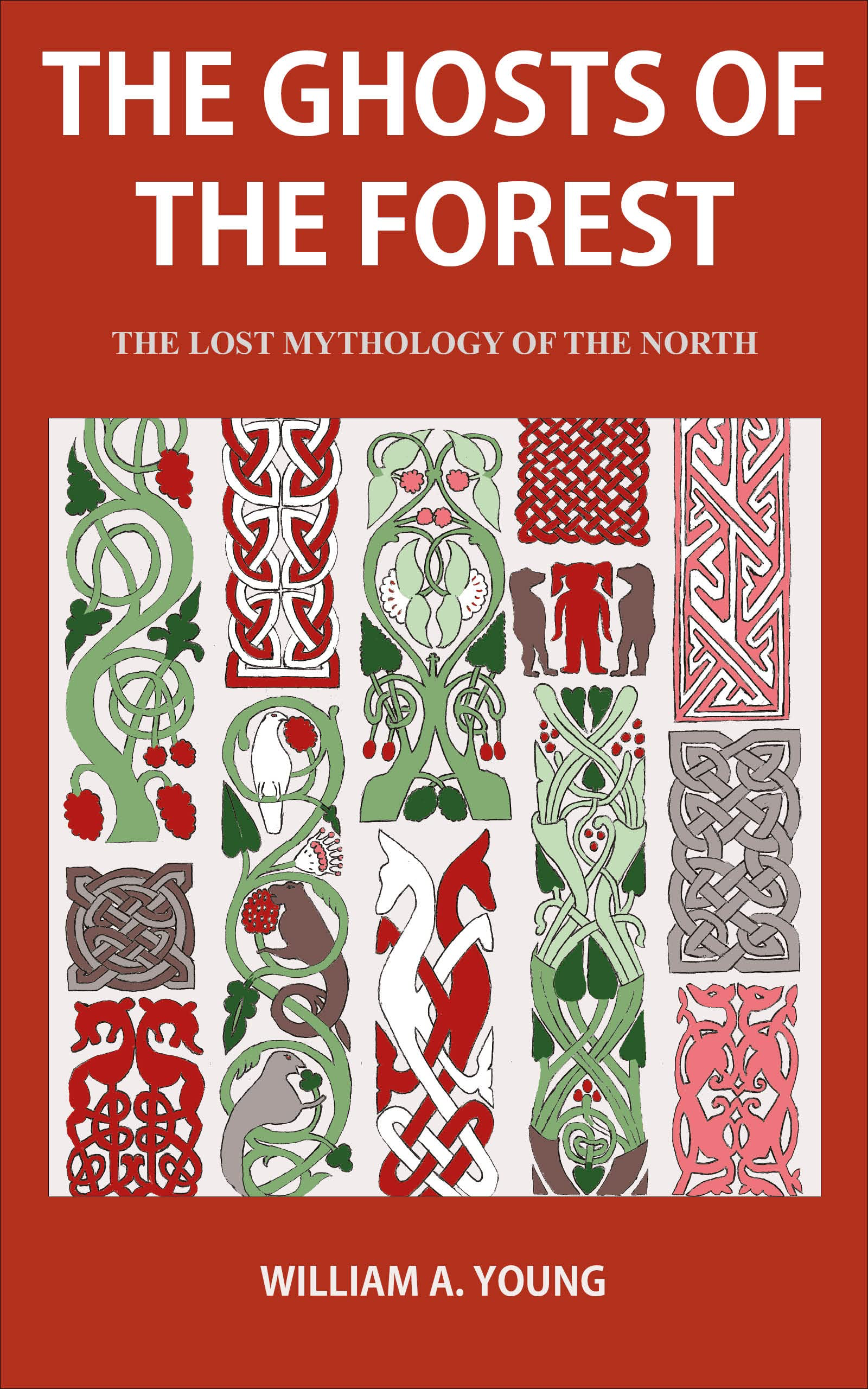
Review: The Ghosts of the Forest by William A. Young

In The Ghosts of the Forest – The Lost Mythology of the North, Edinburgh-based writer William A. Young traces the folklore and legends of southern Scotland and the Borders and the figures within them back into the Brythonic past of Yr Hen Ogledd ‘The Old North’* and prehistoric Britain. 

William follows a number of ghosts in literature and on foot, across the landscapes where the stories are set, to trace how they have arisen from the land – from a ‘Dreaming North’. He begins with Walter Scott and notes that his own collecting of the tales echoes Scott’s ‘raids’. 

His first journey is to Eildon Hill, the Eildon Tree, and the Rhymer’s Stone. Here he finds connections between the legends of Cannabie Dick and Thomas the Rhymer and conjectures that the Fairy Queen might be linked to the Roman Diana, goddess of hunting and the wilds, to whom stood an altar less than 1km away. 

He then journeys with the ghost of Myrthin* Wyllt the ‘surest guide’ to the lost world of the North’. This ‘wild Merlin of the Tweed’ and ‘madman’ is contrasted with ‘the Arthurian Merlin’ and ‘Archdruid’. 

The quest to find Myrthin forms the heart of the journey. William begins with a visit to Myrthin’s grave in Drumelzier then follows William Skene and Nicolas Tolstoy in travelling to Arthuret, Liddel Strength and Caer Gwentholye where the tragic battle of Arfderyth took place and Myrthin went mad. 

Like Tolstoy he makes links between the black mountain in Fergus and Myrthin’s Peak. These leads and the story of Owain take him not to Hart Fell but to the Bewcastle Fells and the complex of Glen Dhu (Black), Marven’s (Myrthin’s) Peak and Cleugh and Capelstone Fell.

William draws connections between the ‘Dark Man’ in Owain and the churl in Fergus. He identifies these figures with the Brythonic deity Cocidius who was worshipped at a shrine at Bewcastle known as Fanocodi. The spirit of the grove with whom Myrthin associates is tentatively identified with Nemetona, who is known as Diana Nemorensis under Intepretatio Romana. Owain’s links with the Brythonic deities Mabon and Modron and his father, Urien’s, with Nevyd, are also explicated. Here we find a potential ‘pantheon’ underlying these tales and this sacred landscape. 

Cocidius is then further traced to legends featuring the ‘Brown Man of the Moors’ whose sacred home might have been the house-sized Kielder stone appearing in the legend of the ‘Colt of Kielder’. William then has a potent encounter with Cocidius ‘the Red God’ at his shrine at Yardstone where he comes ‘face to face’ with the God in a remarkable carving. 

These journeys takes us into the heart of the Forest of Celython where Myrthin fled in his madness. William notes that here he finds not only plantation woodlands but, more encouragingly, areas of restoration such as Kielderhead Wildwood and areas owned by the Borders Forest Trust.

Suggestions based on William’s findings are finally made for further archaeolgical research.

This 606 page book is a labour of love crafted from poring over old texts and following them across the land, walking, camping, holding vigil in wild places, showing how by offering his ‘sweat’ and ‘time’ William has come closer to the old Gods. It gives voice to a quest and is the culmination of many years of dedication. I would recommend it to all who have an interest in the folklore and legends of Britain and how they might be traced to their prehistoric origins.

You can buy Ghosts of the Lost Forest HERE.

*William substitutes ‘th’ for the Welsh ‘dd’ in his spellings. 

The Ghost of Myrddin Wyllt

Mountain ghosts come to me
here in Aber Caraf
A Fugitive Poem of Myrddin in his Grave

He haunts me. He who speaks from his grave at Aber Caraf with other wyllon mynydd, ‘mountain ghosts’ – Myrddin Wyllt.

He entered my life when he broke from a scene we both despise. In Stobo Kirk, in a stained glass window, he kneels before Kentigern, begging for the sacrament, as The Life of St Kentigern claims.

368px-Merlin_and_St_Kentigern,_Stobo_Kirk

“This isn’t true!” the gnosis struck me like shattering glass as Myrddin leapt free in an explosion of splinters; ethereal blue, red, green. The bishop fell in pieces with his chalice and crozier. The light swept in. Not just sunlight but that otherlight, the unendurable brightness that Myrddin gazed upon after the Battle of Arfderydd, which made him gwyllt, ‘wild’, ‘mad’. The light of truth. The ‘White/Clear Light’ of Vindonnus, Vindos, Gwyn ap Nudd, Lord of Annwn.

It illuminated Myrddin in all his naked glory, leafy-haired, bony-limbed, spry and supple as a sapling even in his old age. It glinted in the scintillae of his pupils, declaring him wildman, madman, prophet, awenydd: one who speaks the Awen from the tangled heart of the forest, from the wind-swept mountains where ghosts scream, from the deep wells of Annwn.

The stories of this wild Myrddin have been smothered beneath the fusty robes of Merlin. The popular wizard, who is frequently depicted as an advisor to King Arthur in film and television, was created by Geoffrey of Monmouth in The History of the Kings of Britain (1136) and The Life of Merlin (1150) from the lives of two very different men.

Merlin Ambrosius was based on the Romano-British war leader Ambrosius Aurelianus. He acted as advisor to Vortigern and helped Uther Pendragon to father Arthur by magically disguising him as Gorlois, the husband of Igraine, so he could sleep with her.

Merlin Caledonensis was based on Myrddin Wyllt: a northern British warrior who became gwyllt after the Battle of Arfderydd in 573 and retreated to Celyddon (the Caledonian forest) where he learnt the arts of poetry and prophesy and used them to warn against future wars. The two Merlins became conflated.

In Robert de Boron’s Merlin (1190-1200), Merlin became Uther Pendragon’s advisor and responsible for Arthur’s fosterage, his pulling the sword from the stone, and building the Round Table. The ‘Mage Merlin’ appears as Arthur’s advisor and as a guide to the grail quest in Thomas Malory’s Le Morte D’Arthur (1485). His later depictions draw upon these associations.

The conflation of the two Merlins and the downplaying of Myrddin Wyllt’s stories is deeply problematic. Firstly Myrddin lived after Arthur making their association impossible. Secondly Myrddin would never have supported the warmongering of Arthur and his ‘knights’.

Yet he has been subsumed within the Arthurian tradition and its vile strain of Christian militarism, which brought about the slaying of the dragons, giants, and witches of ancient Britain, then the Anglo-Saxons, then ‘the infidels’ who fell in the Crusades, leading to our War on Terror.

He rages against his identification with Merlin: a political advisor to the warlords of Britain who supports going to war over chemical weapons that don’t exist and approves arms sales to countries using our weapons in attacks that breach international humanitarian law.

He calls to me, a fellow awenydd, to shatter the illusion of his complicity in Arthurian imperialism with the otherlight of Annwn from our god, Gwyn ap Nudd. Here I share his story.

Myrddin grew up amongst the warband of Gwenddolau, the last Pagan warlord of the Old North. He was fierce in those days, blood thirsty, callous, with a love of gold and strong mead. Warring in nothing but the golden torque gifted him by Gwenddolau, his battle-madness was legendary. He piled up corpses for Gwenddolau’s two sea-eagles to strip their flesh.

View from Liddel Strength

Caer Gwenddolau (present-day Liddel Strength)

A great change came over Myrddin after the Battle of Arfderydd. This was fought between the armies of Gwenddolau and Rhydderch, who was married to Gwenddydd, Myrddin’s twin sister. Rhydderch had allied with a number of Gwenddolau’s kinsmen.

Gwenddolau was slaughtered. Aggrieved by the death of his lord Myrddin was consumed by such a battle rage that he killed his niece and nephew, the son and daughter of Gwenddydd and Rhydderch, who were fighting on Rhydderch’s side.

After the battle Myrddin was near-blinded by an unendurable brightness illuminating the carnage. By it he recognised the pale faces of his sister’s offspring who he had hacked apart. Martial battalions filled the sky. To his horror he realised they were the victims he had slaughtered gathered in the form of a cold and angry god staring at him with countless dead eyes.

One of those spirits swept down and tore Myrddin out of himself. With a howl of terror and pain that became a whimper and squeak he leapt and fluttered up like a bird-puppet on a string. He was tossed on the winds of Annwn, on a merlin’s wings, to the forest of Celyddon where he shivered in the branches of an apple tree.

That image of Gwyn ap Nudd containing all the dead who he had killed was indelibly impressed on his mind like an irremovable afterimage from staring foolishly at the sun.

Myrddin does not remember the days when he flitted from tree to tree, a lost soul, birdlike, unable to feel or think or see. He remembers some of his slow return to himself, to chill recumbent flesh, relearning the contours of his body and its need to eat and drink, sights, sounds.

Blog 6. Coille Coire Chuilc

A last remnant of Celyddon at Coille Coire Chuilc

The birds of the forest guided him to tasty berries, the squirrels to hazelnuts, and a happy little piglet to roots and grubs and the most exquisite truffles. When the bleak northern winter brought snow to his hips and icicles to his hair a white-haired wolf taught him the secrets of endurance.

Words came last. Stuttering, stammering, then in a sudden stream. With them the wells of the past opened. Every memory flooded back to him and he poured them out to his apple tree and little pig in a poetry that was only stemmed when each wound had bled, was cauterised, could heal.

Most terrible were his outpourings of guilt and desire for death; his attempts to drown and leaps from trees. Gwyn ap Nudd would not take him. Instead he showed him black holes in the fabric of reality from which the otherlight of Annwn streamed in illuminating future battles.

Myrddin knew then that he must give his suffering a purpose by using his prophetic abilities to warn against those devastating wars. Knowing the influence of Kentigern he took himself to the stone above Molendinar Burn, where the bishop spoke his sermons, to share his prophecies.

Kentigern did not listen. Preoccupied with teaching the word of the one true God he had little time for the words of a wildman naked as a new born rabbit and rambunctious as a rutting stag. Yet the truth of Myrddin’s words pierced some of Kentigern’s followers like antlers. The otherlight in his pine-green eyes terrified and enticed them and some began to believe him.

When Myrddin came to Kentigern to prophesy his death the bishop did not think he could die thrice: by being stoned, pierced by a stake, and drowning. He thought the impossibility of this prediction coming true would put an end to his peoples’ belief in the madman’s prophecies.

Myrddin died as predicted. Kentigern constructed the story of him begging for the sacrament to prove his power over him and his uncanny prophecies, which he claimed were no match for the word of God.

Afterward Myrddin haunted Kentigern with the furore of a soul unable to live out its entelechy because more powerful forces have got in its way.

The poetry of a lonely voice was not enough to stop the rise of Christian militarism seeded by Arthur which dominates Britain to this day. Yet Myrddin opened in many people the portals through which the otherlight comes in, illuminating the horrors Merlin’s illusions cannot conceal.

Myrddin walks amongst us opening doors and haunting us with the countless eyes of the dead until we cannot bear to be complicit with the world of Arthur and the wizard Merlin anymore.

Breaking every window, every text, every screen, he tears us out of ourselves and takes us back to the forest.

The ghost of Myrddin Wyllt sets us free.

*First published in Pagan Dawn, 204, August 2017

SOURCES

Geoffrey of Monmouth, The History of the Kings of Britain, (Penguin Classic, 1973)
Geoffrey of Monmouth, The Life of Merlin, (Forgotten Books, 2008)
Meirion Pennar (transl.), The Black Book of Carmarthen, (Llanerch Enterprises, 1989)
Neil Thomas, ‘The Celtic Wild Man Tradition and Geoffrey of Monmouth’s Vita Merlini: Madness or Contemptus Mundi?’, Arthuriana, Vol. 10, No. 1 (Spring 2000)
Nikolai Tolstoy, The Quest for Merlin, (Sceptre, 1985)
Robert de Boron, Merlin and the Grail: Joseph of Arimathea, Merlin, Perceval (DS Brewer, 2008)
Thomas Malory, Le Morte D’Arthur, (Cassel, 2003)
Tim Clarkson, Scotland’s Merlin, (Berlinn, 2016)
William F. Skene, The Four Ancient Books of Wales, (Forgotten Books 2007)
The Myrddin Who Guides Me

The Myrddin who guides me is Merlin Silvestris not Merlin Ambrosius.

The Myrddin who guides me does not serve Arthur or wear a pointy wizard’s hat and designer robes.

The Myrddin who guides me does not live in a castle and scrape or bow or ensorcel for Christian warlords.

The Myrddin who guides me does not condone the wars the warlords of Britain cause and support.

The Myrddin who guides me remembers the Battle of Arfderydd repeating as if it was yesterday.

The Myrddin who guides me remembers Gwenddolau beneath red soil and stacks of heads and limbs.

The Myrddin who guides me remembers the departing souls and the Gatherer of Souls speaking to him…

a hand gripping him and assigning him to the wild things of the wood.

The Myrddin who guides me shed his battle-madness with his warrior’s calluses like dead skin.

The Myrddin who guides me flew as a hawk and ran as a pine martin.

The Myrddin who guides me was the friend of a happy little pig, a golden apple tree, a silver birch,

and a skinny-flanked wolf with age-whitened hairs who shared the icicles on his naked limbs.

The Myrddin who guides me spoke the Awen from the wells of Annwfn with the aid of a water-sprite.

The Myrddin who guides me was a terrible-eyed prophet who made every tree of Celyddon tremble

with warnings St Kentigern and the Christian warlords ignored.

The Myrddin who guides me died and is dead and haunts me with mynydd ellyllon, ‘mountain ghosts’.

The Myrddin who guides me predicted his death: by stoning, by a skewering stake, by drowning.

The Myrddin who guides me would never have begged for the sacrament from St Kentigern before his death.

The Myrddin who guides me is not the Myrddin kneeling in the stained glass window at Stobo Kirk.

The Myrddin who guides me smashes every window, every text, every screen. He will never be contained.

He bursts from this poem!

The Myrddin who guides me is Myrddin Wyllt: the mad, the wild, the free.

Loch Awe and Cuillich Wood 137 - Copy

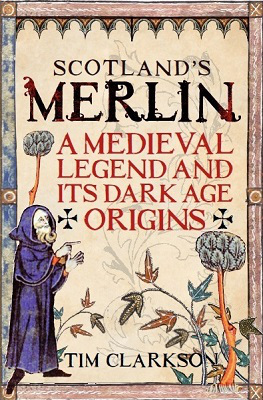
Review: Scotland’s Merlin by Tim Clarkson

Scotland's Merlin by Tim ClarksonTim Clarkson is an independent researcher and historian who gained a PhD in medieval history from the University of Manchester in 2003. He has since written four books on the history of Scotland and the Old North. Scotland’s Merlin: A Medieval Legend and its Dark Age Origins is his fifth.

This clearly written and well-researched book traces the story of Merlin, a figure best known from television as a wizard and advisor of King Arthur associated with Wales and Cornwall, back to its origins in Dark Age southern Scotland, which was then part of the Old North.

Clarkson begins with Geoffrey of Monmouth’s Historia Regum Britanniae as the source of Merlin’s depiction as an Arthurian wizard then turns to the Vita Merlini where we find a different ‘Scottish’ Merlin: a ‘Man of the Woods’ possessed ‘by a strange madness’ after a battle who seeks solitude in the Forest of Calidon and predicts his own threefold death.

This depiction originates from Geoffrey’s knowledge of medieval Welsh poems about Myrddin Wyllt, who became wyllt (‘wild’) after fighting in the Battle of Arfderydd and fled to the forest of Celyddon where he found solace beneath an apple tree with a little pig.

One of Clarkson’s more contentious arguments is that this northern wildman was not originally called Myrddin but Llallogan. The earliest roots of his story may be found in Vita Merlini Silvestris, where Lailoken (Llallogan) tells St Kentigern he became mad after a battle then begs for sacrament before his three-fold death.

The name Myrddin arose from the false etymology of ‘Carmarthen ‘Merlin’s Fort’ (Welsh Caerfyrddin, with ‘m’ softening to ‘f’)’. There is no ‘need to imagine that Lailoken of the North was already known as ‘Myrddin’ before his story migrated to Wales’.

More contentiously, Clarkson claims that Myrddin was not pagan but Christian. This is partially based on textual evidence. Lailoken pronounces ‘I am a Christian’ and petitions Kentigern for the sacrament. In the medieval Welsh poems, Myrddin addresses Jesus and his sister, Gwenddydd, urges him to take communion before he dies.

Clarkson also contests Skene and Tolstoy’s views that Gwenddolau, the northern British ruler who Myrddin fought for at Arfderydd was a pagan. The 5thC archaeological evidence shows ‘the aristocratic landholding elite proudly displayed their Christian credentials on memorial stones’.

‘the organisational infrastructures of paganism were unlikely to have survived the onslaught of the new religion. The two institutions could not exist side-by-side. Wherever Christianity came, the old beliefs died out within a couple of generations. Christian missionaries in the Celtic lands were not, as it is sometimes imagined, willing to turn a blind eye to pagan worship. They were determined to eradicate it. In such a climate of non-tolerance it is very unlikely that druidism, in whatever form, was able to survive… we should envisage Gwenddolau as a Christian king.’

Although Clarkson claims Merlin was not a pagan he admits it is possible to see him as a Celtic seer, shaman, or awenydd, in the Christian tradition. Rather than asserting his view as correct he encourages readers to make up their own mind whether ‘the original story was sprinkled with Christian allusions by later writers and all references to paganism were expunged’ or ‘there was no pagan narrative from the outset.’

Before I read this book it was my personal opinion that the medieval poems about the pagan wildman Myrddin Wyllt formed the earliest strata of the Merlin legend, and that the vitae of St Kentigern and Vita Merlini Silvestris contained later Christianised variants as propaganda promoting Kentigern and the Christian church. I haven’t been persuaded otherwise. It remains my opinion that Gwenddolau was one of the last pagan rulers of the Old North and that Myrddin was pagan; the allusions to Jesus and communion were added by Christian scribes.

Minor personal disagreements aside, this is an excellent book which does valuable work in tracing the origins of the Arthurian wizard, Merlin, to their roots in the story of a northern British warrior who became ‘wyllt’ at the Battle of Arfderydd, found solace amongst the wild creatures of the forest and became a renowned prophet.

I’d recommend this book to everybody interested in Merlin, British mythology, and the history of southern Scotland and the Old North. As somebody based in Lancashire it’s encouraging and inspiring to see the forgotten Dark Age histories of the north returning to life and being reclaimed.

You can find out more about Scotland’s Merlin and how to buy a copy on Tim Clarkson’s blog HERE.

Dumbarton Rock

Consolidating Gwyn ap Nudd’s links with the Strathclyde Britons

In October after the ritual to Epona I stayed overnight with Potia and Red Raven in Glasgow. The next morning, Red Raven kindly took me to visit Dumbarton Rock: Dun Breatann ‘Fortress of the Britons’ to continue my research on Gwyn ap Nudd’s lost connections with the Old North.

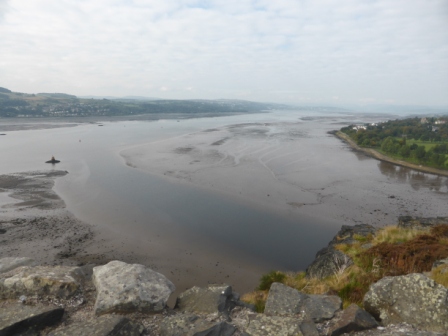
Dumbarton Rock stands on the estuary of the river Clyde beside the river Leven, stern, stony, commanding, cloven into two peaks, White Tower Crag and The Beak. Its proximity to an ancient hill fort on Carman Hill and Roman Forts such as Whitemoss guarding the estuary suggest its use as a defensive position from at least the Iron Age and Romano-British periods. Looking up at its vertical cliff face from beneath and climbing its 557 steps provided a distinct impression of how difficult it would have been to attack.

Dunbreatann emerged as the capital of Strathclyde, controlling south-west Scotland after the Romans withdrew from the Antonine Wall, in the 4th century. Later it was known as Alt Clut ‘Clyde Rock’. The first written reference comes from St Patrick from Ireland between 453 and 493AD, reprimanding Coroticus (Ceretic, ruler of Alt Clut) for taking his new Christian converts and selling them as slaves to the Picts.

The majority of its rulers were descendants of Ceretic: notably Dyfnawl Hen, Cinuit, Clinoch, Tutagual then Rhydderch Hael. After Rhydderch’s death in 612, rulership passed to another line stemming from Ceretic: Neithon son of Guipno and his lineage ruled until Dumbarton Rock was taken by the Vikings in 869.

A fragment in The Black Book of Chirk states that following the death of Maelgwn Gwynedd in 547, Elidyr Mwynfawr (first cousin of Tutagual and husband of Eurgain, Maelgwyn’s oldest legitimate daughter) attempted to seize the throne from Maelgwn’s illegitimate son, Rhun. Elidyr was killed at Arfon. This led to Rhydderch Hael, Clydno Eiddin, Nudd Hael and Mordaf Hael burning Arfon in revenge and being pursued north by Rhun’s forces to the river Gweryd.

Elidyr’s journey is recorded in a triad of ‘Horse-Burdens’ where the eponymous water-horse Du y Moroedd (‘The Black One of the Seas’) is said to have carried Elidyr and his party (seven and a half people including a cook hanging onto the crupper- hence the half!) from an unknown Benllech in the north to Benllech on Anglesey. Du is notably the steed ridden by Gwyn ap Nudd in the hunt for Twrch Trwyth (‘King of Boars’).

Rhydderch Hael (‘the Generous’) is the most famous of Strathclyde’s rulers. He was renowned as one of ‘Three Generous Men of Britain’ and owned a sword called Dyrnwyn ‘White Hilt’ which burst into flames when held by a well-born man and was numbered amongst the Thirteen Treasures of Britain.

The extent of Rhydderch’s generosity is hinted at by the third ‘Unrestrained Ravaging’ where Aeddan Fradog (‘the Wily’) came to his court and left no food, drink nor living beast (if Rhydderch was exceedingly generous and Aeddan took everything he must have been greedy and unrestrained indeed: one can sense the shock and disbelief of a contemporaneous audience).

Rhydderch championed Christianity and was the patron of St Kentigern. He came to power in 573, which coincides with the Battle of Arfderydd. Poems attributed to Myrddin Wyllt in The Black Book of Carmarthen suggest Rhydderch played a leading role in the defeat of the pagan ruler, Gwenddolau at Arfderydd and this was a factor in his rise to power.

In The Black Book of Carmarthen Gwyn ap Nudd states his presence at Gwenddolau’s death. Gwyn’s appearance to gather the soul of Gwenddolau and other dead warriors played a role in Myrddin’s madness and flight to Celyddon. The ex-warrior become wild man and prophet was hounded by Rhydderch Hael and supposedly converted to Christianity by St Kentigern.

Rhydderch also played a prominent part fighting against Theodric of Anglo-Saxon Bernicia with his Brythonic allies Urien Rheged, Gwallog ap Llenog and Morcant Bulc. During the campaign, whilst the Anglo-Saxons were successfully blockaded on Lindisfarne, Morcant assassinated Urien; a move which eventually led to the fall of the Old North.

Rhydderch’s successor, Nwython (Neithon) and his family feature prominently in the episode of Gwyn, Gwythyr and Creiddylad in How Culhwch won Olwen. After Gwyn ‘abducts’ Creiddylad from Gwythyr and takes her to Annwn, Nwython, his sons Cyledyr and Pen, Dyfnarth (Dynfawl?) and his Dyfnarth’s father Gwrgst Ledlwm join Gwythyr in an assault on Gwyn to win her back (four generations of Strathcylde Britons!).

Gwyn defeats Gwythyr and his army and imprisons them. During their imprisonment, Gwyn kills Nwython and feeds his heart to Cyledyr, who becomes wyllt (‘wild’ ‘mad’). Arthur then rescues Gwythyr and his men and places a command on Gwyn and Gwythyr to battle for Creiddylad every May Day until Judgement Day.

It is my intuition this story originates from an earlier seasonal myth where a hero (‘the Summer King’) challenged the god of Annwn (‘the Winter King’) for the love of a goddess of fertility and sovereignty who may originally have been revered as a free agent in a sacred marriage.

This episode is only one variant, fixed in 6th C Strathclyde, known because of its incorporation within the narrative of How Culhwch won Olwen (14th C). It is clear Gwyn has lost his status as a god of Annwn and Creiddylad her independence as a fertility goddess. Its fixity may be read to mark the death of a seasonal rite and its transition into story.

No doubt this coincided with the rise of Christianity, which led to Gwyn’s demonisation as the representative and literal embodiment of the ‘demons’ of Annwn and Creiddylad’s demotion to a helpless maiden flung like a ragdoll between two male lovers and finally locked away, powerless, in her father’s house.

The seasonal myth is thus replaced in the 6th century with a story designed for the political purpose of cementing alliances between the Strathclyde Britons, Gwythyr ap Greidol (deified as ‘the Summer King’) and Arthur against a common enemy: the demonised King of Winter and Annwn, Gwyn ap Nudd.

The disturbing sequence of Gwyn’s murder of Nwython and torture of Cyledyr has led me to question whether it has any historical basis. From my research so far there is nothing to suggest Nwython died a sudden or inexplicable death or disappeared during a campaign (often attributed to otherworldly forces).

However this does not mean such stories did not exist. Another explanation is that it was cited by the bards of Christian rulers to highlight the atrocities Gwyn committed against the lineage of Strathclyde to keep paganism at bay. One can only imagine the fear and repulsion of Strathclyde’s people and in particular Nwython’s descendants when it was voiced.

P1110994

It seems possible early variants of these stories were told in the fortress on The Beak alongside inaugural poems which would form Y Gododdin and The Black Book of Carmarthen. The existing texts suggest belief in Gwyn as a psychopomp lingered on beside the Christian faith for a long while. As a guide and warrior-protector to some and a cruel, demonic figure to others, he haunted the margins of every recital of battle-tales.

After Dumbarton Rock was taken by the Vikings, the kingdom of Strathclyde re-emerged up-river at Govan and stretched from Glasgow into Penrith in Cumbria. During this transition and, later, when Strathclyde was finally integrated into Scotland in 1034 many Britons went into exile and settled in Wales. In medieval Wales the oral tales about Gwyn ap Nudd and the fall of the Old North were finally penned.

Since then Dumbarton Rock has seen various uses; most notably as a medieval royal castle with its famous Wallace Tower. It is now primarily a tourist attraction within the custodianship of Historic Scotland.

Time passes. History fades into story into myth and even myth is forgotten. Yet the deepest myths are fated to return from the most distant edges of the otherworld like a boomerang.

P1110997

Looking out across the Clyde and Leven from the Fortress of the Britons I saw a pair of ravens who have lived forever on that ancient rock flying on the winds from there into poetry to the realm of the gods and back again.

P1120006

On that note I’ll thank Red Raven for taking me to Dumbarton Rock and bring this piece to end.

Gwyn ap Nudd and the Gwyllon: ‘Wyllt-ness’ and the Healing Power of Art

Barrow Mound, Fulwood

The wight whose footsteps I heard
imprinted on my cold soul,
the cold marrow of my bones.
He walked in soul as his bones laid still
and my soul reached out to him:
another one of the gwyllon.

The glimmer of fairy lights.
This place secluded and so still.

Fulwood Barrow MoundSometimes you stumble somewhere and forget yourself. No longer breathing. In the time of the gods. You hear the footsteps of a deity. Not your deity. But one connected with him.

***

In the mythology of ancient Britain, Gwyn ap Nudd (a ruler of Annwn and guide of the dead) is intimately connected with ‘gwyllon’: madmen, wildmen, wraiths, who through some traumatic experience have become ‘outside themselves’, open to the otherworld, ‘wyllt’.

The most famous is Myrddin Wyllt. Myrddin is a golden-torqued warrior of the court of the northern British ruler, Gwenddolau, who becomes wyllt after the Battle of Arfderydd; a conflict between Brythonic kinsmen renowned for its carnage and futility.

Looking across the battlefield, stricken with guilt because his sister Gwendydd’s sons are amongst the dead, Myrddin sees an unendurable brightness and martial battalion in the sky. It seems possible this is Gwyn (‘white’ ‘blessed’ holy’ from Vindos or Vindonnus ‘white’ ‘clear light, white’) and his host: the spirits of Annwn and the war-dead, approaching to gather their kindred to the otherworld.

‘Torn out of himself’ by one of these spirits, Myrddin flees to Celyddon (the Caledonian forest). He wanders there ‘ten and twenty years’ with ‘madness and madmen’ ‘gan willeith a gwyllon’. These gwyllon are ‘seven score men’ who also fought at Arfderydd then lapsed into madness in Celyddon and perished.

Similar cases are found in The Triads of the Island of Britain: ‘Tri Gwyd Ellyll Ynys Brydein’ ‘Three Wild Spectres of the Island of Britian’. The notes state ‘ydellyll’ (for ‘gwyd ellyll?’) ‘occurs in the Gododdin in reference to furious activity in battle’ and could relate to tales of men who become wyllt as a consequence of war.

What makes Myrddin’s story unique is his recovery. Amongst wild creatures of the forest; a piglet, a wolf and a favourite apple tree he undergoes a healing process through which he learns the art of poetry and uses it to prophecy against future bloodshed.

***

Cyledyr Wyllt possesses an entirely different story. In Culhwch and Olwen, after Gwyn abducts Creiddylad, his rival Gwythyr ap Greidol raises an army of northern men to win her back. Amongst them are Cyledyr and his brother, Pen, his father Nwython and his great grand-father’s brother, Gwrgst Ledlwm. If Gwrgst is still living this means Cyledyr must be in his teens.

Gwythyr and his army attack Gwyn. My intuition is this attack represents a raid on Annwn. Gwyn triumphs over Gwythyr and the northern men and takes them prisoner. During their captivity he kills Nwython and feeds his heart to Cyledyr, who goes mad. The etymological links between Cyledyr and Celyddon suggest that, like Myrddin, he flees to the forest.

Gwyn’s motive for torturing Cyledyr is never explained. Did he do it from fury? For vengeance? Did he have some darker purpose in feeding a young man his father’s heart? Could this have originated from some arcane rite of the past whereby the strength of one’s ancestors was conferred by eating their flesh, of which Gwyn makes a mockery?

Another question worth asking is ‘Did it happen at all?’ The historical Nwython is recorded to have died in his bed.

It seems possible Cyledyr’s fevered recollections result from the effects of unbidden entry to Annwn, the battle between Gwyn and Gwythyr’s forces and time spent in prison on an impressionable young mind. Whilst Cyledyr is telling this story Nwython could be anguishing over the unknown fate of his son. Whether Cyledyr recovered from his trauma or died in Celyddon remains uncertain.

***

Another story I believe features Gwyn (as the King of Fairy) and a human ruler who becomes wyllt is Sir Orfeo. This begins when the Fairy King abducts Heurodis, Orfeo’s wife. Driven wyllt by grief, Orfeo abandons his sovereignty and departs ‘like a beggar’ for the wilderness where his only solace is playing his harp, which brings joy to the wild creatures.

After ten long years Orfeo finally finds a way into Fairyland. After travelling sunlit green plains and hunting grounds he comes to the Fairy King’s glass palace. Therein he makes a terrible discovery: ‘Folk long thought dead… as living found’ headless, armless, torn, ‘with dreadful wounds’, ‘full-armed on horses’, strangled, drowned, burned, wives laid in child-bed ‘stolen out of life’: those ‘the fairies seize and keep’. Heurodis lies amongst them.

These images represent a little-known truth, rarely made explicit in Brythonic mythology: the beauty of Fairyland is founded on the horror of death. The knights and damsels of the Fairy King’s hunt who feast in his hall number the war-dead, murder-victims, women who have died in labour.

Heurodis is amongst them because when the Fairy King took her whilst she slept beneath an orchard tree she died or became comatose or catatonic. Such superstitions can be traced through Brythonic fairylore to earlier beliefs about Gwyn and the spirits of Annwn conveying souls to the otherworld.

This knowledge does not prevent Orfeo from entering the Fairy King’s hall and playing his wondrous music. The King is so moved he offers Orfeo anything he wants. Of course, Orfeo asks for Heurodis. He brings her back to this-world where the pair are re-united in sovereignty.

This story shows how Orfeo gains his ability as a musician from his period wandering wyllt and that hard-won art has the power to move the gods, to sing the souls of those held captive in Fairyland back to this earthly home.

***

These myths represent the experience of becoming wyllt at the outermost limits of human experience. The ‘wyllt-ness’ of Myrddin and Cyledyr results from battle trauma. Cyledyr’s battle trauma is exacerbated by his unwarranted entry into Annwn, imprisonment in the ‘not-world’ and real or imagined torture by Gwyn.

Orfeo’s story differs slightly. His wyllt-ness results from loss. His time spent wandering the wilderness provides him with the strength to survives his gnosis of the terrible truth at the heart of Fairyland and Heurodis’ fate to win her back and return to his seat of rule.

Key to the survival of becoming wyllt is the power of art. For Myrddin and Orfeo giving voice to their trauma and to the powers of nature who surround and console them is an essential part of the healing process. It is possibly because he does not discover art that Cyledyr remains wyllt. This may also be the case for the other gwyllon who lapsed into madness and perished.

These stories contain lasting significance for modernity where art and nature therapy are recognised as powerful means of helping victims of war and loss.

***

Later folktales represent a variety of different encounters with and responses to Fairyland. In most we find the recurrent themes of wyllt-ness and art. People who meet fairies, stumble into or are taken to Fairy invariably become ‘dead, mad or poets’. My personal experiences with Gwyn and his realm bear stronger resemblances to these tales.

Glastonbury TorIn the year 2000 at Glastonbury Festival (long before I knew the name of the mysterious god of the Tor) I had a vision of what I recognise now to be Fairyland which left me shocked, stunned and profoundly questioning the nature of reality.

My quest for an explanation led me through a dangerous combination of drink, drugs, all-night dancing and all the texts of the Western European philosophical tradition, deeper into madness, to the brink of an abyss where I was faced with the choice of life or death.

Unable to choose either I was confronted by three beings I now recognise as ellyllon (‘fairies’ akin to gwyllon). What followed was equally beautiful and perturbing and put an end to the pain of having to make that choice. My experiences left me half-wyllt, wandering between life and death, plagued by anxiety and panic attacks and put a temporary end to my vision-quest.

After giving up my philosophy PhD, I spent four years working with horses. During this period of re-connecting with the land, the seasons and the animal world, working hard and thinking little, I underwent a return to nature that bears a little analogy to the flight of the wyllt to Celyddon.

When I met Gwyn and put a face to the god who governed the magical landscape I haphazardly intruded on at Glastonbury Festival twelve years ago, my initial terror was edged by relief. I finally knew the source of the calling to the otherworld that had haunted me for as long as I can remember. Gwyn became my patron and I his awenydd: ‘person inspired’ or ‘poet’.

***

In the contemporary world where poetry, let alone pagan poetry, is rarely acknowledged or valued the path of the awenydd is not an easy vocation. Deep gnosis of nature and Annwn and its deities necessarily places one outside the bounds of ordinary experience; makes one wyllt, other. With Celyddon gone there is no wild and wooded place of retreat outside the norms of society where gwyllon can flee and gather in company.

Yet in the shaded spaces of our localities where trees still stand and that great forest stood before it walked to Scotland centuries ago we can commune with the gwyllon of old and find unison with the gwyllon of today. Sharing can also take place in the green nooks and crannies of books, in the pubs and cafes and wooded stages where we perform and on the internet. In our stories we find camaraderie.

In a world becoming increasingly superficial where we are losing touch with the deep knowledge our ancestors held to help those touched by the wyllt-ness of Fairyland be it through trauma, loss, enchantment or some silly mistake, we have never had a greater need for the stories of Gwyn ap Nudd and the gwyllon. For the healing power of art.

Castle Hill from Fairy LaneSOURCES

Bromwich, Rachel (ed) The Triads of the Island of Britain (University of Wales Press, 2014)
Bromwich, Rachel and Evans, Simon D. (eds) Culhwch and Olwen (University of Wales, 1998)
Davies, Constance ‘Classical Threads in Orfeo’ The Modern Language Review, Vol 56, No 2, (Modern Humanities Research Association, April 1961)
Davies, Sioned (transl.) The Mabinogion (Oxford University Press, 2007)
Evans, J. Gwengobryn The Black Book of Carmarthen (Lightning Source UK Lmtd, 1907)
Friedman, John Block ‘Eurydice, Heurodis and the Noon-Day Demon’ Speculum, Vol 41, Vol 1 (Medieval Academy of America, 1966)
Hunt, Edward Eyre Sir Orfeo (Forgotten Books, 2012)
Pennar, Meirion (transl.) The Black Book of Carmarthen (Llanerch Enterprises, 1989)
Skene, William F. The Four Ancient Books of Wales (Forgotten Books 2007)
Thomas, Neil ‘The Celtic Wild Man Tradition and Geoffrey of Monmouth’s Vita Merlini: Madness or Contemptus Mundi?’ in Arthuriana Vol. 10, No. 1 (Spring 2000)
Tolstoy, Nikolai The Quest for Merlin (Sceptre, 1985)

Coille Coire Chuilc: Seeking Annwn in Caledon

Coille Coire ChuilcThere once existed a tradition amongst the northern Britons of locating Annwn north of Hadrian’s wall. Its origins may be found in the writings of Tacitus about tribes beyond the northern frontier who spoke a different language to the Britons and were impossible to subdue. Ptolemy was the first person to refer to this area as Caledonia Silva.

The 6th C classical writer Procopius said: ‘Now in this island of Britain the men of ancient times built a long wall, cutting off a large part of it; and the climate and the soil and everything else is not alike on the two sides of it… on the north side… it is actually impossible for a man to survive there even half an hour, but countless snakes and serpents and every other kind of wild creature occupy their area as their own. And, strangest of all, the inhabitants say that if a man crosses this wall and goes to the other side, he dies straight away… They say, then, that the souls of men who die are always conveyed to this place.’

These writings show within the Romano-British culture of the Old North the Caledonian forest was considered to be a wild, hostile place associated with death.

Culhwch and Olwen (1350), a medieval Welsh text set during the Arthurian period preserves remnants of these superstitions. In the stories of Gwyn, Gwythyr and Creiddylad and the Very Black Witch, Arthur ‘goes north’ to inhospitable lands. Both stories feature Gwythyr ap Greidol, a northern ruler and warrior of Arthur’s court and Gwyn ap Nudd, a king of Annwn. The latter is an ancient British god associated with wild places and the dead. It is my intuition it was after a vision of Gwyn and his host at the Battle of Arfderydd that Myrddin Wyllt went mad and fled to Celyddon (Caledon) where he wandered thirty years amongst gwyllon (wild, ancestral spirits).

As the story of Gwyn, Gwythyr and Creiddylad is set at Calan Mai, a friend and I decided to head north to Coille Coire Chuilc (one of the southernmost remnants of the Caledonian forest) on the May bank holiday weekend.

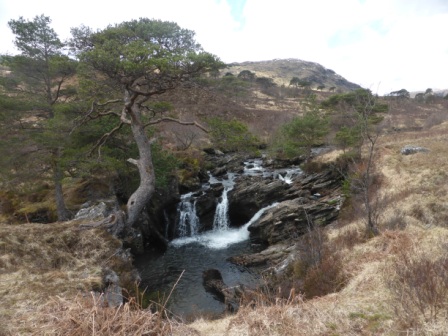
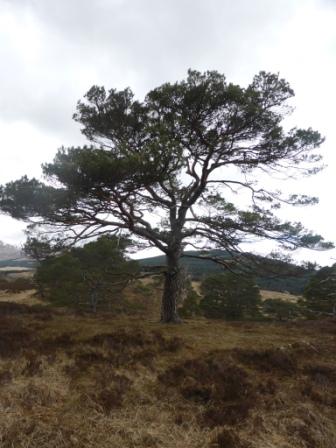
Coille Coire Chuilc is an ancient woodland of Scots pines lying between the river Cononish and Allt Gleann Auchreoch close to the village of Tyndrum in Strath Fillan. Tyndrum grew out of the lead mining industry. The mines were located in Beinn Chuirn. During the 18th C pack horses travelled 50 miles to Alloa with lead ingots then back with fuel for the smelter.

Cononish HillsDuring the 19th C gold was discovered in the hills of the Cononish glen, which led to a miniature gold rush. This ended in the 20th C but has recently restarted with the approval of a second planning application to Scotsgold Resources in 2011. Gold is once more being mined from the hills and may be panned from the river Cononish, although it is more likely one will find lead and pyrite: ‘fool’s gold’. As the area is renowned for its ‘fairy places’ it was interesting to hear the hills were hollowed with mines where one is more likely to find false gold than the real deal…

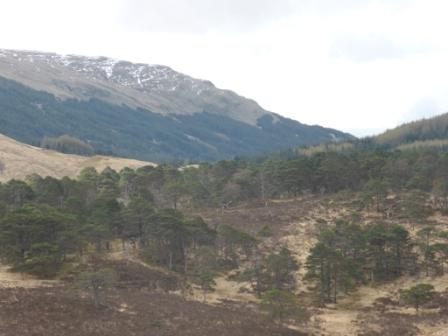
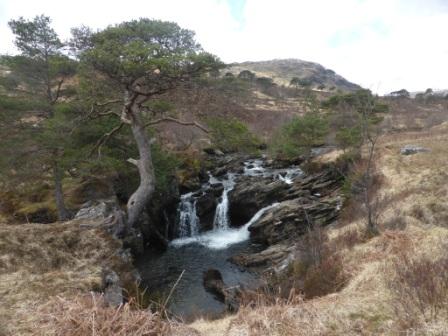
Our expedition to Coille Coire Chuilc did not go to plan. Firstly we took the ‘wrong’ path, ending up north of the river Cononish rather than within the woodland. However this had the advantages of providing a good view of the distant Scots pines and an excuse to walk back down the river, seeing some sensational falls, ravines and trees clinging drastically to rocks.

The next set back was that the bridge across the Allt Gleann Auchreoch pictured in The Ancient Pinewoods of Scotland: A Guide (2013) was plankless and uncrossable!

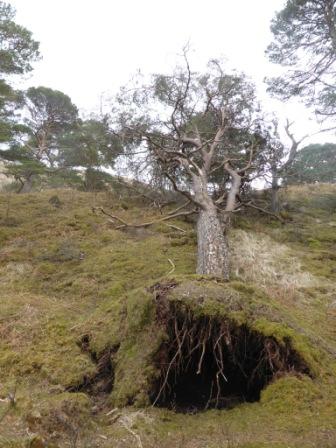
This led to a precarious injurious fording of the burn into a woodland of bent old round-crowned pines and deep sphagnum mosses that didn’t feel overly friendly to two foolish searching humans.

Blog 6. Coille Coire ChuilcDying trees stood with a stark grey dignity reminiscent of gwyllon; ancestral presences of their land. A land where we were not at home. Where all was strange and fey. And said leave.

On our return, after I slipped over again crossing a boggy patch, one of the more positive points was glimpsing a magnificent bird which I think may have been a golden eagle.

Blog 9. Golden EagleTyndrum itself, however, was hellish. No longer a mining village but conglomeration of shops and a tourist information centre. We arrived at the scene of an accident where a car had hit a motorbike and shortly afterward saw two near car crashes within the space of a minute. We saw the whole place was now based around the tourist industry and as tourists we were part of the problem.

I felt like I was a long way north of the wall far from home in a landscape that did not want me.

I left with the impression that whilst the story of Gwyn, Gwythyr and Creiddylad in Culhwch and Olwen contains universal themes (the battle between winter and summer kings for a maiden goddess on May Day) its variant from Strathclyde locating Annwn in the Caledonian forest very much belonged to its time and people.

The fairies of Coille Coire Chuilc had concerns of their own with mining and tourism and little care for a pair of wanderers from Lancashire seeking the ancient roots of a Brythonic tale that may never have been located in their woodland at all.

Whether Myrddin ever fled quite so far remains uncertain. Perhaps we went too far north. However I think sometimes you must stray too far to come back…

Forgotten Arfderydd and the Hearsay of Corvids

Last Saturday I set out north to the site of the Battle of Arfderydd. At the forefront of my mind was the matter of forgetting.

If Arfderydd was significant enough to be recognised as one of Three Futile Battles of Britain, if it was where Gwenddolau, the last pagan Brythonic king of the Old North, made his final stand and one hundred and sixty men lost their lives before he died and three hundred after and where Myrddin Wyllt went mad, why no marker of the site? Why no songs? Why has Arfderydd been forgotten?

Considering Gwyn ap Nudd stated his presence at Gwenddolau’s death and at the deaths of other northern warriors and the episode where he abducts Creiddylad, Gwythyr and his (mainly northern) supporters takes place in the Old North why has his memory faded from the minds of the people of northern Britain?

In search of clues, a friend and I travelled north to Longtown and set off on foot up Netherby Road, consciously following in the footsteps of William Skene and Nikolai Tolstoy. The first place we visited was Netherby Hall, the mansion of the Graham family built on the site of the Roman fort Castra Exploratum. An altar dedicated to a god called Vitris and ram-horned head carved from local red sandstone found nearby suggest it was the location of a Romano-British cult.

Netherby HallAs we approached from the south Netherby Hall’s sandstone walls came into view atop a prominent ridge with polygonal towers, parapets and scaffolding. An encircling wire fence said strictly out of bounds. Following the path round the mansion we passed a woodland carpeted with snowdrops and trees stacked with rooks’ nests filled with noisy, vocal, raucous birds

Never before had I seen many rooks or heard such a racket. Their croaking and cawing see-sawed in my mind like something trying to break through. Unfortunately I don’t speak very good rook. Yet the rooks seemed important. More important than the blank face of the mansion and its ‘Private’ sign.

We rejoined the main road and headed north for Carwinley. When Lailoken (Myrddin Wyllt) told St Kentigern of his guilt at the deaths of the combatants and vision of a host of warriors (who I believe to be Gwyn and the spirits of Annwn) he stated the battle took place ‘in the field between Liddel and Carnwanolow.’ Skene identified Liddel with Liddel Water and Carnwanolow as Caer Gwenddolau and connected this with Carwinley.

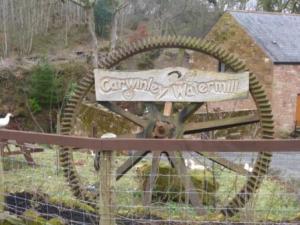
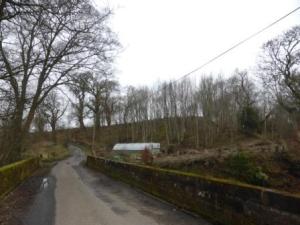
Passing Carwinley cottage, farm and water mill we looked down into the sandstone gulley of the burn, steep banks green with ferns, onto shining reddish water. I recalled Andrew Breeze’s interpretation of Arfderydd as ‘burning weapon’ relating to this bloody stream forming the parish of Arthuret’s boundary. Breeze said ‘Car’ need not mark a fort but a defensive stockade. It certainly seemed possible the burn was named after Gwenddolau’s fall.

Carwinley BurnThe Triads of Ancient Britain also mention ‘the retinue of Dreon the Brave at the Dyke of Arfderydd.’ Dreon ap Nudd is the son of Nudd Hael. If this etymological link to Gwyn ap Nudd (and his father Nudd or Nodens) suggests an ancient connection between a northern family and their ancestral deities it is no surprise Gwyn and his host appeared at the battle where Dreon and his retinue met their end.

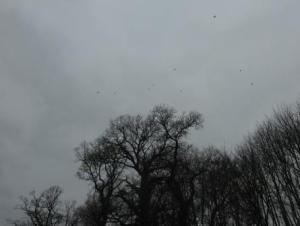
As I pondered whether the ‘Dyke’ they fought on was above Carwinley Burn I saw crows over the trees who shouted and cawed then pitched their games across a sky of constant silver-grey cloud. A sky of concealing. A sky of protection. A sky of no openings onto crashing visions of warriors.

Fields of Arfderydd


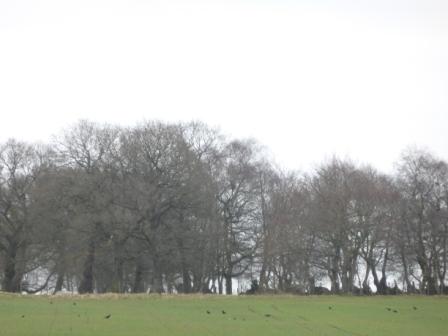
As we passed the green and well-tilled-over crow-haunted fields the dead did not rise. There were no whispers, no warnings, only the hearsay of corvids.


Upper Moat


At Upper Moat where reputedly the three hundred men who fought after Gwenddolau’s death were buried there was no sign of the orchard Skene mentioned but crows filled the trees in the background.

Our final destination was Liddel Strength, a motte and bailey which might have been the location of Gwenddolau’s fort and where his ‘Faithful War Band’ could have made their last stand, fighting for a month and a fortnight after the death of their leader. Unable to find our way we were directed by a local farmer (coincidentally Skene was directed by a farmer from Upper Moat too!) onto a shooter’s path which climbed steeply beside Liddel Water.

On the way we encountered a line of not-dead reeds hauntingly reminiscent of flags or ribboned spears blowing in the wind on an abandoned battlefield. Or of forlorn warriors.

Reeds of ArfderyddThe site of Liddel Strength was badly eroded by the river and appallingly overgrown. Breaching the defensive ditch we scrambled through hat-snatching hawthorns and ankle-snagging brambles up the motte which didn’t feel overly welcoming in its firm return to nature. There were no crows but a bird of prey screeched somewhere out of sight reminding me of Gwenddolau’s birds who fed on the corpses of the Britons.

Looking down from the summit Liddel Water flowed far below at the foot of a slope impossible to ascend. Fields and woodland stretched out before us. The land seemed as determined in swallowing time as it was in absorbing the abandoned railway track Skene arrived on two hundred years ago. On our return journey only the bridge and fragments of the embankment remained.

The dereliction of Liddel Strength contrasted sharply with Caer Laverock Castle (the ‘Lark’s Nest’ Arfderydd was supposedly fought over) which we visited the next day. This splendid medieval stronghold belonging to the Maxwell family was well preserved by the National Trust. Its siege by the English immortalised in the ‘Song of Caerlaverock’ was reconstructed on a video in the display rooms.

Caer Laverock CastleCrows flocked in the trees and played over its terraces. South was an earlier fort closer to the Solway Firth, an artist’s representation showed the higher sea levels and its importance as a strategic location.

Heading north again we climbed Ward Law, a lookout point where the Maxwell Clan gathered shouting their battle cry: “Wardlaw! I bid ye bide Wardlaw!” Beyond was another Roman camp invisible from the ground.

Ward LawLooking south from Ward Law to Solway Firth for the first time the all-encompassing silver-grey clouds broke. Seeing clear light and waters ablaze with cold fire I was reminded of the unendurable brightness Myrddin saw as Gwyn approached with the hosts of Annwn. The otherworld opening only just beyond the sands and tides of this-world.

Solway FirthI left with intuitions but no answers about Gwyn and his kindred, battles, forgetting, clouds and corvids… another part of this story waits to be told about the estuary of the river Nith and I shall be sharing this in my next post…

SOURCES

Breeze, Andrew “The Name and Battle of Arfderydd, near Carlisle,” Journal of Literary Onomastics: Volume 2: Issue 1, Article 1. (2012)
Clarkson, Tim The Men of the North: The Britons of Southern Scotland (John Donald, 2010)
Heron (transl) ‘Gwyn ap Nudd and Gwyddno Garanhir’ https://barddos.wordpress.com/2015/02/08/gwyn-ap-nudd-and-gwyddno-garanhir/
Pennar, Meirion (transl.) The Black Book of Carmarthen (Llanerch Enterprises, 1989)
Ross, Anne Pagan Celtic Britain (Cardinal, 1974)
Skene, William F. The Four Ancient Books of Wales (Forgotten Books 2007)
Tolstoy, Nikolai The Quest for Merlin (Sceptre, 1985)