Review – Bardskull by Martin Shaw

What’s in a bard’s skull? A topography of lands and dreams and stories and mythic figures from Martin Shaw’s local Devonian story-hunting ground and across Britain to as far away as Crete, Africa, Scandinavia, Siberia. Courted, incanted, summoned, they come to inspire, converse with and possess the bard.

The book takes the form of three ritual journeys in the Devonian landscape wherein Shaw offers up physical gifts and storytelling to court the land into opening, conversing, to spilling forth the visions he and the world need to hear.

It differs from his previous publications in its recording of raw thoughts and experiences rather than more refined reflections on mythic material. Sometimes this leads to brilliance and at others borders on self indulgent rant. There are a few pokes at ‘pagans’ and ‘eco-hippies’ some might find offensive.

The first journey leads along the river Durius and tales include ‘Vita Merlini’ and ‘Rhiannon of the Horses.’ Merlin comes swimming up his local watercourses ‘good rivers all’ but full of ‘effluent’ he ‘drank sloughed off the fields’ and puked up ‘outside Taunton services’ protesting about being reduced to an ‘archetype’. Shaw agrees he is clearly ‘not fucking Gandalf.’ 

At the end is a particularly striking scene during which Shaw is called to crawl into the ‘pitch-black belly’ of a ‘butchered horse’ by Childe the Hunter (a character from Dartmoor’s legends who got lost hunting through the snow and slew his horse and climbed inside it to keep warm but no avail). 

This drives Shaw into his next journey – a one hundred and one night vigil in a ‘nest’ ‘in a thirty foot circle, perimeter articulated by flour and whisky’ in a Dartmoor grove with a ‘little hazel bush’ in the middle where he sits and calls.

What he seeks are stories not for a ‘horse time’ but for a ‘wolf time’. This leads to his possession by old man Vainamoinen, a dialogue with his great-great uncle Hamer Broadbent, a Christian missionary in Russia, and his ‘big dream’, his ‘great, lumbering fuck of a dream’ of Wolferland – Doggerland in the shape of a wolf (some of this is recorded in his previous book of that name). 

This section ends with an Old Testament style vision and nine words that will ever be imprinted on his mind that lead to his conversion to Christianity. 

Throughout Shaw is haunted by a rider on a ridge but he does his best not to look. ‘I don’t have time for this… Horseman pass by.’ He appears again talking backwards and is warded off – Shaw isn’t one for courting dark things.

The final journey leads up to Big Rock and singings of the songlines of Devon and Shaw’s final taking of every story he has ever told for a walk and offering them up with myrhh, henna blossoms, a vineyard, his ‘plait, a foot of hair cut away’ as a grand finale resulting in a final vision. And what does he see? 

*SPOILER ALERT* ‘A great gathering of humans and animals… all the originals of this place… And suddenly, there he is. The rider. My teacher. The one who has stalked me this whole time. And finally he speaks. And finally I understand. What was dark sound has become new wine.’ 

This passage gave me goose bumps. It reminded me shiveringly of my first meeting with my patron God, Gwyn ap Nudd, an otherworldly huntsman. Shaw never reveals who this rider, his teacher is, but he is led not to devotion to a pre-Christian deity but to ‘crawling into God’.* *SPOILER END*

This book is highly recommended to all who are not only lovers of myths and stories but wish to enter into them and be initiated by the figures within on a deeper level. It speaks of the trials and tribulations and triumphs of courting old tales, of holding vigils, of honouring the land, of awakening its songlines.

To me it forms the grand finale of a series of books charting Shaw’s life and work as an animistic mythteller before his conversion to Orthodox Christianity.

*Shaw’s conversion to Orthodox Christianity, like his friend, Paul Kingsnorth’s, came as a big shock to me. Whilst I totally understand their being claimed by Jesus their choosing to convert to a black and white religion with binary theology that has oppressed countless peoples and their traditions and stories and deities is beyond my comprehension.

The Edge of the Dark

‘as ‘th’ edge o’ dark’ threw its weird glamour over the scene, boggarts and phantoms would begin to creep about to the music of the unearthly voices heard in every sough and sigh of the wandering wind…’
– James Bowker, Goblin Tales of Lancashire

This landscape has only just been claimed and in its deepest knowing holds the memory of the edge of the dark. The majority of Lancashire’s towns and fields developed where thick shaggy mosses, carr and marsh held rule. Its people lived on the edge of darkness, the edge of unknowable waters, the edge of the otherworld.

Is this existence on the edge the source of its legends? Its fairy lanes and dells, boggart bridges, cloughs and holes, its headless phantoms and saucer-eyed spectral hounds?

How far do these stories stretch back in the minds of its people? Are they the creation of an industrial age that sought to banish darkness and uncertainty with city walls yet built a new hell in its abominable mills: its Dickensian fairy palaces as the wilderness outside grew wilder?

Are they based on the wildening of tales always strange yet homely: of the household boggart whose help might be bought with butter or milk but whose wrath could estrange a family; of fay whose magic could curse or cure; of water spirits who gave of themselves and their secrets but only at great sacrifice?

Could these stories signal an endemic relationship with the otherworld stretching back through centuries? Through Anglo-Saxon boggarts and barguests to the arcane myths of Britain to the repository of stories about ‘Yr Hen Ogledd’ ‘The Old North’ in Welsh mythology and beyond to a near forgotten oral tradition? All hinge upon the cusp of thisworld and the otherworld: the edge of the dark.

In Welsh mythology the otherworld is known as Annwn: the not-world, the deep. It is the beyond of adventure, the locus of alterity. Its landscapes are unstill, its deities and monsters have many faces. It is a source of beauty and terror, of awe, of Awen, the divine inspiration quested by the bards and awenyddion who crossed the edge of the dark to explore its depths.

The ways between the worlds are fraught with danger. Safe passage is only granted at a cost. Those who return from the otherworld are never the same. Thus they shroud themselves in the cowl of the edge of the dark.

Those who live on the edge see our precarious reign over the land and its myths is illusory. Tower blocks and elaborate street lamps are ephemeral as Dickens’ fairy palaces. Electric lighting is no defence against the edge of the dark, which seeps in because its memories are deeper than us, its darkness more permeating than headlights.

These memories evoke intense loss and mourning. Yearning for the fluting wetland birds, bog oaks, reeds, rushes, and hoofed and pawed animals of the wild quagmire we banished. For the fairies and boggarts we dare not believe in. For the gods of the otherworld who haunt the edge of the dark with pawing steeds and sniffing dogs whilst we seal ourselves in a not-world that is not Annwn choosing to occupy tiny lamp lit portions of thisworld beyond the bog’s rushy melodies.

Immersed in false light we neither perceive the people of thisworld nor Annwn until the rain pours down, the marshland rises up, and the weird glamour of the edge of the dark undoes all security as the deepest memories of our land and its legendary reality return.

Greencroft Valley

Choosing a Path

Fairy LaneThe metaphor of choosing a path appears frequently within Paganism but can be applied to the journey of life, which in many religious traditions is seen as the journey of the soul.

I’ve walked many paths; riding instructor and groom, philosophy student, fantasy writer. Over the past three years I have been writing and performing poetry and exploring Druidry. The binding core is that in each I’ve been seeking magic and I’ve pursued all these paths with religious commitment.

Looking back, it appears I have walked one path with many names. This week I have come to question the suitability of the name ‘Druid.’

I have never felt any commonality with, or desire to join any of the systematic orders of Druidry where one can complete courses and achieve grades in exchange for coins. It’s my firm belief that the living landscape, the gods and ancestors are the greatest teachers. Their guidance, trust and respect are not bought but earned, and thus utterly priceless.

However, one place I have felt at home is The Druid Network. Hearing a talk by its chair, Phil Ryder formed a huge turning point in my life that led me to recognise and honour the divine in my local landscape. The Druid Network is the only organisation I know of that promotes Druidry as a religion. There are no set courses or hierarchies. Each member is encouraged to find and explore their relationship with whatever they hold sacred in their own way, and the social forum provides a safe area for discussing issues and experiences. However, there are guiding principles (1).

I’m in agreement with most of these principles, except that the native religion of the British Isles must nominally be called Druidry. I imagine Heathens, Witches, Shamans and many other Pagan groups would make similar claims.

This winter’s solstice I was gifted a name for my path- Awenydd. For Kristoffer Hughes becoming Awenydd forms the core of Druidry. For Elen Sentier it is a form of native British Shamanism. My path currently seems to sit somewhere in an unknown hinterland between two names I am equally uncomfortable with, ‘Druid’ and ‘Shaman.’

For me ‘Awenydd’ works a similar magic to that which others describe in relation to ‘Druid’ and ‘Shaman’. It opens the doors of perception and initiates connection with the Awen, divine inspiration. It is as Awenydd I truly serve my land, gods and communities.

I can see a future for myself as Awenydd; continuing to learn the stories and songs of my local landscape and its spirits; journeying more deeply the immensities of the otherworlds with Gwyn and learning his mysteries; bringing my insights back to my communities and thus learning to weave a magic between the worlds.

Contrastingly, I perceive ‘Druid’ as closing doors, leading to pointless arguments, in-fighting, and attempting to define myself against systems and practices with which I share little commonality.

If the journey of life is the journey of the soul, I want to choose a path that fills my soul with awe and wonder. I want to live a life true to my heart, in devotion to the land and gods who call to me. I want to sing their songs. I want to share their inspiration. I want to die knowing I have done everything I can to respond to their call.

I don’t want to remain a prisoner in the maze of arguments and contradictions which, for me, constitutes contemporary Druidry, and which will only lead me into greater negativity.

It is on this basis I give up the name of Druid and choose Awenydd.

And the consequences?

The biggest consequence is that the path of Awenydd is not classed as a religion. If I am no longer a Druid I no longer belong to a religion.

To anyone on the outside this might look like a massive change. However on the inside this does not change my relationship with my land and deities, nor with family and friends.

It has, and I think will continue to have some impact on my Pagan, Druid and other religious communities. I’ve already talked my decision through with some of the members of TDN who, for the most part, are happy for me to remain a part of the organisation on the basis of shared principles, and I’m hoping to discuss it with my grove at the solstice.

My local Pagan Society is inclusive of open-minded people of any faith or none, so no problems there. As for Preston Faith Forum and the further questions, if I’m not a Druid, then am I Pagan? And can I be an Interfaith Representative if I don’t belong to a faith? That’s another kettle of fish entirely and not one I’m ready to address right now!

I want to live a life that fills my soul with awe and wonder

I choose a path that fills my soul with awe and wonder, in devotion to the magic this land, its deities and spirits, my patron Gwyn ap Nudd and the ancestors. This path is Awenydd. Let their songs be sung!

(1) http://druidnetwork.org/files/about/constitutionrevnov2009.pdf

Penwortham Fairy Funeral

Penwortham Fairy Funeral is a legend based around Castle Hill, a site of religious and formerly military importance in my home town. The first part of this article presents the original version and its later developments in the context of their placement in the landscape. The second will discuss its origin and meaning within the context of British foklore.

The Fairy Funeral receives its first known mention in James Bowker’s Goblin Tales of Lancashire (1878). A cow-doctor and younger man called Robin are walking home by moonlight from a farmhouse at the foot of Castle Hill to Longton. They climb the hill and pass through St Mary’s graveyard. As they make their exit the clock tolls midnight. They walk down a track to the Lodge, where they hear a passing bell. The gate of the Lodge swings open and a little figure wearing dark clothing and a red cap steps into the avenue chanting. He is followed by a cavalcade of similar figures carrying a coffin and singing a requiem.

The coffin is open. Robin looks inside and sees his miniature corpse, dewy and pale. The procession continues into the graveyard followed by the men. Driven by dread, Robin reaches out and touches the leading fairy. The cavalcade vanishes and a storm sweeps in. Driven mad by the scene, a month later Robin falls to his death from a haystack and is buried in the graveyard where he had seen the funeral of his double take place (1).

Fairy Funeral 1

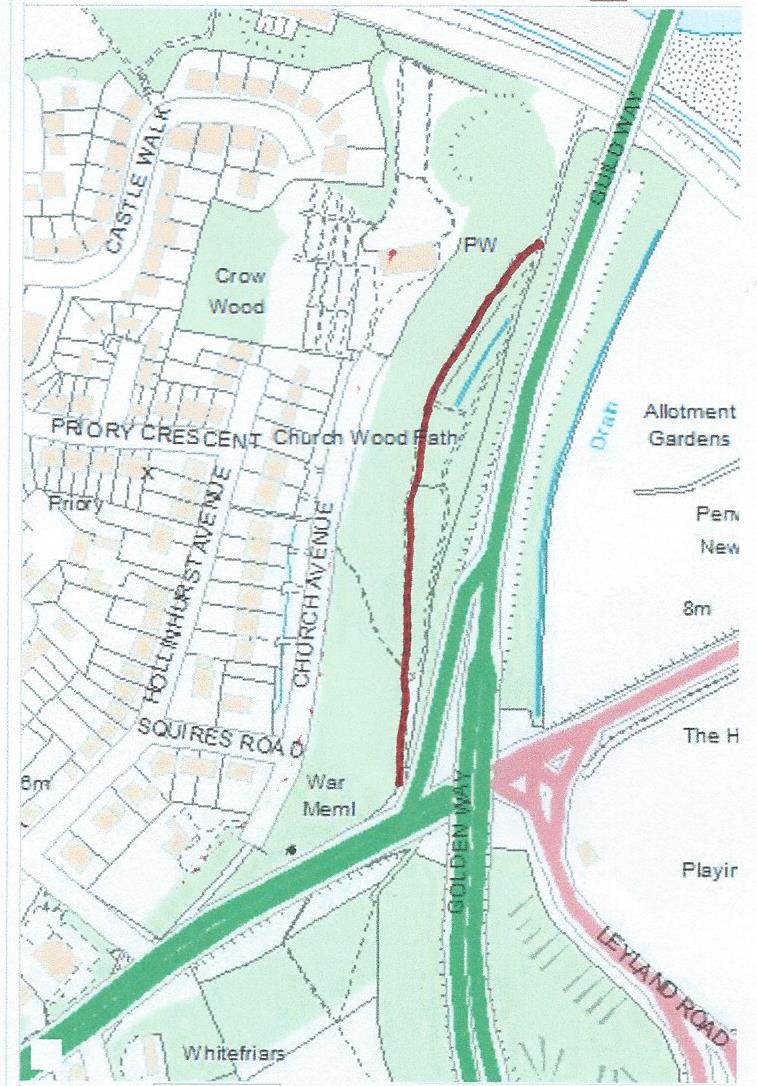
1850’s map, from Mario Maps, route marked in red

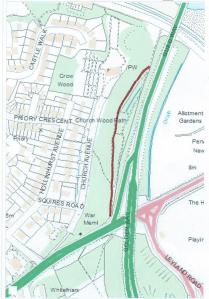
A later version appears to have been passed down by word of mouth. Eli Robinson and Giley Leatherbarrow are walking home from the Black Horse pub in Preston. Having consumed too many Thwaites bitters they decide to take a short cut through Penwortham Wood, which lies on the east slope of Castle Hill. Following the mud track, which is known in the locality as Fairy Lane, they catch sight of the procession. Eli sees the face in the coffin is his own. When he gets home, Eli’s missus refuses to believe he saw a fairy funeral, thinking instead that Thwaites’s ale will be death of him. A month later he is dead. In this version it is uncertain whether he falls from a haystack or takes his own life (2).
Fairy Funeral 2

Current map, from Mario Maps, route marked in red

Whilst the characters, background and location change, the core myth- a young man sees the double of his corpse borne by a fairy funeral procession and dies within a month- remains the same.

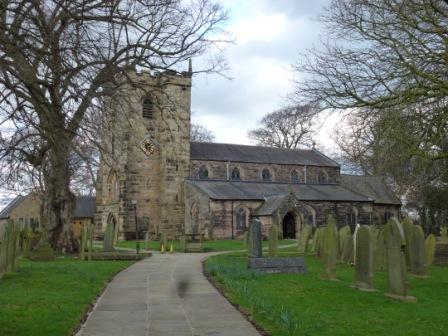
St Mary's Church, PenworthamThe legend can be seen as rooted in the funeral traditions of the township. The earliest known burial at St Mary’s Church is a 12th century crusader. Although there are no more gravestones until 1682, recent excavations uncovered a Rawstorne family crypt and large number of unnamed bodies whose graves had been built over during an extension of the church. Local historian David Hunt believes everybody who lived in Penwortham would have been buried at St Mary’s and suspects many of the uncovered bodies were victims of the 1631 plague (3). The graveyard was expanded greatly during the 18th century and as plaques for cremations exist well into the 21st century, I assume it is still in use.
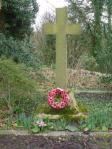
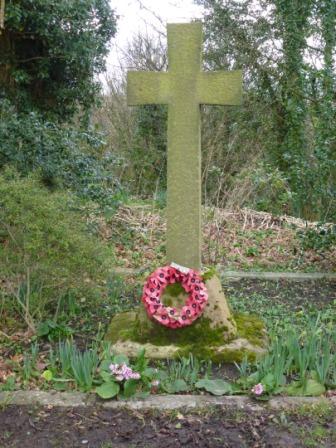
Stone Cross, Church AvenueThe name Church Avenue is suggestive of a processional route. Half way along is a stone cross, replacing a more ancient pedestal (on the map below), which may have been a marker. South of Church Avenue is the site of St Mary’s Well, which was attributed healing powers but dried up at the end of the 19th century before being built over by the A59. Leading to the well from Middleforth was a pilgrim’s path which may also have been part of the route.
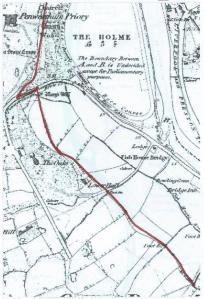
Processional Route

1850’s map, from Mario Maps, route marked in red

The position of the current War Memorial suggests the route has continuing connections with ancestral remembrance.

Penwortham War Memorial

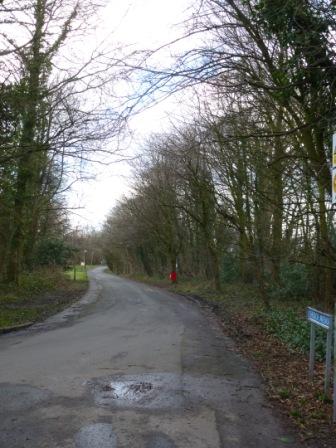
I suspect the reason the location of the legend changed was due to houses being built along Church Avenue in the early part of the 20th century. A secular perspective might assume people stopped associating the well lit avenue and its modern housing with the spectral procession, which in the original version travelled along a dark, tree lined mud road. Contrastingly, those who believe in fairies might argue that when the road and houses were built the fairies were either forced to move or made a decision to hold their funerals elsewhere.

Church Avenue

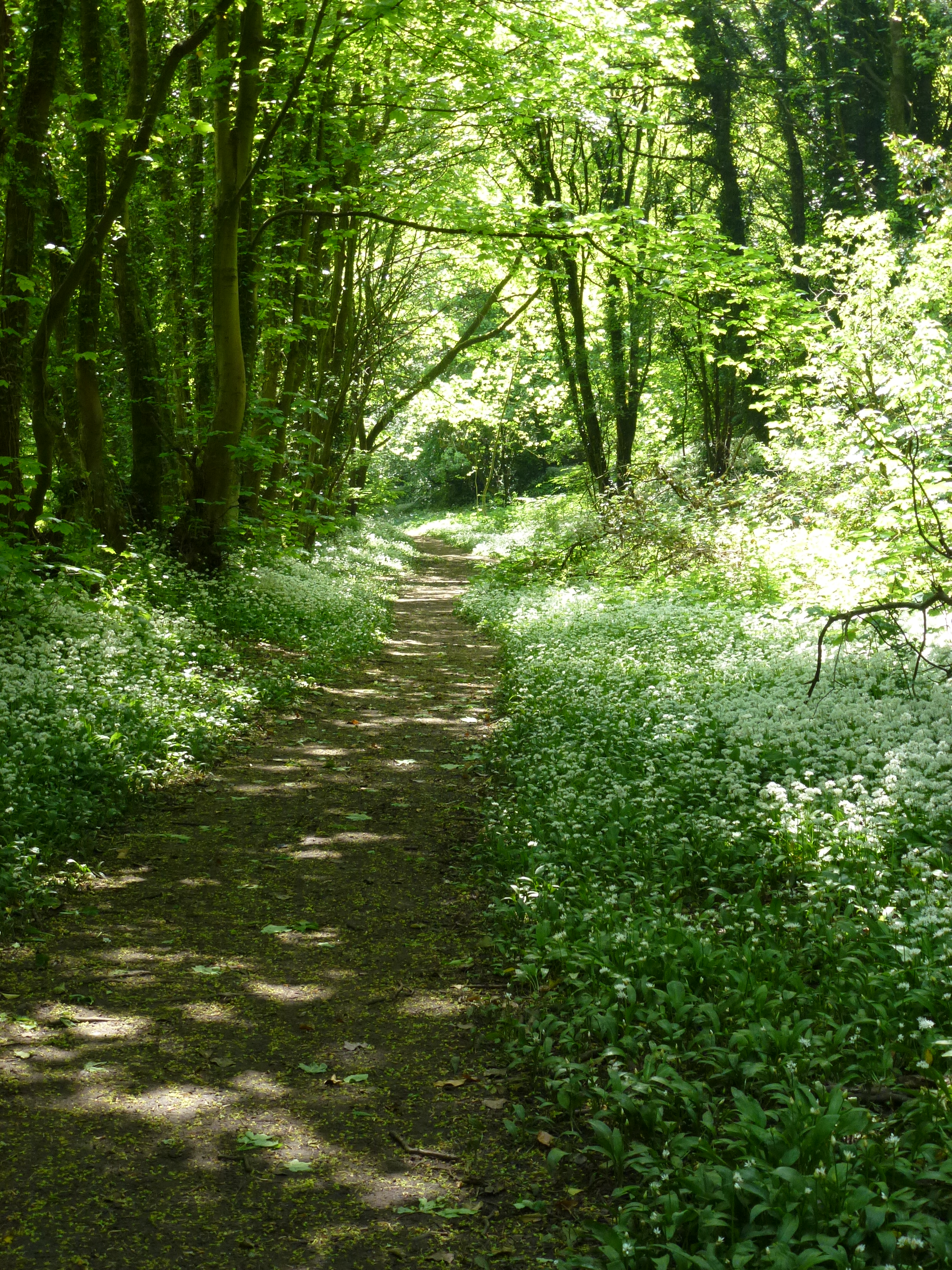
Anybody who has visited Fairy Lane will know it is an enchanted place. Ash and sycamore are decked with ivy and the ground is thick with moss and rich with fern and hart’s tongue. Every spring the woodland is carpeted with wild garlic and bluebells. The trees lining the lane are gnarled and fay and it’s easy to see why it might be associated with fairies, or why the fairies might have chosen it is an alternative location for their processions.
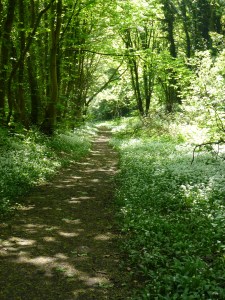
Faery Lane, Spring

~

The origin of Penwortham Fairy Funeral can be partially derived from the landscape and local funeral traditions. However this does not explain why the men saw fairies, as opposed to ghosts or other spectres, or the portentous aspect of the legend. Locating it within the context of British folklore has helped me gain a better understanding.

Prior to Saxon settlement, the inhabitants were part of a culture who spoke Cumbric, a British language close to the Welsh Cymric (4). This is shown in the etymology of ‘Penwortham’. According to Alan Crosby the ‘Pen’ element is a British word meaning ‘prominent headland.’ ‘Worth’ is Old English and means ‘enclosed settlement’. ‘Ham’ is Old English for ‘land within the bend of a river’ (5). An older spelling of Penwortham found in the Domesday Book is ‘Peneverdant.’ Rev. Thornber says ‘the old name of Penwortham is of British origin, thus – Peneverdant is formed of three words – pen, werd or werid and want, as Caer werid, the green city (Lancaster) and Derwent, the water, that is the green hill on the water.’ (6) East of Penwortham is Walton-le-dale. Walton is Old English for ‘the settlement of the Welsh’ (ie. native Britons).

Paul Devereux says that associations between fairies and funeral processions are common in Welsh mythology. He cites Edmund Jones ‘It was said of Welsh fairies “very often they appeared in the form of Funeral before the death of many persons, with a Bier, and a Black Cloth, in the midst of a company, about it, on every side, before and after it”… it was “past all dispute that they infallibly foreknew the time of Men’s death.”’ (7)

The term ‘fairy’ derives from the Latin ‘fatum,’ which means fate. Their Welsh name is ‘the Tylwyth Teg,’ the fair tribe or family (8). Implicit are physical qualities and a capacity to deal in ‘fairness.’ Bowker’s Goblin Tales of Lancashire and other collections of British folklore which depict people’s interactions with fairies, be they helpful sprites or malevolent boggarts, show the survival of a belief they play an active role in the determination of human fate.

In Burnley in Lancashire there is a similar legend. Captain Robert Parker of Extwistle Hall is walking home from a Jacobite meeting. He hides and by moonlight sees his name etched in brass on the coffin. He takes this as a warning not to support the Jacobites and backs out of the 1715 uprising (9) thus escaping imprisonment. However in 1717 he and two of his daughters are seriously injured in an accident in the hall involving gun powder. Parker dies from his injuries a month later (10).

Other fairy funeral legends include the following: In Gwent a man witnesses a fairy funeral procession approaching down a mountain toward ‘Abergeeg, or Lanithel church.’ He hides behind a wall and as the funeral passes steals a black veil from the bier, which he finds to be made of an ‘exceeding fine Stuff… very light’ (11). In Cornwall a man witnesses the funeral of a fairy queen. As the fairies bury her their shriek of lament is so alarming he joins in. Hearing his voice the fairies depart in panic, piercing him with sharp instruments as they fly away (12). The London based poet William Blake also claims to have witnessed a fairy funeral (13).

Although the consequences of witnessing these funerals are not as dire or fortuitous as the Lancashire cases it is clear the fairies are seen as real and that interacting with them has a real effect on human lives. The man from Gwent steals an actual cloth. The Cornish man is physically injured. Whilst Blake is not harmed he claims to have died several times during his lifetime and his poetry certainly displays the visionary quality of Faery.

Whilst our secular worldview attempts to eliminate beliefs unproved by reason or science they continue to be evidenced by arts and folklore and in personal experiences with the fairy races themselves. Penwortham Fairy Funeral is only one example of relations between humanity and Faery. I wonder whether there as many stories as there are incidences of contact with fairies?

Fairy Lane, Spring 2014

(1) http://www.gutenberg.org/files/39712/39712-h/39712-h.htm#THE_FAIRY_FUNERAL
(2) http://everything2.com/title/The+Fairy+Funeral
(3) http://www.srtt.co.uk/2012/12/the-archaeology-of-penwortham-a-talk-by-david-hunt-2/
(4) Aidan Turner-Bishop, ‘Fairy and Boggart Sites in Lancashire,’ ed. Linda Sever, Lancashire’s Sacred Landscape (2010), p96
(5) Alan Crosby, Penwortham in the Past (1988), p14
(6) Rev. W. Thornber, ‘The Castle Hill of Penwortham,’ Transactions of the Historic Society of Lancashire and Cheshire 1856/7, p66
(7) Paul Devereux, Spirit Roads (2003), p135
(8) T. Gwynn Jones, Welsh Folklore (1930), p51
(9)http://www.lancashiretelegraph.co.uk/lookingback/8452575.Bag_a_boggart__but_don___t_give_it_gifts_/?ref=rss
(10) Aidan Turner-Bishop, ‘Fairy and Boggart Sites in Lancashire,’ ed. Linda Sever, Lancashire’s Sacred Landscape (2010), p97
(11) http://www.blaenau-gwent.gov.uk/8037.asp
(12) http://www.sacred-texts.com/neu/eng/efft/efft22.htm
(13) Katherine Briggs, The Fairies in Tradition and Literature (2002), p197

Honouring Gwyn ap Nudd

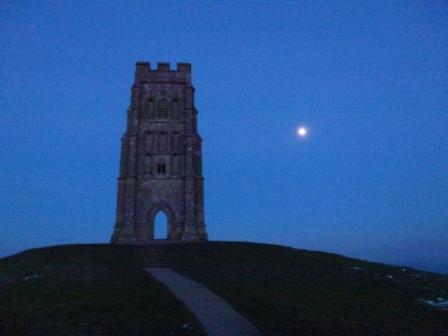
Glastonbury Tor, January 2013On the Winter Solstice a post for Winter’s King.

Samhain has passed. We’re in the dead season. The wild hunt rides the passageways of time and spirit paths lie open. Communities gather and ancestors draw close. Here I feel called to honour Gwyn ap Nudd by telling the story of how he became my muse and patron and made my life whole.

My first meeting with Gwyn took place at the nadir of a crisis. At the end of August 2012 I reached a point of conflict between my spiritual path and ambition to become a professional writer. After two years work completing a fantasy novel I realised its world was too complex and the language too heavy, it held little relevance or hope for a contemporary audience and was at odds with my developing relationship with the land and its myths.

His first appearance was at the head of a fairy procession at a local sacred site. Although I knew of the legend of the fairy funeral I didn’t think I’d encounter it directly nor did I suspect it would be led by a Welsh Fairy King. Yet Gwyn made his name and message clear. The myths of this land are real and he could help me access them. He challenged me to journey with him to the Otherworld, the condition of his guidance being that I lay aside my personal ambitions.

I spent several days considering- could I truly give up my ambition to become a professional writer? How would this change my life? How did I know I could trust him? What if I didn’t come back? Yet this experience, although it was confusing and terrifying felt more powerful and real than anything that had ever happened to me. I knew it was a once in a life time opportunity and I’d only get one chance. I returned to the fairy site and agreed.

Gwyn opened the gates to the past of this land and its myths. With his guidance I learnt how to ride the skies and ancestral pathways on my white mare, viewing the landscape’s lineaments from contemporary suburbia to medieval farmland, oak wood and peat bog to tundra and the age of ice. I met with ancestral people, the ghosts of trees and stampeding aurochs. I entered Faery and descended to Annwn.

Yet I still questioned what a deity associated with Wales and Glastonbury was doing in Lancashire. Reading his myths I realised two of Gwyn’s main stories- the abduction of Creiddylad and Arthur’s slaying of Orddu take place in the North. In the conversation with Gwyddno Garanhir, which depicts his role gathering the souls of the battle dead Gwyn says:

‘I have been where the soldiers of Prydain were slain,
From the East to the North;
I am alive, they in their graves!
I have been where the soldiers of Prydain were slain,
From the East to the South
I am alive, they in death!’

Gwyn is not only a king of Annwn and the fairies but a traveller between the worlds and across the landscape of Britain, maintaining the bonds between nature and humanity, the living and the dead. As a ruler and guide of this isle’s ancestral people his turning up at the head of a local fairy procession was not out of place.

Reassessing my past experiences I realised this wasn’t the first time I’d felt his influence. At Glastonbury festival in my late teens the veil had been lifted to reveal a vision of the Otherworld, a place I now recognise as Gwynfyd, which was coupled with a feeling of truth and ecstatic unity. Thirteen years later he had finally made his presence known, leading me from the cycle of aspiration, failure and frustration caused by my ambition to be a writer back to this magical unison with the land and its myths. He had made my life whole. In January I returned to Glastonbury and made my vow to him at the White Spring.

Since then my relationship with Gwyn has been a constant source of support and inspiration. Whilst the only piece of literature I know of that might link him with the Bardic Tradition is a reference in ‘The Spoils of Annwn’ to the Chief of Annwn possessing a cauldron warmed by the breath of nine maidens, I see him as a god of primal poetry- the wild Awen that thunders like the hunt through space and time and exists in the magic of nature, the songs of the fay and wisdom of the ancestors.

With his guidance I have discovered ways of connecting more deeply with the land and its spirits, its known myths and some unknown ones (a couple of which correspond with factual evidence!). In return I strive to communicate what I have learnt through written and spoken words to maintain the bonds between nature and humanity, this world and the Otherworlds.

And so, as we gather in the dead season, the wild hunt rides and spirit paths lie open I choose this time to tell this story to thank and honour Gwyn ap Nudd.

Lady of the Oak

I leave the shelter of the grove ducking beneath twisted hawthorn branches. The trees weave the entrance closed behind me. Rain hits my face, falling from a heaven of relentless grey. Reading the sky’s grimace I wonder what has been seen.

A crow caws his warning. Sprinting toward me up the hollow way I see a young man, legs a blur of blue white checkers and feet a splash of mud and leather. Hair slicked to his head, his dark eyes flicker with awe and wariness. The first dapples of a beard play across his chin like leafy shadows.

“M-my Lady of the Oak,” he stammers pulling up.

His breathless chest heaves beneath a sodden tunic. It is rare for youths to approach me without an elder. Looking more closely at my gnarled face his eyes widen in dawning horror. “Bad news travels from up river. A Man of the Oak wishes to speak with you.” He runs away in a flurry of muddy feet.

I follow down the hollow way heedless of the downpour weighing my cloak for the damp of the air already resides deep within my bones. Looking east, rain drenches the green hill, our sacred headland, and the greener barrow housing our ancestors. The torrent’s drumming beat strikes bubbles across the marsh land. As I walk onto the wooden pad way the reeds hiss like snakes. Decay bites my throat. The steely cast of the river of shining water reflects the glumness of the sky.

In a canoe roped to the jetty my cousin Drust sits hunched in his robes. I question what he is doing here, alone.

The river’s song answers. Her visions flood my mind. I see the battle at the ford of roaring water. Broken chariots, tribesmen slaughtered, the hero light vanishing from their eyes like fleeing stars. The eagle standard flies high, reflected in the crimson river. Seeing the pale flicker of their separating ghosts I speak a prayer for the souls doomed to return to a land where they no longer belong.

Sorrow chokes me like bile. I vomit it in anger at Drust, “what are you doing here, when your clan are dead?”

Drust looks up, yet his face remains hidden by his cowl. “I am taking the remnants of our traditions and our gods to the island across the sea.”

I laugh, a throaty brittle sound like twigs twisting and snapping. “Gods are not like saplings, to be taken away and re-rooted and traditions are not nurtured by foreign soils. It seems the ideas of the invaders have penetrated more deeply than I imagined.”

Drust tenses. Drawing my knife from its leather sheath I lean down and slice the rope tying his canoe to the jetty. The river sluices him west and out to sea.

The wind carries enemy voices. Reflected in the falling droplets I see swords and plumed helms. Slipping on the wood and slithering up the hollow way I reach the grove and beg the hawthorns for passage. A peace of ancient green breaks over me, like I’m sinking into a bed of moss. Beneath the canopy’s protective shadow I believe myself safe until tumult disturbs the roots. Crows caw, anticipating carrion.

I cross a sea of acorns and approach the grove’s mighty king. Putting my arms around his trunk, I press my face to the rough bark. “Brother Oak, let me see into the future.”

My heartbeat merges with the pulse of rising sap. My feet become roots reaching downward through damp soil to the outer edges of the grove. My arms stretch into branches and split, bearing bunches of lobed leaves nourished by the hidden sun, washed by the rain, flourishing green.

The ground shudders at the march of soldiers, galloping hooves and chariot wheels. Battle cries are hollered. Bows hum to the crash of metal. Screams and groans rock me. I taste blood and its bitterness fills me.

Earth and water shift as ditches are cut, fields plundered to feed the enemy. Ancestral ghosts clutch my twigs shrieking of their barrow torn down and a temple built to a foreign god. I moan at the ache of rot softening my flesh, bowing and creaking as my branches snap and innards hollow. I beg for lightning’s merciful release but there is no answer from the clouds of sorrow.

“Brother, let me return,” I speak. “The tribe need my support in their defeat.”

I ease back from the oak as the hawthorns scream and turn to see branches broken, shredded leaves and burst haws at the sandaled feet of a man dressed in a plumed helmet, iron breast plate and red woollen tunic. His eyes are blue, skin tanned by the sun of a hotter land. Brandishing a sword stained with blood and sap he accuses me of witchcraft, of sacrificing innocents to divine the future from their death throes.

I smile. The man freezes in horror. I draw my knife and mustering all my oaken might I drive it between the iron plates and slice open his stomach, spilling his guts upon the grass. Attempting to gather them in like rope he drops twitching and groaning to his knees.

I read the future of his people and their empire from his pulsing entrails.

Kneeling, I pick up a handful of blood soaked acorns and address my brother, “do not fear. Whilst tribes and empires rise and fall, the steady strength of oak will conquer all.”

Oak, St Mary's graveyard, Castle Hill

Much Hoole Moss

Glacial retreat leaves a wet land weeping
Life breeds teeming in reeds in hollow pools.
Fallen rushes in the deep rot to peat
Sphagnum, master of decay rules all.

Rosemary curves pink, explosive sun dew winks,
Cranberry thrives on hidden stalks, delish gleam.
Cotton grass streaks, eye spotted large heath fleets
Over multi-coloured moss the curlew soars.

Anoxic, unbreathing, hold all beneath;
Primeval plant, box of oak, bone and spear.
Living museum of ten thousand years
Stores the past of the people of Much Hoole.

Dug for peat, drained and fertilised for wheat,
Dropping, drying, sinking precariously.
Much Hoole Moss sole preclusion of mercy
Sways tentative twixt field and fern and man.

If the drainage was stayed, water retained,
Sphagnum regained, the moss could be redeemed.
Natural history, just outside our doors,
An ancient site of wonderment and awe.

Surrendering the land for fun and games;
Thunder of guns and thud of running feet
With erosive shudders the moss land sinks
Lost are its mysteries and future dreams.

Much Hoole Moss Paintballing Site


Penwortham Moss

Boggart:

Long grew the meadow grass, warm glowed the sun
Soft blew the breeze on the gold twitching fronds.
Seedy slight fescue in scattering throngs,
Dog’s tail and cat’s tail, rye grass and fox tail,
Cowslip and clover, sorrel and brome.

Lazy bright days for the faeries above
Skipping through splendour with pink petal wands
Light as the seeds and floating like cloth,
Whispering to flowers and enchanting the hours,
Whilst we fester beneath, shut out and cut off.

This field, now houses, was part of the moss.
The meadow belonged to the beasts of the bog.
A quagmire of paradise, bountiful haunt.
Sphagnum and fen sedge, sundew and star sedge,
Woundwort and dropwort, lizards and frogs.

Thick claggy peat soaked as full as a sponge,
Pools of deep water with bottomless grounds,
Dragonflies glitzed rippling spangling rounds.
We sat in, we soaked in, gloried and gloamed in,
‘til they drained it with ditches and sowed it with crops.

Now we dwell in the doom dark deep
Deprived of pool and moss and peat,
The corner and cranny we crookedly keep
Dried out and wasted, fates wangled, frustrated
‘til the land is returned to the bog and it’s beasts.