We have not the myth of a son of the sun who got burnt by the sun and fell.
When Maponos stole the horses of Bel and rode skywards to the horror of His mother He did not come to grief.
Although Maponos burned He was not burnt.
He returned instead alive and ablaze, replenished, youth renewed, as the Sun-Child.
So, why, black poplars, do You grieve?
Do You grieve because Your brother lives? Do You grieve because You are jealous? Do You grieve because You got no grief?
Or is there a story of another brother?
A forgotten son of Matrona, daughter of the King of Annwn, who mounted a black horse and rode after the black sun when it set and sunk to the depths of the Underworld?
Did He drown in a black lake? Was He eaten by a black dragon? Or does He still wander lost in sorrow through a labyrinth unillumined by the rays of the black sun?
Poor brothers, did You search for Him and almost lose yourselves? Did You get trapped in a dark prison and scrape Your bloody fingers against the walls and weep?
If so, how did You get here?
Did You ride with the black sun or with the King of Annwn on the back of His black horse who carries lost souls?
Did He plant You here, He and His Queen, with labyrinthine roots winding down?
Did He seal Your tears deep within?
Did He kiss Your fingers like His Bride’s, tuck them into a yellow bud to emerge again only in the spring to reach not for the black sun but the love of a mate?
Did He bring You here to tell me when I grieve my fingers are not talons to scrape the walls and my tears are not sap to entrap the insects who get in their way?
Did He bring You here so I could learn from Your clawing, Your crying, my clawing, my weeping, to turn my grief inward in winter and then, in spring, to reach out in love?
*This poem is addressed to the two black poplars who stand at the source of Fish House Brook, near to the Sanctuary of Vindos, in my hometown of Penwortham. The photograph is of one of the fallen catkins, taken in spring 2022, not quite emerged.
There is a black butterfly in Your heart. I cannot decipher the meaning on a bright spring morning when the May flowers blossom and all the hawthorns are in bloom.
There is a black butterfly in Your heart. I cannot decipher the meaning at midday when the sun burns bright and Maponos strums a song on His harp with chords of sunlight brighter than the fires of Bel.
There is a black butterfly in Your heart. I cannot decipher the meaning at sunset as the blackbirds sing the sun down and burning happy dancers dance and talk and do the things that people do.
There is a black butterfly in Your heart. I cannot decipher the meaning until midnight comes and I follow the funeral procession of the sun into darkness. Until I walk with the dead sun into the depths of the Otherworld.
~
“Dead sun, dead sun, what are we doing here, what are we doing here in this darkness, darker than the dark side of the moon, darker than the dark side of the sun?
“Dead sun, dead sun, what are we doing here, what are we doing here in this silence, more silent than the silence when the King of Annwn died and Maponos ceased to play His harp?
“Dead sun, dead sun, what are we doing here, what are we doing here in this stillness stiller than the places between the dance-steps of His faery dancers, the hoofbeats of the horses of His hunt, the spaces between the beats of His heart?”
“Come deeper, come deeper,” says the dead sun, “beneath the world’s chatter and words and images that paint butterfly colours, come deeper, come deeper.”
~
The dead sun takes me to Your tomb in the Castle of Cold Stone. Reminds me of how Your castle fell from the skies of Annwn, circling four-cornered, from the songs of the mead-feast, from the revelry, from the boiling of the cauldron, from the passing of the mead-cup,
down, down, down,
into the Abyss,
into the place between the end and the beginning of life and death, the end and beginning of words and of worlds…
~
You’re dead – there are no words to express my sorrow. You’re alive, only sleeping, there are no words to express my hope.
You’re dressed in black as if ready to attend Your own funeral. Your hair is white and silver as the light of the moon and the hairs in the manes and tails of the horses of Your hunt.
And Your heart, Your heart is red as the reddest of the roses of Your queen who forever betrays You on May the first.
For You I plant five red roses in Annwn and a single rose above.
~
For you I sit here in the darkness, the silence, the stillness. I listen to Your breath and the beating of Your heart.
At first it is felt, not heard, not seen.
Then I hear it, then I see it – the dark flutter of the butterfly in Your heart.
“What is this? What is this?” My heart flutters in concern. “Why has a black butterfly come to abide in the heart of the King of Annwn, the heart of the Otherworld?”
“Worry not.” Even death does not faze You. You do not speak like a corpse but like the most living of the living and the brightest light in Annwn’s darkness. “You are the black butterfly who flaps her wings in my heart.”
~
“Did You hear that?” I ask the dead sun.
The dead sun has already fled – it is morning.
“Did You hear that?” I ask Maponos.
He has already gone to play His harp.
We’re alone now, my King and I, butterfly and heart, in the darkness, in the silence, in the solitude, for a moment before the world’s call forces us to part.
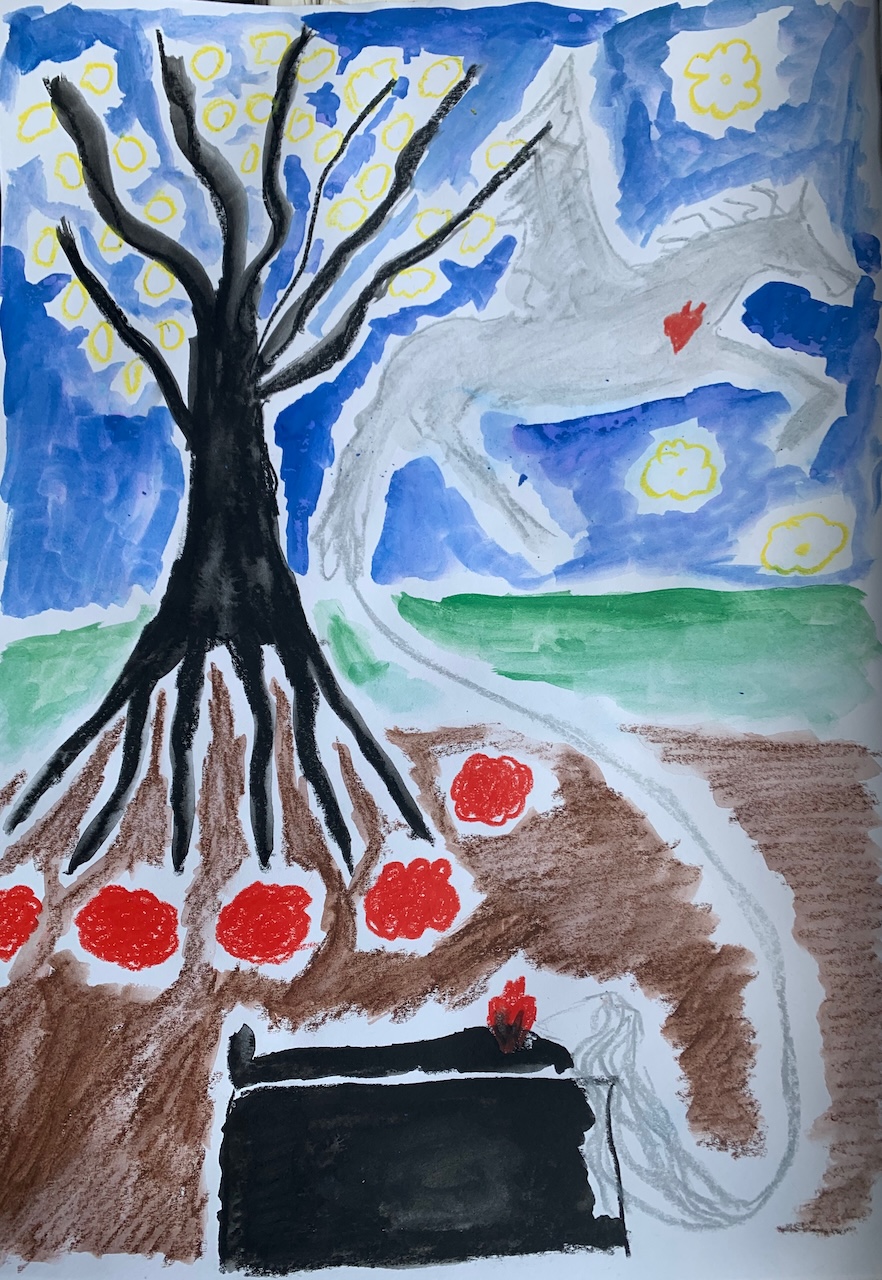
I created this painting at a Beltane focused seasonal creative workshop with Two Birds Therapy and wrote the poem afterwards. It’s based on the dichotomy I always feel at this time of year between the beauty and energy of nature and the sadness of Gwyn’s death and my need to be alone with Him whilst others are celebrating. The black butterfly was the result of a mistake wherein I tried to make Gwyn’s heart redder but instead smudged black into it. For me this gave the piece its meaning.
This is an image I was inspired to draw of the King and Queen of Annwn as Bone Wolf and Bone Mare – a guise Gwyn ap Nudd and Creiddylad/Rhiannon have been appearing to me in this winter, a time of revelation, as so many things have been stripped bare.
with all the sisters who have lost their brothers.
We flit like bats against the walls.
We are searching for our oldest animals
to lead us through the darkness
to the prison of the child now a young man.
On the solstice when the sun stands still by candlelight
we will bring him back.
Today, December the 18th, is the festival of Epona, the Great Mare. Over the past few years the story of the search of the Mare Goddess for her lost son has been revealed to me as a relief of Epona riding through the Otherworld with engravings of animals, Rhiannon’s loss of Pryderi, and Modron’s loss of Mabon have sealed into one.
It’s my personal belief the episode in Culhwch ac Olwen featuring the search of Arthur and his men for Mabon with the help of the Oldest Animals and his rescue from the House of Stone replaced an earlier version in which the Great Mare (Epona) / Great Queen (Rigantona) / Great Mother (Matrona) searched for her son and rescued him from Annwn, where he was taken by his father, Annwn’s King. A similar story is told in the modern film, Labyrinth, where Sarah rescues her brother from the Goblin King.
It has taken on a personal meaning for me this year because, at the beginning of the month, my brother was admitted to hospital for brain surgery. It went well and he came back home to stay with me and my parents to recover, but was readmitted due to complications. We are hoping he will be returning from the hospital, a liminal place like the House of Stone that was Mabon’s Annuvian prison, between sickness and health, life and death, some time after his reassessment on the winter solstice.
Afallach, a Brythonic god whose name is derived from afal ‘apple’, is best known for his associations with Ynys Afallach ‘The Island of Apples’ or the Isle of Avalon. In his Speculum Ecclesiae (1216)Giraldus Cambrensis says: ‘Avallonia is so called either from the British aval which means apple, because that place abounded with apples, or from a certain (A)vallo, lord of that land’.
Giraldus identifies the Isle of Avalon with Glastonbury, in De Instructione Principium (1193 -9): ‘what is now called Glastonia was anciently called Insula Avallonia, for it is like an island, wholly surrounded by marshes, whence it is called in British Inis Avallon, that is the apple-bearing island.’
William of Mamlesbury, in The Antiquities of Glastonbury (1216), follows this tradition. Glastonbury ‘is also well known as by the name of Insula Avalloniae’. He says it may be ‘named after a certain Avalloc who is said to have lived there with his daughters on account of it being a solitary place. (1)
Ynys Afallach is described as a paradisal island by Geoffrey of Monmouth in his Vita Merlini (1150). ‘The island of apples which men call “The Fortunate Isle” gets its name from the fact that it produces all things of itself; the fields there have no need of the ploughs of the farmers and all cultivation is lacking except what nature provides. Of its own accord it produces grain and grapes, and apple trees grow in its woods from the close-clipped grass. The ground of its own accord produces everything instead of merely grass, and people live there a hundred years or more.’
Geoffrey names the nine daughters of Afallach as Morgen, ‘Moronoe, Mazoe, Gliten, Glitonea, Gliton, Tyronoe, Thitis; Thitis best known for her cither.’ He notes Morgen ‘is first of them’, ‘skilled in the healing art, and excels her sisters in the beauty of her person’. She knows the properties of herbs, is skilled in healing, and mathematics and has the ability to shift shape.
Giraldus Cambrensis, in De Instructione Principium (1193), also writes of,‘Morganis, a noble matron who was the ruler and patron of these parts… the island which is now called Glastonia.”
II. Afallach – King of Annwn
It is significant that Morgan is referred to as a ‘noble matron’ for in the Triads she is otherwise named as ‘Modron daughter of Afallach’. Modron is a later form of Matrona ‘Mother’. The Mothers or Matrons were worshipped across northwestern Europe during the Romano-British period.
In Peniarth MS. 70 Modron speaks of herself as ‘the daughter of the King of Annwn’. Annwn means ‘the Deep’ and is the medieval Welsh name for the Otherworld which is a paradisal location.
In The Life of St Collen (14th C)we find an account of Collen’s visit to the castle of Gwyn ap Nudd, a King of Annwn, on Glastonbury Tor:
‘he saw the fairest castle he had ever beheld, and around it the best appointed troops, and numbers of minstrels, and every kind of music of voice and string, and steeds with youths upon them the comeliest in the world, and maidens of elegant aspect, sprightly, light of foot, of graceful apparel, and in the bloom of youth and every magnificence becoming the court of a puissant sovereign. And he beheld a courteous man on the top of the castle, who bade him enter, saying that the king was waiting for him to come to meat. And Collen went into the castle, and when he came there, the king was sitting in a golden chair. And he welcomed Collen honourably and desired him to eat, assuring him that, besides what he saw, he should have the most luxurious of every dainty and delicacy that the mind could desire, and should be supplied with every drink and liquor that his heart could wish; and that there should be in readiness for him every luxury of courtesy and service, of banquet and of honourable entertainment, of rank and of presents: and every respect and welcome due to a man of his wisdom.’
It seems likely Gwyn and Afallach are the same deity. Both are named as King of Annwn and are associated with Glastonbury/the Island of Avalon. Afallach is named as the grandson of Beli Mawr in the Harleian Genealogies (1100)and we find out that Gwyn is the grandson of Beli Mawr from Lludd ac Llefelys (1225) where his father, Lludd/Nudd, is named as the son of Beli.
Further traces of his mythos can be found in ‘Preideu Annwn’ where Pen Annwn, ‘the Head of the Otherworld’ is depicted presiding over an otherworldly mead feast and as the owner of countless treasures including a cauldron ‘kindled by the breath of nine maidens’ with ‘a dark trim and pearls’.
Its refusal to ‘boil a coward’s food’ suggests that it is connected with the initiation of bards such as ‘the loyal lad’, Gwair who, in the poem, is singing before the spoils of Annwn in a heavy grey chain.
III. Afallach and Modron in the Old North
In the Triads and Peniarth MS. 70 Afallach’s daughter, Modron, is the mother of the children of Urien. In Triad 70 the second of the ‘Three Fair Womb Burdens’ is the following: ‘Owain, son of Urien and Morfudd his sister who were carried together in the womb of Modron daughter of Afallach’.
In Peniarth MS. 70 we find the full story of the conception of Modron’s children:
‘In Denbighshire there is a parish which is called Llanferes, and there is there Rhyd y Gyfarthfa (the Ford of Barking). In the old days the hounds of the countryside used to come together to the side of that the ford to bark, and nobody dared go to find out what was there until Urien Rheged came. And when he came to the side of the ford he saw nothing except a woman washing. And then the hounds ceased barking, and Urien seized the woman and he had his will of her; and then she said “God’s blessing on the feet which brought thee here.” “Why?” said he. “Because I have been fated to wash here until I should conceive a son by a Christian. And I am daughter to the King of Annwfn, and come thou here at the end of the year and then thou shalt receive that boy.” And so he came and he received there a boy and a girl: that is, Owein son of Urien and Morfudd daughter of Urien.’
The setting of this story in Denbighshire is strange because Urien was the king of the northern kingdom of Rheged during the sixth century. Urien’s seat may have been Luguvalium (present-day Carlisle), on the River Eden, and his realm likely extended throughout the Eden Valley and much of Cumbria to the Solway Firth and perhaps included Dumfries and Galloway. (2)
The name ‘Eden’ holds associations with Paradise and thus with Afallach/Gwyn and his brother Edern. (3) When Rheged was conquered by the Anglo-Saxons some of the fleeing Britons may have taken the tale to Wales.
I believe this story has its basis in the pre-Christian tradition of a human king entering a sacred marriage with the goddess of the land. There is plentiful evidence for the cultus of Modron/Matrona and her son, Mabon/Maponos in the form of altars and place names in northwest England and southern Scotland.
Altars and inscriptions to the Mother Goddesses and the Mothers the Fates have been found at Burgh-by-Sands, Carlise, Old Penrith, Skinburness, Bowness-on-Solway, Ribchester, and Lund. There is an altar to Apollo-Maponus at Ribchester. Lochmaben and the Clochmaben stone are named after him.
In The Harleian Genealogies the kings of Rheged trace their lineage to Coel Hen and ultimately to Afallach and Beli Mawr. This suggests that Beli, Afallach, Modron, and Mabon were their ancestral deities.
The references to Owain as Mabon in the poetry attributed to Urien’s bard, Taliesin, are suggestive not only of his divine birth, but that he possessed the power to invoke and take on the identity of Mabon.
The story from Peniarth MS. 70 demonstrates the turning of the kings of Rheged to Christianity. Here we find Modron depicted as a sinister figure, as the Washer at the Ford, suggesting links with Morgan and possibly with the Irish death-goddess Morrigan, surrounded by equally sinister hounds (who are likely to be the Hounds of Annwn who hunt the souls of the dead with her father). To see a woman washing one’s clothes was a death portent as was hearing or seeing otherwordly hounds.
Urien, a self-proclaimedly Christian King, ignores the portents, seeing ‘nothing but a woman washing’ and rapes Modron. Her words about being fated to wash there until she conceives a son by a Christian have clearly been put into her mouth by a Christian interlocutor to obscure her role as a sovereignty goddess who holds power not over the land and Annwn but fate itself. Following Urien’s abuse it is no surprise he is assassinated and this leads to the fall of Rheged and the Old North.
The connections of Afallach and Modron with the Old North live on in their folkloric associations with the Roman fortresses of Glanoventa (Ravenglass) and Mediobogdum (on the Hard Knott Pass). In these areas of Cumbria Afallach is known as Eveling, which is an Anglicised version of his name.
IV. Afallach and Gwallen in North Wales
Afallach’s associations with Rhyd y Gyfarthfa in Denbighshire have been noted. Near the hill fort of Moel-y-Gaer in Flintshire is a hamlet called Caerfallwch which means ‘the Fortress of Afallach’.
From the ‘Hanesyn Tract’ we learn that Afallach had another daughter called Gwallen. She is referred to as ‘Gwalltwen verch Yvallach’ in ‘Digyniad Pendefigaeth Cymru’ and here we learn that she was mistress of Maelgwn, the ruler of Gwynedd during the sixth century, and the mother of Maelgwn’s son, Rhun, who ‘was not acceptable to some as prince, only as a regent.’
The kings of Gwynedd traced their ancestry through Cunedda to Afallach and Beli Mawr. It is possible that, like Modron, Gwallen was perceived as a sovereignty goddess. Her name might be translated as ‘White Hair’ (from gwallt ‘hair’ and gwyn/(g)wen ‘white’) suggesting Annuvian characteristics shared with her father, Afallach/Gwyn. The rejection of her son may be indicative not only of the laws surrounding illegitimacy, but Christian superstitions surrounding her otherworld nature.
Maelgwn’s wife was Sanan ferch Cyngen. They had a daughter called Eurgain who was married to the northern warlord Elidyr Mwynfawr. According to The Black Book of Chirk (1592 – 1667):
‘After the death of Maelgwn… many of the nobility of Cambria disdained to yield subjection to Rhun his son, being a bastard begot upon Gwallten the daughter of Afallach, Maelgwn’s concubine, especially the nobility of Arfon, who privately sent unto Elidyr Mwynfawr aforesaid to come speedily to Cambria, to aid him in recovery of the kingdom in the right of his children by Eurgain the daughter and heir of Maelgwn’.
The voyage of Elidyr and Eurgain and their companions from the Old North to Wales is recorded in Triad 44 ‘Three Horses who carried the Horse Burdens’. It is memorable because ‘seven and a half’ people are said to have crossed sea on the back of the water horse Du y Moroedd ‘The Black of the Seas’.
‘Du y Moroedd… horse of Elidyr Mwynfawr… carried on his back seven and a half people from Benllech in the north to Benllech (Elidir) in Mon. These were the seven people: Elidyr Mwynfawr and Eurgain his wife, daughter of Maelgwn Gwynedd, and Gwyn Good Companion and Gwyn Good Distributor, and Mynach Naoman his counsellor, and Prydelaw the Cupbearer, his butler, and Silver Staff his servant, and Gelbeinifen, his cook who swam with two hands and on the horse’s crupper – and he was the half person.’
Du y Moroedd is the horse Gwyn ap Nudd rides when hunting for Twrch Trwyth ‘King of Boars’ and likely for the souls of the dead. (4) Elidyr met his end battling against Rhun at Aber Mefydd. Perhaps Du not only carried them to meet their deaths but to the Otherworld afterwards too.
What this story serves to consolidate is that Afallach/Gwyn and his daughter, Gwallen, had strong and longstanding connections with the Brythonic peoples who claimed descent from Beli Mawr.
V. Lugus and the Island of Apples
In the Irish myths we find Emain Ablach ‘The Island of Apples’. In ‘Ar an doirseoir ris an deaghlaoch’ ‘The doorkeeper said to the noble warrior’, a medieval Irish poem based on the arrival of Lugh at the court of the Irish gods, the Tuatha Dé Dannan, Lugh introduces himself as ‘a poet from Emain Ablach / of swans and yews’ before gaining entry due to his mastery of many skills. This suggests Lugh might have undergone some kind of bardic initiation on Ablach/Afallach’s isle.
Lugh is the son of Cian of the Tuatha Dé Danann, and of Ethniu, daughter of the Formorian giant, Balor. After hearing a prophecy that he would be killed by his grandson, Balor locked Eithne away in a tower on Tory Island, but this did not prevent Cian from entering and fathering Lugh. Balor then attempted to stop the child gaining maturity by preventing him from getting a name and a wife.
In ‘Balor of the Evil Eye and Lui Lavada’ Cian takes Lui to Tory Island where numerous apple trees grow. They pose as gardeners. When Lui shows a good deal of skill picking up the apples Balor says: ‘Tog leat Lui Lavada’ ‘take away with you little long hand’ and this is how he receives his name. Lui/Lugh kills Balor with a slingshot or spear through his burning or poisonous eye.
We find a striking parallel in The Mabinogi (1350 – 1410) in the story of Lleu Llaw Gyffes who is cognate with the Irish Lugh. Lleu is the son of Gwydion and Arianrhod, the son and daughter of Beli Mawr and Don. He was likely conceived by magical subterfuge. (5) In this story it is not Lleu’s grandfather, Beli, but his mother, Arianrhod who curses him with three fates: he will never win a name, arms or a wife. This is because of her ‘shame’ at the slight to her virginity caused by Gwydion.
Gwydion helps Lleu win his name by disguising them as shoemakers and luring Arianrhod onto his boat to get a shoe fitted. When she is on board Lleu shoots a wren that lands on the deck ‘in the leg, between the tendon and the bone’ and she exclaims ‘it is with a skilful hand that the fair one has hit it’ and hence he is called Lleu Llaw Gyffes ‘the fair-haired one with the skilful hand’.
Instead of killing his grandfather, Beli, with his spear, Lleu kills Gronw, his rival for his wife, Blodeuwedd. Gronw, a hunter who arrives with a pack of hounds chasing a deer and turns up at night to seduce Lleu’s beloved is likely to be the King of Annwn, Arawn, who displayed his shapeshifting abilities earlier in the text, and may be identified with Afallach/Gwyn, his cousin.
The Welsh and the Irish myths contain suggestions of a shared mythos surrounding Beli/Balor, Ablach/Afallach, Eithne/Arianrhod, Cian/Gwydion, and Lleu/Lugh/Lugus (his pan-Celtic name) that was important to the people of the Brythonic kingdoms who claimed descent from Beli. (6)
VI. The Apple King in Peneverdant
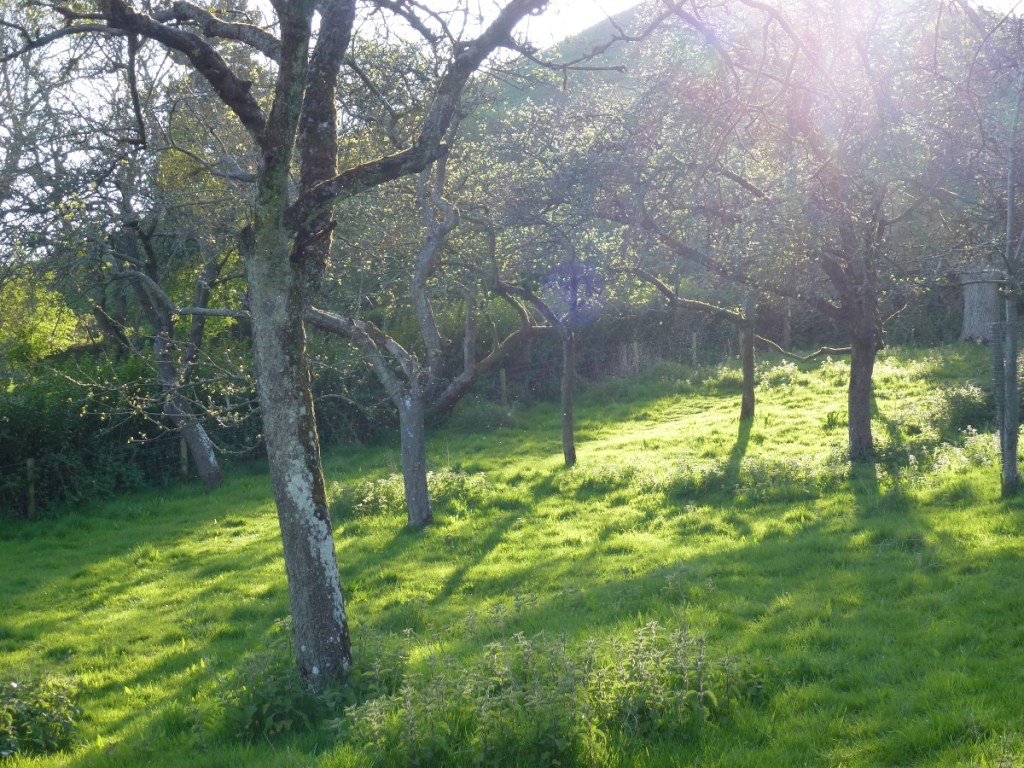
The name of my home town, Penwortham, was Peneverdant in the Domesday Book. The first element, pen, ‘head’ is Brythonic and refers to present-day Castle Hill. Like Glastonbury Tor this headland stood on marshland and is an important sacred site for pagans and Christians.
The dedication of the church on its summit and well at its foot (now dried up) to St Mary Virgin and the fairy funeral legend featuring a fairy leader suggest the presence of a mother goddess and fairy king.
I know from personal experience the fairy king is Afallach/Gwyn. I first intuited the goddess to be Gwyn’s mother, Anrhuna, who I know as the Mother of the Marsh, but am now considering that another presence who better fits the image of Mary in the church with her shining son is Modron with Mabon.
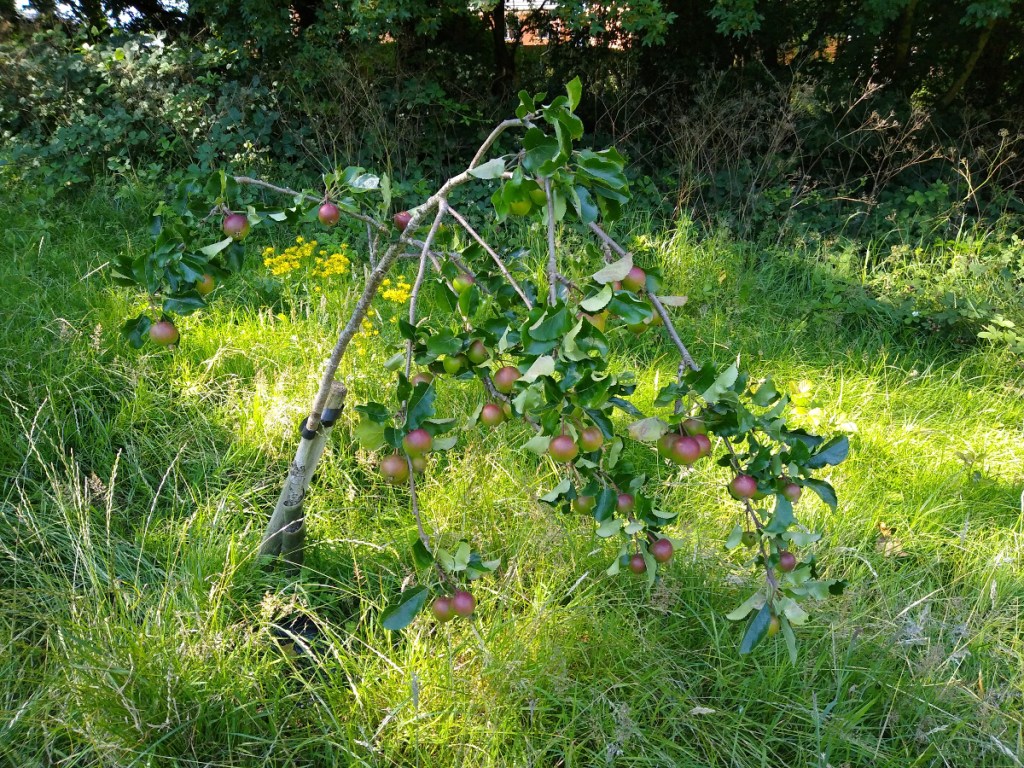
I hadn’t considered this possibility because I hadn’t realised Afallach and Gwyn were the same deity. Looking back I should have realised earlier for I spent a considerable amount of time in the Avalon orchards at Glastonbury when I visited at Calan Mai in 2013 and 2015. On the latter occasion this inspired me to plant five apple trees in Greencroft Valley with the Friends group. Three have survived and two, the Epicure and Sowman’s seedling, have borne apples this year.
I have been making connections between Afallach and Gwyn as I have harvested these apples and those from the two apple trees in my parent’s garden. I’ve noticed they’ve come earlier this year for I usually gather the last before Gwyn’s Feast on the 29th of September and offer an apple to him with pork.
Of course the sweet and juicy apples we eat in Britain today were imported by the Romans. Yet we do have a native apple tree – the crab apple. Although its fruits are too sour to eat raw there is no doubt our ancient ancestors cooked them and served them with meat as a welcome addition to their diet. The fact that apples are harvested at the time of Gwyn’s Feast further consolidates his identity with Afallach. (7)
Another piece of potentially significant information I first heard orally but only found unreferenced online on a website called ‘Ireland Calling’ is the following: ‘The Celts… were said to bury apples in graves as food for the dead, a practice that is shown to date back over 7,000 years to Europe and West Asia where petrified remains of sliced apple have been found in tombs from 5,000BC.’ However, I haven’t been able to find a trustworthy source naming the date or location of these burials.
If it was proved that the Celtic peoples and in particular the Britons buried their dead with apples this might be suggestive of an offering to Afallach/Gwyn in return for taking the souls of the dead to Annwn.
Whatever the case my offering of an apple to the Apple King at his feast this year will have heightened significance and his relationship with Modron and Mabon opens new horizons to explore.
FOOTNOTES
(1) Malmesbury also provides a fascinating alternative foundation story based around apples. ‘Glasteing found his sow under an apple tree near the ancient church, and because apples were rare in those parts when he first arrived there, he called it Insular Avalloniae in his tongue, that is, Isle of Apples’. (2) Urien’s associations with the Eden Valley are suggested by the poems attributed to Taliesin, Urien’s bard, who refers to Urien as the ‘ruler of Llwyfenedd’, the Lyvennet Valley (the Lyvennet flows into the Eden). (3) However this river was known as Ituna ‘water’ or ‘rushing’during the Roman-British period. Urien was also named ‘ruler of Yrechwedd’. Echwedd means ‘flowing water’ and this could be the origin of this appellation. (4) In Culhwch ac Olwen (1190) Twrch Trwyth was allegedly a human chieftain turned into a boar by God on account of his sins. Behind this story lies his abilities as a shapeshifter and the fact Gwyn’s hunt, ‘the Wild Hunt’, was not really for boar but for human souls. (5) Gwydion’s fathering of Lleu is not explicit in the main source for Lleu’s story, the Fourth Branch of The Mabinogi, but is evidenced in other sources such as a poem by Lewys Môn and Harleian 3859 where Lleu is spoken of as ‘Lou Hen map Guidgen’. (6) The significance of Lugus is supported by his giving his name to Luguvalium (Carlisle) which means ‘Strong in Lugus’ and was ruled by Urien Rheged, to ‘the rock of Lleu’, the seat of the rulers of Gododdin from whom Maelgwn Gwynedd was descended, and to Dinas Lleu in the kingdom of Gwynedd.
from Ceunant Coch. I feel like Blaenau Ffestiniog.
No, the mountains above slate hearts torn out.
Where have we hidden it this time in this never ending
shadowplay of shifting guises not knowing whose hand
reaches through the hole in the slate into another world
and drags something back to make us whole?
This poem is based on the battle between Lleu Llaw Gyffes and Gronw Pebyr in the Fourth Branch of The Mabinogi. In it I believe the King of Annwn takes the guise of Gronw to defeat Lleu. In an additional identity exchange, in this poem, I found myself in the role of Annwn’s king becoming Gronw.
The battle took place on the bank of Afon Cynfal near Bryn Cygergyr ‘the Hill of the Blow’. Llech Ronw ‘the Slate of Gronw’ is a stone found in 1934 on the bank of the Cynfal. It was washed down from Ceunant Coch and now stands on Afon Bryn Saeth. I haven’t visited Llech Ronw. The pictured stone is the replica at Llyn Trawsfynydd and the accompanying photograph is of the mountains above Blaenau Ffestiniog.
Spoke the Prophet with the Dragon’s Tongue, The Voice of the Goddess with Nine Dragon Heads: “The Dragon Goddess shall be slain and in Human Form She shall be reborn as the Mother of the Son.
In His darkest dreams the King of Annwn will tear Out the Eye of Bel, He will tear down the Sun and put it Inside the Belly of His Dead Mother and the Queen of Annwn Will shape for Her Dead Mother a new Earthen Form
And They will send Her in a boat to Portus Setantiorium Where She will be met on the Western Shore with Reedlights And up the River of Belisama will sail to Ribel-Castre And there the Eye of Bel will once again be reborn
As Maponos ‘the Son’ to Matrona ‘the Mother’. Yes! Throughout Belisama’s Vale in the Sacred Groves At the Springs and Wells and the Roaring Fords at the Roman Altars and in the Temples They shall be Honoured.
At the birth of every child She shall appear Threefold To Breathe the Blessings of the Awen into the Infant Mouth. As the Three Mothers of Destiny She shall be Revered In all the Holy Places in the Hills and Vales of the Old North.
And she shall appear Ninefold the Dragon Daughter Of the King of Annwn as Morgana and her Sisters breathing Life into His Cauldron before spiralling into Serpent Forms. And the Nine shall be Recoiled in Circles of Stone.
And when the Priests of Christendom come armed With Book and Vestment and Mitre treading widdershins Around our Holy Wells with splashings of Unholy Water But failing with their Prayers to undo our Spells.
Henceforth she will be known as Mary in Nine Churches In Belisama’s Vale: at Peneverdant, at Prestatun, at Wahltun, At Euxtun, at Leyeland, at Sceamlburgh, at Bamber Brig, At Ruhford, at Fernihough, she will be Honoured.
At Cockersand Abbey as Mary of the Marsh As the Magdalen in Maudlands in Nine Times Nine Churches Across the Islands of Prydain and beyond she will be Honoured,” Spoke the Prophet with the Dragon’s Tongue.
This poem was written as an early experiment in writing in the voice of ‘The Prophet with the Dragon’s Tongue’ in a Blakean style and brings together some of the mythic overlayerings of mother figures I have perceived within my landscape, in the Brythonic myths, and in visions and journeys.
I recognise this will not accord with everybody else’s perception of these deities and is very much a personal revelation. And, of course, I won’t be attempting to imitate Blake again, which I knew before setting out is impossible and foolhardy. I see it as a first step on the way to creating a myth to live by.








 The Sanctuary of Vindos