Contemplating the Abyss Part One – ‘In the Deep’

The Abyss was its spiralling core and its beginning and its end. 

The Beginning

It began with a boy falling, falling, falling into the Abyss.

The boy dreamt of the birth of his Dragon Mother from the infinite waters of the Deep with nine heads and nine-hundred-and-ninety-nine coils and her giving birth to an infinitude of dragons, serpents, monster-serpents and monsters.

*

The boy dreamt of the birth of the stars – each the eye of a fiery giant. He watched them mating, spawning bright gods, who built their fortresses in the skies. The King of the Gods ordering the constellations with a turning sword. This god cast out, plummeting like a comet with an icy tail, down to the Deep. 

*

The boy dreamt of the god hanging in his mother’s coils over the Abyss to gain its wisdom. ‘There is no up or down or before or after – everything meets here in you the Dragon Mother.’ He watched them mate and knew he was conceived.

*

The boy dreamt of the Children of the Don descending from the stars to slaughter the Dragons of the Deep. Lugus, their leader, cut off the arm of his father, Nodens and slaughtered his Dragon Mother, Anrhuna. Lugus then tore the boy, Vindos, and his sister, Kraideti, from the womb. He stole Kraideti ‘the Girl who will Bring Life’ to the stars and threw Vindos ‘the Boy who will bring Death’ into the Abyss.

*

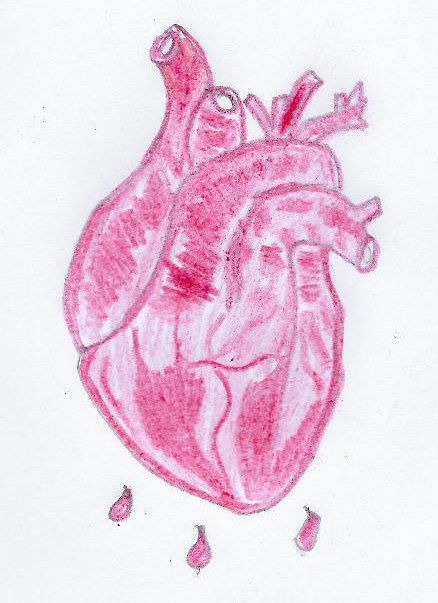
The boy awoke and crawled from the Abyss to eat his Dragon Mother’s heart in a rite that made him King of Annwn (he later gained his name – Vindos / Gwyn ‘White, Blessed, Holy’).
The End

Vindos killed Lugus as vengeance for slaying his Dragon Mother. Lugus took flight in the form of an eagle and perched wounded in an oak tree for nine nights with a sow beneath feasting on the rotten flesh and maggots from his wound. 

Uidianos sang Lugus down from the oak with three englyns and restored him to life.

Lugus returned the blow, shattering the Stone of Vindos, to pierce his enemy’s side. Vindos took the form of a raven and flew to Annwn where he hung wounded on a yew tree upside down over the Abyss and answered its riddles.

Night One: 

“Tell me
the hour the King
and Queen of Annwn
were born.”

“Not easy –
we were not born 
but ripped from the womb 
on the hour of the death 
of dragons.”

*

Night Two:

“Tell me
in your eternal
battle who killed
who?

“Not easy,
summer and winter
are mirrors – when one
kills the other kills 
too.”

*

Night Three:

“Tell Me
how many trees
are in the forests
of Annwn?”

“Not easy,
for they are without
number but ask me again
and I will name
them.”

*

Night Four: 

“Tell me
how many doors
there are to
Annwn.”

“Not easy,
for they are without
number but ask me again
and I will open
them.”

*

Night Five:

“Tell me
where divide 
darkness and light,
day and night?”

“Not easy,
for there are no
divisions – each follows
each in an endless
procession.”

*

Night Six: 

“Tell me
where the restless wind 
comes from and where
he rests.”

“Not easy,
for no-one but he
knows the location of the Lands
of the First and Last
Breaths.”

*

Night Seven:

“Tell me
how many 
stars are in the
Heavens.”

“Not easy,
for they will not
be counted until all
souls are in the
cauldron.”

*

Night Eight:

“Tell me
the fate of
your last drop 
of blood.”

“Not easy,
for I cannot divide it
from the ocean of blood
that will drown
the world.”

*

Night Nine:

“Tell Me
the hour the King 
and Queen of Annwn
will die.”

“Not easy –
we cannot live without 
each other and thus will die
together when all souls
are gathered.”

*

Vindos then fell into the Abyss.

These scenes had a basis in my personal encounters with the Abyss. I will be talking about those in part two, then in part three and four presenting my recent discovery of ‘Abyss Mysticism’ in the writing on medieval monastics and how this has helped me make a little sense of the abyssal visions behind this book.
Why I failed to write a Brythonic creation myth

In my attempted novel, In the Deep, I tried to imagine a story for the origins of Vindos / Gwyn, His kingdom in Annwn, and for the creation of the world. This was based on a combination of my readings of Brythonic and other Celtic and Indo-European and world myths and my personal gnosis. 

I worked for a year and a half on a story that had meaning for me and I felt Gwyn wanted me to write as the awen kept on flowing. Yet it didn’t speak to many humans and, in retrospect, although coherent, contained a lot of flaws.

Looking back, I feel it was a process I needed to go through. I genuinely believe I saw faces of Gwyn, such as the Boy in the Serpent Skins, that were meaningful for me and needed to journey with Him and write those tales.

Yet there were elements of the story I could never quite make work. My personal gnosis led me to perceive parallels between Tiamat in the Enuma Elish and a ‘found’ Goddess I know as Anrhuna who takes the form of a nine-headed dragon and is Gwyn’s mother and the Mother of Annwn.

In the Deep was written as an inversion of Enuma Elish ‘When on High’ reimagining what might have been a wider Indo-European origin myth centring on the slaying of a dragon from the side of the Deep rather than the victors.

It opens with a battle between the Dragons of the Deep (Annwn) and the Children of Don wherein Lugus / Lleu slays Anrhuna, the Dragon Mother. By cutting off Her nine heads He releases the dragon children of the nine elements*. He then cuts open Her womb and tears out Kraideti / Creiddylad (the Girl who will Bring Life) and Vindos / Gwyn (the Boy who will Bring Death). Lugus takes Kraideti to the stars and flings Vindos into the Abyss. Uidianos / Gwydion steals the magical jewels from Anrhuna’s foreheads and with them commands the dragon children to create the world. 

Although I’ve been able to picture the dragon slaying scene quite vividly I’ve never quite managed to see or write the creation of the world. I’ve ‘seen’ Uidianos and a circle of enchanters with their wands conjuring with the elements to form a world but can’t seem to connect it with the dragons.

The role of Gwydion as demiurge I derived from His creation of Taliesin in ‘The Battle of the Trees’ from ‘nine forms of consistency’ – ‘fruit’, ‘fruits’, ‘God’s fruit in the beginning’, ‘primroses’, ‘flowers’, ‘the blossoms of trees and shrubs’, ‘earth’ / ‘sod’, ‘nettle blossoms’, and ‘the ninth wave’s water’. 

In ‘The Song of the Great World’ Taliesin is created by God from ‘seven consistencies’ – ‘fire and earth, / and water and air, / and mist and flowers, / and the fruitful wind’. Like the the microcosmic Adam** his creation may be seen to mirror the creation of the world by God in this poem. It seems possible Gwydion was earlier seen as creating Taliesin and the world.

In ‘A British Myth of Origins’ John Carey suggests the Fourth Branch of The Mabinogion might contain an origin myth with Math’s kingdom whilst He has His feet in the lap of a virgin, Goewin, representing a timeless paradisal state. Gwydion’s scheming with Gilfaethwy to bring about her rape represent a fall. Gwydion and Gilfaethwy’s transformation by Math into a deer and a pig and a wolf, and their bearing of offspring, may explain the origin of animals.

Carey also suggests the story of Taliesin shapeshifting into various animals after stealing the awen from the cauldron of Ceridwen and the animal transformations of figures such as Mongan in the Irish myths function ‘as a device to connect the present with its origins, whether the beginnings of history or the transtemporal eternity of the Otherworld.’

It’s my personal intuition that Ceridwen may be a creator Goddess. That Her crochan ‘cauldron’ or ‘womb’ could be the vessel from which the universe was born. This is another strand that I attempted to weave into my book. 

If we look back beyond medieval Welsh mythology to the Roman sources we find no evidence whatsoever of a creation myth. Instead Strabo reports that the Gallic peoples (who according to Caesar derived their beliefs from the Britons) believe ‘men’s souls and the universe are imperishable’. Several authors speak of the belief that the soul is immortal. According to Caesar it ‘does not die but crosses over after death from one place to another’ showing existence in an ‘otherworld’ (potentially Annwn). Diodorus Siclus claims the Gauls ‘subscribe to the doctrine of Pythagoras that the human spirit is immortal and will enter a new body after a fixed number of years’. The key doctrine of Pythagoras is metempychosis and we find this throughout the Taliesin material wherein he speaks of his transformations. 

It seems possible we don’t have a Brythonic creation myth as the universe was viewed as ‘imperishable’ and the eternal soul as shifting through different shapes, potentially crossing from this world to Annwn and back again.

One of the things that has stood out to me whilst returning to the Taliesin material is that rather than telling of creation as given he instead poses riddles.  ‘How is the sun put into position? / Where does the roofing of the Earth come from?’ ‘Where do the day and the night come from?’ He mocks Christian scribes for not knowing ‘how the darkness and light divide, / (nor) the wind’s course’.

Taliesin seems to be claiming to know yet he leaves the answers a mystery. Could it be that our Brythonic ancestors treated these issues as mysteries rather than having clear cut myths and stories and explanations? 

If so could my failure to create a myth that works be based on the fact there have never been any direct answers and these things should be left mysterious?

If so it seems this book idea has played itself out for what it is but can go no further. I fulfilled my promise to Gwyn to write Him an origin story (something He didn’t ask for but that I did as an act of devotion to Him). It just didn’t turn out to be a novel sellable to humans. Which is ok. 

Where to go from here I’m not sure. I still want to write, I still need to write, in service to my Gods and to give voice to the awen from Annwn and within. To provide content for my patrons who continue to support me. But it might be that now I’ve become a nun of Annwn, Sister Patience, what I write will change.

It seems possible I will be taking a more meditative approach with a focus on mystery, which feels fitting for a nun dedicated to a God of the Deep.

*Stone, earth, water, ice, mist, wind, air, fire, magma.
**In her notes to ‘The Battle of the Trees’ Marged Haycock adds some references to medieval Christian texts where Adam is said to be created from ‘eight consistencies’ – ‘land, sea, earth, clouds of the firmament, wind, stones, the Holy Spirit and the light of the world’ or ‘earth (flesh), fire (red, hot blood), wind (breath), cloud (instability of mind), grace (understanding and thought) blossoms (variety of his eyes), dew (sweat), salt (tears).’

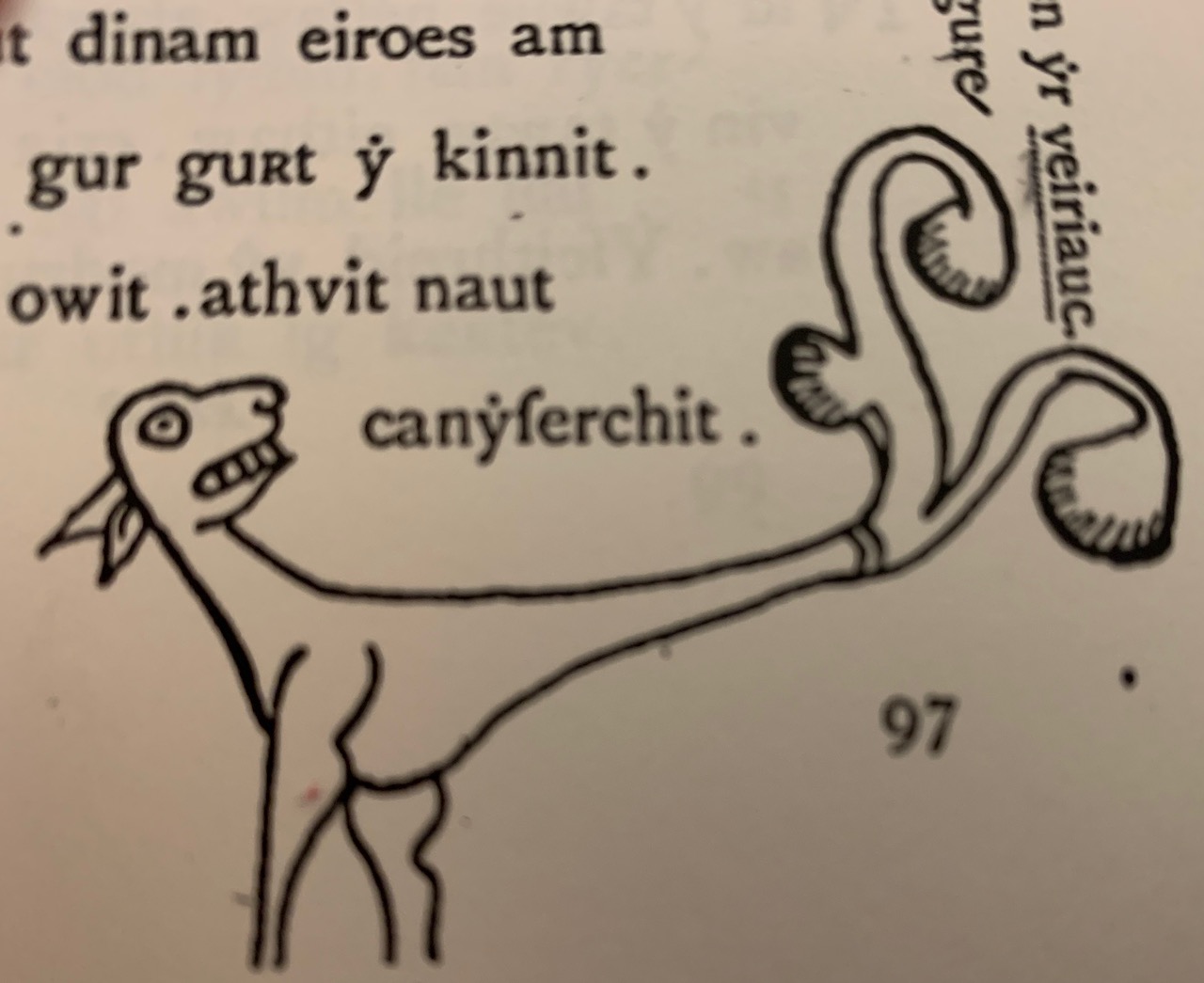
The Hound with the Serpent Tails

I am a mystery
with one end in Thisworld
and one end in the Otherworld.

My tails lead down the long dark tunnels
from light to darkness
and for the lucky ones
back out to the light of day again.

What is my origin?
Was I born at midnight?
From what union?

From what spell?

Oh what has the cauldron
got to sing of my birth to those
who see me as the guardian
of the Gates of Hell?

This image of Dormach, the favourite hound of Gwyn ap Nudd, is based on an sketch of him drawn by a monk in The Black Book of Carmarthen in ‘The Conversation of Gwyn ap Nudd and Gwyddno Garanhir’. Here he is described as ‘sleek and fair’ and as having a red nose. This description is similar to the Hounds of Annwn in the First Branch of The Mabinogion who are ‘gleaming shining white’ with ‘red ears’.

It is unknown why Dormach is depicted with serpent’s tails. It is likely due to his Annuvian nature. Nudd/Nodens, the father of Gwyn, is associated with a battle between red and white dragons and there is a mural of sea serpents in his temple.

In my novel-in-progress, In the Deep, I reimagine how Dormach came to be ‘the Hound with the Serpent Tails’. This story and other exclusive excerpts are available to my patrons on Patreon HERE.

Introducing the Boy in the Serpent Skins

Who would go
with the boy in the serpent skins
draped over one shoulder fastened with a bone pin

to the world of dead dragons at the bottom of the Otherworld?

Who would go with him clambering over the corpses where his hands
and feet are always bloody because the aftermath of the battle is endless?

Who would follow him down the trails of the scales of dead serpents
to where they have sloughed off their skins, one, then another?

Who would face what lies beneath, the glistening organs,
the hearts, the lungs, the livers hung up in caves,
the bowels woven into a pattern on a loom,
the heart strings strung on a harp?

Who would walk amongst those who took the pickings?

Who would run ragged through the caves of a hundred claws?

Who would refuse to admit defeat to the jaws that hang on the walls?

Who would take off all their masks and skins and expose not only raw flesh
and organs but what lies underneath
and hope it is a soul?

~

Vindos/Gwyn ap Nudd first appeared to me as the Boy in the Serpent Skins during some journeywork I was doing to find out more about his boyhood as part of the process of writing my novel-in-progress In the Deep.

The book begins in Annwn, ‘the Deep’, prior to the creation of the world. After his Dragon Mother is slain by the Children of the Stars and he is flung into and escapes the Abyss, the boy finds himself alone except for the corpses and ghosts of dead dragons and the devouring serpents who lie beneath. 

Over the past six months I have been journeying with him to find out more about this phase in his life and how it has been shaped by the challenges of the serpents and his descent and initiation into their savage and visceral culture. This has provided the raw material for a good part of the story of In the Deep.

In the image beneath he is pictured as he appears to me with grey skin, white hair and a white jewel in his forehead*, wearing white serpent skins fastened with a bone pin. He has seven fingers and toes with claws.** He carries a handful of white dragon jewels in his right hand and in the left a serpent’s tooth. Above him are the four winged ghost serpents with whom he forms a bond and come to serve him as his messengers – Tero, Goro, Fero and Kilya.

*I had thought this was an appearance unique to me until by coincidence I was re-reading Pagan Celtic Britain by Anne Ross and came across an image of a bronze head with a jewel in its forehead from Furness, Lancashire, not far from me!

**This is not unknown in Celtic mythology. In The Tain Cu Chullain is described thus – ‘Each foot had seven toes and each hand seven fingers, the nails with the grip of a hawk’s claw or a gryphon’s clench.’ Cu Chullain’s former name was Setanta and he might have been known in northern Britain as Setantios, a possible deity of the Setantii tribe here in Lancashire. 

You can support my work in return for exclusive excerpts from In the Deep HERE.

2022 – Career Failure and What I am Really Here to Do

The first half of 2022, for me, was characterised by a disappointing departure from a career in the environmental sector. This was because I couldn’t meet the demands of higher than trainee level jobs due to a lack of people and project management skills and struggles with irregular routine, travel, night work, multi tasking and working under high pressure due to my autism.

This left me burnt out and not so much depressed but facing a depressing reality. In spite of being academically intelligent I will always be restricted to menial day jobs. When I first got my autism diagnosis I was told it would mean I could ask for ‘reasonable adjustments’ in the workplace. However, this did not mean I would be able to stay in jobs where I did not meet all the criteria.

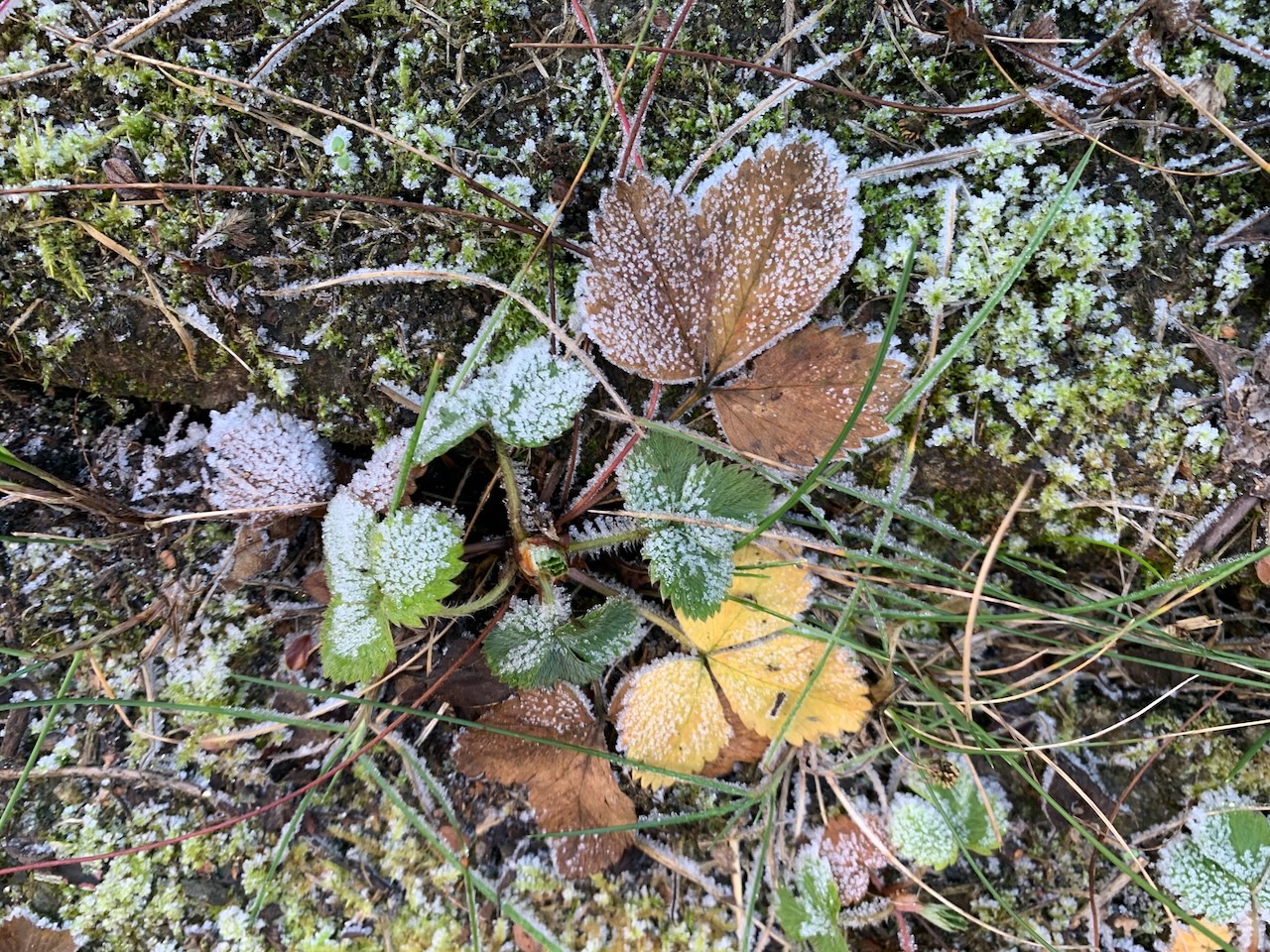
Our primroses, after the Arctic Blast, looking like how I felt when I was burnt out.

On the upside, my career failures led me back to my spiritual vocation as an awenydd dedicated to Gwyn ap Nudd and what I am really here to do. To where my true passion and abilities lie in my creativity as a writer and poet and journeyer of the deeper realities of thisworld and the otherworld of Annwn.

Whilst I was struggling in my ecology job I was led back by Gwyn to a writing project I began in the first lockdown in which I drafted a book called The Dragon’s Tongue, a Brythonic origins myth, drawing on other Indo-European parallels.

I’d given it up partly because the plot was incoherent and partly because a part of me didn’t want to retell our dragon and giant slaying myths, how the culture Gods have come to dominate the Gods of nature and of Annwn, even though my work was exposing the violence and hegemony by writing the otherside.

What good could come of picking at and opening old wounds when, instead, I could be out on the land, healing the earth by re-wetting and growing and planting?

These questions have remained in my mind as I have been recalled to my mythic project which is manifesting as a three part series of novel length called The Forgotten Gods. The first book, which I am currently focusing on, is called In the Deep. It is a dark and violent book. It begins in Annwn with the slaying of the Dragon Mother, Anrhuna, and the tearing of her children, Vindos and Kraideti*, from the womb by Lugus, one of the Children of Don. Kraideti is taken to the stars and Vindos is flung into the Abyss. The book focuses on His crawling out to win the kingship of Annwn, to find His lost sister and to defend His realm against and to take vengeance on his enemies.

There’s a lot of violence, there’s a lot of descent, but there is also transformation and healing for Vindos succeeds in building from the bones of dead dragons the beautiful kingdom of Annwn we know in our myths today and transforming the sorrows of the dead, who He rules over, into joy at His feast.

Kraideti has a role, with Anrhuna’s dragon children, in the creation of the world and bringing of life and discovers Her power as a Goddess of seasonal sovereignty.

Our winter hellebores, flowering ‘late’ this year due to the cold snap, Creiddylad knows best…

I don’t know why I’ve been given these stories to work with only that I have to. Perhaps there is a process of mythic and/or psychic healing taking place or perhaps the Gods have got me writing them for their own undecipherable reasons.

I have learnt to accept that inspiration does not come with an explanation.

Philosophical ponderings aside, on a practical level, I completed my first full draft of In the Deep before my winter solstice deadline at 127,000 words and 317 pages. It is mainly prose, with interspersed poetry, and of novel length. The core plot works. It has found its form. I am now working on the second draft, expanding and developing sub plots, characters and depictions of the worlds.

Another way in which I have been fulfilling my spiritual vocation is ‘building the Monastery of Annwn’ as ‘a virtual space and place of the sanctuary for those who worship and serve the Gods and Goddesses of Annwn’. This task was assigned to me by Gwyn in April and, since then, I have set up a website and opened the monastery to members. We have formulated ‘the Rule of the Heart’ and ‘Our Nine Vows’. Four of us took the vows in October and are living as monastic devotees of Annwn. We have also started running a monthly meditation group focusing on reading Brythonic texts in a lectio divina style. Beginning with ‘The Conversation of Gwyn ap Nudd and Gwyddno Garanhir’ we have had an excellent introductory talk by translator, Greg Hill, and participants have experienced powerful and insightful meditations.

In terms of outdoor work my departure from an environmental career and commitment to monasticism has led me back to taking better care of our garden and of my local greenspace, Greencroft Valley, where I’m hoping to team up with a newly formed group called ‘Guardians of Nature’ based on the Alderfield allotment to further develop the wildflower meadow and run some local history and plant and tree identification and folklore walks.

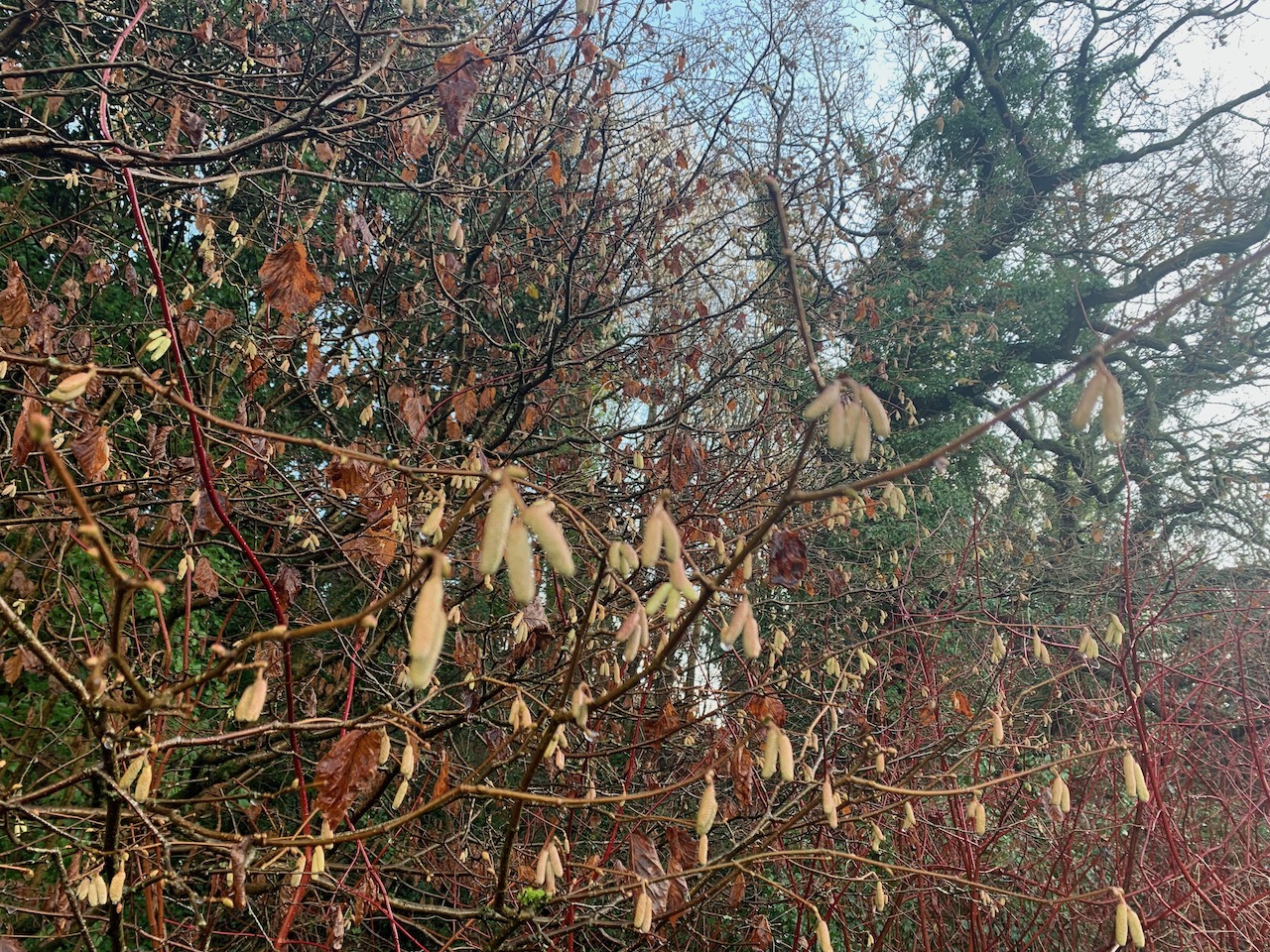
Hazel catkins in Greencroft Valley – a sign of new life as an old year dies and a new one begins.

In my spiritual practices and writing and work for the monastery I am fulfilled.  I am doing what I am really here to do. And I am able to do it because I’m living off savings from my environmental work, live with my parents and receive board and food in exchange for housework and gardening, and receive a very small income from patreon supporters and from book sales.

If you would like to support my writing and receive a quartlery newsletter, exclusive excerpts from In the Deep and other rewards please consider becoming a patron HERE.

*These are ancient British names for Gwyn ap Nudd and Creiddylad. Whilst Vindos is partially attested Kraideti is partly reconstructed, partly made up.

He Will Guide The Dead Back Home

For Gwyn ap Nudd

There’s a sea behind a river,
behind a brook, behind a stream,
and when the stars within it gather
He will guide the dead back home.

There’s an ocean in the cauldron
where the stars began to burn
and as our candlelight grows dimmer
He will guide the dead back home.

His is an infinite vocation
in those dark and starry seas
and when the stars depart their stations
He will guide the dead back home.

When the seas are black and bloody
and the stars are but black holes
all souls to Him He’ll gather –
He will guide the dead back home.

When the cauldron’s but a memory,
seas and stars are but a dream,
all souls in Him He’ll gather –
He will guide the dead back home.

This poem appears in the later part of my book-in-progress ‘In the Deep’ and was written by Maponos/Mabon for Vindos/Gwyn ap Nudd. 

It felt fitting I share it tonight, on Nos Galan Gaeaf, as a way of honouring Gwyn as He rides out with His hunt to gather the souls of the dead.

In the background are my doorway to Annwn and photographs of my ancestors.