Creiddylad’s Garden

Creiddylad
most majestic maiden
in the Islands of Britain,
let me know your
majesty

in this garden

on my knees
two hands clasped
together on this trowel
making offerings
of water

amongst flowers
where you walk unveiled,
stunning, bees dancing
around you.

Let me be your bee!

Feed me
when I’m hungry.
When I fall exhausted
pick me up gently

and I will make
the sweetest honey.

“Stay here in this garden,” my patron god, Gwyn ap Nudd, advised me a week before the lockdown. A couple of days before my conservation internship was cancelled and, like many, I was rendered jobless.

We’ve been on lockdown in the UK for over a fortnight now and how I’ve to-and-froed, some days accepting this advice and, on others, after reading the news, wishing I was doing something more important, more heroic, than shopping and cleaning for my parents, tending the garden, doing my best to find the focus to pray, meditate, spend time in devotion to my gods, and to write for my supporters.

My main battle has been against feelings of guilt and uselessness caused by my awareness of the utter contrast between my easy life, touched by the bliss of the spring sun, and the hell that the nurses and doctors are going through on the front line, risking their lives fighting for the lives of others. The risks taken by the funeral services. The chaos and stress faced by supermarket staff. Our dependence on the long hours and monotonous work of fruit and veg pickers usually imported from abroad.

I’ve thought of applying for, have actually applied for, some of these jobs (which may have necessitated moving out of my parent’s house so I do not put them at risk), but nothing has come of it.

“Stay here in this garden.” I accept the gods have their reasons when the Blasted Oak, spelling disaster, appears in a tarot reading on what will happen if I take a veg picking job.

And deep within I know if I took any of the above jobs I’d likely get physically or mentally ill. That there is something fundamentally wrong with this industrialised and militarised system that keeps comparing the ‘fight’ against this virus with the Second World War and tries to inspire a wartime ethos.

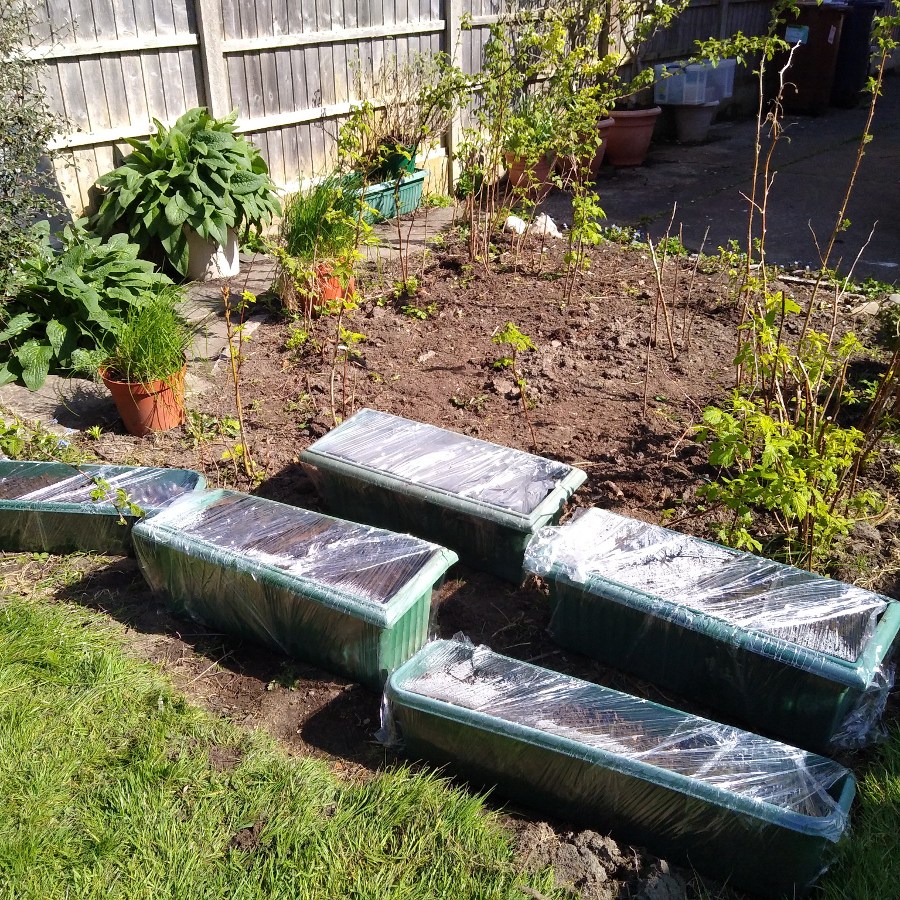
And so I tend my parents’ garden, cutting back years of overgrowth, clearing the paths, weeding amongst the many beautiful flowers that already grow here – hyacinths, daffodils, bluebells, honesty. And the shrubs and trees – apple, pear, rose, quince, camelia. Watering the raspberry canes. Sowing herb and lettuce seeds in troughs and veg seeds – carrot, turnip, onion, cauliflower, broccoli – in the soil.

And somewhere along the way it enters my mind this is ‘Creiddylad’s Garden’. And once the thought has entered it will not leave. I come to see the face of Creiddylad, ‘the most majestic maiden in the islands of Britain’, one of our Brythonic goddesses of flowers and spring, in each flower.

Creiddylad is a sovereignty deity who walks between worlds and lovers. This ‘majestic maiden’ is truly a majesty, a Queen, the lifeforce of nature who inspires great awe in her worshippers and the male deities, Gwyn and Gwythyr, Kings of Winter and Summer, who fight for her every Calan Mai.

Through the Winter she dwells with Gwyn, in the Otherworld, as Annwn’s Queen. In the Summer, with Gwythyr, she is May Queen, a great sovereign in Thisworld, revealing herself slowly flower by flower.

In Creiddylad’s contrary nature I find a better understanding of my own pulls between darkness and light, Thisworld and Otherworld. There is a part of me that wants to walk with Gwyn, a warrior and psychopomp, facing death, disease and sorrow. And at the same time an awareness he and other humans do this so the rest of us can appreciate the flowers and the sunlight and the lives that are our gifts.

It sometimes seems easier, more worthy, to embrace pain than pleasure. Why? I do not know. Only that in Annwn the sadness of the dead is transformed into great beauty and joy, and it this is that Creiddylad brings with her when walks from the Otherworld, into the light, and embraces Gwythyr.

Many of the flowers in my garden speak of similar myths through the correlates of other cultures. The narcissus, or the daffodil, was the plant Persephone was picking before Hades took her to… Hades. The hyacinth was born from the blood of Hyacinth, the lover of Apollo, killed by his rival Zephyrus, and its beautiful petals are inscribed with ‘AI AI’ ‘Alas’. Lungwort’s petals turn from pink to blue as the flowers are pollinated, edging toward death, like flesh, or deoxygenated blood.

Nature and myth, death and life, Thisworld and Otherworld, are deeply intertwined in Creiddylad’s garden. A place where I work slowly, contemplating the mysteries, where I meet flowers, goddess, gods. It seems they don’t want me to be a hero but instead a small suburban bee offering a taste of Creiddylad’s honey.

Caledfwlch

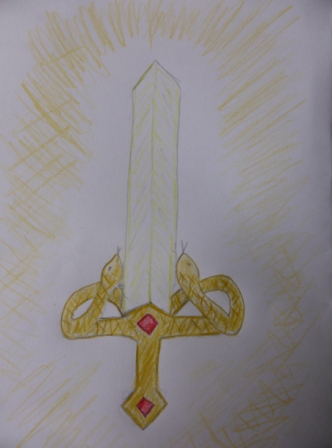
He got up with Arthur’s sword in his hand and the image of two golden serpents on the sword. When the sword was drawn from the sheath, it was like seeing two flames of fire from the serpents’ jaws. And it was not easy for anyone to look at that, because it was so terrifying.’
Rhonabwy’s Dream

On the edge of Celyddon two serpents
danced, ziz-zag bodies tumbling, twining, jaws
bared, jets of fire
hissing from their sword-
like tongues as they rose and fell in terrifying
splendour beneath the golden

sun competing for the favour of a golden-
eyed female. Arthur followed the serpents’
tracks to behold the terrifying
sight. His jaw
dropped as their sword-
like bodies intertwined in deadly combat; fiery

and tempestuous as the fires
of Hell. From the burning undergrowth a golden
lizard scurried to avoid their sword-
play – a flash in a serpents’
eye before jaws
closed over him and a terrifying

darkness. Remembering the terrifying
battle between gods of ice and fire;
Flame-Lipped and Wolf-Jaws,
white and golden-
haired interlocking like serpents
wielding flaming and ice-rimmed swords,

Arthur decided he wanted a sword:
sharp-edged, cloud-lit, to tame those terrifying
rivals. He grasped the serpents,
hissing and spitting fire
in his golden
gauntleted hands beneath their jaws,

took them to the forge of anvil-jawed
Gofannon. “I want a sword
of purest gold,
beaten into the most terrifying
form; living, breathing two flames of fire,
harnessing the strength of these struggling serpents.”

Gofannon plunged the serpents, flickering-eyed, wide-jawed,
into his fire, skins sloughing, blackening, goldening,
intertwining as one terrifying sword.

Caledfwlch

*This is one of the poems that didn’t make it into Gatherer of Souls, but relates to the theme of Gwyn’s opposition to Arthur. The form I have used is the sestina.


Gwythyr and the Lame Ant

In Culhwch and Olwen there is an episode which opens with a curious scene. Gwythyr ap Greidol, ‘Victor son of Scorcher’, ‘was travelling over a mountain’ and heard ‘weeping and woeful wailing… terrible to hear.’ The source was a burning anthill. ‘He rushed forward, and as he came there he unsheathed his sword and cut off the anthill at ground level and so saved them from the fire.’

anna-popovic-187219-unsplash_med

What to make of this strange opening? Why, on earth, was the anthill on fire? Was Gwythyr having a burning bush moment akin to that of Moses on Mount Sinai? The fire shared a similar revelatory and numinous quality. However, the anthill, unlike the bush, definitely appeared to be burning up.

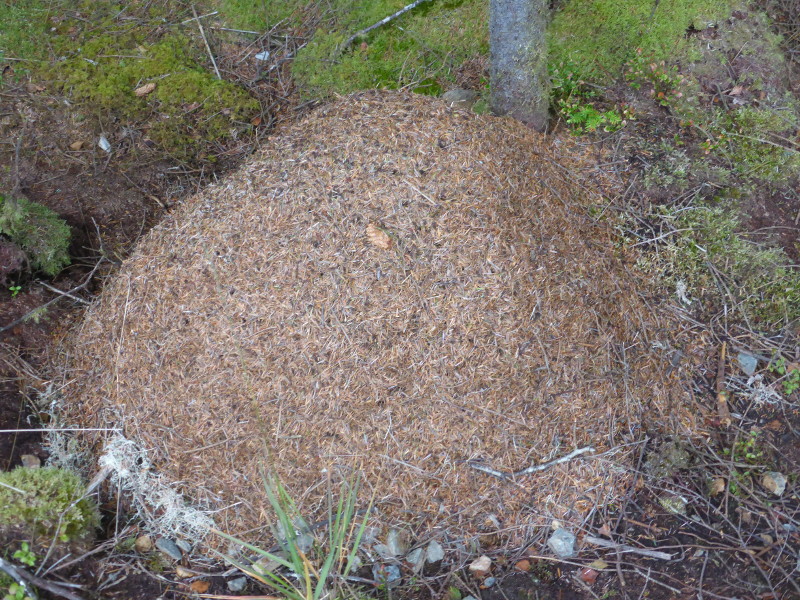
Did Gwythyr’s scorching feet cause the fire? His patronym suggests that, like his father, he is a god of fire and war. If so, his rescue of the ants shows a softer and more compassionate side to his nature. Or did the anthill catch fire on its own? It’s well known that wood ants orientate their complex homes (which have tunnels, storerooms, bedrooms, nurseries and even a graveyard) south toward the sun as if using solar panels in order to harness the energy for heat. Did it just get too hot?

Wood Ant Nest Coed y Brenin

Whatever the case, Gwythyr, rescued the ants. The symbolism of this act reveals Gwythyr’s connections with fire, the sun, the South, summer, and the building, heating, and saving of civilisation. These underlie the rest of the episode and his role in the narrative of Culhwch and Olwen.

Following their rescue the ants said to Gwythyr, ‘Take with you God’s blessing and ours, and that which no man can recover, we will come and recover it for you.’ ‘After that’ they ‘brought the nine hestors of flax seed that Ysbaddaden Bencawr had demanded of Culhwch, in full measure, with none missing except for a single flax seed, but the lame ant brought that before nightfall.’

1024px-A_Formica_rufa_sideview

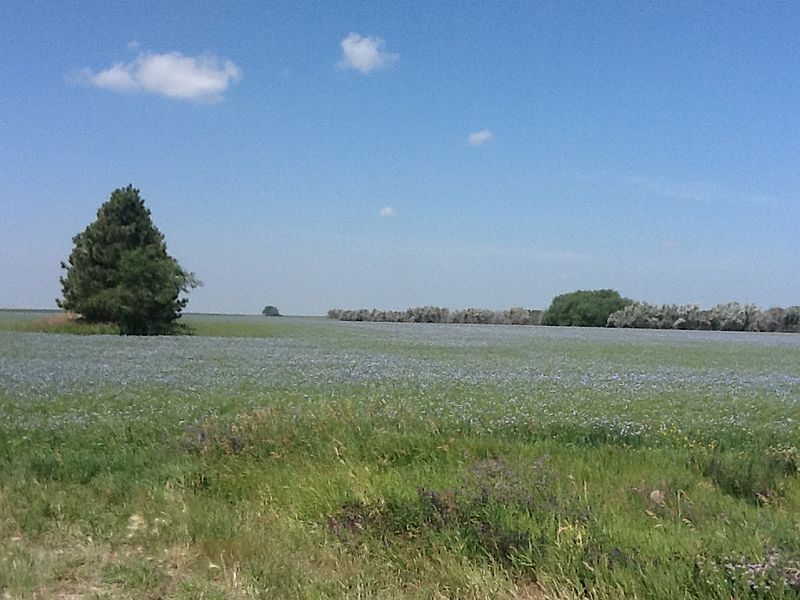
The retrieval of the flax seed was one of the forty amoethau, ‘impossible tasks’, that the giant, Ysbaddaden Bencawr, set Culhwch to win his daughter, Olwen. The flax seed was sown in ‘tilled red soil’ the day Ysbaddaden first met Olwen’s mother yet had never flowered. Culhwch was told he must resow it in a newly ploughed field to make a veil for Olwen in preparation for their wedding day.

Culhwch and Olwen is rooted in the folk motifs of ‘The Giant’s Daughter’ and ‘Six Go Through the World’. However, in this retelling, Culhwch did not fulfil the tasks with six helpers. Instead, his uncle, Arthur, completed them with aid from six warriors and a retinue of outlandish figures with strange abilities (such as Sgilti Sgafndroed who ‘would travel along the tops of trees’, Osla Gyllellfawr whose dagger could bridge a torrent, and Clust son of Clustfieniad ‘if he were buried seven fathoms in the earth he could hear an ant fifty miles away stirring from its bed in the morning’) and pre-Christian gods including Gwythyr, Amaethon the plough-god, and Gofannon the smith-god.

On the surface this narrative is about the overthrow of the primitive and oppressive reign of Ysbaddaden to bring fertility to the land as symbolised by Culhwch and Olwen’s marriage. The story of Gwythyr and the Lame Ant shows how, through an act of kindness, Gwythyr enlisted the aid of helping insects to perform a task no human could accomplish – crawling into the airy interstices of the soil to retrieve the flax seed. It’s possible to imagine that in longer versions there was far more suspense surrounding whether the flax seed was gained by the giant’s deadline and veritable relief when the lame ant finally appeared, limping valiantly, to add the final flax seed to the measure. The sowing and flowering of the seed demonstrates the fertilisation of a barren landscape.

800px-Flax_field

This gentle and benign episode is at odds with the violence pervading the rest of Culhwch and Olwen. Giants were mutilated and beheaded. Orddu the witch was cut in half and her blood drained and bottled. Ysgithrwyn was slaughtered for his tusk, Twrch Trwyth’s seven piglets were killed, and the Twrch only just escaped. Culhwch’s quest to win Olwen was twisted by the narrator to demonstrate Arthur’s civilising of the wild and banishment and all-out slaughter and destruction of the Other.

This conflict is embodied in Arthur’s allegiance with Gwythyr against his rival, Gwyn ap Nudd. In other texts we find out that Greidol was one of Arthur’s forty-two counsellors and that Gwythyr was the father of one of Arthur’s three wives (who are all named Gwenhwyfar!). Gwyn is a ruler of Annwn contrastingly associated with wildness, winter, the North, destructive Annuvian spirits, and death.

In Culhwch and Olwen, Arthur went North to intercede in the battle between Gwyn and Gwythyr for Creiddylad, a fertility goddess. He rescued Gwythyr and his men from Gwyn’s imprisonment, then bound the rivals in combat every May Day and said neither could take the maiden until Judgement Day. This seems to be a Christianised reworking of a seasonal myth in which Gwythyr, Summer, won Creiddylad on Calan Mai and this was surrounded by fertility rites, then she returned to Annwn with Gwyn, Winter, on Nos Galan Gaeaf, and Gwythyr and the powers of summer were imprisoned.

Once Arthur had defeated Gwyn – the Head of Annwn – and the body of Annwn had fallen, he usurped Gwyn’s leadership of the hunt for Twrch Trwyth and slaughtered Ysbaddaden. When his nephew, Culhwch, married Olwen, his civilising hegemony over the wild and the Otherworld was complete.

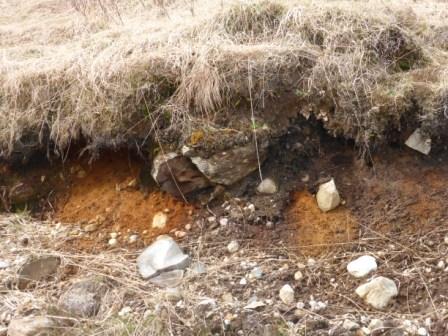
Yet it will not last forever. Otherworld gods don’t stay dead for long and dead giants, witches, and monstrous boars, having joined the furious and vengeful spirits of Annwn, will not remain shut out. Arthur is still dependent on the aid of the gods. And the gods of civilisation are dependent on the Other. Gwythyr depends on the help of the ants to traverse the chthonic regions beneath the red soil to rescue the seeds from the underworld, from the clutches of the spirits of Annwn. And one of those ants is lame. This mission is dangerous and touch-and-go. As more and more of our soil blows away, becomes barren and red, it seems less and less likely the Lame Ant will make the deadline.

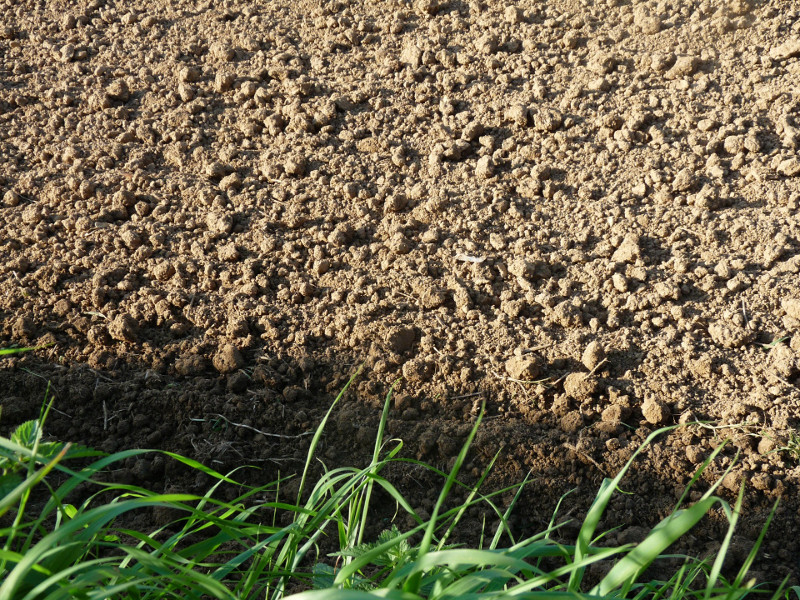
soil_free_stock_photo_med

Uffern ar y Ddaear

Uffern ar y Ddaear – Hell on Earth

I’m surrounded by the smell of dead grass
dreaming of a machine that creates water from nothing.
Someone’s got the radio on too loud and always a baby is wailing.

I lift my nose and smell the smoke on the wind and my throat
is already whining for my master dead on the moors
like cottongrass, heather, butterfly, grasshopper,

where the battle that began on the first of May is still going on
between a fire ignited by one who belongs to the inferno
and the fire fighters with hoses, beaters, leaf blowers.

If only they could bring the rains and autumn winds,
summon them into a summer already too hot and too long,
where reservoirs empty and carbon reservoirs bake, burn, reignite.

I hear they’re trying to save the mast, 1000 feet high, which I saw
lit red like a warning sign beneath the full moon transmitting not only
radio, television for the BBC, ITV, C4, signals for mobile phones,

but some kind of howl we’ve somehow got used to between silences.
What if it goes down like the plane that crashed on the 27th of February
in 1958 when the snow was so cold no-one could rescue the 35 dead

who still roam the hill cursing the faulty radio signals and the drones
flying overhead in the way of the helicopter pouring its cauldron
of water from the reservoirs over the baking baking peat?

When the endless chatter ceases will everyone hear the howl
pouring the dead down Winter Hill like radio waves
from the spring where the Douglas starts

and the mourning song for Winter’s King
dead like a bog body amongst the burial mounds
beneath the burning feet of his rival who is ever victorious?

When we try to shut Hell’s gate with torches on each side
and inside red as a death hound’s oesophagus will we realise
the throat will never close and the howl wrenched from it is us?

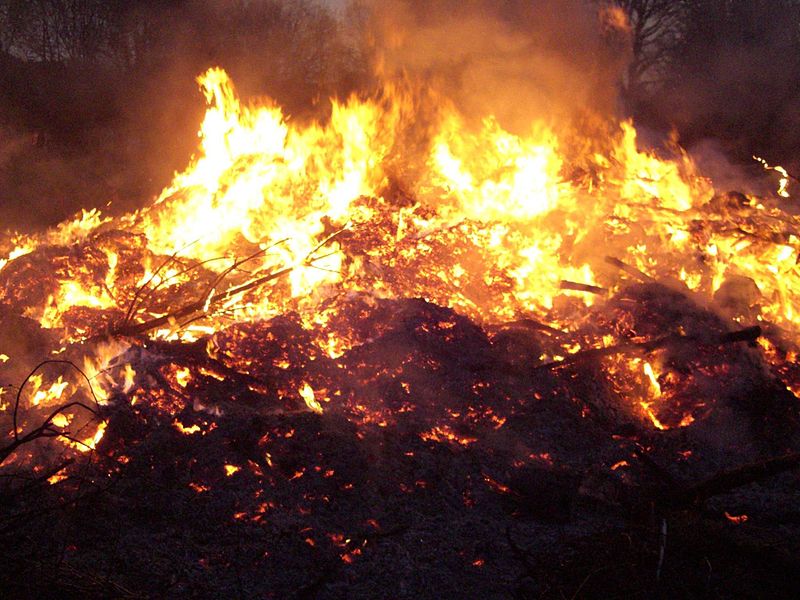
800px-Campfire_flames

*This poem is based on the Winter Hill fire and the mythic battle between Gwyn ap Nudd (Winter) and Gwythyr ap Greidol (Summer).

Scorched

The UK is in the throes of a heat wave. Here in Lancashire temperatures have reached a scorching 30 degrees for four consecutive days. It’s been uncharacteristically warm and dry for two months. Preston, dubbed the ‘wettest city in England’, has barely seen an inch of rain since the beginning of May. Our lawn is scorched, our raspberries are shrivelled, the rivers and streams are running low.

In northern British mythology the first of May is the day that Gwythyr ap Greidol ‘Victor son of Scorcher’ beats Gwyn ap Nudd ‘White son of Mist’ in a ritual battle to win the hand of Creiddylad, a fertility goddess whose name may stem from creir/crair ‘treasure… object of admiration or love.’

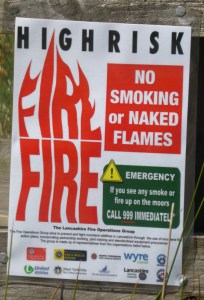
Scorched Fire Sign

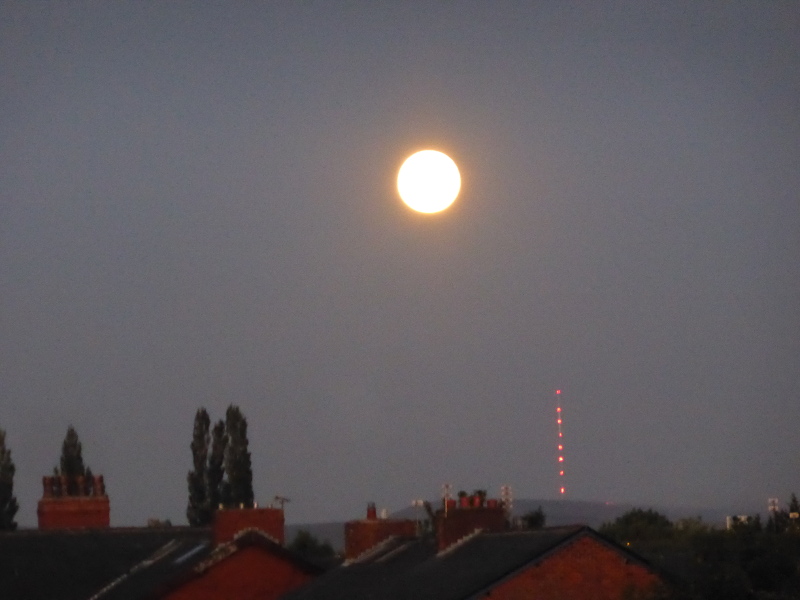
Gwythyr ap Greidol’s name suggests he is a god of victory in combat, the scorching fire of war and the heat of passion. His is the spark that gives life to the land but also initiates the wildfire. Over the last week wildfires have raged across Saddleworth Moor, Rivington Moor, and Winter Hill. The latter seems symbolic of Gwythyr, Summer’s King, beating Gwyn, Winter’s King, on his home ground. Of course I haven’t been up to Winter Hill whilst it is ablaze (last night it reignited in multiple locations), but I noticed the portent of the full moon over the mast, lit up red like a warning sign.

Scorched Winter Hill Warning

People have been evacuated from their houses and schools closed. Less has been said about the numerous birds, small mammals and insects who have lost their lives or been driven from their homes.

Just as concerning is the Ribble running the lowest I have ever seen, banks of silt and sandstone bedrock exposed, tributaries becoming drier and drier, pond water getting lower and lower. Water shortages have already hit in the South East and Staffordshire. In the North West United Utilities are recommending that we cut down on water use. On next week’s forecast there is not a drop of rain in sight.

Scorched Ribble

May 2018 was the hottest on record in the UK and June looks set to be a record breaker too. What is causing this uncharacteristic heat, empowering Gwythyr, the Victor, to increasingly destructive victories?

***

Research suggests this long period of hot weather results from the effects of man-driven global warming on the North Atlantic Polar Front Jet Stream. The Jet Stream is a ‘ribbon’ of winds blowing east to west at up to 200 miles an hour 9 to 16 kilometres above the earth’s surface over the mid-latitudes. It arises due to the contrast between warm tropical air and cold polar air. The differences in the pressure of warm and cold air produce a ‘pressure gradient force’. These winds would blow from high to low pressure, from south to north, if it wasn’t for the Coriolis effect.

jet_streams_wpclipart

The higher the contrast in temperature the stronger the Jet Stream. It is strongest in winter due to the cooling of the poles and weakest in summer due to their warming. Low pressure systems causing wet windy weather occur to the north of the Jet Stream and high pressure systems causing warm settled weather to the south. During the winter, when it’s strong, the Jet Stream lies south of the UK and gives us rain and wind. If it remains to the south we tend to have wet summers too. If the Jet Stream weakens in the summer and shifts north of the UK we are more likely to have hot still weather.

According to Dr. Jennifer Francis and Stephen Vavrus the warming of the Arctic is lessening the temperature gradient between the equator and the North Pole and causing the jet to slow and become ‘wavier’. James Mason explains that when ‘the eastwards progression of these upper waves becomes sluggish or stalls’ this ‘leads to prolonged weather-conditions of one type or another’ like this heat wave, which is dangerous not so much due to its temperature but the length of time without rain leading to wildfires and water shortages and potentially to drought and crop failure.

***

The root of global warming is humanity’s reckless drive for economic growth at the cost of the environment. Our government are aware of the increasing dangers of drought in the summer and flooding in the winter and are taking steps to deal with the effects but not the cause. Instead they are pushing ahead with plans to create more houses, more roads, more jobs; pumping out more greenhouses gases, removing more green space, causing more warming. Here in South Ribble alone 9000 houses are being built along with new and expanded roads and business parks. Preston, South Ribble, and Chorley are being merged into one urban conglomerate with parks as our only green spots.

Lostock Hall Gasworks Development

Dissenting voices are not listened to by the victors. From their positions of wealth and comfort they refuse to see, acknowledge, care about the effects their victory is having on the land and its creatures.

In British mythology Gwythyr and his father sided with Arthur against Gwyn and his spirits, the ancient animals, the monsters, the giants, the witches, and were victorious. In modern Britain the Arthurian court of war-mongering treasure-hoarding politicians and business leaders reign supreme.

800px-Holy-grail-round-table-bnf-ms-120-f524v-14th-detail

What to do in a world where history is determined and written by the victors, when, as Gwyn knows before going into battle every May Day, as Walter Benjamin says, ‘this enemy has not ceased to be victorious’?

Perhaps we must look beyond battle, beyond victory, which can only makes us the next victors, for other ways to our bit for the scorched land, the drying rivers, the dying creatures, the cast-out gods.

SOURCES

Ed Walker, ‘Winter Hill fire reignites and is in multiple locations’, Blog Preston,
John Mason, ‘A Rough Guide to the Jet Stream’, Skeptical Science,
Francis Perraudin, Helen Pidd and Kevin Rawlinson, ‘A hundred soldiers sent in to tackle fire on Saddleworth Moor’, The Guardian
Walter Benjamin, ‘On the Concept of History’, Marxists.Org
BBC Weather, Penwortham, BBC website
Climate change the jet stream’, Climate Central
Preston’s named wettest place in England’, Lancashire Evening Post,
UK weather: Water shortage warnings and hosepipe bans as heatwave intensifies’, The Indepedent
What is the jet stream?’, Met Office

Burial

A Poem for Calan Mai

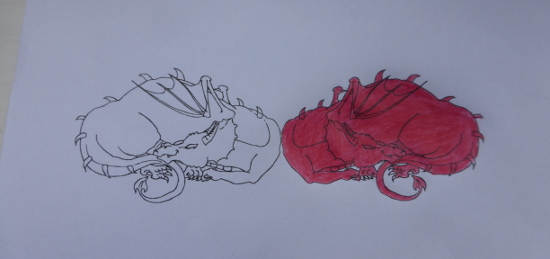
Two gods fight. Two dragons circle the sky.
A scream is in my mouth – soon my god will be gone.

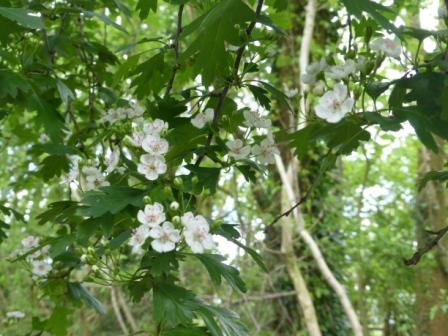
He dies so the bluebells, mayflowers, hawthorn blossoms thrive,
baby birds pecking from eggs stumbling pink into the dawn.

There will be a victory tonight and there will be a wedding.
There will be a death tonight and there will be a burial.

Whilst lovers dance the maypole and tryst in the woods
I will walk alone without a bouquet and in silence

down forgotten paths to the castle of cold stone
where winter is entombed while summer rules

to pay my regards in tears of dew and mourning songs
amongst the kindly fay, the winged horses, the howling hounds.

While others laugh at the wedding I will weep at the funeral.
I will bury two dragons in the stone chest of my heart.

I will bury two dragons

She Walks Between Worlds and Lovers (Calan Mai)

It is summer in this-world when she is here
winter in this-world without her.
In Gwythyr’s arms she is Lady Life:
coming to be as the first snowdrop
purple yellow crocuses are her slippers
pink red primroses her cloak. Her smile
her lips are daffodils’ long trumpets.
May flowers weave her grassy hair
as she embraces this-world’s ruler.
In dewy glades Creiddylad is May Queen
in sacred marriage headdress a veil of hawthorn
wedding dress woven from wood anemone
wood sorrel she lies with him in woodlands
of bluebells starwort becoming buzzing fields
heliotropic gaze of ox-eye daisies poppies
face alive with vibrant butterflies and bees
exulting in the dance of pollen’s gold dust
until the seasons turn and cold winds come
she sees her time in this-world is over
and walks between worlds and lovers.

Blubells and Starwort

The Favour of Creiddylad, May Queen and Queen of Annwn

Wood anenomeA few weeks ago I published an article on the story of Gwyn, Gwythyr and Creiddylad, which highlighted its significance as an ancient British seasonal myth originating in the Old North. This showed Creiddylad’s importance as a Brythonic goddess connected with the sovereignty of the land, outlined a depiction of her viewpoint and described her nature as a spring maiden and queen of Annwn.

It was my intuition Gwyn’s pride in being Creiddylad’s lover and references to his invocation in her name suggested she was an important fertility goddess in her own right. More recently I found this idea backed up by analogy with Ann Suter’s reading of The Hymn to Demeter. Like Persephone with Hades, Creiddylad is a free agent in a sacred marriage with Gwyn. As king and queen of Annwn they form a divine couple equal in power and independence.

To win Creiddylad’s favour on Calan Mai, Gwythyr, a human ruler, must descend to Annwn and battle against Gwyn. His willingness and skill are conditions of Creiddylad’s becoming his May Queen. Thus she returns to this-world to bring fertility to the land and makes him her king for the summer. Gwythyr’s reign is only temporary. On Nos Galan Gaeaf Gwyn takes her back to Annwn where in turn she presides over the processes of life and death.

One of the important lessons of this story is that all life comes from and returns to Annwn. The fertility of this-world is dependent on the underworld and its deities. This is reflected in the simple necessity of planting a seed underground and in offerings our ancient ancestors made in ritual shafts and pits. All trees and plants come from and decay back into the soil. This is ultimately the fate of our flesh and bones.

The beauty of the flowers of May is dependent on the deaths of many others. This applies to human ancestry. Our fruitful modern existence is founded on the death and toil of countless people. As is our creativity. Thus the Awen can only be won by making Gwythyr’s descent down through the ancestral heritage of our soil, establishing our own relationships with the underworld deities. Personal sacrifices must be made and their bounty shared.

Only then will our hawthorns blossom and the favour of Creiddylad, May Queen and Queen of Annwn be won.

Hawthorn*With thanks to Brian Taylor for pointing me toward Sarah Pike’s review of Ann Suter’s The Narcissus and the Pomegranate.

Coille Coire Chuilc: Seeking Annwn in Caledon

Coille Coire ChuilcThere once existed a tradition amongst the northern Britons of locating Annwn north of Hadrian’s wall. Its origins may be found in the writings of Tacitus about tribes beyond the northern frontier who spoke a different language to the Britons and were impossible to subdue. Ptolemy was the first person to refer to this area as Caledonia Silva.

The 6th C classical writer Procopius said: ‘Now in this island of Britain the men of ancient times built a long wall, cutting off a large part of it; and the climate and the soil and everything else is not alike on the two sides of it… on the north side… it is actually impossible for a man to survive there even half an hour, but countless snakes and serpents and every other kind of wild creature occupy their area as their own. And, strangest of all, the inhabitants say that if a man crosses this wall and goes to the other side, he dies straight away… They say, then, that the souls of men who die are always conveyed to this place.’

These writings show within the Romano-British culture of the Old North the Caledonian forest was considered to be a wild, hostile place associated with death.

Culhwch and Olwen (1350), a medieval Welsh text set during the Arthurian period preserves remnants of these superstitions. In the stories of Gwyn, Gwythyr and Creiddylad and the Very Black Witch, Arthur ‘goes north’ to inhospitable lands. Both stories feature Gwythyr ap Greidol, a northern ruler and warrior of Arthur’s court and Gwyn ap Nudd, a king of Annwn. The latter is an ancient British god associated with wild places and the dead. It is my intuition it was after a vision of Gwyn and his host at the Battle of Arfderydd that Myrddin Wyllt went mad and fled to Celyddon (Caledon) where he wandered thirty years amongst gwyllon (wild, ancestral spirits).

As the story of Gwyn, Gwythyr and Creiddylad is set at Calan Mai, a friend and I decided to head north to Coille Coire Chuilc (one of the southernmost remnants of the Caledonian forest) on the May bank holiday weekend.

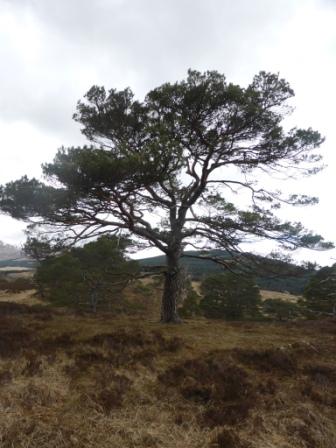
Coille Coire Chuilc is an ancient woodland of Scots pines lying between the river Cononish and Allt Gleann Auchreoch close to the village of Tyndrum in Strath Fillan. Tyndrum grew out of the lead mining industry. The mines were located in Beinn Chuirn. During the 18th C pack horses travelled 50 miles to Alloa with lead ingots then back with fuel for the smelter.

Cononish HillsDuring the 19th C gold was discovered in the hills of the Cononish glen, which led to a miniature gold rush. This ended in the 20th C but has recently restarted with the approval of a second planning application to Scotsgold Resources in 2011. Gold is once more being mined from the hills and may be panned from the river Cononish, although it is more likely one will find lead and pyrite: ‘fool’s gold’. As the area is renowned for its ‘fairy places’ it was interesting to hear the hills were hollowed with mines where one is more likely to find false gold than the real deal…

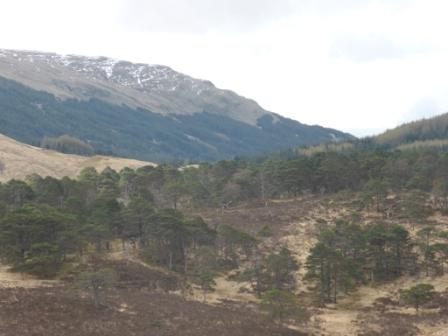
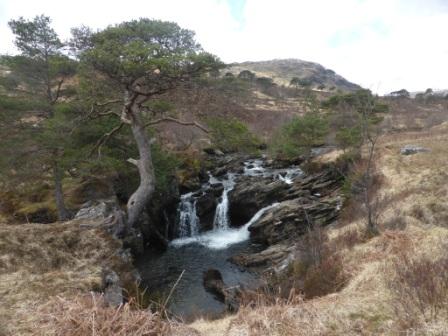
Our expedition to Coille Coire Chuilc did not go to plan. Firstly we took the ‘wrong’ path, ending up north of the river Cononish rather than within the woodland. However this had the advantages of providing a good view of the distant Scots pines and an excuse to walk back down the river, seeing some sensational falls, ravines and trees clinging drastically to rocks.

The next set back was that the bridge across the Allt Gleann Auchreoch pictured in The Ancient Pinewoods of Scotland: A Guide (2013) was plankless and uncrossable!

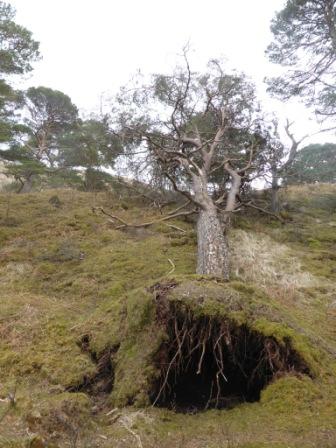
This led to a precarious injurious fording of the burn into a woodland of bent old round-crowned pines and deep sphagnum mosses that didn’t feel overly friendly to two foolish searching humans.

Blog 6. Coille Coire ChuilcDying trees stood with a stark grey dignity reminiscent of gwyllon; ancestral presences of their land. A land where we were not at home. Where all was strange and fey. And said leave.

On our return, after I slipped over again crossing a boggy patch, one of the more positive points was glimpsing a magnificent bird which I think may have been a golden eagle.

Blog 9. Golden EagleTyndrum itself, however, was hellish. No longer a mining village but conglomeration of shops and a tourist information centre. We arrived at the scene of an accident where a car had hit a motorbike and shortly afterward saw two near car crashes within the space of a minute. We saw the whole place was now based around the tourist industry and as tourists we were part of the problem.

I felt like I was a long way north of the wall far from home in a landscape that did not want me.

I left with the impression that whilst the story of Gwyn, Gwythyr and Creiddylad in Culhwch and Olwen contains universal themes (the battle between winter and summer kings for a maiden goddess on May Day) its variant from Strathclyde locating Annwn in the Caledonian forest very much belonged to its time and people.

The fairies of Coille Coire Chuilc had concerns of their own with mining and tourism and little care for a pair of wanderers from Lancashire seeking the ancient roots of a Brythonic tale that may never have been located in their woodland at all.

Whether Myrddin ever fled quite so far remains uncertain. Perhaps we went too far north. However I think sometimes you must stray too far to come back…

Gwyn, Gwythyr and Creiddylad: A Story from the Old North

Cherry BlossomCulhwch and Olwen is one of the oldest and most fascinating repositories of ancient British mythology. It originates from two texts; a fragmented version in The White Book of Rhydderch (1325) and full version in The Red Book of Hergest (1400). The main narrative centres on Culhwch’s quest to win Olwen for which he enlists the help of Arthur and his retinue; a medley of historical and mythological characters.

Embedded within it we find fragments of other tales which may be of older origin and have stood alone. These include the hunt for the legendary boar Twrch Twryth and release of Mabon from imprisonment in Gloucester. Most significantly for me as someone who venerates Gwyn ap Nudd, we find the story of his rivalry with Gwythyr ap Greidol for the love of Creiddylad and their battle for her every May Day.

This story is central to understanding Gwyn’s mythology. Because I am based in Lancashire it also of great interest that it originates from the Old North. In this article I summarise the story and introduce its themes and background with the aim of bringing Gwyn’s neglected connections with the north to the fore. In conclusion I discuss its contemporary relevance.

The story begins by stating that Creiddylad ‘went off’ with Gwythyr. Creiddylad is the daughter of Lludd Llaw Eraint ‘Lludd of the Silver Hand’ a mythic king of Britain. Earlier in the main narrative we are told she is ‘the most majestic maiden there ever was in the Three Islands of Britain and her Adjacent Three Islands.’ This shows she is deeply connected with the sovereignty of the land. Whilst attempts to trace the etymology of her name have been made such as ‘Craidd’ ‘heart’ and ‘dylan’ ‘water’ no agreement has been reached.

Gwythyr and his father, Greidol, are named in the genealogies of the Men of the North. Greidol is ‘the son of Enfael the son of Deigyr the son of Dyfnwal (Dyfnarth) the son of Ednyfed the son of Maxen (Macsen Guledig)’. Greidol’s name means ‘hot, passionate, fierce’. He was a knight in Arthur’s court and appears in the triads as one of the great architects and enemy-subduers of Britain.

Robert Graves interprets Gwythyr ap Greidol as ‘Victor son of Scorcher’. Gwythyr is the father of Arthur’s wife, Gwenhyfawr. His horse appears alongside Arthur’s in The Songs of the Horses ‘boldly bestowing pain’. In Culhwch and Olwen he wins the friendship of a colony of ants who bring nine hestors of flax seed, one of the items Culhwch must attain. Gwythyr’s resting place is included in The Stanzas of the Graves. These references show the longevity of his connection with Arthur and that he was a significant hero in his own right.

Unfortunately I have not found any references to where Greidol or Gwythyr lived. As other Men of the North in his family such as Nwython ruled in the Strathclyde area, south-west Scotland may be a possibility.

Creiddylad’s status as a maiden and the statement about her going off with Gwythyr suggest he may be her first love. Next we are told ‘before he could sleep with her Gwyn ap Nudd came and took her by force.’ It is likely Gwythyr is waiting to marry Creiddylad before they sleep together. Before they can wed Gwyn takes her away.

In Culhwch and Olwen Gwyn ap Nudd ‘White son of Mist’ is introduced as a ruler of Annwn (the Brythonic underworld) who contains the fury of its spirits and prevents their destruction of this-world. This may relate to earlier beliefs about Gwyn’s status as a god of the dead connected with chthonic spirits. Will Parker cites examples of offerings in ritual shafts and pits to propitiate such deities in the Bronze to Romano-British periods.

In The Dialogue of Gwyn ap Nudd and Gwyddno Garanhir Gwyn appears as a gatherer of the battle dead. After offering Gwyddno protection he states his presence at the deaths of a number of warriors; Gwenddolau, a northern British king who perished at the Battle of Arfderydd (north of Carlisle) and Bran who died alongside him, Gwallog ap Llenog ruler of Elmet (Yorkshire), Llachau Arthur’s son and Meurig ap Careian. This provides further confirmation of Gwyn’s role as a god who facilitates the transition from life to death.

In later literature Annwn becomes Fairyland and Gwyn its King. Although Gwyn’s status is reduced from god to fairy (and likewise his people) he remains feared and respected. Our rich heritage of Brythonic fairy lore demonstrates a continuity of relations between the worlds and interactions with spirits. In most of these tales uncanny themes such as glamoury, enchantment, changeling children and abduction take the fore. Fairies are often connected with wild and liminal places. Divisions between the fay and the dead remain blurred.

Gwyn’s abduction of Creiddylad may have its basis in prevalent superstitions. Professor Ronald Hutton notes that Early Welsh literature testifies ‘to the attribution of an especially arcane quality to May Day (‘Calan Mai’) and its eve.’ This was a liminal time when winter gave way to summer and was connected with love, fertility and woodland trysts. It was also a time dangerous spirits were abroad. Marriage was not advised in case one should mistakenly take a fairy lover.

When Gwyn takes Creiddylad by force I assume he abducts her to Annwn and claims her maidenhood. Frustratingly we gain no insight from the text into what Creiddylad thinks or feels. As a ‘maiden’ I imagine she must be terrified when he takes her and they descend. What he says to her and whether their sex is consensual remains uncertain.

Later Gwyn and Creiddylad become lovers. This is shown in The Dialogue of Gwyn ap Nudd and Gwyddno Garanhir where Gwyn introduces himself as ‘Gwyn ap Nudd / The lover of Creiddylad, daughter of Lludd’. If scholars are correct in identifying Nudd (the Romano-British god Nodens) and Lludd, Gwyn and Creiddylad are brother and sister. Whilst this would make their relationship incestuous in human terms, in many myths gods and goddesses consider it superior to sleep with members of their blood-line.

The 14th century manuscript Speculum Christiani reads ‘Gwyn ap Nudd who are far in the forests for the love of your mate allow us to come home’. Gwyn’s love of Creiddylad is central. Whilst he may not always be moved directly by human pleas he can be compelled to answer for love of his partner. This shows Gwyn holds Creiddylad in reverence and esteem. In later stories where Gwyn appears as the King of Fairy he is often accompanied by his Queen who is a respected equal.

Creiddylad’s transition from maiden to Queen of Annwn may be read as a story of coming to maturity. It might also reflect an ‘initiatory’ process whereby her relationship with Gwyn introduces her not only to sexuality but wild nature and the hidden wisdom of the underworld.

In relation to Gwyn and Creiddylad being ‘far in the forest’ it is interesting to note a tradition amongst the Strathclyde Britons of locating Annwn in the forests of the north. The 6th century Byzantine writer Procopius claims the lands north of Hadrian’s Wall were populated with snakes, serpents and other wild creatures. Those who cross the wall die straight away and this area is the destination of the souls of the dead. This fits with Gwyn’s rulership of Annwn and dwelling with Creiddylad in a forest abode. A feasible location is Celyddon (the Caledonian forest).

Gwythyr gathers a host and goes to fight against Gwyn. I imagine they ride into the wild depths of Celyddon and thereby enter Annwn to seek out the lovers. Their attack on Gwyn relates to a long tradition of stories depicting raids on the underworld by the armies of this-world.

In this case Gwyn triumphs and captures Gwythyr and a number of his noblemen. The majority are Men of the North and close relations of Gwythyr’s. Gwrgwst Ledlwm is the son of Dynfnarth. Cyledyr and his father, Nwython are also descended, through Guipno, from Dyfnarth. Pen son of Nethog is a corruption of Nwython. Hence Pen is Nwython’s son. If the genealogies are correct, Gwyn captures four generations of northern men (!). The only persons not of northern descent are Graid son of Eri and Glinneu son of Taran.

Gwyn’s slaughter of Nwython, cutting out his heart and feeding it to Cyledyr casts him as a cruel and sinister deity. This is hinted at in the lines about him containing the fury of Annwn’s spirits. However, there is no historical record of Nwython meeting his end this way. Tim Clarkson says that Neithon ap Guipno ‘died peacefully in his bed’. How much of this episode is a result of Gwyn’s demonization by adherents of Christianity and how much reflects his true nature is open to debate.

That Cyledyr becomes ‘Wyllt’ may relate to superstitions connecting Gwyn and his spirits with wildness and madness. Following the Battle of Arfderydd (where Gwyn states his presence at the death of Gwenddolau) Lailoken (Myrddin) sees an unendurable brightness and host of warriors in the sky. Afterward he becomes ‘Wyllt’ living amongst ‘gwyllon’ in Celyddon. The gwyllon hold a similar status to the spirits of Annwn as ancestral presences immanent in wild places. It seems significant they are connected with the forests of the north.

Afterward Arthur ‘comes north’ summons Gwyn to him and releases Gwythyr and his other noblemen from captivity. The source of Arthur’s power over Gwyn is not mentioned nor is it obvious he brings an army. Sense suggests he cannot take on Gwyn and the spirits of Annwn alone, particularly considering that in The Spoils of Annwn only seven return of each three hundred who set sail for the underworld.

Arthur makes peace between Gwyn and Gwythyr by consigning them to battle every May Day for Creiddylad’s hand. An additional condition, which seems rather unfair, is that neither can take her until Judgement Day. Until then she must remain in her father’s house. Creiddylad is presented not only as a puppet tossed between two lovers but at the beck and call of Arthur. It is not explained how Arthur puts this command on Gwyn, Gwythyr or Creiddylad.

It is my intuition Arthur’s intercession is a later addition to an earlier myth inserted for the purpose of integrating it into the narrative of Culhwch and Olwen. Like ‘God’ (who is said to have put the fury of the spirits of Annwn in Gwyn!) Arthur is introduced as a deus ex machina. His agency explains and makes palatable to a Christian audience the rivalry between an underworld god and human (or perhaps semi-divine) hero for the favour of a fertility goddess. Arthur shutting Creiddylad in her father’s house could represent a Christian ban on woodland liaisons.

MayflowerThis story may originate from an earlier seasonal myth where Gwyn and Gwythyr are the forces of winter and summer battling over Creiddylad who embodies new life and spring. In this case their struggle is eternal. On May Day, Gwythyr the Summer King and a hero of this-world triumphs over Gwyn the Winter King and ruler of the underworld.

That such a tradition existed is suggested by ritual combats enacted in Wales in the nineteenth century by representatives of summer and winter. After summer won celebratory dancing was held around a May-pole. Pairs or groups would often fight over the May-pole. Whilst May-pole dancing is still a strong tradition across northern Britain, I haven’t found any battles between summer and winter yet.

If Gwythyr wins Creiddylad’s hand on Calan Mai (May Day) it would make sense that Gwyn takes her back to Annwn on Nos Galan Gaeaf or Calan Gaeaf (the eve or first of November) another time associated with dangerous spirits. If this is the case I know of no stories or traditions based around it.

I find it important to remember this story of Gwyn, Gwythyr and Creiddylad is only one medieval variant set in the Old North. Doubtless it underwent countless re-tellings in other times and places before it was written down and stuck. For me it is imperative to gain a personal understanding of it through lived relationships with its deities on the land where I live in the here and now.

So far I have reached the insights that the forgetting of this story in northern Britain is also the story of our forgetting of our relationship with the passing seasons, the deities associated with them and the sovereignty of the land. Another lesson it discloses is that human ownership of the land is transitory. There is a balance the forces of the wild and the underworld maintain.

In modern times the majority of people walk only within the Arthurian courts of this-world, paying respect to celebrities, pop culture and football heroes. In this era Gwythyr rules. He and the people of the north have forgotten about Creiddylad’s marriage to Gwyn in the wild forests of Annwn.

However, after centuries of forgetting Gwyn is appearing again within our folklore and as a god to his devotees. We’re remembering the seasons. We’re remembering Annwn, wild places, spirits and the dead. And first-most in Gwyn’s eyes we’re remembering Creiddylad and to treat her with reverence and respect.

***

SOURCES

 Bromwich, Rachel and Evans, Simon D. Culhwch and Olwen (University of Cardiff Press, 1992)
Clarkson, Tim The Men of the North: The Britons of Southern Scotland (John Donald, 2010)
Davies, Sioned (transl.) The Mabinogion (Oxford University Press, 2007)
Evans, J. Gwengobryn The Black Book of Carmarthen (Lightning Source UK Lmtd, 1907)
Green, Thomas Concepts of Arthur (Tempus Publishing, 2007)
Gwynn Jones, T. Welsh Folklore and Custom (D. S. Brewer, 1979)
Heron (transl) ‘Gwyn ap Nudd and Gwyddno Garanhir’ https://barddos.wordpress.com/2015/02/08/gwyn-ap-nudd-and-gwyddno-garanhir/
Hutton, Ronald The Stations of the Sun (Oxford University Press, 1996)
Parker, Will The Four Branches of the Mabinogi http://www.mabinogi.net/
Pennar, Meirion (transl.) The Black Book of Carmarthen (Llanerch Enterprises, 1989)
Rudiger, Angelika H. ‘Gwyn ap Nudd: Transfigurations of a character on the way from medieval literature to neo-pagan beliefs’ in Gramarye, Issue 2 (University of Chichester, Winter 2012)
Sikes, Wirt British Goblins (Lightning Source UK, 2011)
Skene, William F. The Four Ancient Books of Wales (Forgotten Books 2007)
Squire, Charles Celtic Myths and Legends (Parragon, 2000)