Gwyn ap Nudd is a god of the dead and ruler of Annwn. As the Brythonic leader of ‘the Wild Hunt’ he gathers the souls of the deceased back to his realm to be united in an otherworldly feast. This repast of the dead can, at certain times of the year, be participated in by the living.
Unfortunately this is a tradition that Christians went to great lengths to bring to an end. This article will introduce the evidence for Gwyn’s Feast, how it was abolished, and how it can be reclaimed by modern polytheists.
*
In ‘The Spoils of Annwn’, as Pen Annwn, ‘Head of the Underworld’, Gwyn presides over a feast in Caer Vedwit, ‘The Mead-Feast Fort’. At its centre is the cauldron of Pen Annwn, with its ‘dark trim, and pearls’, which ‘does not boil a coward’s food’: a vessel symbolic of rebirth.
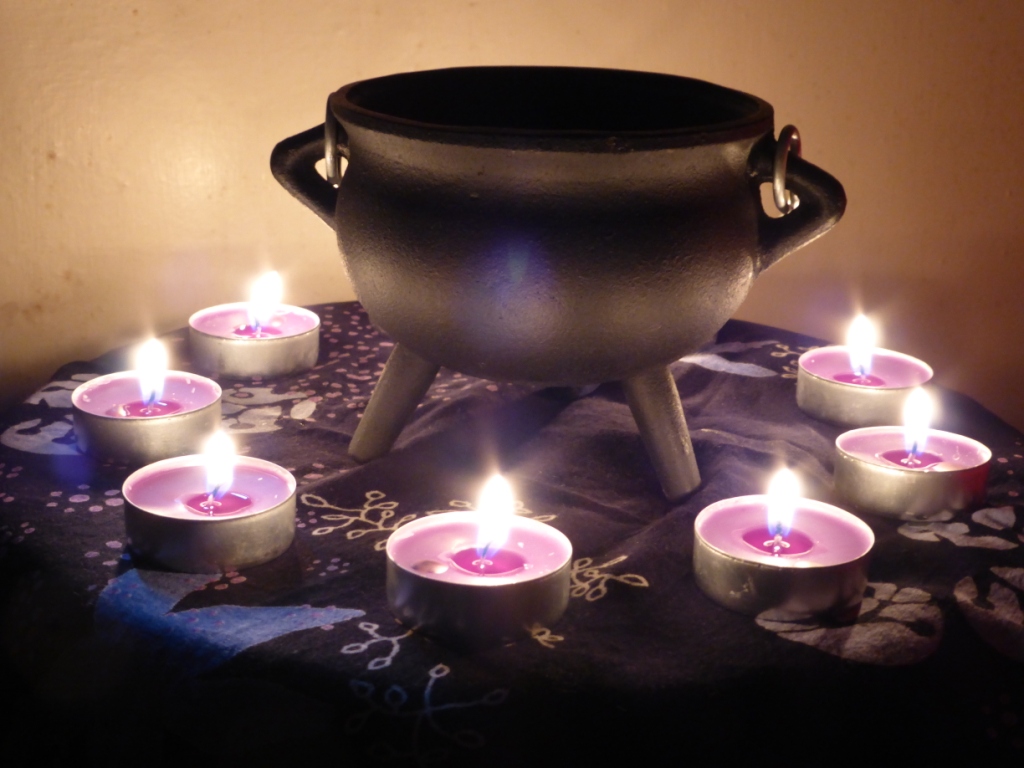
Arthur raids seven Annuvian fortresses, confronting six thousand speechless dead men, inflicting violence on ‘the honoured and fair’ and stealing the Brindled Ox, kidnapping a bard called Gweir, and stealing the cauldron of Pen Annwn before slamming ‘Hell’s Gate’ shut.
I believe Arthur’s raid on Annwn replaced an earlier tradition of the soul’s return to the underworld and journey through seven fortresses (which are faces of the same fort) to Gwyn’s Feast and the Cauldron of Rebirth. Arthur’s defeat of Gwyn and his people and theft of his cauldron represent the triumph of Christianity over the pagan mysteries of death and rebirth.
This story is paralleled in Culhwch and Olwen, where Arthur raids Gwyn’s fortress to rescue Gwyn’s rival, Gwythyr, and his army (who include Graid who might be equated with Gweir), and steals a number of otherworldly treasures including the Brindled Ox and a magical cauldron.
Arthur also usurps Gwyn’s hunt for Twrch Trwyth, ‘King of Boars’, ‘a king and for his sins God changed him into a swine’. This thinly disguises that Arthur takes leadership of Gwyn’s hunt for a human soul in boar-form – ‘the Wild Hunt’ – reducing it to just a boar hunt and again obscuring pagan traditions.
*

Gwyn is intimately associated with Glastonbury Tor. Excavations have revealed the existence of a building with several hearths dating to the 5th – 7th century. Two north-south aligned graves (not Christian) nearby along with an empty stone cairn and helmeted bronze head with ‘a narrow face’ and ‘slit mouth’ in the ‘long’ Celtic style suggest it may have been a pagan temple.
Bones of cattle, sheep, and pigs, from joints of meat, and Mediterranean amphorae (large jugs for holding wine) suggest feasting took place at this temple on the Tor; a liminal place where Thisworld and Annwn and the living and the dead meet in revels presided over by Gwyn.
Several pernicious accounts in saints’ lives record Christian attempts to abolish this tradition. In The Charter of St Patrick, Patrick and his brother Wellias climb the Tor and find ‘an ancient oratory’. There they fast for three months ‘dominating the devils and wild beasts’ and are rewarded with a vision of Jesus telling them to claim the place in his name and invoke St Michael.
In The Life of St Collen, Collen, Abbot of Glastonbury, derides Gwyn and his host as ‘devils’. When Gwyn invites him to the summit of the Tor to feast in ‘the fairest castle he had ever beheld’, Collen refuses to ‘eat the leaves of trees’, says the red of Gwyn’s people’s clothing signifies ‘burning’ and the blue ‘coldness’, then supposedly banishes them with holy water.
Gwyn appears as Melwas (1) in The Life of Gildas, where he violates Arthur’s wife, Gwenhwyfar, and carries her off to the Tor, which is well fortified by ‘thickets of reed, river, and marsh’. Gildas sides with Arthur and wins Gwenhwyfar back. The tradition of ‘Arthur’s Hunting Path’ from Cadbury to Glastonbury and his burial further illustrate his replacement of Gwyn.
*
The tradition of invoking St Michael on Glastonbury Tor continued. In the 11th century a wooden church dedicated to him was built on the summit. In 1243 Henry III granted permission for an annual fair to be held there for six days around the Feast of St Michael, September 29th.
It is likely St Michael’s Feast replaced a feast day for Gwyn. The 29th of September was the final day of bringing in the harvest. In Cornwall, September is known as Gwynngala, ‘White or Blessed Fields’, a name which contains suggestions that Gwyn, a death-god, is associated with reaping and celebrations for him were held when the fields were cleared at the month’s end.
This date has also become attached to St Michael’s defeat of Satan in a war of Heaven and banishment of him to Hell. It seems this Biblical story was recalled to reinforce St Michael’s defeat of Gwyn on his feast day. According to a folkloric tale the Devil first fell to earth and landed in a blackberry bush and spat or urinated on the blackberries, explaining why they go rotten.
Gwyn was identified with ‘that ancient serpent called the Devil’. This is not surprising as Gwyn’s father, Nodens/Nudd/Lludd is associated with two dragons and Gwyn’s dog, Dormach, ‘Death’s Door’, has two serpent’s tails. It may be suggested Gwyn took serpent-form (2).
On the tower of the 14th century stone church on Glastonbury Tor (the wooden one was unsurprisingly destroyed in an earthquake in 1275!) is an image of St Michael with a set of scales weighted toward him, rather than his opponent, the Devil-as-serpent. St Michael’s taking souls to heaven and weighing them forms an antithesis to Gwyn gathering souls to Annwn where all are united at his feast without moral judgement.

*
I’ve been celebrating Gwyn’s Feast on the 29th of September since 2013 as a way of reaffirming his presence in the place of Arthur and St Michael, who has taken over many other sites sacred to Gwyn and the spirits of Annwn/the fairies, including some in Lancashire (3).
When I asked Gwyn if I could celebrate a feast for him on this date, he agreed. Since then I’ve been joined annually by a friend, and Dun Brython members such as Greg Hill and Lee Davies have held their own celebrations. This year I know of several other devotees of Gwyn, who I’m in contact with online, who will be celebrating Gwyn’s Feast.
A meal I have developed and found Gwyn is happy with (4) is pork with apple sauce, a glass of mead, and offerings of meat for his hounds and apples for his horses. I open the feast by calling to Gwyn and his spirits and acknowledging the connection with all who have feasted with him in the past and those who are feasting with him on September the 29th today. Then we eat.
After the meal I read prayers, poems, and stories, which have been written for Gwyn or remind me of him by myself and others. This is followed by some form of communion with Gwyn such as divination, journeywork, or quiet contemplation. Rather than saying farewell I end by welcoming Gwyn and his spirits back into the landscape as we enter the dark half of the year.
This year I will be holding a feast for Gwyn then afterwards the readings will take place at the launch of Gatherer of Souls at the Black Horse in Preston. The publication of this book, which is dedicated to Gwyn and recovers his mythos, is the culmination of six years of devotion.
*
(1) The identification of Gwyn and Melwas is also backed up by Welsh tradition. In ‘The Dialogue of Melwas and Gwenhwyfar’ Melwas introduces himself: ‘Black is my steed and brave beneath me / No water will make him fear / And no man will make him swerve.’ This is clearly Gwyn’s mount, the legendary water-horse Du y Moroedd, ‘the Black of the Seas’. Other lines suggesting Melwas is Gwyn, referring to his otherworld nature, include, ‘It is I that will ride and will stand, / And walk heavily on the brink of the ebb’, and ‘I would hold against a hundred of myself’.
(2) Robert Graves refers to Gwyn as ‘the Serpent Son’ in The White Goddess. This name is of his own coining based on personal inspiration and does not have any historical basis, yet is fitting.
(3) John Rhys notes Michael ‘was regarded as par excellence the defender of Christians against the sprites and demons with which the Celtic imagination peopled the shades of night, the gloom of the forest, and even the straggling mist on the tops of hills. Perhaps it would not be rash to suppose that most of the old foundations associated with his name occupy sites of sinister reputation, inherited from the time when paganism prevailed in the land, sites which were considered to be dangerous and to form the haunts of evil spirits.’ Here in Lancashire there is a church dedicated to St Michael in Whitewell, which is named for its white well, which many be connected with Gwyn. It is close to Fairy Holes and Fair Oak. In Beetham St Michael’s is the destination of a coffin path/fairy path which is famous for its Fairy Steps.
(4) One small word of advice on something he was very unhappy with… avoid eggs at all cost. In 2014 we decided to add boiled eggs to the arranged meal of ham without asking him. Three times we boiled them for the right amount of time and they were completely uncooked!
An earlier version of this article was published on the Dun Brython blog HERE.
SOURCES
Alex Langstone, ‘The Berwyn Mountains of Poetic Adventure’, Mirror of Isis
Anon, ‘The Charter of St Patrick’, Britannia History
Anon, ‘The Dialogue of Melwas and Gwenhywfar’, Mary Jones Celtic Literature Collective
Ben Johnson, ‘Michaelmas’, Historic UK
Caradoc of Llancarfan, The Life of Gildas, http://www.maryjones.us/ctexts/gildas06.html
Charlotte Guest (transl), ‘St Collen and Gwyn ap Nudd’, Mary Jones Celtic Literature Collective
John Rhys, Studies in the Arthurian Legend, (Adamant Media Corporation, 2001)
Marged Haycock, Legendary Poems from the Book of Taliesin, (CMCS, 2007)
Mary Beth Albright, ‘Michaelmas: The Day the Devil Spit on Your Blackberries’, National Geographic
Nicolas R. Mann, The Isle of Avalon, (Green Magic, 2008)
Sioned Davies (transl.), The Mabinogion, (Oxford University Press, 2007)
Yuri Leitch, Gwyn: Ancient God of Glastonbury and key to the Glastonbury Zodiac, (The Temple Publications, 2007)




 The Sanctuary of Vindos