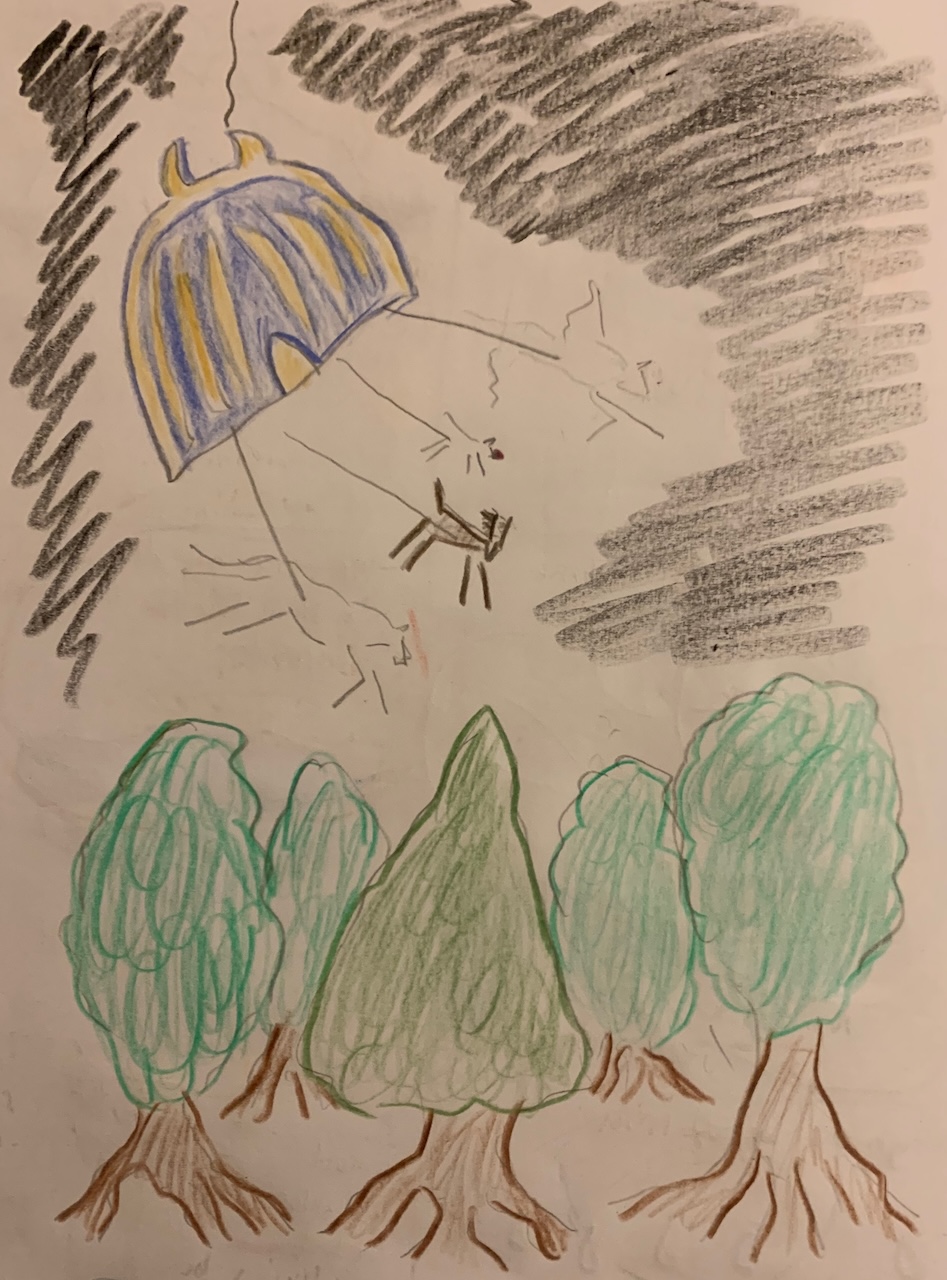
Mither voices through the mizzle, through the mist, mist-numb mutters. He fails to muster them at first with His voice. Hoofbeats louder, huge round hoofbeats of His Horse.
“COME!”
Mistlings mither through the mizzle, seep, sink, sit, slither in the godless grey drizzle of forgetting until the voice of a God loud as the cracking of glass beneath the hooves of His horse calls.
“COME! COME!”
Awake the mistlings remembering, their misting reassembling into a mither of forms. They look like something viewed through cracked glass. They teeter, totter, diused limbs pale, severed, crunch of footfalls.
“COME! COME! COME!”
Oh the baying of the hounds rounding, bounding, barks, bristling hackles, woofs reign! He rounds them up, gentle guidance, touch of red nose, hand on arm, “Don’t dither,” “remember, remember, remember.”
“COME! COME! COME TO MY FORT!”
Oh these feet know the path, the way when the mind does not, misty heel, misty toe. One foot before another soul-forms remembering forest, foray up river, up hill, up mountain, to the in-the-air turning fort.
“COME! COME! COME TO MY HALL!”
Misted ones mix and dance no longer mizzle-like but blue and red as blood and water, the only drizzle sweat upon their brows before they sit and partake in the feast of holy leaf-meat and ever-flowing mead.
“COME! COME! COME TO MY CAULDRON!”
This drink is not one of forgetting – they know themselves now and the pain as He sings their soul-names voice resounding like the sound of shattered glass is outweighed by beauty.
“COME! COME! COME TO BE REBORN!”
The waters in the cauldron are blue as the infinite seas of the Deep and filled with blood and there are stars shining and each beholds a star and reaches out and becomes like glass.
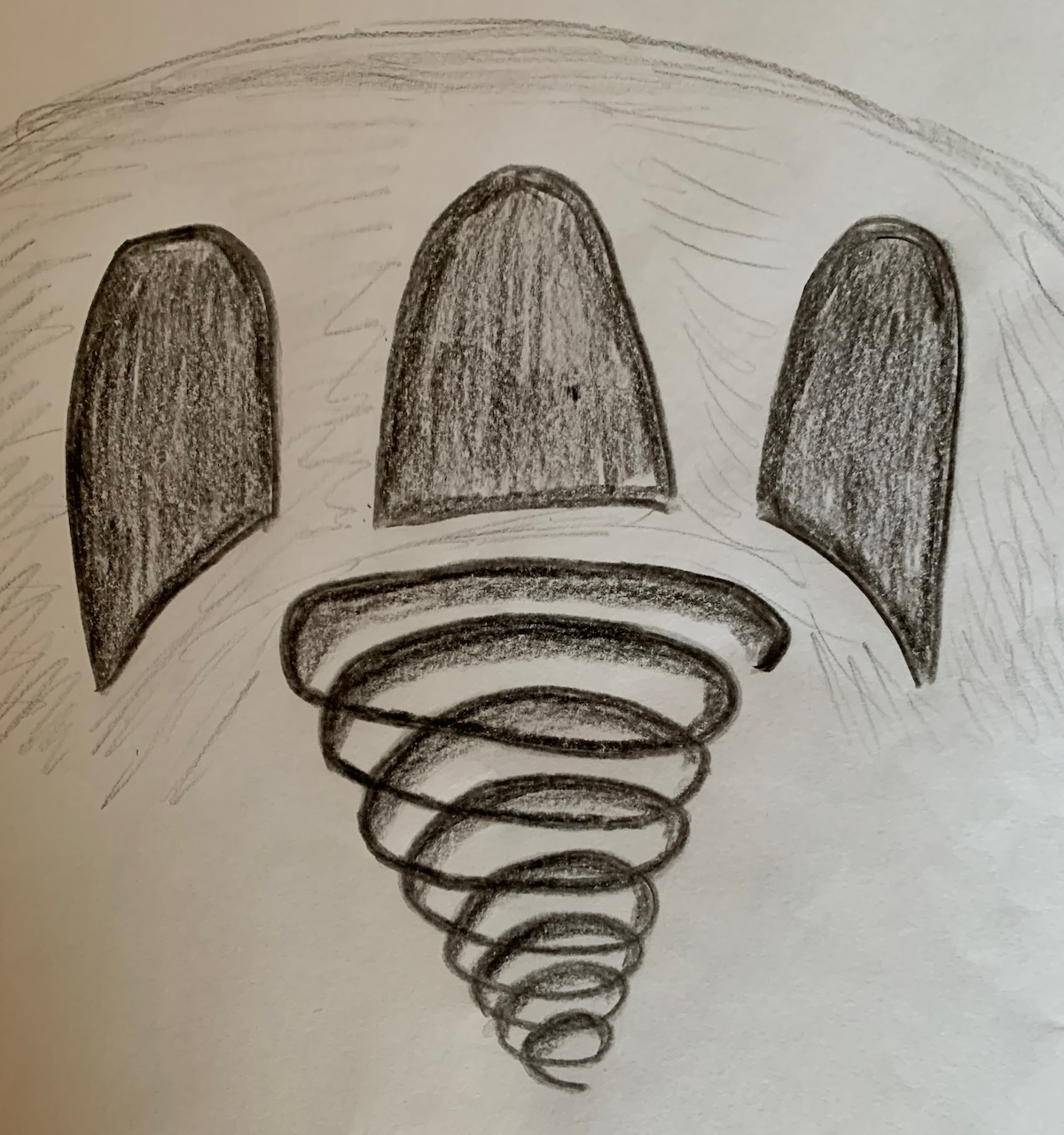
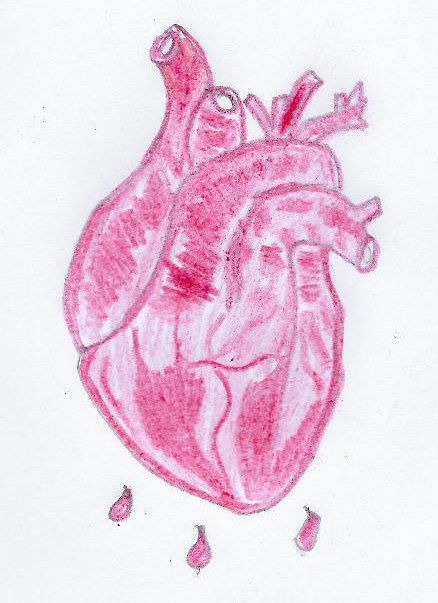
A poem and artwork that came to me as I was revisiting the traditional lore in recent articles based on my experiences of witnessing Gwyn guiding the passage and rebirth of souls.
In my last article I put forward an argument that Annwn is primarily a land of the living through which the souls of the dead pass to be reborn.
The notion that the soul does not stay in the spirit world for good but takes a new form bears similarities to the Dharmic religions (Hinduism, Buddhism and Jainism). Scholars and modern druid orders have noted the similarities between the doctrine of reincarnation and ancient British beliefs about the soul being immortal and passing into a new body after death along with other parallels such as the likeness between the Brahmins and Druids. (1)
References to reincarnation are found in the Rig Veda and Upanishads and the Bardo Thodol (The Tibetan Book of the Dead) lays out a detailed picture of the processes the soul undergoes upon death and by which it is reborn.
In the Brythonic tradition we find hints about the mysteries of rebirth in medieval Welsh literature and in this article to these I will turn.
The Transformations of Taliesin
The most famous and most cited source for evidence of ancient British and druidic beliefs about reincarnation is the poetry of Taliesin. This historical and legendary bard is central to the bardic tradition and to modern druidry.
Taliesin speaks of his transformations in several poems. In the opening lines of ‘The Battle of the Trees’ he tells us ‘I was in a multitude of forms / before I was unfettered’. This might be a reference to being trapped in the cycle of reincarnation before his liberation as an inspired bard.
Taliesin lists his forms which include elemental qualities, a bird, a tree, and a number of man-made artefacts:
‘I was a slender mottled sword made from the hand. I was a droplet in the air, I was the stellar radiance of the stars. I was a word in writing, I was a book in my prime. I was the light of a lantern for a year and a half. I was a bridge standing over sixty estuaries. I was a path, I was an eagle, I was a coracle on the seas. I was effervescence in drink, I was a raindrop in a shower, I was a sword in the hand, I was a shield in battle. I was a string in a harp under enchantment for nine years, (and) foam in water. I was a tinder-spark in a fire, I was a tree in a conflagration.’ (2)
In ‘The Hostile Confederacy’ Taliesin lists animal transformations:
‘I was a blue salmon, I was a dog, I was a stag, I was a roebuck on the mountain’. (3)
Followed by tools:
‘I was a block, I was a spade, I was an axe in the hand, I was an auger (held) in tongs, for a year and a half.’ (4)
Then lusty male animals:
‘I was a speckled white cockerel covering the hens in Eidyn; I was a stallion at stud, I was a fiery bull.’ (5)
He then tells his story as a grain:
‘I was a stook in the mills, the ground meal of farmers; I was a grain… it grew on a hill; I’m reaped, I’m planted, I’m dispatched to the kiln, I’m loosed from the hand in order to be roasted. A hen got hold of me – a red clawed one, a crested enemy; I spent nine nights residing in her womb. I was matured, I was drink set before a ruler, I was dead, I was alive, a stick went into me; I was on the lees, separated from it I was whole… I’m Taliesin.’ (6)
One might read this simply as an account of the bard’s protoplasmic ability to shift through multiple forms in Thisworld if we didn’t find the lines, ‘I was dead, I was alive’. Implicit is the idea each form is a separate incarnation.
Taliesin’s account of his rebirth from the womb of a crested red-clawed hen into his bardic incarnation provides a link to The Story of Taliesin.
2. The Cauldron of Ceridwen
In The Story of Taliesin we meet Ceridwen, who is ‘learned in the three crafts, which are known as magic, witchcraft and divination’. Ceridwen has a son called Afagddu who is ‘terribly ugly’ and because of his ‘wretchedness’ she sets out to brew a potion in her cauldron ‘to make him in possession of the Prophetic Spirit and a great storyteller of the world to come’. (7)
To stir her cauldron for a year and a day she recruits a young man called Gwion Bach. When the time arrives for Afagddu to receive the three magical drops Gwion pushes him out of the way, receives them, and is ‘filled with knowledge’. Ceridwen is furious. Thereon follows a shapeshifting chase. Gwion takes the form of a hare and Ceridwen a black greyhound bitch, Gwion a salmon and Ceridwen an otter, Gwion a bird and Ceridwen a hawk. Finally, he takes the form of a grain of wheat and she a crested black hen and she swallows him. He gestates in her womb for nine months. When he’s born she casts him out to sea in ‘a coracle, or skin belly’. (8) He is found in the salmon weir of Gwyddno Garanhir by Gwyddno’s son, Elffin, who, on opening the skin, declares, “Behold the radiant brow!” Thus he is named Taliesin. (9)
The parallels between the poem and story are clear. Each portrays the soul shifting through a series of forms before it is reborn from the womb of Ceridwen, as a crested black hen, ‘whole’ in its bardic incarnation.
In medieval Welsh literature Ceridwen is associated with the pair awen ‘cauldron of inspiration’ and invoked by the bards as a muse (10). Her presence at the Court of Don as a ‘knowledgeable one’ (11) suggests, like Don and Her children, She is an important Brythonic Goddess.
Kristoffer Hughes notes ‘in the Welsh language the word “crochen” meaning cauldron shares the same prefix “cro” as the word “croth” meaning womb’ (12) suggesting Ceridwen’s cauldron and womb are one. Her magical vessel is the source of initiation, inspiration, transformation and rebirth. (13)
Gwilym Morus-Baird hypothesises this story might be rooted in interactions between the bardic tradition and the visionary tradition of the witches. (14) Taliesin steals his awen from a ‘witch’ who knows its secrets and can be seen continuing his thieving ways in his raid with Arthur on Annwn.
3. The Cauldron of the Head of Annwn
In the midst of Annwn, in the midst of Caer Vedwit ‘The Mead Feast Fort’, lies ‘the Cauldron of the Head of Annwn’. The most likely candidate for this title is Gwyn ap Nudd as He speaks of witnessing a battle at one of the forts raided, Caer Vandwy ‘The Fort of God’s Peak’, in His conversation with Gwyddno.
This cauldron is kindled by ‘the breath of nine maidens’ (15) who might be named as Morgana and Her sisters. (16) It has ‘a dark trim and pearls’ and its ‘disposition’ is such that ‘it does not boil a coward’s food’. (17)
It appears again in association with the Head of Annwn’s cauldron keeper, Dyrnwch the Giant, in ‘The Thirteen Treasures of the Island of Britain’. ‘The Cauldron of Dyrnwch the Giant: if meat for a coward were put in it to boil, it would never boil; but if meat for a brave man were put in it, it would boil quickly (and thus the brave could be distinguished from the cowardly’. (18)
It is clear this cauldron serves an initiatory function distinguishing the brave and the cowardly and this might be linked to the tradition of the hero’s portion wherein the bravest hero gets the choicest cut of meat.
On a deeper level this ‘food’ or ‘meat’ is awen and this might be understood both in the sense of one’s inspiration and one’s destiny. Only the bravest win the best awen, the best fates, from the Cauldron of the Head of Annwn.
An image on the Gundestrup Cauldron may represent Gwyn, a hound at His side, plunging a line of warriors headfirst into a cauldron to be reborn. They emerge on otherworldly steeds with horns and animals on their helms. Perhaps this shows the transformation of the bravest of the battle-dead riding on to new lives, new destinies, symbolised by the features on their headgear, or that they have been gifted with immortality as riders on Gwyn’s Hunt.
Rather than facing their testing by Annwn’s ruler and the nine maidens, Arthur and his men steal the cauldron and bear it back to the Thisworld.
4. The Cauldron of Rebirth
Taliesin’s theft of the awen from Ceridwen’s cauldron results in the poisoning Gwyddno’s land and an episode from the Second Branch of The Mabinogion suggests the consequences of stealing the cauldron from Annwn will be just as disastrous.
‘The Cauldron of Rebirth’ is brought to Bendigeidfran by a ‘huge monstrous man’ ‘with yellow-red hair’ from the Lake of the Cauldron. (19) It has ‘the property’ ‘that if you throw into it one of your men who is killed today, then by tomorrow he will be good as ever except that he will not be able to speak’. (20)
Bendigeidfran gives the cauldron to the King of Ireland who uses it against him in war. ‘The Irish began to kindle a fire under the Cauldron of Rebirth. Then they threw the corpses into the cauldron until it was full, and they would get up the next morning fighting as well as before except that they could not talk’. (21)
This cauldron, brought from the depths of a lake, may be the Cauldron of the Head of Annwn. In Thisworld the magic by which it brings the dead to life does not function fully, bringing them back in their old forms, deprived of speech.
What Arthur and Taliesin do with the cauldron, if they can use it all, outside the presence of its custodians – Ceridwen, Gwyn, the nine maidens, is unknown.
5. The Unfettering of Taliesin
In ‘The Battle of the Trees’ Taliesin claims he has been ‘unfettered’ suggesting that, by his theft of the awen, he has freed himself from the cycle of reincarnation and attained a state akin to moksha ‘liberation’.
This is evidenced by his claim that his ‘native abode / is the land of the Cherubim’ and his boasts of visiting the Court of Don and the fortresses of Gwydion and Arianrhod (22) as well as singing in Caer Siddi ‘The Fairy Fort’. (23)
He might be seen to share a kinship with the ‘ascended masters’ of the Dharmic religions explaining why he remains such a presence as a ‘legendary master’ (24) of the bardic tradition who is still channelled today by bards.
Yet, his state is not well won, but a stolen one. One wonders whether Gwyn and his huntsman will one day catch him and throw him back in the cauldron.
This, along with the image on the Gundestrup Cauldron of warriors potentially becoming riders on Gwyn’s hunt suggests that whereas some of the dead passed quickly through Annwn and into the cauldron to reborn others joined the living for far longer or even achieved immortality.
6. Those Who Return to Utter Darkness
In the reading presented so far it seems only the prestigious – warriors and bards – attain liberation from the cycle of reincarnation and join the immortals.
This raises a number of questions. Firstly, what happens to those who do not taste the awen, who do not die bravely, who like Afagddu remain in ‘utter darkness’? (25)
Parallels with the Dharmic religions suggest they might shift back into animal, plant, mineral, object and elemental forms or descend to lower levels of Annwn where monsters reside and furious spirits are held in check. (26)
This raises further questions about the hierarchical and anthropocentric viewpoints inherent in the Dharmic religions which are less evident in our texts. Is reading Taliesin’s transformations as an ‘ascent’ from a being of ‘seven consistencies’: fire, earth, water, air, mist, flowers and ‘the fruitful wind (27) through a ‘multitude of forms’ to an ‘unfettered’ bard the only way?
Might unfettering not also be seen, contarily, as a joyful return to plant and animal forms, to the elements, to the utter darkness of the womb of Ceridwen, to the vastness of cauldron, that precedes creation?
Conclusion – The Custodians of the Mysteries
In this article I have pieced together a picture of how souls are reborn based on the likenesses between the transformations of Taliesin and the cycle of reincarnation in the Dharmic religions and the material surrounding the cauldron.
It appears that souls takes a number of forms, passing to Annwn, being reborn from the Cauldron of Rebirth, until by some brave deed or inspired work (or act of theft) they win a longer time amongst the living or are granted immortality.
Those of us who wish to engage with these mysteries have the choice of whether to approach the cauldron and its custodians with respect or to continue the thieving and plundering traditions of Arthur and Taliesin.
Haycock, M. (transl), Legendary Poems from the Book of Taliesin, (CMCS, 2007), p174, l1 – 24
Ibid. p121, l229 – 233
Ibid. p121 – 122, l234 – 236
Ibid. p122, l237 – 240
Ibid. p122 – 123, l241 – 263
Hughes, K. From the Cauldron Born, (Llewellyn Publications, 2013), p32
Ibid. p34
Ibid. p37
Haycock, M. (transl), Legendary Poems from the Book of Taliesin, (CMCS, 2007), p313
Ibid. p317, l26
Hughes, K. 13th Mt Haemus Lecture: Magical Transformation in the Book of Talieisn and The Spoils of Annwn, (OBOD, 2019), p24
Hughes notes that the cauldron has ‘three symbolic functions’ – ‘a vessel of inspiration’, ‘a transformative device’ and ‘a vessel of testing’. Ibid. p24
Morus-Baird, G. Taliesin Origins, (Celtic Source, 2023), p147 – 154
Haycock, M. (transl), Legendary Poems from the Book of Taliesin, (CMCS, 2007), p 435, l13
Geoffrey of Monmouth speaks of ‘nine sisters’ who rule ‘the island of apples’, or the Island of Avalon, an Annuvian location Gwyn is associated with. Morgen possesses the skills of healing, shapeshifting and flying. Monmouth, G. The Life of Merlin, (Forgotten Books, 2008), p27
Haycock, M. (transl), Legendary Poems from the Book of Taliesin, (CMCS, 2007), p 435 – 6, l16 – 17
Bromwich, R. The Triads of the Island of Britain, (University of Wales Press, 2014),p259
Davies, S. (transl.), The Mabinogion, (Oxford University Press, 2007), p26
Ibid. p25
Ibid. p33
Parker, W. (transl), The Mabinogion, (University of California Press, 2008), p173
Haycock, M. (transl), Legendary Poems from the Book of Taliesin, (CMCS, 2007), p277, l45
A term used to describe Taliesin by Gwilym Morus-Baird. Morus-Baird, G. Taliesin Origins, (Celtic Source, 2023), p269
Afagddu means ‘Utter Darkness’. Hughes, K. From the Cauldron Born, (Llewellyn Publications), p32
Evidence for monsters of Annwn can be found in ‘The Battle of Trees’ where Taliesin speaks of ‘piercing’ ‘a great-scaled beast’, ‘a black forked toad’ and ‘a speckled crested snake’. Haycock, M. (transl), Legendary Poems from the Book of Taliesin, (CMCS, 2007), p175, l30 – 37. Gwyn is said to hold back the fury of the ‘devils of Annwn’ to prevent them from destroying the world. Davies, S. (transl.), The Mabinogion, (Oxford University Press, 2007), p199
Haycock, M. (transl), Legendary Poems from the Book of Taliesin, (CMCS, 2007), p517
BIBLIOGRAPHY
Davies, S. (transl.), The Mabinogion, (Oxford University Press, 2007 Haycock, M. (transl), Legendary Poems from the Book of Taliesin, (CMCS, 2007) Hughes, K. From the Cauldron Born, (Llewellyn Publications, 2013) Hughes, K. 13th Mt Haemus Lecture: Magical Transformation in the Book of Talieisn and The Spoils of Annwn, (OBOD, 2019) Monmouth, G. The Life of Merlin, (Forgotten Books, 2008), Morus-Baird, G. Taliesin Origins, (Celtic Source, 2023) Parker, W. (transl), The Mabinogion, (University of California Press, 2008)
Over the last couple of centuries there has been a good deal of scholarly debate about whether Annwn is a land of the dead or whether, instead, it is a land of the living. Annw(f)n, from the suffix an ‘Very’ and dwfn ‘Deep’ (1), features in medieval Welsh literature and is generally understood to be the Brythonic Otherworld and later became known as Faery.
In this article I will introduce the evidence for and against the presence of the dead in Annwn in the source texts and the arguments of scholars past and present. Then, on the basis of this inquiry, I will present my conclusion.
1. The Fairest Men
In the First Branch of The Mabinogion, in which Pwyll prince of Dyfed takes the place of Arawn, a King of Annwn, for a year, there is no evidence that Annwn is a land of the dead. The people of Annwn are very much alive. They, their land, dwellings and accoutrements are far brighter and more beautiful than anything seen in Thisworld and they appear to live a life of endless pleasure.
‘He could see… the fairest and best-equipped men that anyone had seen, and the queen with them, the most beautiful woman that anyone had ever seen, wearing a golden garment of brocaded silk… They spent the time eating and drinking, singing and carousing. Of all the courts he had seen on earth, that was the court with the most food and drink and golden vessels and royal jewels.’ (2)
We find a very similar depiction of the fortress of Gwyn ap Nudd, another King of Annwn (3), in The Life of St Collen.
‘And when he (Collen) came there, he saw the fairest castle he had ever beheld, and around it the best appointed troops, and numbers of minstrels, and every kind of music of voice and string, and steeds with youths upon them the comeliest in the world, and maidens of elegant aspect, sprightly, light of foot, of graceful apparel, and in the bloom of youth and every magnificence becoming the court of a puissant sovereign. And he beheld a courteous man on the top of the castle, who bade him enter, saying that the king was waiting for him to come to meat. And Collen went into the castle, and when he came there, the king was sitting in a golden chair. And he welcomed Collen honourably and desired him to eat, assuring him that, besides what he saw, he should have the most luxurious of every dainty and delicacy that the mind could desire, and should be supplied with every drink and liquor that his heart could wish; and that there should be in readiness for him every luxury of courtesy and service, of banquet and of honourable entertainment, of rank and of presents: and every respect and welcome due to a man of his wisdom.’ (4)
However, it is hinted at that the fairness of these men and their ruler and the banquet they offer is illusory and behind them lies a more sinister reality. Collen refuses to eat the food calling it ‘the leaves of trees’. He disdains the ‘equipment’ of the men saying ‘red… signifies burning’ and ‘blue… signifies cold.’ (5) The implication is that the beauty of the banquet is an illusion cast by fairy magic and that these people are hellish and might even number the dead.
The paradisal view of Annwn is echoed in the poetry of Taliesin. In ‘The Spoils of Annwn’ he speaks of seven fortresses raided by Arthur. One is called Caer Vedwit ‘The Mead Feast Fort’ and in its centre lies the cauldron of the Head of Annwn. In Caer Rigor ‘The Petrification Fort’ ‘sparkling wine’ is set in front of a batallion. A youth named Gweir sings in chains in front of the glittering spoils in Caer Siddi ‘The Fairy Fort’. (6)
In ‘The Chair of Taliesin’ Caer Siddi is described more fully:
‘Harmonious is my song in Caer Siddi; Sickness and age do not afflict those who are there… Three instruments/organs around a fire play in front of it and around its turrets are the well springs of the sea; and (as for) the fruitful fountain which is above it – Its drink is sweeter than the white wine.’ (7)
However ‘The Spoils of Annwn’ is shot through with images of restriction and violence. Gweir in his ‘heavy grey chain’ (8) and the Brindled Ox ‘with his stout collar, / and seven-score links in his chain’. (9) The six thousand unspeaking men and the uncommunicative watchman guarding the glass walls. The lightning thrust of Lleog’s ‘flashing sword’ into the cauldron and its theft by Lleminog’s hand. The refrain, ‘save seven none returned from the … fort.’ (10)
In ‘The Conversation of Gwyn ap Nudd and Gwyddno Garanhir’, Gwyn speaks of His ‘sorrow’ at seeing battle at one of the seven fortresses, Caer Vanddwy. ‘I saw a host / Shields shattered, spears broken, / violence inflicted by the honoured and fair.’ (11) Here Gwyn, who I believe to be the Head of Annwn, laments that his fair people were forced to inflict violence on Arthur and his men, because of their raiding behaviour killing three shiploads. ‘Three full loads of Prydwen we went into it: save seven none came back.’ (12) This shows death can take place in Annwn.
No mention is made of whether there are casualties on the side of the Head of Annwn and His people. A parallel tale in Culhwch ac Olwen suggests the cauldron-keeper and retinue are killed (13) and, possibly, the king himself. Yet, like another Annuvian figure, the Green Knight, He doesn’t stay dead long. His fair men, unaging, unsickening, may likewise be immortals.
2. Such the Fairies Seize and Keep
A source showing more explicitly that the dead can be found in Annwn / Faery is the medieval Breton lay Sir Orfeo. This retelling of the Greek story of the descent of Orpheus (Orfeo) to Hades (Annwn / Faery) to recover Eurydice (Heurodis) is set in Winchester (which may be named after Vindos / Gwyn).
Here the dead are found by Orfeo in the castle of the Fairy King:
Some headless stood upon the ground, Some had no arms, and some were torn With dreadful wounds, and some lay bound Fast to the earth in hap forlorn.
And some full-armed on horses sat, And some were strangled as at meat, And some were drowned as in a vat, And some were burned with fiery heat, Wives lay in child-bed, maidens sweet…
… such the fairies seize and keep.’ (14)
It is notable these people died untimely deaths. Implicitly, when Heurodis was bitten by the snake, she died and the Fairy King and Queen restore her to life.
Additionally, in Breton culture, the dead are said to go to Annwn. (15) In later folklore there are numerous tales of fairies taking the living and dead to their realm.
3. Gwyn ap Nudd – Gatherer of Souls
In ‘The Conversation of Gwyn ap Nudd and Gwyddno Garanhir’ Gwyn is represented as a ‘bull of battle’, a divine warrior and huntsman, who appears to gather the soul of Gwyddno, who implicitly is dead, back to Annwn. In this poem Gwyn speaks of attending the deaths of a number of famous warriors. This is followed by a lament which shows His immortal nature:
‘I was there when the warriors of Britain were slain From the east to the north; I live on; they are in the grave.
I was there when the warriors of Britain were slain From the east to the south; I live on; they are dead.’ (16)
In Culhwch ac Olwen we learn ‘God’ has put the aryal ‘fury’ of ‘the demons of Annwfn’ in Gwyn and ‘he will not be spared from there’ ‘lest the world be destroyed’. (17) Reading beneath the Christian overlay we find the suggestion that part of Gwyn’s role as a King of Annwn is to contain a host of dangerous spirits, who may number the dead, to prevent Thisworld’s destruction.
We are told ‘Twrch Trwyth will not be hunted until Gwyn ap Nudd is found.’ (18). ‘Twrch Trwyth’ ‘Chief of Boars’ is presented as a human king changed into a boar ‘for his sins’ ‘by God’. (19) Again, reading beneath, we see the twrch is a human soul in animal form. He cannot be hunted until Gwyn is found as Gwyn is the leader of the hunt for souls – the Wild Hunt.
In later folklore Gwyn is depicted riding out with the Hounds of Annwn on Nos Galan Gaeaf, again leading the Wild Hunt, (20) and as a demonic figure with a black face and horns hunting the soul of a sinner on Cefn Creini. (21)
Put together with the evidence in Sir Orfeo this suggests Gwyn hunts and gathers the souls of dead (in particular the battle-dead and those who died traumatically) and takes them to his fortress in Annwn. His people, the spirits of Annwn / fairies also play a role in the passage of the souls of the dead.
Thus, so far, we have a picture of Annwn as primarily a land of the living to which the dead (and occasionally the living) are taken by Gwyn and His fair men.
4. A Final Destination?
I shall pause here to consider some scholarly opinions. John Rhys clearly views Annwn as a land of the dead for he equates it with Hades, the Greek underworld, where souls stayed forever in a shadowy afterlife. Rhys speaks of another otherworldly fortress, Caer Arianrhod, as a ‘Court of Death’ (22) and of Gwyn and His ‘hell-hounds’ hunting ‘disembodied souls’. (23)
Contrastingly, Roger Sherman Loomis (here cited in a lecture by Kristoffer Hughes) claims Annwn ‘is the realm of the ever-living ones, the immortals, or the abode of the Celtic Gods.’ It lacks mortal inhabitants and those who venture there do not undergo death and usually return unharmed. (24)
Recent scholars take a more nuanced view. Angelika Rudiger argues for the Welsh belief: ‘the realm of the fairies was not generally a realm of the dead but reserved for a special kind of deceased… a kind of liminal space where those souls can linger whose moral life has prematurely ended, but who are not yet “ripe” to be accepted into heaven or hell’ resembling the ‘Catholic limbo’. (25) She cautions against ‘reducing Annwn… to a land of the dead’ or ‘fairies to the spirits of the dead’ and concludes ‘Annwn is a liminal world, though not an abode set aside exclusively for the departed’ (26).
Considering whether Annwn is ‘a type of land of the dead’ Gwilym Morus-Baird cites Dafydd Epynt who describes ‘how in death the poet “casts aside his spear and the four elements”’. Morus-Baird compares this to Taliesin’s creation from ‘seven substances’ (the traditional four elements air, fire, earth and water along with mist, flowers and wind) and says ‘the common idea in all these poems is that the four elements are the foundations of physical existence, and therefore don’t belong in Annwn’. (27)
Annwn is, instead, a place where spirits reside. These include the spirits of dead bards such as Taliesin and Merlin. Both of these famous bards have been through the process of death and rebirth many times. Thus Morus-Baird concludes that Annwn ‘is not a final destination for one’s death, but a place the soul passes through on the way to further incarnations’. (28)
Morus-Baird’s view fits with the evidence from Roman writers on the beliefs of the ancient Celts. For example Julius Caesar says they believe ‘the soul does not die but crosses over after death from one place to another’ (29) and Diodorus Siculus that they ‘subscribe to the doctrine of Pythagoras that the human spirit is immortal and will enter a new body after a fixed number of years’. (30)
Conclusion – A Joyful Union
Following on from these arguments I am led to conclude that Annwn is primarily a land of the living in which the spirits of the dead reside for a period of time before being reborn. Rather than being a final destination, like Hades, or a limbo-land like Purgatory, it is a living realm where spirits are joyfully united with other immortals (such as Gwyn and His people) and reminded of their immortality before moving on into another form. These spirits, dead to us in Thisworld, in the Otherworld are very much alive. Only in rebirth, when they put back on the four elements, do they become mortal again.
*
This is the first in a series of articles exploring the existing lore about Annwn, Gwyn ap Nudd and the spirits of Annwn, and the dead. I’m planning to write more about my personal experiences of journeying to Annwn and how they relate to the source material and more widely on spiritwork in the Brythonic tradition.
I stopped writing such articles for a while because I got down-hearted by the fact that others, such as Gwilym Morus-Baird, Greg Hill, Kristoffer Hughes and Kris Hughes, do it a lot better (some more engagingly on video) and also because I was exploring Annwn more experientially and creatively. I’ve recently been given a kick by my Gods to bring the academic and the experiential together. And been told I have a unique perspective to share as a devotee of Gwyn guided by Orddu and her ancestors in the traditions of the Old North.
You can support my work by joining my Patreon HERE.
REFERENCES
There are a number of translations of Annwn and this one is from Kristoffer Hughes. Hughes, K. 13th Mt Haemus Lecture: Magical Transformation in the Book of Talieisn and The Spoils of Annwn, (OBOD, 2019), p10. Gwilym Morus-Baird notes: an ‘is often read as the preposition “in”, or in this context “inside or inner”, dwfn is a noun that has a few meanings in Middle Welsh: “world” or “sea”; but also as in Middle Welsh “deep” and “profound.” Altogether, Annwfn can be read as meaning “inner world” or “inner depth with connotations of profundity’. Morus-Baird, G. Taliesin Origins, (Celtic Source, 2023), p220-21
Davies, S. (transl.), The Mabinogion, (Oxford University Press, 2007), p5
Some argue that Gwyn ap Nudd, ‘White son of Mist’, and Arawn (meaning unknown) are titles of the same deity who is the ruler of Annwn.
Guest, C. (transl), The Mabinogion, (1838)
Ibid.
Haycock, M. (transl), Legendary Poems from the Book of Taliesin, (CMCS, 2007), p435 – 437
Ibid. p277, l45 – 52
Ibid. p435, l6
Ibid. p437, l39 – 40
(10) Ibid. p436, l18 -19
(11) Hill, G. (transl), ‘The Conversation between Gwyn ap Nudd and Gwyddno Garanhir’, Awen ac Awenydd, l30 – 33
The lines cited here refer to Caer Siddi but the number of men on the ship and the refrain hold for all the fortresses. Haycock, M. (transl), Legendary Poems from the Book of Taliesin, (CMCS, 2007), p435, l9 – 10
‘Bedwyr got up and took hold of the cauldron… Llenlleog grabbed Caledfwlch and swung it round and killed Diwrnarch Wyddel and all his retinue.’ Davies, S. (transl.), The Mabinogion, (Oxford University Press, 2007), p208
Hunt, E. E. (transl), Sir Orfeo, (Forgotten Books, 2012), p21
Morus-Baird, G. Taliesin Origins, (Celtic Source, 2023), p261
Hill, G. (transl), ‘The Conversation between Gwyn ap Nudd and Gwyddno Garanhir’, Awen ac Awenydd
Davies, S. (transl.), The Mabinogion, (Oxford University Press, 2007), p199
Ibid. 199
Ibid. 209
Rhys, J. Celtic Folklore, Welsh and Manx, (Oxford: Clarendon Press, 1901), p203
Ibid. p216
Rhys, J. Studies in the Arthurian Legend, (Oxford: Clarendon Press, 1891), p157
Ibid. p 342
Hughes, K. 13th Mt Haemus Lecture: Magical Transformation in the Book of Talieisn and The Spoils of Annwn, (OBOD, 2019), p11
Rudiger, A. ‘Y Tylwyth Teg. An Analysis of a Literary Motif,’ (Bangor University, 2021), p75
Ibid. p78 – 79
Morus-Baird, G. Taliesin Origins, (Celtic Source, 2023), p258
Ibid. p261
Koch, J. The Celtic Heroic Age, (Celtic Studies Publications, 2003), p22
Ibid. p12
BIBLIOGRAPHY
Davies, S. (transl.), The Mabinogion, (Oxford University Press, 2007 Guest, C. (transl), The Mabinogion, (1838) Haycock, M. (transl), Legendary Poems from the Book of Taliesin, (CMCS, 2007) Hill, G. (transl), ‘The Conversation between Gwyn ap Nudd and Gwyddno Garanhir’, Awen ac Awenydd Hughes, K. 13th Mt Haemus Lecture: Magical Transformation in the Book of Talieisn and The Spoils of Annwn, (OBOD, 2019) Koch, J. The Celtic Heroic Age, (Celtic Studies Publications, 2003) Morus-Baird, G. Taliesin Origins, (Celtic Source, 2023) Rhys, J. Studies in the Arthurian Legend, (Oxford: Clarendon Press, 1891) Rhys, J. Celtic Folklore, Welsh and Manx, (Oxford: Clarendon Press, 1901) Rudiger, A. ‘Y Tylwyth Teg. An Analysis of a Literary Motif,’ (Bangor University, 2021)
I recently had a revelation about a voice* that has haunted me since high school telling me if I don’t acheive certain goals such as passing exams, staying in paid work, fulfilling a role in society, my life is worthless and I don’t deserve to be here.
Mental health-wise I have been much better over the past year as a result of strength training and yoga and working on my spiritual development with my mentor Jayne Johnson. A few months ago for the first time I heard my healthy body saying ‘I want to live’ and this has helped me to combat the negative voice.
Yet I went through a difficult time after my attempt to write a novel for Gwyn failed and I realised I must truly give up my ambition to be a professional author (as I promised Him over ten years ago!). I ended up back at the Abyss with the choice between three gates – to live as I was, to die, or to change. I took the third gate.
During a period of prayer I discerned what to do next – return to outdoor work in horticulture and become a shamanic practitioner. So I started working towards those goals. I began studying for my RHS Level 2 in Horticulture and volunteering with Let’s Grow Preston. I applied for the Sacred Trust’s three year shamanic practitioner training and was over the moon when I was offered a place. However, the downside is the course and the train fares to Devon will cost all my savings and then some.
The negative voice returned as I began to struggle with concerns about finding paid work in horticulture before my savings run out. Long term I am planning to start a nature-friendly gardening business but I am aware it will take a while to complete my training, set up, find clients and start earning. So I started applying for any outdoor work from plant nurseries and garden centres to grounds maintenance and also cleaning (which Gwyn advised me against).
That week, the more jobs I applied for, the more I panicked, the louder the voice grew. Telling me I’m a fool to spend so much money on a course which is my soul’s calling but isn’t likely to help me earn much. Preventing me from meditating and journeying saying instead I should be applying for jobs.
The afternoon before I attended a Radical Embodiment workshop** with Jayne and Alex Walker I had a terrible interview for a cleaning job. I arrived at the workshop scatty with the voice shouting loudly at me telling me the practices were pointless and worthless and wouldn’t help me find paid work.
I spent the first half, in the morning, battling against the voice. Then, in the afternoon, when I was more relaxed and present and connected with other bodies the voice stopped. When finally we came to dancing our insights I decided to have it out with the voice once and for all but found it had vanished.
I then received the gnosis – ‘It’s not my voice’.
This was one of the most significant revelations of my life. For decades I thought it was a part of me, an inner critic, formed from my internalisation of the capitalist work ethic. A little like the inner Sheriff of Nottingham Nicola Smalley describes in The Path to Forgotten Freedom only a whole lot nastier.
Then, finally, it struck me, no part of my psyche would tell me I was worthless or want me dead. This voice differs from my true inner critic who, of course, is critical, can be harsh and judgemental, but is looking after my integrity.
I realised any voice inimical to my life is not my voice.
Then what is it? I began to wonder. I intuited it must be a malevolent entity. When I asked Gwyn He told me it was not one of the spirits of Annwn. I sensed it wasn’t from the underworld or any of the lower worlds but was bound up with the middleworld. Unlike the spirits of Annwn / ‘fairies’ who live in a reciprocal relationship with Thisworld but have their own independent world and reality it could not survive without parasitising upon human emotions.
Names that came to my mind were ‘liar’ and ‘deceiver’ which I remembered are applied to Satan ‘the Father of Lies’. Was I being tormented by the Devil?
When I asked one of my spiritual ancestors she replied that it was a malicious spirit, an ysbryd drygioni. Christians have blown such beings up into one big Devil in the same way they have raised Jahweh into one big God.
I asked whether I needed to hunt it down and destroy it (like Ged does the gebbeth in The Wizard of Earthsea – my experience reminded me of that story). My guide replied, ‘No’, as such beings feed on our attention and negative emotions. The best defences against it are to do the things it tells me not do because they will not help me gain a job and earn money – prayer, meditation, journeywork, sitting still in nature (which I really struggle with), being with other bodies, dancing, play and fun (which I never allow myself).
Realising this voice isn’t mine and hearing how to defend myself from it are huge steps I am hoping will help me move forward towards earning a living in a way that allows me to stay physically and mentally well and fulfil my vocation.
I’d be interested to hear whether anyone else has had similar experiences. How do you tell the difference between inner and outer voices? I’m hoping to get to grips with such discernment processes better towards the end of my shamanic practitioner training when we approach practices such as depossession.
*Here I’m referring to intrusive thoughts not to auditory hallucinations. **A development from embodied relational therapy.
In the middle of winter new shoots begin to show – snowdrop, crocus, daffodil, bluebell. I’m not sure if this has always been the case. But for the last six or so years one of my mid-winter rituals has been looking for new shoots.
New shoots have been showing in my life too. I’m starting to recover from the disappointment of In the Deep not being publishable and have come to terms with the fact the veto on my becoming a professional author is for good.
Before the winter solstice I attended a beautiful in-person workshop called Bear Moon Dreaming with my spiritual mentor, Jayne Johnson, in which she led a small group through shamanic journeying and dancing into connection with bear, the moon, and into the depths of the winter landscape and hibernation. In it I became one with the Water Country and Gwyn as Winter King giving gifts to the people.
Afterwards I realised I couldn’t live my life online anymore. Spending most of my day writing at my laptop and living through this blog has not been healthy.
Around the same time the forum for the Monastery of Annwn got deleted by the member who set it up without consent of the rest of the membership. I was shocked and angry but also a little relieved as I had been spending too much time online doing admin*. When I journeyed on what to do about it I found the monastery hanging by a thread in the Void and with my guides and other animals had to drag it back to the Forest of Annwn and reroot it. This became a metaphor for both what the monastery needs and I need too.
I spent the last moon cycle praying and discerning my future course. I received two answers and the first was that I needed to return to outdoor work. Previously I had been working in conservation and done a little horticulture and since then had been continuing to grow plants.
I have slowly been developing a relationship with Creiddylad as a Goddess of flowers with whom I have been working to improve our garden and the wildflower area in Greencroft Valley where I have volunteered since 2012.
So I have started volunteering with Let’s Grow Preston and Guardians of Nature with the hope this will lead to paid work. I feel horticulture will sit well with my vocation as monastics traditionally labour several hours in their gardens.
My second answer was to train to become a shamanic practitioner. This fit with my having been journeying with Gwyn for over ten years to bring back inspiration from Annwn to my communities and with my practicing core shamanism with the Way of the Buzzard and more recently with Jayne.
It’s something I’ve considered in the past but have been put off because I don’t feel good enough and have doubted whether I have it in me to be a healer.
Yet Gwyn has made it clear I must take this step and has assuaged my doubts. In relation to my presupposition, ‘I don’t have a healing bone in my body’, He reminded me of the time I had a similar thought, ‘I can’t grow things because everything I touch dies’, yet then got good at growing plants. He told me healing is a skill that lies within me and it is time to manifest it.
He also explained ‘it is like the transition between bard and vates’. I’ve been ‘the bard in the meadhall’. Giving up drinking has been for the purpose of clearing my head so I can hear the voices of the subtler spirits. Only I won’t later be becoming a druid but a nun of Annwn – an entirely new vocation.
Thus the new shoots push up through the surface and I see how to reroot. By getting my hands back in the soil through horticulture and working towards becoming a shamanic practitioner to heal both myself and others.
I will also be continuing to blog here about my journey and sharing devotional material as service to my Gods and for my patrons and wider readership.
*It turned out this wasn’t a bad thing as it has given us the chance to start looking for a better forum and share the administrative workload more fairly.
Over the twelve days of devotion (25th of December to 6th of January) I focused on the birth of Gwyn and was guided through a series of practices. I was called to chant, sing, meditate, draw and embody Gwyn and His mother, Anrhuna. On this last day I bring them together to share as an offering to Him and to my online community hoping it will inspire others to delve more deeply into the mysteries of His birth in the future.
Mam Annwfn
Chant: Mam o mam o mam o mam o mam o man Annwfn.
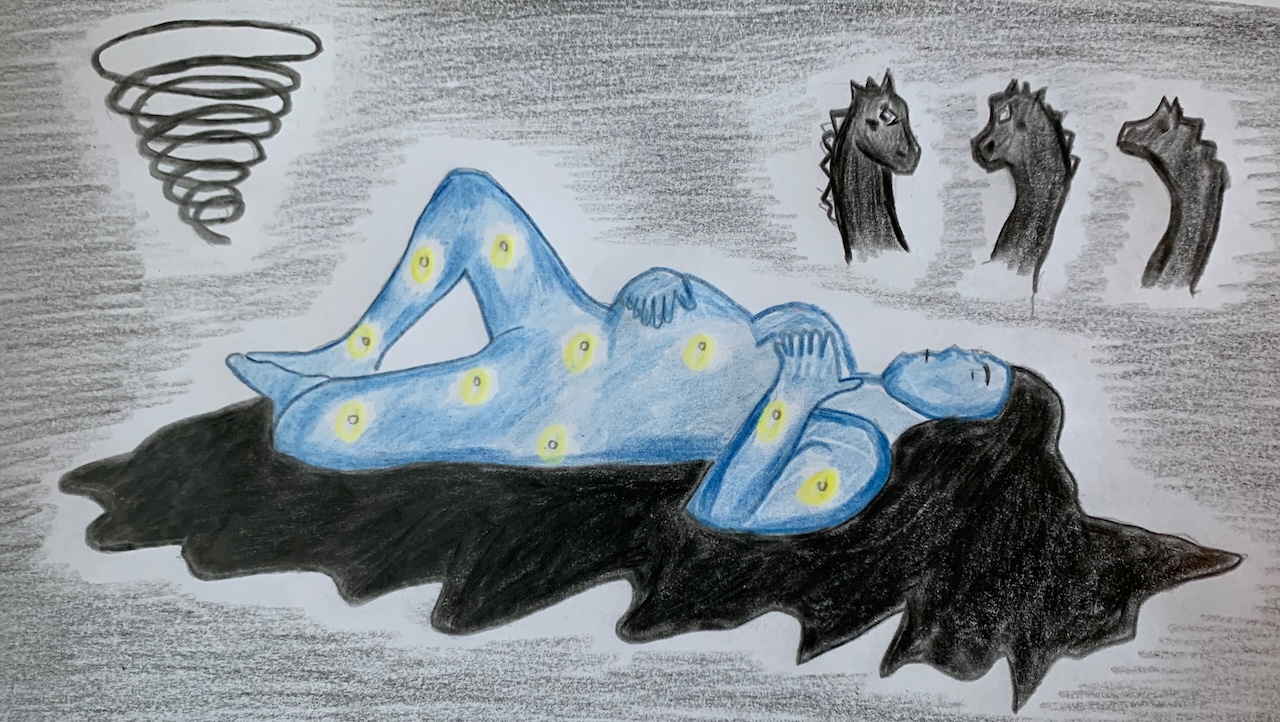
Embodiment practice*: Lying in a modified version of Suptka Baddha Konasana (reclining bound angle pose) with left hand on heart and right hand on belly.
Meditation 1: I am the Deep and I am its mother.
Meditation 2: My heart and His heart beating as one.
Unborn Gwyn
Chant: Gwyn heb ei eini, Gwyn fettws, Gwyn breuddwydio, Gwyn dreaming, foetal Gwyn, unborn Gwyn.
Embodiment practice: Lying in Parsva Savasana (side corpse pose or foetal position).
Meditation 1: I dream the universe.
Meditation 2: I am promise.
Birth
Meditation 1:
Where shall I birth You into the world, my son, my king, my patron, my muse, my inspiration, my truth?
Meditation 2:
A mother’s longest hours like mountains, heaving belly, knees bent, reaching the peak, screaming, running down holding a baby knowing prophecy is born in moments of pain, the first cry of an infant mouth.
She Holds Her Son
Song:
She holds Her son between space and time in the place that’s Hers and His and mine.
The Newborn
Meditation 1:
Born with a laugh to change the world wise a changeling speaking in riddles comes a newborn to break all the rules.
He sings:
Hear the heartbeat, hear the drumbeat, hear the call. Feel the heartbeat, feel the drumbeat stir your soul.
Sing, chant, dance, drum with newborn Gwyn and the shadow nuns.
WE ARE REBORN here, now, in this moment, always, forever.
Inspiration
No-one knows the day or hour of Your birth because You were born before the universe.
*
You have as many births as the facets on your jewel – their number is infinite.
*
The geni in ca fi’n geni ‘I am born’ stems from the Proto-Indo-European root *gene that gives us ‘genesis’. With You, with each child, a universe is born.
*
Each of us contains a universe, like a cauldron, and it’s only when our cauldrons crack and the relationships between the constellations of our presuppositions break down we perceive the sea of stars, the darkness of the Deep, the vastness of Annwfn, the Abyss, the Void.
*
Floating on the starry tide, the infinite waters, You are always being born.
*I have been drawn to use yoga poses in my practice on the basis of gnosis about shared Indo-European origins of Brythonic polytheism and Hinduism. I have found likenesses between Anrhuna and the Hindu Goddess of primordial waters, Danu, who gave birth to the dragon, Vritra, and the Davanas. Gwyn shares many similarities with Shiva.
In the previous post I looked at abyss mysticism in the writing of medieval monastics. Here I shall discuss how it relates to the visions of the Abyss that formed the core of my attempted novel, In the Deep, and to my own experiences.
The Christian abyss mystics of the medieval period perceived the soul and God to be dual abysses. Through a process of annihilation, led by love, the abyss of the soul was dissolved in the abyss of God. Van Ruusbroec conceived this slightly differently suggesting the Abyss was a ‘God beyond God’.
The process of annihilation was one that involved suffering. Penitence, purgation, purification, to varying degrees in different authors but the result was ultimately joyous union with God as the ‘divine’ or ‘blessed’ abyss.
The big difference between my own experiences and visions and those of these Christian mystics is theological as I am a polytheist and not a monotheist and find it difficult to identify the Abyss with the Christian God.
The Abyss has a presence in my life as something powerful, as something divine, as a deity, but not as a God I can name. Thus Van Ruusbroec’s conception of it as a ‘God beyond God’ resonates deeply with me as does the positing by the Gnostics of a God of the Deep preceding the creator God whose prior existence is suggested in Genesis 1.2 ‘And the earth was without form, and void; and darkness was upon the face of the deep. And the Spirit of God moved upon the face of the waters.’ The terms ‘deep’ and ‘abyss’ stem from the Hebrew tehom and are often used interchangeably.
In the cosmology that has been revealed to me by the Brythonic Godsthe Abyss is part of Annwn, ‘Very Deep’, its deepest part, its bottomless depth. It is a place to where the souls of the dead return and from it are reborn.
The way I envisage it bears remarkable similarities to the vision of Hadewijch of Antwerp – ‘an unfathomable depth’, ‘a very deep whirlpool, wide and exceedingly dark; in this abyss all beings were included, crowded together and compressed’.
It is associated with deep wisdom that can only be won as a result of sacrifice. In the stories I was shown Nodens / Nudd agreed to give up His sword arm. He hung over the Abyss in the coils of the Dragon Mother, Anrhuna, the Goddess of the Deep, and received the knowledge, ‘There is no up or down or before or after – everything meets here in you the Dragon Mother.’
Vindos / Gwyn ap Nudd hung over the Abyss on a yew wounded in raven form and gave every last drop of his blood in exchange for a vision ‘to set the world to rights’. His knowledge was brought out of Him by a series of riddles and He saw Himself as a black dragon before plummeting dead into the Abyss.
At the beginning of the next book in death He was united with ‘the source’:
Vindos fell, and as he fell he left behind his shell of bones and black feathers
and his soul flew free on wider wings on the winds of the Abyss. He had won
their favour through his offering of every last drop of his blood.
By his wounding, by his questioning, agony had become ecstasy. The bottomless
abyss was no longer bottomless. He had mastered its paradoxes and knew
where darkness turns to light and death to life. Down was
now up and he was one with the source, the spring
from which the ocean of the stars sprung when the universe was born.’
These scenes bear similarities with Marguerite Porete’s words about the soul, in annihilation, finding ‘there is neither beginning, middle nor end, but only an abyssal abyss without bottom’ before acheiving ecstatic union with God.
It seems my Gods, Nodens / Nudd and His son, Vindos / Gwyn are presenting to me a tradition of sacrifice to the Abyss in return for its wisdom. By leading the way they are showing what might be expected of Their devotees.
My first experience of the Abyss took place as the result of an unconscious process of self-annihilation – dissolution of the self through the combination of practicing Husserl’s epoche (putting all one’s presuppositions about the nature of reality aside) with drugs and alchohol and all night dancing.
There was a yearning within me, I might now say deep for deep, abyss for abyss, but I didn’t know what it was and when I got to the Abyss it terrified me. I wasn’t ready for abyssal wisdom. I didn’t know what to do. I didn’t understand its choices, to live as I was or to die physically, or to take a third door.
I see in my own impulses and those of the abyss mystics, love and annihilation, the interplay of eros the ‘life drive’ and thanatos the ‘death drive’ which together lead to the Abyss and to union with the divine if one is prepared to surrender to make some sacrifice of themselves.
I’ve never been good at giving or sacrifice always wanting things my own way.
Ten years ago, Gwyn, my patron God, a King of Annwn, asked me for a sacrifice in exchange for the wisdom of Annwn – to give up my desire to be a professional author. I did so… but not in full… I secretly entertained a hope if I gave it up for a period I might be let off and be able to have my cake and eat it.
My experience of writing In the Deep, spending a year and a half on a novel that has turned out unpublishable and daring to think it might sell more widely than my previous publications has shown this is not the case.
It’s taken me ten years to realise I must give up my biggest dream in full for good.
This fits with the process of self annihilation found in the medieval mystics. Only by giving up our desires, surrendering our will, can we walk the path of the Gods and with them find a deeper unison with the God beyond the Gods.
I believe this also relates to the need to give up my identity as Lorna Smithers, published author, performing poet, public speaker, to become Sister Patience.
In the Deep was not written purely for self gain. First and foremost it was written for love** of Gwyn, as an origin story for Him, as an offering. I believe it is because of that the awen flowed and I retain these visions as His gift.
That He, ‘White, Blessed’, has led me to the blessed Abyss, the God beyond the Gods, who may or may not be the formlessness of the Mother of the Deep before She took form.
To the third door – to die to his present life, to be annihilated, hopefully like Vindos / Gwyn to be reborn.
He was the first microbe and every single tiny thing.
He was an ammonite and a starfish, He was a silver salmon, every fish.
He swam amongst bright creatures as an eel, as a seasnake, as a snake,
as a horned serpent, as a bull, as a wolf. Playful as a new-born pup Vindos
chased his tail and the trails of starships and traversed every wormhole
before he emerged from the sea of stars and climbed out of the cauldron, naked, dripping, triumphant,
and very much living to stand beside Old Mother Universe.
*I also wrote the sequel, The Spirits of Annwn, in draft form as a long poem, when possessed by the awen last year. **Unlike annihilation love is a difficult thing for me to talk about as someone who, after a number of botched relationships, only discovered they were asexual and aromantic late in life. Unlike a number of Gwyn devotees with an intense devotional relationship with Him I am not a God spouse. Much inside me rebels against using the language of marriage found in Christianity such as ‘bride of Christ’ and even ‘love’ with its sexual and romantic connotations in reference to our relationship. I wish there was a word for purely devotional love.
In part five I will be writing about how these insights relate to the Brythonic tradition.
I write when I fall. It’s a defence mechanism. Like putting out a hand to catch myself.
I write because writing has saved me and I believe my writing might help others.
But putting out a hand doesn’t always work when one is falling into the Abyss…
*
I cried out to the philosophers, “Philosophers save me!”
When I was 21 and in the second year of my philosophy degree I sat on the edge of the Abyss at the nadir of a quasi-initiatory period during which I’d been foolishly been mixing phenomenology (1) with copious amounts of drugs and alcohol, some unknown part of me striving, reaching for… what?
My ‘friends’ had deserted me because I’d ‘gone west’ and I was sitting on the boot of a car, at the end of the world, staring into the Abyss, feeling I couldn’t go on living but not really, truly, wanting to die either. I couldn’t choose.
I was presented with three gateways but didn’t have the courage to take any.
I moved into the front seat of the car and, as dawn arrived, pinking the front windows of my friend’s house, with it came three alienesque beings who I now understand in the Brythonic tradition to be ellyllon ‘elves’. They took me into the heavens in what I saw at the time as an alien aduction experience and performed an intricate operation on my brain with silver instruments.
After that I decided to give up drugs entirely and apply myself to my studies. Not easy. There were after effects. Anxiety. Panic attacks. I ended up on medication but also got subscribed what I really needed – exercise. These things helped me to get my head straight enough to write myself out of the Abyss.
My philosophy studies gave me the tools I needed. I saw my inability to choose life or death as akin to Kant’s antimonies (2) which stem from the use of reason to comprehend sensible phenomena beyond its application. I wrote my dissertation on the concept of the sublime in Burke, Kant, and Lyotard, focusing on how experiences of the sublime depose the rational mind (3).
This helped me to understand the breakdown of my rational faculties but not the visions I encountered as the flip side. It was only when I was studying for my MA in European Philosophy and writing my dissertation on Nietzche’s The Birth of Tragedy I found the clues. Dionysian ecstasy gives way to Apollonian visions. But I wasn’t seeing Dionysus or satyrs. I realised, like Greece, Britain, must have its Gods and spirits, finally met my patron God, Gwyn ap Nudd, a King of Annwn, realised my visions had been of His realm.
Nietzsche, a philosopher, who also stared into the Abyss (4), saved me.
*
The medieval Welsh term Annwn stems from an ‘very’ and dwfn ‘deep’. I believe it shares similarities with the Hebrew term tehom which means ‘deep’ and was translated as abyssos, ‘abyss’, ‘bottomless depth’, in the Septugaint, the earliest Greek translation of the Hebrew Bible in 285–247 BCE.
The Mesopotamian Goddess of the primordial waters, Tiamat, has been linked to tehom. Several years ago myself and other awenyddion found a Goddess named Anrhuna who takes dragon form and is the mother of Gwyn. She plays a similar role as the personification of Annwn. In my visions She, Gwyn, and Nodens/Nudd are associated with the Abyss and its mysteries.
Gwyn was the God who taught me how to fall. He’s fallen too. And I’ve fallen with Him. I’ve crawled out of the Abyss with Him, claw by claw, word by word.
That damned book. It came first when I was falling during the first covid pandemic. I’d given up my supermarket job to volunteer my way into paid work in conservation and my volunteering had been cancelled leaving me with no paid or voluntary role. Utterly unpublishable but writing it got me through.
It came again when I realised I couldn’t cope in a career in the environmental sector. For the last year and a half I’ve worked on it full time, realised it is no good.
That crutch has gone but I’m still putting my hand out – writing whilst falling.
*
I’m back in another antinomy – I love writing but can’t make a living from it.
When I first met Gwyn He asked me to promise to give up my ambition to be a professional author in return for journeying with Him to Annwn. I did it for a while. I took various jobs, cleaning, packing, supermarket, wrote as service for my Gods.
But, sneakily, oh so sneakily, in the back of my mind, I never got rid of the treacherous hope that promise would only be temporary. If I worked hard well enough the veto might come off, I might be able to have my cake and eat it.
I published three books. Sold more copies than I hoped for such niche work. Even got professionally published. Not enough to make a living of course but enough to convince me I might be able to write something that did better.
Ten years after my initial dedication to Gwyn I asked Him by divination about whether that promise still holds and got 1. The Wanderer and thought I was free of it. It’s notable here I asked through the tarot rather than asking Him directly. Consciously I did this because I feared my discernment might be off. Maybe unconsciously, I feared, knew, he’d say, ‘No’. I read the card wrong. In the traditional tarot The Wanderer is the The Fool. I was fooling myself. As I write these words I hear the laughter of my God and realise what a fool I was.
At one point I hoped In the Deep might not only sell to my small Polytheist and Pagan audience but might also appeal to fantasy readers, taking the stories of Gwyn and the other Brythonic Gods into the mainstream.
Hubris. It didn’t work. An individual can’t write myth. And I’m not that good a writer.
A difficult lesson learnt. My ambition to be a professional writer given up for good, vomited up, committed to the Abyss, I’m falling again, writing whilst falling.
I’m remembering my vision of the three gates. I can’t make a living as a writer. I don’t want to die either. I’m asking what lies beyond the third gate.
In the next part I will be writing about the ‘Abyss Mystics’ who, unlike me did not try to cling on, to write themselves out of the Abyss, were not afraid of falling.
(1) In particular using Husserl’s epoche (setting aside all assumptions of existence) as an experiential practice. (2) https://en.wikipedia.org/wiki/Kant’s_antinomies (3) In ‘Scapeland’ Lyotard writes of the ‘The Thing’ as sublime – ‘the mind draws itself up when it draws a landscape, but that landscape has already drawn its forces up against the mind, and that in drawing them up, it has broken and deposed the mind (as one deposes a sovereign), made it vomit itself up towards the nothingness of being-there.’ (4) In Beyond Good and Evil Nietzsche wrote, ‘Battle not with monsters lest ye become a monster; and if you gaze into the abyss the abyss gazes into you.’
The Abyss was its spiralling core and its beginning and its end.
The Beginning
It began with a boy falling, falling, falling into the Abyss.
The boy dreamt of the birth of his Dragon Mother from the infinite waters of the Deep with nine heads and nine-hundred-and-ninety-nine coils and her giving birth to an infinitude of dragons, serpents, monster-serpents and monsters.
*
The boy dreamt of the birth of the stars – each the eye of a fiery giant. He watched them mating, spawning bright gods, who built their fortresses in the skies. The King of the Gods ordering the constellations with a turning sword. This god cast out, plummeting like a comet with an icy tail, down to the Deep.
*
The boy dreamt of the god hanging in his mother’s coils over the Abyss to gain its wisdom. ‘There is no up or down or before or after – everything meets here in you the Dragon Mother.’ He watched them mate and knew he was conceived.
*
The boy dreamt of the Children of the Don descending from the stars to slaughter the Dragons of the Deep. Lugus, their leader, cut off the arm of his father, Nodens and slaughtered his Dragon Mother, Anrhuna. Lugus then tore the boy, Vindos, and his sister, Kraideti, from the womb. He stole Kraideti ‘the Girl who will Bring Life’ to the stars and threw Vindos ‘the Boy who will bring Death’ into the Abyss.
*
The boy awoke and crawled from the Abyss to eat his Dragon Mother’s heart in a rite that made him King of Annwn (he later gained his name – Vindos / Gwyn ‘White, Blessed, Holy’).
The End
Vindos killed Lugus as vengeance for slaying his Dragon Mother. Lugus took flight in the form of an eagle and perched wounded in an oak tree for nine nights with a sow beneath feasting on the rotten flesh and maggots from his wound.
Uidianos sang Lugus down from the oak with three englyns and restored him to life.
Lugus returned the blow, shattering the Stone of Vindos, to pierce his enemy’s side. Vindos took the form of a raven and flew to Annwn where he hung wounded on a yew tree upside down over the Abyss and answered its riddles.
Night One:
“Tell me the hour the King and Queen of Annwn were born.”
“Not easy – we were not born but ripped from the womb on the hour of the death of dragons.”
*
Night Two:
“Tell me in your eternal battle who killed who?
“Not easy, summer and winter are mirrors – when one kills the other kills too.”
*
Night Three:
“Tell Me how many trees are in the forests of Annwn?”
“Not easy, for they are without number but ask me again and I will name them.”
*
Night Four:
“Tell me how many doors there are to Annwn.”
“Not easy, for they are without number but ask me again and I will open them.”
*
Night Five:
“Tell me where divide darkness and light, day and night?”
“Not easy, for there are no divisions – each follows each in an endless procession.”
*
Night Six:
“Tell me where the restless wind comes from and where he rests.”
“Not easy, for no-one but he knows the location of the Lands of the First and Last Breaths.”
*
Night Seven:
“Tell me how many stars are in the Heavens.”
“Not easy, for they will not be counted until all souls are in the cauldron.”
*
Night Eight:
“Tell me the fate of your last drop of blood.”
“Not easy, for I cannot divide it from the ocean of blood that will drown the world.”
*
Night Nine:
“Tell Me the hour the King and Queen of Annwn will die.”
“Not easy – we cannot live without each other and thus will die together when all souls are gathered.”
*
Vindos then fell into the Abyss.
These scenes had a basis in my personal encounters with the Abyss. I will be talking about those in part two, then in part three and four presenting my recent discovery of ‘Abyss Mysticism’ in the writing on medieval monastics and how this has helped me make a little sense of the abyssal visions behind this book.
In my attempted novel, In the Deep, I tried to imagine a story for the origins of Vindos / Gwyn, His kingdom in Annwn, and for the creation of the world. This was based on a combination of my readings of Brythonic and other Celtic and Indo-European and world myths and my personal gnosis.
I worked for a year and a half on a story that had meaning for me and I felt Gwyn wanted me to write as the awen kept on flowing. Yet it didn’t speak to many humans and, in retrospect, although coherent, contained a lot of flaws.
Looking back, I feel it was a process I needed to go through. I genuinely believe I saw faces of Gwyn, such as the Boy in the Serpent Skins, that were meaningful for me and needed to journey with Him and write those tales.
Yet there were elements of the story I could never quite make work. My personal gnosis led me to perceive parallels between Tiamat in the Enuma Elish and a ‘found’ Goddess I know as Anrhuna who takes the form of a nine-headed dragon and is Gwyn’s mother and the Mother of Annwn.
In the Deep was written as an inversion of Enuma Elish ‘When on High’ reimagining what might have been a wider Indo-European origin myth centring on the slaying of a dragon from the side of the Deep rather than the victors.
It opens with a battle between the Dragons of the Deep (Annwn) and the Children of Don wherein Lugus / Lleu slays Anrhuna, the Dragon Mother. By cutting off Her nine heads He releases the dragon children of the nine elements*. He then cuts open Her womb and tears out Kraideti / Creiddylad (the Girl who will Bring Life) and Vindos / Gwyn (the Boy who will Bring Death). Lugus takes Kraideti to the stars and flings Vindos into the Abyss. Uidianos / Gwydion steals the magical jewels from Anrhuna’s foreheads and with them commands the dragon children to create the world.
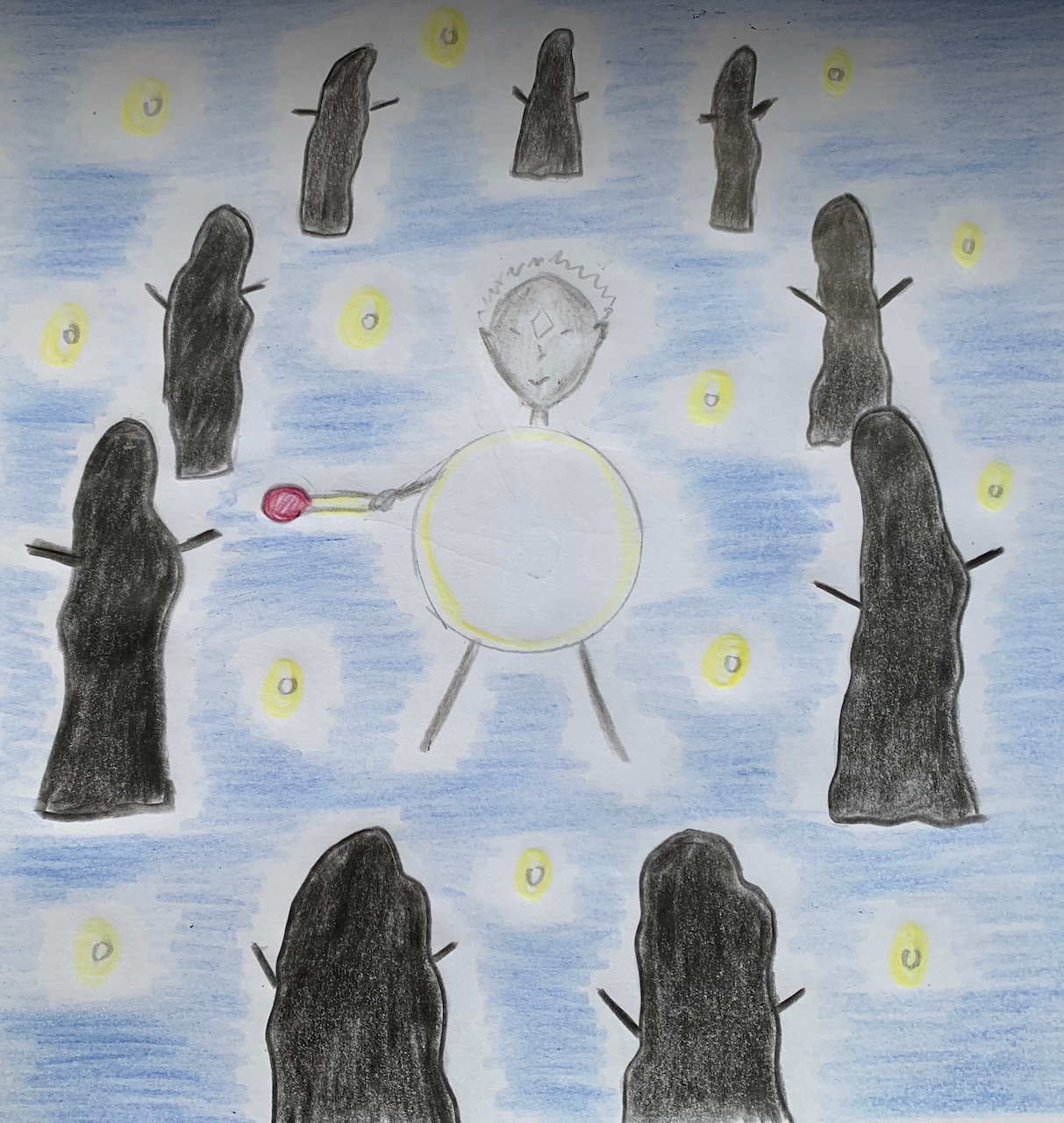
Although I’ve been able to picture the dragon slaying scene quite vividly I’ve never quite managed to see or write the creation of the world. I’ve ‘seen’ Uidianos and a circle of enchanters with their wands conjuring with the elements to form a world but can’t seem to connect it with the dragons.
The role of Gwydion as demiurge I derived from His creation of Taliesin in ‘The Battle of the Trees’ from ‘nine forms of consistency’ – ‘fruit’, ‘fruits’, ‘God’s fruit in the beginning’, ‘primroses’, ‘flowers’, ‘the blossoms of trees and shrubs’, ‘earth’ / ‘sod’, ‘nettle blossoms’, and ‘the ninth wave’s water’.
In ‘The Song of the Great World’ Taliesin is created by God from ‘seven consistencies’ – ‘fire and earth, / and water and air, / and mist and flowers, / and the fruitful wind’. Like the the microcosmic Adam** his creation may be seen to mirror the creation of the world by God in this poem. It seems possible Gwydion was earlier seen as creating Taliesin and the world.
In ‘A British Myth of Origins’ John Carey suggests the Fourth Branch of The Mabinogion might contain an origin myth with Math’s kingdom whilst He has His feet in the lap of a virgin, Goewin, representing a timeless paradisal state. Gwydion’s scheming with Gilfaethwy to bring about her rape represent a fall. Gwydion and Gilfaethwy’s transformation by Math into a deer and a pig and a wolf, and their bearing of offspring, may explain the origin of animals.
Carey also suggests the story of Taliesin shapeshifting into various animals after stealing the awen from the cauldron of Ceridwen and the animal transformations of figures such as Mongan in the Irish myths function ‘as a device to connect the present with its origins, whether the beginnings of history or the transtemporal eternity of the Otherworld.’
It’s my personal intuition that Ceridwen may be a creator Goddess. That Her crochan ‘cauldron’ or ‘womb’ could be the vessel from which the universe was born. This is another strand that I attempted to weave into my book.
If we look back beyond medieval Welsh mythology to the Roman sources we find no evidence whatsoever of a creation myth. Instead Strabo reports that the Gallic peoples (who according to Caesar derived their beliefs from the Britons) believe ‘men’s souls and the universe are imperishable’. Several authors speak of the belief that the soul is immortal. According to Caesar it ‘does not die but crosses over after death from one place to another’ showing existence in an ‘otherworld’ (potentially Annwn). Diodorus Siclus claims the Gauls ‘subscribe to the doctrine of Pythagoras that the human spirit is immortal and will enter a new body after a fixed number of years’. The key doctrine of Pythagoras is metempychosis and we find this throughout the Taliesin material wherein he speaks of his transformations.
It seems possible we don’t have a Brythonic creation myth as the universe was viewed as ‘imperishable’ and the eternal soul as shifting through different shapes, potentially crossing from this world to Annwn and back again.
One of the things that has stood out to me whilst returning to the Taliesin material is that rather than telling of creation as given he instead poses riddles. ‘How is the sun put into position? / Where does the roofing of the Earth come from?’ ‘Where do the day and the night come from?’ He mocks Christian scribes for not knowing ‘how the darkness and light divide, / (nor) the wind’s course’.
Taliesin seems to be claiming to know yet he leaves the answers a mystery. Could it be that our Brythonic ancestors treated these issues as mysteries rather than having clear cut myths and stories and explanations?
If so could my failure to create a myth that works be based on the fact there have never been any direct answers and these things should be left mysterious?
If so it seems this book idea has played itself out for what it is but can go no further. I fulfilled my promise to Gwyn to write Him an origin story (something He didn’t ask for but that I did as an act of devotion to Him). It just didn’t turn out to be a novel sellable to humans. Which is ok.
Where to go from here I’m not sure. I still want to write, I still need to write, in service to my Gods and to give voice to the awen from Annwn and within. To provide content for my patrons who continue to support me. But it might be that now I’ve become a nun of Annwn, Sister Patience, what I write will change.
It seems possible I will be taking a more meditative approach with a focus on mystery, which feels fitting for a nun dedicated to a God of the Deep.
*Stone, earth, water, ice, mist, wind, air, fire, magma. **In her notes to ‘The Battle of the Trees’ Marged Haycock adds some references to medieval Christian texts where Adam is said to be created from ‘eight consistencies’ – ‘land, sea, earth, clouds of the firmament, wind, stones, the Holy Spirit and the light of the world’ or ‘earth (flesh), fire (red, hot blood), wind (breath), cloud (instability of mind), grace (understanding and thought) blossoms (variety of his eyes), dew (sweat), salt (tears).’








 The Sanctuary of Vindos