The Last Witch of Pennant Gofid

I journeyed for weeks
through mist and hunger
to find the split rack of her bones,
bones stripped, flesh burnt
and boiled in the cauldron,
blood drained and bottled in two jars.

I plundered the ashes where the cauldron stood,
sniffed for blood where the jars were filled.
Played maracas with her bones,
made intricate arrangements,
chanted and sung
but could not raise her ghost.

“She is amongst the spirits of Annwn now,”
spoke the god I called instead.

“Lay her bones to rest. In the fire of poetry
console her burning spirit.”

***

I’m laying her bones to rest. The Last Witch of Pennant Gofid. Her name was Orddu. It meant ‘the Very Black Witch’. Whether she had black skin, black hair or used black magic seem irrelevant now. All that is left is her scapula split in twain, her shattered pelvis, two arms, two legs, her broken skull. Jagged shadows in two orbits retrieved from either side of the cavern.

Her bones are still. I am angry and restless. I cannot abide the story of her death. How Arthur came as he always did into every story every world every myth with his hatred of witches: sword slung over his shoulder like a sundered lightning bolt, a living knife in his hilt, a shield on his thigh adorned with an image of the Virgin Mary, aboard a huge mare.

Caw of Prydyn behind him a giant with a curling beard and the damned jars like heinous milk bottles on each side of his saddle; half a man in size, well-stoppered, thick-glassed, unbreakable. Then the retinue with spear and shield, tawdry banners and flags.

Following to stragglers’ jeers Hygwydd the servant staggering bow-legged bent-backed beneath the gigantic cauldron that brewed food for the brave. Hygwydd’s brother Cacamwri with Hir Amren and Hir Eiddil dragging ponies piled with saddle-bags of food and weapons.

At Arthur’s right Gwythyr ap Greidol, a gristled war-lord with fire and a hundred bloody campaigns in his eyes. A blazing passion. And to Arthur’s left Gwyn ap Nudd, the guide who tricked and dizzied their quest cloaked in mist summoning his hounds to eat the fallen from the mountainside.

Of the host who went to Pennant Gofid only a fragment reached the cave where Orddu plaited her black hair, blackened her skin with war-paint, fastened down her helmet. Sharpened her sword then set it aside like an afterthought. Cracked her knuckles and flexed her talons.

When Arthur blanched a voice mocked from the mist “if you’re scared, witch-killer, why not send your servants in instead?”

Arthur pointed Hygwydd and Cacamwri toward Orddu beckoning. She grabbed Hygwydd by the hair, dragged him to the floor, threw off Cacamwri’s assault, arrested their weapons, beat them out bloody and bruised. Arthur sent Hir Amren and Hir Eiddil in to be crushed in her wrestling hold, torn by her talons, beaten out with broken bones. Arthur fumbled for his knife.

“Why are you afraid, Christian warlord?” Orddu asked. “Far from home. Far from heaven. Do you remember I trained your northern warriors? Without my wisdom, gifts from our gods, they will be nothing but bickering chieftains with a lust for gold and immortality that will bring Prydain’s downfall?”

Overcome by fury Arthur threw his knife in a wrathful arc that sliced down through Orddu’s helmet through her ribs. Dropped to the floor as she fell aside in two halves screaming “Prydain will fall!” “Prydain will fall!” “Prydain will fall!” as the mist writhed and the hounds of Annwn howled.

When her twitching halves lay still Caw filled the bottles with her blood still warm and jammed down the corks. They stripped her of armour and flesh. Boiled a merry meal. Stole her sword. Left with a cauldron filled with northern treasure whilst her spirit watched aghast in the misted arms of Gwyn ap Nudd.

***

I cannot abide the story of Orddu’s death. How Arthur came as he always came into every story every world every myth with his hatred of witches with his living knife to put an end to wild recalcitrant women. Now I’ve laid it to rest I’ll share another story instead.

I shall tell what this fatal blow and the blows on the Witches of Caerloyw cost Prydain (“Prydain will fall!” “Prydain will fall!” “Prydain will fall!”). Not only the fall of the Old North and the Men of the North. The rise and fall of the British Empire (it had to needed to fall). But the splitting and bottling of magical women for over a thousand years.

Draining of our blood. Boiling of our flesh. Testing if we float. Gave us The King James Bible and The Malleus Maleficarum. Took away our prophecies and visions, gods and goddesses, our fighting strength. Gave us virginity and chastity belts. Cut us off from plants and spirits, rocks and rain, rivers and mist, otherworlds.

Over a thousand years on we are but shadows of ourselves. Mirrored pouts tottering on high heels. Watching ourselves on selfie-sticks. Worshipping televisions. Still split in half, bottled, boiling, floating, banging to get out.

Not long ago I split the jars. Escaped to another place. Wandered my estate kissing Himalayan Balsam. Watching Ragwort sway with wasps. Mugwort flowering like coral. But this was not enough. Gods and fairies walked to the world of the dead and called me after them. Since then I have seen the dead walk in the bright eye of the sun.

I could not go back to the jars. To glass windows and tower blocks. To numbers on computer screens. The pencil skirts of offices. To fracking rigs threatening to break both worlds.

So I came to Pennant Gofid searching for answers and companionship on my lonely path. Found only Orddu’s bones and the god who took her spirit. Yet found a link in spirit with a companion and a god in the magical tradition of the Old North.

***

So I constructed a fire of poetry and spoke my words of consolation:

“Orddu Last Witch of Pennant Gofid
know you are not the last
to walk these paths
to caves and mountain ranges,
through otherworlds and distant ages,
seeking visions of the present
the future and past.

The rule of Arthur has fallen.
Though Prydain still falls
we have broken the jars.
Our blood is no longer contained
by the tyrants of Arthur’s court.
We are winning back our flesh.
Our magic. Our strength.

Remembering our gods.
Know your life will be remembered
where there are prophecies and hailstorms,
rain and rivers, caves and heresy,
in the mists of Gwyn ap Nudd
where your spirit burns
forevermore.”

Then I took her bones in my rucksack and crawled through to a dark chamber. On a little shelf beside Orwen ‘the Very White Witch’ I laid Orddu’s bones to rest.
Gwyn ap Nudd and the Gwyllon: ‘Wyllt-ness’ and the Healing Power of Art

Barrow Mound, Fulwood

The wight whose footsteps I heard
imprinted on my cold soul,
the cold marrow of my bones.
He walked in soul as his bones laid still
and my soul reached out to him:
another one of the gwyllon.

The glimmer of fairy lights.
This place secluded and so still.

Fulwood Barrow MoundSometimes you stumble somewhere and forget yourself. No longer breathing. In the time of the gods. You hear the footsteps of a deity. Not your deity. But one connected with him.

***

In the mythology of ancient Britain, Gwyn ap Nudd (a ruler of Annwn and guide of the dead) is intimately connected with ‘gwyllon’: madmen, wildmen, wraiths, who through some traumatic experience have become ‘outside themselves’, open to the otherworld, ‘wyllt’.

The most famous is Myrddin Wyllt. Myrddin is a golden-torqued warrior of the court of the northern British ruler, Gwenddolau, who becomes wyllt after the Battle of Arfderydd; a conflict between Brythonic kinsmen renowned for its carnage and futility.

Looking across the battlefield, stricken with guilt because his sister Gwendydd’s sons are amongst the dead, Myrddin sees an unendurable brightness and martial battalion in the sky. It seems possible this is Gwyn (‘white’ ‘blessed’ holy’ from Vindos or Vindonnus ‘white’ ‘clear light, white’) and his host: the spirits of Annwn and the war-dead, approaching to gather their kindred to the otherworld.

‘Torn out of himself’ by one of these spirits, Myrddin flees to Celyddon (the Caledonian forest). He wanders there ‘ten and twenty years’ with ‘madness and madmen’ ‘gan willeith a gwyllon’. These gwyllon are ‘seven score men’ who also fought at Arfderydd then lapsed into madness in Celyddon and perished.

Similar cases are found in The Triads of the Island of Britain: ‘Tri Gwyd Ellyll Ynys Brydein’ ‘Three Wild Spectres of the Island of Britian’. The notes state ‘ydellyll’ (for ‘gwyd ellyll?’) ‘occurs in the Gododdin in reference to furious activity in battle’ and could relate to tales of men who become wyllt as a consequence of war.

What makes Myrddin’s story unique is his recovery. Amongst wild creatures of the forest; a piglet, a wolf and a favourite apple tree he undergoes a healing process through which he learns the art of poetry and uses it to prophecy against future bloodshed.

***

Cyledyr Wyllt possesses an entirely different story. In Culhwch and Olwen, after Gwyn abducts Creiddylad, his rival Gwythyr ap Greidol raises an army of northern men to win her back. Amongst them are Cyledyr and his brother, Pen, his father Nwython and his great grand-father’s brother, Gwrgst Ledlwm. If Gwrgst is still living this means Cyledyr must be in his teens.

Gwythyr and his army attack Gwyn. My intuition is this attack represents a raid on Annwn. Gwyn triumphs over Gwythyr and the northern men and takes them prisoner. During their captivity he kills Nwython and feeds his heart to Cyledyr, who goes mad. The etymological links between Cyledyr and Celyddon suggest that, like Myrddin, he flees to the forest.

Gwyn’s motive for torturing Cyledyr is never explained. Did he do it from fury? For vengeance? Did he have some darker purpose in feeding a young man his father’s heart? Could this have originated from some arcane rite of the past whereby the strength of one’s ancestors was conferred by eating their flesh, of which Gwyn makes a mockery?

Another question worth asking is ‘Did it happen at all?’ The historical Nwython is recorded to have died in his bed.

It seems possible Cyledyr’s fevered recollections result from the effects of unbidden entry to Annwn, the battle between Gwyn and Gwythyr’s forces and time spent in prison on an impressionable young mind. Whilst Cyledyr is telling this story Nwython could be anguishing over the unknown fate of his son. Whether Cyledyr recovered from his trauma or died in Celyddon remains uncertain.

***

Another story I believe features Gwyn (as the King of Fairy) and a human ruler who becomes wyllt is Sir Orfeo. This begins when the Fairy King abducts Heurodis, Orfeo’s wife. Driven wyllt by grief, Orfeo abandons his sovereignty and departs ‘like a beggar’ for the wilderness where his only solace is playing his harp, which brings joy to the wild creatures.

After ten long years Orfeo finally finds a way into Fairyland. After travelling sunlit green plains and hunting grounds he comes to the Fairy King’s glass palace. Therein he makes a terrible discovery: ‘Folk long thought dead… as living found’ headless, armless, torn, ‘with dreadful wounds’, ‘full-armed on horses’, strangled, drowned, burned, wives laid in child-bed ‘stolen out of life’: those ‘the fairies seize and keep’. Heurodis lies amongst them.

These images represent a little-known truth, rarely made explicit in Brythonic mythology: the beauty of Fairyland is founded on the horror of death. The knights and damsels of the Fairy King’s hunt who feast in his hall number the war-dead, murder-victims, women who have died in labour.

Heurodis is amongst them because when the Fairy King took her whilst she slept beneath an orchard tree she died or became comatose or catatonic. Such superstitions can be traced through Brythonic fairylore to earlier beliefs about Gwyn and the spirits of Annwn conveying souls to the otherworld.

This knowledge does not prevent Orfeo from entering the Fairy King’s hall and playing his wondrous music. The King is so moved he offers Orfeo anything he wants. Of course, Orfeo asks for Heurodis. He brings her back to this-world where the pair are re-united in sovereignty.

This story shows how Orfeo gains his ability as a musician from his period wandering wyllt and that hard-won art has the power to move the gods, to sing the souls of those held captive in Fairyland back to this earthly home.

***

These myths represent the experience of becoming wyllt at the outermost limits of human experience. The ‘wyllt-ness’ of Myrddin and Cyledyr results from battle trauma. Cyledyr’s battle trauma is exacerbated by his unwarranted entry into Annwn, imprisonment in the ‘not-world’ and real or imagined torture by Gwyn.

Orfeo’s story differs slightly. His wyllt-ness results from loss. His time spent wandering the wilderness provides him with the strength to survives his gnosis of the terrible truth at the heart of Fairyland and Heurodis’ fate to win her back and return to his seat of rule.

Key to the survival of becoming wyllt is the power of art. For Myrddin and Orfeo giving voice to their trauma and to the powers of nature who surround and console them is an essential part of the healing process. It is possibly because he does not discover art that Cyledyr remains wyllt. This may also be the case for the other gwyllon who lapsed into madness and perished.

These stories contain lasting significance for modernity where art and nature therapy are recognised as powerful means of helping victims of war and loss.

***

Later folktales represent a variety of different encounters with and responses to Fairyland. In most we find the recurrent themes of wyllt-ness and art. People who meet fairies, stumble into or are taken to Fairy invariably become ‘dead, mad or poets’. My personal experiences with Gwyn and his realm bear stronger resemblances to these tales.

Glastonbury TorIn the year 2000 at Glastonbury Festival (long before I knew the name of the mysterious god of the Tor) I had a vision of what I recognise now to be Fairyland which left me shocked, stunned and profoundly questioning the nature of reality.

My quest for an explanation led me through a dangerous combination of drink, drugs, all-night dancing and all the texts of the Western European philosophical tradition, deeper into madness, to the brink of an abyss where I was faced with the choice of life or death.

Unable to choose either I was confronted by three beings I now recognise as ellyllon (‘fairies’ akin to gwyllon). What followed was equally beautiful and perturbing and put an end to the pain of having to make that choice. My experiences left me half-wyllt, wandering between life and death, plagued by anxiety and panic attacks and put a temporary end to my vision-quest.

After giving up my philosophy PhD, I spent four years working with horses. During this period of re-connecting with the land, the seasons and the animal world, working hard and thinking little, I underwent a return to nature that bears a little analogy to the flight of the wyllt to Celyddon.

When I met Gwyn and put a face to the god who governed the magical landscape I haphazardly intruded on at Glastonbury Festival twelve years ago, my initial terror was edged by relief. I finally knew the source of the calling to the otherworld that had haunted me for as long as I can remember. Gwyn became my patron and I his awenydd: ‘person inspired’ or ‘poet’.

***

In the contemporary world where poetry, let alone pagan poetry, is rarely acknowledged or valued the path of the awenydd is not an easy vocation. Deep gnosis of nature and Annwn and its deities necessarily places one outside the bounds of ordinary experience; makes one wyllt, other. With Celyddon gone there is no wild and wooded place of retreat outside the norms of society where gwyllon can flee and gather in company.

Yet in the shaded spaces of our localities where trees still stand and that great forest stood before it walked to Scotland centuries ago we can commune with the gwyllon of old and find unison with the gwyllon of today. Sharing can also take place in the green nooks and crannies of books, in the pubs and cafes and wooded stages where we perform and on the internet. In our stories we find camaraderie.

In a world becoming increasingly superficial where we are losing touch with the deep knowledge our ancestors held to help those touched by the wyllt-ness of Fairyland be it through trauma, loss, enchantment or some silly mistake, we have never had a greater need for the stories of Gwyn ap Nudd and the gwyllon. For the healing power of art.

Castle Hill from Fairy LaneSOURCES

Bromwich, Rachel (ed) The Triads of the Island of Britain (University of Wales Press, 2014)
Bromwich, Rachel and Evans, Simon D. (eds) Culhwch and Olwen (University of Wales, 1998)
Davies, Constance ‘Classical Threads in Orfeo’ The Modern Language Review, Vol 56, No 2, (Modern Humanities Research Association, April 1961)
Davies, Sioned (transl.) The Mabinogion (Oxford University Press, 2007)
Evans, J. Gwengobryn The Black Book of Carmarthen (Lightning Source UK Lmtd, 1907)
Friedman, John Block ‘Eurydice, Heurodis and the Noon-Day Demon’ Speculum, Vol 41, Vol 1 (Medieval Academy of America, 1966)
Hunt, Edward Eyre Sir Orfeo (Forgotten Books, 2012)
Pennar, Meirion (transl.) The Black Book of Carmarthen (Llanerch Enterprises, 1989)
Skene, William F. The Four Ancient Books of Wales (Forgotten Books 2007)
Thomas, Neil ‘The Celtic Wild Man Tradition and Geoffrey of Monmouth’s Vita Merlini: Madness or Contemptus Mundi?’ in Arthuriana Vol. 10, No. 1 (Spring 2000)
Tolstoy, Nikolai The Quest for Merlin (Sceptre, 1985)

Gwyn ap Nudd and Gwallog ap Lleenog: One Brother Dies and the Other Lives On

In The Conversation of Gwyn ap Nudd and Gwyddno Garanhir, Gwyn states his presence at the death of Gwallog ap Lleenog ‘From a long line of princes / Grief of the Saxons’. Gwallog is a descendant of Gwyr y Gogledd ‘The Men of the North’. His descent on his father’s side is recorded in the Harleian Genealogies. ‘[G]uallauc map Laenauc map Masguic clop map Ceneu map Coyl hen.’ This places him amongst the lineage of Coel Hen (Old King Cole).

More importantly within the context of my research on Gwyn ap Nudd and the Old North, Gwyn, Gwallog and Caradog are mentioned as half-brothers through their shared descent on the maternal side from Tywanwedd in Descent of the Saints. Tywanwedd is the daughter of Amlawdd Wledig, a Welsh prince who may have ruled on the border of Herefordshire.

These three brothers appear again in an entry in Peniarth MS 132: ‘Gwyn ap Nudd greiddyei (?) ap Lludd. He went to Llew ap Llyminod Angel. He went between sky and air. He was brother to Caradog Freichfras and Gwallog ap Lleenog. He and they had the same mother.’

Between Sky and Air

Between Sky and Air

In Geraint son of Erbin Caradog, Gwallog, Gwalchmai and Owain son of Nudd appear alongside Arthur as ‘guarantors’ of Edern son of Nudd after he is mortally wounded by Geraint. Caradog and Edern appear together as Arthur’s ‘counsellors’ in The Dream of Rhonabwy. This brings to light further familial links.

It is of great interest to note that if Tywanwedd is Gwyn’s mother, this places him in the same lineage as Arthur (Arthur’s mother was Eigr daughter of Amlawdd) and Culhwch (Culhwch’s mother was Goleuddydd, daughter of Amlawdd): the three are first cousins (!).

However, Peter Bartrum argues due to Gwyn, Gwallog and Caradog’s ‘disparate nature’ in ‘character, place and time’ it was more likely their mother was a fairy like Gwyn. Considering Gwyn is a god whose worship as Vindos / Vindoroicos / Vindonnus can be traced back to the Romano-British period it seems clear she must also have been divine: a goddess who, like Gwyn, may later have been perceived as a fairy.

As within Brythonic mythology there is a long tradition of relations between deities and mortals, often bearing offspring (for example Owain Rheged’s parents were Urien Rheged and the goddess Modron, mother of Mabon) it seems possible the story behind Gwallog’s birth was that his father, Lleenog, slept with a fairy woman. Perhaps one of her guises was Tywanwedd, and as Tywanwedd she seduced Lleenog?

The story of Gwallog’s birth from a fairy woman provides some fascinating insights into the continuity of pagan beliefs within a northern British society that was nominally Christian. It also supports my growing intuition that Gwyn, his father (and now his mother) were viewed as ancestral deities by the Britons of the Old North, Wales and beyond.

***

Gwallog’s kingdom is traditionally Elmet. This is derived from Ifor Williams’ translation of lines in The Song of Gwallawg ap Lleenawg where Gwallog is named ‘a judge over Elmet’. Bede speaks of ‘silva elmete’ (‘the forest of Elmet’) saying ‘subsequent kings made a house for themselves in the district, which is called Loidis.’ Loidis is Leeds and place-name evidence suggests Elmet covered West Yorkshire.

Further evidence Gwallog ruled Elmet comes from Nennius’ History of the Britons. He tells of how Edwin of Northumbria ‘occupied Elmet and expelled Certic, king of that country’. Certic is usually identified as Ceredig, Gwallog’s son.

Gwallog’s renown as a war-leader is evidenced by the Triads, where he is named as one of three ‘Pillars of Battle’, ‘Bull Protectors’ and ‘Battle-Leaders’ of Britain. According to Nennius he was amongst four kings; Urien, Rhydderch the Old, Gwallog and Morcant, who played a leading role in defending the north against the Bernician Angles. Whilst some scholars assume Nennius refers to an alliance between the four kings, Tim Clarkson believes he refers to separate campaigns and these northern rulers were as likely to have been enemies as allies.

Whilst the existence of an alliance is impossible to prove or disprove we know Morcant ordered Urien’s assassination at Aber Lleu (opposite Lindisfarne) and Gwallog fought either with or against the sons of Urien Rheged ‘Gwallach, horseman of battle, planned / to make battle in Erechwydd (Rheged) / against the attack of Elphin’ following Urien’s death.

In two poems attributed to Taliesin we find further evidence Gwallog fought just as ferociously against other Brythonic war-lords as against the Angles and Saxons. In The Song of Llenawg, Taliesin lists battles in Agathes, Bretrwyn, Aeron (a river in Ceredigion), Arddunion, the wood of Beit, Gwensteri and the marsh of Terra. He also mentions a cattle raid and conflict ‘At the end of the wood of Oleddyfein, / From which there will be pierced corpses, / And ravens wandering about.’

In The Song of Gwallog ap Lleenawg, Taliesin says Gwallog ‘rejected uniform ranks of the rulers, / Of the hosts of Rhun and Nudd and Nwython’. This shows he battled against other well-known northern rulers. He is finally described as ‘king of the kings of tranquil aspect’ over Caer Clud (Dumbarton, capital of the kingdom of Strathcylde), Caer Caradawg (the location of one of three ‘perpetual harmonies’ of the Isle of Britain) and the land of Penprys (Powys?). It seems he subjugated a number of other kings.

In The Black Book of Carmarthen we find an enigmatic poem called A Song on Gwallawg ab Lleenawg which refers to how Gwallog lost an eye in his youth. He is said to have lost it to an ‘accursed tree’ which appears thrice: as ‘black’, ‘white’ then ‘green’. In another variant he loses it to a ‘white goose’.

That Gwallog and his battles are so well remembered suggests this fearsome one-eyed warrior was known across Britain during his time and centuries later. Whilst his exploits are celebrated by the Bards I can only imagine his opponents and the ordinary people must have lived in dread of being caught up in the conflicts or ordered to fight.

Sadly we have no records of how anybody outside the ruling classes viewed Gwallog. However in the poem about how he lost his eye we may find reminiscences of a folk tradition. One can imagine gatherings around the fire whereby beery speculations led to a plethora of ‘how Gwallog lost his eye’ songs.

***

The only record I have been able to find which may relate how Gwallog met his end is in Geoffrey of Monmouth’s The History of the Kings of Britain. He refers to Guallauc of Salisbury who dies fighting against the Romans in the Battle of Saussy (France). Whether this is ‘true’ and whether Gwallog and Guallauc are the same person remains uncertain.

In The Conversation of Gwyn ap Nudd and Gwyddno Garanhir, Gwyn tells Gwyddno he was present at Gwallog’s death. Within the context of Gwyn’s rulership of Annwn and role as a psychopomp, I assume he appeared to guide him to the land of the dead. The knowledge that Gwyn and Gwallog were half-brothers adds a whole new dimension to this scene and to their relationship. Gwyn was not only acting as a guide of the dead to a celebrated warrior but to his kinsman.

Gwyn also mentions his presence at Llachau’s death. Llachau is Arthur’s son. If Tywanwedd was Gwyn’s mother, this makes them cousins once removed. Again he gathers the soul of a relative.

At the end of The Conversation, Gwyn laments that he is alive whilst the warriors of Prydain (Britain) are slain and in their graves. Knowledge of Gwyn’s ancestral connections with these men provides a deeper understanding of why he chooses to recite their names to Gwyddno and particularly grieves their fall.

Because Gwyn is a god of Annwn whose role is to guide and contain its spirits until the world’s end, he is fated to witness the deaths of his mortal and semi-mortal kindred as he lives on.

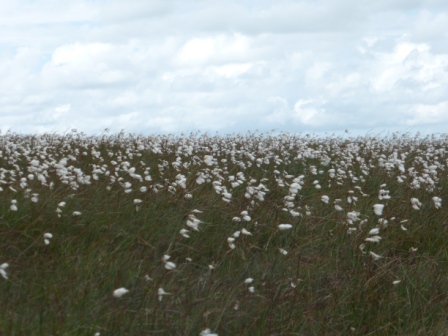
Cotton Grass, Winter HillSOURCES

Bartrum, Peter A Welsh Classical Dictionary: People in History and Legend up to about A.D. 1000 (National Library of Wales, 1993)
Bromwich, Rachel (ed) The Triads of the Island of Britain (University of Wales Press, 2014)
Clarkson, Tim The Men of the North: The Britons of Southern Scotland (John Donald, 2010)
Evans, J. Gwengobryn The Black Book of Carmarthen (Lightning Source UK Lmtd, 1907)
Heron (transl) Gwyn ap Nudd and Gwyddno Garanhir https://barddos.wordpress.com/2015/02/08/gwyn-ap-nudd-and-gwyddno-garanhir/
Monmouth, Geoffrey of The History of the Kings of Britain (Penguin Classic, 1973)
Pennar, Meirion (transl.) The Black Book of Carmarthen (Llanerch Enterprises, 1989)
Skene, William F. The Four Ancient Books of Wales (Forgotten Books 2007)

Gwyn ap Nudd and Du y Moroedd: Travelling the Old North, Wales and Beyond

In Culhwch and Olwen, Du y Moroedd (‘The Black of the Seas’) is introduced as the only horse who can carry Gwyn ap Nudd on the hunt for Twrch Twryth (‘King of Boars’). Du is a water-horse of celebrated fame in the Brythonic tradition. A study of his stories reveals that, like Gwyn, he is intimately connected with the landscapes and peoples of the Old North and Wales. He is also a traveller between worlds and thus a most fitting mount for Annwn’s ruler on his hunt for the greatest of boars.

The most detailed piece of information we possess about Du appears in The Triads of the Islands of Britain. As one of three ‘horse burdens’ he ‘carried on his back seven and a half people from Benllech in the north to Benllech (Elidir) in Mon. These were the seven people: Elidyr Mwynfawr and Eurgain his wife, daughter of Maelgwn Gwynedd, and Gwyn Good Companion and Gwyn Good Distributor, and Mynach Naoman his counsellor, and Prydelaw the Cupbearer, his butler, and Silver Staff his servant, and Gelbeinifen, his cook who swam with two hands and on the horse’s crupper – and he was the half person.’

The historical basis of this triad is Elidyr’s seaward journey from his home in northern Britain to Wales to seize the throne of Gwynedd from Rhun, Maelgwn’s illegitimate son (Elidyr’s claim was based on his marriage to Eurgain). Elidyr was killed at Aber Mewydd near Arfon. Afterward his fellow Men of the North; Clydno Eidyn, Nudd Hael, Mordaf Hael and Rhydderch Hael took vengeance by burning Arfon. Rhun and all the men of Gwynedd pursued them north to the river Gweryd.

This demonstrates the complex ancestral and political relationships between the people of the north and Wales and exemplifies the internecine strife that eventually led to the fall of the northern Brythonic kingdoms. It also shows that armies travelled between the Old North and Wales by land and sea.

It is of interest the Men of the North who came to avenge Elidyr are all of the ‘Macsen Guledig’ lineage. This places them in the same family as Gwyn’s ally and rival, Gwythyr ap Greidol and his kinsmen who Gwyn battles against and takes captive. Gwyn’s relationship with these northern men as a ruler of Annwn is just as fraught and unstable as relations between human rulers.

That Gwyn rides the same horse as Elidyr strengthens the sense of his familial ties with these Men of the North. That he acts as a psychopomp to several northern warriors suggests he may have been seen as an ancestral god. This is backed up by common usage of the name Nudd: Nudd Hael, Dreon ap Nudd and Nudus (the Latinised form from a memorial stone in Yarrow).

***

I assume Du is named as the only horse who can carry Gwyn due to his capacity to move between worlds. This is supported by analogy with The Pursuit of Giolla Dheachair where a ‘monstrous horse’ carries fifteen and a half of Finn’s (Gwyn’s Irish counterpart) companions to the Otherworld.

In this context it seems possible the triad depicts the surprise arrival of Elidyr and his party from the blackness of the sea on the darkest of nights as if from (or perhaps literally from!) the Otherworld. After Elidyr’s death one can imagine Gwyn appearing aboard this great water-horse on the bank of the Arfon to escort him to Annwn.

Du’s possession of uncanny and even monstrous qualities is echoed in later water-horse legends. In Brigantia: A Mysteriography Guy Ragland Phillips identifies the Black Horse of Bush Howe (a horse-shaped landscape feature of stone on the Howgill Fells in Cumbria) with Du. He suggests Elidyr’s northern Benllech was Bush Howe and cites an alignment down Long Rigg Beck valley to Morecambe to Anglesey saying the horse would be within its line of sight.

Ragland Phillips also claims a ‘dobbie cult’ centres on the Black Horse. ‘Dobbie’ is the ‘Brigantian’ name for a water-horse and he defines it as ‘a big, black misshapen thing that ‘slips about’. Like dobbin (a term still commonly used in the north for horses who are ploddy or woodenheaded) it ‘may have for its first element the Celtic Dhu, ‘black’.’

David Raven records a recent visit to the site, during which he photographed the Black Horse and stood on its back. Afterward he found out from a local historian that in the 1930’s and 40’s school children used to be allowed a day off to maintain the horse. A village elder said this was a practice undertaken by farmers in the pre-war period on an ‘annual Boon Day’.

This is strongly suggestive of cult activity and a longstanding service to the Black Horse. Jack (the village elder) also told David of a legend about Roman legions using the horse as a landmark on their travels ‘up the Lune valley, from Lancaster to Penrith and Carlisle.’ The Black Horse of Bush Howe is associated with travelling the northern landscape too.

The continuity of Du’s fame in Wales is attested by Welsh poetry. He appears in The Song of the Horses, a poem attributed to Taliesin: ‘The Black, from the seas famous, / The steed of Brwyn’. He is frequently used as a standard of comparison. Guto’r Glyn compares a foal with the ‘Son of the Black One of Prydyn’ (Du’s grandson) and Tudur Aled compares another horse with Du saying he is of ‘greater vigour… such was his strength and daring.

Like northern Britain, Wales has a water-horse tradition: the ‘ceffyl dwr’. I haven’t found any water-horse stories connected with Anglesey or Arfon on the internet but this doesn’t eliminate the possibility they exist in Welsh literature or folk memory.

***

Finally I’d like to return to Gwyn’s partnership with Du on the hunt for Twrch Trwyth in Culhwch and Olwen. Ysbaddaden’s statement to Culhwch that the hunt cannot begin until Gwyn is found hints at his role as a divine huntsmen and former leader of the boar hunt. Culhwch’s central task of assembling an array of renowned huntsmen, hounds and horses to hunt the Twrch is founded on an older and deeper myth.

About its details we can only conjecture. It is my guess it featured Gwyn, huntsmen, horses and hounds pursuing the King of Boars. It may have contained clues to the ‘mysteries’ of hunting: the hunt, the kill and ensuing feast as sacred activities based on an earlier shamanistic perspective.

Further insights may be gained by analogy with Odin’s hunting of the boar Saehrimnir (‘Sooty Sea-Beast’). Odin rides a great black eight-legged horse who can travel between worlds called Sleipnir (‘Slippy’ or ‘Slipper’). After the hunt Saehrimnir is cooked every evening but the next day is whole. Odin’s feast in Valhalla is mirrored by Gwyn’s feast in his otherworldy hall (in The Life of St Collen on Glastonbury Tor). Perhaps Gwyn’s hunt also rides each day to slay the Twrch then magically he is reborn and this reflects the sacred acts of hunting and eating and the procreation of the boar.

In Culhwch and Olwen it is not mentioned whether Gwyn or Du are found. They do not appear on Arthur’s hunt. Gwyn only comes when summoned by Arthur, who asks him if he knows the whereabouts of Twrch Twryth after he disappears at Glyn Ystun. It is implicit Arthur is seeking Gwyn’s knowledge because he suspects the Twrch has fled to Annwn. Gwyn claims he does not know anything about Twrch Trwyth. It is my intuition he is lying to protect the King of Boars and perhaps to cause mischief.

Following a chase across Wales and finally to Cornwall, whereby many of Arthur’s men are injured or killed by the Twrch and his piglets, they finally catch him and remove the comb and shears from between his ears. Afterward he is driven into the sea, which is suggestive of his return to Annwn. It is of interest that, unlike other otherworldly animals he confronts, Arthur does not slay Twrch Trwyth.

In later Welsh folklore Gwyn is depicted as a demon huntsman aboard a monstrous black horse who preys on the souls of sinners. This image derives from and parodies his partnership with Du as a divine huntsmen and his role as a guide of the dead. Whereas he was revered as much as feared by the pagan Britons, in this Christianised guise he solely brings terror (a misguided and one-sided view).

Gwyn and Du’s names disappear from the stories of northern Britain completely after the medieval period. It seems possible their myths lie behind some of our stories of spectral huntsmen and dobbies but due to the complex intermingling of local legends with Brythonic and Germanic lore the origins of these tales cannot be ascertained.

Yet our landscape remembers the travels of Gwyn and Du across the Old North, Wales and beyond by land and sea. On the paths of the hunt and at river-estuaries where tides beat the shore to gull-cries and winds of distant longing they are still here.

Ribble EstuarySOURCES
Bartrum, Peter A Welsh Classical Dictionary (National Library of Wales, 1993)
Bromwich, Rachel (ed.) The Triads of the Islands of Britain (University of Wales Press, 2014)
Davies, Sioned (transl.) The Mabinogion (Oxford University Press, 2007)
Ragland Phillips, Guy Brigantia: A Mysteriography (Routledge and Keegan Paul Ltd, 1976)
Raven, David http://davidraven-uk.blogspot.co.uk/2010/01/black-horse-of-bush-howe.html
Rhys, John Studies in the Arthurian Legend (Adamant Media Corporation, 2001)
Skene, William F. The Four Ancient Books of Wales (Forgotten Books 2007)
Sturluson, Snorri The Prose Edda (Penguin Books, 2005)

Teyrnllwg: A Bright Kingdom Slips Away Like Dust

A couple of weeks ago something immensely exciting happened: I received a response to queries on my blog regarding the black hole in the post-Roman history of Lancashire. A Penwortham resident called Ozrico told me the area between the Ribble and the Dee was known as Theyrnllwg. It belonged to the Britons until the Battle of Chester in 613 where its king, Brocmail, took on the Saxon king, Aethelfrith (and lost).

Therynllwg! I thought I had finally found the lost name of the kingdom to which south Lancashire belonged. Not only that, I had the name of its king!

Searching the internet, I found two sources for Theyrnllwg. The first was Charles Onam’s England Before the Norman Conquest (1921). Onam said ‘the lands between the Ribble and the Dee’ were ‘originally known as Therynllwg, of which the later Powys was the surviving remnant. It then extended from the Ribble to the Upper Wye, and from the Clwyd to Cannock Chase, and had been for a century a connecting link between the Britons of the North and those of the West.’

Onam’s words extended the territory of Theyrnllwg into Wales and were doubly exciting because for the first time I had found scholarship stating the area we now know as Lancashire formed a link between Wales and the Old North. This would have meant people had a connecting route (or routes) by which to trade and on their travels would have shared myths and stories. In relation to my on-going quest to uncover Gwyn ap Nudd’s forgotten connections with the Old North, if he was known in Wales and by the Strathclyde Britons this would have made it likely he was known in Lancashire too.

Through a reference in the footnotes, I traced Onam’s words back to William Stubbs’ Origines Celticae (1883) where I found within a list of Welsh names of districts ‘Theyrnllwg from Aerfen to Argoed Derwenydd’ (the river Arfon in Gwynedd and the woodland of the river Derwent in Cumbria?). This extended Theyrnllwg further and led to more sources. Stubbs said the list originated from the ‘Iolo MSS’ and this was ‘taken from a MS belonging to Mr Cobb of Cardiff, and is a mere fragment, a page of the MS having been torn out.’

Having obtained as much information as I could on the internet, I contacted Heron (who lives in Wales and is knowledgeable on such matters) and asked if he knew anything about Theyrnllwg. When I received his answer I was greatly disappointed.

Heron replied saying the name Theyrnllwg derives from Teyrnllwg and sent me an extract from Peter Bartrum’s A Welsh Classical Dictionary (1994). Bartrum stated Teyrnllwg was an ‘imaginary territory’ derived from the name of Cadell Ddyrnllug, a prince of Powys mistakenly taken to be its ruler.

I found out Cadell Ddyrnllug first appeared in Nennius’ History of the Britons (830) as Catel Durnluc, a servant of the tyrannical king of Powys, Benlli. When St Germanus arrived to remonstrate Benlli, Castel offered him hospitality. After Benlli, his city and his subjects had been burned by fire from heaven, Germanus rewarded Castel for his hospitality by making him king. This fulfilled ‘the prophecy of the Psalmist: “He raiseth up the poor from dust, and lifteth the needy out of the dunghill”.’

Bartrum said in modern Welsh Durnluc would take ‘the form Ddyrnlluch or Ddyrnllug, meaning ‘gleaming hilt’, from dwrn, ‘hilt’ and lluch, ‘gleaming’ or llug, ‘bright’. The meaning evidently became obscure very early, and was perhaps interpreted as derived from teyrn, ‘prince’ and llwch, ‘dust’. This may have been the basis of the legend which derived Cadell from a humble origin, the author actually quoting Psalm 113 vv.7.8.’

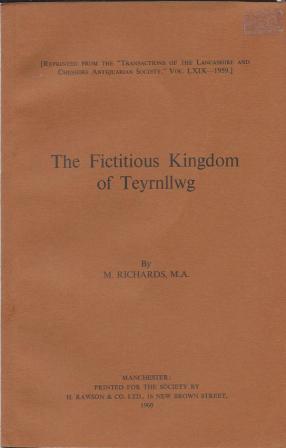
The name Teyrnllwg was later and erroneously identified as Teyrnllwg’s kingdom. When I looked it up on the internet, I found a pamphlet titled The Fictitious Kingdom of Teyrnllwg (1960) by Melville Richards reprinted for Transactions of the Lancashire and Cheshire Antiquarian Society which provided further explanation.

The Fictitious Kingdom of TeyrnllwgIn its two pages Richards criticises an earlier article by Dr. J . D. Bu’Lock which ‘recreates the history of ‘The lost kingdom of Teyrnllwg’’ saying he has been misled by ‘the comparative validity and authenticity of the Welsh material’ (ie. the Iolo MS). ‘Dyrnllug is an epithet which can be readily analysed as dwrn (‘fist’) and llug (‘bright’), referring to some (?) physical characteristic of Cadell… By the fifteenth century Dyrnllug had become Deyrnllug in the genealogical lists.’

Teyrnllwg became accepted as a ‘territorial designation’ firstly because teyrn means ‘king, ruler’ and secondly because -wg was a common territorial suffix (ie. Morgannwg ‘country of Morgan’). Whilst Richards accepted the possible existence of a kingdom in the area of Cheshire and Lancashire he stated adamantly ‘its name was not Teyrnllwg’.

The existence of Teyrnllwg, kingdom of a prince with a bright and gleaming hilt or fist who rose from dust was well and truly refuted. (Although it continues to exist in the gleaming brightness of the name. The glamoury of a bright kingdom slipping away like dust…)

***

However a loose end remained to be tied up. If Teyrnllwg was fictitious what about Brocmail, its king? Oman said Brocmail is the son of Cincen, a descendant of Cadell. I discovered this was backed up by the Harleian MS 3859: The Genealogies, where he appears in the lineage of the rulers of Powys ‘[S]elim map Cinan map Brocmayl map Cincen map Maucanu map Pascent map Cattegirn map Catel dunlurc.’

It was also likely Brocmail was present in the Battle of Chester. In Bede’s Ecclesiastical History of the English People (8th C) Brocmail was the guard of 1200 monks from Bangor who had come to pray for the Welsh army. When the Saxon ruler Aethelfrith commanded his army to slaughter them, Brocmail fled, escaping with fifty.

The Anglo-Saxon Chronicle (9th C) stated Scromail (a mis-spelling of Brocmail?) was the leader of the Welsh. After Aethelfrith slew ‘countless Welsh’ and ‘200 priests’ ‘he escaped as one of fifty.’ In Geoffrey of Monmouth’s The History of the Kings of Britain (1136) Brocmail was Earl of Leicester and the battle took place in Leicester. Brocmail made a stand against Aethelfrith, in spite of having less soldiers, and only fled after he had ‘inflicted exceeding great slaughter upon the enemy.’ This version also mentioned ‘one thousand two hundred monks’ were killed.

As Brocmail is listed as a king of Powys, it seems more likely he was a leader in the battle than a guard. Nick Higham notes Bede is unreliable because he is more concerned about writing ‘providential history’ than military reality and is dubious about the slaughter of the monks. This makes it possible Brocmail’s deposition from a British king who faced the Saxons to a cowardly guard reflects his bias. (However it is equally possible Monmouth’s glorification of him as a British king is biased too…).

Archaeological evidence from Heronbridge, near Chester (a group of skeletons with clear signs of violent injury buried in a pit, believed to be the dead of the Saxon victors) demonstrates the battle took place in Chester and not Leicester. From this we can derive that the Battle of Chester really took place, Brocmail took part in it, and at this pivotal point Cheshire, and perhaps south Lancashire, first became subject to Saxon rule.

Brocmail’s involvement in the Battle of Chester also demonstrates these areas had real political links with Powys. This is supported by the fact when the Mercian Saxons took rule, they formed an alliance with the rulers of Gwynedd and Powys to take on Oswald and the Saxons of Northumbria at Maserfelth (Makerfield in Lancashire). It seems likely they were drawing on a pre-existing alliance.

Whilst the kingdom of Terynllwg may be dismissed as fictitious, the name provides important clues to links between rulers of Powys and the Britons of Cheshire and Lancashire.

***

A more realistic picture of these post-Roman British territories is drawn by Denise Kenyon in The Origins of Lancashire (1991). Kenyon notes attempts to locate Teyrnllwg in north-west England are not widely accepted. She goes on to suggest that concentrations of British place-names may be used to identify areas of lordship.

She posits three main territories. The first centres around Makerfield and Wigan and extends into the Leyland and Newton hundreds down to the Mersey (I assume its northern limit is the Ribble). The second includes the Fylde and centres on ‘Preese and Preesall, Greater and Little Eccleston and Inskip.’ There are two groups in Greater Manchester; around Manchester itself and ‘on the edge of the Rossendale forest’.

A further possibility is that ‘iuxta Rippel was in origin a small British kingdom or lordship encompassing the west Lancashire lowlands on either side of the Ribble, as far south as Makerfield, and extending into the Pennine foothills above Whalley’. These British lordships would have formed the basis for later Anglo-Saxon territorial units.

Kenyon identifies my home town of Penwortham as a ‘central place’ occupying a nodal position in the communication network on a crossing of the Ribble. She says its name is of interest as a hybrid of British and English: ‘Pen’ is British and means ‘hill’ whilst ‘ham’ is English and means ‘safe place’.

‘Ham’ names are indicative of ‘central places’ connected with ‘Roman military and industrial settlements’ (in Penwortham’s case Walton-le-dale) and are often seats of ancient parishes. The construction of the name reflects the acculturation of an important British ‘central place’ by the English.

Thus we have a picture of post-Roman Penwortham lying either on the northern edge of a British lordship centring around Makerfield or in the midst of iuxta Rippel. Differences between the dialects north and south of the Ribble (ie. ‘chester’ to the south and ‘caster’ to the north) make the former seem more probable. This lordship would have been taken over by the Saxons some time after the Battle of Chester. The ‘wahl’ element of Walton-le-dale suggests a strong British presence remained in this town, adjacent to Penwortham.

Kenyon’s identification of Penwortham as a central place on the communication network re-opens the possibility of it linking Wales and the North. Whilst most historians are dubious about connection by road due to boggy ground, the river Ribble was no doubt used for transport and communication with Penwortham as a look-out point and possible port.

Is there any way of making a case that the Britons of the lordship centring on Makerfield once shared a pagan mythology and told similar stories to those further north and in Wales?

The only evidence of native British pagan worship in the vicinity comes from Romano-British altars, statues and inscriptions to deities such as Deae Matronae (the mother goddesses), Apollo-Maponus (Maponos was a Brythonic god of youth) and Mars-Nodontis (Nodens was a Brythonic god of hunting and healing and is cognate with Nudd, Gwyn’s father). These are not in our Makerfield lordship but north of the Ribble in the Fylde.

That Kenyon believes the Anglo-Saxon ecclesiastical divisions are likely to have been founded on earlier British ones (drawing on the etymology of Eccles from eglys ‘church’) and monks from Bangor were praying for the Welsh army suggests the Britons had been Christian before the English arrived in 613.

How and when they were converted (or chose to convert) remains a matter for further investigation. Insights in this direction may throw light on how the ancient British gods and goddesses slipped from the consciousness of the people of my locality like the bright dust of Terynllwg.

The Favour of Creiddylad, May Queen and Queen of Annwn

Wood anenomeA few weeks ago I published an article on the story of Gwyn, Gwythyr and Creiddylad, which highlighted its significance as an ancient British seasonal myth originating in the Old North. This showed Creiddylad’s importance as a Brythonic goddess connected with the sovereignty of the land, outlined a depiction of her viewpoint and described her nature as a spring maiden and queen of Annwn.

It was my intuition Gwyn’s pride in being Creiddylad’s lover and references to his invocation in her name suggested she was an important fertility goddess in her own right. More recently I found this idea backed up by analogy with Ann Suter’s reading of The Hymn to Demeter. Like Persephone with Hades, Creiddylad is a free agent in a sacred marriage with Gwyn. As king and queen of Annwn they form a divine couple equal in power and independence.

To win Creiddylad’s favour on Calan Mai, Gwythyr, a human ruler, must descend to Annwn and battle against Gwyn. His willingness and skill are conditions of Creiddylad’s becoming his May Queen. Thus she returns to this-world to bring fertility to the land and makes him her king for the summer. Gwythyr’s reign is only temporary. On Nos Galan Gaeaf Gwyn takes her back to Annwn where in turn she presides over the processes of life and death.

One of the important lessons of this story is that all life comes from and returns to Annwn. The fertility of this-world is dependent on the underworld and its deities. This is reflected in the simple necessity of planting a seed underground and in offerings our ancient ancestors made in ritual shafts and pits. All trees and plants come from and decay back into the soil. This is ultimately the fate of our flesh and bones.

The beauty of the flowers of May is dependent on the deaths of many others. This applies to human ancestry. Our fruitful modern existence is founded on the death and toil of countless people. As is our creativity. Thus the Awen can only be won by making Gwythyr’s descent down through the ancestral heritage of our soil, establishing our own relationships with the underworld deities. Personal sacrifices must be made and their bounty shared.

Only then will our hawthorns blossom and the favour of Creiddylad, May Queen and Queen of Annwn be won.

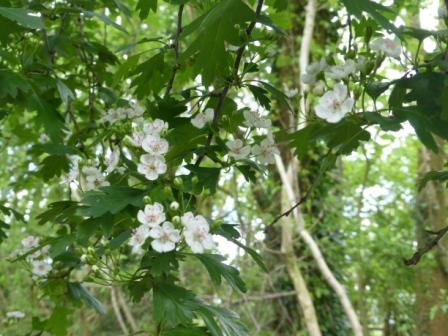
Hawthorn*With thanks to Brian Taylor for pointing me toward Sarah Pike’s review of Ann Suter’s The Narcissus and the Pomegranate.

Coille Coire Chuilc: Seeking Annwn in Caledon

Coille Coire ChuilcThere once existed a tradition amongst the northern Britons of locating Annwn north of Hadrian’s wall. Its origins may be found in the writings of Tacitus about tribes beyond the northern frontier who spoke a different language to the Britons and were impossible to subdue. Ptolemy was the first person to refer to this area as Caledonia Silva.

The 6th C classical writer Procopius said: ‘Now in this island of Britain the men of ancient times built a long wall, cutting off a large part of it; and the climate and the soil and everything else is not alike on the two sides of it… on the north side… it is actually impossible for a man to survive there even half an hour, but countless snakes and serpents and every other kind of wild creature occupy their area as their own. And, strangest of all, the inhabitants say that if a man crosses this wall and goes to the other side, he dies straight away… They say, then, that the souls of men who die are always conveyed to this place.’

These writings show within the Romano-British culture of the Old North the Caledonian forest was considered to be a wild, hostile place associated with death.

Culhwch and Olwen (1350), a medieval Welsh text set during the Arthurian period preserves remnants of these superstitions. In the stories of Gwyn, Gwythyr and Creiddylad and the Very Black Witch, Arthur ‘goes north’ to inhospitable lands. Both stories feature Gwythyr ap Greidol, a northern ruler and warrior of Arthur’s court and Gwyn ap Nudd, a king of Annwn. The latter is an ancient British god associated with wild places and the dead. It is my intuition it was after a vision of Gwyn and his host at the Battle of Arfderydd that Myrddin Wyllt went mad and fled to Celyddon (Caledon) where he wandered thirty years amongst gwyllon (wild, ancestral spirits).

As the story of Gwyn, Gwythyr and Creiddylad is set at Calan Mai, a friend and I decided to head north to Coille Coire Chuilc (one of the southernmost remnants of the Caledonian forest) on the May bank holiday weekend.

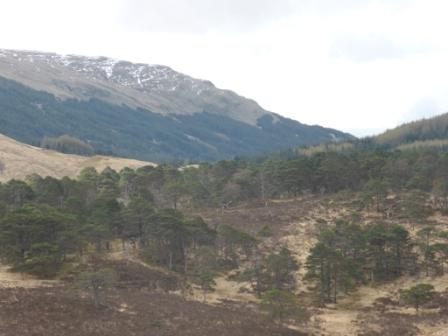
Coille Coire Chuilc is an ancient woodland of Scots pines lying between the river Cononish and Allt Gleann Auchreoch close to the village of Tyndrum in Strath Fillan. Tyndrum grew out of the lead mining industry. The mines were located in Beinn Chuirn. During the 18th C pack horses travelled 50 miles to Alloa with lead ingots then back with fuel for the smelter.

Cononish HillsDuring the 19th C gold was discovered in the hills of the Cononish glen, which led to a miniature gold rush. This ended in the 20th C but has recently restarted with the approval of a second planning application to Scotsgold Resources in 2011. Gold is once more being mined from the hills and may be panned from the river Cononish, although it is more likely one will find lead and pyrite: ‘fool’s gold’. As the area is renowned for its ‘fairy places’ it was interesting to hear the hills were hollowed with mines where one is more likely to find false gold than the real deal…

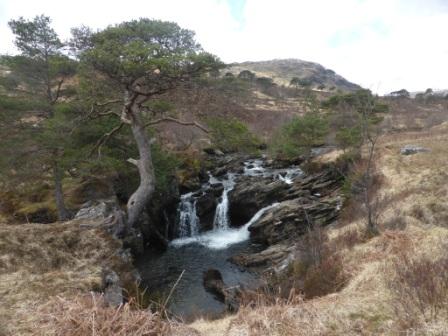
Our expedition to Coille Coire Chuilc did not go to plan. Firstly we took the ‘wrong’ path, ending up north of the river Cononish rather than within the woodland. However this had the advantages of providing a good view of the distant Scots pines and an excuse to walk back down the river, seeing some sensational falls, ravines and trees clinging drastically to rocks.

The next set back was that the bridge across the Allt Gleann Auchreoch pictured in The Ancient Pinewoods of Scotland: A Guide (2013) was plankless and uncrossable!

This led to a precarious injurious fording of the burn into a woodland of bent old round-crowned pines and deep sphagnum mosses that didn’t feel overly friendly to two foolish searching humans.

Blog 6. Coille Coire ChuilcDying trees stood with a stark grey dignity reminiscent of gwyllon; ancestral presences of their land. A land where we were not at home. Where all was strange and fey. And said leave.

On our return, after I slipped over again crossing a boggy patch, one of the more positive points was glimpsing a magnificent bird which I think may have been a golden eagle.

Blog 9. Golden EagleTyndrum itself, however, was hellish. No longer a mining village but conglomeration of shops and a tourist information centre. We arrived at the scene of an accident where a car had hit a motorbike and shortly afterward saw two near car crashes within the space of a minute. We saw the whole place was now based around the tourist industry and as tourists we were part of the problem.

I felt like I was a long way north of the wall far from home in a landscape that did not want me.

I left with the impression that whilst the story of Gwyn, Gwythyr and Creiddylad in Culhwch and Olwen contains universal themes (the battle between winter and summer kings for a maiden goddess on May Day) its variant from Strathclyde locating Annwn in the Caledonian forest very much belonged to its time and people.

The fairies of Coille Coire Chuilc had concerns of their own with mining and tourism and little care for a pair of wanderers from Lancashire seeking the ancient roots of a Brythonic tale that may never have been located in their woodland at all.

Whether Myrddin ever fled quite so far remains uncertain. Perhaps we went too far north. However I think sometimes you must stray too far to come back…

Enchanting the Shadowlands Book Launch

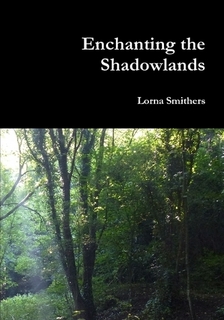
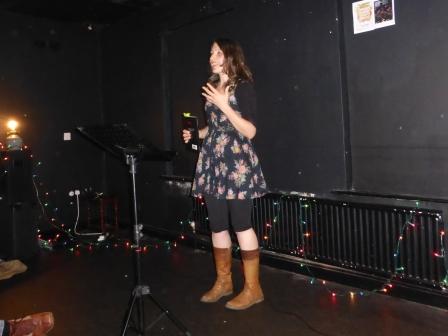
Enchanting the Shadowlands Book CoverOn Wednesday 22nd April I held an evening of poetry, song and story to celebrate the launch of Enchanting the Shadowlands at Korova Arts Cafe in Preston. The night was very special for me because it marked the publication of my first book, the completion of a spiritual journey and brought together friends who have supported me since I took to writing poetry seriously in 2012.

Storyteller Peter Dillon was MC for the night. We opened with a joint performance of ‘The Bull of Conflict’ a glosa recording the moment when my patron god, Gwyn ap Nudd, gave me the imperative of ‘enchanting the shadowlands’.

Vincent Smith’s ‘Woodland Eulogy’ and reflections on early memories of a close friend made a poignant start to the first half. Mike Cracknell brought the house down with his hilarious poem about lovers with nothing in common except filthy habits. Martin Domleo performed poems tying in with my nature themed work including ‘Thor’s Cave’ and the experience of deceleration linking to his passion for motorbikes. Nina GeorgeSinger Nina George was the first headline act. She started with a haunting piece written by a friend. Her second song, she told us, demanded to be sung at the launch! She got everybody joining in with the chorus:

‘She said this is my church here where I stand
With my hands in the earth and my feet on the ground
She said this is my church here where I stand
With my heart in my mouth and my soul in the land.’

Nina finished with a song by Jodi Mitchell. At the end of the first half I performed poems exploring local history written in voices of the ancestors and spirits of the land. These included a reluctant resident of Penwortham Lake Village, a spinner in her cellar, the spirit of the aquifer beneath Castle Hill and Belisama, goddess of the Ribble. During the break we looked out at a pink-purple sunset against fairy-lit trees and the silhouette of St Walburge’s spire. Preston Sunset from KorovaI opened the second half with  ‘Slugless’ which was written when I had a spate of people confessing to me about their slug problems. All but one…. As we often bump into each other walking beside the Ribble, Terry Quinn performed poems about the river, one set at a crucial time when a campaign run successfully by Jane Brunning saved the area that is now Central Park from a huge development scheme. Dorothy mentioned she also had a slug scene in her novel ‘Shouting Back’. Her poems included the memorable ‘City Rats’.

Nina returned to perform a song about reclaiming Druidry and a controversial tongue-in-cheek ditty called ‘The Day the Nazi Died’ by Chumbawamba. Novelist Katharine Ann Angel read excerpts from ‘Being Forgotten’ and ‘The Froggitt Chain’ and spoke of her inspiration from people, particularly working with difficult teenagers.

Nicolas Guy WilliamsThe second headliner was poet Nicolas Guy Williams. He opened with ‘Ancient by thy Winters’ saying he thought it would be suit my launch as it contains howling: ‘Hear them HOWL! HEAR THEM HOWL! Once no forest was defenceless.’ He also performed ‘Woman of the Sap’ and ‘Oh ratchet walk and seek that scent’ one of my personal favourites based on the local legend of the Gabriel Ratchets.

I ended the second half with a piece dedicated to Gwyn on Nos Galan Gaeaf called ‘When You Hunt for Souls in the Winter Rain’ and poems Lorna Enchanting the Shadowlandsrecording a journey to Annwn (the Brythonic Otherworld) with horse and hound to an audience in his hall. As a finale I performed ‘No Rules’ which summarises my philosophy of life:

‘Break every boundary.
There are no rules.
Only truth and promises
Bind us in the boundless infinite.’

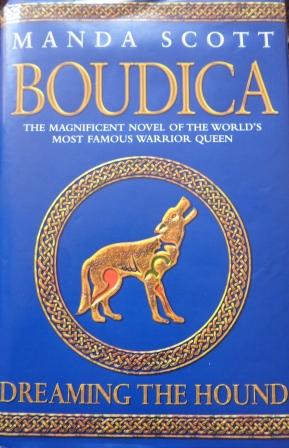
Afterward there was an open-mic where it was great to have Flora Martyr, who is missed as a host of Korova Poetry, back to perform. Following Nina’s protest songs John Dreaming the Hound Winstanley, who is involved with the Wigan Digger’s Festival, sung an old diggers song. I also opened some presents from the generous members of my grove. Nina gave me a bottle of wine (knows me too well!). Phil and Lynda Ryder gave me a book about Boudica, a warrior queen and ruler of the Iceni (horse) tribe, called ‘Dreaming the Hound’ with a wonderful bronze image of a howling hound on the cover.

When we left Korova the crescent moon was high in the sky with a bright and beautiful Venus above the fairy-lit trees. I felt the shadowlands had been enchanted. There is power in a promise… and in the support of friends without whom I wouldn’t have been able to see it through. I’d like end on a note of thanks to Peter as MC, everybody who performed and came to watch and to Sam for providing the venue. Moon, Venus and Fairy Trees

Gwyn, Gwythyr and Creiddylad: A Story from the Old North

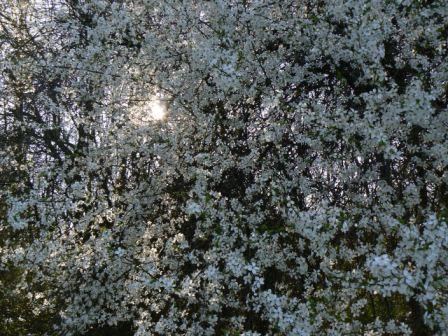
Cherry BlossomCulhwch and Olwen is one of the oldest and most fascinating repositories of ancient British mythology. It originates from two texts; a fragmented version in The White Book of Rhydderch (1325) and full version in The Red Book of Hergest (1400). The main narrative centres on Culhwch’s quest to win Olwen for which he enlists the help of Arthur and his retinue; a medley of historical and mythological characters.

Embedded within it we find fragments of other tales which may be of older origin and have stood alone. These include the hunt for the legendary boar Twrch Twryth and release of Mabon from imprisonment in Gloucester. Most significantly for me as someone who venerates Gwyn ap Nudd, we find the story of his rivalry with Gwythyr ap Greidol for the love of Creiddylad and their battle for her every May Day.

This story is central to understanding Gwyn’s mythology. Because I am based in Lancashire it also of great interest that it originates from the Old North. In this article I summarise the story and introduce its themes and background with the aim of bringing Gwyn’s neglected connections with the north to the fore. In conclusion I discuss its contemporary relevance.

The story begins by stating that Creiddylad ‘went off’ with Gwythyr. Creiddylad is the daughter of Lludd Llaw Eraint ‘Lludd of the Silver Hand’ a mythic king of Britain. Earlier in the main narrative we are told she is ‘the most majestic maiden there ever was in the Three Islands of Britain and her Adjacent Three Islands.’ This shows she is deeply connected with the sovereignty of the land. Whilst attempts to trace the etymology of her name have been made such as ‘Craidd’ ‘heart’ and ‘dylan’ ‘water’ no agreement has been reached.

Gwythyr and his father, Greidol, are named in the genealogies of the Men of the North. Greidol is ‘the son of Enfael the son of Deigyr the son of Dyfnwal (Dyfnarth) the son of Ednyfed the son of Maxen (Macsen Guledig)’. Greidol’s name means ‘hot, passionate, fierce’. He was a knight in Arthur’s court and appears in the triads as one of the great architects and enemy-subduers of Britain.

Robert Graves interprets Gwythyr ap Greidol as ‘Victor son of Scorcher’. Gwythyr is the father of Arthur’s wife, Gwenhyfawr. His horse appears alongside Arthur’s in The Songs of the Horses ‘boldly bestowing pain’. In Culhwch and Olwen he wins the friendship of a colony of ants who bring nine hestors of flax seed, one of the items Culhwch must attain. Gwythyr’s resting place is included in The Stanzas of the Graves. These references show the longevity of his connection with Arthur and that he was a significant hero in his own right.

Unfortunately I have not found any references to where Greidol or Gwythyr lived. As other Men of the North in his family such as Nwython ruled in the Strathclyde area, south-west Scotland may be a possibility.

Creiddylad’s status as a maiden and the statement about her going off with Gwythyr suggest he may be her first love. Next we are told ‘before he could sleep with her Gwyn ap Nudd came and took her by force.’ It is likely Gwythyr is waiting to marry Creiddylad before they sleep together. Before they can wed Gwyn takes her away.

In Culhwch and Olwen Gwyn ap Nudd ‘White son of Mist’ is introduced as a ruler of Annwn (the Brythonic underworld) who contains the fury of its spirits and prevents their destruction of this-world. This may relate to earlier beliefs about Gwyn’s status as a god of the dead connected with chthonic spirits. Will Parker cites examples of offerings in ritual shafts and pits to propitiate such deities in the Bronze to Romano-British periods.

In The Dialogue of Gwyn ap Nudd and Gwyddno Garanhir Gwyn appears as a gatherer of the battle dead. After offering Gwyddno protection he states his presence at the deaths of a number of warriors; Gwenddolau, a northern British king who perished at the Battle of Arfderydd (north of Carlisle) and Bran who died alongside him, Gwallog ap Llenog ruler of Elmet (Yorkshire), Llachau Arthur’s son and Meurig ap Careian. This provides further confirmation of Gwyn’s role as a god who facilitates the transition from life to death.

In later literature Annwn becomes Fairyland and Gwyn its King. Although Gwyn’s status is reduced from god to fairy (and likewise his people) he remains feared and respected. Our rich heritage of Brythonic fairy lore demonstrates a continuity of relations between the worlds and interactions with spirits. In most of these tales uncanny themes such as glamoury, enchantment, changeling children and abduction take the fore. Fairies are often connected with wild and liminal places. Divisions between the fay and the dead remain blurred.

Gwyn’s abduction of Creiddylad may have its basis in prevalent superstitions. Professor Ronald Hutton notes that Early Welsh literature testifies ‘to the attribution of an especially arcane quality to May Day (‘Calan Mai’) and its eve.’ This was a liminal time when winter gave way to summer and was connected with love, fertility and woodland trysts. It was also a time dangerous spirits were abroad. Marriage was not advised in case one should mistakenly take a fairy lover.

When Gwyn takes Creiddylad by force I assume he abducts her to Annwn and claims her maidenhood. Frustratingly we gain no insight from the text into what Creiddylad thinks or feels. As a ‘maiden’ I imagine she must be terrified when he takes her and they descend. What he says to her and whether their sex is consensual remains uncertain.

Later Gwyn and Creiddylad become lovers. This is shown in The Dialogue of Gwyn ap Nudd and Gwyddno Garanhir where Gwyn introduces himself as ‘Gwyn ap Nudd / The lover of Creiddylad, daughter of Lludd’. If scholars are correct in identifying Nudd (the Romano-British god Nodens) and Lludd, Gwyn and Creiddylad are brother and sister. Whilst this would make their relationship incestuous in human terms, in many myths gods and goddesses consider it superior to sleep with members of their blood-line.

The 14th century manuscript Speculum Christiani reads ‘Gwyn ap Nudd who are far in the forests for the love of your mate allow us to come home’. Gwyn’s love of Creiddylad is central. Whilst he may not always be moved directly by human pleas he can be compelled to answer for love of his partner. This shows Gwyn holds Creiddylad in reverence and esteem. In later stories where Gwyn appears as the King of Fairy he is often accompanied by his Queen who is a respected equal.

Creiddylad’s transition from maiden to Queen of Annwn may be read as a story of coming to maturity. It might also reflect an ‘initiatory’ process whereby her relationship with Gwyn introduces her not only to sexuality but wild nature and the hidden wisdom of the underworld.

In relation to Gwyn and Creiddylad being ‘far in the forest’ it is interesting to note a tradition amongst the Strathclyde Britons of locating Annwn in the forests of the north. The 6th century Byzantine writer Procopius claims the lands north of Hadrian’s Wall were populated with snakes, serpents and other wild creatures. Those who cross the wall die straight away and this area is the destination of the souls of the dead. This fits with Gwyn’s rulership of Annwn and dwelling with Creiddylad in a forest abode. A feasible location is Celyddon (the Caledonian forest).

Gwythyr gathers a host and goes to fight against Gwyn. I imagine they ride into the wild depths of Celyddon and thereby enter Annwn to seek out the lovers. Their attack on Gwyn relates to a long tradition of stories depicting raids on the underworld by the armies of this-world.

In this case Gwyn triumphs and captures Gwythyr and a number of his noblemen. The majority are Men of the North and close relations of Gwythyr’s. Gwrgwst Ledlwm is the son of Dynfnarth. Cyledyr and his father, Nwython are also descended, through Guipno, from Dyfnarth. Pen son of Nethog is a corruption of Nwython. Hence Pen is Nwython’s son. If the genealogies are correct, Gwyn captures four generations of northern men (!). The only persons not of northern descent are Graid son of Eri and Glinneu son of Taran.

Gwyn’s slaughter of Nwython, cutting out his heart and feeding it to Cyledyr casts him as a cruel and sinister deity. This is hinted at in the lines about him containing the fury of Annwn’s spirits. However, there is no historical record of Nwython meeting his end this way. Tim Clarkson says that Neithon ap Guipno ‘died peacefully in his bed’. How much of this episode is a result of Gwyn’s demonization by adherents of Christianity and how much reflects his true nature is open to debate.

That Cyledyr becomes ‘Wyllt’ may relate to superstitions connecting Gwyn and his spirits with wildness and madness. Following the Battle of Arfderydd (where Gwyn states his presence at the death of Gwenddolau) Lailoken (Myrddin) sees an unendurable brightness and host of warriors in the sky. Afterward he becomes ‘Wyllt’ living amongst ‘gwyllon’ in Celyddon. The gwyllon hold a similar status to the spirits of Annwn as ancestral presences immanent in wild places. It seems significant they are connected with the forests of the north.

Afterward Arthur ‘comes north’ summons Gwyn to him and releases Gwythyr and his other noblemen from captivity. The source of Arthur’s power over Gwyn is not mentioned nor is it obvious he brings an army. Sense suggests he cannot take on Gwyn and the spirits of Annwn alone, particularly considering that in The Spoils of Annwn only seven return of each three hundred who set sail for the underworld.

Arthur makes peace between Gwyn and Gwythyr by consigning them to battle every May Day for Creiddylad’s hand. An additional condition, which seems rather unfair, is that neither can take her until Judgement Day. Until then she must remain in her father’s house. Creiddylad is presented not only as a puppet tossed between two lovers but at the beck and call of Arthur. It is not explained how Arthur puts this command on Gwyn, Gwythyr or Creiddylad.

It is my intuition Arthur’s intercession is a later addition to an earlier myth inserted for the purpose of integrating it into the narrative of Culhwch and Olwen. Like ‘God’ (who is said to have put the fury of the spirits of Annwn in Gwyn!) Arthur is introduced as a deus ex machina. His agency explains and makes palatable to a Christian audience the rivalry between an underworld god and human (or perhaps semi-divine) hero for the favour of a fertility goddess. Arthur shutting Creiddylad in her father’s house could represent a Christian ban on woodland liaisons.

MayflowerThis story may originate from an earlier seasonal myth where Gwyn and Gwythyr are the forces of winter and summer battling over Creiddylad who embodies new life and spring. In this case their struggle is eternal. On May Day, Gwythyr the Summer King and a hero of this-world triumphs over Gwyn the Winter King and ruler of the underworld.

That such a tradition existed is suggested by ritual combats enacted in Wales in the nineteenth century by representatives of summer and winter. After summer won celebratory dancing was held around a May-pole. Pairs or groups would often fight over the May-pole. Whilst May-pole dancing is still a strong tradition across northern Britain, I haven’t found any battles between summer and winter yet.

If Gwythyr wins Creiddylad’s hand on Calan Mai (May Day) it would make sense that Gwyn takes her back to Annwn on Nos Galan Gaeaf or Calan Gaeaf (the eve or first of November) another time associated with dangerous spirits. If this is the case I know of no stories or traditions based around it.

I find it important to remember this story of Gwyn, Gwythyr and Creiddylad is only one medieval variant set in the Old North. Doubtless it underwent countless re-tellings in other times and places before it was written down and stuck. For me it is imperative to gain a personal understanding of it through lived relationships with its deities on the land where I live in the here and now.

So far I have reached the insights that the forgetting of this story in northern Britain is also the story of our forgetting of our relationship with the passing seasons, the deities associated with them and the sovereignty of the land. Another lesson it discloses is that human ownership of the land is transitory. There is a balance the forces of the wild and the underworld maintain.

In modern times the majority of people walk only within the Arthurian courts of this-world, paying respect to celebrities, pop culture and football heroes. In this era Gwythyr rules. He and the people of the north have forgotten about Creiddylad’s marriage to Gwyn in the wild forests of Annwn.

However, after centuries of forgetting Gwyn is appearing again within our folklore and as a god to his devotees. We’re remembering the seasons. We’re remembering Annwn, wild places, spirits and the dead. And first-most in Gwyn’s eyes we’re remembering Creiddylad and to treat her with reverence and respect.

***

SOURCES

 Bromwich, Rachel and Evans, Simon D. Culhwch and Olwen (University of Cardiff Press, 1992)
Clarkson, Tim The Men of the North: The Britons of Southern Scotland (John Donald, 2010)
Davies, Sioned (transl.) The Mabinogion (Oxford University Press, 2007)
Evans, J. Gwengobryn The Black Book of Carmarthen (Lightning Source UK Lmtd, 1907)
Green, Thomas Concepts of Arthur (Tempus Publishing, 2007)
Gwynn Jones, T. Welsh Folklore and Custom (D. S. Brewer, 1979)
Heron (transl) ‘Gwyn ap Nudd and Gwyddno Garanhir’ https://barddos.wordpress.com/2015/02/08/gwyn-ap-nudd-and-gwyddno-garanhir/
Hutton, Ronald The Stations of the Sun (Oxford University Press, 1996)
Parker, Will The Four Branches of the Mabinogi http://www.mabinogi.net/
Pennar, Meirion (transl.) The Black Book of Carmarthen (Llanerch Enterprises, 1989)
Rudiger, Angelika H. ‘Gwyn ap Nudd: Transfigurations of a character on the way from medieval literature to neo-pagan beliefs’ in Gramarye, Issue 2 (University of Chichester, Winter 2012)
Sikes, Wirt British Goblins (Lightning Source UK, 2011)
Skene, William F. The Four Ancient Books of Wales (Forgotten Books 2007)
Squire, Charles Celtic Myths and Legends (Parragon, 2000)

Nith’s Estuary

After visiting the site of the Battle of Arfderydd, we chose to stay in the Nith Hotel at the mouth of the estuary as it was close to Caerlaverock and because I wondered whether, like Neath, there was a connection with Nudd and his son, Gwyn. I went with no strong expectations or feelings.

When we arrived at the car park I was utterly blown away. Clouds dark blue and dappled silver were reflected perfectly in still quiet waters. Splitting the silence hollering overhead flew drove after drove of barnacle geese following the river’s course then disappearing from sight at the estuary.

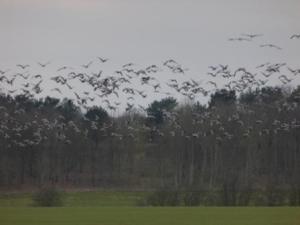
Earlier we had accidentally spooked a field filled with these magnificent birds. With barking cries and clamouring wings they took off flashing black and white, ascending into hurtling v’s.Shortly afterward a covey of swans flew over honking deep and resonant calls.

SwansIn the folklore of Wales, northern England (and beyond) ‘the Wild Hunt’ is associated with flights of swans and geese. Gwyn is one of its leaders. The term is usually limited to instances where the birds cannot be seen and those who hear them fear for their lives and souls.

My experience in this case was more of beauty than terror. The estuary of the Nith where sky met river and Criffel displayed its otherside in the lucid water was clearly a liminal place. There was something deeply magical about the passing birds and their wild song.

This reminded me a translation of Annwn (the Brythonic ‘otherworld’ Gwyn rules) is ‘the deep’. Annwn as hidden depth has intriguing resonances with the sound of ‘Nudd’. Onomatopoeically it links not only to Neath and Nith but the concepts beneath, underneath and the netherworld. This evening showed Annwn’s depth is immanent in this-world and can be experienced here.

Later on the brink of sleep I found myself thinking of Nudd / Nodens’ temple on the estuary of the river Severn. People made votive offerings to him as a god of hunting, healing and dream then slept in a designated space and priests interpreted their dreams in the morning.

Recently I discovered Nudd is not only the name of a family of Brythonic gods but also a human family name. Dreon ap Nudd fought on the dyke of Arfderydd not far from the Nith. His father, Nudd Hael, is included in the genealogies of the Men of the North. In the Yarrow valley lies a memorial stone to ‘the illustrious princes Nudus and Dumnogenus. In this tomb lies the son of Liberalis.’ Tim Clarkson says ‘Nudus is a Latinisation of Nud or Nudd.’

It seems possible this ancient northern family derived their name from Nodens / Nudd and that he was their ancestral deity and they may have served him in a similar way to the priests on the Severn. Preparing to slip into the netherworld, ‘the land of Nod,’ I wondered how many other worshippers of Nudd and his kindred had slept on Nith’s estuary.

In the morning when I awoke the barnacle geese were flying back up river to feed on the fields and salt marsh. Several groups landed on the banks and by making a careful approach we managed to draw close enough to photograph them.

Barnacle GeeseBarnacle geese possess some fascinating folklore. It was once believed they grew on driftwood like barnacles hanging down from their beaks until they grew a coat of feathers and were ready to fly away. Their growth from barnacles in summer explained why they only appeared as birds in the winter months.

Visiting the Caerlaverock Wildfowl and Wetlands Trust we found out the ‘real’ reason they can only be seen in winter. Barnacle geese incubate their eggs and raise their goslings in Svalbard in Norway between May and September when the Gulf Stream melts the ice. As winter approaches they fly 3000 km south to the Solway Firth.

In the 1940’s there were only 300 birds. Due to the work of the trust there are now over 30,000. However, if global warming continues it is possible that ice melting early in Svalbard will leave their eggs vulnerable to being eaten by polar bears.

As well as finding out more about barnacle geese we got to see whooper swans up close at feeding time. Whooper swans are another over-wintering bird who fly in from Iceland and can be told apart from mute swans by their yellow beaks.

Whooper SwansIt is my growing intuition that Gwyn, as a god of winter, may have a connection with birds over-wintering in Britain and that this would vary from place to place.