Cwn Annwn and the Passage of Souls

Cwn Annwn Tattoo Design by Nixie

Gwyn ap Nudd… he went between sky and air.’
Peniarth MS. 132

Have you heard them howling through the skies?
Have you heard them howl of distant worlds?
Have you felt the howling fear you’ll die?
Have you feared they’re howling for your soul?
If you have, your soul is no longer yours, my friend,
It has never been and will never be until the end.
And never is never as the howling winds
That carry us between sky and air.

Dormach and Death’s Door

Gwyddno Garanhir (‘Crane-Legs’) stands in a misty hinterland before the divine warrior-huntsman and psychopomp Gwyn ap Nudd (‘White son of Mist’) and his white stallion, Carngrwn.

Beside Gwyn is Dormach, his hunting dog, ‘fair and sleek’ and ruddy-nosed. Dormach’s gaze is commanding. His nose shines like a torch-fire; a beacon; a setting sun. Although he appears as a dog his shape somehow exceeds dog-like proportions. Gwyddno says:

‘Dormach red-nose – why stare you so?
Because I cannot comprehend
Your wanderings in the firmament.’

Gwyddno’s sensory perception is distorted. Dormach is close enough for his nose to be seen yet distantly wandering across the heavens.

This is due to the misty shape-shifting nature he shares with Gwyn. J. Gwengobryn Evans tells us Dormach ‘moved ar wybir, i.e. rode on the clouds which haunt the mountain-tops.’ ‘Wybir‘ is ‘condensed floating white cloud’ referred to as Nuden and ‘serves as a garment for Gwyn.’

In a remarkable image beside the poem, Dormach appears as a strangely grinning dog with forelegs but instead of back legs he possesses two long and tapering serpent’s tails! This illustrates Dormach’s capacity to be near and distant and shows he is clearly not of this world.
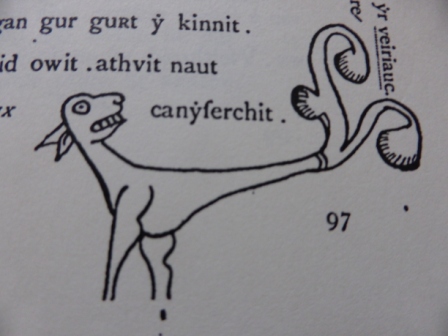
Dormach Sketch - Copy

From J. Gwenogbryn Evans, The Black Book of Carmarthen, (1907)

Dormach is a member of the Cwn Annwn (‘Hounds of the Otherworld’) who are sometimes known as Cwn Wybyr (‘Hounds of the Sky’). They occupy a liminal position between the worlds and play an important role in the passage of souls.

This is represented beautifully by John Rhys’ translation of Dormach (re-construed as Dormarth) as ‘Death’s Door’. He links this to the Welsh paraphrase for death Bwlch Safan y Ci ‘the Gap or Pass of the Dog’s Mouth’, the English ‘the jaws of death’ and the German Rachen des Todes and suggests Dormach’s jaws are the Door of Annwn. Although this translation is disputed by scholars it possesses poetic truth. Death is not an end but a passage to the next life.

Gwyddno’s passing is not depicted in ‘The Conversation of Gwyn ap Nudd and Gwyddno Garanhir’. I’ve been meditating on this poem for several years and had a break-through when I realised Gwyddno’s epithet, Garanhir, was an indicator of his inner crane-nature.

In a personal vision following from the poem Gwyddno donned his red crane’s mask, grew wings and followed the red sun of Dormach’s nose to be re-united with his kindred on an island of dancing cranes in Annwn.

Transformation

Physical death is not always a prerequisite of passage to Annwn. This is shown in the story of Pwyll and Arawn in the First Branch of The Mabinogion. Pwyll’s life-changing encounter with a King of Annwn called Arawn is heralded by the ‘cry of another pack’.

Although Pwyll notices Arawn’s hounds are ‘gleaming shining white’ and red-eared he fails to recognise their otherworld nature. He commands his pack to drive them off their kill: a grand stag, and feasts his own pack on it.

As recompense Arawn asks Pwyll to take his form and role in Annwn and fight his ritual battle against his eternal foe: Hafgan. By defeating Hafgan and resisting the temptation to sleep with Arawn’s wife, Pwyll wins the title of Pwyll Pen Annwn (‘Pwyll Head of Annwn’).

In the liminal space opened by the cries of Arawn’s hounds, Pwyll does not die but is transformed. Where passage to Annwn does not demand physical death it demands the death of one’s former identity and birth of a new one in service to the powers of Annwn.

Cwn Annwn

In later Welsh folklore Cwn Annwn are known by a number of names: Cwn Wybyr, Cwn Cyrff ‘Corpse Dogs’, Cwn Toili ‘Phantom Funeral Dogs’, Cwn Mamau ‘Mother’s Dogs’, ‘Hell-Hounds’ and ‘Infernal Dogs’. Here we find an admixture of pagan and Christian folk beliefs.

Annwn is identified with hell, its gods with demons, and its hounds with hell-hounds. Christianity’s dualistic logic limits the transformative potency of encounters with Annuvian deities by reducing them to objects of fear and superstition.

Yet the lore of Cwn Annwn endures with startling vivacity. They are famed for barking through the skies pursuing the souls of the dead. Therefore to hear them is a death-portent. They often fly the ways corpses will follow: hence their associations with teulu (‘phantom funerals’).

Their magical and disorientating qualities prevail. The 14th C poet Dafydd ap Gwilym speaks of encountering ‘the dogs of night’ whilst lost in ‘unsightly fog’ after hearing Gwyn’s ‘Crazy Owl’. In a report from Carmarthenshire the closer Cwn Annwn get the quieter their voices until they sound like small beagles. The further away the louder their call. In their midst the ‘deep hollow voice’ of a ‘monstrous blood hound’ is often heard.

Like Dormach they delight in a Cheshire-cat-like ability to shift their shape. Some appear as white dogs with red ears or noses. One is a ‘strong fighting mastiff’ with a ‘white tail’ and ‘white snip and ‘grinning teeth’ able to conjure a fire around it. Others are ‘the size of guinea pigs and covered with red and white spots’, ‘small’, ‘grey-red or speckled’. Some are ‘mice or pigs’.

At Cefn Creini in Merioneth they are accompanied by a ‘shepherd’ with a black face and ‘horns on his head’ who sounds remarkably like Gwyn: a horned hunter-god who blacks his face. He is supposedly fended off with a crucifix. In certain areas of Wales the ‘quarry’ of Gwyn and the Cwn Annwn is restricted to the souls of ‘sinners’ and ‘evil-livers’.

Gabriel Ratchets

In northern England we find the parallel of Gabriel Ratchets. Although they are nominally Germanic and rooted in the Wild Hunt there are striking resemblances with Cwn Annwn.

According to Edward A. Armstrong ‘Ratchet’ derives from the ‘Anglo-Saxon raecc and Middle English… rache, a dog which hunts by scent and gives tongue’. Rachen also means jaws: we recall ‘Rachen des Todes’ ‘Jaws of Death’.

In Yorkshire they are known as ‘gabble-ratchets’. Armstrong says ‘Gabble’ is a corruption of ‘Gabriel’ and ‘is connected with gabbara and gabares, meaning a corpse’. We find similarities with Cwn Cyrff ‘Corpse-Dogs’.

Gabriel Ratchets are also defined as packs of dogs barking through the skies portending death. Intriguingly they are identified with noisy flights of nocturnal birds who sound like beagles. In Lancashire James Bowker equates them with ‘whistling’ Bean Geese* flying over lonely moors.

In Burnley, Gabriel Ratchets are connected with the Spectre Huntsman of Cliviger Gorge. A maiden called Sibyl hears ‘wild swans winging their way above her’ before she is swept through the air by a ‘demon’. Poet Philip Hamerton shares the evocative lines ‘Wild huntsmen? Twas a flight of swans, / But so invisibly they flew.’

Thousands of Bewick’s swans and Pink-footed Geese arrive to over-winter on Martin Mere between September and November: the time ‘the Wild Hunt’ flies and may form the root of these Lancashire legends.

In Nidderdale the Gabble Ratchet is equated with the ‘night-jar, goat-sucker, screech-owl, churn-owl, puckbird, puckeridge, wheelbird, spinner, razor-grinder, scissor-grinder, night-hawk, night-crow, night-swallow, door-hawk, moth-hawk, goat-hawk, goat-chaffer… and lich-fowl’

We also find the ‘Ratchet Owl’: the ‘death-hound of the Danes’ and ‘night crow’: ‘This kind of owl is dog-footed and covered with hair; his eyes are like the glistering ice; against death he uses a strange whoop.’

Gabble Ratchets also take the form of birds with burning eyes and appear to warn of death. In some cases they are identified with the souls of un-baptised children.

Cwn Annwn and the Passage of Souls

In stories of Cwn Annwn and Gabriel Ratchets we find an astonishing menagerie of imaginal ‘hounds’. These rich folk beliefs, rooted in wild moorlands and piping wetlands, were not extinguished by Christianity.

Industrialisation forced country dwellers into towns to work in factories. 12 hour shifts in ‘dark Satanic mills’ crushed imagination. Wild places disappeared with the wild mind beneath red bricks of housing developments and asylum walls of schools and universities and secular careers.

Yet through the concrete of office-blocks and head-phones of call-centres over the white-noise of television we still hear the Cwn Annwn howling. The harder we try to shut them out the louder they howl.

The stoppers in Death’s Door tremble as they bark back the liminal spaces where the gods of Annwn are encountered and souls are transformed.

An increasing number of people are encountering hounds and gods of Annwn and having their lives turned around. I met Gwyn at a local phantom funeral site when I was lost. Passing through Death’s Door with him confirmed the reality of the afterlife and has given me a deeper appreciation of life in thisworld.

As I have striven to uncover Gwyn’s forgotten mythos from the British landscape I have been unfailingly drawn to flight paths of migratory birds and recovering wetlands. Locally, the Ribble Estuary and Martin Mere; further afield, Nith’s Estuary and Caerlaverock, Glastonbury Tor and the Somerset Levels, Cors Fochno (‘Borth Bog’) in Maes Wyddno (‘Gwyddno’s Land’).

This has led me to believe that as Brythonic King of Winter Gwyn presides over wintering birds and the passage of souls. This seems significant at a time migratory birds are threatened by melting glaciers and drained wetlands and floods have wrecked havoc across the UK. Our fates are intrinsically linked.

One of the most powerful lessons trusting my soul to Gwyn taught me was it has never been my own. I have always been one of his pack, one of his flock passing between worlds between sky and air.
Arfderydd, River Nith and Caerlaverock 220 - Copy

Swans over Nith Estuary

SOURCES

Charles Hardwick, Traditions, Superstitions and Folklore, (Chiefly Lancashire and the North of England) (1872)
Dafydd ap Gwilym, Rachel Bromwich (ed.), A Selection of Poems, (1982)
Edward A. Armstrong, The Folklore of Birds (1958)
Heron (transl.) ‘The Conversation of Gwyn ap Nudd and Gwyddno Garanhir’ (2015)
Jacqueline Simpson and Steve Roud, A Dictionary of English Folklore, (2003)
James Bowker, Goblin Tales of Lancashire, (1878)
J. Gwenogbryn Evans, The Black Book of Carmarthen (1907)
John Billingsley, West Yorkshire Folk Tales, (2010)
John Rhys, Studies in the Arthurian Legend, (1841)
John Roby, Traditions of Lancashire: Volume 2 (1829)
John Webster, The Displaying of Supposed Witchcraft, (1677)
Miranda Green, Animals in Celtic Life and Myth, (1998)
Philip Gilbert Hamerton, The Isles of Loch Awe and Other Poems of My Youth, (1855)
Sioned Davies, The Mabinogion, (2007)
T. Gwynn Jones, Welsh Folklore and Folk-Custom, (1930)
Wirt Sikes, British Goblins, (1880)
Nottingham Evening Post, Monday 23rd August, 1937

*This seems odd as Bean Geese over-winter in south-west Scotland and Norfolk.
**With thanks to John Billingsley and Brian Taylor for providing some helpful pointers on Gabriel Ratchets, particularly sections from Edward A. Armstrong’s The Folklore of Birds.
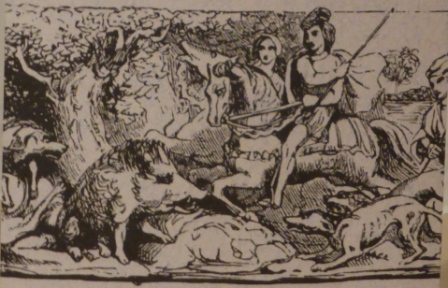
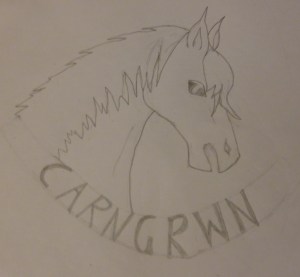
Memories of Gwyn’s Hunt in Culhwch and Olwen

P1130437 - Copy

Boar Hunt (from Moniack Sloe Liqueur)

I.
Recovering the Memories

Introduction: The Hunt for Twrch Trwyth and the Impossible Tasks

Within the main narrative of Culhwch and Olwen (1325) lies the story of the hunt for Twrch Trwyth ‘King of Boars’. To win Olwen, Culhwch must fulfil forty impossible tasks. These are set by Olwen’s father Ysbaddaden Bencawr ‘Hawthorn Giant’. The purpose of hunting the Twrch is to take the comb, shears and razor from between his ears so Ysbaddaden’s thorn-bush beard can be untangled, cut and shaved on the day of the wedding feast.

Twrch Trwyth is not just a huge silver, bristly, hoary, old boar but the son of a human chieftain: Taredd Wledig. He was reputedly turned into a boar by God as punishment for his sins. Beneath this Christian veneer lie deeper animistic roots disclosing Twrch Trwyth’s personhood and significance as one of Britain’s ancestral animals.

Irish and Norse myths feature magical boars who are hunted, killed, eaten, then the next day made whole. These could be rooted in tribal perceptions of father and mother animals who generate so long as they are treated respectfully. It is likely similar beliefs were found in Britain. It is of interest to note the Twrch is the father of seven piglets.

The list of impossible tasks contains the names of huntsmen, hounds and horses who are needed to hunt Twrch Trwyth. These include other mythic and numinous figures such as the pre-Christian hunter-deities Gwyn ap Nudd and Mabon mab Modron and a number of legendary hounds and huntsmen. Culhwch does not recruit these personages himself. He enlists the help of Arthur, who gathers and leads the hunt for Twrch Trwyth.

Gwyn’s Leadership of the Hunt

It is my intuition Arthur’s hunt for Twrch Trwyth is based on an older and more primal hunt led by Gwyn ap Nudd ‘White’ or ‘Blessed’ ‘son of Mist’. Gwyn appears as a divine warrior-huntsman with his white stallion, Carngrwn, and white red-nosed hound, Dormach in The Black Book of Carmarthen (1250). Here his role as a gatherer of souls is disclosed.

In later Welsh folklore Gwyn is associated with the Cwn Annwn ‘Hounds of the Otherworld’ and depicted hunting the souls of sinners. Many modern pagans view Gwyn as the Brythonic leader of the pan-European Wild Hunt. The longevity of Gwyn’s lore demonstrates his ongoing significance as a hunter-god and psychopomp within Britain’s consciousness.

Culhwch and Olwen is the only place Gwyn’s associations with the hunt for Twrch Trwyth can be found. However parallels exist within Irish and Norse mythology. Gwyn’s Irish counterpart, Finn ‘Fair’ ‘White’, leads the hunt for the giant destructive boar of Formael. The Norse hunter-warrior god and psychopomp, Odin, feasts on a mythic self-generating boar called Saehrimnir with his host of dead fighters in Valhalla.

Whereas Finn and Odin are central figures in Irish and Norse mythology, Gwyn plays a more marginal role in the British myths. I believe Gwyn may have once possessed a much greater mythos akin to the Fenian Cycle and the body of lore surrounding Odin.

Due to Gwyn’s rulership of Annwn, the Brythonic otherworld or underworld, he and his hunt have been demonised and marginalised through centuries of Christianity. Annwn has been identified with hell, Gwyn and his huntsmen with demons and the Cwn Annwn with hell-hounds.

This process can be traced within Culhwch and Olwen. Reading the narrative ‘otherwise’ to expose its sub-text shows how Gwyn’s mythos has been suppressed and replaced by Arthur’s. From its deeper levels memories of Gwyn’s hunt and the identities of its members can be recovered.

The Spirits of Annwn

Ysbaddaden tells Culhwch ‘Twrch Trwyth will not be hunted until Gwyn ap Nudd is found’. This may refer obtusely to Gwyn’s earlier leadership of the hunt which cannot begin without its divine leader.

Gwyn is impossible to get because ‘God has put the spirit of the demons of Annwn in him, lest the world be destroyed. He will not be spared from there.’ Ysbaddaden’s words hint at Gwyn’s rulership of Annwn and containment of its spirits.

Gwyn’s paradoxical nature as a white and blessed protector on the one hand and the ‘dark’ embodiment of the fury of the spirits of Annwn on the other is too much for the dualistic logic of Christianity to handle. Hence it calls for an explanation via the agency of God. This intolerable ambiguity is the source of Gwyn’s marginalisation and suppression of his myths.

The only clue I have found to the identity of the spirits of Annwn is an inscription from Chamalieres invoking the Andedion ‘Underworld Gods’ including ‘Maponos Arvenatis’. Maponos ‘The Son’ was the Gallo-Brythonic name of Mabon; a pre-Christian deity of youth and hunting who also appears in the impossible tasks. Mabon’s mother, Modron, is the daughter of Avallach, a King of Annwn. Mabon’s Annuvian nature is clear.

Thus it seems possible Mabon and other figures found imprisoned or underground in the narrative of Culhwch and Olwen are spirits of Annwn and members of Gwyn’s hunt. It seems significant some are viewed as prisoners of Gwyn and it is Arthur’s task to liberate them. By freeing huntsmen, hounds and horses from imprisonment in the underworld, Arthur removes them from Gwyn’s containment and finally usurps his role as the leader of the hunt.

II.
The Members of Gwyn’s Hunt

Who are the members of Gwyn’s hunt?

It is possible to locate them in the Impossible Tasks in Culhwch and Olwen.

Drudwyn and Graid son of Eri

One of Culhwch’s impossible tasks is to get Drudwyn ‘Fierce White’ who is so fierce and strong no leash can hold him except the leash of Cors Cant Ewin. No collar can hold the leash but the collar of Canhastyr Can Llaw plus… the chain of Cilydd Canhastyr is required to hold the collar along with the leash!

Drudwyn has clear Annuvian qualities. I’m reminded of a later folkloric reference to an ‘Infernal Dog’ which takes the form of a mastiff with a white tail and white snip down its nose and grinning teeth which conjures a fire around it.

Drudwyn is the ‘whelp’ of Graid son of Eri. In the episode of Gwyn, Gwythyr and Creiddylad, Graid attacks Gwyn with Gwythyr’s army and is resultingly defeated and imprisoned by Gwyn then rescued by Arthur. It seems likely this takes place in Annwn.

This episode is flanked by the opening sentence ‘It is best to seek Drudwyn the whelp of Graid son of Eri’ and the closing words ‘Arthur obtained… the leash of Cors Cant Ewin.’ By rescuing Graid, Arthur also got Drudwyn and his leash. Thus Graid, Drudwyn and his leash may all be seen as brought from Annwn.

Mabon mab Modron

However it is not Graid who is destined to hold Drudwyn on the hunt but Mabon mab Modron. Mabon is an important god of youth and hunting in his own right. I have previously noted his associations with the spirits of Annwn and descent from Modron, daughter of Avallach: A King of Annwn.

In Culhwch and Olwen Mabon is impossible to get because he was stolen from Modron when he was three nights old. Nobody knows where he is or whether he is alive or dead. Arthur’s men find it necessary to consult the oldest animals: the blackbird of Cilgwri, the Stag of Rhedynfre, the Owl of Cwm Calwyd, the Eagle of Gwernabwy and the Salmon of Llyn Lliw.

This tale is of considerable antiquity and may date back to a pre-Arthurian variant where Modron herself was seen as wandering the earth conversing with the animals to find her lost son.

Arthur’s men are guided by the salmon to Caerlowy (Gloucester) where Mabon is found lamenting in a ‘house of stone’. He complains ‘no-one has been so painfully incarcerated in prison as I, neither the prison of Lludd Llaw Eraint nor the prison of Graid son of Eri.’

Arthur and his warriors arrive to defeat Caerlowy’s defenders whilst Cai tears down the wall and takes Mabon on his back. Mabon is borne ‘home’ and made a ‘free man’.

Links between Mabon, Graid and Drudwyn become clearer. They are all prisoners of Annwn released from its unhomeliness and redeemed of their Annuvian natures to join Arthur’s hunt.

Gwyn Myngddwn

Mabon’s designated steed, Gwyn Myngddwn ‘White Dark Mane’, was also got at the same time as Drudwyn’s leash. Gwyn Myngddwn does not belong to Mabon: he is the horse of Gweddw. Gweddw’s horse is listed as one of ‘Three Bestowed Horses of the Islands of Britain’ in The Triads as Myngrwn ‘Arched Mane’.

Gwyn Myngddwn’s white colouring and epithet ‘swift as a wave’ suggest he possesses Annuvian qualities and may be a water-horse. ‘Myngrwn’ is also suggestive of arching waves. Gwyn Myngddwn’s watery nature makes it possible for Mabon to ride him into the Hafren (the river Severn) and snatch the razor from between the Twrch’s ears.

Rhymi and Her Two Whelps

Another impossible task Arthur fulfils is capturing the ‘the two whelps of the bitch Rhymi’. Rhymi is fascinating because she is a shapeshifter who adopts the form of a ‘she-wolf’. It is enlivening to find a powerful female figure in this male-dominated narrative.

And more so when parallels with Irish mythology are considered. Finn owns two beloved hounds called Bran and Sceolang. They are the son and daughter of his aunt who was transformed into a dog whilst she was pregnant. Hence they are his nephews!

Gwyn’s descent from Nudd ‘the superior wolf lord’ suggests like his father he was theriomorphic and able to take canine form. Perhaps Rhymi and her whelps have familial connections with Gwyn.

Rhymi and her offspring dwell at Aber Cleddyf in a cave. The fact that they can live beneath a river underground is another sure indicator of their Annuvian nature.

When Arthur nears Aber Cleddyf he speaks with a farmer called Tringad who says Rhymi and her whelps have been destroying his landscape. Arthur boards Prydwen and leaves some men on the ground. Together they round up and capture the wolfish-hounds and God turns them back into their ‘own shape’.

I assume ‘own shape’ means human form. This contrasts with God fixing Twrch Trwyth in swine-form. Becoming animal is punishment whereas humanisation represents redemption. Rhymi’s whelps appear as hounds again on the hunt so this magic doesn’t last long.

Cynedyr and Cyledyr Wyllt

Rhymi’s whelps can only be held by a leash from the beard of Dillus Farfog. The only huntsman who can hold the leash is Cynedyr Wyllt who ‘is nine times wilder than the wildest beast on the mountain.’ Cynedyr is one of the gwyllon: madmen, wildmen or spectres who have intimate connections with the forest of Celyddon.

Celyddon is the Welsh name for the Caledonian Forest, which has long-standing associations with wildness and death. The 6th century Classical writer Procopius said north of the wall ‘it is actually impossible for a man to survive there even half an hour, but countless snakes and serpents and every other kind of wild creature occupy their area as their own. And, strangest of all, the inhabitants say that if a man crosses this wall and goes to the other side, he dies straight away… the souls of men who die are always conveyed to this place.’

In The Black Book of Carmarthen Myrddin Wyllt speaks of his flight to Celyddon after the Battle of Arfderydd to recover from trauma wandering amongst wild creatures and gwyllon. In The Life of St Kentigern (12th C) (as Lailoken) Myrddin shares his guilt and a vision of an unendurable brightness in the sky and host of warriors. One is described as a ‘demon’ who tore Myrddin out of himself and assigned him to the wild things of the woods.

It seems possible this company was Gwyn and the spirits of Annwn. Hence they played a role in Myrddin’s retreat to the forest and transition into wyllt-ness but also his recovery and acquisition of the powers of poetry and prophecy.

We know nothing more about Cynedyr Wyllt than his reputation for extreme wildness. Yet we find the story of Cyledyr Wyllt within the episode of Gwyn, Gwythyr and Creiddylad. Along with Graid son of Eri, his brother, Pen, his father, Nwython, Nwython’s uncle Gwrgwst Ledlwm and Gwrgwst’s father Dyfnarth, Cyledyr accompanied Gwythyr in his attack upon Gwyn.

During their imprisonment, Gwyn killed Nwython and fed his heart to Cyledyr, who went mad. I have no idea whether this gory scene is founded in ancient ancestral rites or superstitions about Gwyn or whether it was invented to demonise him.

It seems significant four generations of Strathclyde Britons are captured and Cyledyr is fed his father’s heart. Could Nwython’s heart be viewed as containing the life-force of his family? Could transgressing the moral bounds of Dark Age society be a form of initiation into Gwyn’s hunt? Consuming his father’s heart clearly makes Cyledyr ‘wyllt’.

Neither human or animal (Myrddin takes the form of a bird and Cynedyr is compared to a mountain beast), living or dead, the gwyllon occupy a liminal position similar to the spirits of Annwn.

Later, Arthur goes north and captures Cyledyr. Alongside Mabon, Cyledyr rides the Twrch into the Hafren and snatches the shears from between his ears.

III.
Gwyn’s Hunt and Impossibility

The Escape of Twrch Trwyth

Arthur’s hunt for Twrch Trwyth begins in Ireland. After the hounds are loosed, the Twrch lays waste to a fifth of the land. Arthur fights the boars for nine days and nights and only kills one piglet.

Twrch Trwyth and his piglets then swim across the sea to Wales. The Twrch kills men and beasts in Daugleddyf then cattle in Cynwas Cwryfagyl. At the river Nyder, he stands at bay. In the first round he kills four of Arthur’s champions. In the second he slaughters Arthur’s son, Gwydre, and several other men. The next day he kills numerous ‘men of the country’ including Arthur’s chief craftsman, three servants of his gatekeeper and the King of France.

Arthur’s men lose the Twrch at Glyn Ystun. At this point Arthur summons Gwyn to him and asks if he knows anything about Twrch Trwyth. Gwyn says he does not. It seems likely the Twrch has fled deep into the wild or taken shelter in Annwn and Gwyn is covering his flight from his adversary.

This makes it painstakingly obvious in spite of Ysbaddaden’s demand all the listed hunters are gathered before the hunt begins, Gwyn has not been got and is not riding with Arthur. There is no evidence of Gwyn’s recruitment in the text nor of the capture of his steed: the famous water-horse Du y Moroedd ‘The Black of the Seas’.

Following Gwyn’s evasion of revealing the location of Twrch Trwyth, Arthur’s men are forced to hunt his piglets instead. Of the group who take them on none survive except one. When Arthur arrives with men and hounds the Twrch returns to defend his little pigs. Four piglets are killed. Another piglet is slaughtered at Garth Grugyn. After the King of Brittany and Arthur’s uncles meet their end the last piglet is defeated at Ystrad Yw.

Arthur summons Devon and Cornwall and they agree to drive Twrch Trwyth into the Hafren. Arthur and his warriors fall upon the Twrch and souse him in the river. At this point Mabon and Cyledyr flank him and snatch the razor and shears. Two of Arthur’s servants drown.

Afterward Twrch Trwyth escapes to Cornwall. Following a confrontation which makes the preceding trouble look like ‘mere play’ the comb is taken. He is chased from Cornwall into the Cornish sea. It is noteworthy Arthur and his men do not (cannot, dare not?) kill Twrch Trwyth.

Perhaps the rite of killing the Twrch is preserved for Gwyn, his legendary water-horse, Du, and his Annuvian huntsmen alone. Only they possess the knowledge of Nudd / Nodens ‘the catcher’ which is required to hunt and kill this great magical silver-bristled ancestral boar and bear him away to the feast in the deep from which he runs wild again.

Impossibility and the End of the World

Although Arthur does not complete all the impossible tasks, the comb, shears and razor are wrested from between the Twrch’s ears. Ysbaddaden’s beard is untangled, cut and shaved (down to the bone and even his ears are cut off!) and after his decapitation Culhwch marries Olwen.

The Twrch is hunted and the shaving equipment won but at a terrible cost. A fifth of Ireland is decimated along with a good part of Wales. Countless huntsmen lie dead including members of Arthur’s court, his close companions and family, most notably a son.

One recalls Ysbaddaden’s caution: ‘Twrch Trwyth will not be hunted until Gwyn ap Nudd is found’. The reference to Gwyn’s containment of the spirits of Annwn, a task he cannot be spared from in case the world is destroyed, highlights the danger inherit in Arthur’s decision to usurp his role as leader of the hunt and contain it with the help of God. This raises the question of whether the consequences would have been so dire if they worked together.

I don’t believe this is possible. Gwyn’s paradoxical mythos which transgresses the bounds of civilised Christian society is not compatible with Arthur’s worldview. There is not room for two leaders of the hunt. Arthur’s usurpation of Gwyn’s role as a protector of Britain could be the key to his marginalisation.

The central fact about Gwyn’s hunt is it belongs to him and the spirits of Annwn: the not-world, the deep, the realm of impossibility where all boundaries between civilisation and wildness, human and animal, life and death break down.

Attempting to make the impossible possible Arthur contains Gwyn’s hunt in a form palatable to Christian civilisation for a limited amount of time before, like Twrch Trwyth, it slips back into the watery realm of impossibility.

It is my further intuition Gwyn’s hunt is not only bound up with the literal destruction of the world but the end of the worlds we create as people. It is associated with the dissolution of what is possible and the manifestation of the impossible and thereby with radical change at the deepest level.

Nicolas R. Mann writes: ‘Gwyn is not only a guide into Annwn but also mysteriously connected with the end of a world… Gwyn may be seen as a guide into the next human world.’

EPILOGUE

As centuries of disbelief dissolve
they can be seen again
on the misted edges of Celyddon.

Drudwyn’s fierce white face pushing forward.
Graid son of Eri with a tentative hand on his collar.

Bright radiant Mabon holding Drudwyn’s leash,
leading Gwyn Myngddwn arching
his white neck and tossing his dark mane.

Deep in the forest Rhymi shakes
velvety flaps of red ears
as she suckles a litter of soft white pups
who will one day run with young hunters.

Cynedyr and Cyledyr fly
on the wings of birds
traverse mountains
goat-footed.

Standing apart in ruffled white furs
with a steadying hand on Du’s neck
Gwyn listens with Dormach
to the song of the forest
for a sign it is time.

They call to us to take their hands
ride swift mounts steer bellowing hounds
through the gap in the skies
where nothing is impossible.

Should we choose to join them
it is wise to heed
Culhwch and Olwen:
know for better or worse
the fate of the world is at stake.

Riding the White Horse

Carngrwn

In ‘The Conversation of Gwyn ap Nudd and Gwyddno Garanhir’ Gwyn introduces his white stallion, Carngrwn, before introducing himself. He says:

“My horse is Carngrwn from battle throng
So I am called Gwyn ap Nudd”

At first I was surprised to hear Gwyn introducing his horse before himself. Then I realised a medieval audience would have recognised riding Carngrwn ‘Terror of the Field’ was an essential part of his identity as a gatherer souls and a precedent to the revelation of his name.

Later in the poem ‘the white horse’ calls the conversation between Gwyn and Gwyddno to an end. Carngrwn leads Gwyn away to battles not in Neath and Tawe in this land but a Tawe ‘far away in a distant land / where the tide ebbs fiercely on the shore’.

Gwyn’s service as a psychopomp is necessary not only in thisworld but Annwn. It seems Carngrwn, the white horse, has power over his destiny and he has little choice but to trust in and ride this wild kindred spirit to where he is needed most.

Nothing is known about how Gwyn came into partnership with Carngrwn. My intuition is this story may bear similarities with Cu Chulainn’s. Cu Chulainn was born at the same time as two horses: Liath Macha ‘The Grey of Macha’ and Dub Sainglend ‘The Black of Saingliu’. The grey (or white) horse is a companion from birth and protects him until death.

Gwyn is associated with a white horse: Carngrwn and a black horse: Du y Moroedd ‘The Black of the Seas’. Both are supernatural in origin. I feel Gwyn’s relationship with Carngrwn is stronger and the white horse will be with him until the end. In his case this could mean until the end of the world. The white horse is his destiny.

These insights have helped me understand my own relationship with the white horse. Horses have been part of my life since childhood and I worked with them in my twenties. I constantly dream about them and a white fairy-mare is my guide to the otherworld.

Although I haven’t been called to serve as a psychopomp (yet) I know what it’s like to walk between worlds, tell the stories of the dead and feel my destiny is beyond my control. Whenever I’ve sought to find a comfortable role in the system something with big hooves has kicked back and galloped me away.

Yet since meeting Gwyn I’ve got better at riding the white horse: trusting his guidance; staying true to my wild inner nature; letting my fay-mare run and take me where I’m needed; not being restricted by today’s opinions knowing my destiny will keep running until the end of the world.

Crane-Dance and Sunshine

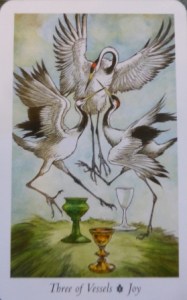
P1130306A card which keeps recurring in my readings (I mainly use The Wildwood Tarot) is ‘The Three of Vessels: Joy’. It features two common cranes dancing and a third spreading its wings, rising into flight with three vessels; white, green and gold. Its meaning is welcoming ‘new life or good fortune’, ‘celebration within a communal group or family’ and ‘successful return after migration’. The reading points state it’s about being able to give ourselves permission to experience ‘authentic joy’ as a ‘gift from the universe’.
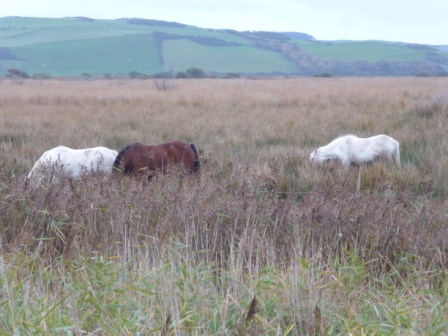
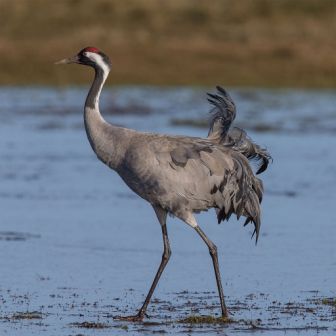
At the beginning of the year after completing my first publication: Enchanting the Shadowlands and dedicating it to him, Gwyn ap Nudd advised me to ‘find my sun’. Interpreting this as finding a calling I enjoyed, I balked. Although intuitively I knew continuing to serve Gwyn as an awenydd by recovering his neglected stories and their associations with the British landscape was a source of joy, I couldn’t believe in it.

There were too many awful things happening in the world. Too many other people stuck in meaningless jobs for me to deserve the liberty to follow my joy. So I ignored Gwyn’s advice, took an admin job and tried to force myself into the political sphere: areas antithetical to my natural disposition as an intuitive thinker and poet. Unsurprisingly, I had a thoroughly miserable time.

The event that broke my misery was a holiday to Wales where I experienced the enormity of Cadair Idris and, after reading Heron’s translation of ‘The Dialogue of Gwyn ap Nudd and Gwyddno Garanhir’ on Borth beach, witnessed the otherworld appearing across the sea at sunset: a gift from Gwyddno’s lands and from Gwyn, a King of Annwn. This led me to write a story based on the ancient Welsh poem called ‘The Crossing of Gwyddno Garanhir.’

During my research I found out whilst Garanhir is usually translated as ‘longshanks’, ‘garan’ means ‘crane’ in Welsh and could refer to ‘crane-legs’. That’s how Gwyddno appeared to me: an old man, grey-faced, crane-legged, picking his way along the misted edge of Borth Beach. He had lost his memory. This was because the cranes were gone with their elegant black legs whose dancing alphabet spelled the forgotten names of his kindred.

Cranes became extinct in Britain during the 17th C due to shooting and the draining of wetlands. I’m not sure when the last crane was sighted in the precincts of Maes Gwyddno ‘The Land of Gwyddno’. According to local legend, Cantre’r Gwaelod ‘the Bottom Hundred’ was drowned after the flood gates of Gwyddno’s fort were left open after Seithenin’s seduction of Mererid.

Boddi Maes Gwyddno ‘The Drowning of the Land of Gwyddno’ is set in the 6th century but could have its roots in sightings of an ancient, submerged forest on Borth beach. Whenever it happened, it seems a flood devastated lowland plains, areas of woodland and the homes of a human community. A haunting story tells of church bells ringing beneath the sea. I imagine the flood-waters drowned coastal wetlands and the nesting places of numerous wildfowl too.

Another tale linked with the area is Hanes Taliesin ‘The Story of Taliesin’. After Gwion Bach spilled three drops of Ceridwen’s brew on his finger and imbibed the Awen, the cauldron shattered and its toxic contents spilled across the land and poisoned Gwyddno’s horses. Today this conjures images of large-scale industrial tragedies such as the Gold King Mine Disaster in Colorado in August this year where three millions gallons of waste water flooded into the Animas.

This may not be far from the ‘truth’ as lead mining took place in the hills close to Cors Fochno ‘Borth Bog’ and lead smelting at Taliesin, Llangynfelyn and Ynys Capel during the Roman period. A medieval wooden walkway connecting these sites has recently been discovered. Perhaps an industrial disaster poisoning streams and wildlife gave rise to this tale? (On a happier note, wild ponies can be seen grazing safely near Cors Fochno in the present-day.)

P1120640

Both ‘Dark Age’ tales may be related to the disappearance of cranes from Maes Gwyddno. A story which has not made its way into legend is the draining and enclosure of Cors Fochno. This began in 1813 and reduced its area of 24 square kilometres to 7 square kilometres (now protected as an SSSI). Whilst this took place too late to be cited as a cause of the disappearance of cranes from Cors Fochno it would have decimated other wetland species.

***

Common_crane_grus_grus

Wikipedia Commons

The extinction of common cranes forms an incredibly sad marker in British history. These striking birds with their grey body- feathers, black and white necks and unique red crowns are renowned for the choreography of their elaborate ballet-like courtship-dance which involves a complex sequence of bobs, bows, crouches, coils, spins, leaps, pirouettes and calls.

After mating, both parents care for and fiercely protect their eggs which are laid in May and hatch 30 days later. After 5-6 weeks the parents go through a post-breeding molt which renders them unable to fly. Their offspring are ready to fly at 9 weeks. It seems possible the precarious 3 week period when none of the family can take off played a part in the demise of common cranes.

As well as being an irreplaceable part of the natural world, cranes are deeply embedded in Celtic and Romano-Celtic culture and mythology. The most famous example is Tarvostrigaranus ‘the Bull with Three Cranes’ from a 1st C Parisian monument. In Dorset, a statue of a three-horned bull with three female figures on his back was found in a 4th C shrine. These seem related through lore about women shapeshifting into cranes. In Risingham, Northumberland, a Gaulish slab depicts Victory with a crane beneath her and Mars accompanied by a goose.

Whilst crane stories in Brythonic tradition seem lacking, I found cranes play a central role in Irish mythology. In light of my devotion to Gwyn I was delighted to find several stories connecting his Irish counterpart, Finn, with cranes. In ‘Bairne Mor’ whilst Finn is a young child, his father, Cumhall, is slain in battle. Finn is thrown over a cliff and caught by his grandmother in the form of a crane.

In ‘Cailleach an Teampuill’, Finn encounters the Cailleach as ‘the Hag of the Temple’ with four sons who appear as cranes. They are associated with death and will only ’emerge as warriors’ if they receive a drop of blood from the skull of the Connra Bull (who is owned by the Cailleach).

Finn also comes into custodianship of a crane-bag which belonged to his father. The story of its origin is fascinating. The crane-bag first belonged to Manannan Mac Lir and contained his treasures. It is made from the skin of a crane who was originally a woman called Aoife. Aoife was transformed into a crane by Iuchra; a jealous female rival for the love of a man. In modern Druidry, the crane-bag is associated with the ogham alphabet and used to carry magical tools.

When I wrote my story, the only part of this complex web of correspondences I knew of was the connection of the crane-bag with letters. Considering the relationship between cranes and female shapeshifters, looking back, it’s intriguing I was guided by an impulse to relate Gwyddno’s regaining of his crane-knowledge to memories of his mother.

Gwyddno’s recollections of his identity and ancestry took place under the auspices of Gwyn’s protection as a psychopomp. It is my belief the dialogue is set between worlds after Gwyddno’s death. Because Gwyddno lost his memory before he died he was unable to find his way to Annwn. Thus Gwyn appeared with his dog, Dormach, to help him regain his memory and ancestral connections and aid his crossing.

In my story, after Gwyn helped Gwyddno re-gain his ‘inner crane-knowing’, Gwyddno saw the arrival of his family, including his grandmother and his wife Ystradwen as a flock of cranes. Finally he took crane-form, was united with them and flew to Annwn as it appeared across the sea by the light of the setting sun.

Thus, for me, the three cranes on ‘The Three of Vessels: Joy’ could represent Gwyddno and Ystradwen dancing watched over by Gwyddno’s mother with Gwyn’s presence represented by the misty background. The three vessels seem linked to the three drops of Awen, which had led to the poisoning of the landscape, recovered and contained.

Another interesting coincidence is that Gwyn appears to Gwyddno as a ‘bull of battle’: a sacred title referring to his status as a psychopomp. In the dialogue I picture him as a white warrior wearing a bull-horned helmet. Could there be a link to the magical power of Tarvostrigaranus and / or the Cailleach’s bull? If so my story inverts the transformation of the Cailleach’s sons as Gwyddno shifts from king and warrior into crane-form.

Another piece of Irish lore worth mentioning is that three cranes guard the sidh (mound and otherworld entrance) of Midir. Their calls have the capacity to ‘unman’ warriors and if a crane is seen before battle this is taken as an ill omen. I’ve also read three cranes act as guardians of Annwn. Although I haven’t found a scholarly reference for this yet, it would fit with my suggested crane-trio and Gwyn as a King of Annwn.

***

Whilst writing my story, I was excited to find out common cranes are returning from ‘extinction’ in Britain. In 1979 common cranes arrived at Horsey on the Norfolk Broads. Their survival was made possible by the custodianship and management of ‘Crane Country’ by John Buxton and his team of wardens.

In 2010 ‘The Great Crane Project’ was established and is ongoing. At the WWT Centre in Slimbridge, crane eggs from Germany are incubated and hatched then the chicks are hand-reared and released; mainly on the Somerset levels and also in South Wales, Wiltshire, Gloucestershire, Oxfordshire and East Somerset.

Although over a dozen pairs have established territories and bred, this is the first year chicks have matured to the age of taking flight. In August not only one or two but three young cranes (two in Somerset and one at Slimbridge) took flight for the first time. The trio have all been named Peter after the RSPB’s Peter Newbery who was a driving force behind the project and sadly passed away before he saw the young cranes fly.

A couple of weeks ago, Brian Taylor (who I have been conversing with for a while about soul-birds amongst other topics) mentioned a pair of Eurasian cranes in the ‘wildfowl garden’ of the WWT Centre at Martin Mere. I’d been planning to go to see the Pink-footed Geese and Whooper Swans so visited with my friend, Peter Dillon.

From a distance, I was struck by the Eurasian cranes’ presence and the dramatic change in their appearance from when they crouched and raised themselves to full height. After spending a short while with them, I walked to the other side of their pen. Both turned from a crouched, coiled, position in synchrony, pirouetted then approached. Seeing them perform a simple movement with such grace in captivity I can only imagine their courtship dance in the wild.

Seeing cranes face to face was a source of joy as was re-imagining the dialogue of Gwyn and Gwyddno. During the process I had an overwhelming gnosis of the significance of Gwyn’s role as a psychopomp, the great service he performs for the dead and his promise of blissful re-union with the depths of nature (Annwn) and one’s ancestors in the afterlife.

In Welsh folklore the hounds who help Gwyn gather the souls of the dead are called Cwn Annwn: ‘Hounds of the Otherworld’. Their barking is identified with noisy nocturnal flights of geese. The hounds in Lancashire folklore who perform this role are Gabriel Ratchets and their baying is also connected with droves of geese and wild swans.

In Wales and Lancashire to hear swans or geese flying over at night is a portent of death. During the day at Martin Mere hearing the calls of Whooper and Bewick’s Swans, Pink-footed and Barnacle Geese on the lakes and overhead filled me with great joy: in their presence and a sense of knowing like them one day I would be going ‘home’ to a land far away.

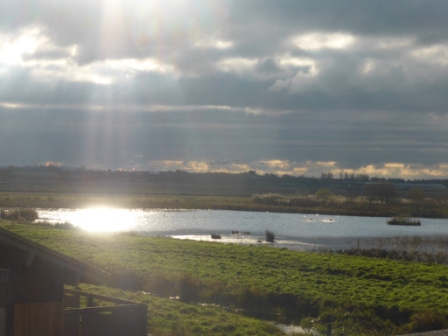
Looking out from the Ron Barker Hide across wetlands lit by magical rays of sunshine as flights of geese and swans arrived and departed I realised in Gwyn, his stories and their revelation within this remarkable landscape I had found my joy, my Awen: my sun.

P1130233 - Copy

I perceive parallels between the return of cranes and the re-emergence of the stories of the old gods and ancestral animals of Britain. Such returns don’t happen on their own or without people dedicated to making them happen. Thus I see my vocation as an awenydd to Gwyn and the spirits of the land not only as a source of joy for myself but hope for future generations. I’ve found my sun and finally accept its gifts.

***

SOURCES

AlainaFae and Cliareach Filleadh, ‘Crane’s Cauldron / Brigid’s Cross
AlainaFae and Cliareach Filleadh ‘Artistic Creation Exploration: Corr Teanga
Anne Ross, Pagan Celtic Britain, (Cardinal, 1974)
Miranda Green, Animals in Celtic Life and Myth, (Routledge, 1992)
The Wildfowl and Wetlands Trust, Waterlife, 194, Oct / Dec 2015
The Great Crane Project
The Norfolk Cranes’ Story

Lund-in-the-mist and Altar to the Mothers

At the beginning of November, I cycled to the church of St John the Evangelist in Lund, which is about six miles outside Preston. Lund means ‘grove’ in Norse and Germanic thus it seems likely the church was built on a pre-Christian sacred site. This is supported by the presence of an altar to the Mothers within the church now used as a baptismal font.

Matronae ‘Matrons’ and Matres ‘Mothers’ were worshipped across Northern Europe from the 1st to 5th C particularly in Germany and Gaul and other places occupied by the Roman army. They are usually depicted in threes, often with fruit, bread, cornucopias and nursing infants.

Worship of the Mothers was widespread in Britain. Whilst some of the Mother Goddesses were clearly brought from over-seas (shown by inscriptions reading ‘To the Mothers from Overseas’ ‘To the German Mother Goddesses’) there is evidence for a Romano-British tradition centring on Matrona ‘the Mother’ and Maponos ‘the Son’ which seems strongest in north-west England and southern Scotland.

Altars and inscriptions to ‘the Mother Goddesses’ and ‘the Mothers the Fates’ have been found at Burgh-by-Sands, Carlise, Old Penrith, Skinburness and Bowness-on-Solway. The worship of Maponos in this area is evidenced by the place-name Lochmaben, the Clochmaben stone and the Locus Maponi.

Matrona and Maponus re-appear in medieval Welsh literature as Modron ‘Mother’ and Mabon ‘Son’. The story of Mabon being stolen from Modron when he is three nights old and rescued from imprisonment in a ‘house of stone’ forms an important part of Culhwch and Olwen.

In The Triads, Modron daughter of Avallach, bears Urien Rheged’s son and daughter, Owain and Morfudd. Urien’s relations with Modron and Owain’s inheritance of Mabon’s divine qualities show his family’s dependence on ancestral deities for the fertility of their land and lineage and success in battle.

Modron’s father, Avallach, is the son of Beli Mawr: one of the oldest ancestral gods of Britain. He is associated with Ynys Avallach ‘The Island of Apples’ or ‘The Island of Avalon’. This is inhabited by nine maidens: Morgan and her sisters. In Welsh and Breton folklore, Morgens are water spirits.

The Mothers are frequently associated with water: in Gaul, Matrona is goddess of the Marne. A reference from 1AD exists to ‘the Island of Sein’ ‘known because of the oracle of a Gaulish God; the priestesses of that divinity are nine in number.’ One wonders whether the god is Dis Pater, from whom the Gauls claim descent.

Avalon is often identified with Glastonbury. Another of Glastonbury’s deities is Gwyn ap Nudd, a King of Annwn who resides over spirits bearing striking similarities to the Gaulish andedion (underworld gods). Both Morgan and Gwyn become known as ‘fairies’ in later literature.

In Peniarth Manuscript 147. the mother of Urien’s children appears as the Washer at the Ford (‘The Ford of Barking’) and introduces herself as ‘daughter to the King of Annwfn’.

A pattern emerges: one, three or nine female figures connected with an underworld god.

Here in Lancashire there are altars to the Matronae and to Maponos (as Apollo-Maponus) in the Roman museum at Ribchester. This is the site of Bremetenacum ‘place by the roaring river’ and is located on a major ford of the Ribble. Ribchester was also likely to have been a centre of worship for the Ribble’s goddess: Belisama ‘Most Shining One’ ‘Most Mighty One’.

During the Romano-British period, the Ribble ran much closer to Lund. This is shown by the nearby place-name Clifton ‘Cliff Town’. St John the Evangelist also stands very close to the Roman road running from Ribchester through Preston to Kirkham and across the Fylde. Because the stone of the altar at Lund is similar to those from Ribchester, it seems possible it was made there and brought on the road. This would mean, like the Ribchester altars, it dates from 2BC.
The altar’s appearance as a font is recorded in a leaflet in the church. In ‘the records of the Parish Vestry’ it says ‘Matt Hall, Churchwarden of Kirkham in 1688 set up a scandalous trough for a font in Lund Chapel…. For this poor Matthew was presented, that is brought before, the bishop of the diocese. History does not record the outcome of the interview, nor for that matter, how he came by the ‘scandalous trough’ in the first place.’ In spite of the ‘scandal’, the ‘trough’ is still used as a font today.

When I set out to St John’s it was originally for a recky so I could get the timing right when I booked an appointment to visit. Therefore it was a pleasant surprise to find the church open (it’s open every day from 10am) and to be greeted by Joan Shepcot, a volunteer gardener and co-ordinator of the Children’s Society, who invited me in to see the altar and let me take as many photographs as I needed.

2. Altar to the Matres, front

As I approached the altar I could see it was beautifully maintained. Three female figures wearing loose dresses or robes stood in the centre. Their hair looked coiffured or perhaps they were wearing headgear. Were they one Mother Goddess in triple-form? Three individual Mothers or the Mothers the Fates?

P1120472 - Copy

On the right and left hand side of the altar female figures were depicted dancing, arms above their heads, feet tapping a beat. They were also clad in loose robes or dresses. Were these the Mother Goddesses dancing? Or perhaps nymphs of the sacred grove? Or devotees? Their swaying stances with arms raised reminded me a little of trees.


Together could they form a sisterhood of nine? Could the ancestral presence of an underworld god be felt in the background?

7. Faith, Hope and Charity

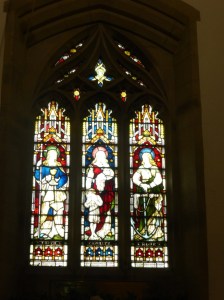
The back of the altar was blank because it once stood against a wall. Behind the altar was a stained glass window depicting Faith, Hope and Charity with the head of an unnamed male figure in blue and gold above. This is interesting because Alex Garman says these ‘three sisters’ show a strong influence of the Matronae. Considering their presence on a font I found myself imagining ‘the Mothers the Fates’ as ‘fairy godmothers’ at baptisms.

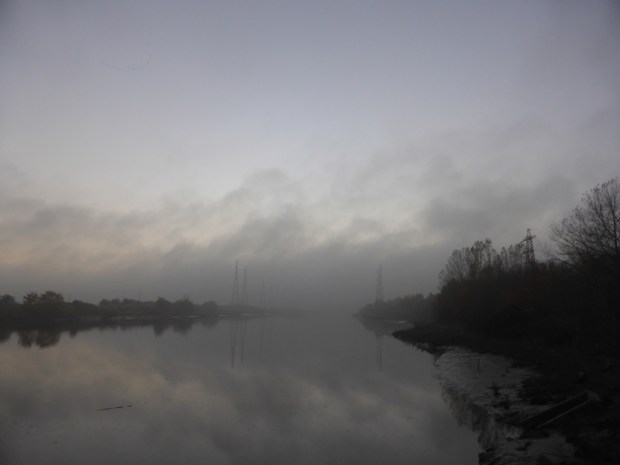
After a chat with Joan about her wildflower patch I cycled to the next point along the Roman road from St John’s: Dowbridge. As I headed back from the bridge over the river Dow, mist descended; cloaking St John’s at Lund, Clifton Cross and Clifton Mill. Rolling over Savick Brook and the Ribble.

In the cold swathes of mist passing over grey waters where time stood still I sensed the passage of underworld spirits. I had, after all, stumbled out on All Soul’s Day.

P1120528

*Many thanks to Joan Shepcot at St John the Evangelist in Lund for permission to use these photographs on my blog.

Glasgow Necropolis

So often returning to the same place.’
Merchants` House motto

It called to me before I went there
across the bridge of sighs:
green avenues of mausoleums,
huge genius loci of merchant patriarchs
towering over obelisks and plinths,
guardians of locked vaults,
faces grey and sombre.

Nothing escapes the rain in the city of the dead.
It pours its fierce torrential acid force
on statues with eyes empty in prayer
gazing forever heavenward.
Makes them raw. Crafts them so white it hurts.
Grants them tears and new stigmata.
An angel holds an oak leaf like a butterfly.
Orange sycamore birds catch in the wind and fall.

How do they feel, how do they see
when their eyes are pupil-less?
Are they blind or do they see as I see
a crack of light in the magma-like clouds,
my lord of the dead approaching on a lime-white horse
where time bends an army of tombstones
into eternity? Do their hearts beat
with mourning and elation?

Do they remember the steady hand
of devotion that carved their limbs,
immortalised them here as I stare statue-like
from amongst merchants, artists, poets,
gathered on green roads,
in sepulchral houses,
ask the rider on the pale horse
“why am I so often returning to the same place?”

Bridge of Sighs

*Glasgow Necropolis was the last place I visited during my time in Glasgow.


Dumbarton Rock

Consolidating Gwyn ap Nudd’s links with the Strathclyde Britons

In October after the ritual to Epona I stayed overnight with Potia and Red Raven in Glasgow. The next morning, Red Raven kindly took me to visit Dumbarton Rock: Dun Breatann ‘Fortress of the Britons’ to continue my research on Gwyn ap Nudd’s lost connections with the Old North.

Dumbarton Rock stands on the estuary of the river Clyde beside the river Leven, stern, stony, commanding, cloven into two peaks, White Tower Crag and The Beak. Its proximity to an ancient hill fort on Carman Hill and Roman Forts such as Whitemoss guarding the estuary suggest its use as a defensive position from at least the Iron Age and Romano-British periods. Looking up at its vertical cliff face from beneath and climbing its 557 steps provided a distinct impression of how difficult it would have been to attack.

Dunbreatann emerged as the capital of Strathclyde, controlling south-west Scotland after the Romans withdrew from the Antonine Wall, in the 4th century. Later it was known as Alt Clut ‘Clyde Rock’. The first written reference comes from St Patrick from Ireland between 453 and 493AD, reprimanding Coroticus (Ceretic, ruler of Alt Clut) for taking his new Christian converts and selling them as slaves to the Picts.

The majority of its rulers were descendants of Ceretic: notably Dyfnawl Hen, Cinuit, Clinoch, Tutagual then Rhydderch Hael. After Rhydderch’s death in 612, rulership passed to another line stemming from Ceretic: Neithon son of Guipno and his lineage ruled until Dumbarton Rock was taken by the Vikings in 869.

A fragment in The Black Book of Chirk states that following the death of Maelgwn Gwynedd in 547, Elidyr Mwynfawr (first cousin of Tutagual and husband of Eurgain, Maelgwyn’s oldest legitimate daughter) attempted to seize the throne from Maelgwn’s illegitimate son, Rhun. Elidyr was killed at Arfon. This led to Rhydderch Hael, Clydno Eiddin, Nudd Hael and Mordaf Hael burning Arfon in revenge and being pursued north by Rhun’s forces to the river Gweryd.

Elidyr’s journey is recorded in a triad of ‘Horse-Burdens’ where the eponymous water-horse Du y Moroedd (‘The Black One of the Seas’) is said to have carried Elidyr and his party (seven and a half people including a cook hanging onto the crupper- hence the half!) from an unknown Benllech in the north to Benllech on Anglesey. Du is notably the steed ridden by Gwyn ap Nudd in the hunt for Twrch Trwyth (‘King of Boars’).

Rhydderch Hael (‘the Generous’) is the most famous of Strathclyde’s rulers. He was renowned as one of ‘Three Generous Men of Britain’ and owned a sword called Dyrnwyn ‘White Hilt’ which burst into flames when held by a well-born man and was numbered amongst the Thirteen Treasures of Britain.

The extent of Rhydderch’s generosity is hinted at by the third ‘Unrestrained Ravaging’ where Aeddan Fradog (‘the Wily’) came to his court and left no food, drink nor living beast (if Rhydderch was exceedingly generous and Aeddan took everything he must have been greedy and unrestrained indeed: one can sense the shock and disbelief of a contemporaneous audience).

Rhydderch championed Christianity and was the patron of St Kentigern. He came to power in 573, which coincides with the Battle of Arfderydd. Poems attributed to Myrddin Wyllt in The Black Book of Carmarthen suggest Rhydderch played a leading role in the defeat of the pagan ruler, Gwenddolau at Arfderydd and this was a factor in his rise to power.

In The Black Book of Carmarthen Gwyn ap Nudd states his presence at Gwenddolau’s death. Gwyn’s appearance to gather the soul of Gwenddolau and other dead warriors played a role in Myrddin’s madness and flight to Celyddon. The ex-warrior become wild man and prophet was hounded by Rhydderch Hael and supposedly converted to Christianity by St Kentigern.

Rhydderch also played a prominent part fighting against Theodric of Anglo-Saxon Bernicia with his Brythonic allies Urien Rheged, Gwallog ap Llenog and Morcant Bulc. During the campaign, whilst the Anglo-Saxons were successfully blockaded on Lindisfarne, Morcant assassinated Urien; a move which eventually led to the fall of the Old North.

Rhydderch’s successor, Nwython (Neithon) and his family feature prominently in the episode of Gwyn, Gwythyr and Creiddylad in How Culhwch won Olwen. After Gwyn ‘abducts’ Creiddylad from Gwythyr and takes her to Annwn, Nwython, his sons Cyledyr and Pen, Dyfnarth (Dynfawl?) and his Dyfnarth’s father Gwrgst Ledlwm join Gwythyr in an assault on Gwyn to win her back (four generations of Strathcylde Britons!).

Gwyn defeats Gwythyr and his army and imprisons them. During their imprisonment, Gwyn kills Nwython and feeds his heart to Cyledyr, who becomes wyllt (‘wild’ ‘mad’). Arthur then rescues Gwythyr and his men and places a command on Gwyn and Gwythyr to battle for Creiddylad every May Day until Judgement Day.

It is my intuition this story originates from an earlier seasonal myth where a hero (‘the Summer King’) challenged the god of Annwn (‘the Winter King’) for the love of a goddess of fertility and sovereignty who may originally have been revered as a free agent in a sacred marriage.

This episode is only one variant, fixed in 6th C Strathclyde, known because of its incorporation within the narrative of How Culhwch won Olwen (14th C). It is clear Gwyn has lost his status as a god of Annwn and Creiddylad her independence as a fertility goddess. Its fixity may be read to mark the death of a seasonal rite and its transition into story.

No doubt this coincided with the rise of Christianity, which led to Gwyn’s demonisation as the representative and literal embodiment of the ‘demons’ of Annwn and Creiddylad’s demotion to a helpless maiden flung like a ragdoll between two male lovers and finally locked away, powerless, in her father’s house.

The seasonal myth is thus replaced in the 6th century with a story designed for the political purpose of cementing alliances between the Strathclyde Britons, Gwythyr ap Greidol (deified as ‘the Summer King’) and Arthur against a common enemy: the demonised King of Winter and Annwn, Gwyn ap Nudd.

The disturbing sequence of Gwyn’s murder of Nwython and torture of Cyledyr has led me to question whether it has any historical basis. From my research so far there is nothing to suggest Nwython died a sudden or inexplicable death or disappeared during a campaign (often attributed to otherworldly forces).

However this does not mean such stories did not exist. Another explanation is that it was cited by the bards of Christian rulers to highlight the atrocities Gwyn committed against the lineage of Strathclyde to keep paganism at bay. One can only imagine the fear and repulsion of Strathclyde’s people and in particular Nwython’s descendants when it was voiced.

P1110994

It seems possible early variants of these stories were told in the fortress on The Beak alongside inaugural poems which would form Y Gododdin and The Black Book of Carmarthen. The existing texts suggest belief in Gwyn as a psychopomp lingered on beside the Christian faith for a long while. As a guide and warrior-protector to some and a cruel, demonic figure to others, he haunted the margins of every recital of battle-tales.

After Dumbarton Rock was taken by the Vikings, the kingdom of Strathclyde re-emerged up-river at Govan and stretched from Glasgow into Penrith in Cumbria. During this transition and, later, when Strathclyde was finally integrated into Scotland in 1034 many Britons went into exile and settled in Wales. In medieval Wales the oral tales about Gwyn ap Nudd and the fall of the Old North were finally penned.

Since then Dumbarton Rock has seen various uses; most notably as a medieval royal castle with its famous Wallace Tower. It is now primarily a tourist attraction within the custodianship of Historic Scotland.

Time passes. History fades into story into myth and even myth is forgotten. Yet the deepest myths are fated to return from the most distant edges of the otherworld like a boomerang.

P1110997

Looking out across the Clyde and Leven from the Fortress of the Britons I saw a pair of ravens who have lived forever on that ancient rock flying on the winds from there into poetry to the realm of the gods and back again.

P1120006

On that note I’ll thank Red Raven for taking me to Dumbarton Rock and bring this piece to end.

Breaking the Silence

Two months ago I decided to take a break from blogging. I’d returned from Wales after climbing mist-ensorcelled hound-haunted Cadair Idris. Standing on the shoulder of a giant dizzied by his mad dreams. Staring down into Llyn Cau and Llyn y Gadair. Finding refuge in the hut of the mountain guide.

In Wales the gods are huge. Their names and stories echo from deep valleys and massive mountains and are carried in streams and rivers to where the immensity of the sky meets the immaculate sea on the western coast. From Pen y Gadair the mists of Gwyn ap Nudd never leave.

On Borth beach I read Heron’s new translation of ‘The Dialogue of Gwyn ap Nudd and Gwyddno Garanhir’. The name Borth derives from Porth Wyddno and is the location of Cantre’r Gwaelod (The Bottom Hundred); Gwyddno’s drowned kingdom. It was my intuition Gwyddno died there and the poem records a conversation between the worlds where Gwyn offers Gwyddno protection and guides him to Annwn (the Brythonic otherworld).

Reading the poem was immensely powerful. I experienced vividly the presence of these two great mythic figures speaking against the backdrop of the pebbled beach and roaring sea. Afterward at sunset I saw the otherland of which Gwyn speaks ‘where the tide ebbs fiercely on the shore’ appear on the horizon.

Borth VI returned to Penwortham mind-blown with much to absorb in thought and dream only to experience another immensity. This time a crushing one. Walking the section of the old pilgrim’s path that leads across the A59 from the site of St Mary’s Well to the War Memorial I got trapped in the middle of the road: unable to cross because of the heavy rush of traffic at school pick-up time.

A59 between site of St Mary's Well and Penwortham War MemorialI knew this was the result of the widening of Penwortham By-Pass. A rush which will only increase when a new stretch of by-pass is built leading over the river Ribble to Junction 2 of the M55 (which exists only in name having been planned over 40 years ago). That this was linked to the expansion of BAE, the University of Central Lancashire, to the building of new housing developments and employment sites throughout Preston and South Ribble.

I was struck by the overwhelming gnosis it was beyond me to stop the growth of this monster. I could not stop the City Deal. I’d known for a while the City Deal was something not even the most seasoned campaigners would dare take on as a whole. That each of us must find our own way of protecting what we value within the realms of possibility whether it’s by campaigning against individual developments, fracking (which will not only ruin the landscape and poison our sacred watercourses but fuel the monster), austerity, defending and caring for an area of green space or growing and nurturing a community group.

Acknowledging this insight has taken a lot of readjustment during which I realised attempting not even to save the world but just South Ribble and Preston, Penwortham even, was beyond my capability and making me ill. Not only that, Peneverdant ‘the green hill on the water’ with its aquifer shattered in 1884, its holy wells dry, its banks subsiding with falling trees and gravestones under increasing duress from the By-Pass wanted to close down. Hence the closure of ‘From Peneverdant.’

What did I have left? The Friends group I run in Greencroft Valley with its wildflowers and apple trees. The monthly poetry night I play a lead role in organising at Korova Arts Cafe & Bar which provides a safe and welcoming space for newcomers and established poets to perform. The Oak and Feather Grove.

My relationship with the land and the gods which my recent travels north and to Wales have taught me need not be limited to Penwortham. The inspiration and awe I find in my path as an awenydd devoted to Gwyn ap Nudd. The depth and magic of his known and unknown stories. A growing awareness of other Brythonic gods and goddesses and their myths.

Whilst I’ve had support and companionship from friends and family and other poets and pagans, until the past couple of months my path as an awenydd and Brythonic polytheist has been a lonely one. However, in October I went to Glasgow to a ritual to Epona-Rigantona led by Potia and last week returned to Borth and finally met Heron, whose writing has guided and inspired me for several years.

Together on Borth beach Heron and I read my story ‘The Crossing of Gwyddno Garanhir’ which I wrote after my previous visit to Borth based on his translation of Gwyn and Gwyddno’s dialogue. It was moving and beautiful reading and listening to the words, born from the place, from an ancient poem passed on from poet to poet, feeling it live on the sea breeze and the rolling tides, honouring Gwyn’s role as a psychopomp, Gwyddno’s passing and the absent cranes (‘garan’ from Garanhir means crane in Welsh) who I gave the role of soul-birds. Afterward we walked across Cors Fochno (Borth Bog), where cranes may have nested, up Cwm Clettwr and to Taliesin’s grave.

I returned nourished with my feeling of the increasing import of the Brythonic myths juxtaposed with my frustration so few people have an interest in them. Of having much to share but no-one to share with. Which led once again to despair until I had a dream which somehow I knew took place ten years in the future.

I was leading a guided tour of one or two disinterested people to ‘Cockersand Fields’ (which I interpreted to be the fields near Cockersand Abbey where a statue to Mars-Nodens was found) and was feeling ready to give up on this task and life altogether. I hadn’t put my heart into it for several years. Then I saw a group of young backpackers approaching from boats on a sunset beach with smiles and eyes filled with hope. They’d come searching for stories about Gwyn, which I’d failed to write: a failure I suddenly regretted and a friend pushed me to rectify.

The dream seemed to be telling me not to lose hope in a vocation that nurtures my soul, brings me joy and could likewise bring meaning and purpose to others because my writing doesn’t provoke immediate responses or recognition. To think of the long term rather than satisfaction in the now.

Thus for the first time since the closure of ‘From Peneverdant’ I break my silence. Whilst I can’t promise my words will save the world or even Penwortham, I hope for others led down strange paths by little-known gods they may provide signposts in the mist that lead to the strength and inspiration to live with joy and depth in this troubled world.

Borth III

Hoddom and Brydekirk: The Fire of the Gods Endures

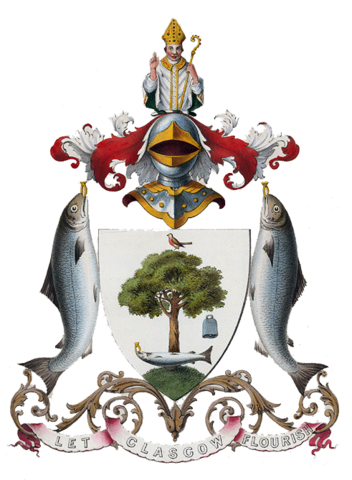
St Kentigern on Glasgow Coat of Arms, Wikipedia Commons

In Jocelyn’s The Life of St Kentigern there is a story about the saint’s recall from Wales to the Old North by Glasgow’s ruler, Rhydderch Hael. Following an angelic vision, Kentigern sets out with 665 disciples and arrives in Hoddom where he is greeted by a multitude of people.

Drawing a cross and invoking the Holy Trinity, Kentigern orders anyone against the word of God to depart. This results in ‘a vast multitude of skeleton-like creatures, horrible in form and aspect’ departing from the assemblage and fleeing from sight.

Reassuring the terrified crowd Kentigern ‘lays bare’ what they believe in. He condemns their idols to the fire and tells them their principal deity ‘Woden’ from whom they claim descent is nothing more than a mortal man of a pagan sect whose body is ‘loose in the dust’ whilst his soul ‘endures the eternal fire’ in the underworld.

As Kentigern preaches faith in Jesus Christ the flat plain of ‘Hodelm’ rises into a hill which remains to this day. The people ‘renounce Satan’ and are washed in the waters of baptism.

This foundation legend explains the association of the site of the church and the graveyard beside the river Annan across from Woodcock Air (the hill) at Hoddom with St Kentigern.

Woodcock Air Hill

The Life of St Kentigern was commissioned by Jocelyn, Bishop of Glasgow, and written by Jocelyn, a monk of Furness, in the 12th century. As a literary hagiography it was clearly designed to promote the life of Kentigern (who lived in the 6th century) and vilify paganism. As a historical document it should be approached with caution, particularly in light of the anachronism concerning Woden.

Whilst there is archaeological evidence of a Northumbrian monastery based around St Kentigern’s church at Hoddom it was not founded until the 8th century. (This is evidenced by an 8th century letter sent by Alcuin to Wolfhard, Abbott of Hodda Helm). The Anglo-Saxons did not arrive until long after Kentigern died. It seems Jocelyn wove later tales concerning the conversion of Woden’s worshippers into the text.

This leaves us with the question of who the people of Hoddom venerated prior to Kentigern’s arrival. The existence of a local cult is evidenced by a Roman altar stone found in the wall of the church at Hoddom Cross and built into the porch in 1817. Unfortunately when it was found the sides could not be seen and the ‘mouldings of the capital and base’ had been ‘dressed off’. There are no clues who it was dedicated to.

However the surrounding area echoes with pagan memories: the place-names Brydekirk and Lochmaben; an altar to Vitris and a ram’s head at Netherby; the story of Gwenddolau, the last pagan Brythonic king, whose soul was gathered by Gwyn ap Nudd after he was killed at the Battle of Arfderydd. Myrddin Wyllt’s flight from Arfderydd in battle-madness to Celyddon.

Intrigued and troubled by the story of Kentigern’s conversion of the people of Hoddom, wondering whether between the lines and beneath the Hollywood-style Biblical pyrotechnics any ‘truths’ (or at least personal gnoses) about their pagan religion may be intuited from the land, I returned to the area North of the Wall.

Walking from Ecclefechan to Hoddom, the first thing that struck me was the teeming of nature in the Scottish villages and fields. Flocks of spotted starlings on the roofs and telephone wires. Droves of sparrows flitting in and out of the hedgerows. The un-mowed roadsides were alive with flowers and every flower was covered with bees. Slick black slugs wandered through long grasses. I felt an unusual liberty in ‘the right to roam’.

Hoddom CrossMy first stop was at the church at Hoddom Cross. Roofless and derelict due to a fire, ivy climbed its walls and mausoleums. Ferns and wildflowers pushed through the railings to adorn older graves marked by sandstone gravestones. Newer graves with shiny porcelain headstones adorned with freshly wrapped bouquets glimmered in the background.

Something birch-white caught my eye. Going to investigate I found myself blinking in disbelief. In a Christian graveyard a couple of miles from any village I was staring at what to all appearances was a carving of a white dog with a purposively painted red nose. Dormach red-nose! I thought immediately of Gwyn ap Nudd’s famous hound who accompanies him as he guides the dead to the otherworld.

Admittedly it had antler-like twigs for ears and might have been a representation of Rudolph the red-nosed reindeer. But why carve it white from birch? It looked far more like a dog and a hound of Annwn at that. Too strange a find in a graveyard to be pure coincidence when I was tracing the deity(s) associated with the Roman altar (which I did not see).

River AnnanAfter visiting the ‘new’ church I walked to St Kentigern’s graveyard at Hoddom across the Annan from Woodcock Air. Watched over by a tall fir (or pine?) tree it was blissfully overgrown with ferns, yarrow, willowherb, bee-humming knapweed, decorated by harebells.

St Kentigern's Graveyard

Wandering amongst the gravestones I noticed carved images of skulls and crossbones and remarkable winged souls which a notice recorded as ’18th century folk art’. So here are Kentigern’s skeletons, I thought, unbanished. Symbols of death and our transition to the otherworld living on through years of Christian rule.

From the vantage point on Woodcock Air as I looked down on St Kentigern’s graveyard the sandstone gravestones shifted into brown-clad people. I gained a sense of the slowness of lives decanted by prayer, steady seasonal work in the fields, the slow turning of cart wheels, the satisfaction of self-subsistency and knowing you would die and be buried in your land close to your community.

St Kentigern's Graveyard from Woodcock AirAnd beneath the Northumbrian monastery did I gain a sense of St Kentigern’s church? The scene of conversion? The deity(s) to whom the ‘idols’ were dedicated? The ‘truth’ felt buried deep. Momentarily seeing the raised area where the church stood as a burial mound I thought back to Jocelyn’s words about ‘Woden’ being a mortal man of a pagan sect whose body is in the dust whilst his soul ‘endures the eternal fire’ in the underworld.

Could these words be read obliquitously to refer to a deified ancestor or ancestral deity believed to live on in the brightness of the world beyond this world? Perhaps even to Gwyn who as a psychopomp and leader of ‘the Wild Hunt’ is Woden’s closest Brythonic equivalent?

BrydekirkI also had the opportunity to visit Brydekirk. Intriguingly Ronald Cunliffe Shawe claims Gwenddolau worshipped ‘Woden’ and ‘a fire goddess’. His reference leads to the passage about Woden in The Life of St Kentigern. I can’t find anything mentioning a fire goddess. However Gwenddolau’s worship of such a deity would make perfect sense if Brydekirk is named after Bride or Brigid. Brigid was later venerated as St Brigid and her priestesses tended an eternal flame.

At the church I was told by one of the parishioners it was indeed named after St Brigid of Ireland. I also learnt St Bryde’s Well was a natural spring and was gifted with an indispensable description of its location.

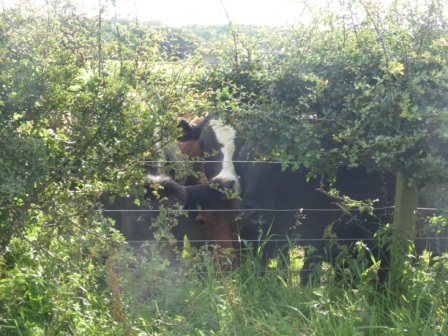
My walk to the well down the Annan then alongside fields was accompanied by a curious herd of cows who followed peeping out through gaps in the hedge. Their strange behaviour led me to recall the story of how St Brigid was raised by a white cow with red ears: another otherworldly animal.

CowsThe area surrounding St Bryde’s Well was hopelessly overgrown with brambles, nettles and Himalayan Balsam. With the guidance of the parishioners I still couldn’t find it. Ready to give up I saw what looked like a pink veil. I first assumed it was a votive offering marking the spring. When I got closer I realised it was a balloon strung with pale gauze. Another extraordinary marker that proved to be no mere coincidence.

Turning round, I noticed a water dispenser and beyond heard running water. Seeing a rivulet at the bottom of a steep bank running into the Annan, I followed its course to find a small stream leading to the natural spring pouring from amongst mosses and ferns into an orangey circular basin: St Bryde’s Well.

Across the river I also visited the remains of St Bryde’s tower. All I found was a single flight of steps climbing upward into the fire of the sun. Could this has have been a stairway walked by Brigid’s priestesses who maintained her eternal flame?

St Bryde's TowerI returned to Penwortham with no clear answers about how or whether St Kentigern converted the people of Hoddom or what they experienced and believed. Such ‘truths’ can only be conjectural and are always determined by our questions, assumptions and  beliefs.

What I gained was a deeper understanding of how our physical and literary landscapes interweave. How sign and signified lead the dance of a journey which is led by the gods who lead us to places where all distinctions break down in the numinosity of their presence.

At Hoddom and Brydekirk I met a myriad inhabitants of a northern land and I met Gwyn and Bride (who I know here in Lancashire as Brigantia) in new ways. I learnt that within the land and its stories and even in the most depredatory of Christian texts the fire of the gods endures.

The lump of my ‘workshyness’ and wanting to change the world

“I want to change the world.”

I state my desire to my deity in meditation at 7am aware as I do so of the rest of the world getting up, feeding the cats, walking the dog, jamming down breakfast, starting the car and joining the endless chug of exhaust fumes to offices and retail centres.

I’m not going to work today. My statement is laden with guilt. As I’m not working and have the luxury of sitting in meditation I feel driven to make my focus changing the world which forces so many other people into mind-numbing meaningless jobs:

sitting in call centres 9-5 Monday to Friday wired up to head phones trying to sell double glazing and insurance;

cleaning the crumbs and greasy handprints off the computers and desks and emptying the bins spilling sandwich and crisp wrappers of the people selling double glazing and insurance;

taking complaint after complaint about benefit fraud and dealing with the pettiness of complaints regarding people claiming to have had a heart attack or to be suffering from depression daring to go outside in the garden or take a walk.

I’m speaking from experience. I’ve done all these jobs: call centre, cleaner, benefit fraud hotline. I’ve also been a chamber maid, shelf-stacker, packer and administrative assistant. I’ve done what is necessary to support my study and later my writing and performing but never managed to stick such jobs because they conflict with what I really want to do.

It’s a vicious cycle and not one I can escape by earning money from my vocation. It’s extremely rare I get paid for my writing and performances or facilitating workshops. Occasionally I sell a book. My yearly income would barely keep me for a month.

If I lived in Nazi Germany I would no doubt be classified as ‘arbeitsscheu’ ‘workshy’ and incarcerated in a concentration camp. Horribly across the UK a similar phenomenon is recurring as people on disability benefits due to physical or mental illness are being reclassified as fit for work. In many instances this has led to suicide.

I’m lucky as I’m not forced to work full-time because my parents put me up. I’m not too ill to work at the moment but I have suffered from anxiety and depression (and still do on and off) and know soul-destroying jobs unfailingly grind me down to tears and hopelessness.

My desire to write goes first. Then my ability to commune with nature and hear the voices of the gods. Meaning and purpose swiftly departs and with that any reason to be alive. If I didn’t have the back-stop of my parents’ home and their support I don’t know what position I’d be in or if I’d be here at all.

Which is why I want to change the world. I want to live in a world where the life of every individual is intrinsically valued. Not this world where a person’s value is determined by their capacity to work in a meaningless job supporting an economy which benefits only the rich and is destroying the earth and human society. A world epitomised by the small-minded vindictiveness of someone who despises their job grassing up the person unable to work because of their depression for taking a walk.

Realistically I don’t possess many qualities suited to changing the world. I’m impractical, illogical and socially inept. I beat myself up continuously because I’m not cut out to be an activist or legislator. Attempting to take a stand on environmental issues at local council meetings I stumble on facts and figures and get the names of councillors wrong to smothered laughs. Unlike some people who buzz off social situations I find them draining and buckle quickly under pressure. I feel like a spare part at protests.(Although I still attend local meetings and protests and will continue to).

What I am good at is poetry and myth. Not the first places you’d look at a time when the greatest need is for manufacturers of pikes, rioters to wield them and thinkers who can traverse the lies and double-speak of parliament with the grace and dexterity of an otter.

Is there anything more useless to this world than a poet? I can think of nothing more useless and could not find a way out of my feelings of uselessness this morning when I dumped the statement of my desire to change the world like a lump of plasticine unformed and unceremoniously at the altar of my god.

Within this monstrous cacophany of thoughts you’re probably wondering whether he got a word in edgeways.

Gwyn ap Nudd’s a King of Annwn: a master of visions and glamoury renowned for his interruptions of hunting horns and a hundred hounds howling on otherworldly winds with a chill to stop one’s heart, his shining beauty and cauldron full of stars.

Today he’s silent. All I see is a depth of indigo and at its edges the melee of my thoughts rattling their pikes. Then further into the deep other pike rattlers throughout the ages who have stated the same desire albeit probably not to Annwn’s King.

Gwyn’s half-smile creases the indigo like a wave. Rattling through the ages comes the answer: there’s no easy solution.

I’m angry. That was not the answer I wanted to hear. I want to throw the ugly unformed plasticine lump of “I want to change the world” out of the window or into the deep.

Sensing my wish curious voices rise. Restless spirits reach forward to examine the plasticine with what may be hands or serpentine tails or wings. I get the impression they want to take it and mould it in their world.

Now it comes down to it I’m not sure I want to give my lump to them. I clutch it close to me. It’s my lump. My problem. My burden. What’s more I want to be seen carrying it and I want to be in control.

They prise it from my fingers. Hold it up to the starlight shining from the seas of Annwn. I see it for what it is. A desire in itself authentic but baked clumsily in the crucible of work and workshyness to the chant of uselessness and guilt. They dive with it back into the deep still indigo.

My guilt and uselessness dissolve and I realise they stem from taking on the values of a system set on devaluing all religion that it cannot harness for political control and all art that does not beg to the custodians of the establishment or market itself as mass entertainment. A system founded on the destruction of mytho-poetic worldviews.

I catch a glimmer of the Awen in what the system needs to keep destroyed. No easy solution but I see what I need to do.

I speak farewell to the lump of my ‘workshyness’ and wanting to change the world.

I assert the value of myth and poetry and the value of a poet ‘useless’ and ‘workshy’.

I pour a libation for Gwyn, the spirits of the deep, the pike-wielding ancestors and walk in trust with a pike in my hand to change the world.

***

*This piece was written yesterday and was provoked by two excellent articles on contemporary political issues: one by Brian Taylor ‘Austerity Watch, Cut to Death‘ and one by Mark Rosher ‘Living with Madness‘ and an awful article condemning ‘otherworldy polytheism’ by John Halstead ‘If It Doesn’t Help Me Save This World, I Don’t Want Your Polytheist Revolution‘.