The Magician of the Orme V -The Vessel and the Lake

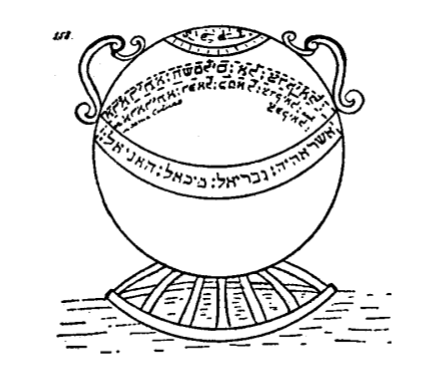
In The Lesser Key of Solomon my attention was arrested by the foundation story in which Solomon imprisoned the 72 spirits in a a brazen vessel with a magical seal and threw it into the Lake of Babylon. Unfortunately, the people of Babylon, hungry to see its wonders and suspecting ‘to find great store of treasure within’, found it, broke it open, and let the demons out to return to their original places. The order of the demons in the text relates to the order in which they were imprisoned. The ‘Vessel of Brass’ and its seal are depicted in the text with instructions for making the seal.

Vessel of Brass

Immediately I thought of the similarities with the Cauldron of the King of Annwn. This magical vessel is described in ‘The Spoils of Annwn’ as also being intricately decorated having a ‘dark trim and pearls’. It is likely to have been made of brass as the people of Annwn/fairies dislike iron. In the Second Branch of The Mabinogion it is brought from a lake in Ireland by two monstrous giants. It is later used by Matholhwch, King of Ireland, to bring dead warriors back to life. Speechless, near-demonic, their battle with the British brings devastation to Ireland – only five women remain  in caves in the wild. It is likewise deleterious for the British – only seven warriors survive.

Gwyn ap Nudd, a King of Annwn, and keeper of the cauldron is described in Culhwch and Olwen as containing the fury of the ‘devils’ of Annwn in order to prevent their destruction of the world. Could it be possible that he was seen as containing them not only in his realm but in the cauldron which, when not being used to boil the meat of the brave* at his fairy feast, was kept carefully sealed?

Could it be possible that, like Solomon, the Magician of the Orme had somehow learned the names of the spirits of Annwn who are contained in the cauldron and how to summon and to command them? That he had attempted to create his own cauldron in imitation of the King of Annwn’s to seal them in? And this is the information contained in ‘The Book the Living Hand’? That, as always, when magicians have the hubris to think they can control spirits who can only truly be contained by the gods, something had gone wrong, and this led to him cutting off his hand to seal it shut?

Whether the Magician of the Orme and his book existed or not I think I have the seeds of a story that remains to be told…

*In ‘The Spoils of Annwn’ we are told the cauldron ‘does not boil a coward’s food, it has not been destined to do so’. The food within may be the flesh of Twrch Trwyth ‘Chief of Boars’ a human shapeshifter hunted by Gwyn. Eating his flesh may represent consuming ancestral wisdom.

The Magician of the Orme II – The Great Orme

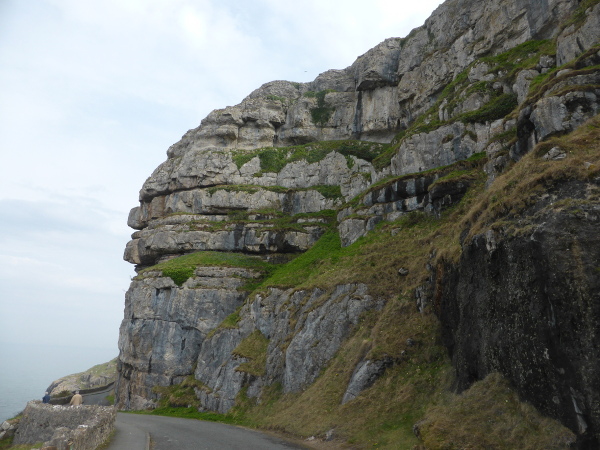
Before starting my historical research I visited the Great Orme. I discovered that Orme is a Norse word meaning ‘sea serpent’ suggesting it was seen as a serpent living in the stone and guarding the coast. The Welsh name is, more prosaically, Y Gogarth which means ‘terraced rock’ and is equally fitting.

P1310756

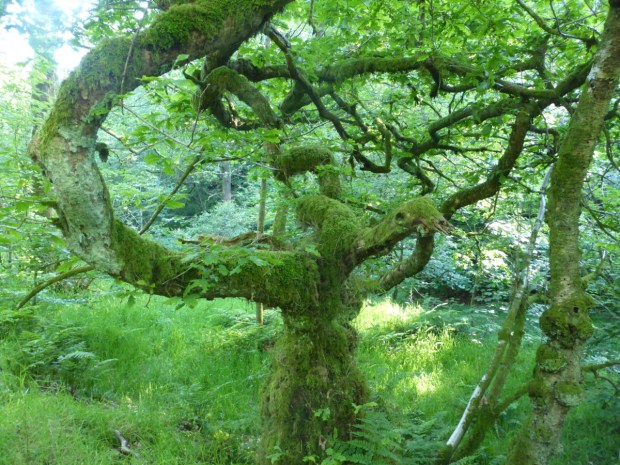
As I walked around the Orme, seeing the many heads of the serpent in the rock, admiring the rock flowers, searching for the springs (I only found Fynnon Gogarth and Fynnon Gaseg) I could imagine how a magician might have traversed the land, knowing all its features and the serpent intimately.

On the beach near Llandudno I found a shell that reminded me of the eye on the back of the magician’s hand.

I found out from a leaflet at the visitor centre the area has been inhabited since the Paleolithic period with flint tools and an intricately carved horse’s skull being found in the limestone caves. There is a Neolithic Cromlech, Bronze Age Mines, the remains of an Iron Age hill fort, and St Tudno lived in a cave (Tudno’s Cave) and built a church during the 6th century. Ridges and furrows provide evidence of a medieval farming community. Mining was resumed in the 17th century. The miners were housed at Cwlach and Maes y Fachell. I didn’t find any evidence of people living on the Orme during the period the magician might have lived or any lore suggesting the existence of a magician.

P1310681

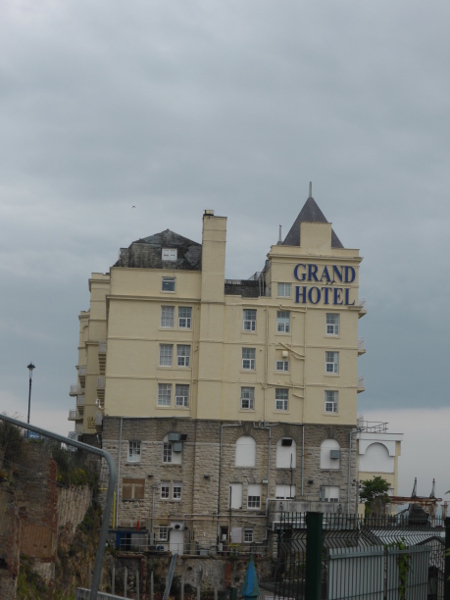
Yet on May Eve I had a dream that the magician was sleeping where I stayed in the Grand Hotel (I got a cheap room on the top floor – no doubt cheap because the lights in the bathroom flashed on and off like a disco and there were noisy seagulls nesting on the roof above!) and I had somehow missed him and was chasing him up down the stairs and lifts and looking behind the trolleys of the house keepers. On waking I had a vision of the magician invoking spirits in a huge cave underground.

P1310842

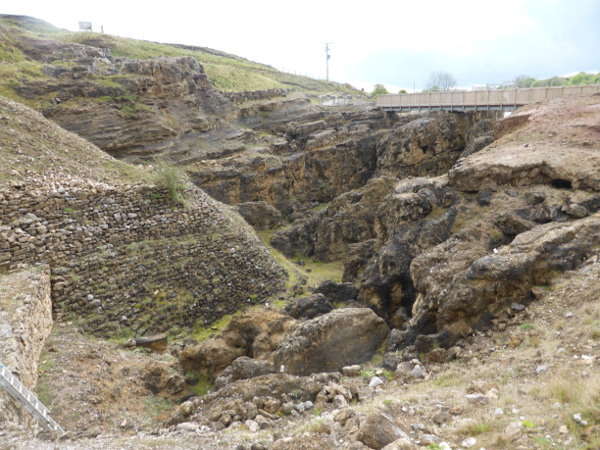
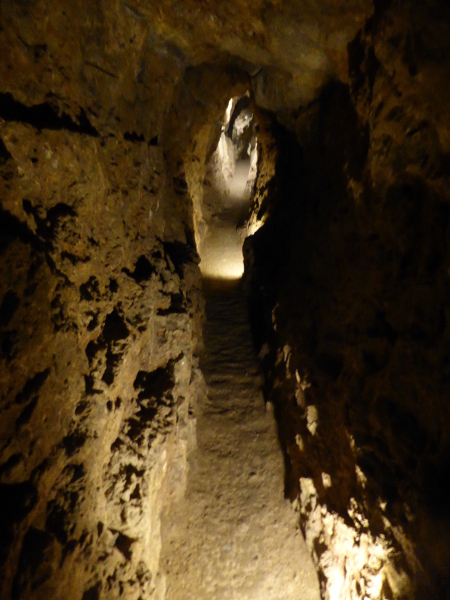
This was significant because that day (May Day) I visited the Bronze Age mines. I hadn’t been before and did not know that, with over 5 miles over of tunnels, they are the largest mines in Europe or that they contain the largest man-made cave. The tunnels leading into the cave are open to the public.

P1310832

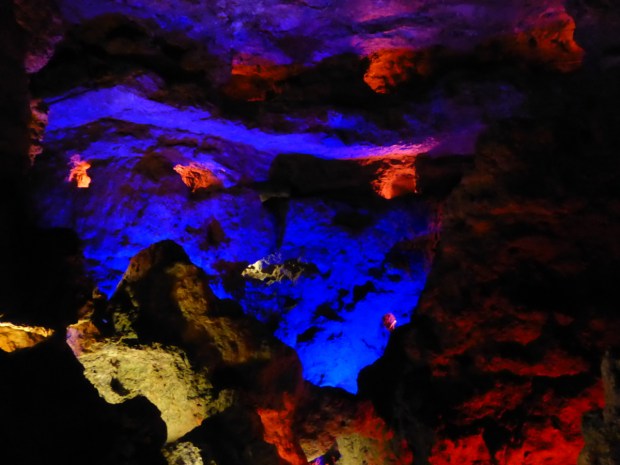
When I entered I struck with awe not only by this finding but the numinosity of the great cavern, with its music of dripping calcite, illuminated by lighting that changed colour to accentuate the features of the rock. I could sense the press of the presence of the spirits, see their shifting forms, their faces.

P1310836

I had the sense that, although it was made for mining bronze, it was seen as sacred – perhaps as the belly of the great sea serpent. It also seemed possible that Nodens/Nudd ‘Lord of the Mines’, his son Gwyn, and the spirits of Annwn along with the dead were revered and their fury was placated there.

That rituals took place to appease the underworld gods and spirits in the mines was evidenced by the burial of a cat surrounded by blackberry seeds 60 metres down. Uncannily, after I left the mines, crossing a field in search of the cromlech, a black cat approached and rubbed around my legs.

I found no direct evidence of the existence of a magician, but it certainly seemed possible he might have existed, found his way into the cavern and used it to invoke the spirits of Annwn.


The Magician of the Orme I – The Book of the Living Hand

The Book of the Living Hand
now lies closed.

Who closed it?

The Hand itself
or the hand of another?

Who will dare
try to bring the Living Hand to life,
to ask it to open the pages,
to fold them back,

to reveal the names
of the terrible beings who will answer,
to risk releasing their fury
into the world again?

What will lie within?
Will the names be the same
or will the pages have been rewritten
in the Living Hand’s sleep?

Do you see its colour returning?

The dim pulse of a vein?

The opening of the eyelid
on the back of the hand?

The twitch of a finger?

The Book of the Living Hand

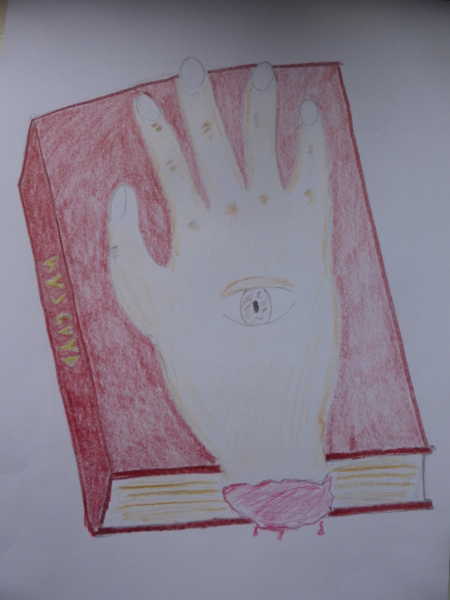
This poem and sketch are based on a vision I had several months ago of a book whose cover had been closed by a human hand with an eye on the back. The hand had become part of the book. This roused a series of questions. Who did it belong to? Who are the furious spirits within its pages? How did its owner lose their hand and how did it become part of the book? What is the significance of the eye?

In a series of gnoses it was revealed that it belonged to ‘the Magician of the Orme’ (the Great Orme in North Wales). Within are the names of the spirits of Annwn whose fury Gwyn ap Nudd holds back to prevent their destruction of the world. The magician cut off his hand in a desperate act of magic to seal the book shut before being arrested on the grounds of practicing witchcraft involving the aid of ‘devils’ and was hung in Ruthin in 1679. The meaning of the eye, as yet, remains concealed.

This inspired me to set out doing some research into whether such a magician and his book could have existed. It’s led me on an interesting adventure to the Orme and through the history of spirit aid magic in seventeenth century Wales and beyond. In the following posts I will be sharing my findings.

Seeing Face to Face

broken-549087_960_720_Pixabay Free Image

In Corinthians Paul famously contrasts seeing ‘through a glass, darkly’ with seeing ‘face to face’. In Revelations we find a series of glassy images leading up to the servants of God seeing his face. We are told, before the throne of God, is ‘a sea of glass like unto crystal’. This is later described as ‘a sea of glass mingled with fire’ with those who have gained ‘victory over the beast’ standing upon it with ‘the harps of God’. The harpers play the song of Moses who ‘the Lord knew face to face’.

The city of New Jersualem is described as ‘pure gold like unto clear glass’, its street ‘pure gold, as it were transparent glass’ and the river of life, running through it, proceeding from the Throne of God ‘clear as crystal’. We are told the Throne of God is in the city and here, where his servants serve him, ‘they shall see his face’.

These images of glass, no longer dark but crystal clear, are bound up with the process of revelation. Of the revealing of the face of God, which is never described, of which his servants are forbidden to make graven images.

This imagery interests me, as a Brythonic polytheist and devotee of Gwyn ap Nudd, because in a number of texts his castle is described as being made of glass or crystal and surrounded by water. In The Life of St Collen, Gwyn is depicted seated on a golden throne in ‘the fairest castle’ Collen ‘had ever beheld’ on Glastonbury Tor. Gerald of Wales notes Glastonbury ‘used to be called Ynys Gutrin… the Island of Glass, no doubt from the glassy colour of the river which flows around it in the marshland.’

In ‘The Spoils of Annwn’ Arthur sails across the sea in his ship, Prydwen, to raid seven otherworldly forts on otherworldy islands. It is my belief they are appearances of the same fort – the abode of Pen Annwn ‘the Head of the Otherworld’ (an older name for the King of Annwn/Faery – Gwyn).

One of the fortresses is named Caer Wydyr ‘the Glass Fort’. The narrator, Taliesin, mocks ‘pathetic men’ (monks) ‘who hadn’t seen Arthur’s feat beyond the Glass Fort’. He tells us ‘six thousand men were standing on its wall; it was hard to communicate with their watchman’. In Nennius’ History of the Britons thirty ships of Spaniards sailing to Ireland find in the midst of the sea ‘a tower of glass, the summit of which was covered with men, to whom they often spoke, but received no answer.’

The Fairy King’s castle is described as being made of crystal in Sir Orfeo:

‘Amid the land a castle tall
And rich and proud and wondrous high
Uprose, and all the outmost wall
Shone as crystal to the eye.
A hundred towers lit up the sky,
Of diamond all battled stout;
And buttresses rose up near by
Arched with red gold and broad about.’

In the Biblical and Brythonic traditions the paradisal abodes where the gods are enthroned, the centres of the mysteries where their faces are revealed, are associated with glassy waters and crystal walls.

One wonders whether there are any stories of people meeting the gods of Annwn face to face. In Sir Orfeo we are told he could not look upon the Fairy King or Queen ‘their crowns, their garments, glistened bright… so hot they shone’. This ‘noble sight’ brings him to his knees before the throne. Afterwards he takes up his ‘merry harp’ and sings the lay that wins his wife, Heurodis, back from Fairyland.

This reverent response is echoed in the First Branch of The Mabinogion when Rhiannon, a Queen of Annwn, unveils herself to Pwyll. This does not take place within a crystal castle, but near the fairy mound Gorsedd Arberth. We are told she ‘drew back the part of her headdress that should cover her face, and fixed her gaze upon him’. ‘And then he thought that the face of every maiden and every woman he had ever seen was unattractive compared with her face.’ He immediately falls in love with her and agrees to marry her, choosing her above all other women.

When I first met Gwyn, he did not reveal his face to me in his glass fortress, but beneath the shadows of a leaning yew tree on Fairy Lane in Penwortham. My response was similar. I recognised him as my patron deity, a god who I chose above all gods, who I could not help but love and serve.

In Ethics and Infinity the French philosopher Emmanuel Levinas notes that the face to face to encounter draws us into service to the Other. Also ‘the face… signifies: “Do not kill me.”’

In the Welsh myths we find this ordainment repeatedly broken by Arthur and his warriors who commit a panoply of acts of defacing. The heads of the witches of Caer Loyw and Pennant Gofid are split in twain. The beard of Dillus Farfog is plucked out whilst he is still alive before his head is cut off. The giants Diwrnach and Wrnach are beheaded. Most horrifically, before Ysbaddaden Bencawr is beheaded, his face is mutilated – Caw of Prydyn shaves off his beard, ‘flesh and skin to the bone, and both ears completely’.

Because Arthur cannot bear the thought of the head of Brân being beneath White Hill as a threat to his sovereignty over Britain he orders it to be dug up and removed. Interestingly Brân’s head lives after his death for eighty-seven years and only when it starts to decay, when he loses his face, is it buried. It seems that Arthur cannot abide even the distant memory of Brân’s face evoked by his head.

The surrounding stories suggest that either Arthur himself or (Llen)lleog beheaded Pen Annwn with Caledfwlch during his raid on Annwn and this was how he gained his cauldron, the leadership of his hunt, and usurped his role as the warrior-protector of Britain. One might see the beheading of the Head of the Otherworld, ‘Arthur’s feat beyond the glass fort’, as the ultimate crime against the Other and the face of the numinous.

This killing blow, with the thrusting of Lleog’s flashing sword into the cauldron, may be seen to bring about the shattering of the glass fortress, the fragmenting of the mythos of Pen Annwn. We are left only with pieces of the narrative like shards of broken glass, the images within like creatures trapped in amber; seeing through glass darkly as the Dark Age is ushered in.

Yet beyond the glass walls Pen Annwn picks up his head and makes himself whole again.

I see his face and he is laughing.

In Moments of Terror

For beauty is nothing but the beginning of terror
which we are barely able to endure, and it amazes us so,
because it serenely disdains to destroy us
– Rilke

I grew up with negative connotations of prayer and still do not fully understand what it is, only that I prayed reflexively at frightening times in my life and someone answered. It was a long while until I found out who that was, began exploring prayer as a regular practice, and came to realise prayer is a fundamental means of reaching out to the gods essential to our being.

Brought up in a nominally Christian family I was never forced to pray, but vaguely recall sleeping at a friend’s house and both us having to say ‘The Lord’s Prayer’ before we went to bed. We jabbered through it as quickly as we could, not thinking about its meaning. She thought God was called Harold, mistaking ‘hallowed’ for ‘Harold’ in ‘hallowed be thy name’.

I went to Sunday School and attended church parade at St Leonard’s C of E Church with Brownies. Some part of my soul rebelled against the rigid services, punitive black-and-white theology, and the patriarchal presence of the Christian God. Eventually I refused outright to go.

Refusing to worship Jahweh I considered myself an atheist for a number of years even though I was looking for something… somebody… I was drawn to the deities of our world myths, but the mainstream worldview taught they belonged to a naive past, even though I could sense their presences dancing in the back of my mind like sunspots long after I’d put down a book.

Without knowing of the existence of modern Paganism or Polytheism I had no context for the sense of the divine I felt in the landscape, for otherworldly experiences some beautiful, some troubling. In moments of terror I prayed although I did not know who I was praying to.

The root of ‘prayer’ is the Latin precarius, ‘obtained by treaty’, which gives us ‘precarious’, suggesting such treaties are made in ‘risky, dangerous, uncertain’ situations. Non-religious people often pray when their lives or those of their loved ones are threatened; like it’s a base instinct, a mechanism deep-wired within our souls to reach out to the divine when faced with peril.

At times when I had panic attacks or thought I was going mad I prayed. Driving on the motorway in the midst of panic, thinking I was going to lose consciousness or control, I felt strangely held. Despite fears I would never get back I always did. When I was convinced I was mad, that I couldn’t tell what was real and what was not anymore, into my mind came the words, “So you’re mad, what difference does it make?” (I’d thought this was a quote remembered from Nietzsche, who walked with mad gods, but have never been able to find it). Nothing, I realised, nothing at all, and since then madness has held no fear for me.

It wasn’t until I was thirty I met the god who was behind my visions of the Otherworld; who’d led me a chase through poetry, philosophy, drink, dancing, to the brink of the abyss and back: Gwyn ap Nudd, the Hunter, Rider of Insomniac Nights, Gatherer of Souls, Light of the Mist.

This happened at a nadir of despair. After failing to become a philosophy lecturer and succeed in a career with horses, I had realised the fantasy novel I spent two years writing was unpublishable. I couldn’t think of anything else I wanted to do with my life or any reason to go on. Yet something within me put out an entreaty, ‘a cry from the heart’. Summoned by tolling bells I went to weep beneath a leaning yew tree at an old fairy site and sang a sad song.

Leaning Yew

When Gwyn appeared to me I was struck by a sense of awe bordering on panic by his terrible beauty:

His spectral shine shimmers white as moonlight
His hair floats fair about his phantom limbs
His warrior attire is black as night.
The eyes of the hunter of souls are grim
As the howl of his hounds on Annwn’s winds.

This was followed immediately by recognition. It was he who swept me away on the winds of terror like the riders on his hunt – I often felt like I was flying ‘between sky and air’ – yet also held me and taught me I was safe. He was the storm and the calm at its centre. He, the god of the dead, the mad, and poets, was the source of the words that cured my fear of madness. He was the somebody I’d always been looking for. Always. Since the beginning of time.

Some soul-deep entreaty/prayer had been answered. A treaty between us soon followed. I dedicated myself to Gwyn as my patron, vowing to honour him daily, stand by my truth, and walk between Thisworld and Annwn (the Brythonic Otherworld which he rules) with reverence. I became his awenydd ‘person inspired’ and have been praying to him every day since.

My initial cries of “Please, please, please help me!” opened a gateway of communication between my god and I, unlocked my heart to the divine, to sacred relationship. In Judaism prayer is defined as ‘a service of the heart’ (from Deuteronomy ‘You will serve God with your whole heart’), describing beautifully the depth of service my knee-jerk prayers have led to.

Not only do I pray to Gwyn for inspiration and guidance, but I see my role of journeying with him between the worlds to recover the lost stories of my landscape from the mists of time and reveal the roots of his forgotten myths as a heartfelt and prayerful process essential to my being.

Sadly, in secular society, even when prayers are answered too few of us question by whom or fulfil our side of the treaty. Our potential for relationship with the divine – to reach outside our everyday lives and enter the service of somebody or something greater – remains unfulfilled.

Obscured by oppressive state religions and secular norms our ability to pray remains dormant until precarious times when somebody opens a door. Could it be that we are fundamentally prayerful creatures? That prayer is the heart-root of all purpose, meaning, our relationships with the gods?

*This article was published in ‘People of Prayer‘, Isis-Seshat, Issue 41, Vol. 13, Spring 2018
**I will be speaking on ‘Becoming a Devotee of Gwyn ap Nudd’ at the Pagan Federation North West Conference at Preston Grasshoppers on Saturday.

For Tonight

I am a shape who shifts
like the costumes of mosses
like the rabbit eyes of trees

Tockholes I

leaping out of my skin
plunging into the dark arms
of underwater trees

Tockholes III

for once knowing beauty and fluidity
as I run down stairs without
missing a single step.

Tockholes IV

I am the waterfall and its deep pool,
the sun reflected and the fear
of loss surrounding him
like the magic of Faerie,
the golden ball,

Tockholes V

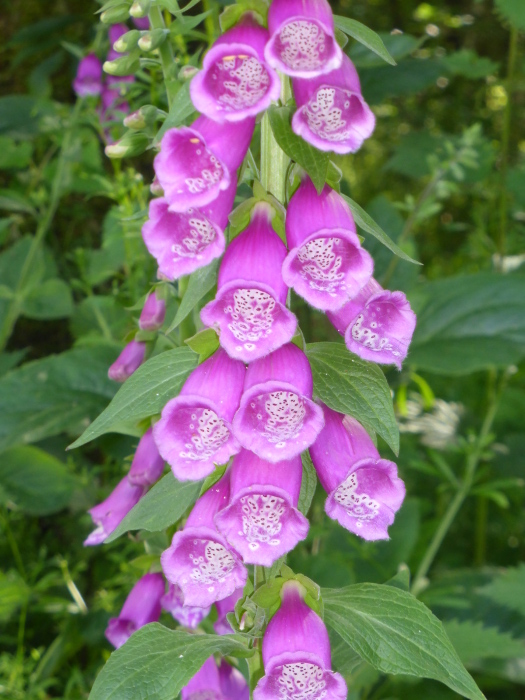
the secrets found by bees
crawling into the purple caverns
of foxgloves emerging centuries later
coated in dusty wisdom.

Tockholes VII (copy)

Can it be possible
that I am wide awake
like your rival as you dream
these enchantments

and here, now, even
at midsummer

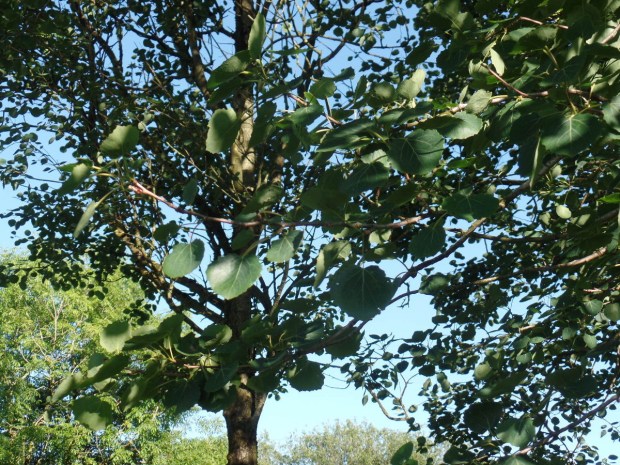
the aspen trembles
at your name?

SAMSUNG CAMERA PICTURES

*This poem is based on a walk in Tockholes Wood on Midsummer Eve and is addressed to Gwyn, who remains a presence in my life even in his absence from the landscape.

Blodeuwedd and the Owl Kind

I.
I’m wandering through a bleak windswept landscape in Annwn and screaming down from the skies come two haggard-looking owl-women who almost look like harpies with shabby feathers, bare breasts, and long claws. At first I’m afraid of them, but less so as I examine their faces, old, wise, grey.

They tell me they are ‘the Owl Kind’ – those who have gone into owls. They watch over families and communities until they stop watching for them. They watch over lands until they become unrecognisable. They watch over the dead and those who go between worlds – their owl eyes are always on them.

They can often be found in graveyards. They show me how they watch over the spirit of a child who is afraid to leave her grave where she thinks she is safe and wants to sleep forever because she died believing there is no life after death and the owlets who sit in a row on the fence who sing her songs.

They tell me the owl kind are becoming less and less as they are leaving the places families and communities have left, where they are forgotten, and fewer know how to or want to go into owls anymore.

They tell me owls watch over my land and to listen for them.

II.
Only once have I met Blodeuwedd, the woman conjured from flowers by Math and Gwydion, then transformed into an owl as a punishment for her part in the plot to murder her husband, Lleu. It was during a journey when I was tricked into Caer Gwydion and she helped me escape, picking me up in her claws and taking me to the Forest at the Back of the World where the Owl Kind dwell. At this point I knew they were connected, that Blodeuwedd was one of the Owl Kind, perhaps the most significant.

This has led me to suspect that when Gwydion and Math conjured Blodeuedd from the blossoms of oak, meadowsweet and broom, when they imbued the blossoms with spirit, that the spirit they unwittingly summoned to animate them was hers – flowers on the surface, owlish huntress and killer beneath. (Thus it’s no wonder she was attracted to the Hunter when he rode into her kingdom).

Perhaps in an older variant of the tale Gwydion did not turn Blodeuwedd into an owl as a punishment but recognised her true nature, that he, the trickster, had been tricked. She couldn’t be confined by his spell.

III.
In modern Britain owls are, rightly, revered as symbolic of wisdom. Yet, appearing wide-eyed and innocent and slightly goofy-looking on bags, pencil cases, cushions, earrings etc. the darker side of their nature (which was emphasised for many centuries in British folklore) has been forgotten.

In a chapter titled ‘Night’s Black Agents’ in The Folklore of Birds Edward A. Armstrong notes that ‘Over Europe and Asia, indeed, most of the world, the owl is, and has long been, a bird of witchcraft, death and doom’. He notes examples of sightings of owls – ‘the trees were covered with owls’ ‘there were a scret (screech) owl on his roof, scretting something horrible’ as precedents of death.

Spenser refers to the owl as ‘death’s dreadful messenger’. Webster writes ‘The Scritch Owle and the whistler shrill / Call upon our dame aloud / And bid her quickly don her shroud.’ Armstrong notes connections between ‘ratchet owls’ and the corpse-eating Gabriel Ratchets and Hounds of Annwn.

In ‘The Owl’ Dafydd ap Gwilym speaks of the ‘Crazy Owl’ of Gwyn ap Nudd who ‘incites the hounds of night’ and no doubt flies at the head of his hunt heralding the chase of the souls of the dead.

IV.
In The Witch Ronald Hutton suggests our associations between owls and witchcraft derive from the Classical figure of the strix. These large-eyed, hungry-beaked, grey-white feathered birds of ill-omen dwelled on the outskirts of Tartarus, feasted on flesh and blood and snatched away the bodies of the dead. The term striges was also applied to ‘women who practice witchcraft’ and ‘flying women’.

The striges seem closely linked to harpies ‘snatchers’. They are described both as ‘lovely’ and ‘repulsive’. By Virgil as ‘Bird-bodied, girl-faced things… abominable their droppings, their hands are talons, their faces haggard with hunger insatiable’. Their names are evocative – Aello ‘storm swift’, Ocypete ‘swift wing’, Celaeno ‘the dark’, Podarge ‘fleet-foot’. Seen as the embodiments of the destructive winds they served as ‘the Hounds of Zeus’ snatching away evil-doers to the Erinyes.

VI.
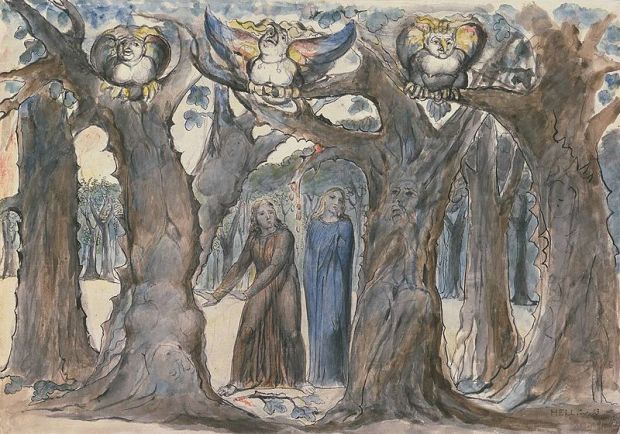
In Dante’s Inferno harpies are depicted in the seventh circle of Hell in the ‘Wood of Suicides’:

No green here, but discoloured leaves and dark,
No tender shoots, but writhen and gnarled and tough,
No fruit, but poison galls on the withered bark…

Wide-winged like birds and lady-faced are these,
With feathered belly broad and claws of steel;
And there they sit and shriek on strange trees.

Dante is horrified when he realises that the trees are the souls of suicides. Their transformation and their fate of being tortured by the harpies, who feast on the boughs, is described by Augustus:

When the wild soul leaps from the body, which
Its own mad violence forces it to quit,
Minos dispatches it down to the seventh ditch.

It falls in the wood; no place is picked for it,
But as chance carries it, there it falls to be,
And where it falls, it sprouts like a corn of wheat,

And grows to a sapling, and thence to a wild tree;
Then the Harpies feed on its leaves, and the sharp bite
Gives agony, and a vent to agony.

VI.
In ‘The Wood of the Self-Murderers: The Harpies and the Suicides’ William Blake provides a vivid depiction of the scene. This partly resonates with my personal vision of the Owl Kind in the Forest at the Back of the World, where the souls of the dead shift into trees, plants, and animals.

800px-The_Wood_of_the_Self-Murderers

Only I do not see the role of the Owl Kind, although they are hunters and devourers of the dead, as punitive. Like the Hounds of Annwn they are simply serving their role hunting down the dead and devouring their dead flesh before bearing their souls back to the otherworldy forest where they can heal.

Perhaps they have always been connected with suicides – teaching them to be tree, plant, flower, blossoming until their bloomy faces are the faces of owls and, like Blodeuwedd, they fly free.

SOURCES

Edward A. Armstrong, The Folklore of Birds, (Dover Publications, 1958)
Dorothy I. Sayers, Dante, Hell, (Penguin Classics, 2001)
Rachel Bromwich (transl), Dafydd ap Gwilym, Poems, (Gomer Press, 1982)
Ronald Hutton, The Witch, (Yale University Press, 2018)
Sioned Davies (transl.), The Mabinogion, (Oxford University Press, 2007)
William Blake, William Blake’s Divine Comedy Illustrations, (Dover Publications, 2008)
Harpy’, Wikipedia
Strix’, Wikipedia

The Vision of Ceridwen

I’m the broken bird-thing
at her table again

her wizened hand
in my claws

telling her
I’m going to mend
our broken vision

and all will be beautiful.

***

Sometimes you end up in a myth. It’s not the myth you thought you’d end up in or the myth you chose. You’re not who you thought you would be. Nobody else sees the myth the same way you do.

It began when I first started learning about the Bardic Tradition and heard that Ceridwen was the goddess of the cauldron that brews awen, the poetic inspiration that is like mead to the Brythonic bards.

As a poet I thought Ceridwen was a goddess well worth meeting so I drew myself a cauldron, lit a candle, constructed a visualisation. One of those 2D interfaces that sometimes helps you interact with what is. I imagined Ceridwen as a blue-robed, dark-haired, faceless woman stirring a cauldron.

Nothing happened. Then, from nowhere, out leapt a hideous grey-haired hag who put her bony arms around my neck, nearly strangling me. She demanded I go with her to her cottage in her woods. She sat me down at her table in a room with a sun dial and smaller cauldron over the hearth on a wobbly three-legged stool and insisted that I call her ‘grandmother’. Initially I thought she was an ancestor.

I presumed this showed Ceridwen wasn’t interested in me. She already had worthier devotees. Soon afterwards I got found by my patron god, Gwyn ap Nudd, a ruler of Annwn and guardian of the cauldron.

I met ‘grandmother’ again when I was travelling Annwn in search of inspiration on my flighty white-winged mare. She ditched me and I found myself falling downwards through the air, flapping my arms like wings, steadily acquiring black feathers, but not quickly enough to stop me hitting the ground. When I returned to my senses the hag-like woman was standing over me. With a wrinkly smile she told me I was ‘beginning to get my raven’s wings’ before taking me to her cottage again.

There she told me to look into her cauldron, where I saw in vivid blues and reds a Dark Age battle of clashing spears, crashing swords, broken shields, fallen flags, blood crimsoning the nearby waters, then the shades rising in a sorrowful march to depart. Researching it afterwards I realised it was the Battle of the Region Linuis fought by Arthur against the Saxons and wrote a poem about it*.

After this gift of awen from her cauldron I began to suspect the hag was the real (as opposed to my imagined) Ceridwen. The name ‘grandmother’ came to make sense a couple of years later. Gwyn had shown me a cauldron filled with stars and not long afterwards I went to see my friend, Nick Williams, performing an experimental poetry set in a blacked-out room with strobe lights. I had the sensation of being in a cauldron of poesy and also in the womb of the universe. I recalled that Nick refers to a goddess called Old Mother Universe and realised she is Ceridwen – the oldest mother of all.

I went on to write a book called The Broken Cauldron, focusing on how Ceridwen’s crochan ‘cauldron’ or ‘womb’ is shattered in the Welsh myths and of my task of gathering the stars back into it.

Whereas, in the Bardic Tradition and Druidry, Taliesin and Arthur, those responsible for stealing the awen and the cauldron and the shatterings that have brought devastation to the land are hailed as heroes, I found myself standing in the shoes of Morfran ‘Sea Raven’, Ceridwen’s dark and ugly son, who was later known as Afagddu ‘Utter Darkness’.

He for whom she boils her cauldron in the hope the brew will inspire him and cure his imperfections. He who does not get the awen, who cannot win poetic inspiration the quick way, but must work to find the words to heal the lands poisoned by the contents of the broken cauldron, to repair it piece by piece, story by story, so the stars shine in bright new constellations on a new world.

Gwyn is my guide in this task, and in serving him, I am also serving Ceridwen. She does not appear to me often, but when she does, I am often her awkward black-winged child, the dark imperfect one.

As Afagddu I’m learning imperfection is necessary; an understanding of what others find repulsive, whether it’s darkness, death, decay, plastic, the monstrous creatures of Thisworld or the Otherworld. That these hold their own beauty when the concept is not corrupted by our society’s false ideals.

It’s not the Old Mother’s Universe that needs fixing, but the way we perceive it, the collective vision, which guides our acts. When we learn to see clearly both Creirwy* and Afagddu will be beautiful.

A star-forming region in the Large Magellanic Cloud Wikipedia Commons

*’The Region Linuis’ was first published in Heroic Fantasy HERE.
**Creirwy means ‘Lively Darling’. She is Afagddu’s beautiful (twin?) sister.

With thanks to Wikipedia Commons for the image ‘A star-forming region in the Large Magellanic Cloud’ by ESA/Hubble.

Shattered Vessels and Scattered Sparks

Notes on Welsh Mythology and Lurianic Kabbalah

In 2015 my patron god, Gwyn ap Nudd, showed me a cauldron filled with stars. Shortly afterwards I was transported into the scene in The Story of Taliesin, where Gwion Bach steals three drops of awen (1) and the cauldron breaks, spilling the deadly remnants of the brew across Gwyddno Garanhir’s lands. With it I saw the stars pouring out and was told by Gwyn my task was to gather them.

This story continues to play a guiding role in my path as an awenydd. I was recently astonished when I found similarities between my personal gnoses and Lurianic Kabbalah. This system was created by the Jewish Rabbi, Issac Luria (1534 – 1572) the Ari or the Holy Lion, who lived in Safed in Israel.

According to Luria Or Ein Sof ‘God’s Infinite Light’ was withdrawn in the Tzimtzum ‘contraction’ that made possible the creation of this finite world. The light continued to emanate through the ten eyes of Adam Kadmon ‘Primordial Man’. Each point of light formed the keter ‘crown’ of a sefirot ‘emanation’ in the world of Tohu ‘Chaos’. These lights were contained by ten vessels. Because the seven bottommost vessels could not contain the intensity of the lights they died, shattering, descending into Tohu. This was known as shevirat ha-kelim ‘the shattering of the vessels’. The three vessels at the top were more powerful and those lights continued to shine, emanating the Infinite Light.

Notozin ‘sparks’ of light clung to the fragments of the vessels. By the act of tikkun, the repair of the world above and below by gathering the sparks (seen both as divine light and holy souls)and returning them to the Creator the unity of the shattered God-Head could be re-established.

Parallels can be found between the broken cauldron and the shattered vessels and between tikkun and the task I was assigned by Gwyn, Gatherer of Souls, gathering the stars back into the cauldron. The three remaining vessels, emanating the Infinite Light, resemble the modern symbol for awen /I\.

In the Welsh myths the cauldron is the womb of Ceridwen. She is replaced as the source of awen and as a creator goddess by God in medieval poetry (2). Her cauldron lies in Annwn ‘the Deep’ and its guardian is Gwyn/Pen Annwn ‘Head of the Otherworld’. In ‘The Spoils of Annwn’ it is stolen by Arthur and his men. We find the lines: ‘cledyf lluch Lleawc idaw ry dyrchit, / ac yn llaw Leminawc yd edewit’, ‘Lleog’s flashing sword was thrust into it, / and it was left in Lleminog’s hand’ (3). This potent image of violation is suggestive of the shattering of the cauldron in a lighting-flash and the theft of its pieces.

This scene might originate from an older creation myth akin to the Mesopotamian story of the slaying of the dragon-goddess, Tiamat ‘Deep’, by the lightning-god Marduk, and Indra’s release of the waters from the dragon, Vritra, by a thunderbolt in the Hindu tradition. In Genesis, before God creates the world, we are told ‘the earth was formless and empty, darkness was over the surface of the deep, and the Spirit of God was hovering over the waters,’ suggesting the existence of an older water-deity.

The shattering of Ceridwen’s cauldron is the Big Bang, the moment of creation, when the waters spill out with the stars (4). Ceridwen may have created of her own will before Lleog broke her sacred vessel.

The cauldron is shattered repeatedly in Welsh mythology and these instances are bound up with the near-destruction of the world. In the Second Branch the cauldron breaks after pouring out the speechless dead in a battle that leaves only seven Britons alive and five pregnant women in Ireland. In The Story of Taliesin its breaking poisons Gwyddno’s lands. The survivors are left to pick up the pieces.

My task as an awenydd living in the Anthropocene, this Sixth Mass Extinction, precipitated by Lleog’s sword and Gwion’s theft of the awen shattering the cauldron, is to regather the stars. By gathering constellations of stories in service to Gwyn and Ceridwen I strive to repair the cauldron, the womb of Old Mother Universe, and mend the ways between Thisworld and Annwn. This is my Tikkun.

Photo by Marika Vinkmann on Unsplash

(1) The Welsh word for poetic inspiration stemming from the Indo-European *uel ‘to blow’ and sharing its root with awel ‘breeze’.
(2) This is evidenced in ‘The Chair of Teyrnon’ and ‘The Childhood Achievements of Taliesin’ from The Book of Taliesin and the poems of Cuhelyn Fardd and Prydydd y Moch.
(3) Lleog ‘death-dealer’ (from Lleawc) and Lleminog ‘the leaper’ (from Leminawc) may be names of the same person, who may also be identified with Lleu Llaw Gyffes ‘the Fair-Haired One with the Skilful Hand’. It would certainly take his skill to steal the cauldron. All may be reflexes of the Pan-Celtic god, Lugus.
(4) This was suggested to me by an initiatory experience. After my first dedication to Gwyn, before the star cauldron (the candlelit White Spring at Glastonbury), I experienced swimming through a sea of stars.

SOURCES

Howard Schwartz, ‘How the Ari Created a Myth and Transformed Judaism’, Tikkun
Kristoffer Hughes, From the Cauldron Born, (Llewellyn, 2013)
Laurence Fine, ‘Tikkun in Lurianic Kabbalah’, My Jewish Learning
Marged Haycock (transl), Legendary Poems from the Book of Taliesin, (CMCS, 2007)
Moshe Miller, ‘Shattered Vessels, Kabbalah Online
Patrick Ford (transl), Mabinogi and Other Welsh Tales, (University of California Press, 2008)
Genesis 1., New International Version, The International Bible Society

Those are but Devils

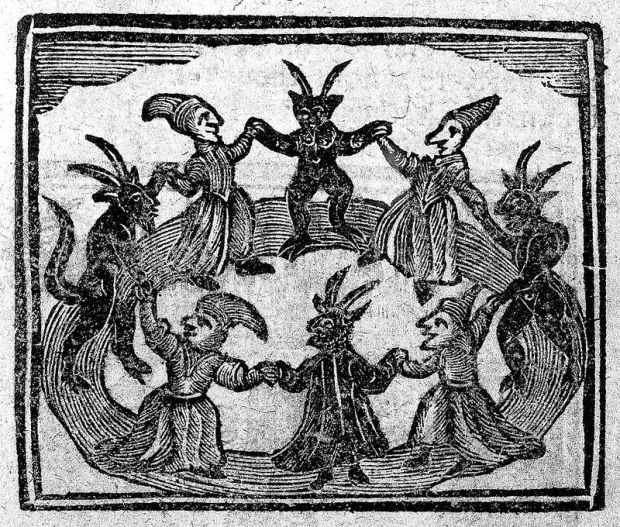
Witches dancing with devils from the History of Wizards and Witches 1720

An essay on the demonisation of Gwyn ap Nudd and the Spirits of Annwfn

Gwyn ap Nudd, ‘White son of Mist’, is a god of the dead and ruler of Annwfn, ‘the Deep’, the Brythonic underworld. In two medieval Welsh texts he and the spirits he rules are identified with devils.

In How Culhwch Won Olwen we are told, ‘Gwyn ap Nudd… God has put the fury of the devils of Annwfn in him, lest the world be destroyed. He will not be spared from there.’

The introduction of God’s agency is clearly a Christian attempt to explain Gwyn’s containment of the spirits of Annwfn. These spirits include the restless dead who have died suddenly or violently:

Some headless stood upon the ground,
Some had no arms, and some were torn
With dreadful wounds, and some lay bound
Fast to the earth in hap forlorn.

And some full-armed on horses sat,
And some were strangled as at meat,
And some were drowned as in a vat,
And some were burned with fiery heat,
Wives lay in child-bed, maidens sweet…

…such the fairies seize and keep.

Others such as the Tylwyth Teg, ‘Fair Family’, or ‘fairies’ and ellyllon, ‘spectres’, ‘goblins’, ‘elves’ occupy a liminal position between life and death, humanity and nature, and mitigate between the worlds. Christians identify these complex and ambiguous spirits with dieuyl, ‘devils’.

Gwyn presents a paradox that does not sit easily with Christianity’s black-and-white theology: because he contains the spirits of Annwfn within him and/or within his realm he is the only being who can hold back their aryal, ‘fury’, and prevent them from destroying this world.

In The Life of St Collen, Collen, the abbot of Glastonbury, overhears two men conversing outside his cell saying Gwyn is ‘king of Annwfn and of the Fairies’. Putting his head out he shouts, ‘Hold your tongues quickly, those are but Devils’.

Collen is invited to feast in Gwyn’s castle on the Tor. There he refuses to eat, saying the food is ‘leaves’ and the red and blue clothing of Gwyn’s host signifies ‘burning’ and ‘coldness’; it is hellish. Collen supposedly banishes them with holy water.

***

Gwyn’s association with devils stems from a longstanding Christian tradition of identifying pagan deities with the Devil and demons and the realm of the dead with Hell. Any god who was not the one God, who demanded no other gods be worshipped before him, was seen as demonic.

In The Bible, Beelzebub, a Semitic deity originally called Baal-zebul, ‘Lord of Princes’, is equated with the Devil along with Satan and Lucifer. The ‘false gods’ of the Canaanites are referred to as ‘demons’ and the se’irim ‘hairy beings’ or satyros (ie. satyrs) as ‘goat-demons’.

The concept of Hell developed much later. In The Old Testament the original Hebrew word is Sheol, ‘the place of the dead’ (it is frequently translated as ‘the grave’). In The New Testament, Hell is translated from Hades, Tartarus and Gehenna. Hades means ‘the unseen place’ and is the name of the Greek underworld and its ruler. Tarturus is ‘the deep place’ beneath Hades. Contrastingly, Gehenna is a thisworldly place, the Valley of Hinnom, where the Kings of Judah sacrificed their children by fire, leading to it being cursed.

Hell derives from the Old English hel or helle stemming from Proto-Germanic *haljo ‘the underworld’ or ‘concealed place’. Hel is also the name of its goddess. Ironically it is a borrowed pagan concept which is not of Biblical origin.

The idea of the land of the dead as a place of punishment by eternal fire was developed in the early days of the Church by scholars such as Second Clement, Justin Martyr and Theophilus of Antioch as a means of controlling the populace. Augustine, bishop of Hippo Regus, was the first Christian leader to teach ‘the doctrine of eternal punishment’ during the 4th century.

Annwfn, ‘the Deep’, shares parallels with the other pagan underworlds and places of the dead. In medieval Welsh mythology there is plenty of evidence that, following their Christianisation between the 4th and 7th centuries, the Britons resisted the view that Annwfn was a place of punishment.

In ‘The First Branch’ of The Mabinogion and even in The Life of St Collen it is a place of beautiful courts and castles, lavishly dressed courtiers, and sumptuous feasts. These paradisal depictions are echoed in later fairylore demonstrating Annwfn became byd Tylwyth Teg, ‘Fairyland’ or ‘Faerie’.

Gwyn’s name means ‘White, Blessed, Holy’ and Gwynfa ‘Paradise’. In Barddas, Iolo Morganwg speaks of Cylch y Gwynvyd, ‘the Circle of White’, ‘the Holy World’ noting gwynvyd denotes ‘bliss or happiness’. Gwynfa and Gwynvyd might originate from a tradition wherein, like Hades and Hel, Gwyn and his realm bore identical names.

When Annwfn became Faerie its associations with the dead were severed and it was reduced to a fantasy realm. However, superstitions remain, many of these pertaining to the uncanny and dangerous nature of the fairies and their associations with abductions, madness, and death.

***

The Conversation of Gwyn ap Nudd and Gwyddno Garanhir’ contains Gwyn’s clearest literary representation as a pre-Christian god of the dead. Gwyddno addresses Gwyn as a ‘bull of battle’: a divine warrior and psychopomp. Other epithets include ‘awesome leader of many’, ‘invincible lord, and ‘lord of hosts’.

Gwyn’s identity as a death-god is revealed when he states he comes from ‘many battles, many deaths’. He asserts his presence at the deaths of Gwenddolau ap Ceidio, Bran ap Ywerydd, Llachau ap Arthur, Meurig ap Careian, and Gwallog ap Lleynog before speaking the lines:

I was there when the warriors of Britain were slain
From the east to the north;
I live on; they are in the grave.

I was there when the warriors of Britain were slain
From the east to the south;
I live on; they are dead.

Here Gwyn laments the downfall of the Brythonic kingdoms to the Anglo-Saxons and his living on as a gatherer of souls. He is a venerable figure. The only thing devilish about him is the bull-horns.

Contrastingly How Culhwch Won Olwen presents Gwyn as a sinister being and pits him against Arthur: a champion of Christianity who rose to popularity by slaughtering and subordinating a variety of Annuvian deities, ancestral animals, giants, and witches.

It is my belief that Arthur’s overcoming of Gwyn was a primary step in the destruction of Brythonic Paganism and the assertion of Christianity. Gwyn’s mythos had to be erased and reconfigured in a new literature documenting his defeat and replacement by Arthur as a protector of Britain who fights against the ‘devils’ of Annwfn rather than containing their fury.

In How Culhwch Won Olwen Arthur intercedes in the ancient seasonal struggle between Gwyn, ‘Winter’, and Gwythyr, ‘Summer’, for their beloved, Creiddylad, a fertility goddess. Gwyn takes Creiddylad from Gwythyr by force, presumably abducting her to Annwfn, explaining the coming of winter on Calan Gaeaf.

Gwythyr raises an army and attacks Gwyn. It might be assumed they also descend to Annwfn. Gwyn defeats them singlehandedly and imprisons Gwythyr and seven of his men. The imprisonment of Summer in Annwfn may also be part of a mythos explaining the rule of Winter.

During their imprisonment Gwyn kills Nwython and feeds his heart to his son, Cyledyr, who goes mad. Whether this scene should be read as a punishment for invading Annwfn demonstrating Gwyn’s furious nature, a muddled echo of a rite transferring ancestral strength from father to son, or Christian propaganda demonising Gwyn remains uncertain.

Whatever the case, Arthur comes to the rescue, presumably storming Gwyn’s prison in Annwfn. He defeats Gwyn, then binds Gwyn and Gwythyr in battle for Creiddylad every Calan Mai until Judgement Day. Arthur’s agency is introduced to explain an existing duel on Calan Mai where Winter is defeated and Creiddylad returns to this world, explaining the rule of Summer. The purpose is to display Arthur’s control over these two old seasonal gods and Creiddylad who he locks in her father’s house saying neither can take her until Judgement Day!

The scene where Gwyn and Gwythyr appear together as advisors to Arthur on his assault on Orddu, ‘the Very Black Witch’, who lives in Pennant Gofid, ‘The Valley of Grief’ in ‘the uplands of Hell’ is again designed to demonstrate his power over them and this Annuvian woman, who he slices in half with his knife, Carwennan, before draining her blood.

It is notable that Gwythyr’s father, Greidol, ‘Scorcher’, is one of Arthur’s forty-two counsellors and Gwythyr’s daughter, Gwenhwyfar, is married to Arthur. This is suggestive of a long-standing alliance between Arthur and the powers of summer against winter and death.

The rescued prisoners join Arthur on his hunt for Twrch Trwyth, ‘King of Boars’. That Gwyn must be found before the hunt can start suggests Gwyn was its original leader. Gwyn’s identity as a hunter god is suggested by his ownership of a white stallion, Carngrwn, ‘Round-Hoofed’, and white red-nosed hound, Dormach, ‘Death’s Door’. In Welsh folklore Gwyn and the Cwn Annwfn, ‘Hounds of the Otherworld’, hunt the souls of the dead. He is the Brythonic leader of the Wild Hunt.

Twrch Trwyth’s transformation from a human king into a boar hints at the tradition of a soul hunt. Arthur’s usurpation of Gwyn’s hunt and its depiction as just a boar hunt marks the end of the mythos featuring Gwyn as a god of the dead and leader of the Wild Hunt.

Many of Arthur’s famous landmarks, including Carn Cafall, where the footprint of Arthur’s gigantic dog was left during the hunt for Twrch Trwyth, may formerly have been associated with Gwyn and Dormach.

The Spoils of Annwfn’ shares similarities with Arthur’s attack on Gwyn suggesting they are two different variants of the same story. Taliesin, the narrator, accompanies Arthur on his journey to seven otherworldly fortresses (which I believe may be faces of the same fort) where he takes on Pen Annwfn, ‘the Head of Annwfn’.

Storming the glass walls and defeating six thousand unspeaking dead men in a devastating battle, Arthur and his raiding party rescue Gweir (who may be equated with Graid, one of Gwyn’s prisoners), steal the legendary Brindled Ox, and seize ‘the Cauldron of the Head of Annwfn’. Escaping with only seven survivors Arthur slams ‘Hell’s Gate’ shut.

Arthur’s defeat of the Head of Annwfn and seizure of his cauldron represent the triumph of Christianity over Paganism, the realm of death, the dead and their ruler, and the mysteries of death and rebirth.

It is no coincidence that Arthur’s raid on Annwfn shares parallels with Jesus’ ‘Harrowing of Hell’ (harrow comes from the Old English hergian ‘to harry or despoil’). Between his crucifixion and resurrection, Jesus descended to Hell to preach to ‘the imprisoned spirits’ and liberate the righteous who had been trapped there since the beginning of the world (the damned were left to stay!) triumphing over the realm of the dead and death itself.

It is my intuition that prior to Christianity and Arthur’s rise to popularity the series of fortresses might have formed part of a Brythonic tradition documenting the descent of the soul to Annwfn. They would have been approached respectfully with due ritual rather than assaulted and despoiled, their guardians killed, their treasures stolen.

***

The demonisation of Annwfn is shown by lines from several poems in The Book of Taliesin equating it with Hell (translated from Uffern which originates from the Latin Inferno ‘underworld’).

And in front of the door of Hell’s gate lamps were burned

What is the measure of Hell?
How thick its veil,
how wide its mouth,
how big are its baths?

Madawg…
Was taken by fierce Erof…
Among the hideous fiends
Even to the bottom of Hell.

Gwyn’s loss of status as a god of the dead led to him being demonised as a demon huntsman who hunted the souls of sinners. His role became punitive as he was subsumed within Christianity’s doctrine of fear and control as a devilish figure.

Charles Squire writes, ‘Gwyn… his game is man… the “mighty hunter”, not of deer, but of men’s souls, riding his demon horse, and cheering on his demon hound to the fearful chase’.

John Rhys notes, ‘What Gwyn hunts are the souls of those who are dying; but Christianity has greatly narrowed his hunting ground, as his quarry can now only be souls of notoriously wicked men.’

Folkloric stories featuring horned figures and/or the devil, Tywsog Annwfn, ‘Prince of Annwfn’, might originally have featured Gwyn, a ‘bull of battle’ who wears bull-horns. The following example is recorded by John Rhys:

‘Ages ago as a man who had been engaged on business, not the most creditable in the world, was returning in the depth of night across Cefn Creini, and thinking in a downcast frame of mind over what he had been doing, he heard in the distance a low and fear-inspiring bark; then another bark, and another, and then half a dozen more. Ere long he became aware that he was being pursued by dogs, and that they were the Cwn Annwfn. He beheld them coming: he tried to flee, but he felt quite powerless and could not escape. Nearer and nearer they came, and he saw the shepherd with them: his face was black and he had horns on his head.’

John Rhys argues this black-faced, horned ‘shepherd’ is Gwyn. This representation is clearly influenced by Biblical tradition, perhaps by the following passage containing Cyril of Alexandria’s interpretation of John 10: 12-13:

‘the father of sin used to put us in Hades like sheep, delivering us over to death as our shepherd, according to what is said in the Psalms: but the really Good Shepherd died for our sakes, that He might take us out of the dark pit of death and prepare to enfold us among the companies of heaven, and give unto us mansions above, even with the Father, instead of dens situated in the depths of the abyss or the recesses of the sea.’

Again we return to Jesus’ ‘Harrowing of Hell’ and his triumph over the realm of the dead. This story forms a large part of the hubristic anthropocentric worldview where ‘Man’ (Jesus/Arthur) conquers all, including death and its deities, which has led to the Anthropocene.

***

For many centuries Christianity has cut us off from the magical underworld beneath our feet and from its deities who we have been taught to fear as devils. As the hegemony of Christianity and its bed-partner, Empire, fail, leaving a void filled by consumerism, materialism, right-wing populism, and regressive nationalisms the need arises to reconnect with the gods of the deep.

Within Brythonic culture there is a tradition of spirit-work referred to by Gerald of Wales. He speaks of awenyddion, ‘people inspired’, ‘the soothsayers of this nation’ who are possessed by and speak with the aid of spirits and receive inspiration from dreams.

Following their example we can rebuild our relationship with the spirits of Annwfn. This isn’t an easy path to take as they have long been demonised, shut out, ignored. The restless dead are growing in number as more people die in war and fall victim to the exploitation of capitalism. They can indeed be furious. As can the fairies who mitigate between the worlds and have witnessed our untrammelled destruction of nature and ignorance of Annwfn.

Yet we have a responsibility to them, to the ‘others’, that deserves a response. Their fury demands the destruction of the exploitative systems of this world and the replacement of the shallow facade of consumer culture with a mythos rich and deep in meaning based in respectful relationship with all beings, human and non-human, living and dead.

Within Brythonic tradition Awen, ‘divine inspiration’, the source of mythic meaning, flows from Annwfn.

The Awen I sing,
From the deep I bring it,
A river while it flows,
I know its extent;
I know when it disappears;
I know when it fills;
I know when it overflows;
I know when it shrinks;
I know what base
There is beneath the sea.

Our existing mythology and folklore shows there are ways into Annwfn/Faerie that are not only traversed by the likes of Arthur but by children, drunkards, poets, fiddlers, and dancers. Admittedly the risk is madness or death, but those who pass the initiatory challenges of the Fairy Kings and Queens emerge with the Awen to guide the way into a better world.

Capitalism thrives on its domination of meaning. With Awen from Annwfn we create our own.

/I\

Gwyn ap Nudd
guide of souls
light of the mist
show us Annwfn’s
disturbing beauty:
shining butterflies
worm-faced death.

Let your dragons
grant us Awen from
unquenchable wells.
Let us be possessed
and ride the fury
of your spirits
into the next world.

***

SOURCES

Charles Squire, Celtic Myths and Legends, (Lomond Books, 1905)
Dennis Bratcher, ‘Demons in the Old Testament: Issues in Translation
Edward Eyre Hunt, (transl), Sir Orfeo, (Forgotten Books, 2012)
Gerald of Wales, Description of Wales, Awen ac Awenydd
John Rhys, Celtic Folklore Welsh and Manx, Volume 1, (Forgotten Books, 2015),
John Rhys, Studies in the Arthurian Legend, (Elibron Classics, 2005)
Greg Hill (transl) ‘Gwyn ap Nudd and Gwyddno Garanhir’, The Way of the Awenydd
Iolo Morganwg, Barddas, (Weiser, 2004)
Lady Charlotte Guest (transl), ‘Gwyn and St Collen’, Mary Jones Celtic Literature Collective
Marged Haycock, (transl), ‘The Spoils of Annwfn’, Legendary Poems from the Book of Taliesin, (CMCS Publications, 2015)
Saint Cyril, Saint Cyril Collection, (Aeterna Press, 2016),
Sioned Davies, (transl), The Mabinogion, (Oxford University Press, 2007)
William F. Skene, Four Ancient Books of Wales, (Forgotten Books, 2007)

*This essay was first published in A Beautiful Resistance 4.