The ship is tall, leaning. Its only crew are the gulls, who tie the knots in the sails; old, old, sailor souls. On its prow stands Barinthus, the helmsman, dark-cloaked, stern, implacable.
No-one sees if his lips move beneath the shadows of his hood as he reads out the roll call: the names of Londeners, Devonians, Bristolians, Scousers, Mancunians, Lancastrians, Glaswegians, Brummies, whose accents mix in the huge make-shift camp that has grown up in the marshy hinterland between the worlds.
They’re mostly old. Veteran souls move between them, boiling tea on stoves that burn on no gas. They drink from metal cups, pull blankets around them, attempt to recall to one another their stories.
Some of them are funny – drunken exploits – other people’s knickers and roundabouts. Some are tragic – motorcycle crashes, the loss of daughters and sons, spouses who lost their memory yet lived on.
“How did we get here?” few recall that journey or what brought them.
White hounds with red markings on their ears, noses, the tips of their tails, patrol the edges of the camp. If anyone tries to leave they are there. A grin and friendly growl is always enough. The pups like to play amongst the child souls, tongues lolling, letting their bellies be rubbed. When their master calls them, not liking them to get attached, they leave whining with their tails between their legs.
“Where are we going?” few recall that journey they have made so many times before.
“The biggest shipload since the last war,” my god’s voice from where he stands invisible so as not to frighten the souls.
Their leaving seems to take forever, one by one getting up from their camp stools, boarding across a wobbly plank and taking their places in the cabins, more cabins-worth of souls than there are cabins on board?
“The number of cabins, the space of the hold, the expanses of the deck, are limitless, infinitesimal,” Gwyn informs me. Speaking ominously “no matter how many passengers the ship is never full.”
I watch with Gwyn as the camp fires go out and the ship sinks deeper and deeper into the waters.
As a gull flies down and with a practiced twist of her yellow red-spotted beak unties the mooring rope I clasp my hands, bow my head in mourning, say farewell to 980 Britons who I never knew.
As I leave, dropping a tea bag in a pot for the next souls, I see them already beginning to arrive. Some are escorted by their ancestors, others by the hounds, others by white birds. A little boy is carrying a white red-spotted hamster wrapped up in his school blazer.
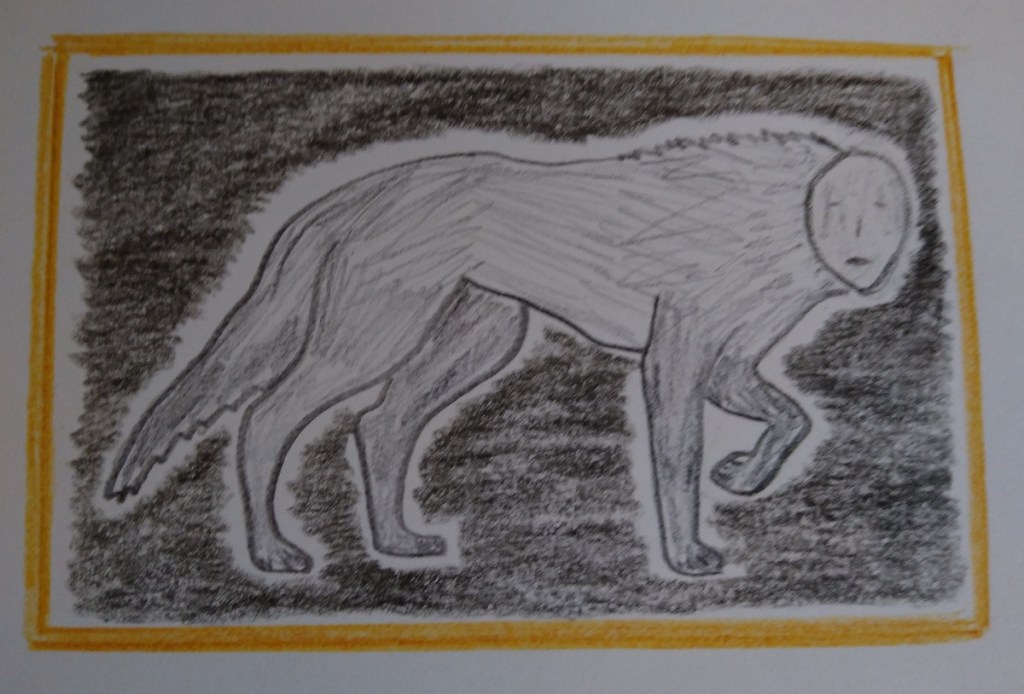
approaches with a little bit of Chernobyl in its deadly stride.
A big black bell is ringing inside it.
Its face is a man’s.
There is nothing behind it.
I wrote this poem following a dream of which I remember little but the vivid image of a lean menacing wolf with a man’s face and the knowing because I’d seen it, been its presence, I was going to die.
I’ve had a handful of dreams in which I’ve had this gnosis. In one I was a captured soldier awaiting execution and Gwyn prepared me for death by telling me I must go into the hazel, and the beetle, and something I can’t recall. In another I was a clawed creature clinging to a lift descending to the abyss. And in another I was and was not a dark magician, who in a magical battle against mechanical forces, was cut into a thousand pieces by whirling blades and resurrected as a vampiric woman.
Through these dreams I know I have lived many lives, died many deaths, in Thisworld and in Annwn, and perhaps in worlds beyond. That a part of me, which I call my soul, carries these memories.
When I was talking to my dad about his funeral plans I was surprised to hear that he, like me a philosophy graduate, had never thought about whether he had a soul or what would happen when he died. He might have theorised about it but had never really contemplated what would happen to him.
Such questions have been on my mind as long as I can remember. Like my dad I theorised about them, attempting to find answers through philosophy, until I met Gwyn and he taught me to journey to Annwn. Until he and his father, the dream-god Nudd/Nodens, helped me to sleep and listen to my dreams.
For the first time since the Second World War people in Britain are suddenly facing death, due to the threat of the coronavirus. This is a complete unknown for people of my mum and dad’s generation, for mine, and the next generation, who might have included my children, if I’d had them.
I understand that one of the reasons Gwyn appeared in my life and taught me to journey was to help me prepare for death. I know a small handful of others who have had similar experiences with him and different gods, and of those who have gained their own understanding without experience of deity.
In contrast to the advice I’ve seen in various places to focus only on the positives, I believe at this time, when so many of us have so much extra time, there is no better time to contemplate the lean wolf.
He started appearing in my tarot readings at the beginning of the year: the Hooded Man. In my reading for 2020 on New Year’s Eve in the place of ‘home’, then again and again, strangely, mysteriously, as we shifted from a stormy winter to a glorious spring and I was spending more time with people outdoors.
In the Wildwood Tarot the Hooded Man occupies the traditional position of the Hermit. His ‘Position on the Wheel’ is ‘the mid-winter solstice’. Dressed in a black cloak adorned with holly he stands amidst the snow with a wren at his side, a staff in one hand, a shining lantern in the other. He points towards a doorway in a great tree with a wreath upon it, offering solace from winter’s harshness.
The main meaning of this card is ‘this is the time of solitude and contemplation’. Why was I getting this card when I was busying myself with work parties five days a week and preparing for an internship at Brockholes, which involved outdoor work and engaging with large groups of volunteers?
The answer came as the arrival of coronavirus, as the lockdown, the perfect reason to respond to his call. But what did I do for the first three weeks? Spend my time watching what everyone else was doing, beating myself up for not being busy, for not having a proper job, resisting the call of the Hooded Man.
And yes, I felt it, and he spoke to me clearly. On one occasion this was through the new module on ‘Holly’ in the Tree Spirit Medicine course on the Way of the Buzzard Mystery School. The course leaders, Jason and Nicola associate holly with ‘sanctuary, resilience, and protection’. These were qualities I felt I needed to draw upon and immediately I associated them with the Hooded Man. I journeyed to holly to ask ‘how to slow down and participate in the Hooded Man’s sanctuary.
Holly said:
The berries of life are not always yours.
So what is yours?
How will you grow your berries?
What can you offer?
How will you shape your sanctuary?
I took this to mean that I couldn’t just barge into the Hooded Man’s sanctuary and assume his berries (the hard-won fruits of many years of solitude and contemplation) are mine for the taking. That I must take the time and effort to shape my own sanctuary, grow my own berries, share them with others.
What was particularly significant about this journey is that the day afterwards, after I had cut back and cleared the blackberry bushes which were taking over the bottom of my parents’ garden, I found a little holly sprig. Immediately I knew this was ‘the Hooded Man’s corner’: a place I could find sanctuary.
But still I resisted for fear that retreating would make me less of an awenydd to my community and gods. When I first set out on the awenydd path it was with the purpose of serving Gwyn and the spirits of the land through sharing poems and research on mythology and my personal journey.
Somewhere along the line, when I was involved with Dun Brython, when Greg Hill and I founded ‘Awen ac Awenydd’ I felt these responsibilities were nudging me toward community leadership. However, Dun Brython never grew due to a lack of interest in Brythonic Polytheism. Whilst the Awen ac Awenydd Facebook group generated some interesting discussions, the participants didn’t mesh enough to develop a shared practice, and the plans for a physical meet-up failed completely.
I reached the conclusion that Facebook is not a suitable platform for building meaningful relationships and left. ‘You’re not a follower but you’re not a leader,’ the words of my wise friend, who read my tarot, haunted me. What am I then? What is the role of an awenydd who neither leads nor follows?
“You must focus on your gift,” the voice of my god from within.
Reflecting on the nature of this gift I realised that it is the awen and the meaning of ‘gift’ is manifold. The awen is not only my gift, my talent, my role in the world, my destiny, but is given by the gods and something I have a responsibility to give back to others. This being gifted with and my giving of awen is of value in itself. I don’t need to be a leader or a spokesperson for my path.
This revelation came as a huge relief and has given me clarity about where I’ve made mistakes in the past. After watching a podcast with Martin Shaw on ‘Pandemic and Mythic Meanings of this Cultural Movement’ in which he posed the question ‘would this not be a good time to re-establish a relationship with our souls?’ I realised over the past few months I have neglected my soul’s journey.
When I journeyed to the Hooded Man for advice on how to focus on this he said I need to ‘clear space outer and inner’ and ‘cultivate a longing for the mysteries’ in the place of my anxieties.
What was of interest, and slightly disturbed me, was that he told me has had burning ambitions, been riddled by doubts, that he has made made mistakes, that his aura of calm is the result of centuries of inner work. That sometimes it is just a facade that covers over the conflicts he feels within.
For some reason I thought he had always been the Hooded Man at perfect peace in his self-mastery. Yet a story, or many stories, lie beneath the the hood of this man who has many faces.
Creiddylad most majestic maiden in the Islands of Britain, let me know your majesty
in this garden
on my knees two hands clasped together on this trowel making offerings of water
amongst flowers where you walk unveiled, stunning, bees dancing around you.
Let me be your bee!
Feed me when I’m hungry. When I fall exhausted pick me up gently
and I will make the sweetest honey.
“Stay here in this garden,” my patron god, Gwyn ap Nudd, advised me a week before the lockdown. A couple of days before my conservation internship was cancelled and, like many, I was rendered jobless.
We’ve been on lockdown in the UK for over a fortnight now and how I’ve to-and-froed, some days accepting this advice and, on others, after reading the news, wishing I was doing something more important, more heroic, than shopping and cleaning for my parents, tending the garden, doing my best to find the focus to pray, meditate, spend time in devotion to my gods, and to write for my supporters.
My main battle has been against feelings of guilt and uselessness caused by my awareness of the utter contrast between my easy life, touched by the bliss of the spring sun, and the hell that the nurses and doctors are going through on the front line, risking their lives fighting for the lives of others. The risks taken by the funeral services. The chaos and stress faced by supermarket staff. Our dependence on the long hours and monotonous work of fruit and veg pickers usually imported from abroad.
I’ve thought of applying for, have actually applied for, some of these jobs (which may have necessitated moving out of my parent’s house so I do not put them at risk), but nothing has come of it.
“Stay here in this garden.” I accept the gods have their reasons when the Blasted Oak, spelling disaster, appears in a tarot reading on what will happen if I take a veg picking job.
And deep within I know if I took any of the above jobs I’d likely get physically or mentally ill. That there is something fundamentally wrong with this industrialised and militarised system that keeps comparing the ‘fight’ against this virus with the Second World War and tries to inspire a wartime ethos.
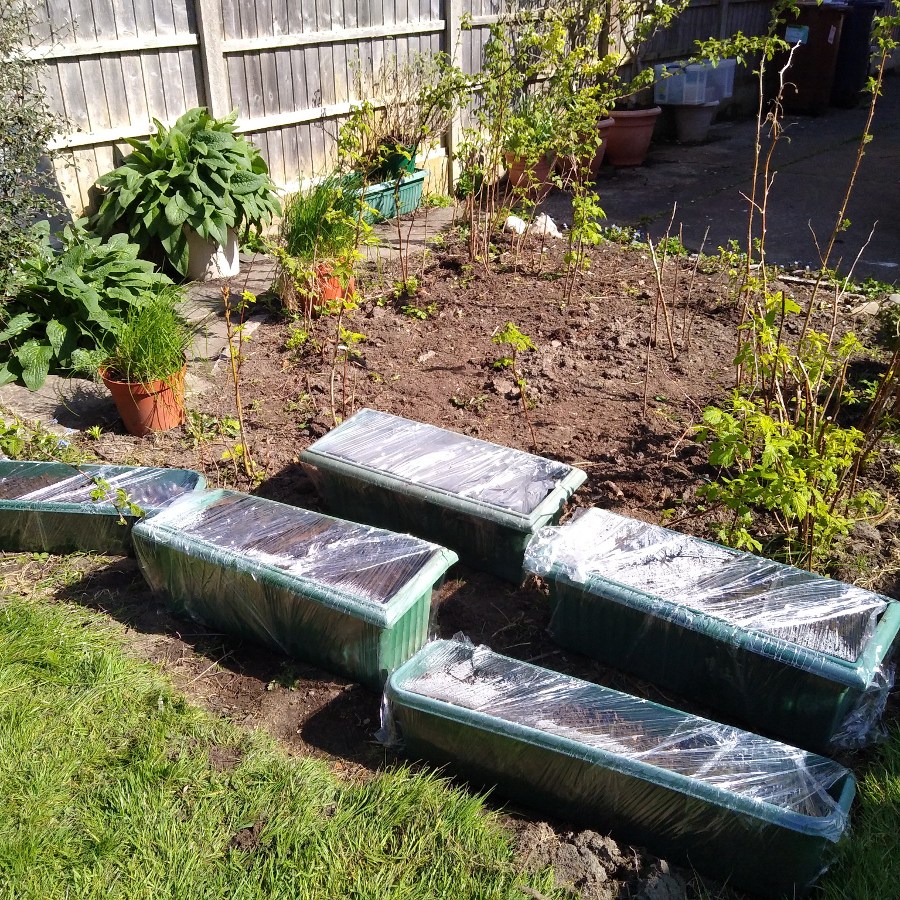
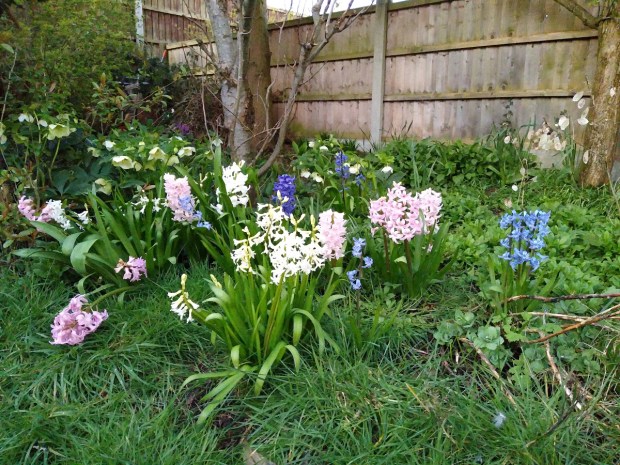
And so I tend my parents’ garden, cutting back years of overgrowth, clearing the paths, weeding amongst the many beautiful flowers that already grow here – hyacinths, daffodils, bluebells, honesty. And the shrubs and trees – apple, pear, rose, quince, camelia. Watering the raspberry canes. Sowing herb and lettuce seeds in troughs and veg seeds – carrot, turnip, onion, cauliflower, broccoli – in the soil.
And somewhere along the way it enters my mind this is ‘Creiddylad’s Garden’. And once the thought has entered it will not leave. I come to see the face of Creiddylad, ‘the most majestic maiden in the islands of Britain’, one of our Brythonic goddesses of flowers and spring, in each flower.
Creiddylad is a sovereignty deity who walks between worlds and lovers. This ‘majestic maiden’ is truly a majesty, a Queen, the lifeforce of nature who inspires great awe in her worshippers and the male deities, Gwyn and Gwythyr, Kings of Winter and Summer, who fight for her every Calan Mai.
Through the Winter she dwells with Gwyn, in the Otherworld, as Annwn’s Queen. In the Summer, with Gwythyr, she is May Queen, a great sovereign in Thisworld, revealing herself slowly flower by flower.
In Creiddylad’s contrary nature I find a better understanding of my own pulls between darkness and light, Thisworld and Otherworld. There is a part of me that wants to walk with Gwyn, a warrior and psychopomp, facing death, disease and sorrow. And at the same time an awareness he and other humans do this so the rest of us can appreciate the flowers and the sunlight and the lives that are our gifts.
It sometimes seems easier, more worthy, to embrace pain than pleasure. Why? I do not know. Only that in Annwn the sadness of the dead is transformed into great beauty and joy, and it this is that Creiddylad brings with her when walks from the Otherworld, into the light, and embraces Gwythyr.
Many of the flowers in my garden speak of similar myths through the correlates of other cultures. The narcissus, or the daffodil, was the plant Persephone was picking before Hades took her to… Hades. The hyacinth was born from the blood of Hyacinth, the lover of Apollo, killed by his rival Zephyrus, and its beautiful petals are inscribed with ‘AI AI’ ‘Alas’. Lungwort’s petals turn from pink to blue as the flowers are pollinated, edging toward death, like flesh, or deoxygenated blood.
Nature and myth, death and life, Thisworld and Otherworld, are deeply intertwined in Creiddylad’s garden. A place where I work slowly, contemplating the mysteries, where I meet flowers, goddess, gods. It seems they don’t want me to be a hero but instead a small suburban bee offering a taste of Creiddylad’s honey.
It’s the last day of March. It has been a week since the lockdown to contain coronavirus began in the UK. I wake at 4am, as has become my habit, and lie awake with my mind running through all the things I need to do and all the worries that it is useless to worry about and then I beat myself up for worrying about them. By 5.30am I’ve had enough and decide to get up and do something useful.
Breakfast, my morning prayers to my gods and the spirits of place, my daily too often failed attempt to sit and breathe and listen. Then I fire up my laptop, open Firefox, and click on the link to gmail. ‘This webpage is unavailable’. Agh. How the hell am I going to send my patron newsletters? Now my conservation internship has been cancelled until who knows when I have no route into paid work and my Patreon account is my only source of income. My heart’s racing and I can’t breathe as I check the modem (green lights on) and my network connection (fine) then turn the machine on and off.
Thankfully it starts working. I can breathe again. And now I’m looking back at my reaction. What the fuck? How, in the space of a few days, have I gone from being happy in a role that involves making positive changes out in nature alongside likeminded people – building a hibernaculum for newts, planting wildflowers, installing an outdoor classroom – to being completely dependent on something as ineffable and fallible as the internet not only for money but for a place in society?
~
Over the past few days I have been reflecting on how much of my identity and reason for being have become bound up with this blog, which provides a platform for my voice as an awenydd in service to Gwyn and the gods and spirits of my landscape and my online communities, as well as for book sales.
Its small successes have partly been down to my use of social media platforms such as Facebook and Twitter. Over the past few years the former, in particular, has had a massively detrimental effect on my mental health. For me it’s the virtual equivalent of walking into a large, noisy crowd in a magical castle that has no walls but the multiplicity of glass screens that grant us access and contain us.
Attempting to find friends and acquaintances at some illusory fairy feast where the food looks its tastiest but cannot be touched and interacting only with their reflections in their best party gear. Like the speechless dead their mouths do not move and their facial expressions do not change one bit.
Yet words appear on the page and conversations take place, stuttering, dragging on for days, as people blink in and out of existence, moving between the worlds, like ghosts. Being able to flit in and out of the crowd, of groups, creates a perennial nosiness. It takes up an incredible amount of headspace trying to keep up, to find the right answers, to argue against points of disagreement, to read responses in the absence of real faces. When I get offline a part of me remains in the glass castle, a shadow of myself arguing with shades of my own imagining, exhausted, distracted, lost.
I recognise this. But it’s only when coronavirus hits and so many people are forced online for work and to communicate due to the social distancing rules I realise just how powerful the internet has become. To the point we can neither earn a living nor live without it. The web has made it possible for us to work and meet without travelling (which is also greener) and set up groups for mutual support. I admit these are very good things yet something within me is screaming a warning about the surrender of our power to the invisible rulers of the halls of the internet on their glass thrones.
I make the decision to leave Facebook. It’s hard. I know the costs. I will lose contact with people, I will miss events, I will be giving up opportunities for publicity. Less people will see my blog posts and buy my books. These are the teeth, like a monster of Annwn, it has sunk into me. These are the tendrils of dependency that the beast beneath the glass castle has coiled around me, extending from my virtual being to my well being in Thisworld. It hurts when I pull them off, although there is no blood.
I return to Peneverdant, to the green hill in this virtual space between Thisworld and Annwn. I look back at the times I’ve been lost in the ether of pointless arguments and at the good it’s done. Through it I’ve helped real people connect with real lands and real gods and put real books in their hands. But at the cost of the loss of a piece myself, the surrender of part of my identity, to the glass castle.
Looking forward, to the promised ‘when this is all over’, I realise, if I survive, I no longer want to be ruled by the web. I want to walk again amongst the people of Thisworld and Annwn. To put down firmer roots in my land and my community – I determine that I will carry on volunteering for the Wildlife Trust whether it leads to paid work or not and put my name on the waiting list for an allotment. I will continue my service of blogging here but I will not let it rule or define me.
I whistle to that lost piece of my soul and pray to my god, Gwyn ap Nudd, to guide it back to his glass castle in Annwn where our souls are reunited and the dance of the dead reconciles illusion and truth.
~
Only once this process is complete do I feel ready to face the scary now this piece self-indulgently avoids. The escalating infections, the escalating deaths, of course relayed in figures and graphs by the internet. The rising numbers worldwide, across the UK, here in Lancashire. I see people are infected in Liverpool, Salford, Bolton, Wigan, Chorley, Blackpool, dying in the Royal Lancaster Infirmary.
That soon it will be here in South Ribble and Preston. That people will be fighting for their lives and dying in the Royal Preston Hospital, where the day centre has been allocated to coronavirus patients. I fear for my elderly parents, friends who are old or have health problems, know I’m not immune.
I’m asked to provide a pagan perspective on faith requirements in relation to excess deaths as a result of COVID-19 for the Lancashire Resilience Forum (Lancashire County Council’s emergency planning service). A small useful thing I can do. I revive my Microsoft laptop to attend a Skype meeting.
Right now there is no avoiding using the halls of the internet’s glass castle to bring about physical changes. All over the world fellowships are founded with people we may or may not see on the otherside. I walk these spaces more mindfully, my eyes on the goal, not allowing myself to get lost. I pray that one day some of us will meet on the green hills of Thisworld and, if not, on the hills of Annwn.
‘We need to remember that our very breathing is to drink our mother’s milk – the air – made for us by countless microbial brothers and sisters in the sea and soil, and by the plant beings with whom we share the great land surfaces of our mother’s lustrous sphere.’ Stephan Harding
Inspire. Expire. Anadlu i mewn. Anadlu i allan. Breathe in. Breathe out.
Respiration (from spirare ‘breath’ and re ‘again’) is participation.
Inspire. Expire. Anadlu i mewn. Anadlu i allan. Breathe in. Breathe out.
Lungs. Two. Right and left. Each enclosed in a pleural sack in the thoracic cavity of the chest. Primary bronchus, secondary bronchi, tertiary bronchi, terminal bronchiole. In the alveoli, ‘little cavities’, across the blood-air barrier, gas exchange takes place.
Breathe in: oxygen 21%, carbon dioxide 0.04%. Breathe out: oxygen 16%, carbon dioxide 4.4%. 6 carbon glucose, oxidised, forms carbon dioxide. Product: ATP (adenosine triphosphate) ‘the molecular unit of currency of intracellular energy transfer’. The spark of all life.
Inspire. Expire. Anadlu i mewn. Anadlu i allan. Breathe in. Breathe out.
Respiration (from spirare ‘breath’ and re ‘again’) is participation.
Inspire. Expire. Anadlu i mewn. Anadlu i allan. Breathe in. Breathe out.
Birds have lungs plus cervical, clavicular, abdominal, and thoracic air sacs. Hollow-boned they are light as balloons, breathing in, breathing out. Then there are the lungless. Through tiny holes in the abdomen called spiracles leading to the trachea, insects fill their air sacs. Earthworms and amphibians breathe in and out through moist skins. Fish breathe water in through gulpy mouth breathe it out through gapey gills.
Plants breathe through their leaves. By daylight they photosynthesise. Stomata breathe carbon dioxide. It mixes with water. The green lions of chlorophyll work their magic by sunlight. Oxygen is released. From glucose the magical hum and buzz of ATP. At night they respire glucose and oxygen back to carbon dioxide and water. 10 times more oxygen produced than used.
Underground fungi breathe the air of the soil through thread-like hyphae that mass as mycelia. They respire aerobically (with oxygen) or anaerobically (without oxygen), changing glucose to ATP (it’s all about ATP!), ethanol, carbon dioxide, and water. This old, old, metabolic pathway dates back to the days before oxygen ruled our breath and is utilised by microbes. The hidden ones of the deep, single-celled, or living colonies, breathe through their single cell walls in ancient ways – acetogenesis, methanogenesis – to gain the blessed ATP.
Inspire. Expire. Anadlu i mewn. Anadlu i allan. Breathe in. Breathe out.
Respiration (from spirare ‘breath’ and re ‘again’) is participation.
Inspire. Expire. Anadlu i mewn. Anadlu i allan. Breathe in. Breathe out.
And what is this creature that does not breathe (in or out) with no metabolism or need for ATP? This simple strand of genes in a designer jacket called a capsid? Does this thing, neither dead nor living, have a spirit? Like all living things was it breathed into life by the gods?
Or is this death-bringer undead? This assaulter of lungs? Lung-cell-killer and causer of coughs – dead lung cells coughed up as sputum, mucus, the yellow remains of what was ours?
By what dark programme does it turn the body against itself – alveoli ‘little cavities’ where the exchange of carbon dioxide and oxygen takes place filling with water – no space to make ATP? No lungs – no breath. The pump of ventilators, breathing in, breathing out, our new iron lungs…
Did it crawl from the cauldron of inspiration like the speechless dead or is it something entirely other?
Inspire. Expire. Anadlu i mewn. Anadlu i allan. Breathe in. Breathe out.
Respiration (from spirare ‘breath’ and re ‘again’) is participation.
Inspire. Expire. Anadlu i mewn. Anadlu i allan. Breathe in. Breathe out.
To whom do we pray? To the gods and goddesses of breath and to the spirits of inspiration? To Ceridwen, Gwyn ap Nudd, Morgana and her sisters, who gave us breath, and take it away?
“Breath always leads to me,” says Gwyn. I find this reassuring and disconcerting from a death-god. From the one who releases the spirits of Annwn from the cauldron and holds them back.
So we breathe together with the lunged and lungless creatures with skin, fur, feathers, shells, scales, leaves, hyphae, the single-celled, the uncelled who ride our breath, until we return to the gods. To the winds that carry the voices of all ancestors over our 4.543 billion year old earth.
Inspire. Expire. Anadlu i mewn. Anadlu i allan. Breathe in. Breathe out.
Respiration (from spirare ‘breath’ and re ‘again’) is participation.
Inspire. Expire. Anadlu i mewn. Anadlu i allan. Breathe in. Breathe out.
*I adapted this meditation from an earlier version ‘The Ways We Breathe‘ previously published on Gods & Radicals following guidance from my deities to focus on my breath and being struck by the realisation that a distinguishing feature of coronavirus and other viruses is that they do not breathe.
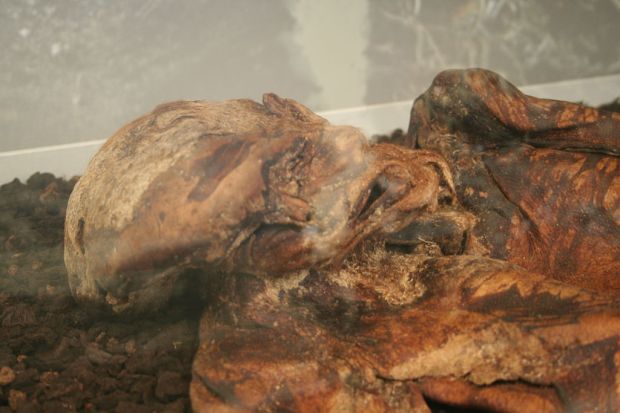
The wetlands of the old counties of Lancashire and Cheshire which were inhabited by the Setantii tribe ‘The Dwellers in the Water Country’ are well known for their bog burials; Lindow Man and Woman, Worsley Man, severed heads from Pilling Moss, Briarfield, Red Moss, Ashton Moss, Birkdale.
The archaeological evidence suggests that Lindow Man and Worsley Man were human sacrifices. Lindow Man (also known as Lindow II) was strangled, hit on the head, and his throat was cut before he was cast into the peat bog. Worsley Man was garotted and his skull fractured before his beheading. These ‘overkill’ injuries are suggestive of ritual killing rather than death in battle or murder.
This is supported by the fact many bog burials from Britain and Europe ate special last meals. The last meal of Lindow Man was a griddle cake baked from finely ground wheat and barley. Lindow III, another man whose remains were found nearby, ate a meal of wheat and rye with hazelnuts. Old Croghan man from Ireland, and Grauballe Man and Tollund Man from Denmark also ate similar meals.
The head from Briarfield was ‘deposited in a defleshed state without the mandible’ ‘with abundant remains of hazel’. Further north, at Seascale Moss in Cumbria, a body was buried in the bog with a hazel walking stick. Miranda Aldhouse Green notes that bog bodies from Gallagh in Ireland and Windeby in Germany wore hazel collars and another from Undelev in Denmark was buried with three hazel rods.
She connects them with a lead defixio of ‘late Roman date’ ‘from the river Ouse near the Hockwold Roman temple’ in Suffolk: ‘Whoever… whether male or female slave, whether freedman or freedwoman… has committed theft of an iron pan, he is to be sacrificed to the god Neptune with hazel’.
The Romans equated Neptune with our ancient British water-god Nodens at Vindolanda on Hadrian’s Wall where an inscription reads ‘DEO NO/NEPTU’. At his Romano-British temple at Lydney, Nodens is depicted on a mural crown driving a chariot pulled by four water-horses accompanied by winged wind-spirits and centaurs with fish-tails and a fish-tailed fisherman.
Nodens gifted pilgrims with healing dreams but was also called upon to remove health. A curse tablet reads: ‘For the god Nodens. Silvianus has lost a ring and has donated one-half [its worth] to Nodens. Among those named Senicianus permit no good-health until it is returned to the temple of Nodens.’
It thus seems possible the people who ingested hazel prior to their deaths or were buried with it were sacrifices to Nodens who was equated with Neptune due to his watery qualities by the Romans.
***
The associations between Nodens and hazel have deep mythic roots. In Ireland Nodens was known as Nuada Airgetlám ‘Silver Hand’ and Nechtan (from the Old Irish necht ‘clean, pure, white’). Nechtan was the keeper of the Tobar Segais ‘Well of Wisdom’. Around it stood nine hazel trees which dropped their hazelnuts, containing imbas ‘inspiration’, into the water. They were eaten by salmon and this special poetic wisdom, known as awen in the Welsh myths, was infused into their flesh.
Only Nechtan and his three cup-bearers: Flesc, Lam, and Luam, were allowed to visit the well. Of those who transgressed their eyes would explode (!) – a possible metaphor for the effects of poetic vision.
When Nechtan’s wife, Boann, disobeyed this command the well overflowed and became the river Boyne. One of its kennings is ‘the forearm of the wife of Nuadhu’ and it was known in the early 2nd century CE as Buvinda (from early Irish *Bou-vinda ‘the white lady with bovine attributes’).
When Finn ‘White’, a descendant of Nuadha, cooked the Salmon of Wisdom for his master, Finnegeas, he burnt his thumb, put it in his mouth, and accidentally imbibed his eye-bursting imbas.
I believe it is likely a similar mythos surrounded Nodens here in Britain. On his mural crown a fisherman is catching a large fish and, on a mosaic on his temple floor at Lydney, two sea monsters are surrounded by salmon. Additionally, in medieval Welsh mythology, Arthur and his men ride up the river Severn, past the Temple of Nodens, on the back of the Salmon of Llyn Llyw, to rescue Mabon.
In the dindsenchas the river flowing from Segais has many names. In Ireland it is not only known as the Boyne, but the Trethnach Tond ‘Ocean Wave’ and Sruth Findchoill ‘Stream of White Hazel’. Abroad it becomes Lunnand in Scotland, the Severn in England, then the Tiber, Jordan, Euphrates and Tigris.
At Lydney we also find iconography depicting Nodens’ wife and our British Boann: a stone statuette, thirty inches in height, left leg crossed over right, holding a cornucopia. Pins were offered to her by women seeking aid with childbirth. Unfortunately we do not know her name but the early Irish Bou-Vinda may relate to Vindos/Gwyn ap Nudd, the son she bore Nodens/Nudd. Gwyn’s name not only means ‘White’, but he is referred to as a ‘bull of battle’ in ‘The Conversation of Gwyn ap Nudd and Gwyddno Garanhir’, suggesting he inherited her bovine attributes.
As Vindonnus, at a spring in Gaul, he was offered bronze plaques depicting eyes. It has been suggested they were for aid curing eye ailments but they may also have been connected with poetic vision.
In medieval Welsh mythology, Gwyn, as Pen Annwn ‘Head of the Otherworld’, is the guardian of a cauldron that is warmed by the breath of nine maidens and will not brew the food of a coward, suggesting it is associated with initiation into the mysteries of the awen tasted from its bubbling waters.
It seems Gwyn, who like Finn, has tasted the wisdom of the salmon from the hazelnuts from the nine hazel trees, and received his awen, later adopts his father’s role as a wisdom-keeper.
***
How, then, does this ancient Celtic mythos appear in and relate to the Water Country? On Cockerham Moss two Romano-British silver statuettes dedicated to Nodens as Mars-Nodontis were found. This suggests that a temple lay nearby. Cockersand Abbey, the closest sacred site, is dedicated to Mary of the Marsh, a Christian overlay on an earlier water-goddess – the wife of Nodens. I know her as Anrhuna which means ‘Very Great’ and is probably only one of her names.
The church on Castle Hill, the pen which gives its name to Penwortham (earlier Peneverdant ‘the Green Hill on the Water’ as it stood on Penwortham Marsh), is dedicated to St Mary the Virgin, as was the holy well at the hill’s foot. The large number of Marian dedications in the marshy areas of Penwortham and Preston with their sacred springs hint at the underlying presence of this water-goddess.
The legend of Penwortham Fairy Funeral, set on Castle Hill, with its fairy leader ringing a passing bell and singing a mournful chant as he leads a procession of little black-clad men in red caps, bearing the fairy-double of an unfortunate young man to his grave suggests the presence of Gwyn.
Past the pen, sacred to Anrhuna, Nodens, and Vindos/Gwyn/Pen Annwn, runs the river Ribble. From Ptolemy’s Geography (2AD)we know Belisama is the goddess of the Ribble. She is the sister and/or consort of Bel, who is later known as Beli Mawr, father of Nudd/Lludd. The Ribble is rich in salmon and Maponos/Mabon and his mother Matrona/Modron were worshipped upriver at Ribchester. Modron is the daughter of Afallach (from afall ‘apple’), King of Annwn, a name of Gwyn.
Here, at the Green Hill on the Water, we find a parallel with Lydney ‘Lludd’s Island’. With salmon swimming upriver past a site associated with Mabon to the source where perhaps once stood nine hazel trees.
These stories run deep through this land as they ran through the land of our ancient British ancestors. Before its draining it was truly a water country of intertidal marshlands, reedbeds, carr, lakes and pools, peat bogs, and a damp oak woodland in which hazel and its nourishing nuts were precious.
It’s no wonder they were associated with Nodens, ‘the Catcher’, the wise fisher-god. Perhaps, by sacrificing their enemies to Nodens with hazel, the water dwellers repaid him for his generosity.
Another possibility is that some of the bog burials were devotees of Nodens sacrificed willingly to their god. Awenyddion who, like his son, had imbibed the hazel-rich awen. Lindow III’s consumption of hazelnuts before his death may have been a last act of communion. The man buried with the hazel staff might have carried it as a symbol of his role as a wisdom-keeper.
Hazel grows on the banks of Fish House Brook, which runs through the area once known as Fish Pan Field in Greencroft Valley into the river Ribble. In autumn its nuts are eaten by grey squirrels before they can drop into the brook where, due to changes in water level and pollution, fish no longer swim.
Still, as I pass, I think of the myth of Nodens and his nine hazel trees, Anrhuna’s transgression, Vindos/Gwyn eating the salmon imbued with awen from the hazelnut and his eye-bursting poetic vision, which he has gifted to me as his awenydd to pass on and share with my communities.
***
SOURCES
Anne Ross, Pagan Celtic Britain, (Cardinal, 1974) Anne Ross, Life and Death of a Druid Prince: The Story of Lindow Man, an Archaeological Sensation, (Touchstone, 1991) David Barrowclough, Prehistoric Lancashire, (The History Press, 2008) Finnchuill, ‘Catching Wisdom: Nuadha, Nechtan, Nodens’, Finnchuill’s Mast, (2016) Jody Joy, Lindow Man, (The British Museum Press, 2009) Kay Muhr, ‘Water Imagery in Early Irish’, Celtica 23, (1999) Miranda Green, Dying for the Gods, (The History Press, 2002)







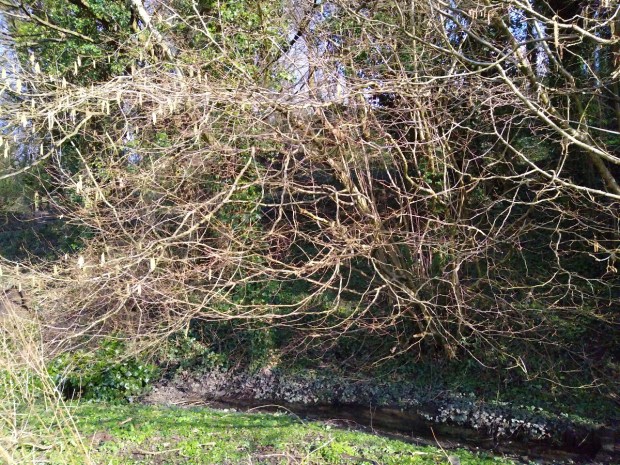

 The Sanctuary of Vindos