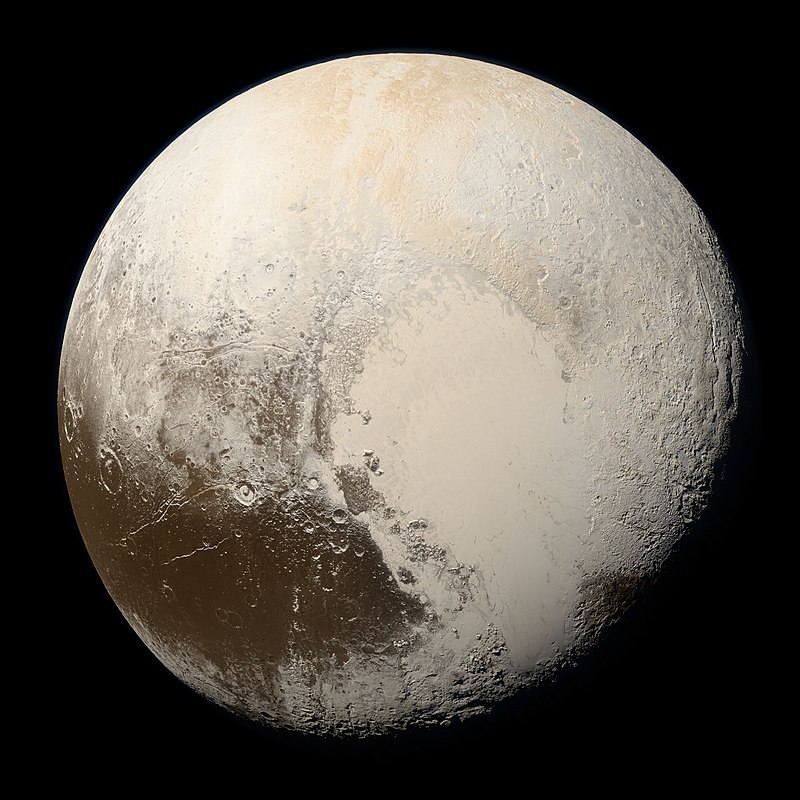
was the night you were furthest away from the world like a distant asteroid – like Pluto.
From now you’re coming back – your land of ice and darkness will thaw and the mists will make it beautiful again.
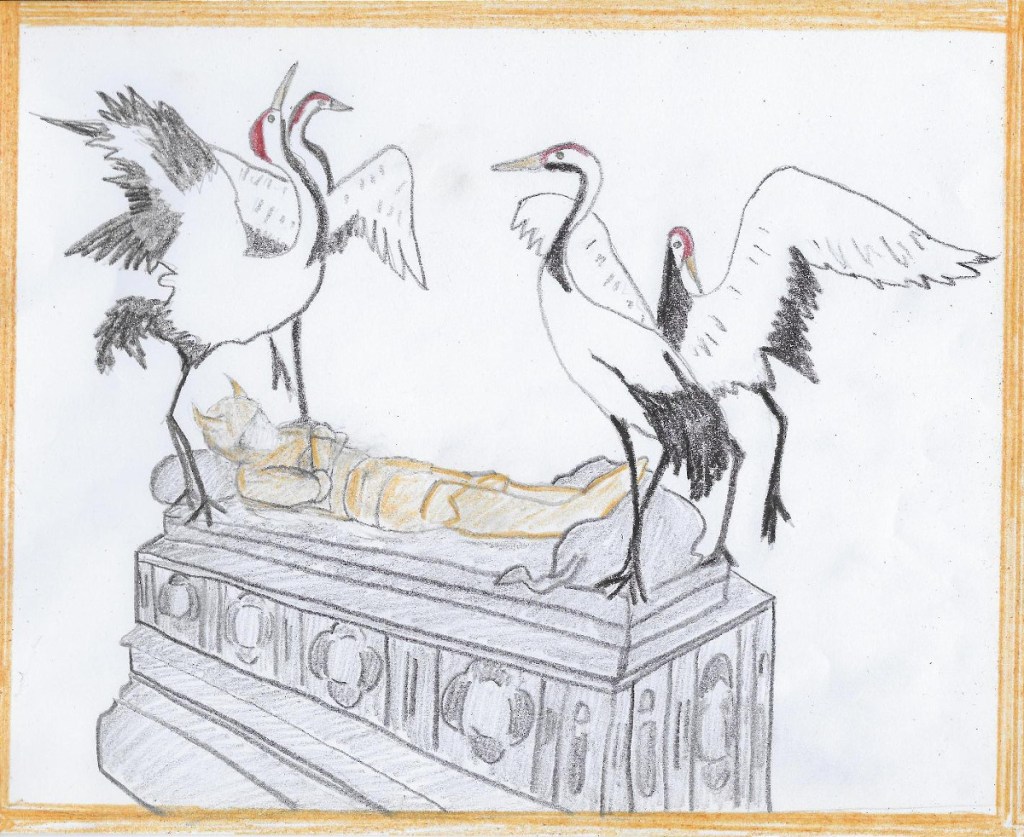
From the coffin where you dream of nuclear winter you will step into a new suit of armour.
Summer is a’coming to Annwn and winter is already on its way here.
This poem is based on my gnosis that whilst it is summer in Thisworld it is winter in the Otherworld. It is addressed to Gwyn ap Nudd, a Brythonic ruler of the Otherworld and Winter’s King, who is killed by his rival, Gwythyr ap Greidol, Summer’s King, on Calan Mai, and sleeps through the Summer.
After I received this poem in a vision this morning I looked up Pluto, a planet named after the Roman King of the Underworld and saw that, in Japanese its name is Meiōsei – ‘Star of the King of the Underworld’. I thought this was very beautiful and apt for the planet that rules my birth sign, Scorpio, much as Gwyn, my patron god, is the ruling force in my life.
I then returned to an essay by Brian Taylor called ‘Photographing the Underworld? A Note of NASA’s Pluto Fly-by’ which has had a big influence on me. Here he speaks of how the photographing of Pluto ‘ruler of occultation, and protector of the integrity of mystery’ may have been saved from being an act of ‘casual intrusion’ by the plutonium powered spaceship carrying the ashes of Clyde Tombaugh ‘discoverer of Pluto’ (as a kind of offering to the underworld gods?).
Brian also speaks of how he ‘traced the exteriorisation of Pluto in the history of the nuclear era, and found the planet’s signature etched into the geography of the discovery region, most notably in an extraordinary spatial co-incidence. Pluto was discovered in 1930 at the Percevall Lowell Observatory in Flagstaff Arizona. Ten years later Plutonium was manufactured at the Lawrence Livermore Laboratory in California, and five years after that the first atomic bomb was detonated at the Trinity Test Site north of Alamagordo in New Mexico. Curiously these three sites fall in an almost perfect straight line, about a thousand miles long, that maps the connection between the planet and the nuclear project on to the land in the most unexpectedly graphic way.’
Coincidentally I have been returning to these themes, which I touched on in The Broken Cauldron, in the later sections of the new book I am writing, which explores more deeply the influence of the gods within the modern world and Gwyn’s connections with nuclear war and nuclear winter.
At the bottom of the essay I saw an old comment I left for Brian in 2015 mentioning a dream I had about Gwyn and nuclear winter, leading me to recall it. Brian notes that the spaceship made closest contact with Pluto on a dark moon and the moon was dark last night.
‘My soul, where are you? Do you hear me? I speak, I call you – are you there? I have returned. I am here again.’ Carl Jung
In his Red Book Carl Jung speaks of refinding his soul and rebuilding his relationship with her after a period of soul loss. He was called to do this by ‘the spirit of the depths’ who is opposed to ‘the spirit of this time’:
‘The spirit of this time would like to hear of use and value… that other spirit forces me nevertheless to speak beyond justification, use, and meaning… He took away my belief in science… my understanding and all my knowledge and placed them at the service of the inexplicable and the paradoxical. He robbed me of speaking and writing for everything that was not in his service.’
Jung records how the spirit of the depths opened his eyes to vision – to his soul, the things of the soul, and the soul world. This spirit forced Jung to stop treating his soul as a ‘scientific object’ and told him to ‘call upon her as a living and self-existing being. I had to become aware that I had lost my soul.’
Once he reached that awareness Jung called out to his soul and encountered her as a person and as a living landscape. She appeared to him in a number of guises (all female) – as Salome, as the spirit of a dead girl (who forced him to eat her liver!), as a serpent, and as a ‘small white bird’. She showed him a variety of visions, some of which predicted the First World War, some beautiful, most Hellish. She appeared to him as a desert, and, it may be argued, as the many places in Hell he explored.
Jung learnt that he is merely the ‘symbol and expression’ of his soul. She taught him that everything he does and says ‘comes from and belongs to me’. Ultimately he entered ‘the service of the soul’.
***
Jung’s words are of interest not only because they contain a great deal of mystical depth and wisdom but because they remind me of my own calling to serve Gwyn ap Nudd, a god of Annwn (‘the Deep’ – the soul world in the Brythonic tradition) and to restore my relationship with my own soul.
Like Jung I was called away from service to ‘the spirit of the times’ by ‘the spirit of the depths’.
From doing something ‘of use and value’ to the ‘inexplicable’ and ‘paradoxical’ – to ‘the service of the soul’. This happened when I decided to write my PhD thesis on ‘Imagination’ in William Blake’s prophetic books rather than trending topics and in my choice to write books based on personal visions that challenge the grounds of already obscure Brythonic/Welsh myths rather than a ‘how to’.
It’s only since I’ve accepted I’m never going to be able to make a living from such work and stopped using social media to publicise it I’ve managed to make space to journey and write more deeply.
Over the past month I’ve begun a quest, like Jung’s, for ‘a myth to live by’, that has been calling me even further away from the myths that others recognise from the medieval Welsh texts. To visions of my gods that are more direct, unfiltered by Christianised narratives, but less recognisable and hence relatable (unless, as I hope, I ultimately succeed on touching, through the personal, on the universal…).
In this space, as a way of repairing my own soul loss, I have been reconsidering my relationship with my soul. This began the day I met Gwyn leading the fairy funeral procession on Fairy Lane in my home town of Penwortham. Unlike in the original legend in which the fairies were tiny black-clad men clad with red caps they were taller than me and dressed in Victorian funeral garments. Gwyn, who I didn’t recognise, was wearing a black hat and leaning on a walking cane, his only recognisable feature being his long, silky white hair. As in the original the ‘fairies’ carried a coffin. And, like the hapless protagonist, I looked into the coffin and saw my own corpse. Only she looked ‘other’. Gwyn told me “a part of your soul is trapped in Annwn” before revealing his identity.
When I started journeying to Annwn with Gwyn I was reunited with this lost part of my soul. She appears as a warrior-huntress (who I am and/or watch) aboard my white winged mare with hounds. She’s everything I’m not – practical, courageous, able to fight, hunt her own food, survive in the forest.
At first I wondered whether this is simply facile wish fulfilment. Shouldn’t I, a suburban muppet, be more like my usual bumbling, clumsy, scatter-brained self? To this Gwyn replied with a resounding “No!” and told me this is the exact form my soul needs to take to get work done in his world.
I wasn’t completely certain she was my soul at first and I’m still not sure she’s the whole of my soul. Yet I haven’t found any other parts yet. I’ve has inklings in intuitions and dreams of past lives as a soldier and a nun but they feel like past selves my soul has inhabited rather than soul parts. There is also the dark magician who sometimes shows up in my dreams and who I’ve chased through a number of books and who I’ve always kind of wanted to be if only I was good at magic. I spent a while wondering if he is my animus* but have reached the conclusion he has his own enigmatic existence, that dark magicians don’t give away their secrets, and accepted him as a guide of sorts.
In contrast to Jung I’ve found that my soul rarely speaks to me. For the past eight years since I’ve journeyed with/as her she hasn’t said a word and it’s only since reading Jung I’ve tried to speak to her. This resulted in her telling me to ‘be silent’ and ‘to come’ (to see what she had to show me). This demonstrates it’s not that she can’t speak but she’s not very talkative. I’m guessing this may be because I’m so full of words and chatter and her silence compensates like with our other qualities.
I think it’s possible that my white winged mare and perhaps my hounds are also parts of my soul. I believe my mare has been with me since birth and am tentatively referring to her as ‘my soul animal’ or ‘my spirit animal’ (as opposed to ‘a spirit animal’) to avoid terms from other cultures such as ‘power animal’ or ‘totem animal’. This manifested early on in me galloping round and round the playground on my own pretending to be a horse when the other children were playing games. Eventually I started horse riding and spending all my time at a local riding school working for rides, training as a riding instructor, and later returning to a career in horses after finishing my PhD.
And with horses there were always yard dogs – labradors, terriers, the crazy cocker spaniel I shared a mobile home with. Unlike with horses I’ve never had my own dog (my parents are cat people) so I’ve never got to know dogs that intimately. Whilst I generally feel at one with my horse I often feel like I’m full of yappy excitable hounds jumping up and down inside me that refuse to calm down. Like the dogs that come and shake all over me or out me when I’m meditating I find them annoying. Whilst I’ve only got one horse** my first hound guide was an old shaggy wolf hound and he was replaced by two young Hounds of Annwn when I decided to make my lifelong dedication to Gwyn.
So my current view contrasts with Jung’s in that my soul appears as many parts at once. Also my soul is both male and female – my huntress is female, my mare is female, and both my hounds are male.
My main challenge in this deepening ‘service of the soul’ is learning to trust my soul. Putting aside my feelings of bitterness and resentment that my soul will never earn me any money and my fears that by following my soul away from known Brythonic mythology I may lose my already small audience.
But what are these fears compared to losing one’s soul?
*Mainly because Jung states that that men have a female anima and women have a male animus – a gendered binary logic that doesn’t ring true to me. **Ok there’s ‘the dark horse’ but I think he’s a water-horse, a land spirit, rather than a part of my soul.
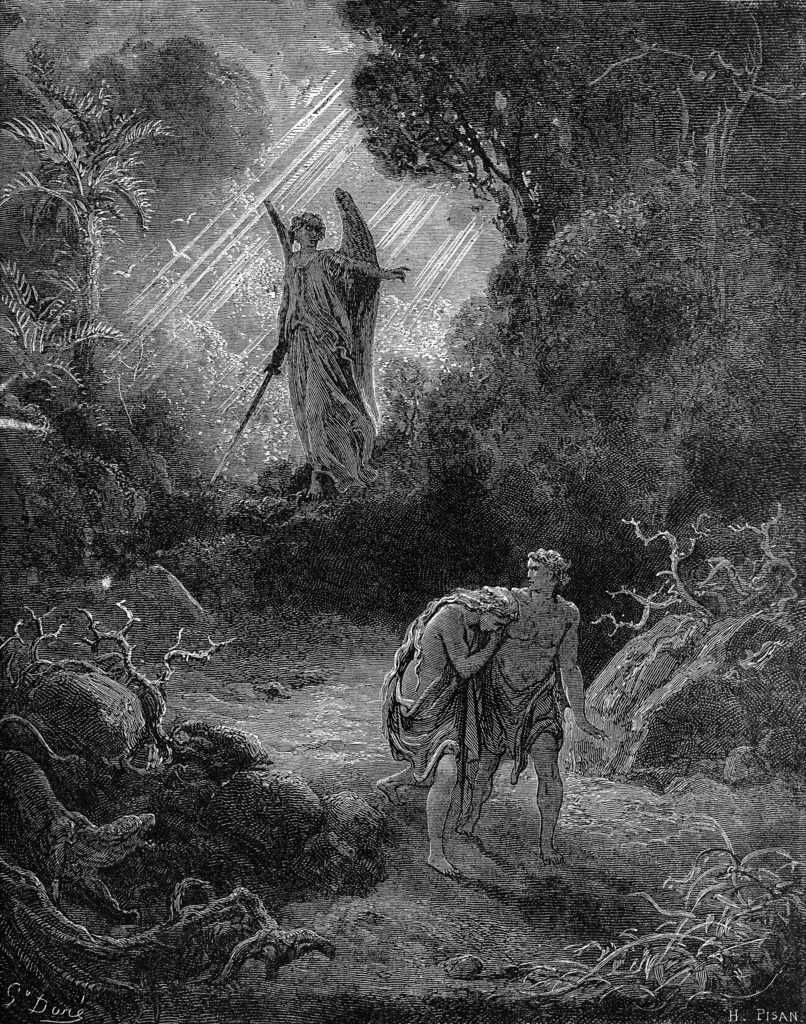
‘… to nobler sights Michael from Adam’s eyes the film removed Which that false fruit that promised clearer sight Had bred, then purged with euphrasy and rue The visual nerve (for he had much to see) And from the Well of Life three drops instilled. So deep the power of these ingredients pierced Even to the inmost seat of mental sight That Adam now enforced to close his eyes Sunk down and all his spirits became entranced. But him the gentle angel by the hand Soon raised and his attention thus recalled: Adam, now ope thine eyes and first behold The effects which thy original crime hath wrought…’ Paradise Lost
I’ve recently been re-reading John Milton’s Paradise Lost (1667). The third or fourth time round this epic vision seems no less powerful in its depictions of Heaven and Hell and Earth both pre and post fall or radical in Milton’s writing the perspective of Satan and his inner motivations and turmoil.
As an Annuvian kind of person I will admit to feeling more sympathy with Milton’s rather magnificent Satan, refusing to serve in Heaven preferring to reign in Hell, the only one amongst the fallen angels (who include many pre-Christian gods) who dares travel to Paradise to thwart God’s plans by bringing about the fall, than the brainless Adam and Eve, Milton’s spoilsport God, or his Son.
The ending, with its deus ex machina, again was disappointing. It turns out the fall was not only predicted but designed by God to make possible and all the more powerful Jesus’ redemption of humanity. Paradise Lost is, in essence, a work of theodicy, written ‘to justify the ways of God to men’.
I’m sharing this because, whilst re-reading the book, I found the lines cited above that seem to contain Christian and pre-Christian Brythonic lore. When the archangel, Michael, purges Adam’s fallen sight he not only uses traditional plants – euphrasy, or eyebright, and rue were used for treating eye ailments – but ‘three drops’ from ‘the Well of Life’. This grants Adam visions of the future, mainly the ill-doings of his offspring until the Flood. As far as I know there is a Tree of Life but not a Well of Life in Paradise in Christian literature, which makes me wonder if it comes from another source.
The most obvious is the Welsh ‘Story of Taliesin’. In this tale Gwion Bach steals three drops of awen ‘inspiration’ from the cauldron of Ceridwen, which grant him omniscience as the all-seeing Taliesin. Milton’s evocative description of these ‘ingredients’ piercing ‘to the inmost seat of mental sight’ and putting Adam into a trance before he opens his eyes to see the future fit shares similarities with the prophetic visions of Taliesin and other awenyddion, ‘persons inspired’ referred to by Gerald of Wales.
However, although this story had been published in Welsh in the mid-16th century, it was not available in English at Milton’s time. Whether he had travelled to Wales (Milton was born in London, studied at Cambridge, lived in Berkshire, and travelled extensively throughout Europe before returning to London) or had heard the story in England in some form remains unknown.
The resemblances are so uncanny that, if he had not, it seems possible he was tapping into some deeper source. It is of interest that Milton refers not to a cauldron, but to a well, a far older image. Throughout the British and Irish myths cauldrons and wells are associated with inspiration and rebirth.
After Gwion tastes the awen Ceridwen pursues him in a shapeshifting chase and swallows him into her crochan ‘cauldron’ or ‘womb’ from which he is reborn, shining-browed, and omniscient as Taliesin. In ‘The Second Branch’ the cauldron brings dead warriors to life. In ‘The Spoils of Annwn’, refusing to ‘boil the food of a coward’ it is associated with the bardic initiation rites of Pen Annwn.
In the Irish myths the Well of Segais is associated with imbas ‘inspiration’. No-one was allowed to approach it except its keeper, Nechtan, and his three cup-bearers on pain of their eyes exploding. However, Boann, Nechtan’s wife, disobeyed. It overflowed and she was dismembered and died. The river created took her name – the Boyne. When Finn burnt his thumb whilst cooking a salmon from this river he received the imbas. In The Battle of Moytura the Tuatha Dé Dannan dig Wells of Healing and throw in their mortally wounded, who not only come out whole but more ‘fiery’ than before (!).
It seems that Milton is, indeed, tapping into a deep source. Here, in Peneverdant we once had a Well of Healing, dedicated to St Mary at the foot of Castle Hill, which I believe was associated with an earlier Brythonic mother goddess of healing waters who has revealed her name to me as Anrhuna. I believe she is the consort of Nodens (cognate with Nechtan) and the mother of Gwyn ap Nudd (cognate with Finn), Pen Annwn. Perhaps we once had a myth based around these deities that has now been lost.
In Paradise Lost, for Adam, as for many who taste the three drops of inspiration (aside perhaps for Taliesin) possessing foreknowledge is both a blessing and curse. At first he laments Michael’s gift:
‘O visions ill foreseen! Better had I Lived ignorant of future, so had borne My part of evil only, each day’s lot Enough to bear! Those now that were dispensed, The burden of many ages, on me light At once, by my foreknowledge gaining birth Abortive to torment me, ere their being, With thought that they must be! Let no man seek Henceforth to be foretold what shall befall Him or his children…’
He is then reconciled by his perception of God’s purpose:
‘… Now I find Mine eyes true op’ning and my heart much eased, Erewhile perplexed with thoughts what would become Of me and all mankind, but now I see His Day in whom all nations shall be blest.’
‘O goodness infinite, goodness immense! That all this good of evil shall produce And evil turn to good more wonderful Than that which by Creation first brought forth Light out of darkness!’
Adam’s visions give him the strength to depart with Eve from Paradise to Earth to beget humankind. The gate to Paradise, to the Tree of Life and the Tree of Knowledge, and no doubt to the Well of Life is barred and guarded by a ‘flaming brand’ ‘the brandished Sword of God’ ‘fierce as a comet’.
In Christian literature, in contrast to the simplistic notion preached to school children that the souls of good people go to Heaven and those of bad people go to Hell, Paradise is not truly regained until after the Apocalypse and Jesus’ harrowing of Hell and the resurrection of the dead.
It may be suggested that, in our Brythonic myths, all souls return to the Well of Life. That, with a little awen to awaken ‘mental sight’, the living can travel in spirit to Annwn and be reborn as awenyddion.
Here, in Peneverdant, where the well has run dry due to the foolishness of humans shattering the aquifer when moving the river Ribble to create Riversway Dockland, it remains possible to traverse the waters of the past, of the Otherworld, to return to the unfathomable source from which Milton drew.
Beneath the tall blue sky the white-blossomed hawthorns dance. Twisted, gnarled, they are beautiful in their imperfection. They cast no judgement on themselves or others.
People are not like trees with their constrictive norms of body and mind. Look at me from the outside and (aside from the lockdown hair which resembles something between a hedgehog, a mushroom, and a duck’s arse) and you will see a ‘normal’ thirty-eight-year-old woman – able-bodied, physically fit, average-looking. Talk to me at a Pagan or poetry event and I might pass. Get to know me over a few days, a month, a couple of years and you may notice the scars, physical and psychological, catch a glimpse of my hawthorn mind. The twists, the gnarls, the thorns turned out and in.
Since primary school I’ve felt mentally crippled. Highly intelligent but socially inept. Being speccy-four-eyed, pot-bellied in my puppy fat, and lower middle-class with a southern accent at a school on a northern council estate (which was once referred to as ‘the Beirut of Preston’) didn’t help. I was mercilessly bullied.
Eventually I learnt not to talk about the fairies at the bottom of my garden or my imaginary friends. To feign an interest in the other children’s gossip about each other and celebs and to watch the soaps so I could join in (even though I hated them and would much rather have been lost in the imaginal worlds of the Faraway Tree, Narnia, or Krynn).
When I hit my teens I found a crutch. Alcohol. It helped me disguise my social limp, to keep limping along when otherwise I’d have fallen flat on my face in a gormless heap. It quickly became a cure-all. It obliviated, for a while, my feeling of being different. It helped me find words when I had none, to kiss boys when I had no desire to, to find oblivion when I could not sleep, to dance when I wanted to lie down and die.
Between the drink and the drugs and working hard toward my philosophy and English degree I sometimes wondered what was wrong. It wasn’t until my third year when I had a particularly bad meltdown during which, in vision, I was sitting on a rock at the end of the world unable to decide whether to live or die, that I decided to seek help.
I got a standard diagnosis of ‘anxiety and depression’, a packet of anti-depressants, and a referral to a psychiatrist who refused to help me because I wasn’t suicidal at the time, despite having constant panic attacks, suffering from insomnia, and self-harming.
The anti-depressants worked and, perhaps partly because I couldn’t drink on them, I excelled in my final year. I gained a first by getting 80% on my dissertation on the sublime, the writing of which, unknown to my tutors, was my way of understanding the undoing of my own mind by panic brought about by social and/or sensory overwhelm.
After failing to get funding for my PhD, with a career in horses, and to write a fantasy novel, all the while continuing to battle with anxiety and depression and using alcohol again as crutch, I finally met my patron god, Gwyn ap Nudd. He helped me find meaning and purpose in my life as his awenydd, taking me to other worlds, and out of myself to perform poetry. For the first time in my life, in service to him, I did not fail. I wrote three books and the climax was the performance for Gatherer of Souls.
My depression lifted. I found I didn’t hate myself, others, or the world so much any more. When I discovered the possibility of finding paid work that fit with my vocation and hoped wouldn’t be too taxing on my mental health through volunteering with the Lancashire Wildlife Trust I found the strength to kick away the crutch.
Yet the anxiety I had been using alcohol to medicate remained and threatened to be my undoing as my dread of social situations and feeling of being overwhelmed grew. I tried the doctors again and, this time, refusing anti-depressants, was offered counselling.
Three months on, in the midst of lockdown, I’ve started CBT and, during this period, had a revelation that came not from my counsellor but from my mum which explains why I feel so different: she’d always thought I had Asperger’s, but didn’t know how to tell me!
Suddenly everything made sense. My highly focused interests: philosophy, horses, visionary poetry, Brythonic polytheism, my singular devotion to Gwyn. My problems with social communication and human relationships and inability to understand how other people can want to talk about each other and celebrities rather than pursuing ‘that one thing’. That my feelings of panic and overwhelm are symptoms of autistic meltdown.
That this is the reason I have been stuck in a constant cycle of wanting to find paid work and to have a small role in my communities locally and online, but failing because I don’t recognise the limitations brought about by Asperger’s, which lead to me getting anxious, overwhelmed, and burnt out, and giving up, and feeling like a failure.
That it’s likely I have Asperger’s was confirmed when I scored 7/10* in the AQ10 test on the phone with my counsellor a couple of days ago. I’m hoping for a referral to the Lancashire Autism Service (which I understand will take a while particularly at this time).
Looking back a part of me feels bitter. If I’d received a diagnosis as a child perhaps I would have recognised my limitations, wouldn’t have hated myself so much for being different, wouldn’t have got so anxious and depressed, (yet another whispers perhaps I’d have felt worse…).
Another part says I wouldn’t have learnt the lessons I’ve learnt. It’s possible that, living a more sheltered life, ‘the doors of the perception’ to the visionary realms would never have opened, that I’d never have met Gwyn and never become his awenydd.
My gut feeling is that now, during the lockdown, when I’ve got plenty of time to reflect on and process it and work through how it might affect me in the future and plan ahead, is the perfect time to find out. I might have gone to pieces otherwise.
As I walk beside the twisted white-blossomed hawthorns I come to understand my differences. To not only accept but celebrate the twists and gnarls of my hawthorn mind.
will you depart to the land of the dead to sleep in your cold castle in Annwn?
~
The seasons must turn.
My battle must commence and my death-blow must be struck.
Yet when I die you will see my ghost and when I sleep I will sleepwalk.
Many will see the wolf of my soul.
Through these days of plague I will guide the dead.
This poem is addressed to my patron god, Gwyn ap Nudd, on Calan Mai. Today Gwyn (Winter’s King) battles against Gwythyr (Summer’s King) for Creiddylad, a goddess of spring and flowers, and is destined to lose and return to sleep in the Castle of Cold Stone, in Annwn.
‘Porth-Annwfyn. Some numinous, arcane agnomen, but which to my dream cognition was livid as moonshine and did plainly signify: Gate of Elysium.’ David Jones
Porth Annwn ‘Door of the Otherworld’. Porth so easily rolling into ‘portal’. The type of door that not only forms both a barrier and an entranceway between here-and-there but transports elsewhere.
Doors are usually boundaries between rooms in a building or its inside and outside and gates serve a similar function in walls, fences, and hedges. Doors and gates that are portals transport between worlds.
Most famously, in the Brythonic tradition, in the poem ‘The Spoils of Annwn’ we find the lines ‘A rac drws porth Vffern, llugyrn lloscit’ ‘And in front of Hell’s gate lamps were burned.’ This suggests there is a gateway through which Arthur and his warriors travelled from Thisworld to the Otherworld and that lamps were burned in the course of a vigil until he and only seven of his men returned. Annwn, ‘the Deep’, was equated with Uffern ‘Inferno’ or ‘Hell’ by Christians in medieval Wales.
Although there a number of places known as ‘Hell’s Gate’ across the world I’ve never found one in Britain. Although, at liminal times, in liminal places, I have been transported to the Otherworld. I have no control over such events.
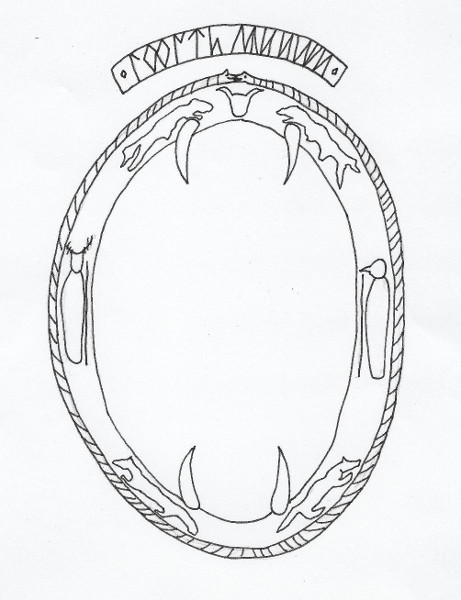
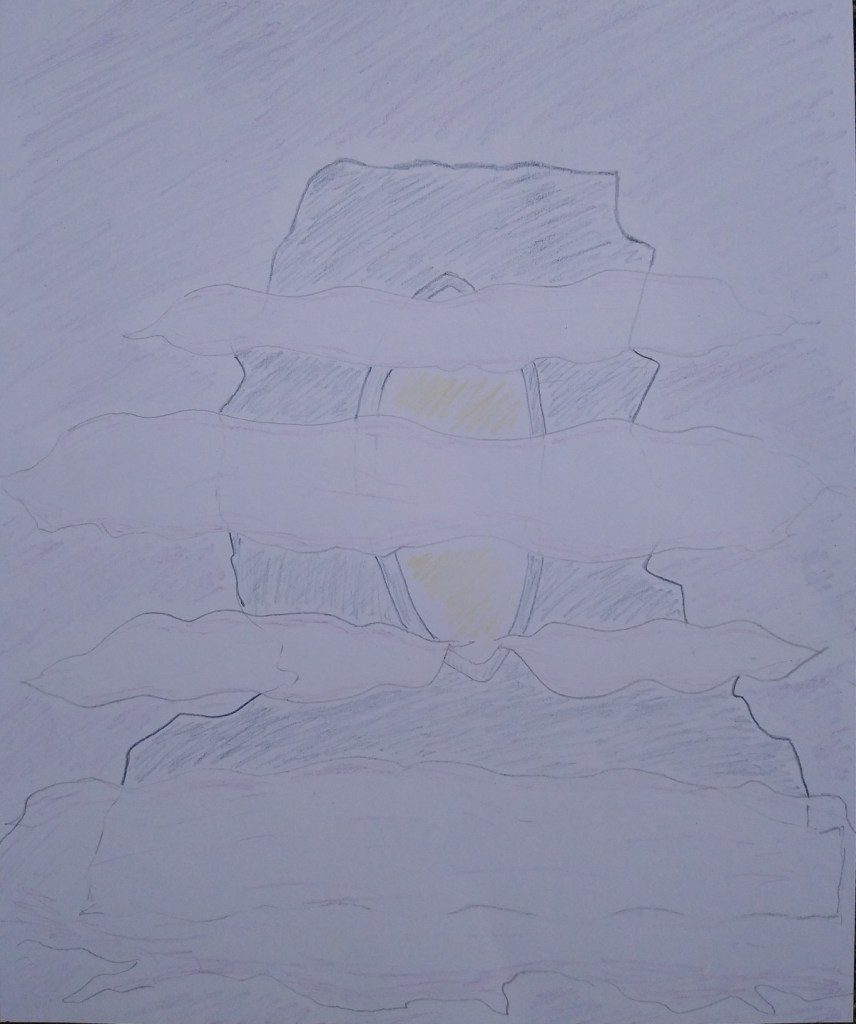
Finally, I was guided by the Witches of Pennant Gofid, who I believe were similarly devoted to Gwyn ap Nudd, my Lord of Annwn, to create my own doorway. They guided my hand in drawing it and decorating it with the head of Gwyn as bull-of-battle, shapeshifting horses and hounds, and two new guides – a bird man and antlered woman. The teeth symbolise it being the maw of Dormach, Gwyn’s Death Hound. the Jaws of Death.
When I step out of the door it is always into a misty hinterland. Occasionally I’m standing on solid ground, but often it’s marsh, and more often I’m on my winged horse treading mist with my hounds beside me. It’s said of Gwyn and Dormach that they travel ar wybir ‘on the clouds that haunt the mountaintops’ and that wybir or nuden ‘condensed floating white cloud’ ‘serves as a garment for Gwyn’.
And so we travel ar wybir, like Gwyn, until the mist clears, or someone appears to guide us out. Setting off right or left, or North, East, South, or West never works as the directions don’t function the same in Annwn (if they exist at all). I often end up in the same places, but never by the same routes. In contrast to other followers of shamanistic paths I haven’t managed to form a stable map of Annwn.
I’ve been told by numerous teachers one should always return by the same route. Some days I manage this, but other days the routes undo themselves as if Annwn is innately resistant to memory. I search instead for the mist, wait for it to come, like my god, to sweep me up, place me back at the portal.
The door is always shrouded by mist and I have only just realised, after two years of constant use, that I have never seen the other side of the door. That I drew only my entryway, on my side, in my room, in Thisworld. That the origin and location of the exit, on Gwyn’s side, in the Otherworld, is a mystery.
All I know is that as I approach through the mist I have a feeling of increasing solidity. There is ground beneath my feet and the door is set within a wall. This creates the impression the door may once have been part of a fortress, shattered, fragmented, still able to float in the mist like Gwyn’s castle.
Could it be a cast-off door from the Fort of Pen Annwn rendered disposable by Arthur’s despoiling? A relic of Hell’s Gate? Or something older, or newer, but nonetheless no less mysterious? No burning of lanterns will shift the mist and again I must trust a gift of Gwyn’s that is incomprehensible.
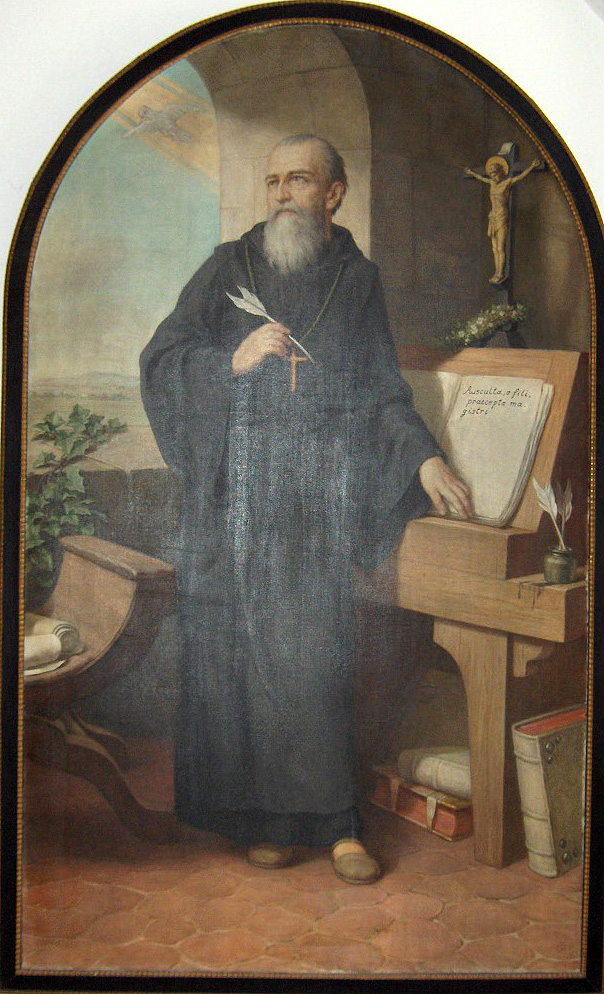
All around me in my local landscape, in my parents’ garden, a persistent three-leafed plant. Wood avens (Geum urbanum), otherwise known as colewort, Herb Bennet, and St Benedict’s Herb. My mum wants me to get rid of this common ‘weed’ but, like with the cleavers and the nettles, I give it a small patch as it provides nectar for the bees and is the food plant of the grizzled skipper caterpillar.
I do not know how wood avens came to be associated with Saint Benedict. Only that it was considered to drive off evil spirits and was used to treat the poisonous bites of snakes and rabid dogs. It has been suggested its three leaves and five flowers are reminiscent of the trinity and the wounds of Christ. Whatever the case, it seems like a good plant to have around in a time of pandemic. Its leaves make a tasty addition to salads and it’s possible I’d try using its roots to flavour soup.
Interestingly, with the emergence of Saint Benedict’s Herb into my life, my awareness of the influence of the Order of Saint Benedict in my locality and what feels like either past life or ancestral memory has been growing stronger.
I’ve long been fascinated by the Benedictine Priory which was located next to St Mary’s Church on Castle Hill in my home town of Penwortham. It was founded in the 1140s as an obedience of Evesham Abbey, dissolved in 1539, rebuilt as a mansion, then demolished in the 1940s to make way for housing.
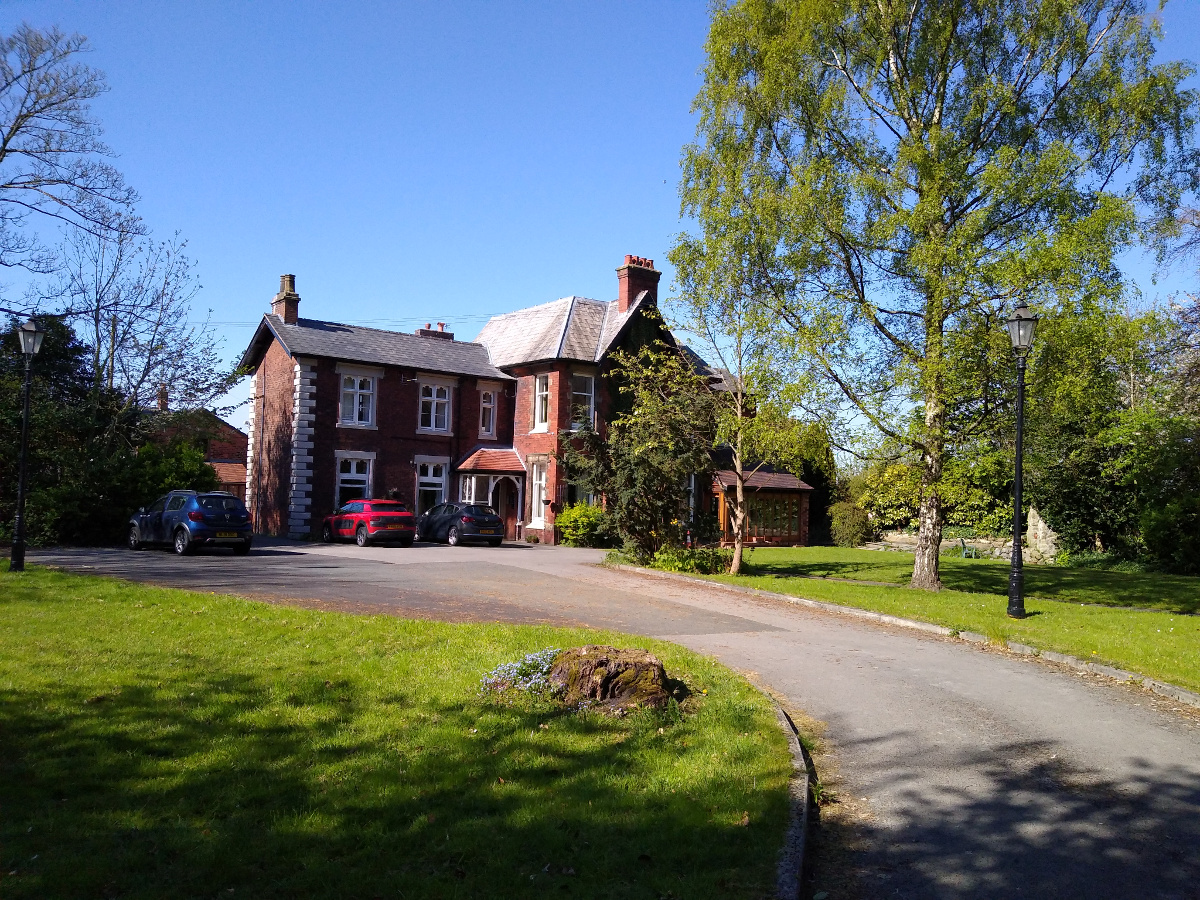
On my daily walks I’ve been repeatedly drawn to St Mary’s Church and the Benedictine Monastery in Bamber Bridge. The latter was founded by the Order at Ampleforth Abbey in 1780 and closed in 2016.
I’ve felt the Benedictines, with their motto of ora et labora ‘pray and work’, and their slow prayerful way of life organised around eight offices of prayer a day: Matins (midnight), Lauds (dawn), Prime (early morning), Terce (mid-morning), Sext (midday), None (mid-afternoon), Vespers (evening), Compline (bedtime), has something important to say to a world in lockdown due to coronavirus.
This feeling was confirmed when I learnt that the Benedictine nuns of the Abbey of Notre-Dame de Fidélité de Jouques in France had released six days of their Gregorian chants of the offices in Latin for free via Neumz for Holy Week to help people in isolation. Their singing and the sound of the bells and organ is beautiful and calming and the perfect antidote to the stresses of this turbulent time.
The re-emergence of Saint Benedict has brought back to the forefront my own monastic leanings. A couple of years back I really wanted to be a nun but could not reconcile the demands of living by a rule with my own unruliness or the renunciation of worldly pursuits with sharing awen as an awenydd. I also felt uneasy adopting a lifestyle originating from the Christian religion, which played a major role in extinguishing British pre-Christian beliefs and demonising my god, Gwyn, and his spirits.
Yet my craving for a life of prayer and work has not gone away but has grown stronger. Since the beginning of the year, when I stopped drinking alcohol and thus having drunken evenings and lie-ins and going to the pub, my life has been structured around prayer/meditation/journeywork, writing and study, physical work in the house and outdoors, and exercise including a martial art.
Since the lockdown the biggest changes have been the cancellation of my volunteer work parties with the Lancashire Wildlife Trust, my Taekwondo classes, my monthly drumming circle with the Way of the Buzzard, and the Damson Poets event, and not being able to see friends. I’ve dealt with this by replacing my practical conservation work with gardening, practicing my Taekwondo moves and patterns alone in the garden, participating in the Way of the Buzzard online drumming circles, and keeping in touch with friends and the other members of Damson Poets by email and text message.
Slowly I’ve been developing a semi-monastic routine based on my natural rhythms and my duties to Gwyn and the gods and spirits of Peneverdant rather than the rule of a Christian saint. It is helping me stay focused through these days of isolation and to build a deeper relationship with my land and my gods.
5.30am – Dawn prayer and breakfast 6.00am – Morning prayers and practice 7.00am – Writing, study, blog 10.00am – Housework/shopping/cooking/gardening 11.30am – Dinner 12 noon – Noon prayer and study 1.00pm – Housework/gardening 2.00pm – Exercise (walk, run, or cycle, Taekwondo) 4.30pm Afternoon prayer and bath 5.00pm – Tea 5.30pm – Emails and news 6.00pm – Housework and water plants 6.30pm – Evening prayer and meditation in garden 7.00pm – Study 9.30pm – Night and bedtime prayers 10.00pm – Bed
A nun in a small room. A big woman, robed in grey, not only her bulk but her presence fills the space. Every ounce of her being, of her focus, of her concentration, is directed to the page on which she slowly, painstakingly, inscribes flowing letters and illuminates the words with beautiful artworks.
How I envy her slow pace of life. The space she has, inner and outer, for this steady work. For her fulfilment in this golden now of creation and lack of cravings for whatever lies beyond those stony walls.
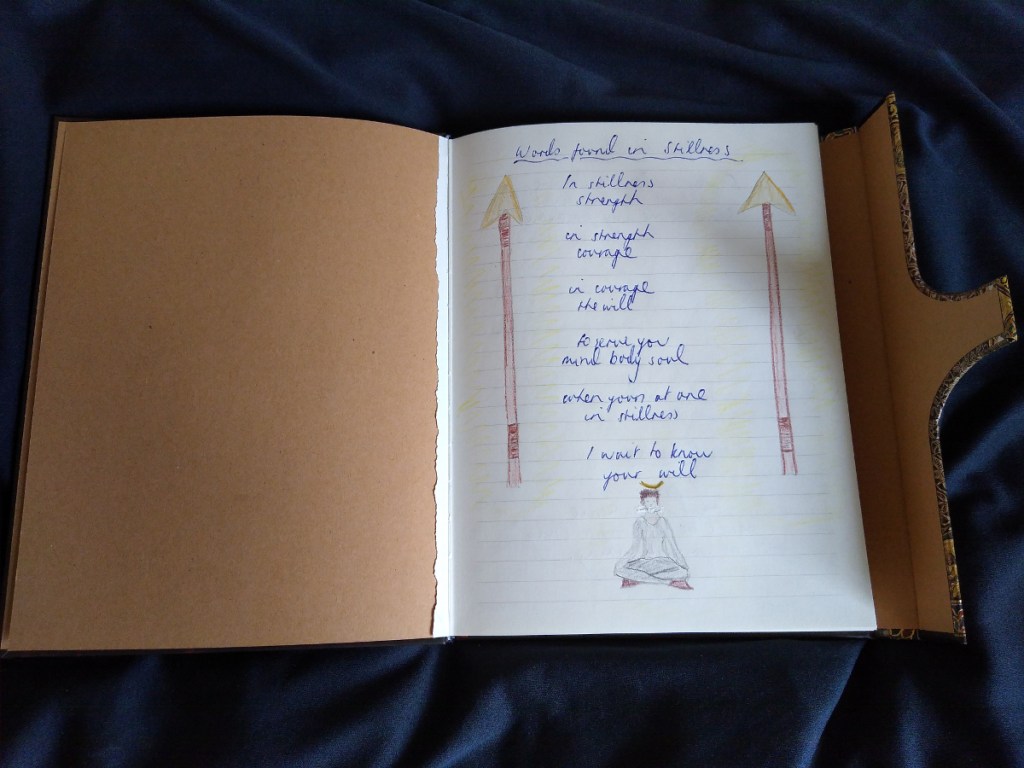
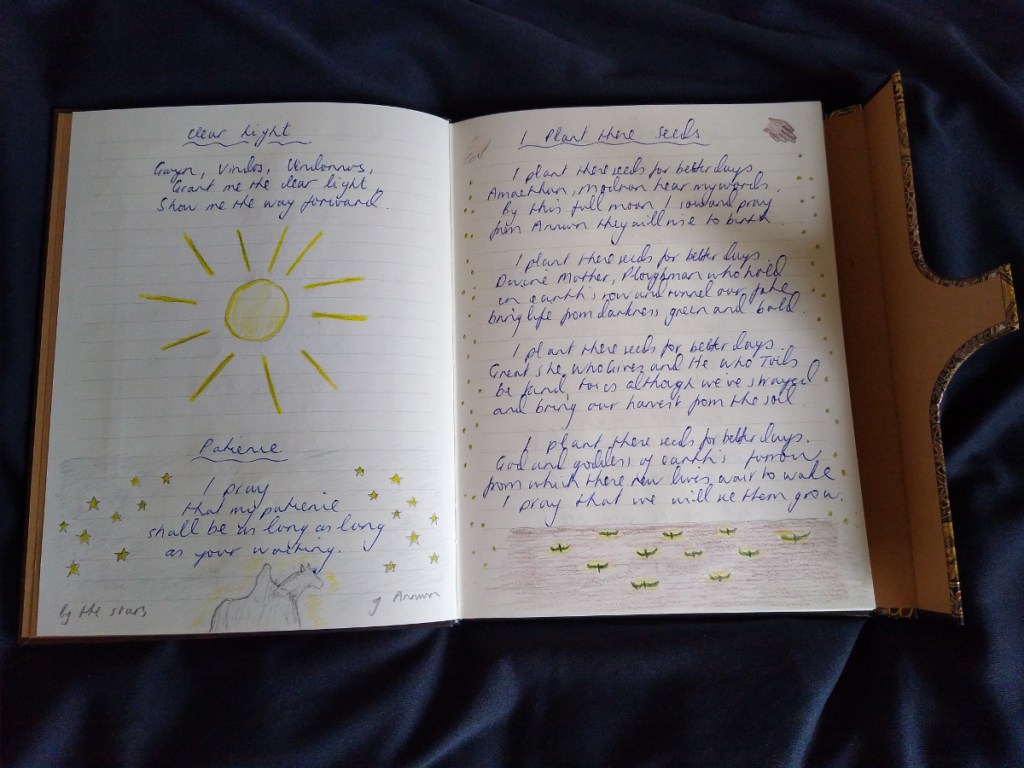
She first appeared to me a few weeks ago and I took this as a signal the time had arrived to start writing in a notebook with a cover based on the Lindau Gospels, which a friend bought for me several years back. I’d never dared write in it for fear of spoiling it as the artwork is so beautiful.
The Lindau Gospels are so named because they were once housed in the Abbey of Lindau in Germany. The lower cover, on which my notebook is based, was produced in 8th century Austria, but its style is that of insular British art. It is predominantly Christian. Around the central topaz are the monograms ‘IHS, XPS, DNS, NOS’ ‘Jesus Christ Our Lord’ and Jesus appears on each of the arms of the cross in a cruciform halo. The four evangelists appear in the plaques in the corners. Yet the spaces between the cross and within the cross are filled with swirling, shapeshifting figures, which morph from serpent to bird to fish to dog and back again, and recall pre-Christian traditions.
Illuminated manuscripts, based on Christian scripture, were produced across Western Europe from 500 to 1600 CE. The phrase derives from the use of gold or silver to illuminate the words and pictures. Many were ‘Books of Hours’ containing devotional prayers said at set times of the day.
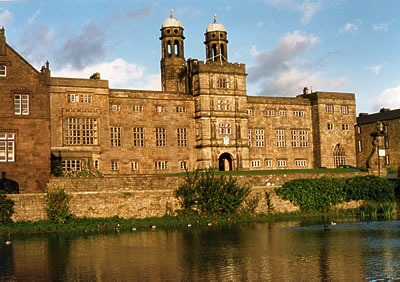
I’ve been drawn to such books before. Several years back I visited Stonyhurst College, which was founded by the Jesuits in 1593, with Preston Poets’ Society. Whilst the other poets were geeking out over Shakespeare’s First Folio I was far more fascinated by the prayer books of Mary Queen of Scots and Elizabeth of York one of which, if I recall rightly, was illuminated by lapis lazuli.
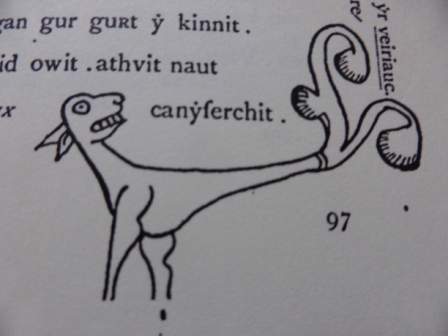
And, of course, many of the medieval Welsh manuscripts which contain the myths of my gods were illustrated by their scribes, including The Black Book of Carmarthen where we find ‘The Conversation of Gwyn ap Nudd and Gwyddno Garanhir’ with a cheeky portrait of Gwyn’s dog, Dormach.
The childlike nature of the drawings in the old Welsh texts and the way the seething mass of pre-Christian imagery unsettles the golden veneer of the Lindau Gospels gave me the confidence and the feeling of rightness to open the notebook, to begin writing. To dedicate it to ‘Gwyn ap Nudd and the gods and spirits of Peneverdant’ and to begin penning within my first prayers and illustrations.
I am now using it as a space in which my re-emerging monastic leanings can combine with my relationship with the Annuvian gods. Where my prayers and pictures are not illuminated by gold but by the golden light of the Otherworld.












 The Sanctuary of Vindos