Over the next month, on Land Sea Sky Travel, in the Corvids and Cauldrons chatroom, Vyviane Armstrong, Thornsilver Hollysong, Bryan Hewitt, and I are going to be hosting a series of meetings titled Tylwyth Gwyn. In them we are going to be exploring and deepening our devotional relationships with the Brythonic deity Gwyn ap Nudd and his family through shared devotions, practices such as meditations, and discussions of gnosis.
Thurs 4th Feb 2.30pm EST / 7.30pm GMT – Gwyn ap Nudd
Thurs 11th Feb 2.30pm EST / 7.30pm GMT – Creiddylad
Thurs 18th Feb 2.30pm EST / 7.30pm GMT – Nodens/Nudd
Thurs 25th Feb 2.30pm EST / 7.30pm GMT – Anrhuna
These meetings are free and everybody is welcome. You can join by the Zoom link HERE.
*This image is an illustration from Y Tylwyth Teg (1935) and pictures a man brought before the Fairy King (Gwyn).
It has been the worst year since I have been born.
I have felt hurt, anger, resentment, abandonment, wondered if I’ve made a mistake.
If my choice to dedicate myself to you has brought family sicknesses, plague, landslips, floods…
But, you reassure me, it has not –
you warned me of the sadness coming to this land long ago.
In your thereness I have found strength knowing how tirelessly you guide the dead (so many!).
You have laughed away my fears. When I’ve cried, wailed, wallowed in self pity and uttered every expletive in Thisworld and Annwn told you: “I’m afraid I’m going crazy…”
you have shown me the lives and deaths of your spirits – what true madness is –
Annwn’s multi-sided perspective.
You have been there for me through the worst year as you are always there for the living and dead.
I have been blessed in my service to you as your awenydd whether in words or in work in the woodlands and the marshlands…
Tonight, in your cauldron, help me transform my battle-fog into mists of enchantment.
White, Blessed, Holy, be not only the Wrathful Hunter but the Kindly One. Help me delight in being yours again.
I wrote the poem above, addressed to Gwyn, to mark the two year anniversary of my lifelong dedication to him. This took place beside yew tree on Fairy Lane by the light of the ‘Super Wolf Blood Moon’. I had already served a seven year apprenticeship to him, most of which had been magical and wonderful.
The last two years have been far harder, in particular the last, for all the reasons stated above. Family illnesses, covid, minor natural disasters in my local area and far worse ones further afield.
All of these devastating signs of the consequences of climate change and overpopulation.
Last night, I performed a ritual to mark the anniversary of my dedication to Gwyn, which involved casting these happenings and the feelings of resentment and anger that were getting in the way of our relationship and my service to him as an awenydd into his cauldron to be transformed.
“Know that every thought, like all things, has a soul,” he reminded me, “like you dies and is reborn.”
During our communion Gwyn gave me a combination of warnings, reassurance, and guidance.
“There is harder to come. I will give you no false hope or empty promises. Yet I can provide inspiration. In the journey of the soul you are not alone. Both the living and the dead face these problems. I too, for we all connected. Set aside your resentment and reach out in cooperation. Every thought, word, act, has its effects running through both worlds and throughout time. Know these cannot be predicted but even the worst horrors can turn to awen in the cauldron.”
So the magic of Annwn was worked and this morning I awoke to the full moon shining over my garden.
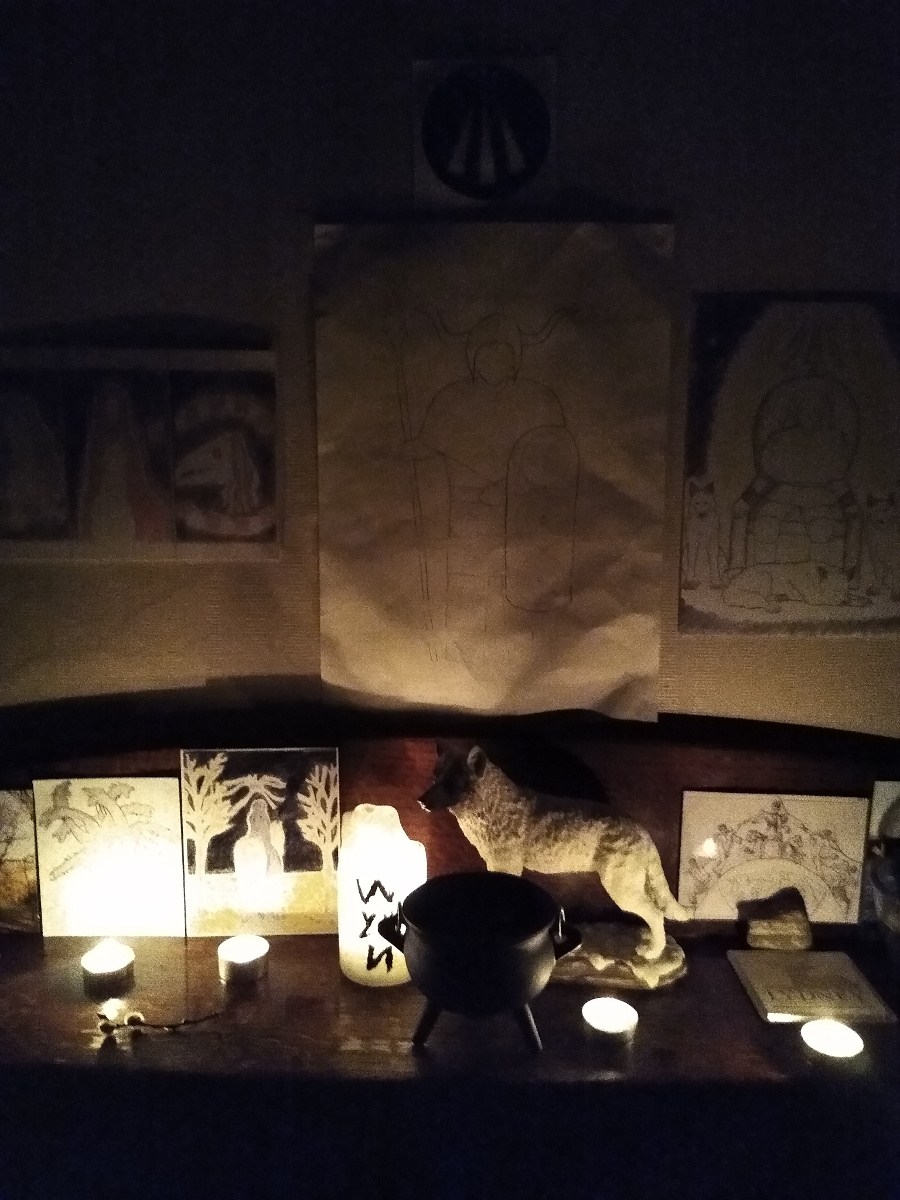
This is an image I was inspired to draw of the King and Queen of Annwn as Bone Wolf and Bone Mare – a guise Gwyn ap Nudd and Creiddylad/Rhiannon have been appearing to me in this winter, a time of revelation, as so many things have been stripped bare.
Landslip, landslide, we live in treacherous times, the very land we hold so dear to us with the grounds of life as we know it is being pulled from beneath our feet.
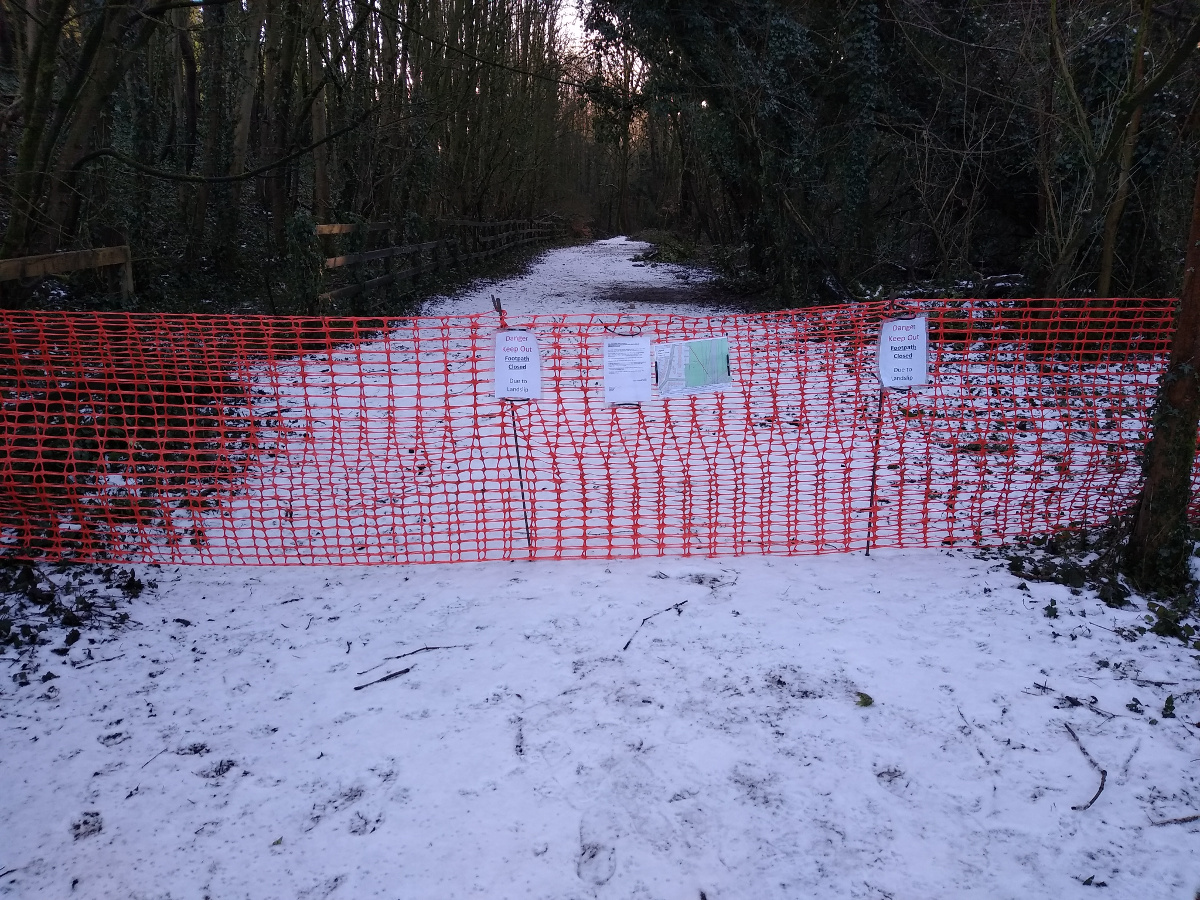
Orange mesh and ‘Do Not Enter’ signs at the entrances to Fairy Lane do not deter me slipping by fay-like to bear witness to another cataclysmic event.
For a long while railings, gravestones, have been falling away and no-one speaks of gathering up the bones of the dead.
This has been a place of peace with its holy well, monastery, church, and chapel, but has also been a place of penitence.
Black Roger sent to the ends of the earth.
(I sometimes wonder if I am a penitent and whether I have served my time).
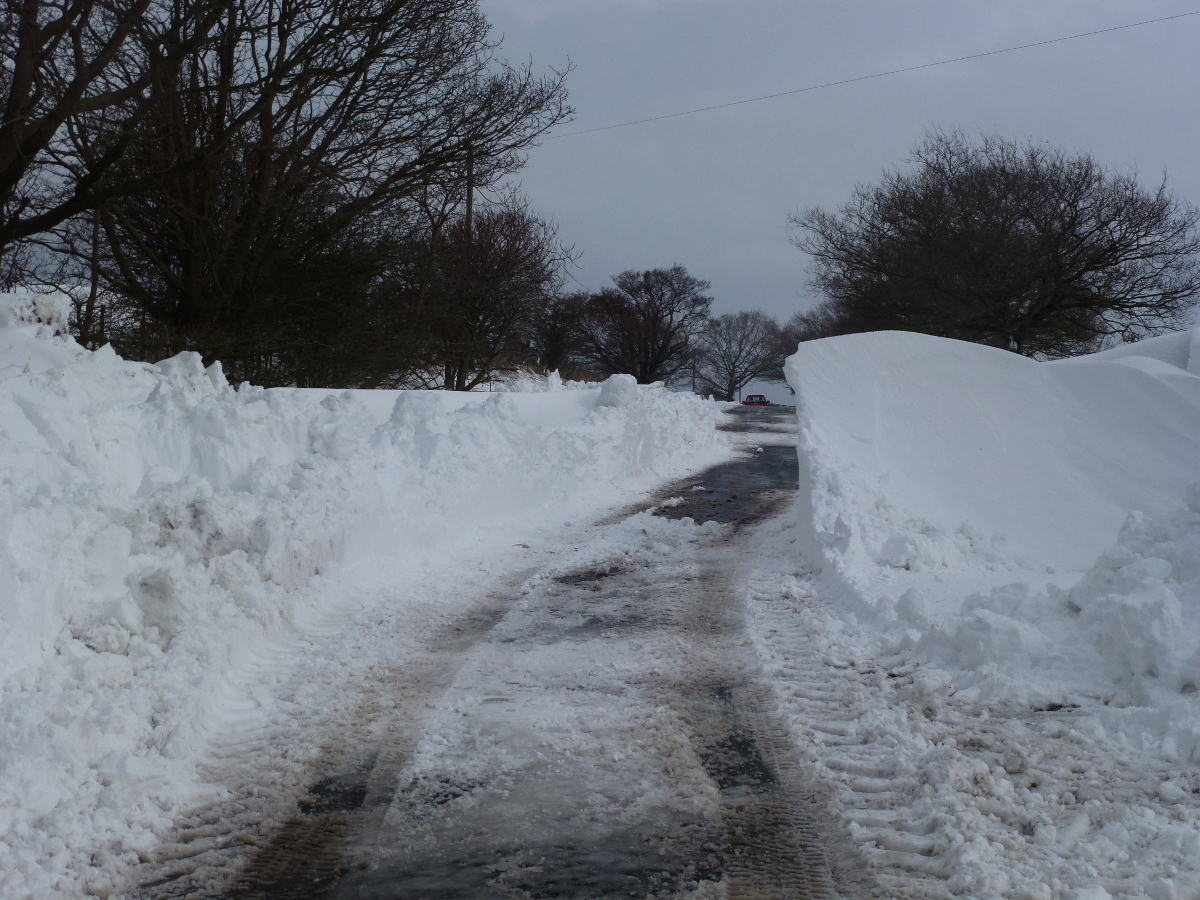
The weather gods have been cruel this year with their freeze-thaw-rain dichotomy opening fresh wounds.
The steps leading down to the yew where I first met Gwyn ap Nudd and to him made my dedication defying the transcendent gaze
of the Christian God who has never set foot on this earth (except perhaps in his son whose feet in ancient times may have walked here in Blake’s poetry)
are now twisted like something out of Labyrinth.
He has thrown my world out of kilter again – a consequence of being devoted to a wild god…
When I see trees upside-down I think how natural it is for us to fall whereas trees are born upright and to go root over crown is certain death.
Yet as we grow older falls hurt more and we come to wonder which will be the last.
~
I wrote this poem after being called to bear witness to yet another cataclysmic event in my local area. It was three days until the January full moon, on which I made my life-long dedication to my patron god, Gwyn ap Nudd, beside the leaning yew tree on Fairy Lane two years ago. (I made my initial dedication to him at the White Spring beneath Glastonbury Tor on the January moon in 2013.)
It’s a place I visit often, so I was surprised, when I got there, to find orange mesh across the entrance from the A59 and to read a notice stating that the footpath was closed due to a landslip. I walked to the second entrance by the Ribble where, again, I found the orange mesh, but it didn’t extend into the woodland.
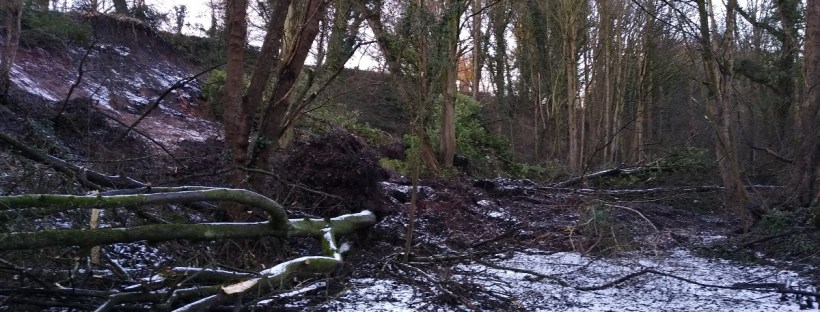
Following the intuition that the place was safe now and my gods wanted me to see what had happened I slipped past. Usually the council will fence things off at the tiniest reason. This was not small. It was catastrophic. A whole swathe of land had slipped away from the side of Church Avenue, which runs along Castle Hill – a pen ‘prominent headland’ – shaped a bit like Pendle. It had piled up on Fairy Lane with the debris of huge ivy-clad trees in their prime, fallen root over crown.
Furthermore the steps leading down to the leaning yew had been skewed and looked dangerous.
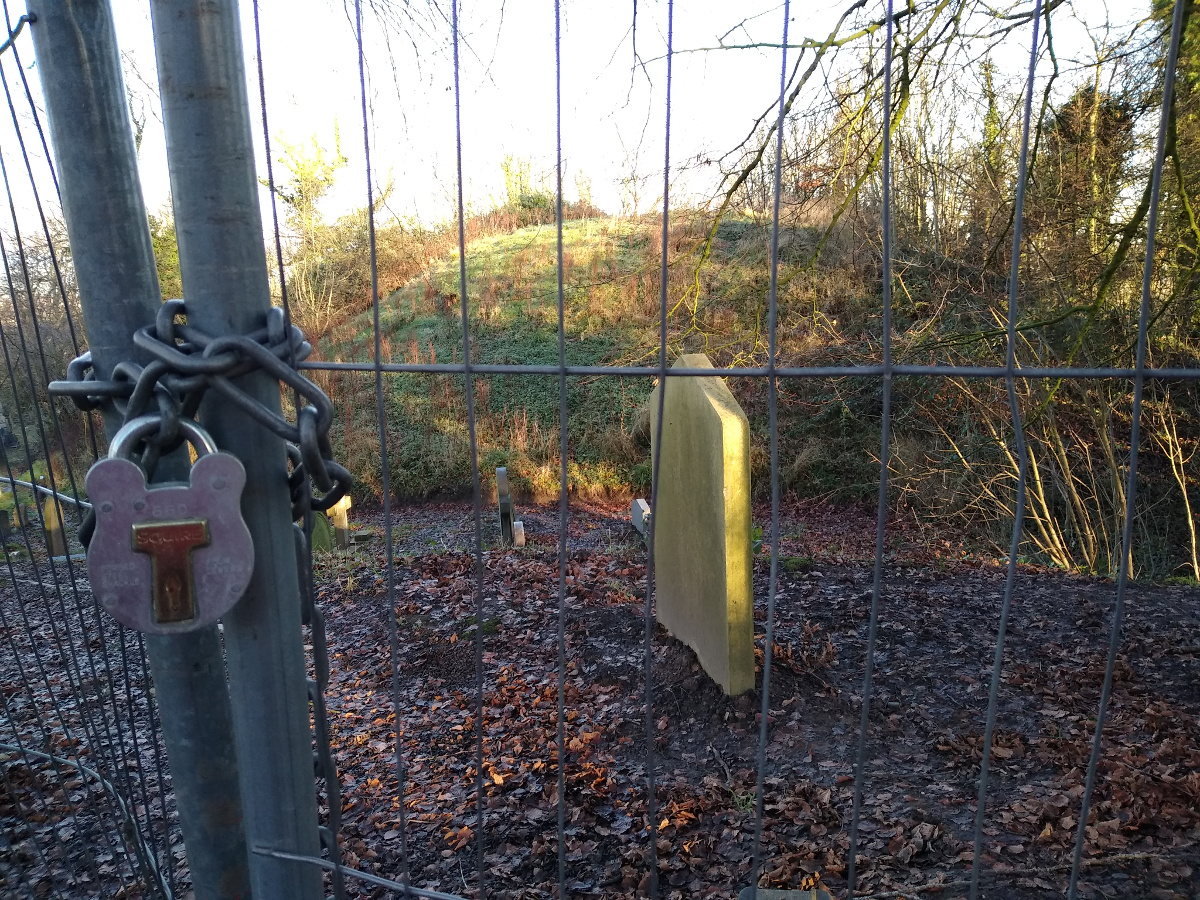
In some ways, that this had happened, was not a surprise. The whole bank, with its leaning trees, has always looked precarious. There have been landslips before, bearing away railings and graves. Due to falling gravestones the castle mound and parts of the graveyard have been closed off for several years.
There are several reasons for the instability of the land. When the river Ribble was moved five hundred yards south from her original course to run beside Castle Hill, the sandstone bedrock was shattered. The aquifer beneath the hill was broken, leading to the holy well at the hill’s foot drying up. The building of the adjacent by-pass and its vibrations are likely causing the damaged land to slip.
The final contributor to this is the recent weather with its dangerous patterns of freezing, thawing, and heavy rain. No doubt all these factors have come together to cause these landslip.
Yet as well as physical reasons there are spiritual reasons too. The conversion of the hill and well from a pre-Christian to Christian sacred site and the severing of the links between the people and the gods of the land have led to the mindset that makes moving a river, shattering an aquifer that feeds a holy well, and building a by-pass beside a sacred place acceptable. Within a culture that saw the river as a divinity and the hill as the body of a goddess and abode of the dead and their god these would have been seen as acts of desecration that would bring about the wrath of the gods. And so their anger is seen in the decline of this once (and still on occasion) beautiful and enchanting place.
My first thought, when I arrived at the scene, was that this was linked somehow to my Gwyn dedication. Had I done something wrong? Was I on the wrong track? Might it be linked to the series of workshops on Gwyn and his family I am planning with other Gwyn devotees for Land Sea Sky Travel?
I received the gnosis that the landslip had nothing to do with me or my actions and would have happened anyway. I was already in two minds about visiting the yew on my dedication day as I am at my conservation internship on that day and don’t really want to go at night without a friend to accompany me (due to lockdown).
What it means to have the place I met Gwyn and made my life-long dedication cut off I haven’t cogitated yet. It seems to fit with two bridges over the Ribble being declared dangerous and closed. The land, the gods, displaying their anger, the council attempting to protect us, connections being severed.
This event has also made me aware the yew, leaning precariously on an ash, won’t be there forever…
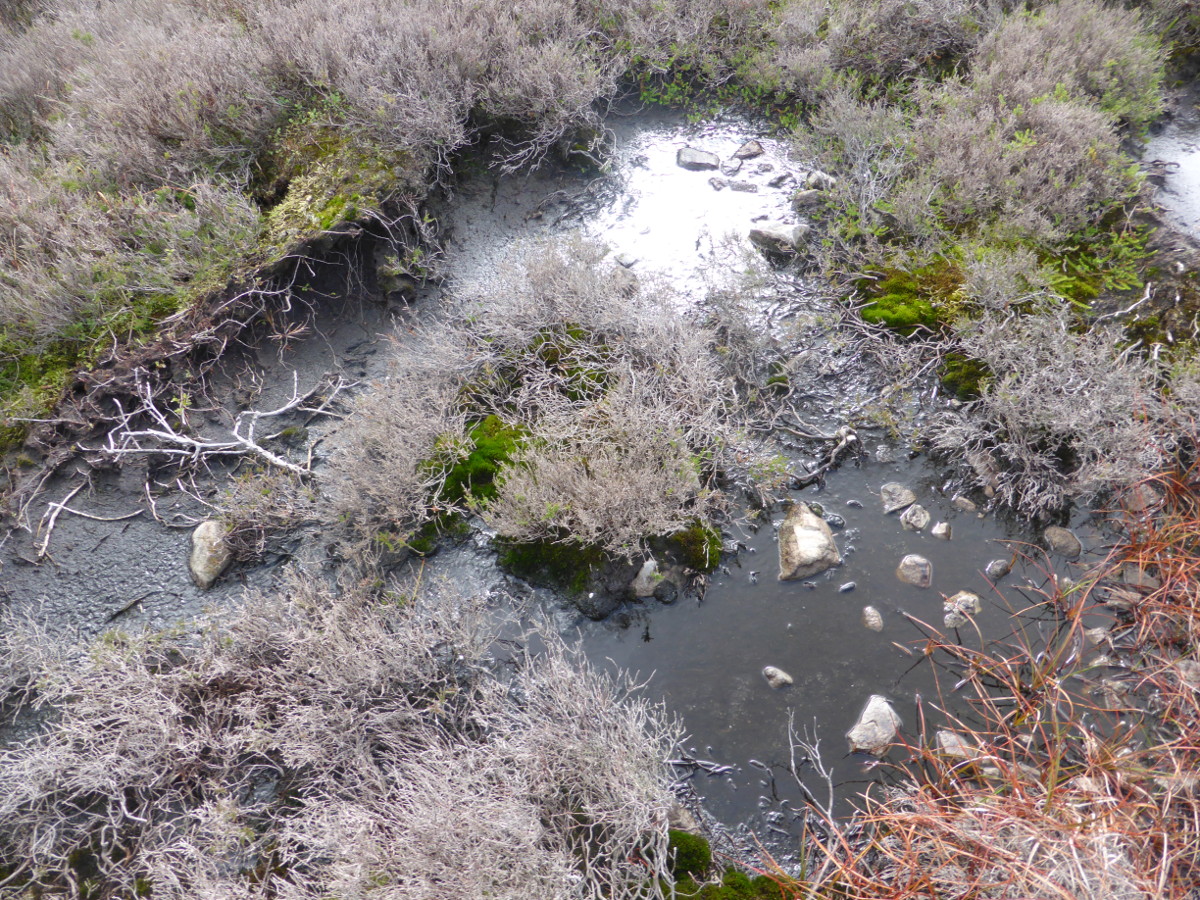
For nearly a decade I have been writing enthusiastically about two topics – the lost wetlands of Lancashire (lakes, marshlands, wet woodlands, peat bogs) and my patron god, Gwyn ap Nudd. I didn’t realise there was a link until I watched the first of Gwilym Morus-Baird’s videos on Gwyn’s folklore.
Here he shared three poems by the Welsh poet Dafydd ap Gwilym (1315-1350). Whilst I had read ‘Y Dylluan’, ‘The Owl’, and ‘Y Niwl’, ‘The Mist’, I was unfamiliar with ‘Y Pwll Mawn’, ‘The Peat Pit’. In this masterfully crafted and, in places, humorous poem, Dafydd ap Gwilym narrates how he and his‘grey-black horse’ foolishly get lost on a ‘cold moor’ in the darkness and fall into a peat-pit.
Unfortunately much of the craftsmanship of the poem in Welsh is lost in translation. The original is written in strict metre with seven syllables in each line, follows an AA BB rhyme scheme, and also contains internal rhyme (possibly cynghanedd – it is beyond my skill to judge). It also features repetition.
Gwae fardd a fai, gyfai orn, Gofalus ar gyfeiliorn. Tywyll yw’r nos ar ros ryn, Tywyll, och am etewyn! Tywyll draw, ni ddaw ym dda, Tywyll, mau amwyll, yma. Tywyll iso fro, mau frad, Tywyll yw twf y lleuad.
Woe to the poet (though he might be blamed) who’s lost and full of care. Dark is the night on a cold moor, dark, oh, that I had a torch! It’s dark over there, no good will befall me, it’s dark (and I’m losing my senses) over here. Dark is the land down below (I’ve been duped), dark is the waxing moon.
Here, in the first verse, we see that not only are the rhyme and metre lost in the English translation but also the repetition of tywyll ‘dark’ at the beginning of six of the eight lines.
Dafydd ap Gwilym goes on to lament his ‘woe’ ‘that the shapely girl, of such radiant nature, / does not know how dark it is’ before admitting his foolhardiness for venturing out on the moors at night.
It’s not wise for a poet from another land, and it’s not pleasant (for fear of treachery or deceit) to be found in the same land as my foe and caught, I and my grey–black horse.
Here we gain a sense of unhomeliness, of the poet having ventured far from home, to an arallwlad ‘other-land’ – to the land of his ‘foe’, who we might surmise is the otherworldly Gwyn, from the following lines and those in other poems. In ‘Y Niwl’ the mist is described as ‘his two harsh cheeks’ which ‘conceal the land’ ‘thick and ugly darkness as of night / blinding the world to cheat the poet.’
After speaking of how he and his horse drowned in the peat-pit, Dafydd ap Gwilym goes on to describe evocatively and curse the place of his undoing and to associate it directly with Gwyn and his spirits.
Such peril on a moor that’s an ocean almost, who can do any more in a peat-pit? It’s a fish–pond belonging to Gwyn ap Nudd, alas that we should suffer it!
I love this image of ‘a moor that’s an ocean’. It reminds me of the German term schwingmoor ‘swinging wetland’. This evokes how a bog can sway with each step like the sea.
I am dying to know whether the reference to the peat-pit as a ‘fish pond belonging to Gwyn ap Nudd’ is a metaphor that Dafydd ap Gwilym has created or whether it comes from the oral tradition.
We know Nudd/Nodens, the father of Gwyn, is associated with fishing by the iconography at his temple in Lydney. A crown, which would have been worn by a priest of Nodens, features a strange fisherman with a long tail catching a salmon and images of fish and sea-serpents appear on a mural.
So it isn’t too surprising to find a reference to fish ponds belonging to Gwyn. However, anyone familiar with the ecology of peat bogs will be aware it is very rare to find fish in their waters due to the low oxygen levels. This raises the question: for what is Gwyn fishing?
I believe an answer can be found in a later English poem by Winthrop Mackworth Praed (1802 – 1839) called ‘The Red Fisherman’ which might also contain echoes of an older tradition.
This recounts how an abbot came to a pool with the ‘evil name’ ‘The Devil’s Decoy’ and encountered ‘a tall man’ on ‘a three-legged stool’ clad all in red with shrunken and shrivelled ‘tawny skin’ and hands that had ‘long ages ago gone to rest’ – ‘He had fished in the flood with Ham and Shem’.
With a ‘turning of keys and locks’ he took forth bait from his iron box’ and when he cast his hook ‘From the bowels of the earth / strange and varied sounds had birth’, ‘the noisy glee / of a revelling company’.
To this otherworldly music the red fisherman drew up ‘a gasping knight’ ‘with clotted hair’ ‘the cruel Duke of Gloster’. Casting off again, ‘a gentleman fine and fat, / With a big belly as big as a brimming vat’ ‘The Mayor of St Edmund’s Bury’. His next catch, with ‘white cheek’ ‘cold as clay’ and ‘torn raven hair’ was ‘Mistress Shore’ and, after countless others, finally a bishop. The abbot was cursed by the Red Fisherman to carry his hook in his mouth and from then on stammered and stuttered and could not preach.
If this poem derives from an older tradition based around the lore of his Gwyn and his father (like the Red Fisherman Gwyn was also identified with the devil) we might surmise he is fishing for the dead.
The mention of the noise of a revelling company is also pertinent as in ‘Y Pwll Mawn’ we find the lines:
A pit between heath and ravine, the place of phantoms and their brood. I’d not willingly drink that water, it’s their privilege and bathing–place.
The term ellyllon is here translated as ‘phantoms’ but also means ‘elves’. It no doubt refers to Y Tylwyth Teg, ‘the fair family’ or ‘fairies’ over whom Gwyn rules as the Fairy King. ‘Brood’ has been translated from plant ‘children’ which is also suggestive of the family of Gwyn.
The peat-pit, like other bodies of water such as lakes, pools, springs, and wells, is a liminal place where Thisworld and the Otherworld meet, where the fair folk bathe, and their leader fishes for souls.
Finding out about this lore has deepened by intuition that Gwyn is associated with Lancashire’s lost peat bogs and former peat-pits, such as Helleholes, just north of my home.
At the end of his poem Dafydd ap Gwilym curses ‘the idiot’ who dug the peat-pit and swears he will never ‘leave his blessing in the peat bog’. This may refer to a practice taking place in his day – people leaving butter in peat bogs for the fairies, which may carry reminiscences of more ancient offerings to Gwyn and his family.
Contrarily, the next time I visit a peat bog, I intend to leave a blessing for Gwyn, the Blessed One.
*With thanks to Gwilym Morus-Baird for his video HERE and for pointing me in the direction of Dafydd ap Gwilym.net where ‘Y Pwll Mawn’ can be read in Welsh and English.
So far January has been pretty grim. Not only due the slippery alternation of icy weather and heavy rain, but because the UK is back in national lockdown due to a sharp rise in coronavirus cases as a result of holiday gatherings combined with a new variant that is 30 to 50 per cent more infectious. Hospitals are teetering on the brink of being overwhelmed and, on Wednesday the 13th of January, 1, 564 deaths from COVID-19 were recorded – the highest number since the pandemic begun.
My conservation volunteer work parties have been cancelled and my internship at Brockholes Nature Reserve has been limited to one day. Again we’re back to the horrible dichotomy between essential workers being stressed and overstretched whilst others have no work and feel useless.
However, unlike during the first lockdown in March, with the new vaccines and the vaccination programme underway there is hope of a return to some degree of ‘normality’ on the horizon. I have lived with the fear of catching coronavirus and passing it onto my parents, who are over seventy and have health issues for nearly a year, and am hoping they will be vaccinated by mid-February.
This moon cycle Gwyn has prompted me to look more deeply into the nature of the coronavirus and how this relates to his role as a ruler of Annwn who gathers the souls of the dead from battlefields, and arguably those who die of plagues, such as Maelgwn Gwynedd, who died of the Yellow Plague after seeing a golden-eyed monster through the keyhole where he was self-isolating in the church at Llan Rhos.
Gwyn is also said to contain the fury of the ‘devils’ of Annwn to prevent them from destroying the world. We might, perhaps, include viruses amongst this host. It is also notable that Gwyn’s father, Lludd/Nudd, put an end to three plagues in Lludd ac Llyefelys.
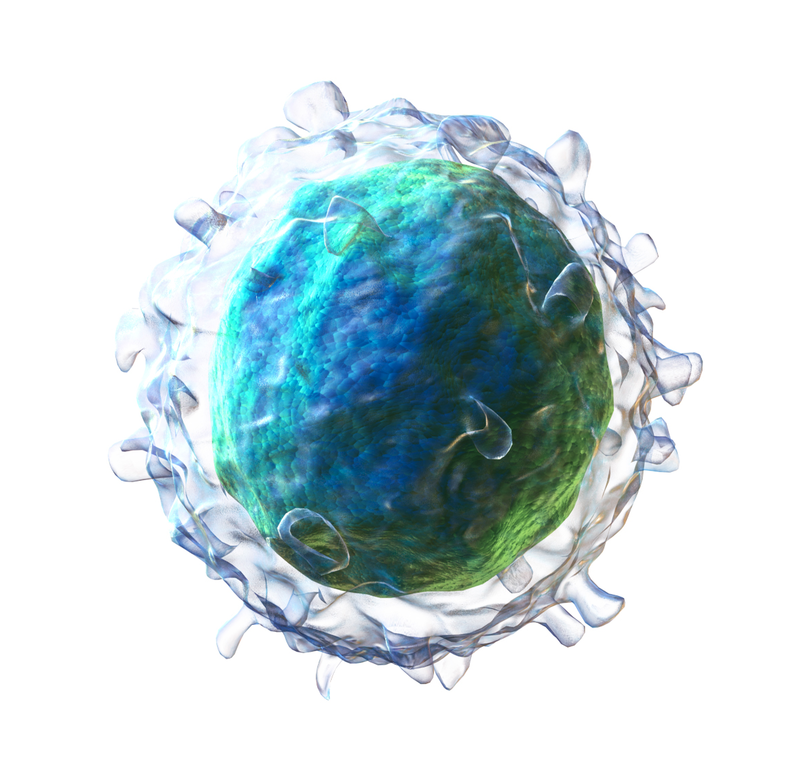
When I set out on and progressed with my research I was stunned by the proficiency of the coronavirus and more so by the cleverness and complexity of the human immune system and its cells. As I learnt about them and viewed their 3D representations I was filled with awe and wonder at their agency and beauty and more so because they are part of me.
Here is an account of my discoveries about the nature of coronavirus and the wonders of the immune system upon whose agency and efficacy the success of the vaccine depends. I write this for Gwyn and his father, Lludd/Nudd, defenders against plagues.
***
SARS-CoV-2 is the coronavirus that causes the disease COVID-19. Like other coronaviruses it is spherical in shape and consists of a membrane, which encloses its RNA, and protein spikes (which look like a corona). These are really important as they help the virus bind onto and attack host cells.
When droplets of the virus are inhaled or transferred from surfaces to the eyes, nose, or mouth of a healthy person it is provided with passage to the mucous membranes. These epithelial barriers not only provide a barricade against pathogens, but have their own defences such as tears, saliva, and mucus.
However, coronavirus has developed a particularly smart way of penetrating them. On these surfaces is a protein called angiotensin-converting enzyme 2 – ACE2 – and to this it binds its spike protein ‘like a key being inserted into a lock’. Thus ACE2 is the doorway by which it enters the host.
Once the virus gets into the membranes of the nose, throat, airways, and the lungs (where ACE2 is particularly abundant on type 2 pneumocytes in the alveoli), it hijacks the original function of the cells and turns them into ‘coronavirus factories’ in which it creates countless copies of itself, which go on to infect more cells, which go on to infect more cells, which go on to infect more cells…
Luckily, the invasion does not go unnoticed for it triggers a response from the innate immune system. (It is worth mentioning here that humans have not only one but two immune systems. The innate immune system, which is shared with other animals, plants, fungi, and insects, is the most ancient and the most primitive, having developed 500 million years ago. This provides a ‘front line’ general response. If it is unsuccessful, the adaptive immune system, which developed in vertebrates only, is activated and provides a more finely honed response, which targets a specific pathogen.)
Upon the invasion of the coronavirus, cells of the innate immune system stationed in the tissues and patrolling in the blood stream, which possess specialised pattern recognition receptors (PPRs), recognise pathogen-associated molecular patterns (PAMPs) and damage-associated molecular patterns (DAMPs), and send out chemical signals that initiate the inflammatory response.
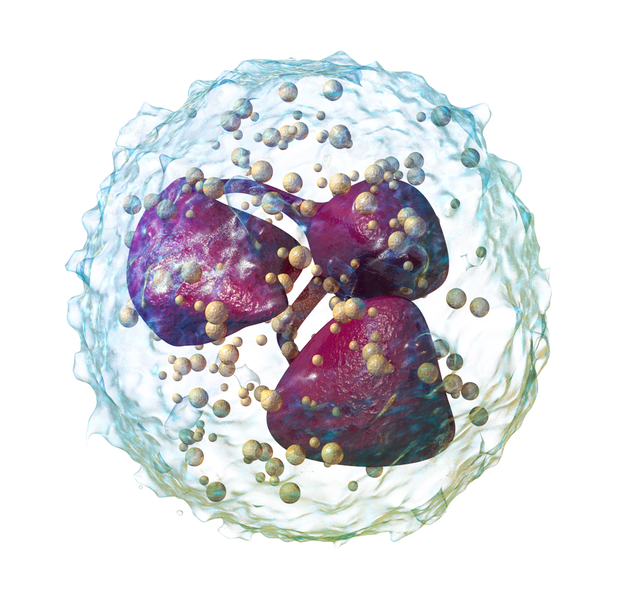
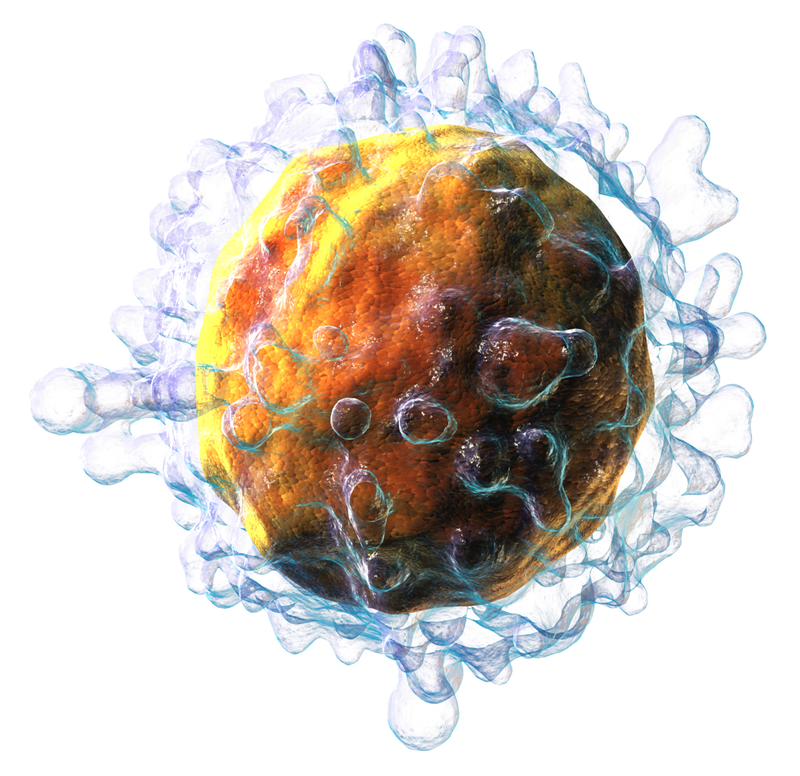
Chemicals such as histamine increase the blood flow to the infected area and cytokines attract white blood cells called phagocytes ‘eating cells’ (from Greek phagein ‘to eat’ and cyto ‘cell’) – firstly neutrophils and, within 24 hours, macrophages ‘big eaters’ (from Greek makrós ‘large’ and phagein ‘to eat’)
These phagocytes strive to destroy the virus through a process called phagocytosis that is unlike anything seen in the outside world. They engulf the virus within their membrane, enclose it within a vacuum known as a phagasome, then kill it by bombarding it with toxins. Afterwards neutrophils self-destruct via a process called apotosis. Macrophages also perform the role of devouring the dead cells. Around three days into the infection more phagocytes known as natural killer cells join the fight.
If the innate immune system fails to fend off the virus, the adaptive immune system steps in. The cells of the adaptive immune system target only specific antigens – molecules on the outside of a pathogen – and cannot recognise new antigens alone. Therefore they must be presented with them by antigen-presenting cells, such as macrophages and the dendritic cells of the membranes. These cells not only devour but process the virus and display its antigen on their surface. Thus they play an essential role in mediating between the innate and adaptive immune systems.
The main cells of the adaptive immune system are white blood cells called T-cells (because they are produced in the thymus) and B-cells (because they are produced in the bone marrow). When T-cells are activated by the presentation of an antigen they begin to mature and proliferate.
Four types of T-cell are produced. Cytotoxic T-cells specific to the coronavirus antigen bind to an infected cell and produce a chemical called perforin, which penetrates it, then cytotoxins called granzymes which destroy the cell and any virus inside by causing it to self-destruct via apoptosis.
Helper T-cells produce chemicals such as cytokines, interleukin (a pyrogen which increases molecular activity) and interferons (which cause nearby cells to heighten their viral defences) and activate B-cells. Regulatory T-cells stop the immune response and memory T-cells remember the antigen.
Once activated, B-cells produce and release antibodies that are perfectly fitted to the antigen. These perform several functions. They neutralise the virus, making it incapable of attacking the host cells; bind virus particles together in a process called agglutination; and bind to antigens, labelling them as targets. Memory B-cells, like memory T-cells, which remember the virus antigen, are also formed.
After five days, once the T-cells and B-cells are recruited, and the battle begins in earnest, the infected person starts to feel the symptoms of COVID-19. A sore throat, loss of smell and taste, and a persistent cough are caused by the inflammatory response. The mucus from a runny nose and that coughed up from the lungs is composed of dead phagocytes, dead cells, inflammatory exudate, and dead and living microbes. It is through these particles an infectious person spreads the disease.
Pyrexia, caused by the pyrogen interleukin (which you might recall increases molecular activity), is what brings about a heightened temperature, loss of appetite, and feelings of fatigue.
Most healthy people fight off the virus within 7 – 10 days. Those who do not become more seriously ill because the immune system overreacts and this leads to pneumonia, a condition in which the alveoli fill with water as a result of excess inflammation and tissue damage. This may be caused by coronavirus binding to ACE2 on type-2 pneumocytes and other membranes. ACE2 regulates a protein called angiotensin II, which raises blood pressure and causes inflammation. When coronavirus binds to ACE2, it inhibits its ability to regulate angiotensin II, thus the overreaction.
This can lead to acute respiratory distress syndrome, which happens when the inflammation of the lungs is so severe the body cannot get enough oxygen to survive, and can lead to organ failure. At this point a person is at risk of death and is admitted to intensive care and put on a ventilator.
Knowledge of the immune system not only helps us to understand how the body fights off coronavirus but also how the vaccines work. The Oxford-AstraZeneca vaccine, like other flu vaccines, uses a weakened form of the virus to activate the immune system’s response, so the T-cells and B-cells have memory of the antigen and can respond immediately upon a repeat infection.
The Pfizer-BioNTech is more novel because it takes the genetic code from the coronavirus antigen and uses it to create a messenger RNA (mRNA) sequence that tells the vaccinated person’s cells to produce antigens and present them to the T-cells and B-cells, preparing them for an immediate response.
***
My research has provided me with an illuminating revelation of hidden processes inside my body I was unaware of. In the death-eating phagocytes who process the dead virus and present its antigens it is possible to find elements of the Annuvian.
Could the white blood cells be seen as ‘guardians’ posted by Gwyn ‘White’ to help us defend ourselves from viruses like he and his host hold back the fury of the spirits of Annwn?
Perhaps… but I think truth of the matter is more complicated for Gwyn is said to contain the spirits of Annwn not only in his realm, but in his person, which is equivalent to us being able to contain the virus. This is impossible for us – for each side it is a battle to the death. It can only be contained by a god.
Paradoxically, Gwyn might be associated both with the breath-stealing life-stealing coronavirus and with the white cells who act as defenders and mediators within our bodies.
As a ‘bull of conflict’ he embodies the dark truth that, without and within, existence is ‘battle and conflict’. Yet that in this, beauty and wonder – the poetry of Annwn – can be found.
SOURCES
Anne Waugh, Alison Grant, Ross and Wilson Anatomy and Physiology, (Elsevier, 2018)
‘I want to live, I want to love But it’s a long hard road out of Hell.’ Marilyn Manson
So it’s December the 31st and we stand at the gateway between one year ending and the next beginning. As ever I feel obliged to write a retrospective. Looking back, quite frankly, 2020 has been a shitter of a year – on global, national, familial, and personal levels.
A global pandemic. A messy Brexit. Life at home has been incredibly difficult with my dad’s ongoing health problems, my mum having a fall and a hip replacement, and my brother having brain surgery and coming to stay with us with us whilst he recovers. And this has all happened on top of me finding out it’s likely I’m autistic for which I’m in the midst of the lengthy process of getting a diagnosis.
I received the first hint that this year would prove portentous in February when I was volunteering on the Wigan Flashes Nature Reserve and noticed a profusion of scarlet elf cups (Sarcoscypha austriaca). In a blog post I posed the question: ‘Will these red cups bring good or bad luck?’
By March we had the answer – coronavirus was spreading rapidly and we entered a national lockdown. This turn of bad luck felt particularly cruel as I had left my supermarket job to volunteer with the Lancashire Wildlife Trust full time as a way into a career in conservation. The first day of the lockdown was meant to be the first day I started a conservation internship at Brockholes Nature Reserve. This got put on hold and all my other volunteering was cancelled. I was left with neither furlough from a paid job or training toward paid work with only the small income from my writing.
During the first lockdown my mum and I agreed that it was like being in Purgatory – a sentiment I have seen echoed elsewhere, for example in the Scarlet Imprint Newsletter. This makes me realise how deeply engrained Christian concepts are within our psyches, even for non-Christians, and how lacking we are in Pagan and Polytheist concepts through which to understand our situation. At several points I have wondered if the gods are punishing us on a global level for our ‘sins’ against nature and whether my family and I have done something to bring about their disfavour.
In the Brythonic tradition it is the fury of the spirits of Annwn that threatens to bring about the destruction of this world and usually this is held back by Gwyn ap Nudd – a King of Annwn. Gwyn’s father, Nudd/Lludd, also played a role in protecting Britain from three plagues – a people called the Coraniaid, a dragon’s scream, and ‘a mighty magician’ – all caused by Annuvian forces.
The term used for these plagues is gormes which also translates as ‘pestilence’, ‘destruction’, ‘oppression by an alien race or conqueror’, ‘oppressor’, ‘oppressive animal or monster’. The coronavirus is a plague and might also be viewed as an alien being or a monster of Annwn.
My prayers, conversations with my gods, meditations, and research have led me to the conclusion that we are experiencing a ‘monstrum event’ (here I resort to Latin as I haven’t found an equivalent Brythonic concept). Monstrum is the root of the word ‘monster’ and also means ‘revelation’ so seems linked with ‘apocalypse’ in its original sense (from the Greek apokaluptein ‘uncover’).
As the Beast with the Fiery Halo has ravaged Britain’s populace, underlying physical and mental health problems have been brought to the fore, accidents waiting to happen have happened, the hidden has surfaced from the deep. Many of the excess deaths were not caused by coronavirus.
If the first lockdown was Purgatory then the past couple of months have felt more like Hell on Earth. Again I struggle to find an equivalent for this oh-so-fitting Christian concept. Perhaps it is possible to see ‘Hell’ as one of the deepest and most unpleasant levels of Annwn, which is described in the medieval Welsh texts both as a paradisal place and a hellish one where souls are imprisoned and tortured in the napes of a Black Forked Toad and within the innards of a Speckled Crested Snake.
It takes a lot of work to undo our associations of these scenes with the Christian concepts notion that unpleasant experiences are the result of our ill doings and are thus punishments for our sins. Gwyn has taught me they are processes of transformation that lie beyond human morality and reason. This is my current understanding of what has been happening with coronavirus.
In the ‘hells’ that I have witnessed others experiencing I have also witnessed the power of healing. Of the miracle of the hip replacement and the remarkable intricacies of brain surgery. In this I have seen the work of Lludd/Nudd/Nodens, a god of healing, to whom I have prayed for my family’s health.
I have also seen the healing hand of Nodens in the advances in treatment for coronavirus and in the creation of the vaccines. It seems to be more than coincidence that, as a more virulent strain emerges in Britain, both the Pfizer-BioNTech and Oxford-AstraZeneca vaccines have been approved. This gives me hope that, even as we face this plague, the gods are equipping us with the tools to deal with it.
In most stories, Christian and non-Christian, a descent into Annwn or Hell is followed by a return. As things slowly improve at home, as the time my parents get vaccinated approaches, I am intuiting that our time of descent is approaching an end and I am starting to catch glimpses of the road ahead.
My internship at Brockholes finally began on the 4th of December and I am predicting it will continue within Lancashire’s current Tier 4 restrictions. I believe that due to people being brought into greater appreciation of nature by the lockdown and, unfortunately, because of the climate crisis, in the future there will be more jobs in conservation and am tentatively hopeful about finding work.
I am beginning to feel, for the first time in a long time, like in the words of a Marilyn Manson song that I listened to a lot at a dark point in my life many years ago, ‘I want to live, I want to love,’ but I am painfully aware it is going to be ‘a long hard road out of Hell.’
‘Arthur said, “Are there any of the wonders we have still not obtained?
One of the men said, “Yes, the blood of the Very Black Witch, daughter of the Very White Witch from Pennant Gofid in the uplands of hell.
Arthur set out for the North, and came to where the hag’s cave was.’
– Culhwch ac Olwen
I. The Witch’s Cave
In the medieval Welsh story Culhwch ac Olwen (1090), Orddu ‘Very Black’, a ‘witch’ who lives in a cave in Pennant Gofid ‘the Valley of Grief’, battles against the servants of Arthur and is slaughtered by him in a gristly scene where he cuts her in twain with his knife to drain her blood.
In this tale Gwyn ap Nudd, a Brythonic god of the dead and ruler of Annwn, is dubiously made to appear beside his eternal rival, Gwythyr ap Greidol, as an advisor to Arthur. I judge this to be a move by a Christian interlocutor do demonstrate Arthur’s power not only over Orddu but her god.
It is my personal belief that Orddu was the last of a lineage of ‘witches’ of the Old North who resided in the cave at Pennant Gofid, which is identified with hell, showing Annuvian associations. They were powerful warrior-women and prophets who shared a kinship with the Witches of Caer Loyw who trained Peredur and with Scatach ‘the Shadow’ who schooled Cú Chulainn.
Their martial prowess and ability to commune with Gwyn and the spirits of Annwn to prophecy were seen as a threat to Christianity thus Orddu met her brutal end at the hands of the Christian king.
Orddu’s story has long haunted me. A few years ago it led me to trace her lineage through a series of spirit-journeys and in inspired writing from her mother, Orwen ‘Very White’, back to Snow, the first of her ancestors to arrive in Pennant Gofid (then known as the Valley of Winter) after the Ice Age.
Of all the stories I have written Snow’s has felt the realest, the deepest and the most profound. It tells how she and her people were led by Vindos/Gwyn and his wolves and ravens, following the reindeer and wild horses, to her northern cave, where it is remembered in her lore her ancestors once lived.
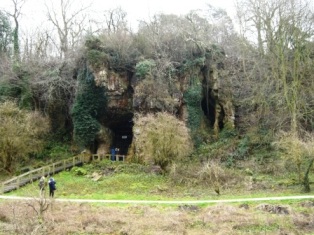
I have no idea whether Orddu, Orwen, or Snow are real or mythic persons or whether Pennant Gofid is an actual place in northern Britain (if it is I haven’t found it yet). However, archaeological evidence demonstrates that people lived here in caves after the last Ice Age and in the interstadials.
During recent research I found out from Barry Cunliffe’s Britain Begins and Stephen Oppenheimer’s The Origins of the British that a high percentage of the modern population can trace its ancestry back to the period after the last Ice Age when people recolonised Britain from Northern Iberia along the Atlantic seaways and from the North European Plain across Doggerland.
Up until now it had never occurred to me to question who Orddu’s people were and where they came from. To follow their footsteps back to the continent, into older times, and deeper into the cave.
II. After the Ice Age
Following the end of the last Ice Age, the Younger Dryas Stadial, (12,900 to 11,700 BP), the earliest evidence for the inhabitation of Britain comes from caves in south-west Wales. The oldest human remains from Worm’s Head include a human scapula (9920 BP), an ulna (9450 BP), a femur (9420 BP), and a cranium (9360 BP). Human bones dating from between 9000 and 7000 BP have been found at Paviland, Foxhole Cave, Ogof-yr-Ychen ‘Cave of the Oxen’, Potter’s Cave, and Daylight Rock.
One of the most famous Mesolithic burial sites is Aveline’s Hole in the Mendip Hills of Somerset. It was discovered in 1797 and investigations reported the presence of between 50 and 100 human skeletons. Unfortunately most of the finds and documentation were destroyed by bombing during World War II. Only 21 skeletons remain and they have been dated to between 9115 and 8740 BP.
Most were adults and adolescents, but they also included three children aged between 2 and 7 and an infant of 6 – 18 months. One of the skeletons was buried ceremonially in a disused hearth with ‘red ochre, abundant animal teeth some of which were perforated, and a set of fossil ammonites’.
The cave was sealed after the burial. This may have symbolised closing a connection to relatives become ancestors and to the Otherworld, or may have been a precaution to prevent their return.
In 2003 ‘an engraved panel’ consisting ‘of two rows of crosses with six in the upper row and four in the lower’ was discovered in Aveline’s Hole. Because the cave was sealed after the burial it is suspected this cave art belongs to the Mesolithic. Further art, three engravings taking the form of ‘rectilinear abstract designs’, possibly of a similar date, were found nearby, in Long Hole.
Other finds from the Mendips from this time include a mandible (9360 BP) and cranial fragments (9060 BP) from Badger Hole and the skeleton of Cheddar Man (9100 BP) from Gough’s Cave. Research into DNA has made possible a reconstruction of Cheddar Man’s appearance. His genetic make-up shows he had dark skin of a pigmentation ‘usually associated with sub-Saharan Africa’ and blue eyes.
This suggests that the earliest inhabitants of Britain, including Snow and her people, were dark-skinned. Snow received her name because she was born in a snow storm not because she had snow-white skin. Dark skin is hinted at in the way I describe Snow’s Very Great Grandmother whose face was ‘wrinkled like an old crowberry’, crowberry (empetrum nigrum), being black. Perhaps Orddu ‘Very Black’ was herself black due to a gene that linked her back to oldest ancestors.
In northern Britain a piece of human thigh bone contemporary with the burials in Aveline’s Hole was found in Kent’s Bank Cavern near the Kent estuary where it enters Morecambe Bay. Other evidence of human inhabitation of this area includes microliths and an antler point from Bart’s Shelter.
III. Creswell Crags Cave Art
Snow possessed stories about her cave, passed down by her ancestors, suggesting her people had lived in Britain in the past. Archaeological finds from a number of caves show the landmass, then attached to the continent, had indeed been occupied during the Lateglacial Interstadial (14,670 – 12,890 BP).
Creswell Crags, a limestone gorge in Derbyshire, is famous for its parietal and portable cave art and stone tools. According to Paul Petitt these have ‘very direct parallels with material from France, Belgium, the Netherlands, and Germany… the term Magdalenian… links these British industries to a much wider population dispersal into empty areas of Europe following the Last Glacial Maximum. This dispersal has its roots in the Magdalenian of south-western Europe… Magdalenian sites in Britain cluster relatively tightly between 12,600 and 12,200 radiocarbon years ago, which places the sites in the relatively mild conditions of the first half of the Lateglacial Interstadial.’
There are 25 examples of parietal art at Creswell; 23 in Church Hole, one in Robin Hood Cave, and one in Mother Grundy’s Parlour. All are engravings that often use the structures of the cave walls.
The clearest engravings are of a stag, bison, and an ibis. The latter is a bird for whom we have no faunal remains in Britain, but would have been seen on the continent by the highly mobile artists.
One of the most intriguing is a bird/woman motif, which has been interpreted as ‘long-necked birds of some kind…. cranes, herons, bitterns, and swans’ and ‘schematic human females, drawn upside down.’
Another, equally ambiguous, is described as ‘a diving bird, a serpentiform or a stylised human female?’ There is a also a ‘headless horse’, ‘small incomplete engraved animal’ and ‘abstract designs such as a ‘boomerang’, ‘engraved triangle’, ‘horn-like motif’ and ‘two small triangles’. ‘Figures of uncertainty’ include a ‘square’, a ‘bison-head profile’, a ‘horse-head’, and a ‘bear’.
In Robin Hood’s Cave was found a rib engraved with a horse coloured by red ochre. William Boyd Dawkins described it in 1867: ‘the head and fore quarters of a horse incised on a smoothed and rounded fragment of rib, cut short off at one end and broken at the other. On the flat side the head is represented with the nostrils and mouth and neck carefully drawn. A series of fine oblique lines show that the animal was hog-maned. They stop at the bend of the back which is very correctly drawn.’
The Ochre Horse shares parallels with portable Ice Age horse depictions from the caves of Perigord in France and Kesserloch in Switzerland. It is also contemporary with a decorated horse jaw from Kendrick’s Cave, Llandudno, which had five panels of chevrons cut into it creating a zig-zag effect. That people carried these representations with them may suggest horses held a special place in their traditions. Whether this was simply as a prey animal or as a spirit guide or deity remains unknown.
In Pin Hole Cave, engraved on the rib-bone of a woolly rhincoeros, was a masked figure described by Albert Leslie Armstrong as a ‘masked figure in the act of dancing a ceremonial dance.’ Again, the identity of this figure and why he was carried into and left in the cave remains a mystery.
Other British examples include an engraving of a reindeer from Gower Cave in Wales and engraved plaquettes from La Varines in New Jersey featuring abstract designs and ‘zoomorphic representations’, possibly of horses, mammoths, a bovid, and human face, dating to 14,000 years ago.
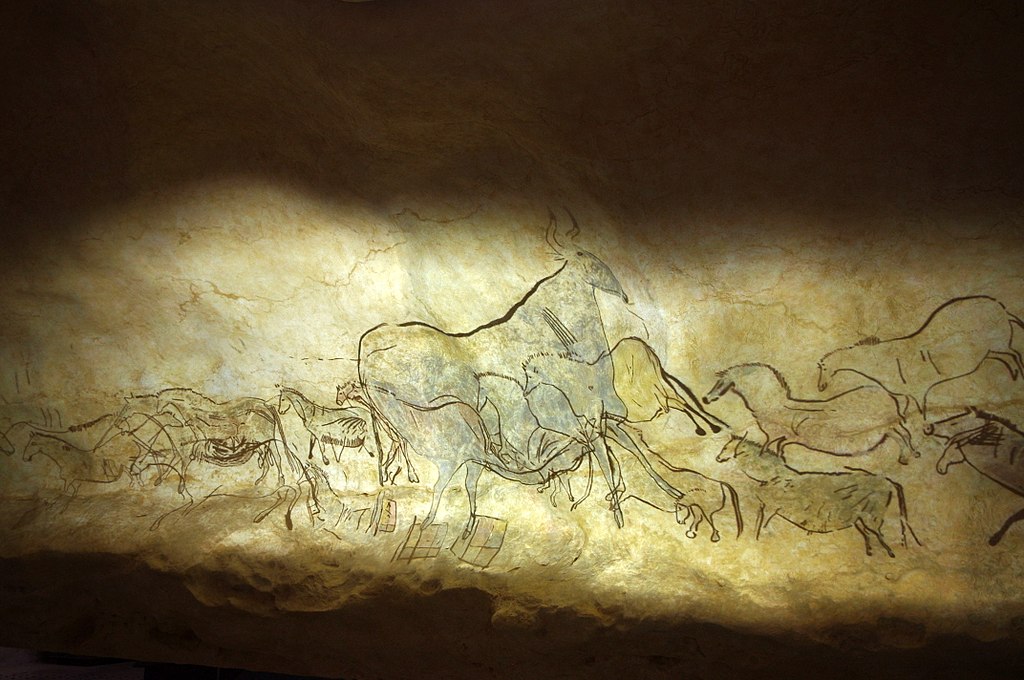
The art of Creswell Crags shares similarities with Magdalenian art from across south-western Europe. Paul Pettitt links its characteristics artworks at Altamira in Spain and Lascaux in France. He suggests the Creswell Crag artists spent their summers in this area and retreated to the lowlands that now form part of the North Sea or the Netherlands and central Rhine areas and says they would have been in contact with people from Ardennes and the Dordogne, which was also accessible on foot. “The Magdalenian era was the last time that Europe was unified in a real sense and on a grand scale.”
IV. Prehistoric Chapels and Rites of Initiation
The French archaeologist and Catholic Priest, Abbé Breuil, referred to Lascaux as ‘the Sistine chapel of prehistory’. The caves of the Franco-Cantabrian area have long been seen as sacred sites that were central to the religion of the Magdalenian people and their predecessors who made earlier paintings.
According to Bruno David these caves were used for ritual performances and rites of passage. He describes Cougnac: ‘Human engagements in the deep, dark space of the cave are intriguing: here are found animals that take shape along rock walls in a combination of natural concretions and painted red or black lines. At the entrance of chambers, palms of hands were dipped in red ochre and fingers smeared with black pigment, and then pressed against rock walls to leave distinctive marks. Animals were neatly arranged along rock walls, their viewing intentionally and carefully choreographed. Depictions were made of repeatedly speared humans or human-like creatures, and rocky concretions were tapped to make a ringing sound, it appears. This is the stuff of rituals… It formed part of an inner sanctum of knowledge, of an inner life, one that needed to be performed.’
David speaks also of ‘orchestrated performance’ at Tuc d’Audoubert where, adjacent to the Gallery of the Clay Bison, in the Chamber of Heels are found ‘183 impressions of the balls of human heels and myriad shallow impressions of fingertips’ ‘which show that those who walked this space did so on the heels of their feet, carefully avoiding placing the flat of their feet on the ground… The size of the heel imprints… indicates they were not made by adults but by youths probably adolescents.’
‘What we see in the art and imprints in the clay are the products of choreographed actions involving youths walking on the balls of their feet and pressing fingertips into clay along long and sometimes narrow tunnels underground, leading to sculpted clay bison that were never meant to be seen by the broader populace of the outside world. These were rituals along passageways that were, we think, literally rites of passage for youths approaching adulthood. The art was not just to be seen, but to be performed.’
David Williams argues that Lascaux holds ‘the key to major mysteries’ as a place for ‘vision quests’ leading to shamanic initiation. He says ‘different rituals were performed in contrasting areas’. In the ‘Hall of the Bulls’ the only area that can accommodate a large number of people, ‘dancing, music, and chanting’ may have taken place. He describes this area as a ‘vestibule’. In the Axial Gallery the Roaring Bull might have evoked auditory hallucinations and the Falling Horse sensations of falling and descent.
The dense engravings in the Apse featuring ‘crowded images of horses, bison, aurochs, ibexes, deer, and a possible wolf’ etched on top of one another might have provided a glimpse of the spirit world. Having passed a pair of ‘Cerberus-like paired bison’ and crawled down a tunnel to the Diverticule of the Felines to eight formidable cave-lions, ‘a horse seen face-on’, and ‘bison with a raised tail’, ‘questers came face to face with visions of power and made personal contact with the spirit realm.’
The Shaft, and end area, which falls away into a deep well is where offerings with ‘broken signs’ were left. Here is the famous painting of a bison wounded by a spear charging down a bird-headed man with a bird-staff. Williams says here ‘we have transformation by death: the ‘death’ of the man paralleling the ‘death’ of the eviscerated bison. As both ‘die’, the man fuses with one of his spirit helpers, a bird’. He interprets this as the ‘zoomorphic transformation… becoming a shaman necessitated.’
It seems possible that Creswell Crags was also seen as a prehistoric ‘chapel’ where people communed with spirit animals and sought and then engraved visions of the spirit world. Perhaps the witch’s cave at Pennant Gofid was also used for rituals of descent presided over by Orddu and her kin that led to initiates, like them, becoming awenyddion, ‘people inspired’, the Brythonic term for ‘shamans’.
V. Gough’s Cave – Skull Caps and Cannibalism
A discussion of the cave-based rituals of the people living in Britain during the Magdalenian period would not be complete without mention of the skull caps of Gough’s Cave, Somerset, and ritual cannibalism.
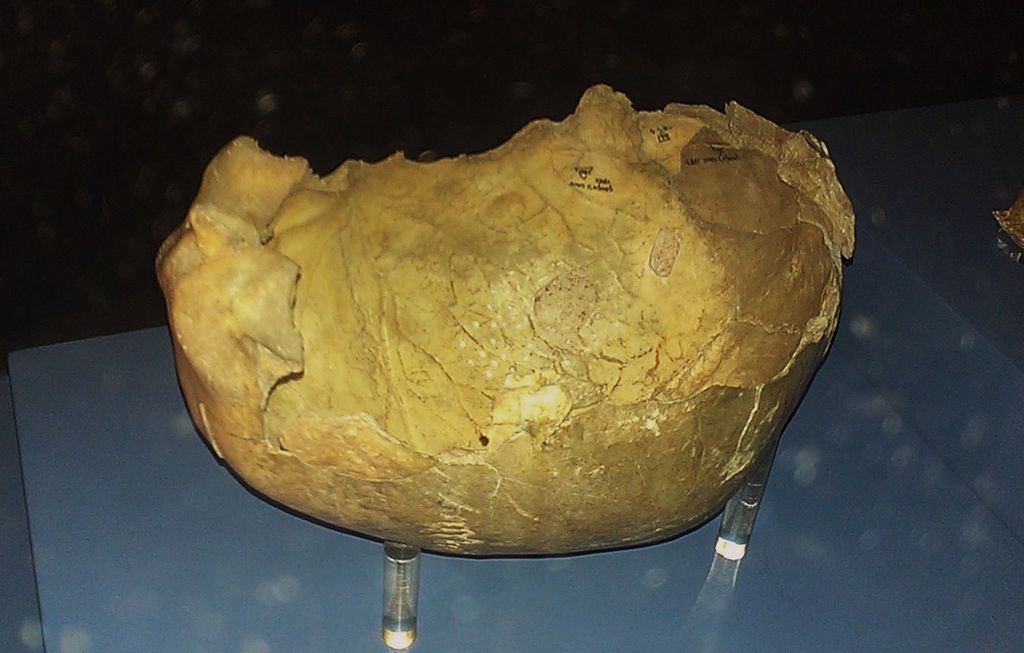
There were discovered the skeletal remains of ‘a Minimum Number of six individuals: a child (aged 3.2 years), a young adolescent (approximately 12–14 years old), an older adolescent (approximately 14–16 years old), at least two adults and an older adult’ dating to 14,700 BP. Results of the research by Silvia Bello et al. ‘suggest the processing of cadavers for the consumption of body tissues (bone marrow), accompanied by meticulous shaping of cranial vaults. The distribution of cut-marks and percussion features indicates that the skulls were scrupulously ‘cleaned’ of any soft tissues, and subsequently modified by controlled removal of the facial region and breakage of the cranial base along a sub-horizontal plane. The vaults were also ‘retouched’, possibly to make the broken edges more regular. This manipulation suggests the shaping of skulls to produce skull-cups.’
These skull caps resemble those from other Magdalenian sites such as La Placard Cave and Isturitz in France, and from Herxhein, Germany, in the Neolithic period, and El Mirador, Spain, in the Bronze Age.
In Gough’s Cave was also found a human radius engraved with a zig-zag pattern of ‘87 incisions: 33 single-stroke incisions, 32 to-and-fro sawing incisions’, also bearing evidence of cannibalism. What was particularly interesting is that ‘the decorative pattern seems to have been applied in the middle of this process: the break where the bone was snapped to extract marrow cuts across the zig-zag. It seems that the arm’s flesh had been removed, but then the butchery was paused while someone engraved the bone, and only then was it broken to get at its contents.’
This shares similarities with an ulnus from Kent’s Cavern with fine cut marks and percussion marks dating to 8185 BP. The zig-zag also resembles the pattering on the Kendrick’s Cave decorated horse skull.
It is clear that complex rituals and beliefs surrounded these acts of cannibalism and the creating of skull-caps and engraving of bones. Were these acts performed to honour the ancestors? Was eating one’s kindred an act of holy communion through which their life’s essence passed from the dead to the living?
What did the marks on the bones symbolise? Days? Acts? The release of the spirit from the bones? Was the creation of skull caps linked to belief that the soul presided in the head and with its release? What did wearing or drinking from the skull caps mean? Answers to these questions can only be guessed at.
It is worth nothing that, in Culhwch ac Olwen, Gwyn is associated with ritual cannibalism. He feeds the heart of Nwython, the ruler of Strathclyde to his son, Cyledyr, who becomes wyllt ‘mad’ or ‘wild’, but later becomes a rider on the hunt for Twrch Trwyth – a veiled version of the Wild Hunt. Here the consumption of the flesh of an ancestor is initiatory, leading first to madness, then to prowess.
Orddu is associated with Gwyn and witchcraft and her abode is described as hellish. One wonders whether the practice of cannibalism lived on and was practised by her and her ancestors in the Old North.
It certainly continued into the Iron Age in other areas of Britain. In the Bone Cave of Alveston, in Gloucestershire, the remains of seven individuals were found including an individual murdered by a pole-axe. The femur of one these adults ‘had been split longitudinally and the bone marrow scraped out.’
The skeletons were deposited with dog bones, cattle bones, a possible bear vertebra, and wooden twigs.’ Mark Horton says: ‘This was a highly structured deposit that can only have got there as a result of some form of ritual activity. This region was an important centre for underworld cults during the later Iron Age, some of which survived into the Roman period; in particular the Celtic Hound God, Cunomaglus, was represented as a dog guarding the underworld in a local temple sculpture.’
VI. Further Back in Time and Back to Now
The footsteps of Snow and her ancestors might be followed back from Britain to the continent and back again through earlier glacials and interglacials. The famous ‘Paviland Red Lady’, actually a male hunter found in Goat’s Hole Cave, Paviland, on the Gower Peninsula in Wales, his bones stained with red ochre, with mammoth ivory and nerite shells, dates to 33,000 BP. This is our earliest evidence for a ritual burial and thus for beliefs linking caves and the Otherworld.
The first record of Homo sapiens in Britain comes from a maxilla fragment from Kent’s Cavern, Devon, and is dated to between 34,700 and 36,400 BP and an Aurignacian burin busqué from Ffeunon Beuno, Wales, dated to 36,000 BP may have belonged to an early ancestor.
Homo sapiens arrived in Europe in 43,000 years ago having travelled through Israel after dispersing from Africa 120,000 years ago where the earliest evidence, from Omo I, dates to 195,000 years ago.
The stories of Snow and her predecessors remind us of our shared European heritage and its origins in Africa when, as Brexit approaches, Britain is cutting itself off from the EU and limiting foreign aid.
Whilst the cave art of the Magdalenians appears to have been born of a shared culture and religion, much later on, due to Christianity, Orddu, the last carrier of these traditions, appears alone in her cave. Isolated like those of us drawn to the Brythonic tradition today and those isolating due to COVID-19.
Dare we hope, instead of fearing death by Arthur’s knife, for a happier time when we can meet safely in caves and other sacred places to celebrate our bond with the Otherworld and its gods and spirits?
It’s Nos Galan Gaeaf. The night before the first day of winter. An ysbrydnos – ‘a spirit night’. Unlike its counterbalance, Nos Galan Mai, when monsters are slain and dragons calmed this is a night when the ysbrydion Annwn ‘spirits of the Otherworld’ walk abroad at the height of their power.
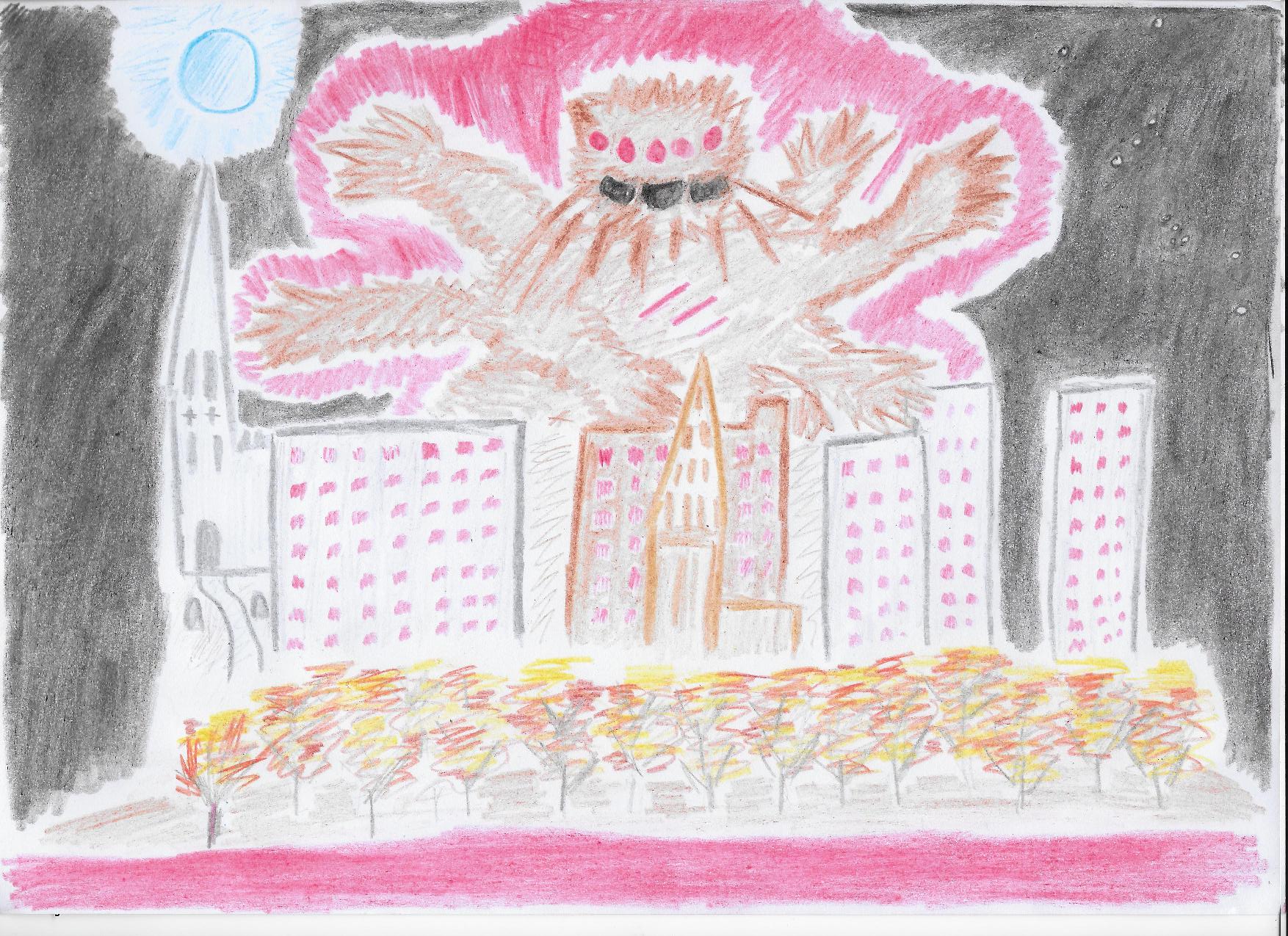
There is a monster amongst us, COVID-19, the Beast with the Fiery Halo. To represent it as such is in keeping with the traditions of many generations of ancestors who perceived diseases to be caused by malevolent beings, before science and technology revealed they are caused by micro-organisms. From an animistic standpoint, wherein all things are alive and have personhood, these views are not incompatible.
In ‘Hanes Taliesin’ the illustrious bard predicted the death of Maelgwn Gwynedd at the hands of ‘A most strange creature… His hair, his teeth, and his eyes being as gold.’ Maelgwn died after seeing Y Vat Velen, ‘The Yellow Plague’, through the keyhole in the church of Llan Rhos where he was ‘self isolating’.
Malaria, once known as the ague, took the form of a hag. Yr Hen Wrach, ‘The Old Hag’, was a seven foot woman who haunted Cors Fochno, Borth Bog. Her nocturnal visitations caused people to wake with the shakes. Samuel Taylor Coleridge later spoke of ‘the ghastly Dam, / Fev’rish yet freezing, eager paced yet slow, / As she that creeps from forth her swampy reeds, / Ague, the biform Hag!’
Nos Galan Gaeaf is a night when the veil of mist that separates the worlds is thin and the living may commune with the dead and the spirits of Annwn, some of whom we can name, and some whom are beyond categorisation. It is a time for telling stories in which otherworldly beings appear to haunt us and in which journeys to the Otherworld made. There is usually a dispelling or a safe return.
If we had a story about the Beast with the Fiery Halo it might go something like this. Many years ago our ancestors tried to build a world that was very much like the Otherworld, in which there was no want of food, or drink, or light, or heat, where no-one was cold, where no-one went hungry.
And that world was built at a great cost. The land was despoiled by mining and building. The air was polluted by fumes, which caused the temperature to rise. This led to the perishing of millions of trees, plants, animals, fish, and insects and to most of our ancestors living in servitude to the rulers who took power over the resources and machines that made this life possible. To depart from the system and the virtual world created by its technologies meant loneliness and ignominy, and at worst, death.
Most people accepted the cost, whether or not they were happy working at the machines, and turned a blind eye to the despoiling of the natural world because it was the only way to feed their families. Some did not. Some fought for change by protesting on the streets and others created nature reserves and planted trees and wildflowers and started growing their own food as an alternative.
Some prayed, to God, to the old gods, to Mother Earth, to Old Mother Universe, for something that would bring this system to an end. As if in answer to this prayer (and monsters are wily) appeared a beast the size of a sky scraper with limbs of countless animals, bent and twisted, as if trapped in a cage. Its lungs heaved phlegmatically in its scarred and hairy chest. Its many eyes were red and its mouths were gaping holes. Around its head was a blazing halo that burnt without burning the beast.
Like so many of the monsters in our myths it did not have a voice. It did not strike a bargain. It just came silently in the depths of winter and started taking the lives of our oldest most vulnerable people.
Protecting them came at a great cost: maintaining a distance from our friends and family, working less, travelling less, shopping less, to the benefit of the natural world and the detriment of our freedom. Our dependency on the rulers for financial support and the machines connecting us grew.
It felt like the unspoken bargain was this: ‘The lives of your old ones or your lives as you know them.’
Towards the end of summer we saw light shining through our prison bars. Although we all knew we had not defeated the monster we thought our sacrifices had kept it at bay. We dared to hope things might return to ‘normal’ but, as our liberties were restored, the monster took advantage. As winter approached, we saw the light was not sunlight, but the beast’s fiery halo, its triumphal crown.
The death toll is rising again. We are not at the end of the story but in media res, at the ‘crisis’, a Middle English term ‘denoting the turning point of a disease’ which is derived from medical Latin and dates back to the Greek krisis ‘decision’ and krinein ‘decide’. It’s decision time.
It’s as if we’re in a ‘choose your own ending’ book but the endings haven’t yet been written. We can only imagine them, happy or sad, tragic or comedic, apocalyptic or redeeming, guess there may be a twist.
Tonight the light of the blue moon is eclipsed by the beast’s fiery halo burning brighter than bright.
Nos Galan Gaeaf is a night on which, as a Brythonic polytheist devoted to Gwyn ap Nudd, I pray to him as the god who holds back the fury of the spirits of Annwn to prevent their destruction of the world and takes the souls of the lost and the angry dead to the Otherworld.
Countless times I have wondered why he has not held the beast back. Is it because he cannot or he will not? Is it because we are destroying the world? Because we too are monstrous?
We might consider that ‘monster’ originates from the Latin monstrum ‘to reveal’ or ‘to foretell’. Nos Galan Gaeaf, when Gwyn may be implored to part the mists of time, is a time for divination, for monstrous truths to be revealed and upon them our decisions based.
~
Gwyn ap Nudd
Starry Hunter in the Darkness guide us through these nights of fear.
Midnight Rider on the Storm of Madness teach us to ride these nights of tears.
Wise Warrior who guards the Cauldron by the light of the blue moon
lead the living to deeper wisdom and the dead back to Annwn.


















 The Sanctuary of Vindos