‘A Rainbow Bridge that rises and greets your foot… will carry you over the void as you step, trusting and empowered, into the unknown…’ – 0 The Wanderer, The Wildwood Tarot
I stand with one foot on Astley Moss,
rising onto tiptoe, the other raised, flexed, heel up, toe down,
like the hoof of a winged horse.
I still know little about where I came from and less about where I am going.
There is little comfort or security in the shifting mists below, haunted by the ghosts,
the bog bodies, the severed heads, the voice of Worsley Man.
They are all telling me, compelling me to move on, unlike restless spirits.
I am reminiscing about the day I drove into the end of the rainbow on the M6, throwing up splashes of rain like fairy gold.
‘Do Not Look Back.’
I hear His arcane commandment.
My wings are spread and deep within I know it is time to move on.
This is an image of Anrhuna in her guise as ‘the Mother of the Moss’ through which she has been speaking strongly to me over the past year. Anrhuna is not known from Brythonic lore but has presented herself to me and a couple of other awenyddion as an ancient goddess, who is the mother of my patron god, Gwyn ap Nudd. It’s my intuition that she was the driving force behind the earliest colonisation of the land by mosses.
I was diagnosed with Autism Spectrum Disorder Level One* on the 28th of September.
The day before Gwyn’s Feast. “Happy Autism Day,” he said, “welcome to my people.”
Still, I didn’t feel much like celebrating. I’d hoped that a diagnosis would bring clarity. However, being told that I have a lifelong neuro-developmental disorder or disability cast me into a fog of wondering how much my autism had played a role in my difficulties with social relationships and to hold a stable career in the past and how it was going to affect my future.
I’ve been a trainee with the Lancashire Wildlife Trust on the Manchester Mosslands since April. It’s been a great job, on great sites, with great people. Yet my enjoyment of the practical work of growing, planting, translocating, clearing scrub, building dead hedges, of the remarkable opportunity to restore the last remnants of our mosslands to their boggy glory has been overshadowed, fogged, by my anxiety about what people think of me, whether I’m doing well enough, measuring up, whether I will be able to progress to the next position up in this competitive job industry.
I’ve felt like I’ve been on trial and in some ways I have and in some I have not. I know my colleagues would rather I enjoyed my traineeship than see it that way. Still, I’ve had to meet my short term objectives and training targets. When it comes to progress I will have to meet the next person specification.
Good news is that a meeting with my line manager and project manager recently revealed in just six months, in spite of being autistic, I am nearly there.
Job-wise I’m good. Still, I’ve spent a lot of time dwelling on how my autism and the anxiety that stems from being an autistic person in a neurotypical world, finding it hard to read people and projecting negative opinions of myself, has skewed my perceptions of others and affected my relationships.
Few of us are psychic, but being autistic leaves me less able to judge what others think and feel unless I am directly told. Living with uncertainty is tough but, I’m learning, is better than living with the false certainty everyone hates me.
One of the upsides of living in the fog is the moments it parts like when a friend and I were lost on Cadair Idris and, after a man and his dog approached, the mists shifted and we found ourselves looking down on Llyn Cau. Being able to see and speak the uncomfortable truths that others avoid or ignore.
At least I know I’m living in the fog and, as a devotee of Gwyn ap Nudd, ‘White son of Mist,’ can know and embrace it as my patron god and as a friend.
“Welcome to my people,” he says and I see the faces of all the others down the centuries who have been able to swing an axe or a mattock or push a wheelbarrow, to write poetry under the trees, to walk light-footed as a will-o-wisp across a peat-bog but could not endure one day of electric light in the office.
“Welcome to my people,” he says, “to doubt, uncertainty, anxiety, and truth.”
In the fog, in the unknowing, I walk along the bunds that will bring the peat-bogs back then disappear into the moss as it swallows its surroundings.
It’s cold here and it’s November, but at least I know I’m living in the fog.
*This is the current term for what was formerly known as Asperger’s Syndrome.
for the torn apart all the parts of our bodies will ride tonight, crawl up from the bogs onto our swampy horses,
not the bog bodies who were found, but those who were not found.
*
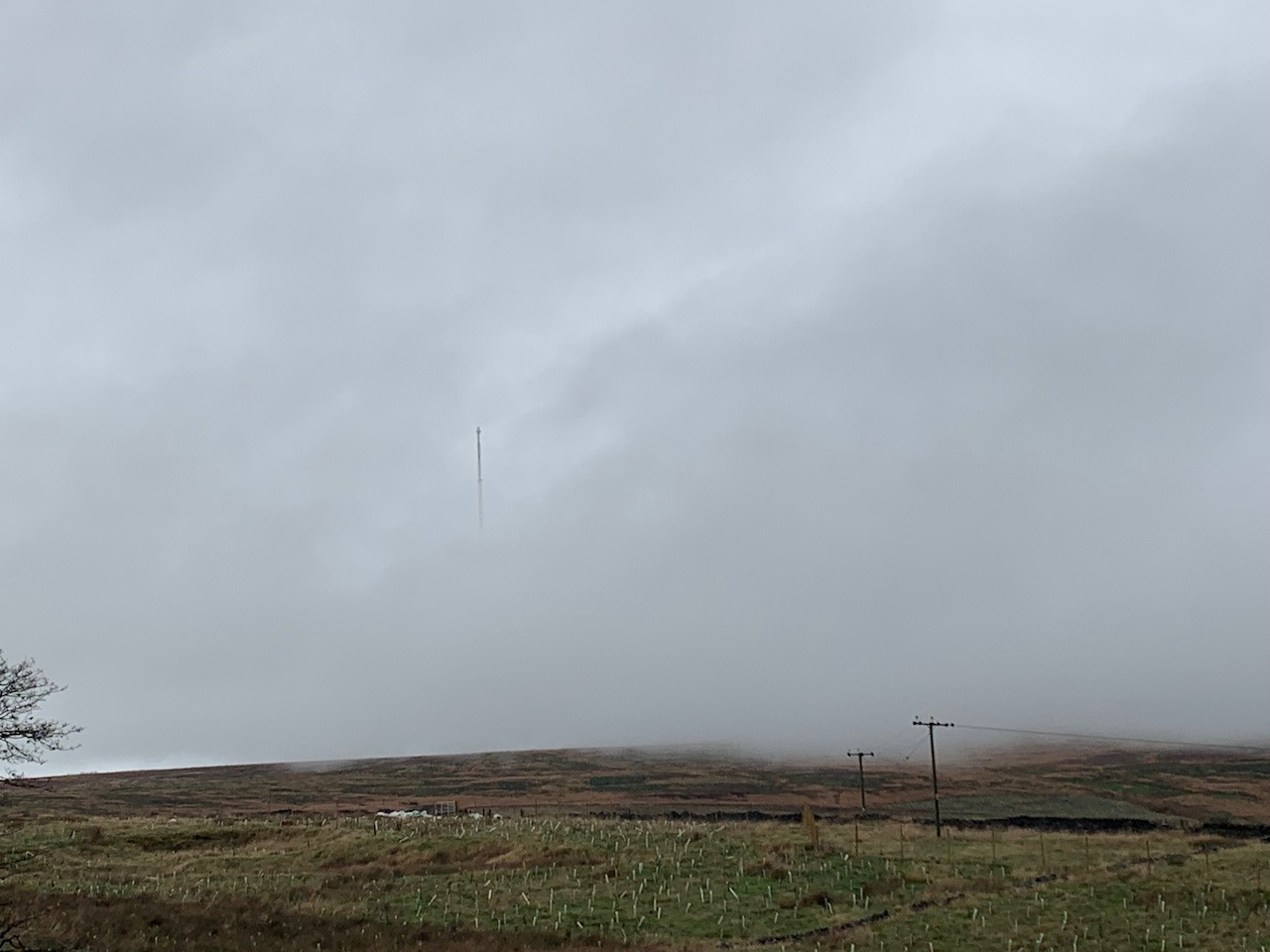
You summon back our voices like the mast on Winter Hill.
You make us appear again like television. Your hunt would make a good film but most times myth is better told in softly spoken words and half-seen visions.
Radio broken. Someone smashed the television.
*
You are always off screen. You are the one who is not named. You are the one whose face is the face of a god.
The howls of the wind are the chorus of your hounds,
your words are furies and each has a hand, clutching, pulling, ripping, tearing.
*
You are the god of illusion and the rending apart of all illusions.
The one who tears our false truths to shreds.
The jostling elbows, stuck-out toes, the heels dug in.
*
This is the time of fire, flood, rain, and catastrophe, yet the beech leaves are yellow, gold, and green
in the kingdom beyond the kingdom beyond the kings
and we call you a king without knowing the true meaning
of sovereignty, that your throne means more than gold.
*
Are you silence or the breaker of silence?
So long ago I wrote:
“The universe began with a howl and from the howl came death.”
The death-hounds within me giving tongue to a mythos that came to me before my world had begun.
*
AWEN is not always a smooth chant in the mouths of druids, but the broken vowels of an awenydd when language cannot help and poetry fails.
Still, the body, its dislocated limbs, remember how to ride tonight.
*
And where is she in all of this? Riding ahead treading air un-abducted? Did you take her from the underworld or did she take you there?
Time, the clock does not obey, pivots like she on her wild white mare
like a dislocated limb. I have found that myth dislocates too, frees itself from time and space, free and true.
This poem marks the first time I have felt inspired to share something here for a long time, something I felt compelled to share for my god after a walk near Winter Hill on Nos Galan Gaeaf. Maybe there will be more, maybe not, no promises, no deadlines…
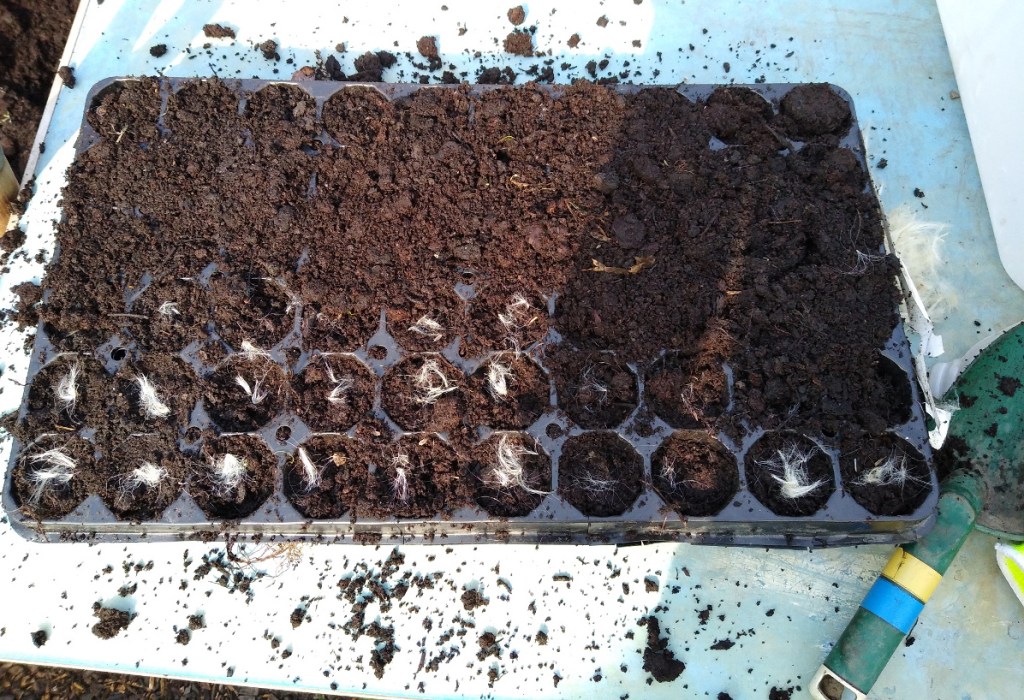
Last August, at Brockholes Nature Reserve, I helped on work parties common cottongrass (Eriophorum angustifolium). Winnowing the tiny dark seeds from the fluffy white heads, placing 1 – 2 into each cell of a 60 cell tray, which we had firmly packed with compost, covering them over, praying they would grow.
We sowed 10,000 plants in total. Some have grown better than others. Later I learnt they were for Little Woolden Moss – a strange synchronicity for it was through contacts at Brockholes that I recently gained a six week contract planting common cottongrass and other peatland plants on this mossland (which was purchased by the Lancashire Wildlife Trust in 2012 after having been badly damaged by peat extraction).
Prior to gaining this work I had discovered my patron god Gwyn ap Nudd’s connection with peat bogs/mosslands* in the medieval Welsh poem ‘Y Pwll Mawn’ ‘The Peat Pit’ by Dafydd ap Gwilym. I promised to make an offering to Gwyn next time I visited one. As we were in lockdown I hadn’t expected to go to a peat bog soon (the only area of lowland raised level bog in South Ribble, Much Hoole Moss, has been drained and, to add insult to injury, commandeered as a paint balling site). On receiving the contract, when I asked what Gwyn wanted, he showed me a common cottongrass plant.
So my planting on Little Woolden Moss had meaning in terms of both conservation and devotion.
I loved my time there in spite of the difficulty and what some might call the monotony of the work – pushing heavy wheelbarrows of plant trays along unstable bunds and repeating the same motion of digging five holes with a spear-spade, planting common cottongrass plugs, moving on, for seven hours.
Although we had many cold starts and some days were grim – with constant rain and up to 50mph winds – most were temperate and we were surrounded by the spring song of skylarks and meadow pipits, curlews, lapwings display flighting, brown hares racing up and down the bunds, and deer tracks (but not deer) were often seen.
When encountering the glacial till, seeing the ancient bog oaks exposed by the excavations (with 8 metres of peat 10,000 years of the archaeological record had been stripped away, unknown stories, our exploitation only slightly redeemed in that the compost had been used to nurture new plants) I experienced profound feelings of sorrow, awe, and privilege in partaking in the restoration process.
I later learnt ‘Little Woolden’ derives from the Viking Vuluedene ‘Wolf’s Valley’. This was significant for a couple of reasons. Firstly, I had previously agreed to write a series of poems for a Ghost Wolf Trail in New Moss Wood, just down the road, for the Carbon Landscape Partnership. Secondly, Gwyn and his father, Nudd/Nodens, are associated with wolves.
Little Woolden Moss is one of the few places that, in the words of storyteller Martin Shaw, I have felt ‘claimed’ by. The only others are my locality of Penwortham and the stretch of the Ribble from the Douglas estuary to Brockholes and those to which I have been a fleeting visitor such as Glastonbury, Cadair Idris, Borth beach, and Coed Felenrhyd (beautiful in their own ways but not truly ‘mine’).
Thus I was disappointed when, after succeeding with an application, and attending an interview, I didn’t gain either of two paid Great Manchester Wetlands Traineeships. I received positive feedback from Lancashire Peatlands Initiative Officer, helpful for other interviews, but assumed I had no future in peatland restoration.
So I returned to my voluntary internship at Brockholes, which I continued to enjoy, 3 – 4 days a week. One of my jobs was watering the common cottongrass, which we planted last year, and is due to go to Little Woolden Moss in mid-June.
On Thursday, after watering the cottongrass, I heard my phone ringing and just missed the call.
“That’s odd,” I said to the Assistant Reserve Officer, with whom I was working, “nobody every rings me.”
When I checked the number I saw it belonged to the Lancashire Peatland Initiative Officer.
“You’d better ring him back,” my colleague said, with a knowing tone in his voice.
So I rang back and, to my surprise, was offered the Great Manchester Wetlands Traineeship on the mosslands, based at Little Woolden Moss, as the previous candidate had chosen another job.
So… of course… I have taken it. The funding for the job will last a year. I will hopefully be starting on Monday 26th April and I have arranged to work my contracted 30 hours a week Monday – Thursday so I can continue with my internship at Brockholes one day a week on a Friday. So it looks like I may be both watering the common cottongrass we planted at Brockholes and planting it on Little Woolden Moss.
In total there are another 45,000 plants to be planted on Little Woolden this year. When Gwyn asked me for an offering of cottongrass I wasn’t expecting it to be in quite such numbers or to be planting it later in the year and, if this traineeship leads to a permanent job in peatland restoration, for many years to come.
III. You were here before someone wounded the Fisher King
red dripping into blue
the blood from his groin
like blood from his queen’s menses
flowing into the sea
(when male and female had to bleed).
IV. You were here before the fae danced in your colours
in the hall of the King of Annwn like devils
burning red and cooling blue.
V. You sat on your perch and you watched
the gods –
some say you advised the Fisher King.
VI. His wound
is beginning to heal with the demise
of industry.
The red rivers are flowing blue.
VII. You are no longer a myth
we cannot reach
on boats of fish bones
sailing for halcyon days
because they are here like you
on this river.
VIII. The Fisher King is fishing.
The red world is turning blue.
This poem is the third of three pieces about creatures who build their nests in sandy banks and can be seen at Brockholes Nature Reserve. I wrote it a couple of weeks ago when I was applying for a paid traineeship on the Kingfisher Trail – a 14 mile recreational route following the rivers of the Croal-Irwell Valley connecting ‘the rural West Pennine Moors to the urban communities of Bolton, Bury, and Salford’ (HERE). Although I didn’t get the job (of 300 applicants I made the top three) I intend to walk the trail.
In this poem I link the kingfisher to Nodens/Nudd, an ancient British god of hunting, fishing, healing and dreams, from whose mythos the story of the Fisher King may have arisen (although Brân is a candidate too) and to his son, Gwyn ap Nudd, a King of Annwn/Faery, whose people make merry in red and blue costumes in his feasting hall.
Coincidentally, around the same time, Gwilym Morus-Baird published a video on ‘Gwyn ap Nudd and St Collen’ (HERE) where he discusses the symbology of Gwyn’s people wearing red and blue, which might have alchemical significance. Intriguingly he linked this to the two streams, Y Gwter Las and Y Gwter Goch which flow into Llyn y Fan Fach, the location of a story where a fairy bride is given away by a Fairy King-like figure.
The pit of despair is a familiar metaphor. For me it’s a peat pit. Not the pwll mawn,the fishpond-sized peat cutting that Dafydd ap Gwilym fell into whilst riding his grey-black horse across the misty moors of Wales many centuries ago, but the empty expanses of the Lancashire peatlands made into gigantic peat pits by commercial peat extraction.
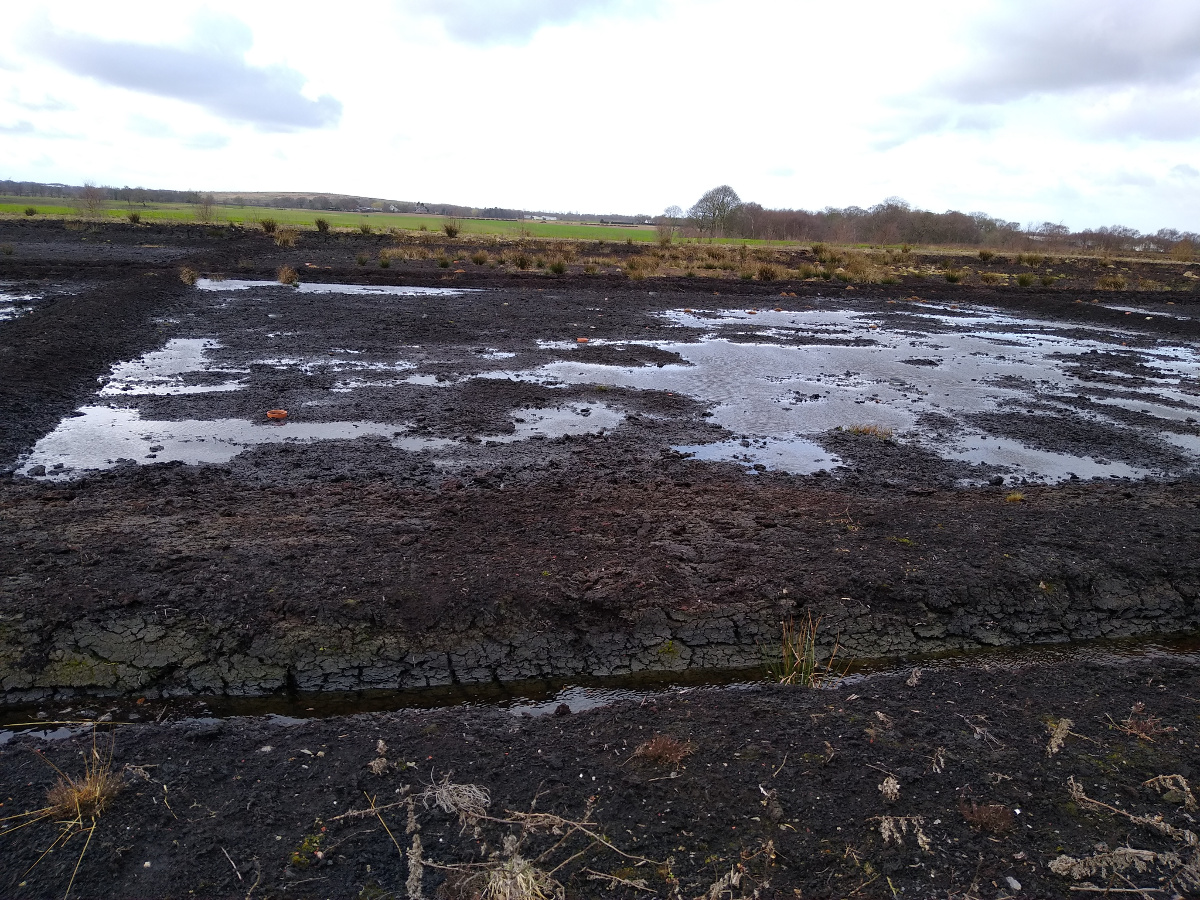
Drained, the vegetation (sphagnum moss, cross-leaved heath, bog rosemary, bog asphodel, sundew, cottongrasses) of the living acrotelm stripped away, rotovated, left to dry, bulldozed, bagged up for horticultural use or taken to power stations. The catotelm left bare, barren, leaking its carbonic ghosts into the atmosphere.
I’ve fallen into it metaphorically many times over the past year. When the first lockdown struck and all my conservation volunteering was cancelled and my internship postponed, when my mum had a fall and broke her hip, when the third lockdown put an end to all my volunteering but my internship.
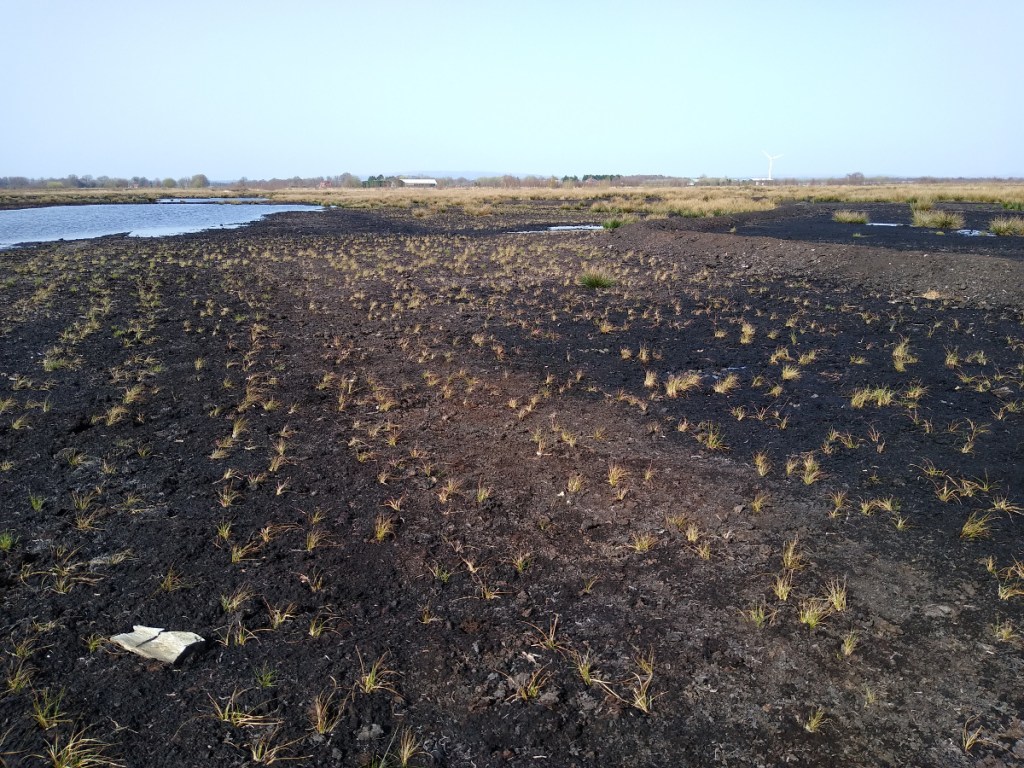
Now I’m there for real. On Little Woolden Moss, part of Chat Moss (which was once 10 square miles), near Manchester, which has been severely damaged by peat extraction. Since the Lancashire Wildlife Trust took it over in 2012 the east side is steadily being restored, but much of the west is bare.
This week my task, as part of the contracts team, has been planting the barren section with common cottongrass and hare’s tail cottongrass. I’ve been acutely aware of the wrongness of the exposure of the catotelm, the under-layer of peat, the underworld bare for all to see, its spirits disturbed, released.
Yet it has been rewarding to have the opportunity to make amends, hole by hole, plug plant by plug plant. Slowly but steadily recovering and restoring the broken body of the Mother of the Moss. Giving back her tresses by which, like by the hair of Rapunzel, I may too pull myself out of the peat pit.
It seems to be no coincidence, before I got this temporary contract work, I found out ‘the fish-pond of Gwyn ap Nudd’ was y pwll mawn ‘the peat pit’ and Gwyn, my patron god, was associated with peat bogs. I promised to make him an offering next time I visited him a bog.
Two weeks later I was offered this job. When I asked Gwyn what he wanted, he showed me a cottongrass plant and told me my planting would be the offering – restoring the body of his mother, Anrhuna, who I believe to be a long-forgotten Brythonic wetland goddess.
I’ve long been in a pit of despair because I have unable to find paid work by which I can serve my gods. Now I’ve got it, temporarily at least, and have applied for two other watery jobs – traineeships on the Kingfisher Trail (on Bradshaw Brook) and on the Great Manchester Wetlands.
I’m currently in an in-between place with three weeks done and two weeks left on Little Woolden Moss. Not knowing if I’ll get an interview and where my life might be heading next. A little like the mossland, teetering between death and recovery, this fragmented part of Anrhuna’s body slowly being brought to life.
Gwyn has stolen me to the underworld countless times. He has put into my hands the healing plants. He has sent me back to repair the damage of its exploitation with work and words.
I pray to you my gods, Gwyn and Family, to grant me the means to continue with this work.
‘After My Vows (Love Songs from a New Godspouse)’ is the second album from Thornsilver Hollysong. Thorn is a fellow awenydd and devotee of Gwyn ap Nudd who I met through the Awen ac Awenydd Facebook group in September 2019. He hosts Gwyn Day Thursdays on Land Sea Sky Travel and we have since worked together on conferences and workshops for Gwyn and his ‘family’.
It has been spiritually affirming to form a friendship with someone else who shares my devotion to Gwyn. Whilst my relationship with Gwyn is primarily devotee to god, Thorn is also a godspouse, thus Gwyn’s lover and husband. Godspousery is an ancient tradition which has probably been around since humans met gods and entered liaisons and marriages with them. Its best-known form is Christian nuns becoming Brides of Christ and it is particularly deeply embedded in the Brythonic tradition, which contains numerous stories of the Fairy King and his people taking humans as lovers. It has been illuminating listening to this album and hearing of experiences familiar and unfamiliar.
‘After My Vows’ was composed by Thorn with his own piano-playing and vocals. There is a rawness and immediacy to this music, a heartfelt passion, an outpouring of devotion. Whereas some songs are waltz-like, others are operatic, some put me in mind of a monk’s voice from a polytheistic cloister.
If there is one line from the album that summarises it for me it is: ‘Come to the ballroom of waltzing shadows’. This is from ‘Won’t You Dance’, a song that, although the tunes differ, put me in mind of David Bowie’s ‘Let’s Dance’. Here Thorn relates meeting Gwyn as ‘Black shade, silver mist / In a raven’s mask’ ‘At the Faery Ball / Sparkling shadows darkling as the moonbeams fall.’ It took me back to my own clubbing days, dancing alone, melting into the oneness of Faery. It gives voice to the timeless truth that gods are not only met at the altar or out in nature, but on the dance floor. In other songs this moonlit ballroom becomes Gwyn’s Hall in ‘the Castle of ice and bone’ where Thorn sings before his Fairy King like Gweir in his heavy blue-grey chain.
In ‘Greensleeves (He’s My Heart of Gold)’ Thorn takes the tune and rewrites the lyrics from the traditional English Folk Ballad, replacing Lady Greensleeves with Gwyn in an incredibly catchy chorus that I’ve been singing along to since I heard it. The following lines felt deeply familiar:
He rode with grace and I knew his face Though I had no reason to know him– The songs I sing have crowned him King With a pathway of stars strewn below him.
Another song which stirred this sense of familiarity was ‘Reunion’:
Was I a monk or mystic? Did I meet You? Was I a cunning man or woman? Did I know You? Was I a heretic or witch who dared to greet You? And for me, to put the holy Church below You?
It put me in mind of my own feeling, upon meeting Gwyn, that I’d known him in other lives, since the beginning of time. This is also conveyed in Thorn’s songs and his vows to love him ‘forever’.
‘Light of the Mist’, with its softly song couplet ‘Light of the Mist / Ghost of the Void’, sent shivers down my spine. Here ‘ghosts stars’ burn in ‘Inspired art’ and we find untold stories only hinted at such as the tale of ‘the Star who gave his Wings’ and how ‘He kissed the dead/ To bring me back’.
In other songs, like ‘As I Made My Vows (It Felt Like a Wedding)’ and ‘Just a Life with You’ I found lines that, as someone without a romantic or sexual relationship with Gwyn (or a human partner), it was harder to relate to. However, I appreciated their craftsmanship and aesthetic beauty.
And You take my hand Saying “Come, lie down Where the fruit trees stand Each with blossoming crown– In the winter sun Under apples sweet With our hair undone And our joy complete.”
The album is filled with instances anyone who has sat with Gwyn in a woodland or the forests of Annwn would ‘get’: ‘You’re taller than a man could be– / Your antlers, like an ancient tree / Branch out and cover up the distant cross.’ ‘I dream of stars in a forest sky / I dream we watch them, You and I.’
I would recommend ‘After My Vows’ to polytheists who have devotional relationships with Gwyn or other gods, to those who are called to godspousery and to those who are not, and to all who appreciate beautiful music.
‘After My Vows’ is available on Bandcamp for $3 HERE.
In ‘The Conversation of Gwyn ap Nudd and Gwyddno Garanhir’, Gwyn recites the names of a series of northern British warriors* whose deaths he attended ‘when ravens croaked on gore’.
I was there when Gwenddolau was slain, Ceidio’s son, a pillar of poetry, When ravens croaked on gore.
I was there when Bran was slain, Ywerydd’s son of wide fame, When battle-ravens croaked.
I was there when Llachau was slain Arthur’s son, wondrous in wordcraft, When ravens croaked on gore.
I was* there when Meurig was slain, Careian’s son, honoured in praise, When ravens croaked on flesh.
I was there when Gwallog was slain, From a line of princes, Grief of the Saxons, son of Lleynog.
The repetition of lines featuring croaking battle-ravens at the end of four of the five three line stanzas drives home the devastation wreaked upon the battlefields where these northern men were killed, some in internecine rivalry, some battling against the Anglo-Saxons. It shows few or none of the Britons on their side lived on to bury their dead, who were scorned by their enemies.
The image of battlefield ravens and other carrion birds along with wolves and/or dogs feasting on the corpses of the dead is common throughout the poetry of the ‘heroic age’ across Northern Europe and expresses the gristly reality of conflict and its aftermath, which few of us witness first hand today.
In it we find the expression of attitudes towards heroism, war, death, and the battle-dead. Although most of this poetry was composed after the pre-Christian peoples of Northern Europe had been converted to Christianity it is still possible to find hints of pre-Christian superstitions surrounding ravens and other carrion birds as ‘death-eaters’ who were associated with the death gods and goddesses.
The sense of Gwyn’s omnipresence on the battlefields where these northern British warriors died combined with our knowledge from other sources that he is a ruler of Annwn (‘the Deep’ – the Brythonic Otherworld) suggests he attended their deaths as a psychopomp to gather their souls back to his realm and that, like him and his hounds, the death-eating ravens served a role in their transition.
An examination of the literature surrounding battlefield ravens in the Brythonic and other Northern European cultures suggests they were viewed not only as carrion-eaters associated with the aftermath of battles but as manifestations of the death-gods, those who served them, and the dead.
In the Brythonic tradition there is a great deal of raven imagery in The Gododdin, which relates the tragic Battle of Catraeth, where over three hundred Brythonic warriors died fighting the Anglo-Saxons.Here a battle is referred to as a ‘raven’s feast’ and ‘raven’s gain’. Whilst one of the warriors ‘fed the ravens on the rampart of the fortress’ another became ‘food for ravens’ ‘benefit to the crow’. This reflects a possible heroic adage that the fate of a warrior was either to feed the ravens or become food for them. In ‘The Battles of Gwallog’ ‘there are… many stinking corpses, / and scattered crows’.
The rulers of the northern British kingdom of Rheged were associated with ravens. Three ravens appear on their coat of arms (designed in the Middle Ages) which might have been based on a raven banner**.
Having fed the ravens most of his life Urien Rheged becomes food for ravens after his assassination. Whilst his cousin, Llywarch Hen, rides away with his head, ‘on his white bosom the sable raven gluts.’
In Rhonabwy’s Dream, the warriors of Owain Rheged take the form of ravens and feast on their living enemies. After a defeat by Arthur’s men, the squire ‘raised the banner’, and they took revenge. ‘They carried off the heads of some, the eyes of others, the ears of others, and the arms of others and took them up into the air. There was a great commotion in the sky with the fluttering of jubilant ravens and their croaking, and another great commotion with the screaming of men being attacked’.
In the Irish myths ravens and crows are associated with the battle-goddesses the Badb and the Morrigan. The name Badb means ‘crow’. In ‘The War of the Irish with the Foreigners’ she appears as ‘a wild, impetuous, precipitate, furious, dark, frightful, voracious, merciless badb, screaming and fluttering over their heads’ with ‘ancient birds’, ‘destroying demons of the air’, and a ‘phantom host’. In The Tain, the Badb is invoked by the war-cry of Cú Chulainn along with ‘fiends of the air’ and it is only when the Morrigan settles as a raven on his shoulder that his enemies know he is dead. In Anglo-Saxon literature the raven is one of three ‘beasts of battle’ with the eagle and wolf, hungry for, and feasting on the corpses of the dead. In ‘Judith’ ‘the dark raven’ is described as ‘a slaughter-greedy bird’. In ‘Elene’ ‘dark and slaughter-fierce’ it ‘rejoiced in its work’. In the Old English Exodus, in a verse that opens with screams of war-birds, it is described as ‘the dark chooser of the slain’.
This is interesting in relation to the lore surrounding ravens in Norse mythology. Two ravens named Huginn ‘thought’ and Muninn ‘memory’ fly across the world to gather information for Odin, the god who receives half the souls of the battle-dead in his hall, Valhalla, who are taken there by his valkyries.
The term valkyrie comes from valr (the battle-slain)and kjósa (to choose) and means ‘chooser of the slain’. Valkyries and ravens were frequently depicted together, such as in ‘Raven Song’, where a valkyrie asks a raven: ‘How is it with ye ravens? Whence are ye come with bloody beak at rithe dawning of the day? Torn flesh is hanging from your talons, and a reek of carrion comes from your mouths. I do not doubt that ye have passed the night amid a scene of carnage’. These companions may have been seen as shapeshifting into one another, as raven-woman figures, like the Badb.
Another intriguing figure, from Danish lore, is the valravn ‘raven of the slain’. These beings are described alternatively as ravens who gain the knowledge and form of men by eating the heart of a fallen king or as restless souls who can only be rid of their animal countenance by drinking the blood or eating the heart of a child. Sometimes they are described as half-raven, half-wolf.
Parallels with other sources suggest ‘the ravens who croak on gore’ who accompany Gwyn may be more than what they seem, that they might be shapeshifters, valkyrie or Babd or Morrigan-like deities.
In relation to this theory it is notable that Gwyn may be identified with Afallach, the father of Morgan. She appears in the Vita Merlini as one of nine sisterswho‘knows an art by which to change her shape, and to cleave the air on wings’. Morgan and her sisters may be the nine maidens whose breath kindles the fire beneath the Cauldron of the Head of Annwn in a poem attributed to Taliesin called ‘The Spoils of Annwn’. On the surface the names Morgan and Morrigan appear to be similar. However, mor in Welsh means ‘sea’ whereasmór in Irish means ‘great’ and rigan ‘queen’.
Afallach is also the father of Modron, who is raped by Urien Rheged, and bears Owain and Morfudd, in Peniarth MS. 70. Here we find further potential connections between the King of Annwn and the raven-rulers. Whether Morgan and Modron are the same goddess by different names I remain uncertain.
What my research has opened up is the possibility that whilst, on one level, the ravens in ‘The Conversation of Gwyn ap Nudd and Gwyddno Garanhir’ are physical beings partaking in the visceral reality of feasting on the battle-dead after tragic battles they might also be seen in other ways.
Perhaps they were shapeshifting goddesses who were daughters of Gwyn, valkyrie-like figures who served him, or embodiments of dead or living warriors. These meanings shift and overlap and open new paradigms for understanding the lines about warriors feeding and becoming food for ravens.
Their croaking over gore becomes increasingly sinister in our modern eyes, but may reflect an older worldview in which life feeds on life and the dead on death and to feed the ravens is not an insult but an honour.
* A possible exception being Arthur’s son, Llachau, unless there is an argument for a northern Arthur. ** It seems possible the rulers of Rheged had a raven banner with animistic qualities like those carried by Viking leaders. If the raven flapped its wings there would be victory and if it hung limp, defeat.
The image is ‘The Twa Corbies’, an illustration from Arthur Rackham’s Some British Ballads (2019). Courtesy of Wikipedia Commons.
Hugo Edward Britt, ‘The Beasts of Battle – Associative Connections of the wolf, eagle, and raven in Old English Poetry’, (The University of Melbourne, 2014)
Marged Haycock (transl), Legendary Poems from the Book of Taliesin, (CMCS, 2007)
Sioned Davies (transl.), The Mabinogion, (Oxford University Press, 2007)
Only art can bring back that which should never be touched:
grave goods, treasures of the mound and bottomless lake,
your cauldron.
Like you, my lord, they are beautiful and cursed,
filled with spirits who haunt us with wishes that shall never be.
Sword of Nodens, Spear of Lugus, Shield of Brân,
your mother’s secret jewellery,
the Golden Ring by which you are bound to fight your enemy,
numinous and just as deadly as the battles of dragons.
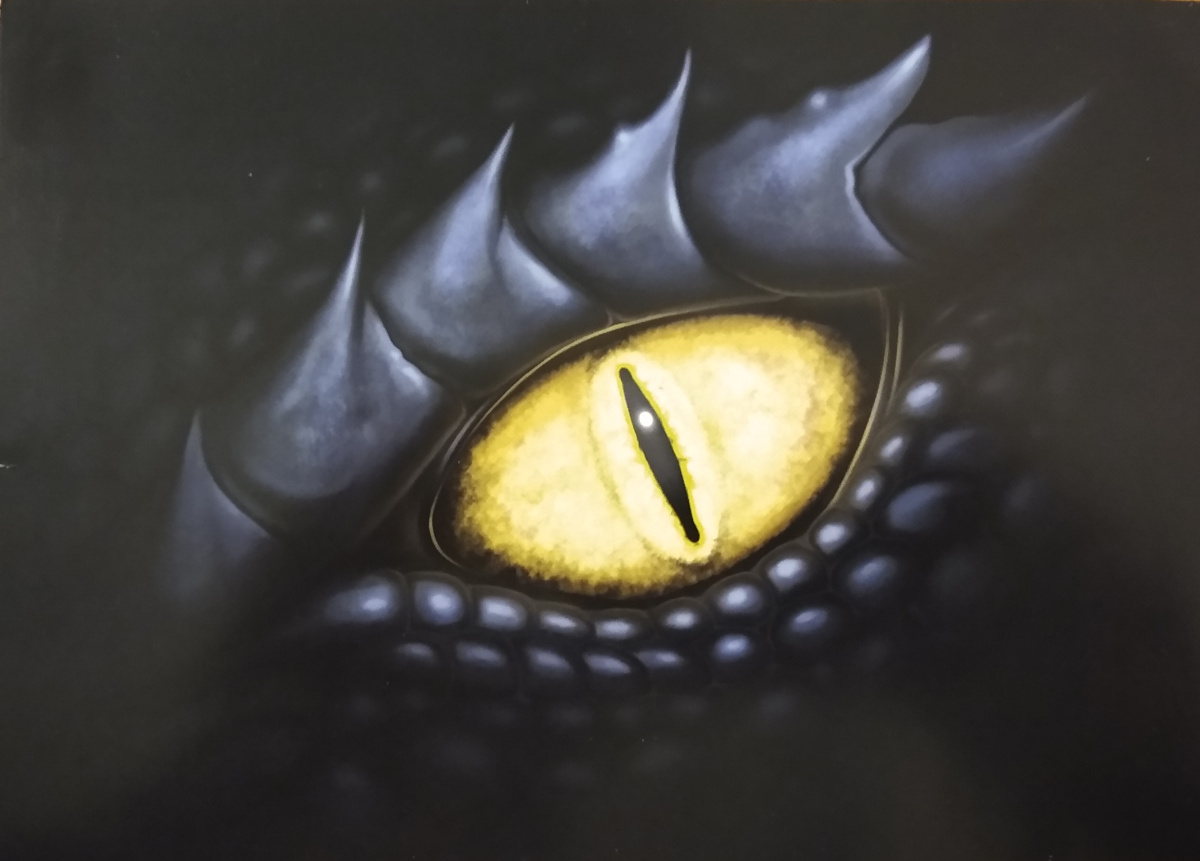
As a great black dragon you watch over the dragon-spirits within.
Only art can bring them back and for those who touch your terrors reign.
*This image of a dragon’s eye is from a birthday card my aunt sent me last year. It reminds me of Gwyn-as-dragon and is blu-tacked on my wardrobe, overlooking my writing desk.








 The Sanctuary of Vindos