This Dark Night

Vindos Vindos Vindos
by the Winter Wind
I call to You

Vindos Vindos Vindos
Father of Night
oh hear my cry

Vindos Vindos Vindos
in the darkness
make me one with You

Vindos Vindos Vindos
heal my wounds
on this dark night

Audio HERE

*A chant to Vindos for all those in need of healing over the dark moon and winter solstice period.

The Edge of the Dark

A memoir in the form of a novella based around my childhood, teens, and twenties. It records a confrontation with the darkness within the land, our culture and in my own psyche and a failed initiation into adulthood and shamanism. Finally, how my patron God, Gwyn ap Nudd, saved me from myself.

Free digital copy HERE. If you enjoy it please share the link to this post.

Black poplars who do you grieve?

We have not the myth of a son
of the sun who got burnt
by the sun and fell.

When Maponos
stole the horses of Bel
and rode skywards to the horror
of His mother He did not come to grief.

Although Maponos burned He was not burnt.

He returned instead alive and ablaze,
replenished, youth renewed,
as the Sun-Child.

So, why, black poplars, do You grieve?

Do You grieve because Your brother lives?
Do You grieve because You are jealous?
Do You grieve because You got no grief?

Or is there a story of another brother?

A forgotten son of Matrona,
daughter of the King of Annwn,
who mounted a black horse and rode
after the black sun when it set and sunk
to the depths of the Underworld?

Did He drown in a black lake?
Was He eaten by a black dragon?
Or does He still wander lost in sorrow
through a labyrinth unillumined
by the rays of the black sun?

Poor brothers, did You search 
for Him and almost lose yourselves?
Did You get trapped in a dark prison
and scrape Your bloody fingers
against the walls and weep?

If so, how did You get here?

Did You ride with the black sun
or with the King of Annwn on the back
of His black horse who carries lost souls?

Did He plant You here, He and His Queen,
with labyrinthine roots winding down?

Did He seal Your tears deep within?

Did He kiss Your fingers like His Bride’s,
tuck them into a yellow bud
to emerge again
only in the spring to reach
not for the black sun but the love of a mate?

Did He bring You here to tell me when
I grieve my fingers are not talons
to scrape the walls
and my tears are not sap
to entrap the insects who get in their way?

Did He bring You here so I could learn
from Your clawing, Your crying,
my clawing, my weeping,
to turn my grief inward in winter
and then, in spring, to reach out in love?


*This poem is addressed to the two black poplars who stand at the source of Fish House Brook, near to the Sanctuary of Vindos, in my hometown of Penwortham. The photograph is of one of the fallen catkins, taken in spring 2022, not quite emerged.

Trampled like Cut Reeds to the Ground

‘Gwyn ap Nudd, helper of hosts,
Armies fall before the hooves of your horse
As swiftly as cut reeds to the ground.’
~ ‘The Conversation of Gwyn ap Nudd and Gwyddno Garanhir’

So far it’s been a grim month. Grey skies. Heavy rain. Storms. 

The scythe of the Reaper has been swinging, chopping, cutting. The cut reeds have been falling swiftly. The huge round hooves of His horse, of the horses of Annwn have been trampling them into the rain-soaked ground.

Sister Patience, chop, cut, gone. The Monastery of Annwn, chop, cut, gone. My dream of living the rest of my life as a nun of Annwn, chop, cut, gone

It’s happened so suddenly. Yesterday I spent a moment, like waking in the morning after a night I’d self-harmed, in shock, thinking what have I done? 

Yet this was not the work of my blade but the Reaper’s blade…

Gwyn was there to reassure me, His hand on my shoulder (slightly bony) letting me know that it was for the best, that dying reeds have got to fall. 

I could see the monastery was dying but Sister Patience felt alive to me.

“Sometimes you don’t know you’re dying until it’s too late.” 

I trust His wisdom in taking a part of me – a sacrifice to save the whole. 

What now? I stare down at crushed reeds in the muddy churned-up ground, attempting to scry a message from the mess of my life – the mash of criss-crossed stalks and the rain-filled half moons of the hoofprints spilling into pools.

There’s always been an obvious road that I’ve never managed to take. Write that much-needed book on Brythonic polytheism or Brythonic shamanism. Write some how-tos on how to meet the Brythonic Gods. It’s always been blocked. That dark hooded figure with His scythe in the way.

“That is not your work,” he slides a whetstone along the curved blade. “I want you to write the words that cut to the truth, that hurt, that have edge.”

I see I’ll always be an edge person. Not salesy enough to sell. Not humble or practial enough to crawl away from the blogosphere and get a proper job. Suburban in the sense of lower down rather than rows of identical houses with cut lawns (although I live in one). Far too English to be properly Brythonic.

I’ll never be able to say, “Look at my bright shiny life you can have this too!”

Yet, in giving voice to uncomfortable edges, to exploring the messier, lesser-spoken side of relationship with Gods and spirits I feel I have a place as a writer and guide.

A place of cut and trampled reeds, muddy waters, dark hooves, forever shadowed by the Reaper’s hooded form and His skeletal touch.

Photograph from when I was cutting reeds during a fen cut (albeit with a brushcutter rather than a scythe) when I worked for the Lancashire Wildlife Trust on the Wigan Flashes.

Swaying White Fields

Swaying white fields,
dancing white mist,
a mouse on each wheat ear –
around them tails twist.

Oh Grey King
You’ve haunted this land,
memories lost,
now You’ve returned.

Your poor hungry people
had nothing to eat
but now they’re well feasted
on white ears of wheat.

Oh Grey King
You’ve haunted this land,
memories lost,
now You’ve returned.

And tonight we will feast
on apples and mead,
You and Your mouse wife
in these bare fields of wheat.

Oh Grey King
You’ve haunted this land,
memories lost,
now You’ve returned.

CLICK HERE FOR AUDIO

I wrote this song for Gwyn ap Nudd to celebrate September which is known in Cornwall as Gwyngala ‘White Fields’ and in Wales as Mis Medi ‘the Reaping Month’. Here I equate Gwyn with Llwyd ap Cil Coed from the Third Branch of The Mabinogion, who sends His people as a plague of mice to eat the wheat fields with His wife as the ring-leader. Llwyd is likely to be the Welsh folkloric figure Brenin Llwyd ‘the Grey King’.

An Introduction to Vindos / Gwyn ap Nudd

I am writing this article for those who are new to the Sanctuary of Vindos and for those who have been following me for a while who might enjoy reading an article that brings together my research on Vindos / Gwyn in one place. 

Vindos

Vindos is the reconstructed Proto-Celtic name of the medieval Welsh God, Gwyn ap Nudd, ‘White son of Mist’. It stems from the root *Windo ‘White’ (1). It is possible that Vindos was worshipped at Vindolanda ‘the Land of White Springs’ (a Roman auxiliary fort on Hadrian’s Wall) and, like His father, Nodens (2), more widely across Britain during the prehistoric and Romano-British periods. 

From Gwyn’s role as a ruler of Annwn ‘Very Deep’ (the Brythonic Otherworld / Underworld) and gatherer of souls, we might derive that Vindos, too, ruled the chthonic regions and was associated with the dead.

It’s my personal intuition that the chalk God found at the bottom of a ritual shaft in Kent and recorded by Miranda Aldhouse Green might be Vindos: 

‘At the bottom of this shaft… all some 2.5 metres deep, was an oval chamber containing a complete figurine, composed of a featureless block of dressed chalk from which rises a long, slender neck and a head with a well-carved, very Celtic face. This figure may have stood in a niche high up in one wall of the chamber… Pottery would indicate a first or second-century AD date’ (3).

It is possible that prehistoric burial monuments with stonework made from chalk and limestone, described by Rodney Castleden as ‘bone-white buildings… temple-tombs… sharply defined with deep boundaries and blinding chalk-domes visible for many miles,’ (4) were associated with Vindos.

Vindos might be equated with the Gaulish Vindonnus ‘Clear Light, White’. According to James McKillop, Vindonnus was worshipped at ‘a site coextensive with Essarois in Burgundy, eastern France. Bronze plaques nearby depicting eyes suggest he was attributed curing powers for eye diseases’ (5).

It is likely that the coming of Christianity played a role in expunging the evidence for veneration of Vindos on the basis of His associations with the Underworld and death. Luckily, as Gwyn, His stories lived on in medieval Wales.

Bull of Battle – Warrior-Protector and Psychopomp

Gwyn’s clearest representation comes from a medieval Welsh poem called ‘The Conversation of Gwyn ap Nudd and Gwyddno Garanhir’ from The Black Book of Carmarthen (1250). Herein Gwyn and Gwyddno (6) converse at an undisclosed location. I believe the poem implicitly suggests that Gwyddno is dead and Gwyn has appeared to guide his soul to Annwn. This is also the interpretation of translator, Greg Hill, whose translation I have used below (7).

In this poem, Gwyn is addressed with deep reverence and respect by Gwyddno as a ‘fierce bull of battle’, ‘leader of many’, and ‘lord of hosts’. This fits with Gwyn’s name not only meaning ‘White’ but ‘Blessed’ and ‘Holy’. Gwyddno petitions Gwyn for protection, and Gwyn replies that from Him, an ‘invincible lord’ (hinting at His divine status), ‘He who asks shall have protection’. As a ‘bull of battle’, Gwyn is a warrior-protector.

At first, Gwyddno does not recognise Gwyn and thus asks what land He comes from. Gwyn replies: ‘I come from many battles, many deaths’. These words are suggestive of His role as psychopomp gathering the souls of the battle-dead. Only when Gwyddno asks Gwyn of His descent does He reveal His identity: ‘My horse is Carngrwn from battle throng / so I am called Gwyn ap Nudd / the lover of Creiddylad, daughter of Lludd.’ There is a sense here that it is only when Gwyddno recognises Gwyn that he realises that he is dead. ‘I will not hide from you.’ He realises he cannot hide either from Gwyn or the truth that he is deceased and states his own name, ‘I am Gwyddno Garanhir.’

Gwyn is then drawn away by His restless horse and red-nosed hound, Dormach, who is wandering away across the firmament, to further battles. Before He departs, He recites a series of verses recording the names of a number of famous warriors, mainly from Yr Hen Ogledd ‘the Old North’ (8), whose souls He has gathered from the battlefield. He then ends by speaking two of the most haunting verses in medieval Welsh literature. 

‘I was there when the warriors of Britain were slain
From the east to the north;
I live on; they are in the grave.’

I was there when the warriors of Britain were slain
From the east to the south;
I live on; they are dead.’

Here, Gwyn laments His role as an undying God fated to witness the deaths of his people and gather their souls until (as we shall soon see) the end of the world.

Leader of the ‘Demons’ of Annwn and the Wild Hunt

In Culhwch and Olwen (1100), Gwyn is contrastingly represented as a sinister figure. Herein we find the lines, ‘Twrch Trwyth will not be hunted until Gwyn son of Nudd is found – God has put the spirit of the demons of Annwfn in him, lest the world be destroyed. He will not be spared from there’ (9). 

These lines, penned by a Christian scribe, allude to Gwyn’s rulership of the spirits of Annwn. They suggest that Gwyn contains the aryal ‘spirit’ or ‘fury’ of beings seen as demons by the church both within His realm and within His person. Paradoxically, it is only because Gwyn partakes in their nature that He can hold them back in order to prevent them from destroying the world.

The lines about the hunt for Twrch Trwyth ‘Chief of Boars’ also contain darker allusions. The Twrch is not just any old boar but a human chieftain who was supposedly turned into a boar by God on account of his sins (10). That Twrch Trwyth is a human shows this is not a boar hunt but a hunt for human souls. That it cannot begin until Gwyn is found demonstrates He is the leader of the Brythonic variant of the Wild Hunt (which occurs across Europe).

Gwyn’s leadership of the Wild Hunt is further evidenced in the works of John Rhys. He refers to Iolo ap Huw, Gwyn’s chief huntsman, ‘cheering cwn Annwn over Cadair Idris’ every Nos Galan Gaeaf / Halloween (11). Rhys also refers to a horned figure with a black face, likely Gwyn, with the cwn Annwn ‘Hounds of the Otherworld’ hunting down a sinner ‘across Cefn Creini’ (12). As a devilish huntsman with His hounds and demonic followers He rides out through the winter months to hunt down not only the dead but living sinners.

Gwyn’s associations with winter and destruction are also hinted at in Culhwch and Olwen. Creiddylad, His sister, goes off with Gwythyr ap Greidol ‘Victor son of Scorcher’ but before He can sleep with Her, Gwyn takes Her by force (presumably to Annwn). Gwythyr gathers an army, attacks Gwyn, fails and is imprisoned. During their period of imprisonment, Gwyn kills the northern king, Nwython, cuts out his heart and feeds it to his son, Cyledyr, who goes mad. Arthur is brought in to intervene, calling Gwyn to him and determining that from thereon Gwyn and Gwythyr will battle for Creiddylad every May Day until Judgement Day and only then one may take her (13).

This Christianised episode is likely based on a pre-Christian seasonal myth wherein Gwyn, a Brythonic Winter King, takes Creiddylad, a Goddess of fertility and sovereignty, to Annwn for the duration of the winter months. On May Day, Gwythyr, a Brythonic Summer King, wins Her back for the summer.

Arthur’s intervention is employed to show the Christian warlord’s power over Gwyn. Throughout the tale, Arthur is demonstrated to have power over giants, witches, and magical white animals who are associated with Annwn. 

In another episode, Gwyn and Gwythyr accompany Arthur to slay Orddu, ‘Very Black’, a witch who lives in Pennant Gofid ‘the Valley of Grief’, ‘in the uplands of Hell’ (14). Gwyn attempts to stop Arthur from attacking Orddu to no avail, and Arthur cuts her in half and drains her blood. It is likely that Orddu was a ‘witch of Annwn’ (15) who worked magic with Gwyn and His spirits. 

Again, Arthur is shown to have power over Gwyn and His followers. Ultimately, Arthur usurps the hunt for Twrch Trwyth, seizing Gwyn’s role and replacing Him as warrior-protector of the Island of Britain. Yet, in the story and now, Arthur fails to hold back the forces who threaten to destroy the world. It is only Gwyn who can contain the furious spirits, who number the spirits of Annwn and the dead, until the world’s end.

King of Annwn and the Fairies

In The Life of St Collen (1550), Gwyn is described as ‘King of Annwn and of the fairies’, and He and His people are once again derided as ‘devils’. Gwyn summons Collen to His fair castle, which is described as being filled with ‘appointed troops, ‘minstrels’, ‘steeds with youths upon them’, and comely maidens. There, from his seat upon a golden chair, Gwyn invites Collen to feast upon His bountiful feast of delicacies, dainties, drinks, and liquors. Collen refuses, saying he will not ‘eat the leaves of trees’, suggesting the food is an illusory conjuration. He then says the red and blue clothing of Gwyn’s people signifies ‘burning’ and ‘coldness’ (it is hellish). Finally, he throws holy water over the heads of Gwyn and His people, and they vanish (16). Once again, we find a legend showing the power of a Christian over Gwyn.

The description of Gwyn’s castle is similar to the fortress of the King of Annwn / Faerie in other sources. In ‘The Spoils of Annwn’, we find seven fortresses, which I believe to be fragmented appearances of the same fort. This fortress, as Caer Wydyr ‘the Glass Fort’, is made of glass. As Caer Siddi ‘the Fairy Fort’, it contains the treasures of Annwn, and above it is a fountain that pours a drink sweeter than wine. As Caer Wedwit ‘the Mead Feast Fort’, it holds the ‘cauldron of the Head of Annwn’, which is ‘kindled by the breath of nine maidens’ and will not boil food for a coward (suggesting an initiatory function). Again, Arthur assaults Annwn and its people, stealing the spoils (17). 

In spite of Christian intervention, Gwyn and the spirits of Annwn live on as Y Tylwyth Teg ‘the Fair Family’ in later folk and fairylore. Like the Greek Furies, who are referred to as the Eumenides ‘Kindly Ones’ or ‘Benevolent Ones’ (with whom They are equated), this is likely a euphemism used to conceal Their contrary nature. They continue to steal or entice people to Their realm; curing, cursing, driving to madness, turning space and time and lives around.

Protector of the Sanctuary

Gwyn is a paradoxical God. On the one side, dark and furious. On the other, blessed and holy. Only because He is both can He offer protection and healing.

In The Speculum Christiani, Gwyn is invoked to heal the evil eye. ‘Some stupid people also go stupidly to the door holding fire and iron in their hands when someone has inflicted illness, and call to the King of the Benevolent Ones and his Queen, who are evil spirits, saying: ‘Gwyn ap Nudd, who are far in the forests for the love of your mate, allow us to come home’ (18). 

This might be seen to relate to the ability of Vindonnus to cure eye ailments. The father of Vindos / Gwyn, Nodens, was a God of healing dreams. Thus, it makes sense that Gwyn is not only a God of death and destruction, but of healing. 

In my experience, Gwyn is a powerful God of transformation who invites us to put to death the parts of ourselves we no longer need to become more whole.

“You who ask shall have protection,” He speaks. “I shall help you to come home.”

~

Footnotes and References

(1) Proto-Celtic – English https://web.archive.org/web/20060114133008/http://www.wales.ac.uk/documents/external/cawcs/pcl-moe.pdf
(2) Nodens, ‘the Catcher’, later known as Nudd or Lludd Llaw Eraint ‘Mist Silver-Arm’, was venerated at Lydney ‘Lludd’s Isle’ and two silver Romano-British statuettes dedicated to Him as Mars-Nodontis were found on Cockersand Moss in my home county of Lancashire.
(3) Aldhouse-Green, M., The Gods of the Celts, (1986, Sutton Publishing), p134
(4) Castleden, R., Britain in 3000 BC (Sutton Publishing, 2003), p90-91
(5) McKillop, J., Dictionary of Celtic Mythology, (Oxford University Press, 1998)
(6) Gwyddno Garanhir ‘the Knowing One with Crane-Legs’ is a legendary figure most famously associated with Cantre’r Gwaelod, ‘the Lowland Hundred’, a sunken land off the coast of Wales extending from Borth Beach (Porth Wyddno). He also had a port in the North and his hamper is listed in ‘The Thirteen Treasures of the Island of Britain’ which were in the North.
(7) https://awenydd.weebly.com/the-conversation-between-gwyn-ap-nudd-and-gwyddno-garanhir.html
(8) This name refers to the post-Roman Brythonic kingdoms of northern England and southern Scotland, which eventually fell to the Anglo-Saxons.
(9) Davies, S. (transl.), The Mabinogion, (Oxford University Press, 2007), p. 199
(10) Ibid., p. 209
(11) Rhys, J., Celtic Folklore, Welsh and Manx, (Oxford: Clarendon Press, 1901), p. 180-181
(12) Ibid., p. 281
(13) Davies, S. (transl.), The Mabinogion, (Oxford University Press, 2007), p. 207
(14) Ibid., p. 212
(15) Dafydd ap Gwilym refers to ‘witches of Annwn’ in his poem ‘The Mist’. Browich, R., (ed.), Dafydd ap Gwilym Poems, (Gomer Press, 1982), p. 134
(16) https://www.maryjones.us/ctexts/collen.html
(17) Haycock, M., Legendary Poems from the Book of Taliesin, (CMCS, 2015), p. 435-438
(18) Roberts, B.F., ‘Gwyn ap Nudd’, Llên Cymru, XIII (Jonor-Gorffennaf, 1980-1), pp.283-9.

Six s’s of Sister Patience that will live on

With the Monastery of Annwn, I took vows of simplicity and sustainability. I simplified my wardrobe, cutting it down to three sets of winter clothes, three sets of summer clothes, a couple of things for in between, and gym kit. All but my fleeces, coats, and waterproofs fit into my great-grandmother’s chest of drawers. I never buy clothes or shoes unless I need them. I once had altars to many Brythonic gods and various spirits, but as they were little used (the only thing worse than no altar is a neglected one), I rearranged them to reflect my near-henotheistic devotion to my patron God, Gwyn ap Nudd. I walk or cycle within my limitations as someone with knee issues and a cheap bike (after my last one was stolen), and do my best to buy local or at least British food.

Solitude has always come naturally to me. I love being alone (with my Gods), and only the call of the awen or the fulfilment of my shamanic vocation can happily draw me out of this state. Silence has been one of the greatest blessings. As an autistic person, exterior quiet has long been essential for me, but it’s only since exploring Eastern methods of meditation and Christian methods of prayer that I have managed, on occasion, to attain the inner silence needed to truly listen to the Gods.

I’ve lived in the same house in Penwortham pretty much since I was four years old, so stability really accords with me. Increasingly, I have no desire to travel. I’m happier and happier deepening my relationship with my home, garden, local valley, and walking and cycling in the local area. 

When I learnt I must give up the name Sister Patience, I feared her sanctuary would have to go with her. I was saddened to think of the departure of its spirit. Yet Gwyn came along and asked that I dedicate it to Him by His older name Vindos. I was absolutely delighted. It felt so right (although I had a sneaking feeling that He might have been planning for this all along…).

Another word, which I can’t include as it doesn’t begin with an ‘s’ but does have ‘s’s’ in it, and forms the spiritual core of all the ‘s’s’ is godspouse. It was as Sister Patience I married Gwyn, as a nun of Annwn, similarly to a Bride of Christ. I’m glad to say that we’re still happily wed and our relationship will live on. In retrospect I guess it makes sense that a year after we get married He moves in!

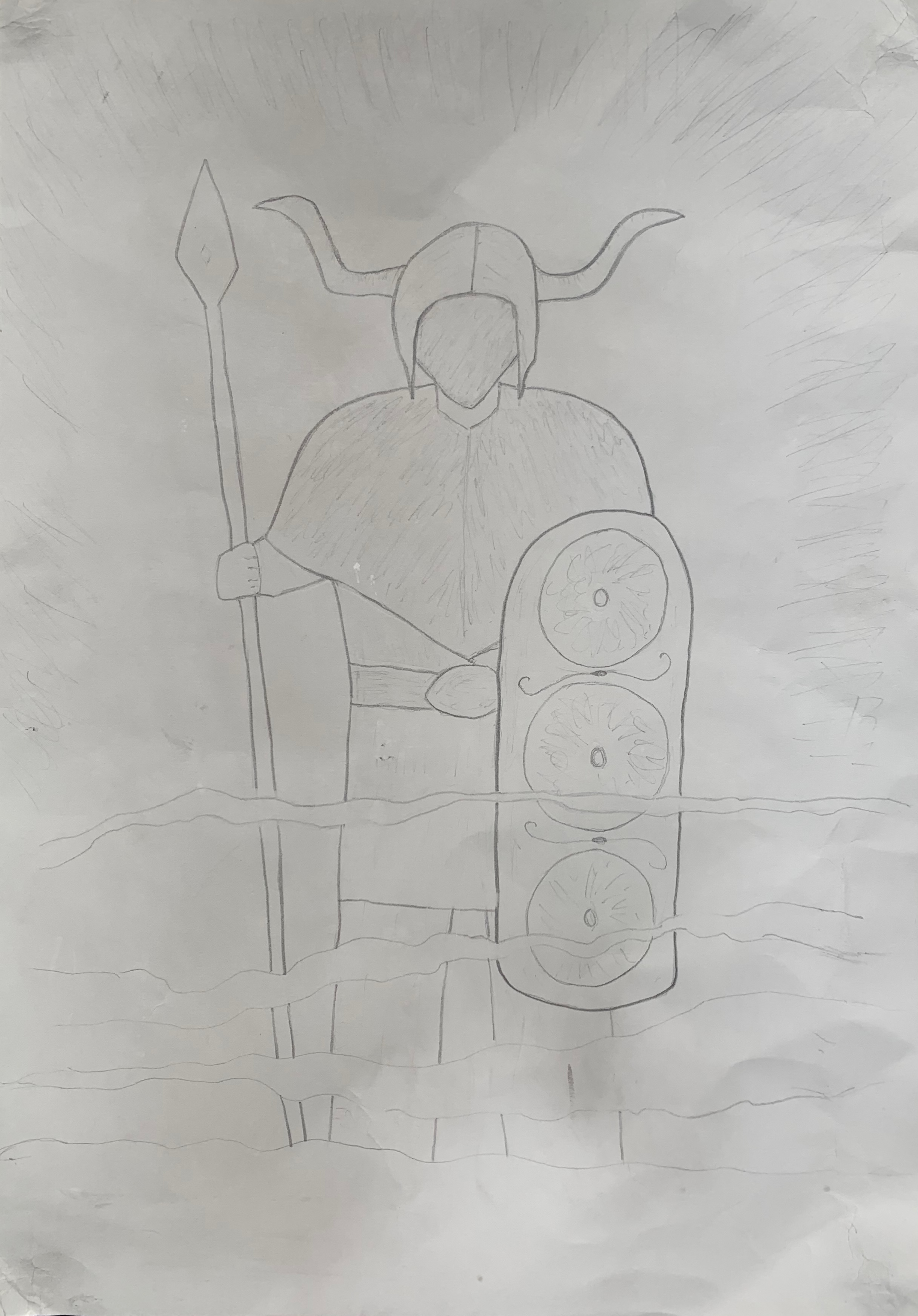
Beneath is an image from the cover of a poetry book about our marriage called ‘The Heart of Annwn’ that I wrote for Gwyn and was planning to offer to Him when I retook my temporary monastic vows this year. The book wasn’t quite good enough and the vows will not be made, but I’m hoping I might one day rework it. For now, here is the image I was planning to use as cover art.

The Sanctuary of Vindos Dedication

Beloved Vindos,
my patron, inspiration and truth,
on this night of the Reaping Month,
on the total eclipse of the full moon,
I hereby dedicate this Sanctuary to You.

May I honour You well
with my prayers and inspiration.

Through Your guidance as a Guide of Souls
may I guide and heal others too.

Together may we reweave 
the ways between Thisworld and Annwn.