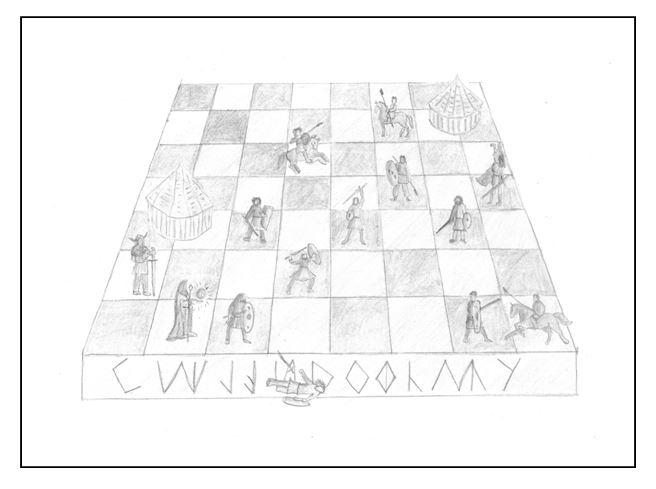
Gwyddbwyll is a Brythonic war game. The name derives from gwydd, ‘wood’, and pwyll, ‘sense’, hence ‘wood sense’. It is played with gwerin, which means both ‘pieces’ and ‘men’.
We find references to gwyddbwyll in a number of medieval Welsh texts. Together these suggest it was played by sovereigns and that the board represented their realm and the gwerin their army and the army of a rival. The board and gwerin are usually carved from gold or silver. The gwerin are anthropomorphic and magically endowed with a life of their own.
In The Dream of Macsen Wledig, the Roman Emperor, Macsen, dreams of a hall in which two lads are playing gwyddbwyll with silver and red gold pieces whilst a grey-haired man sits at a second board carving pieces with steel files from a bar of gold watched over by a beautiful, lavishly dressed maiden who he falls in love with.
Macsen finds out the maiden is Elen Luyddog, ‘Elen of the Hosts’ and her castle is at Aber Saint. He travels from Rome to Elen’s hall where he finds her overlooking the gwyddbwyll boards just as in his dream and marries her. It seems likely the first gwyddbwyll board represents Elen’s old realm and the new one the realm she will rule alongside Macsen.
In Peredur, the protagonist sees a gwyddbwyll board in the Fortress of Wonders. The two sides are playing each other. When the side Peredur supports loses, the other side shouts ‘just as if they were men’. Angry because his side has lost, Peredur takes the pieces in his lap and throws the board into a lake.
A black-haired maiden enters saying, ‘May you not receive God’s welcome. You do evil more than good… You have made the empress lose her board, and she would not wish that for her empire.’ Again we find evidence that the gwyddbwyll board of a sovereign represents her realm.
The Gwyddbwyll Gwenddolau is amongst ‘The Thirteen Treasures of the Island of Britain’ ‘which were in the North’. Gwenddolau ruled Arfderydd and may have been a ‘High King’ of northern Britain during the 6th century. The text states, ‘if the pieces were set, they would play by themselves. The board was of gold, and the men of silver’. It clearly had magical qualities.
Rhonabwy’s Dream features a gwyddbwyll match between Arthur and Owain Rheged. As they play, messengers arrive reporting that Arthur’s men are harassing then wounding and killing Owain’s ‘ravens’. Arthur refuses to call them off saying, “your move” and they play on.
The tides turn. As Owain’s ravens lift Arthur’s men into the skies and drop them in pieces, Owain refuses to call them off saying, “your move” and they play on. When Arthur finally loses his temper and crushes the golden pieces to dust everything becomes peaceful.
This shows gwyddbwyll was related to real wars via the logic of microcosm – macrocosm and suggests that matches had a divinatory function. Perhaps when the gwerin played by themselves they predicted the outcome of future battles.
***
Unfortunately we have no archaeological evidence for the existence of gwyddbwyll. This is odd because boards and counters for the Roman Ludus Latrunculorum, ‘The Game of Little Soldiers’, have been found at Housesteads, Vindolanda, and in the grave of a man from Stanway in AD 50 alongside diving rods suggesting it was buried with its owner and served a divinatory purpose.

Ludus Latrunculorum, modern reconstruction, Museum Quintana, Germany, Wikipedia Commons
These boards were wooden (as ‘wood sense’ might suggest) and have not rotted away. If gold and silver gwyddbwyll sets existed, which indeed might have been possible based on examples of Romano-British silversmithing such as the ‘Empress Pepper Pot’, surely they would have been found?

Empress Pepper Pot, British Museum, Wikipedia Commons
In Ireland we find a parallel game called fidchell, from fid, ‘wood’, and ciall, ‘intelligence’, also ‘wood sense’. Again it belongs to sovereigns, the board and pieces are made of gold and silver, and are anthropomorphic and endowed with their own life (in one instance ‘the queen is asleep’). Games are played for high stakes bound up with the livelihood of the realm. Likewise there is no archaeological evidence for its existence.
According to the Lebor Gabala Erenn, the god Lug brought fidchell to Ireland along with ball-play, horse racing and assembling. It seems possible that gwyddbwyll was also perceived to be of divine origin and introduced by the pan-Celtic god Lugus who is euhemerised in the medieval Welsh texts as Lleu Llaw Gyfes, ‘Lleu of the Skillful Hand’ and Lleog, ‘death-dealer’ or ‘flashing light’.
Although gwyddbwyll is the modern Welsh name for chess they should not be equated. Chess originated in India in the 6th century and spread to Spain via Persia, arriving in Britain with the Normans in the 12th century.
***
As I’ve conducted this research I’ve been nagged by a constant question, ‘Why the war games?’
The very concept of gwyddbwyll as a game played by sovereigns predicated on perpetual war between players and realms has felt increasingly problematic.
The gwyddbwyll board symbolises the fact that Britain’s sovereigns have always maintained their power through warfare and by positing a mentality of ‘us’ against ‘the enemy’.
It is no coincidence that Arthur, the first warlord to unite Britain, plays gwyddbwyll. Or that when he raids the Otherworld, subdues its deities, and steals its treasures he is aided by Lleog, the bringer of war games, with his deadly flashing sword.
Arthur’s reign is founded on his defending Britain from enemies within (such as giants, monsters, and the deities of the Otherworld) and from enemies without (such as the Anglo-Saxons).
This gwyddbwyll mentality has led to the Crusades, imperialism, colonialism, and to the War on Terror.
Whereas movements for electoral reform and the rights of minority groups have succeeded, anti-war protests and campaigns have consistently been ignored because war lies at the heart of Britain’s political and economic structure and maintains its hierarchies and elites.
We’re trapped on a gwyddbwyll board growing more terrified of attacks whilst the rulers muster their gwerin.
Where does our hope lie?
In breaking their rules, revealing their war games as ‘wood sense’, refusing to ‘play on’?
 The Sanctuary of Vindos