
One of the last places I visited during my time in Glasgow was the cathedral, which was founded on the site of St Kentigern’s tomb. The first stone was laid in 1136 and the building was consecrated in 1197. During this period, Bishop Jocelin commissioned Jocelyn of Furness to write The Life of St Kentigern (1185) to encourage devotion to the saint.
The story of Kentigern’s birth is a troubling one. His mother, Teneu, was the daughter of Lleuddun, ruler of Gododdin. Teneu was seduced by Owain, ruler of Rheged, in the guise of a woman. Afterward she became pregnant.
When Lleuddun found out, he threw her off Dumpelder (Traplain Law: a hill in Gododdin, which may have been the seat of power prior to Din Eiddyn; Edinburgh). Luckily she survived and washed up in a coracle on the river Forth at Culross. There Kentigern was born.
Teneu is now revered as a saint. A medieval chapel to her once stood on the site of her grave at present-day St Enoch Square. At the ritual to Epona, I was told the well in the cathedral dedicated to Kentigern as Mungo may originally have been to Teneu. This is backed up the nearby street-name Lady Well Street.
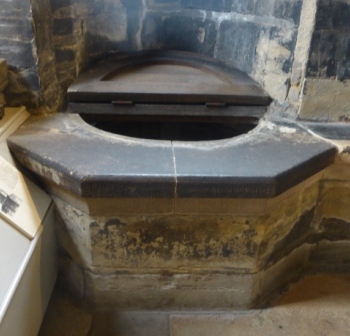
This made me wonder whether Teneu may have been a pre-Christian deity. Owain is often equated with Mabon and his mother is Modron. These names are derived from the pre-Christian deities Maponus ‘the Son’ and Matrona ‘Mother’. In a Welsh romance, Owain courts, acts as a guardian for, and eventually marries ‘The Lady of the Well.’
Combined with her river-journey this suggests Teneu may have been a deity connected with sacred waters. If this is the case, her appalling treatment by both Owain and Lleuddun forms a sad reflection on the transition from a worldview where water-deities were revered and women were treated as equals to patriarchal Christianised society.
Teneu and Kentigern were taken in by Saint Serf, who named the boy Mungo ‘my dear’. Kentigern started preaching when he was twenty-five and built a church where the cathedral now stands. He was then expelled by an anti-Christian movement headed by King Morken, ruler of Strathclyde*.
Kentigern fled to Wales until called back by Strathclyde’s new Christian ruler, Rhydderch Hael, after the Battle of Arfderydd in 573. Rhydderch’s defeat of the pagan ruler, Gwenddolau, formed a precedent for St Kentigern’s conversion of the people of Hoddom, who were said to have worshipped Woden**. Kentigern then returned to Glasgow.
Whilst praying in the wilderness, Kentigern met Lailoken (Myrddin Wyllt) who spoke of the source of his ‘madness’: a vision of host of warriors in the sky after the Battle of Arfderydd and being ‘torn out of himself’ by an evil spirit and assigned ‘to the wild things of the woods’.
Afterward, Lailoken followed Kentigern back to Glasgow and took to prophesying from a steep rock above Molendinar Burn (unfortunately covered over in the 1870’s and now beneath Wishart Street) north of the church.
Little heed was paid to his words because they were obscure and unintelligible and he refused to repeat himself. However, some of his ‘apparently idle remarks’ were written down. I wonder whether these lost fragments, passed on orally, could have formed the basis for the prophetic poems attributed to Myrddin in The Black Book of Carmarthen?
Just north of Glasgow Cathedral, Lailoken predicted his ‘three-fold’ death and supposedly begged Kentigern for communion before he met his end.

Kentigern’s miracles are depicted outside and within the cathedral and on Glasgow’s Coat of Arms: a robin he brought back to life, a hazel tree from which he started a fire, and a bell he brought back from Rome. Most curious is a fish which swallowed a ring, belonging to Rhydderch’s wife, Languoreth. Rhydderch is said to have thrown her ring into water with the purpose of proving she had given it to a lover. By ordering one of his monks to catch the fish, Kentigern saved her from execution.
Perhaps Kentigern’s compassion resulted from knowledge of his mother’s near execution at the hands of his grandfather?
In his old age Kentigern became increasingly debilitated to the point his chin needed to be tied up with a bandage. He is said to have died in the bath on Sunday 13th of January in 614.
*An alternative king list does not name Morken but Tutagual, Rhydderch Hael’s father as his predecessor to the rulership of Stratchclyde.
**This seems to be an anachronism because the Anglo-Saxons had not arrived in south-west Scotland in the 6th century.


 The Sanctuary of Vindos