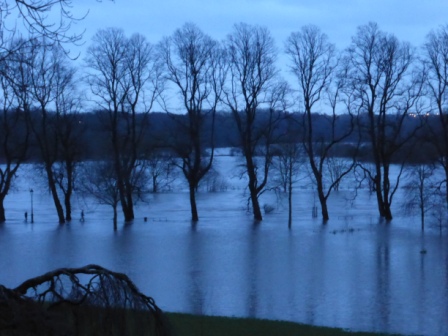
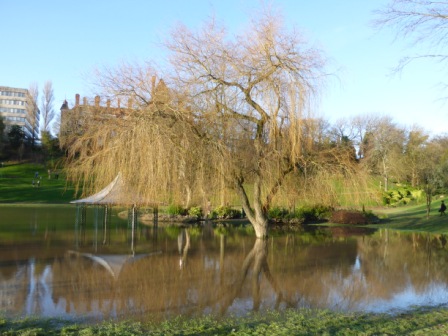
The River Did Not Burst Her Banks

You did not burst your banks today…

River goddess your fearsome torrent pouring
from here to the sea how many times do I have to stand in you,
no, to drown in you, to know you are never the same?

What rites would you have me keep, Riga Belisama, as I walk beside you?

Long have I kept this piece of your humble mudstone close to my heart
(which I must give back should I ever leave), renewed your waters,
lit your candle, created for you a little temple

and cleared Fish House Brook – just one of your dirty daughters
running from one of the estates to the sea.

I have seen your many colours –
red, blue, green, grey as concrete bollards.

What is a river without a goddess or a goddess without a river
meandering, twisting, to the sea, like our own blue blood to our heart?

Sometimes I see you as a goddess but most often you are being a river,
fulfilling your purpose, delivering water, divine water-bearer.

To be one with your flow on days like this is a blessing,
to walk so close to the edge knowing I could be carried away

by your rush of waters, by your rush of deadly words,
but you did not burst your banks today.
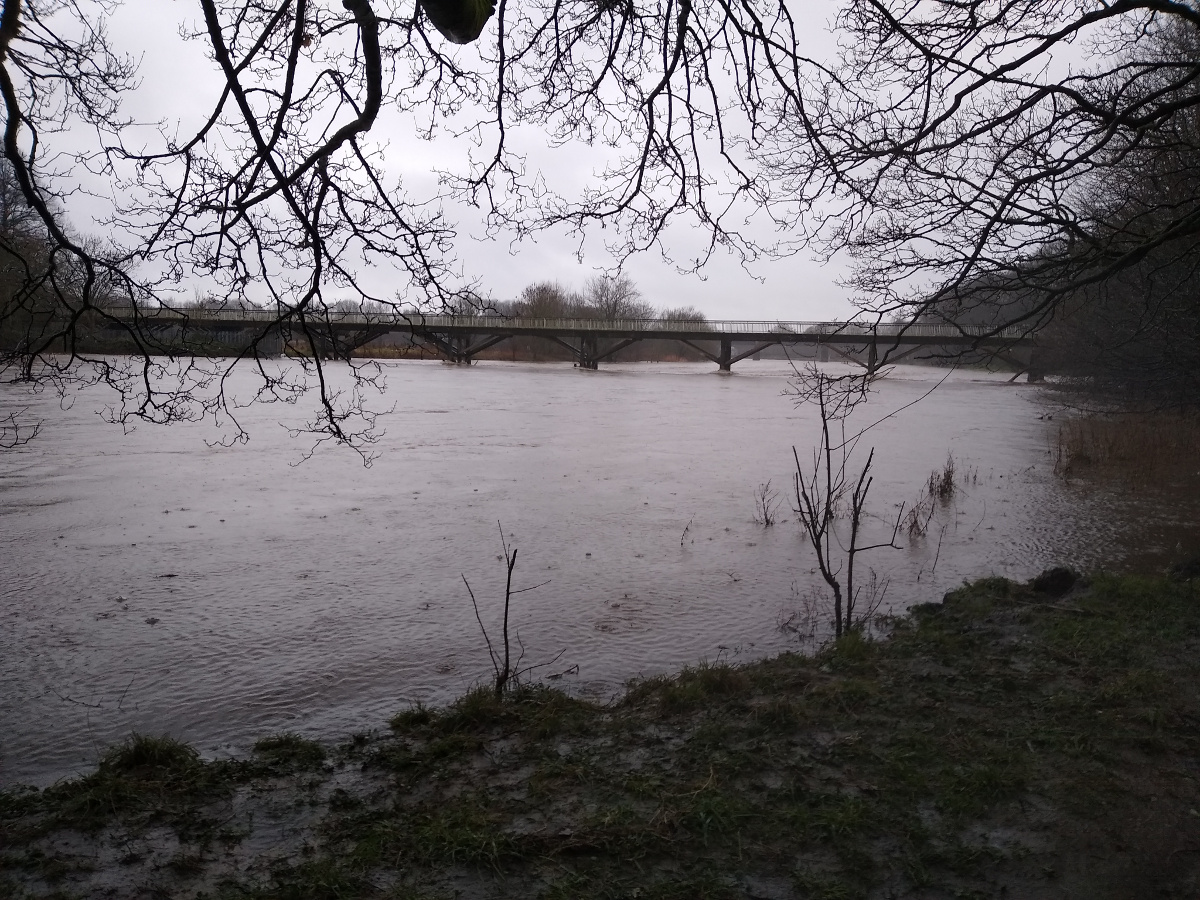
I wrote this poem after my daily walk beside the Ribble yesterday during Storm Christoph. Contrary to the flood warnings the river did not burst her banks but came very close, the water lapping at the edge, at high tide. It’s not often we can walk so close to a force of nature, to a mighty goddess, whose might could destroy us if we take a false step – an experience awe-inspiring and humbling.

We were lucky, here in Penwortham, that the river did not burst her banks. Upriver Brockholes Nature Reserve has been forced to close due to the access road flooding. People from Didsbury and Northenden in Manchester, Maghul in Merseyside, and Ruthin and Bangor-on-Dee in North Wales have been evacuated. This must be a doubly awful experience during a pandemic. The combination of the virus with flooding feels like an ominous portent of decline and I fear worse is to come.

The first time I saw major floods on the Ribble was 2015 and she has flooded almost every winter since. In response, the Environment Agency and Lancashire County Council have implemented the Preston and South Ribble Flood Management Scheme, which will raise the current flood walls from 1.2 metres to up to 2.2 metres, with a glass screen at the top so people can see the river, and build new ones.

Some of the trees on the banks, such as the row of elms near the Continental pub, will be dug up to make way for the defences. Five new trees will be planted for each tree removed, but it will be forty to fifty years until they are the size of the original ones. Local people have asked for the old trees to be made into benches.

More positively, some of the area, which is now Preston Junction Nature Reserve, rather than housing, due to the Save the Ribble campaign, is going to be kept as flood plain. There are plans for the creation of a new wetland habitat with ponds with dipping platforms, species-rich wildflower meadows and grasslands, wet woodlands, and orchard trees.

My local stretch of the Ribble, where I have been walking for nearly forty years, is going to change dramatically. How long the defences will keep people’s homes safe I don’t know. As this past year has shown, our safety from the forces of nature, small and large, is very much illusory. The climate and the world are changing. The river will burst her banks again. Yet, on her banks, we find the very first snowdrops, who have weathered the floods. A small sign of hope in these apocalyptic times.

A Winter of Dreaming the Rain

P1130736 - Copy

For Nodens

I.
I’m working with horses again, putting a saddle and bridle into a tack box outside a stable. The setting feels like a long time ago as at modern yards everything is locked in a tack room, burglar alarm set. The last task is to take the horses to the fields. This must be done quickly because the tides will come in to cover the path.

We lead the horses out in a single line down the narrow raised track: impatient, pulling at their bridles, hooves clomping on the water-logged ground. We take them through the gate and set them free. They spit their bits then buck and leap into the distance. On the return, water washes over our wellingtons. I realise no-one can steal the tack because of the tides.

II.
I’m standing with a friend beside a road. The road is composed of water and leads uphill into an old mill town and. Instead of cars, timber boats move slowly upward on a pulley like a fairground water-ride. I’m kind of glad to see this change. It will slow my friend’s driving down. It will slow everyone down.

We’re standing together again, this time at a roundabout on Penwortham By-Pass. But this time it’s like spaghetti junction but worse and all the roads are rushing water-courses. A Bard on a motorbike appears to show us a secret lane, cutting water with his tyres. We splosh through safely.

III.
I’m in bed. Where my altar usually stands is a dressing table and shoe rack. Water seeps up through cracks in the floor boards and over my shoes. In reality I don’t have lots of shoes and I’m not a shoe-hoarder. However in this dream I have strappy golden stilettos, heels with complex buckles, shiny fat-tongued trainers, studded leather boots. The most important task is to rescue the shoes.

I gather as many as I can and take them to the edge of a lake. The only way to cross is on a duck. Even though the ducks are duck size this is possible and they’re used to it. Lots of ducks are giving rides. When I get halfway across the lake, someone turns the wave machine on. My duck bobs and leaps. We can’t get across and to my horror I start dropping the shoes.

IV.
I’m standing at the top of a tall stone tower. Beneath is a lake. The Keeper of the Tower has given me a missive. I must steal the young of a monstrous cat before they cause trouble. I’m expecting something like Cath Palug. Looking down I see my parents’ house cat; black with a white snip, fast asleep, tail wrapped around yellow tennis balls in which she keeps her kittens.

It looks too easy to be true. Except, how am I going to get down? Suddenly I’m swooshing downward on swift black wings. I can fly! I’m a raven! I can barely believe it. Delighting in my newfound ability I circle and swoop, skate on the water, flap my wings.

“Look! Look! Look at that raven!” children pull on the sleeves of their mothers gathered with prams to feed the ducks at the water’s edge, pointing excitedly.

I’m having so much fun I don’t care until I remember my mission. I swish down and steal one of the tennis balls from the sleeping cat. When I take it from beneath my wing it is nothing but a piece of wood engraved with a number. I’ve been tricked.

V.
Old college friends have moved into my street because it’s one of few places left unflooded. Fish House Brook has become a river. However that isn’t the threat. Water rises from drains with sewer rats. Some are big as dogs. One floats by balloon-like, dead, bloated with disease.

We bag up our belongings and camp beneath the By-Pass. For some reason there are rat-sized portholes in the tents. Volleys of rats pour in, sleek and wet as otters, biting, squealing. We’re forced to leave in a mass exodus with our lives on our backs down a long and watery road knowing nowhere is safe.

Ribble Rising

After a month’s heavy rain across northern England, rivers have risen to record levels. Following 100mm of downpour in one night in Lancashire, the river Ribble (from Gallo-Brythonic Riga Belisama ‘Most Shining’ or ‘Most Mighty Queen’) burst her banks at Ribchester and Whalley, forcing people from their homes.

Yesterday the Ribble ran high between Penwortham and Preston swelling under Penwortham Bridge carrying trees, branches, tyres and other debris out to the sea with an urgent roar.

A playground in Middleforth with an overflowing storm drain was underwater.

Several riverside footpaths were submerged.

The Ribble had flooded the bottom of Miller Park completely, almost covering the fountain and pagoda.

The Pavillion Cafe was cut off like a stranded lake dwelling.

P1130527

As dusk approached, Victorian lamps illuminated the submerged pathway.

P1130534


Luckily at the most dangerous point: high tide at around 11pm, the Ribble did not break over the flood walls. Avenham and Miller Parks and the flood plains of Central Park managed the rest and no-one was evacuated.

It would have been a very different story if the Riverworks project, which intended to create a barrage on the Ribble and build on its floodplains had gone ahead. We have Jane Brunning and other ‘Save the Ribble‘ campaigners to thank that we have Central Park instead.

This morning, I walked along the old railway track to see Central Park’s flooded fields.

The floods had receded from Avenham and Miller Park and the Ribble sunk back to her normal course.

P1130579

Last night Belisama heard our apologies, songs and prayers. Today she received gratitude and thanks. This was the highest I have ever seen the Ribble rise. It was really quite terrifying and gave me a fuller understanding of why, before flood-walls, our ancestors revered and feared her as a Mighty Queen.

With temperatures increasing ten times faster than in known history and water levels rising globally I fear this will not be the last time the Ribble bursts her banks. It is a clear message everything possible must be done to slow climate change and adjustments must be made to accomodate rising rivers and returning wetlands.

Having Central Park saved us here. My thoughts are with those not so lucky in Ribchester, Whalley and in York from where 2,200 people have been evacuated.