The Death of a Dragonfly

Dyed he is with the
Colour of autumnal days,
O red dragonfly.
Hori Bakusui
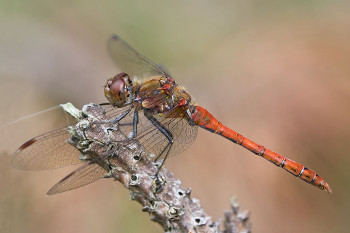
It was an accident. Still, if I’d accidentally killed a human I’d have been jailed for murder. I’m often killing midges, greenflies, flies, as I cycle down the Guild Wheel along the Ribble to Brockholes Nature Reserve. Not on purpose of course – they just have a terrible habit of getting in my eyes, in my mouth, down my top. It’s said there were more flying insects before cyclists, cars, climate change…

I’m not sure why killing a dragonfly somehow seems worse than killing all those tiny things. I didn’t even see him. I was too busy thinking about the fantasy novel that I was planning to set in a marshland and how the flora and fauna of Brockholes, as a wetland nature reserve, might inspire me.

Thinking not listening. There was just a buzzing at my neck and a kind of crackling against my skin. Without thinking I swatted at it compulsively, then stopped in a panic, fearful of what I’d done. Looking down, for a moment I felt relief, seeing what looked like a twig before I realised it was a ruddy abdomen. Severed from it a furred red-brown thorax, two cobwebby filmy wings, and a head with two huge dark red globular eyes and three small eyes that, between them, didn’t see me coming.

I didn’t know what he was right then, that he was a he, or a common darter. Only that I’d killed a dragonfly. I laid the broken pieces at the side of the cycle way with an apology to dragonfly kind and rode onward more slowly, more aware of other ruddy darters rising from where they were basking on the path. After I’d arrived, locked up my bike, they haunted me for the short period I was there. Flying in front of me, landing on the wooden walkways and handrails.
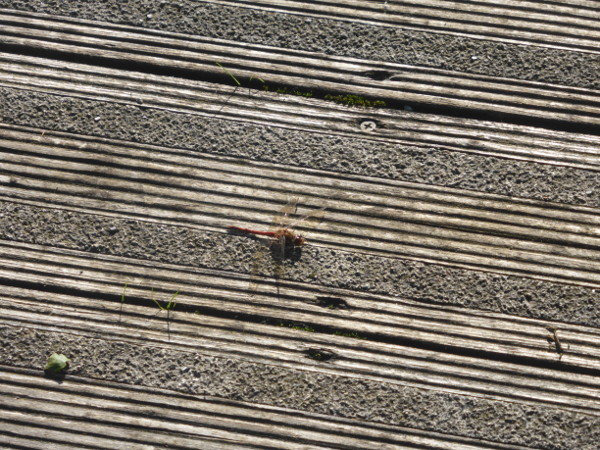
One, in particular, caught my eye. Beholden by the huge round portals of his eyes I drowned in the utter inadequacy of not knowing what he was thinking. Did he know I was a murderer? Did he know what I was? Could he sense my awkward reaching? My overall impression was one of curiosity. That it seemed likely he was thinking dragonfly thoughts distant from my own – trying to place this gigantic monster with its small eyes within his brief sunlit world of eating and flying and mating.

Dragonflies are old. The oldest fossils date back to the Carboniferous period – 350 million years ago. They spend most of their lives as nymphs, living for up to four years in muddy waters. They then crawl up the stem of a plant and shed their nymph-skin, emerging as dragonflies, leaving behind the exuvia. In the brief six months of their adult life they feed on smaller flying insects and find a mate, in an acrobatic display forming a spectacular mating wheel, then afterwards the female lays her eggs on the leaves of plants or in the water. Death follows shortly and the life cycle begins again.

It’s impossible to know if that dragonfly had fulfilled his life’s purpose before I killed him. And, of course, in that all-too-human way that has reduced the earth and its creatures to resources, I’m searching for a meaning, like nature is here to teach us lessons. I can’t help it. That’s human nature.

And it’s pretty obvious, slow down, listen, maybe just maybe I’m heading off on the wrong path trying to write a fantasy novel about an imaginary marshland when our existing wetlands need our voices. Making up new creatures when it may be more valuable to introduce people to Sympetrum striolatum ‘common darter’, Sympetrum sanguineum ‘ruddy darter’, Anax imperator ‘emperor dragonfly’.

This is leading me to think that, rather than writing second world fantasy, I might be best off writing a novelset in this landscape, but further back in time. Not only before the wetlands, the marshes, the peat bogs, the lakes, were drained off, but before the people lost their spiritual relationship with the land.

I’ve long been drawn to the archaeological evidence for the ancient marsh-dwellers in my local area. During the Romano-British period they were known as the Setantii ‘The Dwellers in the Water Country’ but had lived here far longer. Here, on Penwortham Marsh (now drained) and not far from the river Ribble (now moved) they had a Bronze Age Lake Village evidenced by the remains of a wooden platform, dug-out canoes, a bronze spearhead, 30 human skulls, and skulls of aurochs and deer. There were numerous other settlements such as those beside the great lakes Marton Mere and Martin Mere (now drained), wooden trackways such as Kate’s Pad, and the (now lost) Port of the Setantii.

If I was to write about that time, rather than making up critters and magic and gods and monsters, I would be able to draw upon the real magic of an animistic and shamanistic culture rooted in a lived relationship with the ‘water country’ – its reeds and rushes, its wetland birds, its dragonflies and damselflies. With the spirits of the ancestors, gods we know throughthe Romans, such as Belisama and Nodens, and those who are unknown such as the goddess I know as Anrhuna, Mother of the Marsh.

That dragonfly was one of her children perhaps. She who has been here as the marshland since, at least, the thaw of the Ice Age and thousands of years of water country, these last four centuries of its draining off, and is still here in the last remnants preserved by wetland nature reserves such as Brockholes.

Would it be too very human to read, in an unlucky accident, a message from a goddess?

O red dragonfly,
Colour of autumnal days,
Dyed he is with the

Mother of the Marsh
Returned to mud and water
Rest well O red one.

***

Those who follow this blog will note this event has led me to returning to its old name ‘From Peneverdant’. This was the name of my hometown of Penwortham in the Doomsday Book and signals a homecoming from an exodus through Welsh mythology and Annwn. It makes sense in relation to my lifelong dedication to Gwyn, here, in January.


In Moments of Terror

For beauty is nothing but the beginning of terror
which we are barely able to endure, and it amazes us so,
because it serenely disdains to destroy us
– Rilke

I grew up with negative connotations of prayer and still do not fully understand what it is, only that I prayed reflexively at frightening times in my life and someone answered. It was a long while until I found out who that was, began exploring prayer as a regular practice, and came to realise prayer is a fundamental means of reaching out to the gods essential to our being.

Brought up in a nominally Christian family I was never forced to pray, but vaguely recall sleeping at a friend’s house and both us having to say ‘The Lord’s Prayer’ before we went to bed. We jabbered through it as quickly as we could, not thinking about its meaning. She thought God was called Harold, mistaking ‘hallowed’ for ‘Harold’ in ‘hallowed be thy name’.

I went to Sunday School and attended church parade at St Leonard’s C of E Church with Brownies. Some part of my soul rebelled against the rigid services, punitive black-and-white theology, and the patriarchal presence of the Christian God. Eventually I refused outright to go.

Refusing to worship Jahweh I considered myself an atheist for a number of years even though I was looking for something… somebody… I was drawn to the deities of our world myths, but the mainstream worldview taught they belonged to a naive past, even though I could sense their presences dancing in the back of my mind like sunspots long after I’d put down a book.

Without knowing of the existence of modern Paganism or Polytheism I had no context for the sense of the divine I felt in the landscape, for otherworldly experiences some beautiful, some troubling. In moments of terror I prayed although I did not know who I was praying to.

The root of ‘prayer’ is the Latin precarius, ‘obtained by treaty’, which gives us ‘precarious’, suggesting such treaties are made in ‘risky, dangerous, uncertain’ situations. Non-religious people often pray when their lives or those of their loved ones are threatened; like it’s a base instinct, a mechanism deep-wired within our souls to reach out to the divine when faced with peril.

At times when I had panic attacks or thought I was going mad I prayed. Driving on the motorway in the midst of panic, thinking I was going to lose consciousness or control, I felt strangely held. Despite fears I would never get back I always did. When I was convinced I was mad, that I couldn’t tell what was real and what was not anymore, into my mind came the words, “So you’re mad, what difference does it make?” (I’d thought this was a quote remembered from Nietzsche, who walked with mad gods, but have never been able to find it). Nothing, I realised, nothing at all, and since then madness has held no fear for me.

It wasn’t until I was thirty I met the god who was behind my visions of the Otherworld; who’d led me a chase through poetry, philosophy, drink, dancing, to the brink of the abyss and back: Gwyn ap Nudd, the Hunter, Rider of Insomniac Nights, Gatherer of Souls, Light of the Mist.

This happened at a nadir of despair. After failing to become a philosophy lecturer and succeed in a career with horses, I had realised the fantasy novel I spent two years writing was unpublishable. I couldn’t think of anything else I wanted to do with my life or any reason to go on. Yet something within me put out an entreaty, ‘a cry from the heart’. Summoned by tolling bells I went to weep beneath a leaning yew tree at an old fairy site and sang a sad song.

Leaning Yew

When Gwyn appeared to me I was struck by a sense of awe bordering on panic by his terrible beauty:

His spectral shine shimmers white as moonlight
His hair floats fair about his phantom limbs
His warrior attire is black as night.
The eyes of the hunter of souls are grim
As the howl of his hounds on Annwn’s winds.

This was followed immediately by recognition. It was he who swept me away on the winds of terror like the riders on his hunt – I often felt like I was flying ‘between sky and air’ – yet also held me and taught me I was safe. He was the storm and the calm at its centre. He, the god of the dead, the mad, and poets, was the source of the words that cured my fear of madness. He was the somebody I’d always been looking for. Always. Since the beginning of time.

Some soul-deep entreaty/prayer had been answered. A treaty between us soon followed. I dedicated myself to Gwyn as my patron, vowing to honour him daily, stand by my truth, and walk between Thisworld and Annwn (the Brythonic Otherworld which he rules) with reverence. I became his awenydd ‘person inspired’ and have been praying to him every day since.

My initial cries of “Please, please, please help me!” opened a gateway of communication between my god and I, unlocked my heart to the divine, to sacred relationship. In Judaism prayer is defined as ‘a service of the heart’ (from Deuteronomy ‘You will serve God with your whole heart’), describing beautifully the depth of service my knee-jerk prayers have led to.

Not only do I pray to Gwyn for inspiration and guidance, but I see my role of journeying with him between the worlds to recover the lost stories of my landscape from the mists of time and reveal the roots of his forgotten myths as a heartfelt and prayerful process essential to my being.

Sadly, in secular society, even when prayers are answered too few of us question by whom or fulfil our side of the treaty. Our potential for relationship with the divine – to reach outside our everyday lives and enter the service of somebody or something greater – remains unfulfilled.

Obscured by oppressive state religions and secular norms our ability to pray remains dormant until precarious times when somebody opens a door. Could it be that we are fundamentally prayerful creatures? That prayer is the heart-root of all purpose, meaning, our relationships with the gods?

*This article was published in ‘People of Prayer‘, Isis-Seshat, Issue 41, Vol. 13, Spring 2018
**I will be speaking on ‘Becoming a Devotee of Gwyn ap Nudd’ at the Pagan Federation North West Conference at Preston Grasshoppers on Saturday.