In the medieval Welsh story Lludd ac Llefelys the island of Britain is beset by three plagues. The second is a scream which is ‘heard every May eve… It pierced people’s hearts and terrified them so much that men lost their colour and strength, and women miscarried, and young men and maidens lost their senses, and all animals and the earth and the waters were left barren.’ (1)
Lludd finds out from Llefelys the plague ‘is a dragon, and a dragon of another foreign people is fighting it and trying to overthrow it, and because of that… your dragon gives out a horrible scream.’ (2) It is likely the ‘foreign people’ are ‘the Coraniaid’, the Romans, who are the cause of the first plague.
Following the advice of Llefelys, Lludd digs a pit in the centre of Britain and fills it with mead. After the dragons have stopped fighting, firstly as dragons, then in the shapes of ‘monstrous animals’ and finally ‘two little pigs’, they fall into the vat, drink the mead and sleep. Lludd wraps them in ‘a sheet of brocaded silk’, puts them in a stone chest, and buries them at Dinas Emrys. (3)
The dragons battle again during the invasions of the Anglo-Saxons. At this time Vortigern attempts to build a tower at Dinas Emrys and it will not stand. Merlin tells Vortigern this is because there is a pond beneath the foundations and when the pond is drained two dragons will be found in hollow stones.
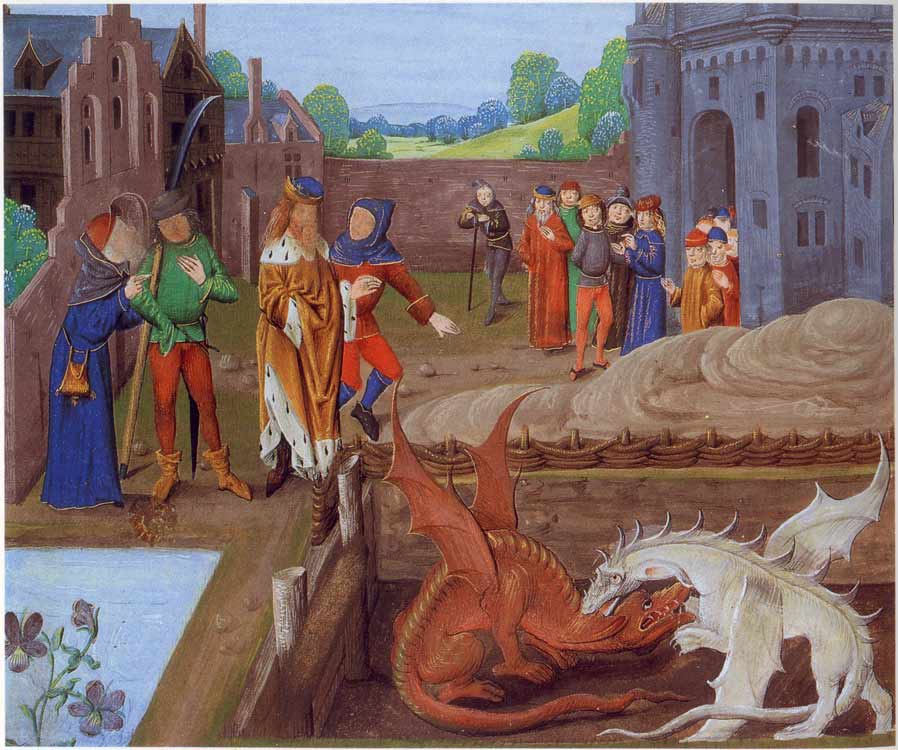
Whilst Vortigern is sitting on the bank, the two dragons, one red, one white, begin a ‘terrible fight’ casting ‘forth fire with their breath’. The white wins. Merlin says this predicts the defeat of ‘the British nation’ by ‘the Saxons’. (4)
The scream of the red dragon and the battle between the red and white dragons takes place at times of war and potentially during other periods of upheavel. I believe it is connected with the diasbad uwch Annwfn ‘scream over Annwn’ or ‘cry over the abyss’ which is found in several of the Welsh law texts including The Laws of Hywel Dda. It is uttered by a claimant who is threatened by the loss of their claim to ancestral land. (5) It perhaps has its origins as an invocation of the spirits of Annwn, those who were held back by the King of Annwn, Gwyn ap Nudd, to prevent their destruction of the world. These spirits may well include the dragons who Gwyn’s father, Nudd / Lludd subdued.
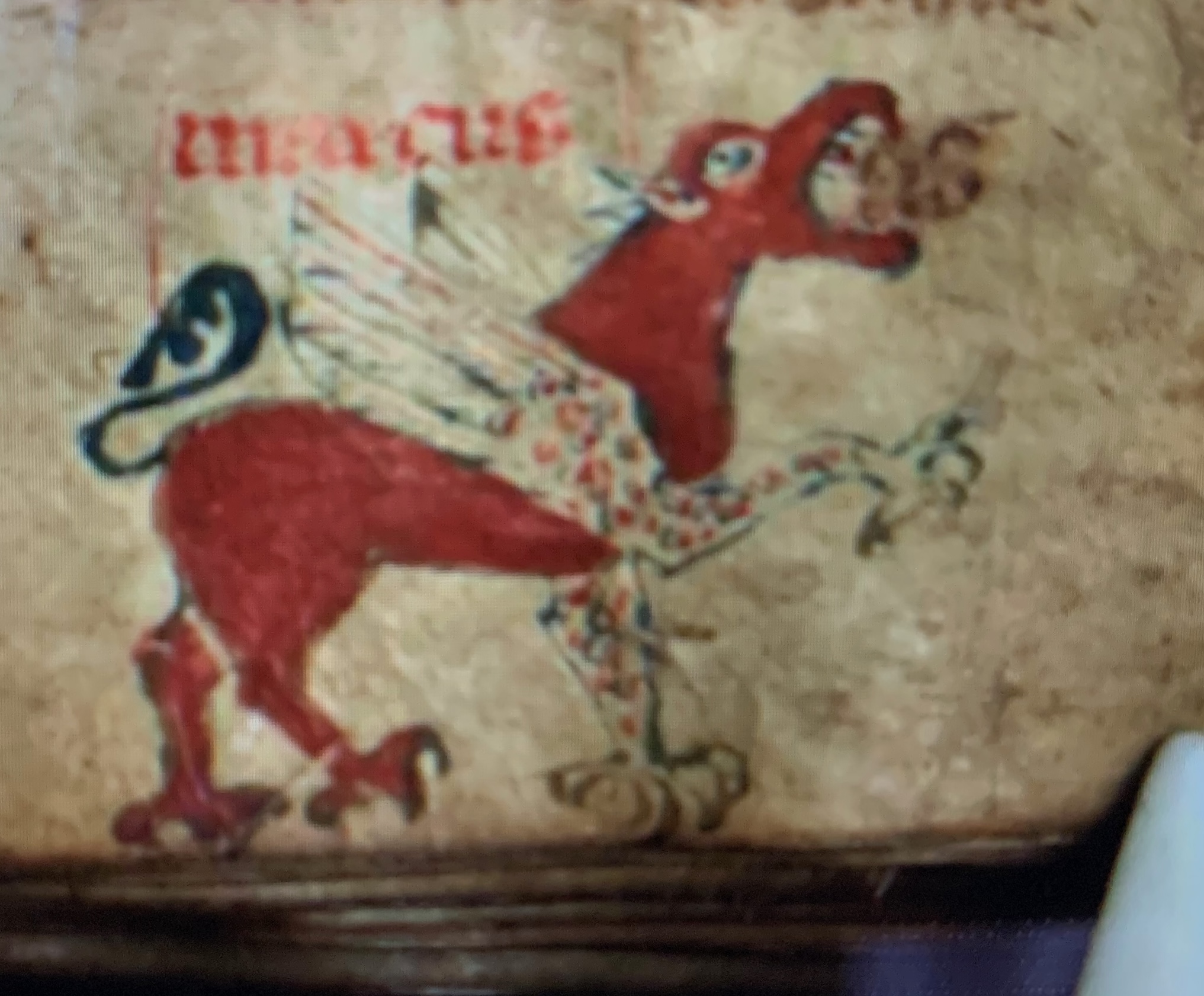
According to the National Library of Wales The Laws of Hywel Dda features an illustration of a two-headed dragon. (6) I couldn’t find this image but did find two of the red dragon, from f.21.r and f.51.r, which are in the public domain.
*
I’m returning to this lore after a journey circle with the Way of the Buzzard wherein we discussed the connection between dragons and voice and journeyed to the underworld to ask a dragon for guidance around personal power.
I met a black dragon who instructed me to ‘put on my dragon skin’. I shapeshifted into a dragon and we flew over the volcanoes with the smoke cleansing my skin. I was then taken to an iron grate with forms behind it. I was told I ‘must learn to release the prisoners’. The black dragon’s final message was: ‘Those who are denied are needed.’ I’m not sure if they are parts of myself who I have shut away, people, or spirits, or perhaps might be all.
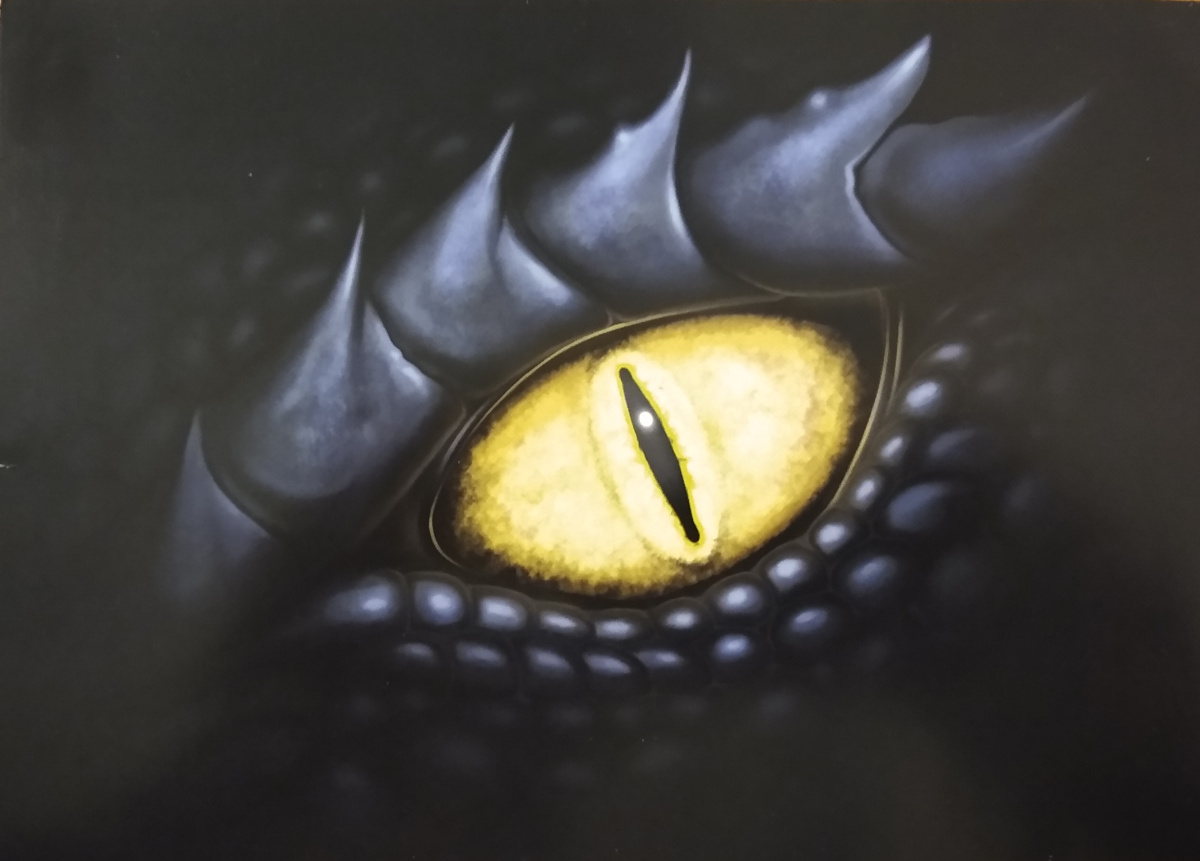
Other participants reported visions of a dragon’s golden eye and dragon’s heart. This really struck me as it fit with the black dragon who I met, who I suspect to be Gwyn, the King of Annwn, in dragon form, His heart the Heart of Annwn. Several years ago my aunt sent me a birthday card with a golden dragon eye on it and it watches over me here in my monastic cell.
My vision of a black dragon fits with the legends of the red and white dragons because white, red and black are the colours of the Otherworld.
I later received the gnosis that the iron grate is ‘the Dragon’s Gate’. I believe behind it lie the spirits of Annwn who Gwyn keeps shut up until the end of the world because of their furious and nature which can harm or possess us.
That these spirits, ‘who are denied are needed’, feels like a big revelation although not an entirely unexpected one. The story of Lludd and Llefelys and the scream over Annwn teach us that occassionally these spirits need to be released.
I’m going to be talking with Gwyn further about safe ways of releasing these spirits with His guidance and how this might relate to my personal power.
It’s harvest time. I’ve been gathering in the apples from our back garden. I’ve also started to take some time out to reflect on what I have harvested on a spiritual and creative level whilst, although living with my parents, spending most of my time in solitude since leaving my ecology job in August last year.
I’ve been through a lot of changes. It was a big blow realising that the limitations of my autism rendered me incapable of coping with the demands of working in either conservation or ecology due to my inability to manage projects and people, multi-task, or work flexible shifts or do night work.
Yet my patron God, Gwyn ap Nudd, gifted me with two tasks that gave me purpose and hope. The first, writing a series of books titled The King of Annwn Cycle imagining His unknown story from His birth until the end of the world. The second building the Monastery of Annwn of which He is also the patron.
For the first few months I threw myself into those tasks with utter joy and was completely absorbed in the awen working on my first book In the Deep. I took initial vows as a nun of Annwn on the new moon in October and being part of a group of monastic devotees devoted to the Annuvian Gods and Goddesses has been an ongoing source of inspiration and support.
II. Losing Hope
Yet over the winter I had a few things that derailed me. Blocks with the book after realising that due to it being a personal vision of Gwyn’s story with only subtle links to the existing myths it is unlikely to reach as wide an audience as my work that explicitly related Brythonic content to our environmental crisis.
Minor health problems. Tests around raised liver function that never came to anything. Rosacea. Runner’s knee. Then in spring, just as my knee issues were easing and the weather was getting better I went and pulled my sciatic nerve in my glute and had to reduce my running and strength training.
At this point I was also struggling with breathwork meditation. Gwyn began encouraging me to learn to focus on my breath prior to covid and has told me holding spaces of calm free of chattering thoughts is one of the most important things we can do for the world on an energetic level.
Failing to master my internal chatter alone I tried looking to Buddhism and considered going to meditation classes at a Preston’s Kadampa Buddhist Meditation Centre. To prepare I read one of the books by the Venerable Geshe Kelsang Gyatso Riposte who founded the Kadampa tradition. It led me to the realisation the path of freeing oneself from the suffering of earthly existence isn’t for me and left me feeling profoundly unspiritual so I did not go.
On top of my feelings of despair about being called to write a series of books that would never sell, dread of my savings running out and having to return to menial work, and my nerve pain, this led to me feeling ‘there is no hope left.’
The very moment this thought popped into my mind, when I was open and vulnerable, on my way home from a local walk, my nerve bothering me, I met a person who somehow knew my name and that I ran an online monastery and invited him to join and he caused trouble and had to be thrown out.
This was a big lesson on my failure to address the negative thought patterns that had got a hold on me. I’ve long been quite good at serving my Gods but terrible at taking care of my mental health and spiritual development.
I’ve served as a vessel for Their inspiration without taking care of the vessel.
III. Taking Care of the Vessel
My recovery from what I now believe to be ‘power loss’ began with a ‘power retrieval’ journey with the Way of the Buzzard Mystery School.
Therein I was given a set of ‘wolf’s teeth’ and told that I must be ‘fiercer’. This went against my preconceptions of what being a nun meant as I was striving to be humbler. Yet I took my teeth and the advice. When I reported this to Gwyn, not long before his death and departure on May Day, He told me by the time He returns at the end of August He wanted me to own them.
Shortly afterwards, on the suggestion of my personal trainer, I started practicing yoga to help with my sciatic nerve problems and with flexibility. I had never considered it before due to issues around its appropriation by westerners.
However I decided to give it a go and immediately found a Youtube channel called Breathe and Flow led by a pair of practitioners who make clear from the start the poses are just part of a wider spiritual practice and philosophy and who make the effort to incorporate breathwork and meditation into their classes.
At once I found both a physical practice to help heal my sciatic nerve pain and improve my flexibility and mobility and support with breathwork and meditation.
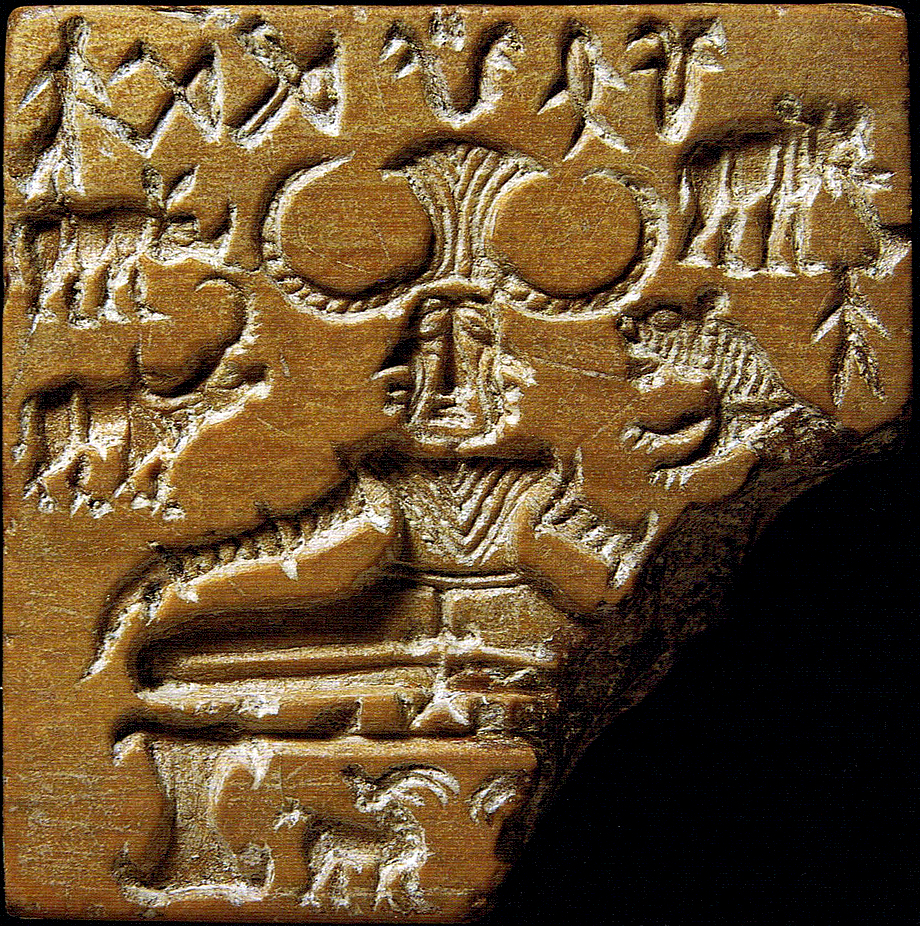
When I started reading up on the religious and philosophical background of yoga to my amazement I found out the Hindu God who is Lord of Yoga is Shiva and He bears similarities to Gwyn as a destroyer and transformer. They both have associations with bulls and serpents and, to my surprise and delight, Shiva’s serpent, Nandi, has a magical jewel on his forehead. In my personal gnosis Gwyn and the serpents of Annwn have similar jewels.
The images of Shiva and the meditating deity who I believe to be Gwyn on the Gundestrup Cauldron bear a striking resemblance. As I persevered with my meditation practice over the summer, although asleep, Gwyn began visiting me in spirit form, as ‘meditating Gwyn’, in the likeness of this image. As if he had been cut from the cauldron, in shining silver, to help me with my breathing. I finally found the practices I needed to take care of my vessel.
Another source of help and support has been working with a supervisor and therapist, who is also a shamanic practitioner and I was put in touch with by Nicola Smalley who co-runs the Way of the Buzzard Mystery School. This is the first time I have had a human teacher and it has taken a long while for the circumstances to come into play that have made this desirable and possible.
When we were looking into my fears around panicking/freezing/melting down when faced with unexpected difficulties, particulary in social situations, we journeyed together on it and she saw a red dragon on my shoulder breathing fire and was told by Merlin that I must learn to ‘tame the dragon’.
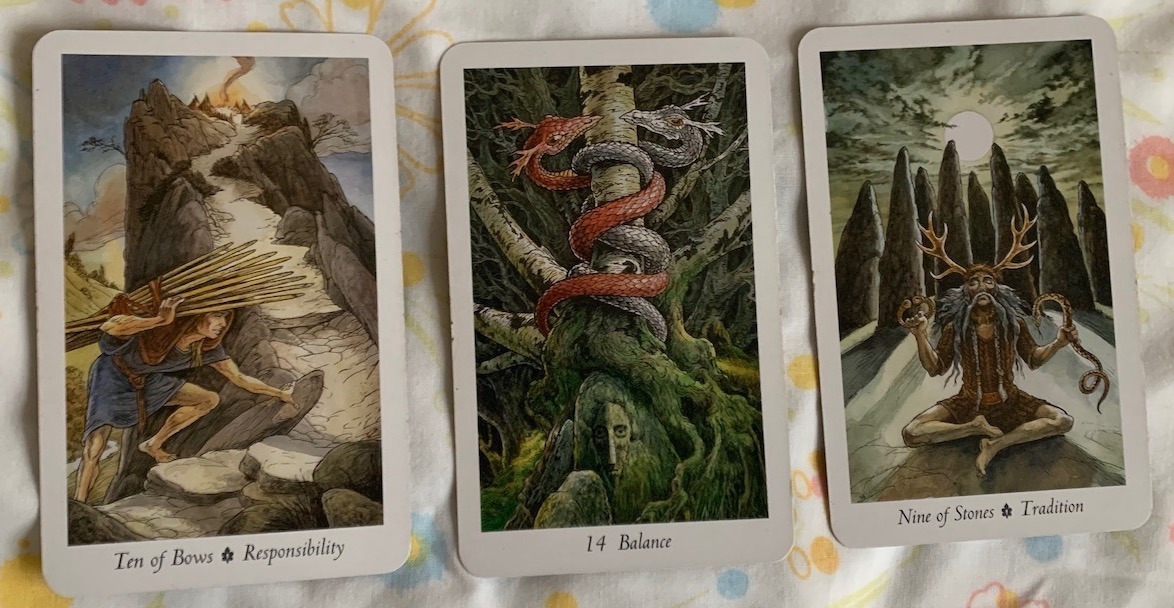
This unsurprisingly led ‘my red dragon’ to rebel which I gave voice to in a poem*. Yet a tarot reading revealed that what Merlin was calling for was the need not so much to tame the red dragon but to balance her energies with those of the white dragon through meditative traditions and taking responsibility.
Of course, in the Welsh myths, it is Merlin who reveals the red and white dragons battling beneath Dinas Emrys where Vortigern wants to build his fortress following their burial by Gwyn’s father, Nudd/Lludd. Amazingly my supervisor knew nothing of my connection with these myths prior to the journey.
I have begun a process of transmuting the anger of the red dragon to strength and the panic of the white dragon to calm in my yoga practice by coupling them with holding postures on either side and with alternating nostril breathing along with trying lion’s breath to release the fiery energy.
V. Unblocking the Flow
Prior to this I had considered alternative options for possible paid work – running courses and workshops or writing a book on Brythonic Polytheism as quite a few people have asked me for reliable material. However, whenever I have attempted to put something together I have met a block.
On the one hand I felt with my background in research into the Brythonic tradition and my experiential relationship with a few of the deities I was in a position from which I could deliver this. Yet I also knew my approach is highly personal and idiosyncratic and critical of the medieval Welsh texts, penned by Christian scribes, in which Gwyn and the spirits of Annwn, the witches, giants and ancient animals are demonised and repressed.
I’m not a person who could deliver the literary background formally, without opinion, without a few of the teeth and claws of the spirits of Annwn getting through.
When I entertained the idea again this year I was told by Gwyn to set it aside and ‘stop thinking about money’. Yet my feeling this might be a future obligation and potential source of income in spite of my blocks continued to persist.
I finally let go of this once and for all following a conversation with my supervisor. She advised that rather than acting from my sense of obligation and presuppositions about what the world wants and needs I should follow my inspiration, the flow of my creativity, asked where my passion really lies.
I said, “in my books”, “in Gwyn,” “in the Annuvian,” “in all He and the Otherworld represent”. She told me this is what I should focus on and write about in spite of my fears about my work not being well received or making money.
For the past year I had increasingly been struggling to create blog content based on what I think my readers want in terms of Brythonic content and poetry. My prayers and songs for Gwyn had all been from the heart but I’d had to drink alcohol to force the poetry out and I hadn’t managed to write much about the other Brythonic Gods and Goddesses in spite of my intent.
As soon as I let go of what I felt my obligations are I had two new poems come through without the aid of alcohol pretty much complete and was inspired to write a couple of pieces on my ‘forbidden pleasure’ – dark fantasy.
VI. The Dark Magician’s Door
At the time I was considering where my future prospects and obligations lie I dismissed the possibility that I might gain a larger readership for my books, which I would describe as mythic fiction containing elements of heroic and dark fantasy, by engaging more with the world of fantasy and its readers.
I flirted briefly with the idea of starting a new blog for thoughts on fantasy and reviews but decided it would be too time consuming and didn’t like the idea of having two blogs and profiles. I also got put off by the fact a lot of engagement takes place on social media and this is an absolute no-no for me. I took one look at Twitter and felt like I was staring into the pits of Hell.
I also dismissed the idea of posting fantasy content on this blog as I have tried it in the past and it hasn’t been well received. I decided there are enough people in the world talking about fantasy and not enough talking about the Brythonic Gods so I should continue to make that duty my focus.
I then had a seemingly unrelated experience that led to my giving up alcohol for good. I used alcohol to self-medicate my anxiety from my late teens until 2020 when I began giving it for periods and cutting down a lot. The habit of weekends and occasional mid-week drinking had snuck back during my difficulties with my sciatic nerve pain even though my body was rebelling against it – expunging it with night sweats and its stink in my piss and shit.
I really wanted to give it up for another long period but was having no success.
Then I had a dream in which my dark magician guide (who is a character in a fantasy novel who has been with me since I was around thirteen) showed up with a vision of planks leading up and down a wall to different doors, told me he was angry I had ‘closed his door’ and left through it.
The next morning he appeared again in my meditation, vivid as in a dream, in Annwn, beside the Abyss, with the part of myself who is addicted to alcohol, sweating, writhing, stinking of its excesses, wrapped in a white shroud. He told me it was time I gave up alcohol for good and that I must cast her in. Although this completely terrified me I went along with what he said. Afterwards I reported it to Gwyn and solemnly promised Him I would not relapse.
Knowing I would never have the comfort of alcohol again was scary at first but has proved to be a big release with the part of my mind obsessing about whether I’ll drink then feel guilty and like a failure having finally been laid to rest. It has opened a lot more space for communion with my Gods and creativity.
I forgot all about the dark magician’s door until the block allowing me only to write Brythonic content and poetry for my blog was released and I came up with new poems and the fantasy book reviews I had denied myself of writing.
I’d closed his door – the door to fantasy – and now it stands open again.
VII. Returning to Orddu’s Cave
Over this year of solitude I have harvested a good many things. I have produced a finalish draft of my first book, In the Deep, and am well on my way with the drafting of my second book, The King and Queen of Annwn. The building of the Monastery of Annwn is going well with our development of our shared practices, meditation group and first year of online rituals.
I’ve come a long way in discerning the direction of my path as an awenydd and nun of Annwn devoted Gwyn and learning to follow my inspiration.
Another important learning is that whereas in the past I forced myself out into various communities, spiritual, creative and environmental, I am happiest when I am alone or interacting with very small groups of like-minded people.
There is a lot of stigma around solitude identifying it with mental ill health. Yet, for me, and I would warrant a lot of autistic people, it is a source of well being.
This has led me back to the cave of Orddu, the Very Black Witch, an inspired one and warrior woman intimately connected to Gwyn who was slaughtered by Arthur.
I no longer see it as my duty to sing back the traditions in which the King of Annwn and his followers are demonised and killed but to join the inspired ones past and present who are perceiving new visions from the Cauldron of Inspiration, brewing them in their own vessels, birthing them in words. Owning my wolf’s teeth, my black beak and claws, all that Arthur forbids.
In my cave, my room, my monastic cell, I tend my cauldron and my awen sings.
*This is the poem recording my initial rebellion against Merlin’s words.
The Dragon on my Shoulder Breathes Fire
I. She sees the things that are unseen but are – the dragon on my shoulder breathes fire.
Not just any fire but Annwn’s fire, the type that warms the belly, implodes the head, bursts forth as poetry (on a good day) but is otherwise expressed as anger.
Anger that will not be satiated by death or by the spilling of blood.
Where do dragons come from?
II. There are fire eaters and fire breathers and those who swallow stars not to make a living but to avoid our soul’s death.
Dragon fire has been within us all along.
III. Red is danger and danger is anger with a letter d at the front.
Red and hatred have the same vibe. Red, goch, iron, the red at the earth’s core. My temper will not be tempered – my metalwork got melted down.
I did not master fire.
Instead I released the dragon soaring soaring from the forge wept the day I did not save my Lord from Arthur’s sword.
But it was I who freed the fiery serpents sizzling, hissing, spitting.
IV. Now a large grandfather clock is ticking down to doomsday. The dragons are fighting again and will not be quieted.
Merlin tells me that I must ‘tame the dragon’.
Why, oh prophet, diviner, madman, must I try to tame what cannot be tamed?
Why, oh son of a demon, who prophecies in dragon fire are you speaking this Arthurian language of taming?
All I know is you have demons inside you too, in your heart, in your head, that both of us like to sit beneath the apple trees.
The dragons are within me.
The Island of Prydain.
The dragons are within you too.
The dragon on my shoulder breathes fire and she sees the things that are unseen but are.
Only art can bring back that which should never be touched:
grave goods, treasures of the mound and bottomless lake,
your cauldron.
Like you, my lord, they are beautiful and cursed,
filled with spirits who haunt us with wishes that shall never be.
Sword of Nodens, Spear of Lugus, Shield of Brân,
your mother’s secret jewellery,
the Golden Ring by which you are bound to fight your enemy,
numinous and just as deadly as the battles of dragons.
As a great black dragon you watch over the dragon-spirits within.
Only art can bring them back and for those who touch your terrors reign.
*This image of a dragon’s eye is from a birthday card my aunt sent me last year. It reminds me of Gwyn-as-dragon and is blu-tacked on my wardrobe, overlooking my writing desk.
Don is a Brythonic goddess who is best known as the mother of ‘the Children of Don’. In ‘The Fourth Branch’ of The Mabinogi she is named as the sister of Math ap Mathonwy (this shows Mathonwy was her father), and her children are named as Gwydion, Gilfaethwy, and Arianrhod. In the Bonedd yr Arwyr they are listed as Gwydion, Gilfaethwy, Gofannon, Efydd, Amaethon, Hunawg, Idwel, Elestron, Digant, Kynnan, Hedd, Addien, Elawg, and Arianrhod.
In Triad 35. Beli Mawr is named as the father of Arianrhod and this may suggest Beli fathered some or all of her other children. Beli is also named as the father of Nudd/Lludd Llaw Eraint, Caswallon, Nyniaw, and Llefelys in Lludd ac Llefelys and it is possible they too are Children of Don.
Don is likely to be identical with Anna, the consort of Beli, in the Harleian Genealogies, and is thus the grandmother of Afallach (Gwyn ap Nudd), who is the father of Modron and the grandfather of Mabon. Don and Anna are named as the forebears of the lineages of many of the kings of the North and Wales.
Parallels exist between the Children of Don and the Tuatha Dé Danann ‘the Children of Danu’. Unfortunately we know nothing about Danu from inscriptions, place-names, or Irish literature. The nominative *Danu is a hypothetical reconstruction from the genitive ‘Danann’.
However, there are strong parallels between some of their children. Nuada and Nudd/Lludd are both warrior-kings with silver arms, Gofannon and Goibnu are both divine smiths, and Lugh and Lleu (more distant descendants of Danu and Don) are many-skilled gods who wield deadly spears.
I was highly excited when, online, I found claims for links between Don and Bel and Danu and Bile. I was disappointed to find out these are based on a loose claim about ‘British analogies’ from Charles Squire in Celtic Myths and Legends (1905) and there are no etymological or textual grounds for Danu and Bile having been consorts or parents of the Tuatha Dé Danann.
Nothing more is known about Don from medieval Welsh literature or from inscriptions but she gives her name to the rivers Don in Yorkshire and Aberdeen and perhaps to the river Dee. This forms part of the boundary between the the Wirral and Wales and is known is Wales as the Afon Dyfrdwy. This might derive from Dyfrdonwy with Donwy being an earlier name of the goddess Don.
It is possible that there might be connections between the Irish Danu, the Brythonic Don, and the Hindu goddess Danu rooted in a shared Indo-European tradition. Her name may derive from the Proto-Indo-European root *dʰenh₂- ‘to run, to flow’ and be the source of the river-name Danube.
In The Rig Veda Danu is named as the mother of the 100 Danavas – demonic beings known as asuras. One of these is a dragon called Vritra who holds back the water of the world’s rivers. Vritra is slain by the thunderbolt of Indra and the river-water is released. Vritra then attacks and defeats Danu. This suggests Danu and her descendants are associated with primal waters and rivers.
This is of deep interest to me as it suggests parallels between Danu as the mother of the dragon, Vritra, who is slain by Indra, and Don as the mother of the dragon-goddess Anrhuna, who is slain by Lugus. (Anrhuna is not known in any Brythonic sources but she revealed herself to me as the consort of Nodens/Nudd and the mother of Vindos/Gwyn ap Nudd. I was inspired to write a story about how she was killed by Lugus. I hadn’t guessed that Don might be her mother until now. In my story it was not Don who birthed hundreds of demons but Anrhuna who birthed monster-serpents).
The notion that, like Danu, Don is the mother of primordial waters, is one that has long accorded with my intuitions. Several years back I had a vision of Don as the source of generation and I associated her with Fidelma Massey’s ‘Water Mother’ sculpture on the cover of Greg Hill’s Creatures.
The possibility that Don did not only birth the ‘culture gods’ but the dragon-goddess Anrhuna and maybe other dragons and demon-like beings associated with water is one that speaks deeply to me.
As I have been writing this essay the words an dubno have repeatedly come into my mind. When I looked them up I recalled that several years ago I came across the proto-Celtic root *dubno or *dumno meaning ‘the deep’ or ‘dark and gloomy’ and Liz Greene’s claim Danu’s ‘dark face was Dumno’.
An means ‘not’ or ‘very’. The term an dubno thus shares its meaning with Annwn, ‘Very Deep’, the Otherworld. Perhaps this is telling me that Don was originally an Annuvian goddess who proceeded Anrhuna as the Mother of Annwn. In my story both Don and Anrhuna were amongst the oldest children of Old Mother Universe but I am now considering that Anrhuna may be the daughter of Don. This opens new possibilities for when the time returns to resume work on my mythic book.
SOURCES
Alexei Kondratiev, ‘Danu and Bile: The Primordial Parents’, The IMBAS Journal of Celtic Reconstructionism, Vol. 1, No. 4, (1998)Asterope, ‘Danu/Don’, Deity of the Week, (2011), http://deity-of-the-week.blogspot.com/2011/11/danudon.html Peter Bartrum, A Welsh Classical Dictionary: People in History and Legend up to about A.D. 1000, (National Library of Wales, 1993) Rachel Bromwich (ed), The Triads of the Island of Britain, (University of Wales Press, 2014) Sarah E. Zeiser, ‘Performing a Literary Paternity Test: Bonedd yr Arwyr and the Fourth Branch of The Mabinogi’, Proceedings of the Harvard Celtic Colliqiuim, Vol. 28, (2008) Sioned Davies (transl.), The Mabinogion, (Oxford University Press, 2007)
*Updated 15/11/2020 to include the river Don in Aberdeen following a comment from angharadlois.
Nine towers of stone. Around each coils a wyrm. No way in – no door, lock, key, but a single row of windows at the top where I think I glimpse the face of a madman. They are old as the grey mountains. I want to claim they were built by the haulers of scree, the wyrms summoned and bound by the might of magicians or that they came of their own free will raising the towers from some secret land underground that has never been seen. Share rumours of a sibylline prophetess who consulted the wyrm’s heads but whose words are not recorded in dusty books in an arcane language eaten by bookworms. But no explanation rings true or exists. I feel like banging my head against the stone demanding an answer from the inexplicable unblinking eyes and long stony tongues silent as the purple skies. I cannot accept this vision defeating poetry.
I wrote the poem above a couple of years ago and the vision it is based on has stuck with me. It’s only since I started writing my new mythic book, The Dragon’s Tongue, that I realised that the nine towers correspond to the nine heads of the Dragon Mother Anrhuna and that when she was killed her nine heads were bound on the towers so the creator gods had power over the nine elements (stone, earth, magma, fire, air, wind, water, mist, and ice). I’ve finally got round to trying to draw the scene, which I find helps.
In previous posts I have spoken about how I’ve come to know Anrhuna ‘the Lady of Peneverdant’ or ‘the Mother of the Marsh’ as the ancient British mother goddess associated with marshlands and healing waters who was replaced by Saint Mary the Virgin at the well and church on Castle Hill in Penwortham.
As the mother of Vindos/Gwyn (a ruler of Faerie/Annwn whose presence at Castle Hill may be attested by a local fairy funeral legend) by Nodens/Nudd/Lludd, I have more recently been getting to know her as ‘the Mother of Annwn’ and in this guise she appears to me as a nine-headed dragon.
This is an image I have never come across in Brythonic mythology. However, stories of dragons abound across Britain and Nodens/Nudd/Lludd and Vindos/Gwyn are associated with them. In the Temple of Nodens at Lydney is a mosaic of two sea serpents and Nodens is depicted on a mural crown with ‘icthyocentaurs’ with serpent tails. Plus, as Lludd, he stops the battle of two dragons. Gwyn’s dog, Dormach, is depicted with two serpent tails and Robert Graves calls Gwyn ‘the Serpent Son’.
At the Temple of Nodens, who is surrounded by the watery subliminal imagery of the dream world and where sick people received healing dreams, a statue of a mother goddess holding a cornucopia was found. Pilgrims offered her pins for aid in childbirth. This may be a representation of Anrhuna. Maybe, just maybe, the two sea serpents are Anrhuna and Nodens in more primordial forms. In this context the appearance of Anrhuna, Mother of Annwn ‘the Deep’, as a dragon makes more sense.
Yet her myths are lost. I have recently returned to the Babylonian creation epic, Enuma Elish, which features a dragon-goddess called Tiamat, who shares similarities with Anrhuna, to look for clues. Tiamat is a goddess of the salt sea. Her name may be cognate with the semitic tehom (‘the deep’ or ‘the abyss’) and she appears as a dragon or sea serpent. After she gives birth to the gods they turn on her. Against them she births an army of monster-serpents and puts her son, Kingu in the lead. Following a primal battle she is slain by the storm god, Marduk, and the world is created from her remains.
I’ve long found the following lines about Tiamat’s birthing of monsters beautiful and awe-inspiring:
Ummu-Hubur [Tiamat] who formed all things, Made in addition weapons invincible; she spawned monster-serpents, Sharp of tooth, and merciless of fang; With poison, instead of blood, she filled their bodies. Fierce monster-vipers she clothed with terror,cc With splendor she decked them, she made them of lofty stature. Whoever beheld them, terror overcame him, Their bodies reared up and none could withstand their attack. She set up vipers and dragons, and the monster Lahamu, And hurricanes, and raging hounds, and scorpion-men, And mighty tempests, and fish-men, and rams; They bore cruel weapons, without fear of the fight. Her commands were mighty, none could resist them; After this fashion, huge of stature, she made eleven [kinds of] monsters. Among the gods who were her sons, inasmuch as he had given her support, She exalted Kingu; in their midst she raised him to power.
I’ve wondered whether we once had a story in which Anrhuna gave birth to Monsters of Annwn such as the Great Scaled Beast, the Black Forked Toad, and the Speckled Crested Snake who feature in ‘The Battle of the Trees’. This depicts a conflict between the forces of Annwn and the Children of Don and perhaps records a primordial battle between monsters and culture gods that shaped the world. The parallels suggest Anrhuna gave the kingship of Annwn to her son and made him leader of her armies.
I am currently exploring these ideas in early drafts of my next book ‘The Gods of Peneverdant’. You can find out more about what is going on behind the scenes in my monthly newsletter and see unseen work by supporting me on Patreon HERE.
the extent of the marshland of Annwn. Some cross it in a day. For others it goes on forever like the mist that obscures the musical birds, the shriekers of the mournful shrieks, the droners of the ancient drone, the players of the carnyxes that gurgle beneath the waters. You never know what is splashing behind on countless feet until it is too late. Sometimes you get lost following the will-o-wisps like lost hopes to where all hope fails. Sometimes you make sacrifices or become the sacrifice see your bog body your ghost flying free like a lonely bird. You become an inspirer or a guide only to bring doom to the unwary. When you think you know the way you slip. When you think you have found the awen you find it escapes words, that the sigh of its name is already escaping your lungs, that breath is not yours to keep forever and must return to the gods.
Awenydd of the Marsh
“You have not yet crossed the marsh.”
No, I’ve got lost again, led round on splashing circle feet to the village where there is a wooden pole and on it a woman seated cross-legged on the head of a bull a crane with wings spread above her.
When she’s not on the pole she’s in the central hut a cord of light down the centre of her spine surrounded by worlds that flicker in and out of existence whether at her will or not I am uncertain.
I’ve never heard her speak, seen her eyes blink, perhaps she dare not for fear of unseeing the realities she holds within her gaze. She doesn’t even breathe. Without her things would fall apart.
My eyes are tired, I’m out of breath, my worlds are out of reach, and I’m missing something.
An Abandoned Sea-Dragon
A blue watery dragon is snared by a weak rusty-looking metal chain around one leg, like a ship at anchor, like an abandoned boat, where the tides come up and wash over her body then back down again. She is ridden with fleas. She is one of the dragons that have been forgotten. I know I could easily break the chain but am told that it is not the chain that binds the dragon there. She has forgotten how to leave. The knight who chained her has fled from his fear of her death. The people do not feed her. She just lingers. It’s an awful story. A terrible mess. There’s no resolution. It’s embarrassing.
‘If the ninth person comes to ask for land, his proprietorship is extinguished, and he gives a shriek… and that is called diasbad uwch Annwfn.’
The Laws of Hywel Dda
‘Every May Eve… your dragon gives out a horrible scream.’
Lludd and Llefelys
I.
I am not a ninth son.
I am not an only daughter.
I am not dispossessed but I will scream.
I will scream in dragon’s fire.
I will scream in dragon’s blood.
I will scream myself dry
for those who have lost their land,
their kin, their deepest dreams.
II.
I will scream because I have walked
where harpers play in the stars, looked down
on the beauty of our mother earth
and seen her dirtied
by petrochemical giants with top hats of fracking rigs,
oil rigs, gas rigs, refineries, distilleries lit up
like the Blackpool Illuminations
along our coastlines
great big selfish hands throwing plastic into the seas.
III.
I will scream because I have walked
countless cities wrecked by war planes hearts hanging out
like the untied shoelaces of civilians
who had no chance to flee
seen the bombs, the bullets, the missiles,
plastic water bottles bouncing down the streets,
schools and hospitals in flames,
burning aid-workers
and the long long trains of landless refugees.
III.
I will scream because I have walked
where ice caps melt the Polar Vortex melts down
and the Polar Night Jet unravels
unleashing a Yeatsian Beast
leaving a trail of the withered dead –
tired old trees, frail crocuses, the homeless.
How we demonise the weather and refuse to face our demons!
This is madness, madness, madness, madness, madness pumping
through my searing veins and heaving in my dragon’s chest.
V.
I will scream and wish myself possessed by the spirits of Annwn.
Spirits of Annwn I call on you. Spirits of Annwn I summon you.
Bring terror to all who profit from the desecration of our mother.
Spirits of Annwn I call on you. Spirits of Annwn I summon you.
Make their businesses barren, make their money dust and leaves.
Spirits of Annwn I call on you. Spirits of Annwn I summon you.
Drain them of strength and colour and bring them to their knees.
Spirits of Annwn I call on you. Spirits of Annwn I summon you.
Bring them to kneel at altars of compost and resurfacing streams.
Let me be your dragon and I will scream ‘til the end of this world.
You can find out more about the Scream Over Annwn and its connection with the red dragon HERE.
Nodens is in an ancient British god of hunting/fishing, water, the weather, healing, and dreams. ‘Nodens’ has been translated as ‘the Catcher’ and ‘Cloud-Maker’, and ‘Deus Nodens’ as ‘God of the Abyss’ and ‘God of the Deep’. The latter links him with Annwfn, ‘the Deep’, the underworld. The nursery rhyme name for the dreamworld, ‘the Land of Nod’, derives from ‘Nodens’.
Nodens is a god of the subliminal realms beneath the everyday world and their hidden processes. This is suggested by the imagery of his Romano-British dream-temple at Lydney. In the centre was a mosaic depicting two blue and white sea-serpents with intertwined necks and striking red flippers. William Bathurst likens them to the icthyosaurus, ‘fish lizard’, of the late Triassic and early Jurassic whose remains have been found across Europe and Asia.
The mosaic also depicts numerous fish, possibly salmon, which would fit with salmon fishing on the river Severn, which the temple overlooks, and the legend of the salmon of Llyn Lliw carrying Arthur’s men up the Severn to Gloucester to rescue Mabon.
An inscription on the mosaic reads: ‘D(eo) N(oenti) T(itus) Flavious Senilis, pr(aepositus) rel(oqiatopmo), ex stipibus possuit o [pus cur]ante Victorio inter[pret]e.’ ‘The god Nodens, Titus Flavious Senilis, officer in charge of the supply-depot of the fleet, laid this pavement out of money offerings; the work being in charge of Victorious, interpreter of the Governor’s staff.’ It has been argued Victorio inter[pret]e, ‘Victorious, interpreter’ was an interpreter of dreams.
Another artefact found in Nodens’ temple was a bronze plaque from a priest’s ceremonial headdress. Nodens rides from the deep on a chariot pulled by four water-horses. He wears a crown, carries a sceptre in his right hand, and a sea-serpent is looped around his left arm. Flanking him are two winged wind-spirits and two icthyocentaurs, ‘fish-centaurs’ or ‘centaur tritons’, with heads and chests of men, front hooves of horses, and tails of fish. They carry hammers and anchors. Beneath is another icthyocentaur with a hammer and chisel and a fisherman with a short tail and gills hooking a fish, which could be a salmon.
All of this imagery is suggestive of the deep: rivers, the sea, and the depths of the dreamworld/underworld where prehistory gives birth to myth and the boundaries between species break down.
Pilgrims came to Lydney for dream-healing. They would arrive at the guesthouse, bathe in the baths, then make offerings to Nodens through a funnel in his temple (which suggests he dwelled below in the deep). They would then retire to a long row of cells to enter a sacred (likely drug-induced) sleep during which they would receive a vision from Nodens. The dream-interpreter would listen to the dream then suggest a method of healing based on Nodens’ message.
Offerings included coins and several beautifully crafted bronze hounds. It is likely dogs were present to lick the wounds of the injured to aid in the healing process. They may also have acted as psychopomps guiding the sleepers through the dreamworld. The son of Nodens/Nudd, Gwyn ap Nudd, had a red-nosed dog called Dormach with two serpents’ tails.
***
Nodens’ temple was built on an iron ore mine and he was known as ‘Lord of the Mines’. This may explain the hammers and chisels carried by the icthyocentaurs. Mines are associated with the chthonic depths of the underworld and its riches, which are often guarded by serpents.
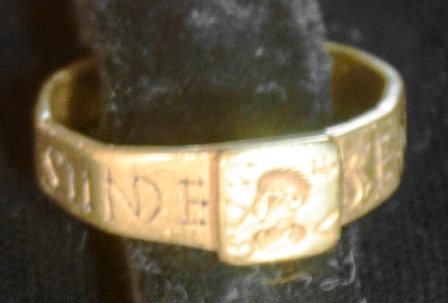
Intriguingly a man called Silvianus vowed half the worth of a 12g golden ring to Nodens in exchange for withholding health from its thief, Senicianus, until it was ‘returned to the Temple of Nodens’. The ring was dug up in a field in Silchester in 1785 with a new inscription: Seniciane vivas in deo, ‘Senicianus, may you live in God’. What was originally inscribed on it remains unknown. It seems possible it served a ritual function in Nodens’ temple.
In ‘The Conversation of Gwyn ap Nudd and Gwyddno Garanhir’, Gwyn states ‘I have a carved ring, a white horse gold-adorned’. His ring is an important part of his symbology and might have been a gift from his father. Angelika Rüdiger links its circularity with the ouroboros.
The ouroboros first appears in ‘The Enigmatic Book of the Netherworld’ in the ancient Egyptian Funerary text KV62, which focuses on the union of the sun-god Ra with Osiris, god of the underworld. In an illustration two serpents with their tails in their mouths coil around the unified Ra-Osiris. The image represents the beginning and the end of time.
The ouroboros was passed on to the Phoenicians and ancient Greeks who gave it its name. In Greek oura means ‘tail’ and boros ‘eating’, thus ‘tail eater’. The ouroboros appears in most cultures across the world and throughout history.
A pair of sea-serpents are central to Nodens’ temple. He holds a sea-serpent. It seems possible two ouroboros serpents may have been carved on a ring worn by Nodens and passed on to his son, representing their knowledge of the depths of time where beginning and end meet as they bite their tails. Silvianus’ ring may have been a replica of this powerful mythic artefact.
It’s rumoured that Tolkien based his One Ring on the ring from the temple of Nodens and that Nodens, ‘Lord of the Mines’ was a precursor to Sauron, ‘Lord of the Rings’.*
***
In medieval Welsh literature Nodens appears as Nudd/Lludd Llaw Eraint, ‘Lludd of the Silver Hand’. Their linguistic connection is certified by a bronze arm found in the temple of Nodens.
Nobody knows how Lludd lost his arm or how his silver one was made. Parallels might be found with his Irish cognate, Nuada Airgeadlámh, ‘Nuada Silver Arm’, king of the Tuatha Dé Danann, who lost his arm battling against the Fir Bolg. Because of his physical imperfection Nuada was replaced as king by the tyrant, Bres. After Bres was removed Nuada was restored to sovereignty with a new silver arm made by the healer Dian Cecht.
In the story of Lludd and Llefelys, Lludd’s sovereignty is also under threat. Although he is described as ‘a good warrior, and benevolent and bountiful in giving food and drink to all who sought it’ he is unable to defend Britain from three plagues; perhaps this is due to his missing arm.
The first plague is a people called the Coraniaid who cannot be harmed because they can hear all conversations on the wind. The second is a scream every May eve that causes such terror that men lose their strength, women miscarry, youths go mad, and the land becomes barren. The third is the disappearance of the year’s supply of food and drink from the king’s courts.
This story is set during Caesar’s invasion of Britain in 55BC. The Coraniaid are the Caesariad, ‘Romans’ and the other plagues seem linked to the ill effects of their attacks. Lludd, of course, was not a ‘real’ king at that time but a divine ruler of the underworld who may have been called upon by the Britons for aid against the Romans.
Unable to defeat the plagues himself, Lludd is forced to seek the aid of his brother, Llefelys, ‘king of France’. Llefelys instructs Lludd to poison the Coraniaid with insects crushed into water. He then explains the scream: ‘that is a dragon, and a dragon of another foreign people is fighting it and trying to overthrow it, and because of that your dragon gives out a horrible scream.’
Lludd’s dragon represents the Britons and the other dragon the Romans. Lludd, again, is connected with two dragons/serpents. Will Parker has likened Lludd’s dragon’s scream to ‘the scream over Annwfn’, a ‘mysterious ritual frenzy’ uttered by a person threatened with losing their claim to inherited land. It may have originated as an invocation of the spirits of Annwfn to bring about madness and barrenness. Likewise Lludd’s dragon screams as its land is lost to the Romans, blighting all who live there. Lludd has lost control of these chthonic forces.
Llefelys teaches Lludd to put an end to the second plague by a complex ritual process. He must measure Britain, length and breadth, and locate its centre. This omphalos, ‘navel’, turns out to be Oxford. It is of interest that the Greek omphalos, Delphi, was formerly known as Pytho and its oracle, the Pythian priestess, spoke with the aid of the whispering python coiled beneath.
Could Oxford have been the location of a dragon (or dragons) who whispered prophecies from the navel of Britain? Dragon Hill lies 50 miles outside Oxford. Its connections with Uther Pendragon and a dragon-slaying by Saint George are suggestive of an older and deeper mythos.
Lludd is instructed to dig a hole at the centre of Britain then place in it a vat of mead with a sheet of brocaded silk over the top. Llefelys says, ‘You will see the dragons fighting in the shape of monstrous animals. But eventually they will rise into the air in the shape of dragons; and finally when they are exhausted after the fierce and frightful fighting, they will fall onto the sheet in the shape of two little pigs, and make the sheet sink down with them, and drag it to the bottom of the vat, and they will drink all the mead, and after that they will fall asleep.’
This scene depicts the return of the escapee dragons to the omphalos of Britain and the deep. It is intriguing that they are not just dragons but are capable of taking many different forms. It is possible to perceive a mythic and perhaps evolutionary development in their shapeshifting from ‘monstrous animals’ beyond description to ‘dragons’ to two seemingly innocent ‘little pigs’.
Finally Llefelys tells Lludd to ‘wrap the sheet around them, and in the strongest place you can find in your kingdom, bury them in a stone chest and hide it in the ground, and as long as they are in that secure place, no plague shall come to the island of Britain from anywhere else.’
Lludd buries the dragons at Dinas Emrys in Snowdonia. The next time they cause trouble is during the reign of Vortigern. Every time he attempts to build a fortress on the hill it falls down. Merlin Emrys reveals to him that the cause is two dragons battling. The red one represents the Welsh and the white one the Anglo-Saxons.
Llefelys informs Lludd that the food and drink are stolen from his court by a magician who uses a sleep spell. He suggests Lludd step in a tub of cold water to keep himself roused. Lludd defeats the magician in combat, all that is lost is restored, and the magician becomes his vassal.
All three plagues are defeated. The chthonic forces of Annwfn are brought back under Lludd’s control. Caesar’s invasion of Britain fails. Lludd and Llefelys depicts the mythic processes beneath this historical period, which the Druids and seers who interacted with the deities of the underworld might have been aware of and perhaps instigated with prayers and invocations.
Lludd reigns ‘until the end of his life’ ‘in peace and prosperity’. One wonders whether Llefelys had a role in creating Lludd’s silver arm…
It seems Lludd’s ‘kingdom’, Annwfn, the deep, is passed on to his son, Gwyn ap Nudd, whose role is to contain the spirits of Annwfn to prevent them from bringing about the end of the world.
Does Gwyn’s inheritance include the serpents of the deep: beings who are older than gods, whose ‘battles’ may be less about conflicts between groups of humans than the regenerative processes that shape the earth through the aeons, through the beginnings and endings of each world?
***
*Tolkien advised Sir Mortimer Wheeler on his excavation of Lydney in 1938







 The Sanctuary of Vindos